Showing posts with label summit series. Show all posts

Wednesday, September 28, 2022

September 28, 1972: The Temptations Release "Papa Was a Rollin' Stone"

Left to right: Eddie Kendricks, Dennis Edwards,
Paul Williams, Otis Williams, Melvin Franklin

September 28, 1972: The Temptations release "Papa Was a Rollin' Stone." It was their 4th and last Number 1 hit on the U.S. pop charts.

Norman Whitfield, lyrics, and Barrett Strong, music, had written "Papa Was a Rollin' Stone" for Motown Records group The Undisputed Truth in 1971. Their version was a minor hit. They reworked it for The Temptations, backed by the Motown house band, the Funk Brothers, and the Detroit Symphony Orchestra. The Temptations' version was released on September 28, 1972. Despite its length -- 7 minutes for the single, 12 minutes for the album version -- It hit Number 1.

After the long opening -- 2 minutes out of the 7 on the single version, 4 minutes out of the 12 on the album cut -- the opening by lead singer Dennis Edwards is unforgettable:

It was the 3rd of September
The day I'll always remember
Yes, I will
'cause that was the day
that my Daddy died.

The various members of the group -- at this point, consisting of Edwards, founding members Otis Williams and Melvin Franklin, and newcomers Damon Harris and Richard Street -- took turns acting as the various children of the late father, asking their mother which of the things they've heard about him are true, perhaps hoping none of them are, but they need to know: "Mama, I'm depending on you to tell me the truth."

Legend has it that Edwards was furious with Whitfield, because his father actually did die on a September 3, and was not a "rolling stone," but a minister, with Dennis Jr. becoming his choir director, and eventually being ordained himself.

It wasn't true. The Rev. Dennis Edwards Sr. actually died on an October 3. The real reason why Dennis Jr. was angry with Whitfield wasn't his writing, it was his producing: He didn't like doing take after take on his vocals. He was lucky he wasn't acting in a Stanley Kubrick film.

My own father was anything but a rolling stone. What he thought of this song, or even if he ever heard it, I never asked him. Probably because I didn't want to remind him of his own father. Who was... It's complicated. At any rate, despite being at the early side of the right age group to be an original rock and roll fan, he preferred classical and folk music, but he probably would have appreciated the opening. And he did once express an appreciation for one Motown singing legend: Marvin Gaye.

Former co-lead singers David Ruffin and Eddie Kendricks has already left the group, in 1968 and 1971, respectively. Ruffin died in 1991, at age 50, from a cocaine overdose. Kendricks died in 1992, at 52, from another drug: Cigarettes. Another member, Paul Williams, also left in 1971, and had fallen victim to alcoholism. He took his own life in 1973, at 34.

Bass singer Melvin Franklin died in 1995, at 52, from diabetes. Damon Harris and Richard Street, who replaced Kendricks and Williams, died within a few days of each other in 2013, at 62 and 70, respectively. Dennis Edwards died in 2018, at 74. As of the 50th Anniversary of the song, September 28, 2022, Otis Williams, no relation to Paul, the last surviving founding member, is 82. He is also no relation to the Otis Williams who led the Cincinnati-based vocal group The Charms, who had an early rock-and-roll hit in 1954 with "Hearts of Stone."

*

September 28, 1972 was a Thursday. This was also the day the hockey "Summit Series" ended in Moscow, with Paul Henderson's last-minute goal securing victory for Canada over the Soviet Union, 6-5. I have a separate entry for that event.

September was chosen for the Summit Series because it was before either country's major league began play for the new season. The NBA and the ABA hadn't yet started their 1972-73 seasons, either. And while it was during the football season, at the time, NFL and college games played on Thursdays other than Thanksgiving were rare. And only 4 Major League Baseball games were played:

* The New York Yankees beat the Detroit Tigers, 3-2 at Tiger Stadium in Detroit. Thurman Munson, Roy White and pitcher Lindy McDaniel all hit home runs off the Tigers' Mickey Lolich. Because of the designated hitter, McDaniel remains the last Yankee pitcher to have hit a home run. White's homer won the game in the 12th inning. Mel Stottlemyre started the game, and Sparky Lyle won it in relief of Stottlemyre and McDaniel.

* The Boston Red Sox beat the Kansas City Royals, 3-1 at Fenway Park in Boston.

* The Philadelphia Phillies beat the Pittsburgh Pirates, 2-1 at Veterans Stadium in Philadelphia.

* And the Oakland Athletics beat the Minnesota Twins, 8-7 at the Oakland Coliseum.

September 28, 1972: Canada Wins the Summit Series

"Henderson has scored for Canada!"
Number 12 is Yvan Cournoyer.

September 28, 1972: The "Summit Series" between Canada and the Soviet Union comes to a close with Game 8 at the Luzhniki Palace of Sports in Moscow.

Team Canada had made a big mistake in only letting NHL players play for them, meaning that Bobby Hull, who had signed a contract with the Winnipeg Jets of the new World Hockey Association, wasn't eligible. Also, Bobby Orr of the Boston Bruins was injured. If either of the Bobbys was able to play, it would have been a very different series.

But the Soviets, led by goaltender Vladislav Tretiak and left wing Valery Kharlamov, shocked the Canadians by winning Game 1, 7-3, at the Montreal Forum, no less. It was the most distressing moment in the history of Canadian sport.

For Game 2, at Maple Leaf Gardens in Toronto on September 4, Canada manager Harry Sinden, also the general manager and former head coach of the Boston Bruins, made a few changes, including replacing Ken Dryden in goal with Tony Esposito. It worked: Canada won, 4-1, and the Canadian media calmed down.

Game 3 was played at the Winnipeg Arena on September 6 -- which seems odd to me, given that Winnipeg had a team in the new WHA, not the NHL, and Team Canada had purposely frozen out the WHA players. Canada blew leads of 3-1 and 4-2, and it ended in a 4-4 tie. There was no provision for overtime.

Game 4, at the Pacific Coliseum in Vancouver, was a disaster. Serge Savard hurt his ankle in practice, and turned out to be unavailable until Game 6. Sinden put Dryden back in goal. Bill Goldsworthy committed 2 dumb early penalties, both converted into goals by Boris Mikhailov. A Rod Gilbert goal was disallowed, and Sinden told the media after the game that this took a lot out of his players.

The Soviets won, 5-3, taking a 2-1-1 lead, with the rest of the games set for Moscow. And it would be 2 weeks before Game 5, with plenty of time for the bad feelings to fester in Canadian hearts and minds. It looked bad, and the fans in Vancouver booed their national team off the ice.

The last Canada player to leave the ice was Phil Esposito, and he spoke to CTV interviewer Johnny Esaw:
To the people across Canada, we tried, we gave it our best, and to the people that boo us, Jeez. I'm really, all of us guys are really disheartened and we're disillusioned, and we're disappointed at some of the people. We cannot believe the bad press we've got, the booing we've gotten in our own buildings.
 
If the Russians boo their players, the fans, Russians boo their players, some of the Canadian fans, I'm not saying all of them, some of them booed us, then I'll come back, and I'll apologize to each one of the Canadians, but I don't think they will.
 
I'm really, really, I'm really disappointed. I am completely disappointed. I cannot believe it. Some of our guys are really, really down in the dumps. We know. We're trying like hell. I mean, we're doing the best we can. And they got a good team, and let's face facts. But it doesn't mean that we're not giving it our 150 percent, because we certainly are.
 
I mean, the more, every one of us guys, 35 guys that came out and played for Team Canada, we did it because we love our country, and not for any other reason, no other reason. They can throw the money, uh, for the pension fund out the window. They can throw anything they want out the window. We came because we love Canada. And even though we play in the United States, and we earn money in the United States, Canada is still our home, and that's the only reason we come. And I don't think it's fair that we should be booed
.

In an interview almost 20 years later, Dryden said, "Here's a guy standing there, with the sweat of the world dripping off of him." And Dryden, and many other people, gave Espo credit for stopping the negativity from the fans and the media.

After the Vancouver game, the series went on a two-week hiatus. The Soviets returned home and played in a domestic tournament. The Canadians took a few days off, then travelled to Sweden for a pair of exhibition games, before arriving in Moscow. On September 16, Canada beat Sweden, 4-1. The next day, those teams played to a 4-4 tie. Both games were played at Johanneshovs Isstadion (a.k.a. "Hovet") in Stockholm.
The Moscow games would all be played at the Luzhniki Palace of Sport in Moscow, built in 1956 as part of the sports complex that includes Luzhniki Stadium, then known as the Lenin Stadium. Game 5 was played on September 22. Soviet Premier Leonid Brezhnev was in attendance. Also on hand, in Moscow for a treaty negotiation between the United States and the Soviet Union, is Ambassador and former child film star Shirley Temple Black. There were 3,000 seats among the 14,000 set aside for Canadian fans.
I recently saw a rerun of The Dick Cavett Show, with Shirley as a guest, telling that she thought the games in Moscow were thrilling. Rod Gilbert of the New York Rangers, who played for Team Canada in this series, was a guest on the same show, and he admitted that the Canadian scouts had let the players down, by downplaying the Soviet players' talents.
Canada led 4-1 with 18 minutes left. But the Soviets stormed back and won, 5-4. The Soviets now led 3 games to 1, with 1 tie. Canada had to win the last 3 straight, on Soviet ice, to win the series. It didn't look good.
Game 6, on September 24, changed everything. The Soviets took a 1-0 lead early in the 2nd period. But the Canadians took a 3-1 lead on goals by Dennis Hull, Yvan Cournoyer and Paul Henderson. And, on the advice of assistant coach John Ferguson Sr., who had been one of the roughest players of the 1960s, they targeted Kharlamov. Brad Park threw several solid but legal checks on him.
At one point, Kharlamov knocked down one of the youngest Canadians, Bobby Clarke. Perhaps the birth of the reputation of his team, the Philadelphia Flyers, as "The Broad Street Bullies," began right there in Moscow: Clarke threw his glove into Kharlamov's face, starting a fight. After Kharlamov later knocked Pete Mahovlich down, Clarke raced down the ice, and, knowing that Kharlamov had an injured ankle, slashed it with his stick.
In obvious pain, Kharlamov skated over to the Canadian bench, and yelled at their players, not that they could understand Russian. (Not even Stan Mikita, born in Slovakia but raised in Ontario.) The referees, a pair of Germans named Franz Baader and Josef Kompalla, whose seeming pro-Soviet calls led the Canadians to nickname them "Badder and Worse," gave Clarke 2 minutes for slashing, and an additional 10 minutes for misconduct, leading to a power play goal by Alexander Yakushev. But the Russians had been intimidated, and Canada held on for a 3-2 victory.
Game 7 was played on September 26. In spite of Dryden's win in Game 6, Sinden went back to Tony Esposito. Maybe it inspired his brother Phil, because he scored 2 goals. Yakushev also scored 2, but with just 2:06 to go, Henderson scored to give Canada a 4-3 win. It was now tied, 3 games apiece, plus the Game 2 tie. Game 8, on September 28, would be for all the marbles.
Dryden was back in goal, while Tretiak had played every minute of the series for the Soviets. A power play led to a Yakushev goal at 3:34, but one on the other side led to a Phil Esposito equalizer at 6:45. Vladimir Lutchenko scored at 13:10, but Park tied it at 16:59.
Vladimir Shadrin scored just 21 seconds into the 2nd period, but the Canadians tied it again, on a goal by Bill White at 10:32. Yakushev scored another, and Valeri Vasiliev scored with 3:16 left in the period. It was 5-3 Soviets, and it looked all over.
It wasn't. Phil scored 2:27 into the 3rd period, to make it 5-4. With 7:04 left, Cournoyer tied the game at 5-5. With one minute left, Soviet officials went to the Canadian officials, and claimed victory on total goals.
But as the seconds ticked down, Phil assisted Henderson, and with 34 seconds left, Foster Hewitt, the 1st man to broadcast a hockey game on radio, and the Voice of Canada for so long, who had come out of retirement for this series, shortly before his 70th birthday, broadcasting on CBC with Brian Conacher, said, "Cournoyer has it on that wing. Here's a shot! Henderson made a wild stab for it and fell. Here's another shot. Right in front, they score! Henderson has scored for Canada!"
It remains the most famous goal in the sport's history, and it lifted Henderson, a good player but never considered a great one, to the role of national hero. Dryden and the rest of the Canadians hung on for another 34 seconds, and had the win, 6-5, to take the Series.

Canada had been shaken by the Series, but emerged victorious. The nation celebrated harder than they had for anything since World War II ended. It was a confirmation of national greatness -- barely. In contrast, when the U.S. team beat the Soviets, including many of the same players, 8 years later in the Winter Olympic in Lake Placid, New York, instead of avoiding a tremendous upset, it was one. In the end, the Soviets are remembered more for those 2 losses than for all the games they won.

Foster Hewitt died in 1985. Bill Goldsworthy of the Minnesota North Stars died in 1996. Gary Bergman of the Detroit Red Wings died in 2000. John Ferguson died in 2007. Johnny Esaw, to whom Phil Esposito delivered his speech, died in 2013. Jean-Paul Parisé of the North Stars died in 2015. Bill White of the Chicago Black Hawks died in 2017. Stan Mikita of the Black Hawks died in 2018. Pat Stapleton of the Black Hawks died in 2020. Tony Esposito of the Black Hawks and Rod Gilbert of the New York Rangers died in 2021.

The remaining 20 Canadian players are still alive, 50 years later: Frank Mahovlich of the Montreal Canadiens (a legend in Toronto) is 84; Red Berenson of the Red Wings is 82; Jean Ratelle and Vic Hadfield, both of the New York Rangers, are about to turn 82; Phil Esposito of the Boston Bruins is 80; Paul Henderson of the Toronto Maple Leafs and Don Awrey of the Bruins are 79; Yvon Cournoyer of the Montreal Canadiens is 78; Wayne Cashman of the Bruins, Dennis Hull of the Black Hawks (Bobby's brother), Rod Seiling of the Rangers and Ron Ellis of the Toronto Maple Leafs are 77; Serge Savard of the Canadiens is 76; Pete Mahovlich of the Canadiens (Frank's brother) is about to turn 76; Ken Dryden of the Canadiens is 75; Brad Park of the Rangers, Guy Lapointe of the Canadiens and Mickey Redmond of the Red Wings are 74; Bobby Clarke of the Philadelphia Flyers is 73; and Gilbert Perreault of the Buffalo Sabres is 71. Head coach Harry Sinden is 90. Broadcaster Brian Conacher is 81.
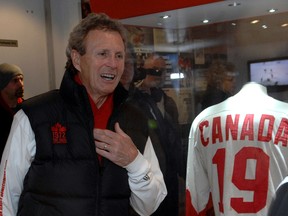
Paul Henderson, posing next to his 1972 Canada jersey,
on display at the Hockey Hall of Fame in Toronto
Of the Soviet players, most of them came from Moscow and environs, and all were from Russia proper, except for Evgeni Paladiev, from Kazakhstan.

Viacheslav Solodukhin was a suicide in 1979, Valeri Kharlamov was killed in a car crash in 1981, Alexander Ragulin died in 2004, Gennadiy Tsygankov in 2006, Yevgeni Mishakov in 2007, Viktor Kuzkin in 2008, Evgeni Paladiev in 2010, Valeri Vasiliev in 2012, Vladimir Vikulov in 2013, Vladimir Petrov and Alexander Bodunov in 2017, Yuri Shatalov and Yevgeni Zimin in 2018, Alexander Gusev in 2020, and Vladimir Shadrin in 2021.

Still alive: Vyacheslav Starshinov is 82, Boris Mikhailov is about to turn 78, Yuri Lyapkin and Alexander Martynyuk are 77, Alexander Yakushev is 75; Vladimir Lutchenko, Yuri Blinov and Alexander Maltsev are 73; Yuri Lebedev and Vyacheslav Anisin are 71, and Vladislav Tretiak and Alexander Volchkov are 70.

(UPDATE: Alexander Martynyuk died later in 2022. Ron Ellis died in 2024. Ken Dryden died in 2025. Dennis Hull died in 2026.)

*

September 28, 1972 was a Thursday. This was also the day The Temptations released their song "Papa Was a Rollin' Stone." I have a separate entry for that event.

September was chosen for the Summit Series because it was before either country's major league began play for the new season. The NBA and the ABA hadn't yet started their 1972-73 seasons, either. And while it was during the football season, at the time, NFL and college games played on Thursdays other than Thanksgiving were rare. And only 4 Major League Baseball games were played:

* The New York Yankees beat the Detroit Tigers, 3-2 at Tiger Stadium in Detroit. Thurman Munson, Roy White and pitcher Lindy McDaniel all hit home runs off the Tigers' Mickey Lolich. Because of the designated hitter, McDaniel remains the last Yankee pitcher to have hit a home run. White's homer won the game in the 12th inning. Mel Stottlemyre started the game, and Sparky Lyle won it in relief of Stottlemyre and McDaniel.

* The Boston Red Sox beat the Kansas City Royals, 3-1 at Fenway Park in Boston.

* The Philadelphia Phillies beat the Pittsburgh Pirates, 2-1 at Veterans Stadium in Philadelphia.

* And the Oakland Athletics beat the Minnesota Twins, 8-7 at the Oakland Coliseum.

Sunday, September 4, 2022

September 4, 1972: The New "The Price Is Right" Premieres

September 4, 1972: The Price Is Right returns to CBS. The original version had been hosted by Bill Cullen. This one is hosted by Bob Barker, and he remained the host until 2007. Announcer Johnny Olson (who died in 1985) hadn't yet developed the classic call-up: "Come on down!"

The full-hour show started with 4 contestants, each trying to guess the price of an item on the stage, presented by the female models who would eventually be known as "Barker's Beauties" -- some of whom would eventually sue him for sexual harassment. Whichever of the 4 came the closest to "the actual retail price" without going over was the winner, and got to play a "pricing game," in which they had to guess the prices of items, or drop a digit in the prices, or rearrange the prices to the correct items. The prizes could range from the actual items on the stage up to, as Olson would gleefully shout, "A new car!"

The show was taped at CBS Television City in Burbank, California, and all prices were based on a survey of stores in the Los Angeles metropolitan area that month.

This would be repeated until there were 3 semifinalists. Those 3 would spin a Big Wheel with sub-dollar prices on its panels, and the one who came the closest to getting $1.00 would advance to the final. If they got $1.00 even, they won a bonus, and a chance to win more money with another spin. Then they would repeat the process, until there were 3 more semifinalists, and another Big Wheel spin to produce another finalist.

Each finalist went to a "Showcase Showdown," where a whole set of prizes would be strung together. Usually, one would conclude with a new car, the other with a major all-expenses-paid vacation in some exotic location. (Sometimes, it would be an American city, but, since they taped in Burbank, it would never be Los Angeles. On the rare occasion that it was New York, I, growing up near that city, found it funny.) Again, the closest bid to the actual price of the total package, without going over, won.

There was also a half-hour version, airing weekly on Saturday nights, with 3 rounds, no Big Wheel, and of the 3 winners, the 2 with the prizes totaling the most worth advanced to the Showcase Showdown.

Wisely settling the lawsuits rather than risk any further damage to his good name by going to trial and losing, Barker was still considered too popular for CBS to fire, and was allowed to leave on his own terms. In 2007, finally giving in to age, the 84-year-old Barker handed the show off to comedian and former sitcom star Drew Carey. As of September 4, 2022, the show is still on the air, and Carey is still the host. (UPDATE: Barker died in 2023, 4 months short of what would have been his 100th birthday.)

The Joker's Wild also premiered on CBS on September 4, 1972, rehabilitating scandalized 1950s game show host Jack Barry. Alan Thicke, later the star of Growing Pains and father of singer Robin Thicke, was one of the writers of the theme song.

When The Joker's Wild was syndicated in New York on WOR-Channel 9 (now WWOR), it became my favorite game show as a kid -- mainly because, unlike The Price Is Right and Match Game, it aired after school, instead of during, so I got to see it regularly. (To my mother's dismay: I don't know if she objected to me watching so much TV, or to this show in particular.)

Barry hosted the show until he died of a heart attack in 1984. He was 66. Bill Cullen then hosted until it was canceled in 1986. The show has been revived in 1990-91, in syndication, with Pat Finn as host; and in 2017-19, on TNT, hosted by Snoop Dogg.

*

September 4, 1972 was a Monday, Labor Day. In the years to come, CBS would air reruns of The Price Is Right on Labor Day, because the holiday weekend coincided with the Minnesota State Fair, and Barker became a regular guest there, running Price Is Right-like games.

At the time, Labor Day was still a day when baseball teams tended to host doubleheaders. These games were played:

* The New York Yankees and the Baltimore Orioles split a doubleheader at Memorial Stadium in Baltimore. The O's won the opener, 4-3. Fritz Peterson pitched well for 6 innings, but manager Ralph Houk brought Sparky Lyle in too soon. Though he saved 35 games this season, a major league record that would last all of 1 year, he gave up 3 runs in the 7th and 1 in the 8th, to lose. Oddly, O's starter Doyle Alexander, who would go on to pitch well both for and against the Yankees, left after 3 innings, and a former Yankee farmhand, Roric Harrison, went the rest of the way for the win.

The Yanks won the nightcap, 5-2. Rob Gardner won it, and Lyle saved it, defeating future Yankee Pat Dobson. Bobby Murcer hit a home run. For the Orioles, Mark Belanger, perhaps the greatest of the "good-field-no-hit" shortstops, hit a home run, 1 of only 20 he would hit in an 18-year career. He batted .228 lifetime, but won 8 Gold Gloves. Over the 2 games, Brooks Robinson went 3-for-7 with a walk.

* The New York Mets split a doubleheader with the Chicago Cubs at Shea Stadium. The Cubs won the 1st game, 2-0. Fergie Jenkins pitched a 4-hit shutout to beat Jon Matlack. Carmen Fanzone and Ron Santo hit home runs. The Mets won the 2nd game, 7-2. Gary Gentry outpitched Juan Pizarro. After not playing in the 1st game, Willie Mays went 1-for-3. Bud Harrelson and Ted Martínez each had 3 hits.

* The Pittsburgh Pirates swept the Philadelphia Phillies, 10-0 and 5-1 at Three Rivers Stadium in Pittsburgh. Steve Blass pitched a 5-hit shutout in the 1st game. Al Oliver hit 2 home runs. Over the 2 games, Roberto Clemente went 2-for-7 with a walk and an RBI, and Willie Stargell went 5-for-8 with a home run, a walk and 3 RBIs. For the Phillies, hope was on the way: Mike Schmidt made his major league debut 8 days later.

* The Detroit Tigers beat the Cleveland Indians, 2-1 at Tiger Stadium in Detroit. Al Kaline appeared as a defensive replacement, and didn't get to bat.

* The Minnesota Twins swept the Chicago White Sox, 2-1 and 4-0 at Comiskey Park in Chicago. Ray Corbin pitched a 4-hit shutout in the 2nd game. Over the 2 games, Harmon Killebrew went 1-for-7 with an RBI, and Rod Carew went 1-for-8.

* A doubleheader was split at Milwaukee County Stadium. The Boston Red Sox won the 1st game, 2-0. In the 1st game, Carl Yastrzemski hit a home run off Jim Lonborg, the 1967 American League Most Valuable Player and Cy Young Award winner on opposite sides. Lonborg was outpitched by Luis Tiant, who threw a 5-hit shutout. The Milwaukee Brewers won the 2nd game, 6-2. Over the 2 games, Yaz went 5-for-7 with a home run, a walk and 2 RBIs.

* A doubleheader was split at Busch Memorial Stadium in St. Louis. The Montreal Expos won the 1st game, 1-0. Carl Morton pitched a 5-hit shutout, outpitching Bob Gibson. The St. Louis Cardinals won the 2nd game, 8-7.

* The Kansas City Royals beat the Texas Rangers, 4-3 at Arlington Stadium in the Dallas suburb of Arlington, Texas.

* The Atlanta Braves beat the Houston Astros, 6-5 at the Astrodome in Houston. The Braves scored 3 runs in the top of the 9th to come from behind and win. Hank Aaron did not start in the game, but went 1-for-2 with 2 RBIs after pinch-hitting.

* The San Diego Padres beat the San Francisco Giants, 1-0 at San Diego Stadium (later renamed Jack Murphy Stadium and Qualcomm Stadium). Mike Corkins (4 hits over 6 innings) and Gary Ross combined on a 5-hit shutout.

* A doubleheader was split at Dodger Stadium in Los Angeles. The Los Angeles Dodgers won the 1st game, 6-5. The Cincinnati Reds scored 2 runs in the top of the 9th to tie the game, but the Dodgers won it in the bottom of the 9th, on a ground-rule double by Manny Mota that scored Bill Russell.

The Reds won the 2nd game, 8-4. Over the 2 games, Pete Rose went 3-for-11 with an RBI, and Johnny Bench went 2-for-7 with a home run, 3 walks, and an RBI.

* And a doubleheader was split at the Oakland Coliseum. The Oakland Athletics won the 1st game, 10-5. John "Blue Moon" Odom was the winning pitcher, and, in this last month before the American League adopted the designated hitter, hit a home run in his own cause. The California Angels won the 2nd game, 2-1. Nolan Ryan outpitched Joe Horlen. Over the 2 games, Reggie Jackson went 2-for-5 with a walk and 2 RBIs.

This was also the day of Game 2 of the "Summit Series," and Canada beat the Soviet Union, 4-2 at Maple Leaf Gardens in Toronto.

Friday, September 2, 2022

September 2, 1972: The Soviets Shock Canada

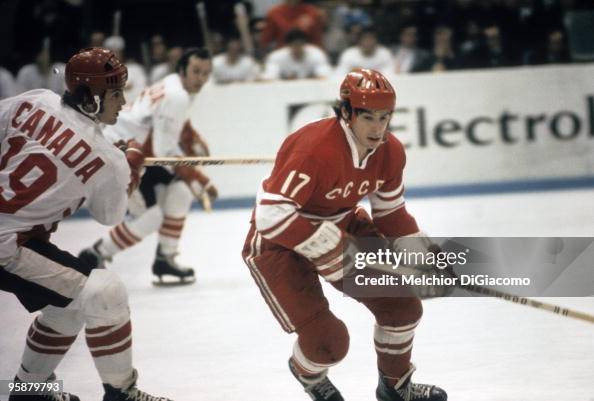
Paul Henderson (left) and Valeri Kharlamov.
Henderson's moment was yet to come. Kharlamov's had arrived.

September 2, 1972: Hockey's "Summit Series" begins at the storied Montreal Forum. It is the 1st of 4 games across Canada, followed by 2 weeks of rest, then 4 games in Moscow.

Team Canada was a team of NHL All-Stars -- and only NHL players. Superstar left wing Bobby Hull and goaltender Gerry Cheevers, the latter recently having backstopped the Boston Bruins to a 2nd Stanley Cup in 3 seasons, were ruled ineligible because they'd defected -- not to the Soviet Union, but to the newly-formed World Hockey Association.

The greatest player in the game at the time, Bobby Orr of the Bruins, was hurt and unable to play. And 2 of the all-time greats, Gordie Howe and Jean Béliveau, had retired a year earlier. And, at the age of 36, Béliveau's Montreal teammate Henri Richard was considered too old. But these players were available and selected:

* From the Montreal Canadiens: Goaltender Ken Dryden, defensemen Guy Lapointe and Serge Savard, left wings Frank Mahovlich (better known from his earlier years with Toronto) and Pete Mahovlich (Frank's brother), right wing Yvan Cournoyer.

* From the Toronto Maple Leafs: Left wing Paul Henderson and right wing Ron Ellis.

* From the Boston Bruins: Defenseman Don Awrey, center Phil Esposito and right wing Wayne Cashman.

* From the New York Rangers: Defensemen Brad Park and Rod Seiling, left wing Vic Hadfield, center Jean Ratelle and right wing Rod Gilbert. Hadfield, Ratelle and Gilbert were known as the GAG Line, for "Goal A Game."

* From the Chicago Black Hawks: Goaltender Tony Esposito (Phil's brother), defensemen Pat Stapleton and Bill White, left wing Dennis Hull (Bobby's brother), and center Stan Mikita.

* From the Detroit Red Wings: Defenseman Gary Bergman, center Red Berenson and right wing Mickey Redmond.

* From the Philadelphia Flyers: Center Bobby Clarke.

* From the Minnesota North Stars: Left wing Jean-Paul Parisé and right wing Bill Goldsworthy.

* And from the Buffalo Sabres: Center Gilbert Perreault.

Home Provinces:

* From Quebec, Lapointe, Savard, Cournoyer, Ratelle, Gilbert and Perreault.

* From Ontario, the Mahovliches, the Espositos, Dennis Hull, Dryden, Henderson, Ellis, Awrey, Cashman, Park, Seiling, Vic Hadfield, Stapleton, White, Bergman, Redmond, Parisé, Goldsworthy, and, though born in Slovakia, Mikita.

* From Manitoba, Clarke.

* And from Saskatchewan, Berenson.

* None come from the Maritime Provinces or Western Canada. This was not unusual: In the 1972 All-Star Game, John McKenzie of the Bruins, Garry Unger of the Blues and Greg Polis of the Pittsburgh Penguins were from Alberta, but McKenzie had defected to the WHA; Ross Lonsberry of the Flyers and Keith Magnuson of the Black Hawks were from Saskatchewan; but everybody else selected for that game was from Manitoba on east. No players were from British Columbia or any of the Maritimes.

Most of the Soviet players were from Moscow and environs:

* From CSKA Moscow (Central Club of the Army): Goaltender Vladislav Tretiak; defensemen Alexander Gusev, Vladimir Lutchenko, Viktor Kuzkin and Alexander Ragulin; center Vyacheslav Starshinov; left wings Valery Kharlamov, Yuri Blinov and Yevgeny Mishakov; center Vladimir Petrov; right wings Boris Mikhailov and Vladimir Vikulov.

* From Spartak Moscow, better known for its soccer team: Goaltender Victor Zinger, defensemen Gennady Tsygankov and Yevgeny Poladiev, left wing Alexander Yakushev. center Vladimir Shardin, right wings Yevgeny Zimin and Alexander Martynyuk.

* From Dynamo Moscow, also better known for its soccer team: Defenseman Valery Vasiliev and right wing Alexander Maltsev.

* From Krylya Sovetov (translated as "Soviet Wings," another Moscow-based club team): Goaltender Alexander Sidelnikov, defenseman Yuri Shatalov, left wing Yuri Lebedev, center Vyacheslav Anisin, right wing Alexander Bodunov.

* From Khimik Voskresenk (based outside Moscow): Defenseman Yuri Liapkin.

* And from SKA Leningrad (now SKA St. Petersburg): Center Vyacheslav Solodukhin.

The pseudo-amateur Soviets had picked on real amateurs in the World Championships and the Winter Olympics for years. Still, they would be no match for real professionals from the country that invented the game. Especially in the Forum, the Yankee Stadium of hockey -- or was Yankee Stadium the Montreal Forum of baseball? No, the Commies didn't stand a chance...

And when Phil Esposito scored for Canada, only 30 seconds into Game 1, most Westerners' suspicions appeared to be confirmed. When Paul Henderson made it 2-0 at 6:32, it looked like the rout was on.

It was -- the other way. Zimin scored at 12:30. Petrov tied it at 17:28. Kharlamov gave the Soviets the lead with a terrific goal at 2:40 of the 2nd period, and scored an even more spectacular goal at 10:18.

Clarke, the young Captain of the Flyers, closed the gap to 4-3 with 11:38 remaining in regulation. But Mikhailov scored with 6:28 left, Zimin scored again with 5:31 left, and Yakushev put the exclamation point on with 1:23 left. Soviet Union 7, Canada 3.

This game was more shocking for Canada than the U.S.-U.S.S.R. basketball game that was played in the Olympics 7 days later; and for this, the Soviets didn't have to cheat. Had the Soviets put together a baseball team that upset a U.S. team at Yankee Stadium, it wouldn't have been as shocking to Americans as this game was to Canadians. Kharlamov and goaltender Tretiak became legends on this night.

Canada had been embarrassed, in its national sport, in that sport's greatest building. And it would get worse before it would get better.

*

September 2, 1972 was a Saturday. This was also the day that Milt Pappas pitched a no-hitter for the Chicago Cubs against the San Diego Padres at Wrigley Field in Chicago, with the Cubs winning, 8-0. It should have been a perfect game, but it was taken away from him due to a bad call by umpire Bruce Froemming. I have a separate entry for that event.

These other Major League Baseball games were played:

* The New York Yankees beat the Chicago White Sox, 2-1 at Yankee Stadium. Steve Kline outpitched Tom Bradley. Bernie Allen hit a home run. Thurman Munson went 1-for-3 with the team's other RBI.

* The New York Mets beat the Houston Astros, 11-8 at the Astrodome in Houston. Ken Boswell hit a home run for the Mets. Willie Mays appeared only as a defensive replacement, and did not come to bat.

* The Boston Red Sox beat the Kansas City Royals, 5-3 at Fenway Park in Boston. Carl Yastrzemski went 0-for-3, with an RBI on a sacrifice fly.

* A doubleheader was split at Atlanta Stadium (later renamed Atlanta-Fulton County Stadium). The Atlanta Braves won the opener, 10-7. The Philadelphia Phillies won the nightcap, 3-0. Dave Downs pitched an 8-0 shutout. It was 1 of 13 shutouts pitched by the Phillies that year, 8 of which were pitched by Steve Carlton.

Over the 2 games, Hank Aaron went 4-for-8 with a walk and 4 RBIs, including hitting the 666th and 667th home runs of his career. Ten days later, Mike Schmidt would make his major league debut for the Phils.

* The Pittsburgh Pirates beat the San Francisco Giants, 6-3 at Three Rivers Stadium in Pittsburgh. Roberto Clemente went 2-for-3 with 2 walks, a home run, and 3 RBIs. It was the 239th home run of his career. He would hit 1 more.

* The Montreal Expos beat the Cincinnati Reds, 7-2 at Riverfront Stadium in Cincinnati. Pete Rose and Johnny Bench both went 0-for-4, with Rose adding a walk.

* The Cleveland Indians beat the Minnesota Twins, 5-3 at Metropolitan stadium in the Minneapolis suburb of Bloomington, Minnesota. Steve Dunning was the winning pitcher, and helped his own cause with a 2-run home run. Harmon Killebrew went 1-for-3 with an RBI. Rod Carew went 2-for-5.

* The Los Angeles Dodgers beat the St. Louis Cardinals, 5-1 at Busch Memorial Stadium in St. Louis. Lou Brock went 0-for-3. Frank Robinson, in his only season with the Dodgers, did not enter the game.

* The Milwaukee Brewers beat the Texas Rangers, 6-2 at Arlington Stadium in the Dallas suburb of Arlington, Texas.

* The California Angels beat the Baltimore Orioles, 2-0 at Anaheim Stadium (now Angel Stadium). Rudy May pitched a 3-hit shutout to beat Jim Palmer. Brooks Robinson went 1-for-4.

* And the Detroit Tigers beat the Oakland Athletics, 3-1 at the Oakland Coliseum. Bill Freehan and Mickey Stanley hit home runs in the top of the 11th inning, off Dave Hamilton, who blew the game for Vida Blue. Fred Scherman was the winning pitcher, in relief of Mickey Lolich. Al Kaline went 2-for-5. Reggie Jackson went 1-for-4.

It was the week before the college football season opened in America. In English soccer, it was a battle of London teams, and Arsenal and Chelsea played to a 1-1 draw at Highbury.

September 2, 1972: Bruce Froemming Blows Milt Pappas' Perfect Game

September 2, 1972: The Chicago Cubs host the San Diego Padres at Wrigley Field in Chicago. Milt Pappas is the Cubs' starting pitcher, entering the game with a record of 11-7. Although a decent pitcher, he is best known for being the pitcher that the Cincinnati Reds traded their best player, Frank Robinson, for following the 1965 season. In the past 7 years, that trade had already gone down in history as one of baseball's worst trades. The events of this game did not change that.

The Cubs granted Pappas a quick lead, scoring 2 runs in the bottom of the 1st inning. They made it 4-0 in the 3rd. In the 8th, they extended it to 8-0. The result of the game was no longer in doubt. But Pappas inched closer and closer to baseball history. In the 8th inning, he made a fine play on a comebacker hit by Derrel Thomas for the final out. It was 24 men up 24 men down.

Johnny Jeter, no relation to Derek, led off the top of the 9th inning, and he hit a line shot to left-center field, where future Hall-of-Famer Billy Williams caught it. Fred Kendall, father of future All-Star Jason Kendall, grounded to shortstop, and Don Kessinger threw him out.

The batter was Larry Stahl, pinch-hitting for Al Severinsen, who had relieved Padre starter Mike Caldwell. He ran the count full. Pappas threw a pitch that was a little outside. Stahl checked his swing, but appeared to go around. It should have been strike 3, the last out, a no-hitter and a perfect game for Pappas.

The home plate umpire was Bruce Froemming, in only his 2nd season in the major leagues. A native of Milwaukee, a few days away from his 33rd birthday, he called the pitch a ball, and sent Stahl to 1st base. The perfect game was ruined.

Garry Jestadt was the next batter. He popped up, and 2nd baseman Carmen Fanzone caught it for the final out. Pappas had his no-hitter. But this game went into the books as a perfect game ruined on a walk to the 27th and, potentially, last batter. It remains the only such game in baseball history: 27th men have reached on hits, and on errors, but only this one due to a base on balls.

After the game, Pappas approached Froemming, and appealed to his ego. He reminded Froemming of how few perfect games had been pitched -- 10 at that point -- and thus how few umpires had called them. Froemming told Pappas, "Milt, if I'd called that pitch a strike, I'd never be able to live with myself." Pappas forgot the high road and yelled, "How do you live with yourself with all the other lousy calls you make?"

Pappas would finish his career with a fine record of 209 wins and 164 losses, a 3.40 ERA, and a 1.225 WHIP. He deserved better than to be remembered only as the man acquired in the Frank Robinson trade. Certainly, he deserved that perfect game. He is still remembered for having pitched a no-hitter for the Cubs, something that Burt Hooton had done the season before, and Ken Holtzman had done 1 and 3 seasons before. Pappas died in 2016, shortly after the 50th Anniversary of the infamous trade.

Froemming went on to umpire for a record 37 years (since broken), and became one of the worst ever. In Philadelphia, he is notorious for a call at 1st base that cost the Phillies an out that would have clinched the 1977 National League Pennant, leading to the Los Angeles Dodgers winning the Pennant. Froemming's swan song was the 2007 American League Division Series between the Yankees and the Cleveland Indians, when he, as crew chief, refused to stop the game until the Lake Erie Midges left.

*

September 2, 1972 was a Saturday. These other Major League Baseball games were played:

* The New York Yankees beat the Chicago White Sox, 2-1 at Yankee Stadium. Steve Kline outpitched Tom Bradley. Bernie Allen hit a home run. Thurman Munson went 1-for-3 with the team's other RBI.

* The New York Mets beat the Houston Astros, 11-8 at the Astrodome in Houston. Ken Boswell hit a home run for the Mets. Willie Mays appeared only as a defensive replacement, and did not come to bat.

* The Boston Red Sox beat the Kansas City Royals, 5-3 at Fenway Park in Boston. Carl Yastrzemski went 0-for-3, with an RBI on a sacrifice fly.

* A doubleheader was split at Atlanta Stadium (later renamed Atlanta-Fulton County Stadium). The Atlanta Braves won the opener, 10-7. The Philadelphia Phillies won the nightcap, 3-0. Dave Downs pitched an 8-0 shutout. It was 1 of 13 shutouts pitched by the Phillies that year, 8 of which were pitched by Steve Carlton.

Over the 2 games, Hank Aaron went 4-for-8 with a walk and 4 RBIs, including hitting the 666th and 667th home runs of his career. Ten days later, Mike Schmidt would make his major league debut for the Phils.

* The Pittsburgh Pirates beat the San Francisco Giants, 6-3 at Three Rivers Stadium in Pittsburgh. Roberto Clemente went 2-for-3 with 2 walks, a home run, and 3 RBIs. It was the 239th home run of his career. He would hit 1 more.

* The Montreal Expos beat the Cincinnati Reds, 7-2 at Riverfront Stadium in Cincinnati. Pete Rose and Johnny Bench both went 0-for-4, with Rose adding a walk.

* The Cleveland Indians beat the Minnesota Twins, 5-3 at Metropolitan stadium in the Minneapolis suburb of Bloomington, Minnesota. Steve Dunning was the winning pitcher, and helped his own cause with a 2-run home run. Harmon Killebrew went 1-for-3 with an RBI. Rod Carew went 2-for-5.

* The Los Angeles Dodgers beat the St. Louis Cardinals, 5-1 at Busch Memorial Stadium in St. Louis. Lou Brock went 0-for-3. Frank Robinson, in his only season with the Dodgers, did not enter the game.

* The Milwaukee Brewers beat the Texas Rangers, 6-2 at Arlington Stadium in the Dallas suburb of Arlington, Texas.

* The California Angels beat the Baltimore Orioles, 2-0 at Anaheim Stadium (now Angel Stadium). Rudy May pitched a 3-hit shutout to beat Jim Palmer. Brooks Robinson went 1-for-4.

* And the Detroit Tigers beat the Oakland Athletics, 3-1 at the Oakland Coliseum. Bill Freehan and Mickey Stanley hit home runs in the top of the 11th inning, off Dave Hamilton, who blew the game for Vida Blue. Fred Scherman was the winning pitcher, in relief of Mickey Lolich. Al Kaline went 2-for-5. Reggie Jackson went 1-for-4.

This was also the day of Game 1 of the "Summit Series," and the Soviet Union shocked Canada, 7-3 at the Montreal Forum.

It was the week before the college football season opened in America. In English soccer, it was a battle of London teams, and Arsenal and Chelsea played to a 1-1 draw at Highbury.

Tuesday, January 11, 2022

January 11, 1976: Flyers vs. Red Army

January 11, 1976: For once, there were a lot of Americans rooting for the Commies. But those Reds were shown just how tough Americans -- or, at least, Canadians -- could be.

First, let's take a step back, to 1972. A "Summit Series" was set up between National Hockey League All-Stars under the name "Team Canada" and an all-star team from the Soviet Union. It was set for 8 games, 4 in each country, and the Soviets shocked the Canadians by winning Game 1 rather easily.

After 5 games, it was Soviets 3 wins, Canada 1 win, and 1 tie. Canada won the last 3 games in Moscow to take the series, salvaging their pride, but the Soviets, previously ridiculed for being professionals in all but name picking on amateur teams in the Winter Olympics, had served noticed: They were as good as the free world's best.

There was another series in 1974, this time between the Soviets and a team of all-stars from the World Hockey Association. Given the lesser competition -- only 3 players from Canada '72, including Paul Henderson, who scored the winning goal of the series, played for this WHA team -- the Soviets won 4 games, Canada just 1, with 3 ties.

Super Series '76 was scheduled, with 2 Soviet club teams taking on NHL teams. One was the reigning Soviet Champions, CSKA Moscow. Translated into English, "CSKA" became "Central Sports Club of the Army." It was a team sponsored by the country's Red Army, and that's what they were called in the American media: "The Red Army."

The other was Krylya Sovetov, translated as "Soviet Wings." This suggests they were sponsored by the country's Air Force. Not quite: They were sponsored by the country's aircraft builders.

The Super Series began on December 28, 1975, at Madison Square Garden, and the Red Army pounded the New York Rangers, 7-3. This was understandable: Despite celebrating their 50th Season, the Broadway Blueshirts were in total disarray, having recently fired their head coach and general manager, Emile Francis; and traded away several key players, including goaltender Eddie Giacomin, defenseman Brad Park and center Jean Ratelle.

On December 29, the Soviet Wings beat the Pittsburgh Penguins, 7-4. Also not a surprise: The Pens were not a good team at the time. The next game got people's attention, though: On New Year's Eve, at the Montreal Forum, the Red Army took on the Montreal Canadiens, a team loaded with future Hall-of-Famers and one of the favorites to win the Stanley Cup. It ended in a 3-3 tie, and has been called one of the greatest games in the sport's history.

On January 4, 1976, an NHL team finally got a win. The Buffalo Sabres, who had advanced to the previous season's Stanley Cup Finals, beat the Wings, 12-6 at the Buffalo Memorial Auditorium. But the Russians re-established their dominance: On January 7, the wings went into the Chicago Stadium, and beat the Chicago Black Hawks, 4-2.

On January 8, the Red Army went into the Boston Garden and, playing a Boston Bruins team with Bobby Orr injured, Phil Esposito traded to the Rangers for Park and Ratelle, and Park and Ratelle not really settled in yet, dominated the Beantown Brats, 5-2. And on January 10, the Wings went out to Long Island, and beat the rising New York Islanders, 2-1.

There was one game left to play. On January 11, the Red Army went into The Spectrum in Philadelphia, to play the Philadelphia Flyers.

The Flyers had won the Stanley Cup in 1974, beating the Bruins in an upset, and again in 1975, beating the Sabres. They had a well-balanced team led by Captain Bobby Clarke and goaltender Bernie Parent. But they were also the most violent team hockey had ever seen, known as "The Broad Street Bullies."

There was a game in 1972 in Vancouver, when they were pelted with garbage by Canucks fans. Some of the players went into the stands to fight the fans, and got arrested. After the next game, which they won, along with some fights in the game, one of the players who had been arrested, defenseman Andre "Moose" Dupont sat for an interview in the locker room. He said, "It was a good night for us. We beat up their chicken forwards, we didn't get arrested, we scored goals, and we won. Now, the Moose drinks beer."

Philadelphia fans, enjoying their image as a city for tough people, loved this shit. They loved Dupont, and Dave "The Hammer" Schultz, and Ed Van Impe, and the brothers Jimmy and Joe Watson, and Tom "the Bomber" Bladon, and Bob "Hound" Kelly, every bit as much as they loved skill players like Clarke, Parent, and Bill Barber, all of whom ended up in the Hockey Hall of Fame, along with coach Fred Shero, general manager Keith Allen, and founding owner Ed Snider.

They were to take on the Red Army team with Vladislav Tretiak in goal, Viktor Kuzkin on defense, Boris Mikhailov and Vladimir Petrov at center, and Valeri Kharlamov on left wing. Each of these players would be elected to the International Ice Hockey Federation (IIHF) Hall of Fame, while Tretiak and Kharlamov were elected to the main Hall of Fame in Toronto.

The Flyers were the most hated team in hockey -- and, along with the Canadiens, 1 of the 2 best. But the other team was the Soviet Red Army. The Communists. America's enemy. On the other hand -- the third hand? -- of the 28 players who appeared in regular-season games for the Flyers that season, only 1 was an American, rookie right wing Paul Holmgren. The other 27 were Canadian. True, Canada is America's closest ally, but was it really patriotic to root for 27 Canucks and 1 American rookie who might not even get into the game?

Yes, yes it was. It in America. It was 1976, the Bicentennial year. And it was Philadelphia, birthplace of the nation through the Declaration of Independence, and birthplace of our system of government through the Constitution. And, as they so often did when they needed some good luck, the Flyers played Kate Smith's recording of "God Bless America" rather than "The Star-Spangled Banner." (Smith herself had sung in person a few times, but was not there on this occasion.) And the Philly fans belted it out along with the recording. Game on, you Commie bastards.

Shero had 2 slogans. One was, "We will win together now, and we will walk together forever." The other was, "Take the shortest route to the puck, and arrive in ill humor." In the 1st period, Van Impe was sent to the penalty box for hooking. When his penalty ended, with the score still 0-0, he went right at Kharlamov, and elbowed him in the head.

The referee, Lloyd Gilmour, did not call a penalty. Red Army coach Konstantin Loktev decided that his players were not going to be treated fairly, and, with the clock reading 11:21 of the 1st period (in other words, 9:39 to go), pulled his them off the ice. Bob Cole, calling the game for CBC (the Canadian Broadcasting Corporation), yelled, "They're going home! They're going home!"

Legend has it that Snider went to Vyacheslav Koloskov, the president of the Soviet Hockey Federation, and told him that his team would not get paid unless they returned to the ice. It wasn't true: NHL President Clarence Campbell, and tournament organizer Alan Eagleson (who later went to prison for embezzling from many of the players he represented) talked to Koloskov, and he talked to Loktev, and the Red Army players returned, taking a delay of game penalty.

And just 30 seconds into this power play, Reggie Leach deflected a shot past Tretiak to make it 1-0 Philadelphia. Toward the end of the period, Rick MacLeish scored to make it 2-0. Early in the 2nd period, the Red Army were on a power play when Joe Watson, known as a defensive defenseman, scored a shorthanded goal to make it 3-0. Shero told Joe he had "set Soviet hockey back 25 years."

Victor Kutyorgin scored for the Soviets in the period, but it was merely a consolation, not the start of a comeback. In the 3rd period, Larry Goodenough -- whose nickname, naturally was "Izzy" Goodenough -- tallied to make it 4-1. This would be the final score. And the Flyers, who had so deeply relied on Parent to win back-to-back Cups, did this with Wayne Stephenson playing the entire game in goal.

Tretiak said the Flyers won by playing "rude hockey." Loktev called them "a bunch of animals." They were both right. But the Flyers had won, and came away believing the Russians were skilled by soft. They were right, too.

The Flyers made it 3 straight trips to the Stanley Cup Finals, and printed up memorabilia reading, "HAT TRICK IN '76." But the Canadiens put a stop to that, sweeping them in 4 straight, for the 1st of 4 straight Stanley Cups.

The Flyers have never won another Cup. From 1976 to 2021, they were in 6 Stanley Cup Finals, and lost them all. And it wasn't because they got soft: For the rest of the 1970s, into the '80s, and even through the '90s, they were still one of the dirtier teams in the game. But bad management and bad luck have combined to give them a Cup drought that, even if they do it this season, will have lasted 47 years.

But their teams of 1974, '75 and '76 will always be remembered, for beating the Big Bad Bruins, and also for beating the Red Army when no one else could.

*

January 11, 1976 was a Sunday. There were 5 regular-season NHL games played that day:

* In an "Original Six" matchup, the New York Rangers beat the Chicago Black Hawks, 6-2 at the Chicago Stadium.

* In another "Original Six" game, the Montreal Canadiens beat the Toronto Maple Leafs, 2-0 at the Montreal Forum.

* The Boston Bruins beat the Washington Capitals, 7-4 at the Capital Centre in the Washington suburb of Landover, Maryland.

* The Buffalo Sabres beat the Pittsburgh Penguins, 6-0 at the Buffalo Memorial Auditorium.

* And the Atlanta Flames beat the Vancouver Canucks, 5-2 at The Omni in Atlanta.

There were 5 games played in the World Hockey Association:

* The New England Whalers beat the San Diego Mariners, 8-4 at the Hartford Civic Center (now the PeoplesBank Arena).

* The Cleveland Crusaders beat the Indianapolis Racers, 4-3 at The Coliseum in the Cleveland suburb of Richfield, Ohio.

* The Minnesota Fighting Saints beat the Cincinnati Stingers, 7-4 at the Riverfront Coliseum in Cincinnati (now the Heritage Bank Center).

* The Winnipeg Jets beat the Ottawa Civics, 6-5 in overtime at the Winnipeg Arena. The Civics had been the Denver Spurs only 10 days earlier, and would play a grand total of 7 games as the Civics before folding.

* And the Houston Aeros beat the Edmonton Oilers, 5-3 at the Northlands Coliseum in Edmonton.

Baseball was out of season. The NFL was halfway between its Conference Championships and Super Bowl X. But there were 7 games played in the NBA that day:

* The New York Knicks beat the Phoenix Suns, 99-98 at the Arizona Veterans Memorial Coliseum in Phoenix.

* The Philadelphia 76ers beat the Boston Celtics, 118-107 at The Spectrum. Yes, the building hosted its NBA and its NHL teams on the same day. And it's a toss-up as to who Delaware Valley fans hated more: The Russkies or the Celtics.

* The Cleveland Cavaliers beat the Washington Bullets, 106-104 at The Coliseum. Yes, this building also hosted pro basketball and pro hockey on this same day.

* The Milwaukee Bucks beat the Los Angeles Lakers, 95-89 at the Milwaukee Exposition, Convention Center and Arena, or "The MECCA." Since 2014, it has been named the UW-Panther Arena. The Lakers had recently acquired Kareem Abdul-Jabbar from the Bucks, and he scored 35 points and grabbed 22 rebounds in this game, but the Bucks won anyway.

* The Portland Trail Blazers beat the Atlanta Hawks, 116-109 at The Omni in Atlanta. Yes, it hosted an NBA game and an NHL game on the same day. John Drew scored 42 points for the Hawks.

* The Kansas City Kings beat the Detroit Pistons, 105-99 at the Kemper Arena in Kansas City. (This arena still stands, but is now named the Hy-Vee Arena.)

* And the Buffalo Braves beat the Seattle SuperSonics, 125-104 at the Seattle Center Coliseum. Bob McAdoo scored 38 for the Braves, the team now known as the Los Angeles Clippers.

There were 2 games played in the American Basketball Association, in what turned out to be its last season. The New York Nets beat the Indiana Pacers, 112-102 at the Nassau Coliseum. And the Spirits of St. Louis -- that was the official name, never "the St. Louis Spirits" -- beat the Kentucky Colonels, 113-111 at the Checkerdome, as the St. Louis Arena was then known due to its ownership by Ralston-Purina with its "checkerboard square" logo. 

December 31, 1999 & January 1, 2000: The Millennium

December 31, 1999:  The Millennium arrives. The people of planet Earth survived. At a terrible cost. But we hadn't destroyed ourselves. ...