
"Henderson has scored for Canada!"
Number 12 is Yvan Cournoyer.
September 28, 1972: The "Summit Series" between Canada and the Soviet Union comes to a close with Game 8 at the Luzhniki Palace of Sports in Moscow.
Team Canada had made a big mistake in only letting NHL players play for them, meaning that Bobby Hull, who had signed a contract with the Winnipeg Jets of the new World Hockey Association, wasn't eligible. Also, Bobby Orr of the Boston Bruins was injured. If either of the Bobbys was able to play, it would have been a very different series.
But the Soviets, led by goaltender Vladislav Tretiak and left wing Valery Kharlamov, shocked the Canadians by winning Game 1, 7-3, at the Montreal Forum, no less. It was the most distressing moment in the history of Canadian sport.
For Game 2, at Maple Leaf Gardens in Toronto on September 4, Canada manager Harry Sinden, also the general manager and former head coach of the Boston Bruins, made a few changes, including replacing Ken Dryden in goal with Tony Esposito. It worked: Canada won, 4-1, and the Canadian media calmed down.
Game 3 was played at the Winnipeg Arena on September 6 -- which seems odd to me, given that Winnipeg had a team in the new WHA, not the NHL, and Team Canada had purposely frozen out the WHA players. Canada blew leads of 3-1 and 4-2, and it ended in a 4-4 tie. There was no provision for overtime.
Game 4, at the Pacific Coliseum in Vancouver, was a disaster. Serge Savard hurt his ankle in practice, and turned out to be unavailable until Game 6. Sinden put Dryden back in goal. Bill Goldsworthy committed 2 dumb early penalties, both converted into goals by Boris Mikhailov. A Rod Gilbert goal was disallowed, and Sinden told the media after the game that this took a lot out of his players.
The Soviets won, 5-3, taking a 2-1-1 lead, with the rest of the games set for Moscow. And it would be 2 weeks before Game 5, with plenty of time for the bad feelings to fester in Canadian hearts and minds. It looked bad, and the fans in Vancouver booed their national team off the ice.
The last Canada player to leave the ice was Phil Esposito, and he spoke to CTV interviewer Johnny Esaw:
In an interview almost 20 years later, Dryden said, "Here's a guy standing there, with the sweat of the world dripping off of him." And Dryden, and many other people, gave Espo credit for stopping the negativity from the fans and the media.
After the Vancouver game, the series went on a two-week hiatus. The Soviets returned home and played in a domestic tournament. The Canadians took a few days off, then travelled to Sweden for a pair of exhibition games, before arriving in Moscow. On September 16, Canada beat Sweden, 4-1. The next day, those teams played to a 4-4 tie. Both games were played at Johanneshovs Isstadion (a.k.a. "Hovet") in Stockholm.
The Moscow games would all be played at the Luzhniki Palace of Sport in Moscow, built in 1956 as part of the sports complex that includes Luzhniki Stadium, then known as the Lenin Stadium. Game 5 was played on September 22. Soviet Premier Leonid Brezhnev was in attendance. Also on hand, in Moscow for a treaty negotiation between the United States and the Soviet Union, is Ambassador and former child film star Shirley Temple Black. There were 3,000 seats among the 14,000 set aside for Canadian fans.

I recently saw a rerun of The Dick Cavett Show, with Shirley as a guest, telling that she thought the games in Moscow were thrilling. Rod Gilbert of the New York Rangers, who played for Team Canada in this series, was a guest on the same show, and he admitted that the Canadian scouts had let the players down, by downplaying the Soviet players' talents.
Canada led 4-1 with 18 minutes left. But the Soviets stormed back and won, 5-4. The Soviets now led 3 games to 1, with 1 tie. Canada had to win the last 3 straight, on Soviet ice, to win the series. It didn't look good.
Game 6, on September 24, changed everything. The Soviets took a 1-0 lead early in the 2nd period. But the Canadians took a 3-1 lead on goals by Dennis Hull, Yvan Cournoyer and Paul Henderson. And, on the advice of assistant coach John Ferguson Sr., who had been one of the roughest players of the 1960s, they targeted Kharlamov. Brad Park threw several solid but legal checks on him.
At one point, Kharlamov knocked down one of the youngest Canadians, Bobby Clarke. Perhaps the birth of the reputation of his team, the Philadelphia Flyers, as "The Broad Street Bullies," began right there in Moscow: Clarke threw his glove into Kharlamov's face, starting a fight. After Kharlamov later knocked Pete Mahovlich down, Clarke raced down the ice, and, knowing that Kharlamov had an injured ankle, slashed it with his stick.
In obvious pain, Kharlamov skated over to the Canadian bench, and yelled at their players, not that they could understand Russian. (Not even Stan Mikita, born in Slovakia but raised in Ontario.) The referees, a pair of Germans named Franz Baader and Josef Kompalla, whose seeming pro-Soviet calls led the Canadians to nickname them "Badder and Worse," gave Clarke 2 minutes for slashing, and an additional 10 minutes for misconduct, leading to a power play goal by Alexander Yakushev. But the Russians had been intimidated, and Canada held on for a 3-2 victory.
Game 7 was played on September 26. In spite of Dryden's win in Game 6, Sinden went back to Tony Esposito. Maybe it inspired his brother Phil, because he scored 2 goals. Yakushev also scored 2, but with just 2:06 to go, Henderson scored to give Canada a 4-3 win. It was now tied, 3 games apiece, plus the Game 2 tie. Game 8, on September 28, would be for all the marbles.
Dryden was back in goal, while Tretiak had played every minute of the series for the Soviets. A power play led to a Yakushev goal at 3:34, but one on the other side led to a Phil Esposito equalizer at 6:45. Vladimir Lutchenko scored at 13:10, but Park tied it at 16:59.
Vladimir Shadrin scored just 21 seconds into the 2nd period, but the Canadians tied it again, on a goal by Bill White at 10:32. Yakushev scored another, and Valeri Vasiliev scored with 3:16 left in the period. It was 5-3 Soviets, and it looked all over.
It wasn't. Phil scored 2:27 into the 3rd period, to make it 5-4. With 7:04 left, Cournoyer tied the game at 5-5. With one minute left, Soviet officials went to the Canadian officials, and claimed victory on total goals.
But as the seconds ticked down, Phil assisted Henderson, and with 34 seconds left, Foster Hewitt, the 1st man to broadcast a hockey game on radio, and the Voice of Canada for so long, who had come out of retirement for this series, shortly before his 70th birthday, broadcasting on CBC with Brian Conacher, said, "Cournoyer has it on that wing. Here's a shot! Henderson made a wild stab for it and fell. Here's another shot. Right in front, they score! Henderson has scored for Canada!"
It remains the most famous goal in the sport's history, and it lifted Henderson, a good player but never considered a great one, to the role of national hero. Dryden and the rest of the Canadians hung on for another 34 seconds, and had the win, 6-5, to take the Series.
Canada had been shaken by the Series, but emerged victorious. The nation celebrated harder than they had for anything since World War II ended. It was a confirmation of national greatness -- barely. In contrast, when the U.S. team beat the Soviets, including many of the same players, 8 years later in the Winter Olympic in Lake Placid, New York, instead of avoiding a tremendous upset, it was one. In the end, the Soviets are remembered more for those 2 losses than for all the games they won.
Foster Hewitt died in 1985. Bill Goldsworthy of the Minnesota North Stars died in 1996. Gary Bergman of the Detroit Red Wings died in 2000. John Ferguson died in 2007. Johnny Esaw, to whom Phil Esposito delivered his speech, died in 2013. Jean-Paul Parisé of the North Stars died in 2015. Bill White of the Chicago Black Hawks died in 2017. Stan Mikita of the Black Hawks died in 2018. Pat Stapleton of the Black Hawks died in 2020. Tony Esposito of the Black Hawks and Rod Gilbert of the New York Rangers died in 2021.
The remaining 20 Canadian players are still alive, 50 years later: Frank Mahovlich of the Montreal Canadiens (a legend in Toronto) is 84; Red Berenson of the Red Wings is 82; Jean Ratelle and Vic Hadfield, both of the New York Rangers, are about to turn 82; Phil Esposito of the Boston Bruins is 80; Paul Henderson of the Toronto Maple Leafs and Don Awrey of the Bruins are 79; Yvon Cournoyer of the Montreal Canadiens is 78; Wayne Cashman of the Bruins, Dennis Hull of the Black Hawks (Bobby's brother), Rod Seiling of the Rangers and Ron Ellis of the Toronto Maple Leafs are 77; Serge Savard of the Canadiens is 76; Pete Mahovlich of the Canadiens (Frank's brother) is about to turn 76; Ken Dryden of the Canadiens is 75; Brad Park of the Rangers, Guy Lapointe of the Canadiens and Mickey Redmond of the Red Wings are 74; Bobby Clarke of the Philadelphia Flyers is 73; and Gilbert Perreault of the Buffalo Sabres is 71. Head coach Harry Sinden is 90. Broadcaster Brian Conacher is 81.
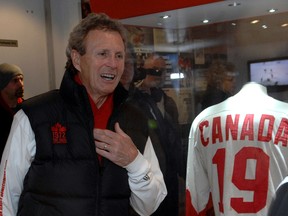
Paul Henderson, posing next to his 1972 Canada jersey,
on display at the Hockey Hall of Fame in Toronto
Of the Soviet players, most of them came from Moscow and environs, and all were from Russia proper, except for Evgeni Paladiev, from Kazakhstan.
Viacheslav Solodukhin was a suicide in 1979, Valeri Kharlamov was killed in a car crash in 1981, Alexander Ragulin died in 2004, Gennadiy Tsygankov in 2006, Yevgeni Mishakov in 2007, Viktor Kuzkin in 2008, Evgeni Paladiev in 2010, Valeri Vasiliev in 2012, Vladimir Vikulov in 2013, Vladimir Petrov and Alexander Bodunov in 2017, Yuri Shatalov and Yevgeni Zimin in 2018, Alexander Gusev in 2020, and Vladimir Shadrin in 2021.
Still alive: Vyacheslav Starshinov is 82, Boris Mikhailov is about to turn 78, Yuri Lyapkin and Alexander Martynyuk are 77, Alexander Yakushev is 75; Vladimir Lutchenko, Yuri Blinov and Alexander Maltsev are 73; Yuri Lebedev and Vyacheslav Anisin are 71, and Vladislav Tretiak and Alexander Volchkov are 70.
(UPDATE: Alexander Martynyuk died later in 2022. Ron Ellis died in 2024. Ken Dryden died in 2025. Dennis Hull died in 2026.)
*
September 28, 1972 was a Thursday. This was also the day The Temptations released their song "Papa Was a Rollin' Stone." I have a separate entry for that event.
September was chosen for the Summit Series because it was before either country's major league began play for the new season. The NBA and the ABA hadn't yet started their 1972-73 seasons, either. And while it was during the football season, at the time, NFL and college games played on Thursdays other than Thanksgiving were rare. And only 4 Major League Baseball games were played:
* The New York Yankees beat the Detroit Tigers, 3-2 at Tiger Stadium in Detroit. Thurman Munson, Roy White and pitcher Lindy McDaniel all hit home runs off the Tigers' Mickey Lolich. Because of the designated hitter, McDaniel remains the last Yankee pitcher to have hit a home run. White's homer won the game in the 12th inning. Mel Stottlemyre started the game, and Sparky Lyle won it in relief of Stottlemyre and McDaniel.
* The Boston Red Sox beat the Kansas City Royals, 3-1 at Fenway Park in Boston.
* The Philadelphia Phillies beat the Pittsburgh Pirates, 2-1 at Veterans Stadium in Philadelphia.
* And the Oakland Athletics beat the Minnesota Twins, 8-7 at the Oakland Coliseum.


No comments:
Post a Comment