Showing posts with label 1913. Show all posts

Monday, December 26, 2022

December 26, 1913: The Disappearance of Ambrose Bierce

December 26, 1913: Ambrose Bierce disappears in Mexico, covering that country's Revolution. He was never seen again.

Born on June 24, 1842 in Horse Cave Creek in southeastern Ohio, worked at an abolitionist newspaper in Indiana, and was decorated for heroism by the Union Army for his actions at the Battle of Rich Mountain in what's now West Virginia, before sustaining a head wound at the Battle of Kennesaw Mountain outside Atlanta.

After the American Civil War, he wrote for several magazines, and was noted for his crime reporting for the San Francisco News Letter. He lived in London from 1872 to 1875, and it was there that his 1st book was published, a compilation of his articles titled The Fiend's Delight. He went back to San Francisco, and in 1881, he joined the staff of the San Francisco Examiner, becoming the 1st high-profile hire of its ambitious young publisher, William Randolph Hearst. He would continue to work for Hearst until 1909.

He wrote 25 stories based around his Civil War service, which, collectively, would be called "the greatest anti-war document in American literature." Among these was "An Occurrence at Owl Creek Bridge," in 1890. This story about a condemned Confederate who thinks he's escaped being hanged by the Union Army became his most popular work, and has been filmed several times, including by French director Robert Enrico, winning Best Short Subject at the 1962 Cannes Film Festival, and the Academy Award for Best Short Subject in 1963. Rod Serling, creator, head writer, and narrator of The Twilight Zone, a show that specialized in twist endings, made that film the only one he ever bought for an episode of the show. It cost $25,000, whereas putting together a new episode from scratch usually cost his production company about $65,000.

In 1906, Bierce published The Cynic's Word Book. He re-published it in 1911, under the title The Devil's Dictionary, and it is by that title that it is better remembered. It is a darkly comic glossary. Some examples:

* Air (n.) A nutricious (that's how he spelled it) substance supplied by a bountiful providence for the fattening of the poor.

* Cannon (n.) An instrument employed in the rectification of national boundaries.

* Conservative (n.) A statesman who is enamoured of existing evils, as distinguished from the Liberal, who wishes to replace them with others.

* Egotist (n.) A person of low taste, more interested in himself than in me.

* Lawyer (n.) One skilled in circumvention of the law.

* Love (n.) A temporary insanity curable by marriage.

* Marriage (n.) A household consisting of a master, a mistress, and two slaves, making in all, two.

* Positive (a.) Mistaken at the top of one's voice.

* Religion (n.) A daughter of Hope and Fear, explaining to Ignorance the nature of the Unknowable.

Critic William Dean Howells said, "Mr. Bierce is among our three greatest writers." Bierce responded, "I am sure Mr. Howells is the other two."

In October 1913, Bierce departed from Washington, D.C. for a tour of his Civil War battlefields. Then, despite being 71 years old, he went to Mexico, at the height of its Revolution -- really, another civil war. The San Francisco-based journalist Blanche Partington, a friend and possibly girlfriend of the divorced Bierce, received a letter from him, dated December 26, 1913. He mentioned that he had joined the army of Pancho Villa as an observer, and witnessed Villa's victory at the Battle of Tierra Blanca on November 25. He closed his letter by saying, "As to me, I leave here tomorrow for an unknown destination."

No American ever heard from him again. It was suggested that he had been in the city of Chihuahua in January 1914. Another theory said that he'd gone back across the border, went to the Grand Canyon in Arizona, and committed suicide. Another said that he'd been captured by government forces in Sierra Mojada, and was executed by firing squad there.

If this last theory is true, it appears that he wouldn't have minded it. In one of his last letters, he wrote, "Good-bye. If you hear of my being stood up against a Mexican stone wall and shot to rags, please know that I think it is a pretty good way to depart this life. It beats old age, disease, or falling down the cellar stairs. To be a Gringo in Mexico -- ah, that is euthanasia!"

*

December 26, 1913 was a Friday. Frank Swift was born on this day. A star goalkeeper for English soccer team Manchester City, he became a journalist writing about the sport, and was killed in the Munich Air Disaster of 1958, covering Manchester United in the European Cup.

Baseball was out of season. Football season was over. Professional basketball barely existed. There was no hockey, either: The National Hockey Association season began the next day.

Being the day after Christmas, Boxing Day, there were soccer games played in England. At their brand-new home of Highbury in North London, Arsenal defeated Yorkshire team Bradford Park Avenue, 2-0. Manchester City defeated Liverpool, 1-0 at Anfield in Liverpool. And Everton FC defeated Manchester United, 5-0 at Goodison Park in Liverpool.

Saturday, December 24, 2022

December 24, 1913: The Italian Hall Disaster

December 24, 1913: A crowded Christmas party turns into a disaster -- possibly a massacre -- in Calumet, Michigan.

Calumet is on the Keweenaw Peninsula, on Michigan's Upper Peninsula, near Lake Superior. This region of the Upper Midwest -- the U.P., northern Wisconsin, northeastern Minnesota, and the section of Canada's Ontario on the other side of the Lake -- was copper-mining country in the early 20th Century. In 1913, there were 15,000 men working for the Calumet and Hecla Mining Company (C&H), about 9,000 of them belonging to a union, the Western Federation of Miners.

The WFM went on strike on July 23, 1913, demanding recognition of their union, and adjustments to wages, hours and working conditions. On December 24, Christmas Eve, many of the striking miners and their families had gathered for a holiday party, sponsored by the WFM's Ladies Auxiliary. It was held on the 2nd floor of Calumet's Italian Hall, built in 1908.

A steep stairway was the only way to the 2nd floor. However, there was a poorly-marked fire escape on one side of the building, and ladders down the back of the building, which could be reached only by climbing through the windows.

Over 400 were in the room, and someone yelled, "Fire!" Except there was no fire. Still, attendees panicked, and rushed for the stairs. In the ensuing stampede, 73 people were killed -- 59 of them children. So much for "Peace on Earth, goodwill toward men."

No one knows who yelled, "Fire!" or why. It is conjectured by some historians that an anti-union ally of mine management did it to disrupt the party. On March 7, 1914, a Congressional Subcommittee came to the area to investigate. Eight witnesses testified that the man who first yelled, "Fire!" wore a button for the Citizens' Alliance, an anti-union organization, on his coat. But no one was ever prosecuted in connection with the disaster.

The folksinger Woody Guthrie was just 1 year old at the time, but, during his career, he always on the lookout for subjects about which to write, and he wrote "1913 Massacre" about the disaster, releasing it in 1945. Clearly, he believed the union-buster story, writing the line, "It's just the thugs and the scabs fooling you."

One story about the disaster that has lingered is that the doors at the bottom of the Hall's stairs opened inward, making it hard to open them to let the people out. This wasn't true: They opened out. Eleven years to the day later, doors opening inward would be part of the reason so many died in a school fire in Babbs Switch, Oklahoma.

The Italian Hall remained in use until it was demolished in 1984. The archway, shown at the bottom left of the photo above, was preserved for a memorial park.
It is 566 miles northwest of Detroit, 278 miles northwest of the Mackinac Bridge, 428 miles north of Chicago, 338 miles north of Milwaukee, 223 miles north of Green Bay, 339 miles northeast of Minneapolis, and 231 miles east of Duluth. It's also about 300 miles west, across Lake Superior, from the site of another disaster, the final resting place of the SS Edmund Fitzgerald, which sank in 1975.

*

December 24, 1913 was a Wednesday. Baseball was out of season. Professional football and basketball barely existed. There were no college football games played that day. There was no hockey, either: The National Hockey Association season began 3 days later, and the Pacific Coast Hockey Association, while already underway, had no games scheduled. So there were no scores on this historic day.

Thursday, December 22, 2022

December 23, 2013: The Federal Reserve System Is Established

December 23, 2013: The Federal Reserve System is established, with the enactment of the Federal Reserve Act. The U.S. House of Representatives passed it on September 18, and the Senate passed it on December 18. On December 22, a conference committee settled the differences, and the House passed it 298-60. The next day, the Senate passed it 43-25, and President Woodrow Wilson signed it into law.

The Federal Reserve Act created a system of private and public entities. There were to be at least eight and no more than twelve private regional Federal Reserve banks. Twelve were established, and each had various branches, a board of directors, and district boundaries.

The Federal Reserve Board, consisting of seven members, was created as the governing body of the Fed. Each member is appointed by the U.S. president and confirmed by the U.S. Senate. In 1935, the Board was renamed and restructured. Also created as part of the Federal Reserve System was a 12-member Federal Advisory Committee and a single new United States currency, the Federal Reserve Note.
The Federal Reserve Act created a national currency and a monetary system that could respond effectively to the stresses in the banking system and create a stable financial system. The goal of the system was to ensure that there would always be a supply of money and credit in times of financial strain.

The 12 branches, with letters on the front side (since 1996, only on $1 bills, but on all of them before that), are as follows:

* A: Boston, covering the 6 New England States: Maine, New Hampshire, Vermont, Massachusetts, Rhode Island and Connecticut. Since 1977, it has been headquartered in a 32-story tower at 600 Atlantic Avenue.

* B: New York, covering the State of New York, the northern half of New Jersey, Puerto Rico, and the U.S. Virgin Islands. Since 1924, it has been headquartered at 33 Liberty Street in Lower Manhattan.

* C: Philadelphia, covering the eastern two-thirds of Pennsylvania, southern New Jersey, and Delaware. Since 1979, it has been headquartered at 10 Independence Mall, on the north side of Arch Street between 6th and 7th Streets.

* D: Cleveland, covering Ohio, the western third of Pennsylvania, and the eastern half of Kentucky. Since 1923, it has been headquartered at 6th and Superior Streets.

* E: Richmond, covering Maryland, the District of Columbia, Virginia, West Virginia, North Carolina and South Carolina. Since 1978, it has been headquartered at 701 East Byrd Street.

* F: Atlanta, covering Georgia, Florida, Alabama, the eastern two-thirds of Tennessee, and the southern halves of Mississippi and New Orleans. Since 2001, it has been headquartered at 1000 Peachtree Street NE.

* G: Chicago, covering the Lower Peninsula of Michigan, the northern two-thirds of Indiana, the northern half of Illinois, the southern two-thirds of Wisconsin, and all of Iowa. Since 1922, it has been headquartered at 230 South LaSalle Street.

* H: St. Louis, covering the eastern half of Missouri, the southern half of Illinois, the southern third of Indiana, the western third of Kentucky, the western third of Tennessee, the northern half of Mississippi, and all of Arkansas. Since 1924, it has been headquartered at 411 Locust Street.

* I: Minneapolis, covering Minnesota, the northern third of Wisconsin, the Upper Peninsula of Michigan, and all of North Dakota, South Dakota and Montana. Since 1997, it has been headquartered at 90 Hennepin Avenue.

* J: Kansas City, covering the western half of Missouri, Kansas, Nebraska, Oklahoma, Colorado, Wyoming, and the northern half of New Mexico. Since 2008, it has been headquartered at 1 Memorial Drive.

* K: Dallas, covering Texas, the northern half of Louisiana, and the southern half of New Mexico. Since 1992, it has been headquartered at 2200 Pearl Street.

* L: San Francisco, California, Oregon, Washington, Idaho, Nevada, Utah, Arizona, Alaska, Hawaii, and the U.S.' Pacific territories. Since 1983, it has been headquartered at 101 Market Street.

"The Fed" as a whole is headquartered at the Marriner S. Eccles Building, which opened in 1937 at 2051 Constitution Avenue NW in Washington. Eccles was Chairman of the Federal Reserve Board from 1937 to 1948, and the building was named in his memory in 1982.

There are those who believe The Fed is evil. That its establishment was the worst thing that ever happened to this country. That its creation, all by itself, is enough to make Wilson the worst President int he nation's history.

There are even those who believe that The Fed had President John F. Kennedy assassinated, because of an Executive Order that JFK signed that curtailed its power. This people have not thought this conspiracy theory through. On June 4, 1963, JFK signed Executive Order 11110. It allowed the Secretary of the Treasury to issue silver certificates during a transition period. The order was intended to help eliminate silver certificates, and use Federal Reserve Notes. In other words, it didn't curtail The Fed's power, it increased it. Therefore, if The Fed had any say in whether JFK lived or died, it was in their best interest that he live out his term, and even be re-elected in 1964.

*

December 23, 2013 was a Tuesday. Baseball was out of season. Professional football and basketball barely existed. There were no college football games played that day. There was no hockey, either: The National Hockey Association season began 4 days later, and the Pacific Coast Hockey Association, while already underway, had no games scheduled. So there were no scores on this historic day.

Thursday, December 1, 2022

December 2, 1913: Woodrow Wilson Delivers the State of the Union -- Live

December 2, 1913: President Woodrow Wilson delivers his State of the Union Address before a joint session of Congress, at the U.S. Capitol Building in Washington. He gives written copies to the Speaker of the House of Representatives, Champ Clark of Missouri; and to his Vice President, Thomas R. Marshall, in his role as President of the Senate.

The speech itself was unremarkable. He stated, "The country, I am thankful to say, is at peace with all the world, and many happy manifestations multiply about us of a growing cordiality and sense of community of interest among the nations, foreshadowing an age of settled peace and good will." Nor was the speech unusual for length: It was just over 3,500 words, and took 28 minutes to read. It recent years, the Address is usually twice that long, or longer; but, at the time, a major Presidential speech lasting under half an hour was no big deal.

The timing might seem odd to modern eyes: Prior to the 20th Amendment to the Constitution of the United States in 1933, with its fixed date of January 3, Congress tended to take the Summer off, and then reconvene in early December. So, until then, Presidents would send their "Annual Message to Congress" to Congress in early December. Since then, it's usually done in late January or early February, at 9:00 PM Eastern Time, and usually on a Tuesday, though sometimes on a Wednesday.

A new President, in his 1st few weeks on the job, will usually give an address before a joint session of Congress, but this 1st one is not generally called "The State of the Union Address." A few outgoing Presidents have given such addresses, but none has since Gerald Ford in 1977.

What was unusual about the message was that it was delivered in person at all. That hadn't happened in 113 years.

In the Constitution, Article II, Section 3, Clause 1, spells out this particular duty of the President: "He shall from time to time give to the Congress Information of the State of the Union, and recommend to their Consideration such Measures as he shall judge necessary and expedient."

But the Constitution doesn't say how it shall be done. On the TV show The West Wing, series creator and main writer Aaron Sorkin had his fictional President's White House Director of Communications, Toby Ziegler (played by Richard Schiff), say, "The President could simply buy Congress a subscription to The Wall Street Journal, and fulfill the Constitutional obligations."

George Washington delivered the 1st regular annual message before a joint session of Congress on January 8, 1790, at Federal Hall in New York, then the provisional U.S. capital. He did so every year thereafter, as did John Adams.

In 1801, Thomas Jefferson discontinued the practice of delivering the address in person, regarding it as too monarchical, similar to the British monarch's "Speech from the Throne" before Parliament. That was his official reason. In reality, he never felt good about public speaking: He made only 2 public speeches as President, his Inaugural Addresses. Like some other Presidents -- George H.W. Bush comes to mind -- he was much more at ease speaking to small groups than to large audiences.

Jefferson has often been regarded as the best writer among Presidents, and sent his Annual Message by mail. Every President followed him -- even Theodore Roosevelt, who loved public speaking as much as any President ever has, though he was also a renowned writer -- until Wilson. Every President since has delivered it live, except for Herbert Hoover. (Richard Nixon delivered one in writing in 1973, and Jimmy Carter in 1981, but each had otherwise done it live.)

The part that usually bugs me about the ceremony is that the House's Sergeant at Arms introduces the President, and he takes his own sweet time in shaking hands and taking on the way to the rostrum, and then soaks in the standing ovation (from his own Party, at least), and then the Speaker of the House starts the process all over again by saying, "I have the high honor and distinct privilege of presenting to you the President of the United States." And then there's another ovation. And people wonder why the speech lasts so long: It's not always the fault of the President or his writers.

In the days of the written message, the best-remembered one is from 1823, when James Monroe delivered the Monroe Doctrine, defining American foreign policy in ways that still matter today. Notable moments in the spoken version have included:

* 1941: Franklin D. Roosevelt discussing what he called the Four Freedoms.
* 1944: FDR proposing what he called the Second Bill of Rights.
* 1964: Lyndon Johnson introducing what he called the War On Poverty.
* 1975: Gerald Ford actually telling the American people the truth, saying, "The State of the Union is not good." Two years later, leaving office, he was able to say, with some truth, "The State of the Union is good."
* 1984: Ronald Reagan delivered the Address on February 6, his 73rd birthday, and Congress sang "Happy Birthday" to him.
* 1994: Bill Clinton saying, "The State of our Union is strong," but also telling Congress that if they sent him legislation on health care reform that didn't cover every American citizen, he would veto it and force them to start over. He even held up a pen as a prop. The threat failed.
* 1998: Clinton delivering the Address mere days after the exposure of his affair with former White House intern Monica Lewinsky, acting as though nothing out of the unusual was happening, and winning back some of the American people.
* 1999: Clinton delivering the Address while his Impeachment trial, connected with the affair, was ongoing in the Senate, again acting like it was just another SOTU.
* 2002: George W. Bush calling Iraq, Iran and North Korea "an axis of evil." It wasn't true.
* 2020: Donald Trump delivering it having already been impeached by the Democratic-controlled House, and acquitted by the Republican-controlled Senate.

Since 1966, the opposing party has delivered a televised response. Usually, it's either a leader of that party in either house of Congress, or someone that party would like to set up as a potential opponent for the incumbent's re-election. The latter has never, ever worked: Although Ford, George H.W. Bush and Clinton did it and later became President, none did so in the term in which they delivered the response; and the only responder to ever even be nominated in the year in question has been Bob Dole in 1996, and he lost to Clinton solidly.

*

December 2, 1913 was a Tuesday. There were no scores on this historic day: Baseball season was over, football was in midweek, professional basketball barely existed, and the seasons of the National Hockey Association and the Pacific Coast Hockey Association started a few days later.

Tuesday, November 1, 2022

November 1, 1913: The Birth of the Notre Dame Legend

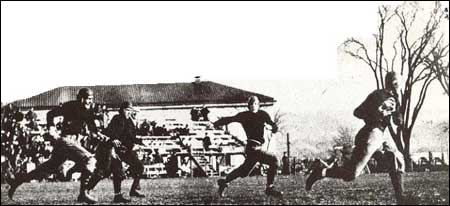
Knute Rockne carrying the ball on The Plain, November 1, 1913

November 1, 1913: The University of Notre Dame says hello.

Had this not happened, the South Bend, Indiana school might now be just another "mid-major" Catholic school in the Midwest, often with a good basketball team, but not a football school -- like Canisius in Buffalo, Duquesne in Pittsburgh, Xavier in Cincinnati, the University of Detroit Mercy, DePaul and Loyola in Chicago, Marquette in Milwaukee, and Saint Louis University.

But it did happen, and the Fighting Irish became, at least for Catholic Americans, the college football program.

From the start of the 1906 season to October 25, 1913, Notre Dame went 47-3-5, but most of that was against what were then called "small colleges." They had, however, beaten the University of Pittsburgh, 3-0 at Forbes Field on November 2, 1912, having played them to a 0-0 tie there in 1911. So it's not as though they hadn't played and beaten a big team before.

As a safety measure, the forward pass was legalized in American football in 1906. But it hadn't been used much by 1913. But Notre Dame quarterback Charles "Gus" Dorais and end Knute Rockne, an immigrant from Norway, had Summer jobs as lifeguards at a Lake Erie beach in Ohio. While there, they practiced passing the football of the time, rounder and less pointy than the one that would be developed in the 1930s.

So that when Notre Dame, 3-0, under new head coach Jesse Harper, took the field at The Plain on November 1, they were ready. Army, still stung by their shocking loss there the year before, to Jim Thorpe and the Carlisle Indian School, were 4-0, were not expecting another upset.

They got it. Dorais threw 17 passes, completing 14, for 243 yards. Rockne was the main receiver. Notre Dame won 35-13. For the 2nd year in a row, Army were beaten by a school that no one expected to beat them.

What's that? You didn't know that Knute Rockne had ever played? Well, there wasn't a National Football League for him to play in just yet. In 1915, Dorais-to-Rockne became the passing combination that led the Massillon Tigers to the Championship of the Ohio League. They played together until 1917, and then enlisted in World War I.

When "The War to End All Wars" ended, Rockne took his pharmacy degree back to South Bend, taught chemistry, and coached football. He coached Notre Dame to the National Championship in 1919, 1920, 1924, 1929 and 1930, before being killed in a plane crash in 1931.

Dorais coached at Dubuque College in Iowa; Gonzaga University in Spokane, Washington; and Detroit Mercy, before taking the reins of the Detroit Lions from 1943 to 1947. But by that point, the forward pass had been refined enough that Sid Luckman had quarterbacked the Chicago Bears to 4 NFL Championships in 7 years. The game had passed Dorais by. And he couldn't go back to Notre Dame, where Frank Leahy had taken over for Rockne, and kept the winning going. Dorais also died young, in 1954, after a few years of health difficulties.

*

November 1, 1913 was a Saturday. Baseball was over for the year, and the NFL, the NBA and the NHL hadn't been founded yet. But there were other college football games played:

* Harvard beat Cornell, 23-6 at Harvard Stadium in Boston.

* Colgate upset Yale, 16-6 at Yale Field in New Haven, Connecticut. The Yale Bowl opened the next year.

* Penn beat Penn State, 17-0 at the original Franklin Field in Philadelphia. The present Franklin Field opened in 1922.

* Princeton beat Holy Cross, 54-0 at University Field in Princeton, New Jersey. Palmer Stadium opened the next year.

* Rutgers lost to Wesleyan University, 20-9 at Neilson Field in New Brunswick, New Jersey.

Also, in their last season using that name, because it was their 1st season away from the locality in it, Woolwich Arsenal beat Nottingham Forest, 3-2 at the Arsenal Stadium in Highbury, North London. 

Monday, October 31, 2022

October 31, 1913: The Lincoln Highway Is Dedicated

October 31, 1913: The Lincoln Highway, America's 1st coast-to-coast highway, is dedicated, running from Times Square in New York to Lincoln Park in San Francisco.

In New Jersey, this included the New York Central Railroad's ferry to the Weehawken Terminal (replaced by the Lincoln Tunnel in 1937); Pershing Road, 5th Street (now 49th Street), Hudson Blvd. (now John F. Kennedy Blvd.) and Communipaw Avenue in Jersey City; the Newark Plank Road (now Truck Route 1 & 9) in Kearny; Ferry Street, Market Street, Broad Street and Frelinghuysen Avenue in Newark; what's now New Jersey Route 27 through Elizabeth, Linden, Rahway, Woodbridge, Edison, Metuchen, Highland Park, New Brunswick, North Brunswick, South Brunswick, Franklin, Plainsboro and Princeton; and U.S. Route 206 in Princeton, Lawrence, and Trenton, where the Highway turns and crosses the Delaware River into Pennsylvania via the Calhoun Street Bridge.

It goes down into Philadelphia. From there, what was the Lincoln Highway pretty much becomes concurrent with U.S. Route 30 all the way out to Wyoming, including Pittsburgh, Chicago and Omaha.

The federal highway system -- the "U.S. Routes," indicated by black numbers on a white shield on a black background -- pretty much took the place of the early American highways in the 1920s. By the 1950s, the Interstate Highway System pretty much replaced those, and Interstate 80, essentially connecting the George Washington and San Francisco-Oakland Bay Bridges, has taken the New York-to-San Francisco role formerly held by the Lincoln Highway.

*

October 31, 1913 was a Friday. Baseball season was over. Basketball and hockey season hadn't started. And college football was played the next day. So there were no scores on this historic day.

Thursday, October 27, 2022

October 28, 1913: Christy Mathewson vs. Walter Johnson

Walter Johnson (left) and Christy Mathewson

October 28, 1913: In the only time the 2 greatest pitchers of their time face each other -- baseball would have no All-Star Game until 1933, and no Interleague Play until 1997, and they never faced each other in a World Series -- Walter Johnson and Christy Mathewson square off, at South Main Park in Tulsa‚ Oklahoma.

Normally, Johnson pitched for the Washington Senators. This time, he is backed by the Chicago White Sox‚ with the addition of another superstar, Boston Red Sox center fielder Tris Speaker. Johnson wins the battle‚ as the White Sox beat the New York Giants, 6-0. Johnson went the distance, striking out 8, while Matty exited after 4 innings.

Speaker and White Sox regular Buck Weaver did the hitting for the Pale Hose‚ while Oklahoma native, Sac and Fox Indian, and fan favorite Jim Thorpe got 2 hits for the Giants off Johnson. 

The game had been delayed for nearly 2 hours when the stands collapsed‚ injuring 52 people and killing a soldier. Governor R.L. Williams of Oklahoma narrowly escaped injury in the tragedy.

This was part of a world tour undertaken by the Giants and White Sox from late October 1913, after the Giants lost the World Series to the Philadelphia Athletics, until February 1914, through the Western United States, then to Asia, Australia, Egypt and Europe, although some of their intended games were rained out.

Mathewson won more games in the 1900s (1900 through 1909) than any other pitcher: 236. Johnson was the winningest pitcher of the 1910s: 265. Each would be among the 1st 5 inductees into the Baseball Hall of Fame in 1936, along with Ty Cobb, Babe Ruth and Honus Wagner. Unfortunately, both men would die too soon: Mathewson from tuberculosis in 1925, at the age of 45; Johnson from a brain tumor in 1946, at 59.

*

October 28, 1913 was a Tuesday. Football was in midweek. Professional basketball barely existed. And it was too early for hockey season. So this was the only score on this historic day.

Tuesday, October 11, 2022

October 12, 1913: The McGraw-Robinson Split

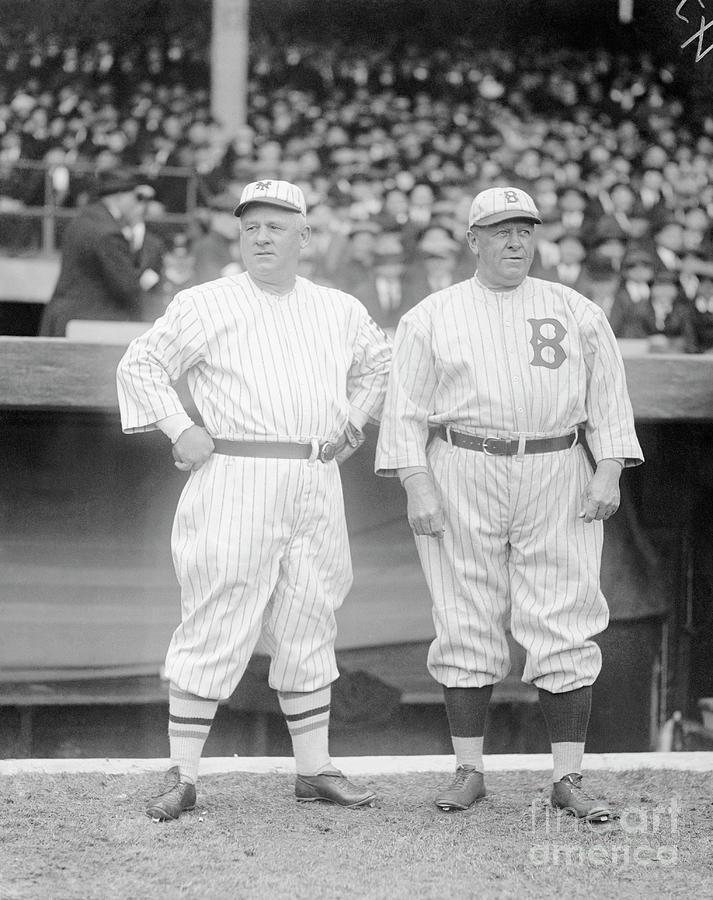
October 12, 1913: Following the World Series, which his New York Giants lost to the Philadelphia Athletics, John McGraw hosts a reunion for Hughie Jennings and the old National League version of the Baltimore Orioles, who won Pennants in 1894, 1895 and 1896, revolutionizing the game in the process.

After a night of heavy drinking‚ McGraw blames his longtime friend‚ Giants business partner, and former Oriole teammate Wilbert Robinson, perhaps baseball's 1st great pitching coach, for too many coaching mistakes in the 1913 Series. "Uncle Robbie" replies that McGraw made more mistakes than anybody. McGraw fires him. Eyewitnesses say Robbie doused McGraw with a glass of beer and left.

Six days later, Robbie will begin a legendary 18 years as manager of the crosstown Brooklyn franchise‚ replacing Bill Dahlen. The team will carry the nickname Robins‚ as well as Dodgers‚ during his tenure.

Robbie and Mac won't speak to each other for 17 years, and after winning 3 straight Pennants together, McGraw will win just 1 Pennant in the next 7 years, in 1917; while Robbie will win 2, in 1916 and 1920, the only Pennants the Brooklyn team will win between 1900 and 1941.

This is not the beginning of the rivalry between the Giants and the Dodgers, not by a long shot. That rivalry had its beginning in rivalries between clubs of New York (Manhattan) and Brooklyn when they were separate cities prior to 1898, even going back to the days of amateur baseball in the 1850s and '60s. And the rivalry between Manhattan and Brooklyn would have happened even if baseball had never been invented.

But the McGraw-Robinson bustup is the beginning of a rivalry that ruined one of baseball's great friendships, not resolved until both men were retired and near death, as seen in the photo above. Still, they both ended up in the Hall of Fame – neither lived to see the Hall's establishment, though – and are buried in the same Baltimore cemetery.

Somebody should write a book about it: We've seen books about the Giants, about the Dodgers, about the Dodger-Giant rivalry, about McGraw, and even about the old Orioles -- but the McGraw-Robinson relationship is a fascinating one. They're like the John Adams and Thomas Jefferson of baseball: Great friends in a great cause, then a nasty split and a nastier rivalry, and ultimately the relationship was repaired and the great friendship restored toward the end.

October 12, 1913 was a Sunday. Baseball season was over. Pro basketball and pro hockey barely existed, and, in those days, it was considered too early to start their seasons, anyway. Pro football existed, but only on a minor-league level.

But there was one score on this historic day: Despite it being a Sunday, a college football game was played. Georgia Tech beat the University of Chattanooga (now the University of Tennessee at Chattanooga), 71-6 at Chamberlain Field at Chattanooga, Tennessee.

Monday, September 19, 2022

September 20, 1913: American Golf Comes of Age

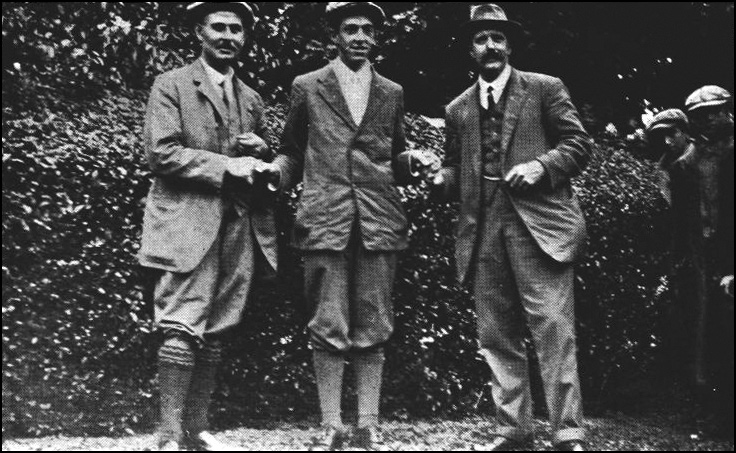
Left to right: Harry Vardon, Francis Ouimet, Ted Ray

September 20, 1913: Francis Ouimet wins the U.S. Open golf tournament, held at The Country Club in his hometown of Brookline, Massachusetts, outside Boston.

NOTE: For a long time, with this project, I resisted putting in references to golf, because of the kind of people who tend to play it. I finally caved in, although I haven't included as many references as I would if it were a real sport, which it is not.

This was the 19th time that the Open was conducted. It wasn't the 1st time an American had won it -- that was John McDermott, who had won the previous 2, ending the English and Scottish monopoly on America's top golf tournament -- but it was a watershed moment, because he had to defeat the 2 leading golfers in the world to do it, both from the Channel Island of Jersey: Harry Vardon and Ted Ray.

Vardon was 43 years old, Ray 36, Ouimet 20. Ouimet was the quintessential New Englander: Father of French-Canadian descent, mother from Ireland. Both ancestries would have inspired him to beat the Englishmen.

After 72 holes of regulation play ended in a 3-way tie, Ouimet, Vardon, and Ray engaged in an 18-hole playoff the next day, in rainy conditions. Ouimet won the playoff at one-under-par for the day, beating Vardon by 5 strokes and Ray by 6.

His victory was widely hailed as a stunning upset over the strongly favored British, who were regarded as the top two golfers in the world. He was the first amateur to win the U.S. Open. The biggest crowds ever seen in American golf followed the playoff, and his achievement was front-page news across the country.

Ouimet's U.S. Open success is credited for bringing golf into the American sporting mainstream. Before his win over Vardon and Ray, golf was dominated by British players. In America, the sport was restricted to players with access to private facilities. There were very few public courses. Ten years after his 1913 victory, the number of American players had tripled and many new courses had been built, including numerous public ones.

In 1951, Francis Ouimet became the first non-Briton elected Captain of the Royal and Ancient Golf Club of St Andrews, where the game was allegedly invented, and still the game's spiritual home. He died in 1967.

*

September 20, 1913 was a Saturday. These baseball games were played that day:

* The New York Yankees beat the Cleveland Naps, 7-2 at the Polo Grounds. Ray Caldwell went the distance for the win. Napoleon "Nap" Lajoie, the Cleveland team's 2nd baseman, best hitter, manager and namesake, did not put himself into the game. "Shoeless" Joe Jackson went 1-for-3 with an RBI.

* The Brooklyn Dodgers swept a doubleheader from the Pittsburgh Pirates at Forbes Field in Pittsburgh. The Pirates won the opener, 1-0. Hank Robinson pitched a 4-hit shutout. The Dodgers won the nightcap, 4-3. Herbie Moran went 4-for-5. Honus Wagner did not play in either game.

* The Philadelphia Athletics beat the Detroit Tigers, 4-2 at Shibe Park in Philadelphia. Ty Cobb went 2-for-4 with an RBI.

* And the Washington Senators beat the St. Louis Browns, 6-3 at National Park (later Griffith Stadium) in Washington. Walter Johnson pitched 3 2/3rds innings of relief to get the win.

There was 1 college football game played, the opening game of the season: The Carlisle Indian School beat Albright College, 36-0 at Indian Field in Carlisle, Pennsylvania, outside Harrisburg. The Carlisle school was shut down in 1917.  Albright, in Reading, Pennsylvania, downgraded their program, and now play in NCAA Division III.

And in English soccer, at their brand-new Arsenal Stadium in the Highbury section of North London, Arsenal played Yorkshire team Hull City to a 0-0 draw.

Tuesday, September 6, 2022

September 6, 1913: The Arsenal Stadium Opens In Highbury

The stadium's final configuration, 1993-2006.
Note the words "ARSENAL STADIUM" on the East Stand,
even though most people called it "Highbury."

September 6, 1913: The Arsenal Stadium opens, in the Highbury section of North London. In time, the stadium itself will come to be called "Highbury." Woolwich Arsenal, who had played in South-East London since their founding in 1886, had come to North London because it would be easier for fans, and for other teams, to get to. Woolwich Arsenal defeat Leicester Fosse, 2-1, on a penalty kick by Archie Devine, following a late Leicester handball in the box.
Highbury, in its 1913-1932 configuration

At the conclusion of this 1913-14 season, the team's owner, Henry Norris, dropped the locality from the name, and the club officially became "Arsenal Football Club" -- to this day, unofficially called "The Arsenal," capital T, capital A, by many.

Along with Port Vale in Staffordshire, Arsenal are 1 of only 2 clubs in the Football League to not have a locality as part of their name. (Well, technically, "Arsenal" could be, but the club had long since outgrown their "works side" status.) Leicester Fosse would later become Leicester City, and are still in business.

Tottenham Hotspur, or "Spurs," based 4.7 miles away at White Hart Lane, which was then in Middlesex but would be in North London once city boundaries were redrawn, objected to the move, as they did when Chelsea Football Club were established in 1905, all the way across the city in West London. 

, yet again, flip out about a club invading "their territory," even though the new stadium, to be named Arsenal Stadium, but nicknamed "Highbury" after the neighborhood, is 4 1/2 miles away -- roughly as far away from White Hart Lane as Clapton Orient already were.

It should be noted that neither Clapton Orient (also about 4 1/2 miles away from White Hart Lane), nor West Ham United (in East London), nor Chelsea, nor any other London or quasi-London club objected to the Arsenal move. Just Spurs, whose fans, even today, claim, "North London is ours."

It isn't. It took Arsenal until 1930 to win a trophy, but, starting then, in a span of 9 seasons, they won 5 Football League titles -- compared to 2 for Spurs in their entire history -- and 2 FA Cups. This success allowed Arsenal to build a West Stand and an East Stand in that decade, in the Art Deco style.
View from the Clock End, of the 1936-1988 configuration,
with the singled-decked, roofed, all-standing North Bank

They won the League and the Cup in 1971, for their 1st "Double." They did that again in 1998 and 2002. In 1989, which would end up as another title-winning season, they put luxury boxes over their south side, the Clock End. In 1993, to comply with the Taylor Report's demand for all-seater stadiums, they opened a new, double-decked North Bank stand. In 2004, they completed an unbeaten Premier League season.

By that point, realizing that they could not expand Highbury beyond its all-seater capacity of 38,000, they had to build a new stadium. The Emirates Stadium opened half a mile away, and Highbury was closed on May 7, 2006, with a 5-2 win over Birmingham-area team West Bromwich Albion. The North Bank and the Clock End were demolished, but the East and West Stands were converted into an apartment complex called Highbury Square. Some former Arsenal players bought apartments there.

*

September 6, 1913 was a Saturday. In American football, the college season was 2 weeks away. But these baseball games were played:

* The New York Yankees lost to the Washington Senators, 9-1 at American League Park (later Griffith Stadium) in Washington. The Yankees only got 1 hit, by 1st baseman John Knight, off 3 Senator pitchers, none of whom was Walter Johnson.

* The Brooklyn Dodgers beat their arch-rivals, the New York Giants, 2-0 at the Polo Grounds. Ed Reulbach, a veteran of the Chicago Cubs' rivalry with the Giants, pitched a 3-hit shutout.

* The Boston Braves swept a doubleheader from the Philadelphia Phillies, 4-1 and 7-2 at the South End Grounds in Boston.

* The Philadelphia Athletics beat the Boston Red Sox, 9-2 at Shibe Park in Philadelphia. Eddie Collins went 2-for-4.. Tris Speaker went 3-for-4.

* The Pittsburgh Pirates beat the St. Louis Cardinals, 4-2 at Forbes Field in Pittsburgh. Honus Wagner went 2-for-4 with an RBI.

* The Cleveland Naps beat the Detroit Tigers, 3-1 at Navin Field in Detroit. Napoleon "Nap" Lajoie, the Cleveland team's 2nd baseman, best hitter, manager and namesake, went 0-for-3 with a walk. "Shoeless" Joe Jackson went 1-for-4. Ty Cobb went 0-for-3, but had an RBI on a groundout. The Naps were renamed the Indians in 1915 and the Guardians in 2022. Navin Field was renamed Briggs Stadium in 1938 and Tiger Stadium in 1961.

* The Chicago Cubs beat the Cincinnati Reds, 5-3 at the West Side Grounds in Chicago.

* And the St. Louis Browns beat the Chicago White Sox, 4-0 at Sportsman's Park in St. Louis. Roy Mitchell pitched a 5-hit shutout, to outpitch Christy Mathewson.

Friday, June 3, 2022

June 4, 1913: The Death of Emily Davison

June 4, 1913: A demonstration for women's rights takes a tragic turn at one of the world's great sporting events.

Emily Wilding Davison was born on October 11, 1872 in Blackheath, Southeast London. She was an early feminist, fighting for women's right to vote in Britain in the late 19th and early 20th Centuries. She was arrested 9 times, and would lead her fellow suffragettes in hunger strikes. In return, prison officials would force-feed them. American suffragettes would follow the tactics of their British counterparts -- and so would American prison officials.

On June 4, 1913, 40 years old, and never a wife or a mother, she attended the Epsom Derby in Epsom, Surrey, 16 miles southwest of Central London. She had bought a round-trip ticket from London's Victoria Station, indicating that she expected to return to London alive.

Along with the 2,000 Guineas Stakes and the St. Leger Stakes, the Epsom Derby is part of British thoroughbred racing's Triple Crown. Like the Belmont Stakes in America, it is held every 1st Saturday in June. First run in 1780, its length is 1 mile, 4 furlongs, 6 yards -- a shade over a mile and a half, the length of the Belmont Stakes.

In the 1913 Derby, King George V owned one of the competing horses, Anmer. Anmer was ridden by Herbert Jones, who had previously won the Triple Crown in 1900, aboard Diamond Jubilee, a horse so named because it was born in 1897, the year of Queen Victoria's 60th Anniversary on the throne, and owned by her son, then the Prince of Wales, soon to be King Edward VII, father of George V, who kept Jones on to race the royal thoroughbreds after his father died.

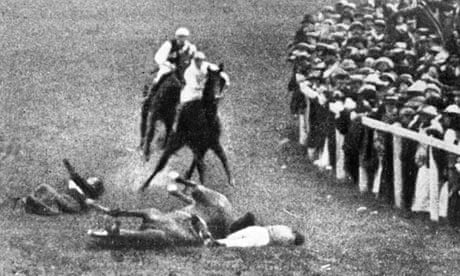
Emily Davison ran onto the track, and waited for Anmer to reach her. As newsreel footage examined for the 100th Anniversary of the incident showed, she had a clear view of the oncoming horses, and purposely targeted the King's horse, and attempted to attach a sash to Anmer's bridle. The sash was emblazoned with the colors of the British women's suffrage movement. Had she succeeded, it would not have meant that the King, or even that Jones, supported women's right to vote, but it would have been one strong public statement: That the King should support it.
Instead, she mistimed her action, and Anmer crashed into her. Both she and Jones were thrown and injured. Both suffered concussions. Davison also received a fractured skull, most likely when she hit the ground, but her other injuries may also have killed her. She died 4 days later.
Davidson is at the left, in the dark clothing.
Jones is at the bottom, in white, next to the fallen Anmer.
Jones survived the incident, and continued racing for another 10 years. Anmer also escaped serious injury, and Jones rode him just 2 months later, at England's other great thoroughbred track, Ascot Racecourse in Ascot, Berkshire, 6 miles southwest of Windsor Castle (making it a favorite weekend haunt of the royal family) and 31 miles west of Central London.
In 1928, Jones laid a wreath at the funeral of Emmeline Pankhurst, Britain's leading feminist, in her memory and in that of Emily Davison. When his wife died in 1951, he fell into a deep depression, and, unlike Davison, definitively took his own life. He was 70, and outlived King George V by 15 years and Davison by 38 years. In 2013, on the 100th Anniversary, a plaque was placed at Epsom Downs Racecourse in her memory.
Women age 30 and up got the right to vote in Britain in 1918. At the same time, the voting age for men was lowered to 21. Women age 21 and up got the right to vote in 1928. It has since been reduced to 18. American women got the right to vote in 1920, with the ratification of the 19th Amendment to the Constitution of the United States. Prior to that, only 4 States had given women the right to vote, including New York in 1917.
*
June 4, 1913 was a Saturday. These baseball games were played that day:
* The New York Yankees lost to the Cleveland Naps, 9-5 at the Polo Grounds. Napoleon "Nap" Lajoie, the Cleveland team's 2nd baseman, best hitter, manager and namesake, did not put himself into the game. He did put Joe Jackson in, and "Shoeless Joe" hit a home run. Left fielder Jack Graney, who went on to become the 1st former player to become a broadcaster, also hit a home run.
Shortstop Ray Chapman went 1-for-5 with an RBI. Seven years later, on that same field, Chapman would be hit in the head with a pitch, and become baseball's only fatality from an on-field event. Ed Sweeney homered for the Yankees. The Naps became the Cleveland Indians in 1915, after Lajoie left; and the Cleveland Guardians in 2022.
* The New York Giants lost to the St. Louis Cardinals, 6-4 at Robison Field in St. Louis. Christy Mathewson was in the unusual position of losing the game and only pitching 6 innings.
* The Brooklyn Dodgers lost to the Cincinnati Reds, 4-3 at Redland Field in Cincinnati. (It was renamed Redland Field in 1933.)
* The Chicago White Sox beat the Boston Red Sox, 4-1 at Fenway Park in Boston. Eddie Cicotte, later to be one of the 8 banned "Black Sox" (as was Shoeless Joe) went the distance for the win. For the Red Sox, Tris Speaker went 0-for-3, but had an RBI on a sacrifice fly.
* The Philadelphia Athletics beat the Detroit Tigers, 14-6 at Shibe Park in Philadelphia. Ty Cobb went 2-for-4. Eddie Collins went 3-for-5 with 3 RBIs.
* The Washington Senators beat the St. Louis Browns, 6-2 at National Park in Washington. (It was renamed Griffith Stadium in 1922.)
* The Philadelphia Phillies beat the Pittsburgh Pirates, 4-0 at Forbes Field in Pittsburgh. Honus Wagner went 1-for-4.
* And the Chicago Cubs beat the Boston Braves, 5-0 at West Side Park in Chicago. Orval Overall -- yes, that was his real name -- pitched a 5-hit shutout.

Saturday, May 28, 2022

May 29, 1913: Igor Stravinsky Premieres "The Rite of Spring"

May 29, 1913: Igor Stravinsky's ballet Le Sacre du printemps -- in English, The Rite of Spring -- premieres at Théâtre des Champs-Élysées, which had opened in Paris a month earlier, as the city's first structure designed in the Art Deco style, and is still operating.

Stravinsky, his father an opera singer and his mother a concert pianist, grew up outside St. Petersburg, Russia, near the border with Finland. He was commissioned to write the ballet for Sergei Diaghilev, then the world's leading producer and promoter of the dance form, the founder of the Ballets Russes. Three years earlier, Diaghilev had taken Stravinsky, then 28 and virtually unknown, and commissioned him for the first time. The result was Firebird, and it was a success. The following year, Stravinsky wrote Petrushka for Diaghilev, and it was another success.

These first two, and The Rite of Spring, starred Vaslav Nijinsky, who also choreographed them. At the time, Nijinsky was considered the greatest male ballet dancer in the world. This was both aided and complicated by the fact that he and Diaghilev were having a gay affair, and it would end with a bad breakup later in 1913, when Nijinsky, for the sake of public appearance, married his female dance partner, the Hungarian ballerina Romola de Pulszky.

Writing to conductor Serge Koussevitzky, Stravinsky described Le Sacre du printemps as "a musical-choreographic work... unified by a single idea: The mystery and great surge of the creative power of Spring." There was a surge, all right: Nijinsky had directed the dancers to practically stomp around the stage, in time to Stravinsky's score.

Some in the audience laughed. Some whistled, generally considered to be the European equivalent of booing. Some hissed. Newspapers recorded these reactions. At one point, the laughers and the hissers started fighting with each other. The premiere has gone down in history as a "riot," although that term wasn't used to describe the events until a book written over a decade later.

A total of 6 performances were given, and the reactions were hostile at each one, if not descending into any more "riots." Italian composer Giacomo Puccini, author of the operas La bohème, Tosca and Madama Butterfly, attended the 2nd performance. He called it "the work of a madman. The public hissed, laughed -- and applauded."

But it was a new century. Puccini and his contemporaries were out. Avant-garde artists like Stravinsky and Gustav Mahler were in. In the audience at the May 29 premiere were composer Maurice Ravel, painter Marcel Duchamp, writer Gabriele D'Annunzio, and fashion designer Coco Chanel. (Decades later, Chanel claimed to have had an affair with Stravinsky. This claim has never been backed up by any evidence other than her memoir.)

Painters like Duchamp and Pablo Picasso, who became a close friend of Stravinsky's, were in the process of changing the art world. Just a few weeks before The Rite of Spring premiered -- from February 17 to March 15, making it difficult for me to do a separate "Scores On This Historic Day" post for it -- the International Exhibition of Modern Art was held at the 69th Regiment Armory in Manhattan, exhibiting the works of people like Duchamp, Picasso and Paul Cezanne.

Over the next few years, Hollywood was established as America's film center, and Charlie Chaplin and D.W. Griffith would ensure that a person seeking entertainment wouldn't have to dress up and go all the way into the big city to see a stage production. Stravinsky saw this coming, and adapted, doing a considerable amount of composing for movies. And jazz was arriving, becoming the dominant form of American music until the mid-1950s, when rock and roll began to take over.

Diaghilev and Nijinsky had a professional reconciliation, but never a personal one. Nijinsky fell victim to mental illness, and was institutionalized from 1919 until his death in 1950. Diaghilev, exiled from Russia after the Bolshevik Revolution, died in 1929, and was buried on an island near Venice.

Stravinsky married twice, and had 4 children. He went on to collaborate with Picasso, writer Jean Cocteau, and the man who replaced Diaghilev as the greatest ballet producer, George Balanchine.

His music would be embraced by the Soviet Union, but the feeling was not mutual. A cultural conservative who was devoted to the Russian Orthodox Church until the end, he continued to live in Paris until 1939, and then in Los Angeles until his death in 1971. He was buried in the same cemetery as Diaghilev.

*

May 29, 1913 was a Thursday. Boxer Tony Zale was born on this day. The Middleweight Champion of the World from 1941 to 1947, and again for 3 months in 1948, he is remembered for his trilogy of fights with Rocky Graziano.

Football, basketball and hockey were all out of season. But 7 games were played in what we would now call Major League Baseball:

* The New York Yankees lost to the Philadelphia Athletics, 6-5 at Shibe Park in Philadelphia. The winning pitcher for Connie Mack's A's, on their way to a World Series win, was Bullet Joe Bush, later to help the Yankees win their 1st World Series, in 1923. A's 3rd baseman Frank "Home Run" Baker lived up to his nickname by hitting the game's only home run. He, too, would later help the Yankees win Pennants, in 1921 and 1922, though he retired before the 1923 title.

* The New York Giants beat the Philadelphia Phillies, 7-6 in 14 innings at the Polo Grounds. Grover Cleveland Alexander pitched the 1st 8 innings for the Phils, but was not involved in the decision. Jeff Tesreau was the winning pitcher. Chief Meyers, the Giants' Native American catcher, hit a home run. However, Baseball-Reference.com does not have a play-by-play listed (not surprising, given how far back this game was), so I don't know how the Giants got the winning run home.

* The Washington Senators beat the Boston Red Sox, 5-2 at National Park in Washington. (It was renamed Griffith Stadium in 1922.) Tris Speaker went 2-for-3 with an RBI, and Steve Yerkes went 3-for-5. But it wasn't enough, as the Senators beat the defending World Champions.

* The Pittsburgh Pirates beat the Chicago Cubs, 5-4 at Forbes Field in Pittsburgh. For the Pirates, Ham Hyatt hit a home run (try saying that fast five times), and Honus Wagner went 1-for-4.

* The Cleveland Naps beat the St. Louis Browns, 6-3 at League Park in Cleveland. Napoleon "Nap" Lajoie, the Cleveland manager and 2nd baseman, did not play. However, "Shoeless" Joe Jackson went 3-for-4 with an RBI.

* The Chicago White Sox beat the Detroit Tigers, 3-2 in 10 innings at Comiskey Park. Ty Cobb went 1-for-3 with 2 walks, but it was in a losing cause for the Tigers.

* The Cincinnati Reds beat the St. Louis Cardinals, 13-10 at Robison Field in St. Louis.

* And the Boston Braves and the Brooklyn Dodgers were rained out at the South End Grounds in Boston. The game was rescheduled for 2 days later, as part of a doubleheader. The Dodgers won the 1st game, 2-0. The 2nd game went 10 innings, and was tied 3-3 when it was called due to darkness. (No lights at ballparks in those days.) 

Tuesday, May 10, 2022

May 10, 1913: The Longest Shot to Win the Kentucky Derby

May 10, 1913: Donerail, ridden by Roscoe Goose, wins the Kentucky Derby, at Churchill Downs in Louisville. He began the race with odds of 91-1. He remains the longest shot ever to win America's biggest horse race.

Under beautiful conditions, 12 horses were scheduled to race, but scratches reduced the number to 8. Donerail won what would later be called "the most exciting two minutes in sports" in 2 minutes, 4.8 seconds, a record that would stand for just 1 year. Ten Point, the betting favorite, was 2nd, half a length behind. Gowell was 3rd, an additional length behind.

It would be a long time before another genuine longshot won the Kentucky Derby, when Giacomo came from 50-1 to win it in 2005. But a few have done it since then: Mine That Bird was also 50-1 in 2009, Country House was 65-1 in 2019, and Rich Strike was 80-1 in 2022.

The longest shot ever to win the Preakness Stakes wasn't very long: The ironically-named Master Derby was 23-1 when he won in 1975. The Belmont Stakes is friendlier to really long shots: Sherluck was 65-1 when he won in 1961, Temperence Hill was 53-1 when he won in 1980, and Sarava was a race record 70-1 when he won in 2002.

Donerail continued to race until 1918. He is lost to history after that, and it is not known when he died. Jockey Roscoe Goose, a Louisville native, never won any other major races, and lived until 1971.

*

May 10, 1913 was a Saturday. These baseball games were played that day:

* The New York Yankees beat the Detroit Tigers, 10-9 in 10 innings at Navin Field in Detroit. (That ballpark would later be renamed Briggs Stadium and Tiger Stadium.) Ty Cobb only appeared as a pinch-hitter, but had an RBI on a sacrifice fly.

* The New York Giants lost to the Chicago Cubs, 2-1 at the Polo Grounds.

* The Brooklyn Dodgers beat the Cincinnati Reds, 9-3 at Ebbets Field.

* The St. Louis Cardinals and the Boston Braves were tied, 1-1 after 12 innings at the South End Grounds, when the game was called due to darkness.

* The Philadelphia Phillies beat the Pittsburgh Pirates, 6-0 at National League Park (later Baker Bowl) in Philadelphia. Eppa Rixey couldn't finish the job, and Tom Seaton had to pitch the last inning and 2/3rds, but the 12-hit shutout was completed.

* The Cleveland Naps beat the Boston Red Sox, 9-2 at League Park in Cleveland. Tris Speaker hit a home run for the Red Sox. Napoleon "Nap" Lajoie, the Cleveland team's 2nd baseman, best hitter, manager and namesake, went 0-for-3, but had an RBI on a sacrifice fly. "Shoeless Joe" Jackson went 2-for-3 with a walk and 3 RBIs. The Naps became the Cleveland Indians in 1915, after Lajoie left; and the Cleveland Guardians in 2022.

* The Washington Senators beat the Chicago White Sox, 1-0 at Comiskey Park in Chicago. Walter Johnson pitched a 2-hit shutout.

* And the Philadelphia Athletics beat the St. Louis Browns, 8-6 in 10 innings at Sportsman's Park in St. Louis.

Saturday, April 23, 2022

April 24, 1913: The Keystone Kops Star In "The Bangville Police"

April 24, 1913: The Bangville Police premieres. It is a silent film, lasting just 8 minutes, but it changes the history of movies. It launched the Keystone Kops to stardom.

Producer Mack Sennett had named them after his employers, the Keystone Studios, based in the Los Angeles neighborhood of Edendale. He introduced the Kops in the 1912 film Hoffmeyer's Legacy, but The Bangville Police, directed by Henry Lehrman, became the film that got everyone to notice them.

The synopsis: A farmer (played by Nick Cogley) and his daughter (Mabel Normand, probably the biggest film star of the time, who got her start by sleeping with Sennett) are in a barn, where she wishes the cow would have a calf. Left alone in the house, she hears strangers in the barn and calls the police. She barricades herself in. Her parents return, and have to break the door down. She thinks it is the robbers. Meanwhile, a car brings the police. After misunderstandings are resolved, they find a new-born calf in the barn.

A total of 11 Keystone Kops films were made between 1912 and 1915. In 1914, A Thief Catcher included a pre-Little Tramp Charlie Chaplin as a Keystone Kop. (Normand fooled around with him, too. Then again, he was no saint, either.) This film was thought lost, and so a rumor that Chaplin had been a Kop swirled for decades, but the proof wasn't available, until a copy of the film was finally found at a Michigan antique sale in 2010.

There is no definitive list of the actors who played the Kops, as giving proper credit wasn't exactly a priority in the early film industry. The ones credited in this film were Fred Mace as the Chief, Raymond Hatton, Edgar Kennedy, Hank Mann, Ford Sterling and Al St. John.

Other actors established as having been Kops: The aforementioned Nick Cogley, Billy Gilbert, Charles Avery, Bobby Dunn, George Jeske, George "Slim" Summerville, Dan Albert, Joe Bordeaux, William Hauber, Grover Ligon, Wallace MacDonald, Chester Conklin, Rube Miller, Robert Z. Leonard, Chester M. Franklin and Arthur Tavares. (There may have been others. As I said, there is no definitive list.)

The Bangville Police led to Mace getting more mail than Santa Claus, and he let his fame go to his head. He left Keystone in 1914, but the Kops did better without him than he did without them. He came crawling back to Sennett in 1915, but it was too late: The public had moved on, and Gilbert had replaced him as the Chief. He died of a stroke in 1917, only 38 years old.

Albert died in 1919, from the worldwide Spanish Flu epidemic. Avery died in 1926, Miller in 1927, Hauber in 1929, Normand in 1930, Cogley in 1936, Dunn in 1937, Sterling in 1939, Summerville and Lehrman in 1946, Kennedy in 1948, Bordeaux in 1950, Jeske in 1951, Franklin and Tavares in 1954, Sennett in 1960, Gilbert in 1961, St. John in 1963, Ligon in 1965, Leonard in 1968; Conklin, Hatton and Mann in 1971; Chaplin in 1977, and MacDonald appears to have been the last survivor, living until 1978.

Keystone Studios went out of business in 1935, a victim of the Great Depression. But the Kops' legacy lives on. In 1955, the comedy team of Bud Abbott and Lou Costello made Abbott and Costello Meet the Keystone Kops. Directing The Beatles in A Hard Day's Night, Richard Lester opened the film with the band members being chased by fans around a train station, done in the style of the Kops. And poor defending in sports is often described as "Keystone Kops defending."

*

April 24, 1913 was a Thursday. This was also the day the Woolworth Building opened in Lower Manhattan. It was then the tallest building in the world. I have a separate entry for that event.

These baseball games were played that day:

* The New York Yankees lost to the Philadelphia Athletics, 4-1 at Shibe Park in Philadelphia. Albert "Chief" Bender outpitched Al Schulz.

* The New York Giants beat the Philadelphia Phillies, 7-1 at the Polo Grounds.

* The Brooklyn Dodgers lost to the Boston Braves, 1-0 in 12 innings at the South End Grounds in Boston.

* The Boston Red Sox beat the Washington Senators, 6-3 at National Park (later Griffith Stadium) in Washington. Tris Speaker went 0-for-2 with a walk, but had an RBI on a sacrifice fly.

* The Cleveland Naps beat the Detroit Tigers, 5-3 at Navin Field in Detroit. (It was renamed Briggs Stadium in 1938 and Tiger Stadium in 1961.) Napoleon "Nap" Lajoie, Cleveland's manager, 2nd baseman, best hitter and namesake, went 0-for-4. Ty Cobb did not play.

* The St. Louis Browns beat the Chicago White Sox, 3-1 at Comiskey Park in Chicago.

* The Cincinnati Reds beat the St. Louis Cardinals, 10-3 at Robison Field in St. Louis.

* And the Chicago Cubs and the Pittsburgh Pirates were not scheduled.

December 31, 1999 & January 1, 2000: The Millennium

December 31, 1999:  The Millennium arrives. The people of planet Earth survived. At a terrible cost. But we hadn't destroyed ourselves. ...