Showing posts with label walter johnson. Show all posts

Monday, October 31, 2022

October 31, 1924: The Babe vs. the Big Train In California

I don't know when this photo was taken,
and I don't know why they're holding chickens.

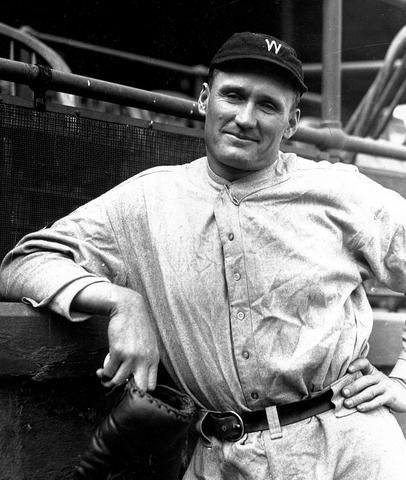
October 31, 1924: A postseason barnstorming tour brings baseball's greatest hitter, Babe Ruth of the New York Yankees, and baseball's greatest pitcher, Walter Johnson of the newly-crowned World Champion Washington Senators, to Brea, Orange County, California. Although born in Kansas, Johnson, a.k.a. the Big Train, spent his teenage years in Brea, and went to nearby Fullerton High School.

Also making the trip: Yankees Bob Meusel and Ernie Johnson (no relation to the Ernie Johnsons who went into baseball broadcasting), St. Louis Browns star Ken Williams, and, since he lived nearby, retired Detroit Tigers' star Sam Crawford, who would join the Babe and the Big Train in the Hall of Fame.

Johnson pitched for a team of all-stars under the name of the Anaheim Elks. Ruth, who hadn't pitched in a major league game in 3 years, started for a team called, without much imagination, the Babe Ruth All-Stars.

Johnson was the hometown favorite, but the Bambino spoiled the party. Not only did he pitch a complete game, he hit a towering drive off Johnson, said to have gone about 550 feet. Ruth's All-Stars won, 12-1. In the 100 years since, housing has been built on the site of the field.

*

October 31, 1924 was a Friday, and Halloween. Baseball season was over. Football was in midweek. The NBA hadn't been founded yet. And the NHL season didn't start for another 29 days. So, this game aside, there were no scores on this historic day.

Two notable sports figures were born on this day. Dee Fondy was a 1st baseman, who played 8 seasons in the major leagues, batting .286. With the Pittsburgh Pirates on September 24, 1957, he became the last player to bat at Ebbets Field: Facing Danny McDevitt, he grounded out to shortstop Don Zimmer, as the Brooklyn Dodgers beat the Pirates 2-0. He later became a scout for the Mets and the Milwaukee Brewers, signing future Hall-of-Famer Paul Molitor in 1977. He died in 1999.

And Marcelino Huerta Jr. was a pilot for a B-24 bomber over Nazi territory in World War II. He was an All-American guard at the University of Florida. He went into coaching, at the University of Tampa and later Wichita State University. In 1963 he led WSU to the Missouri Valley Conference title. He finished with a record of 104-53-2. He died in 1985, and was posthumously elected to the College Football and Florida Sports Halls of Fame.

Thursday, October 27, 2022

October 28, 1913: Christy Mathewson vs. Walter Johnson

Walter Johnson (left) and Christy Mathewson

October 28, 1913: In the only time the 2 greatest pitchers of their time face each other -- baseball would have no All-Star Game until 1933, and no Interleague Play until 1997, and they never faced each other in a World Series -- Walter Johnson and Christy Mathewson square off, at South Main Park in Tulsa‚ Oklahoma.

Normally, Johnson pitched for the Washington Senators. This time, he is backed by the Chicago White Sox‚ with the addition of another superstar, Boston Red Sox center fielder Tris Speaker. Johnson wins the battle‚ as the White Sox beat the New York Giants, 6-0. Johnson went the distance, striking out 8, while Matty exited after 4 innings.

Speaker and White Sox regular Buck Weaver did the hitting for the Pale Hose‚ while Oklahoma native, Sac and Fox Indian, and fan favorite Jim Thorpe got 2 hits for the Giants off Johnson. 

The game had been delayed for nearly 2 hours when the stands collapsed‚ injuring 52 people and killing a soldier. Governor R.L. Williams of Oklahoma narrowly escaped injury in the tragedy.

This was part of a world tour undertaken by the Giants and White Sox from late October 1913, after the Giants lost the World Series to the Philadelphia Athletics, until February 1914, through the Western United States, then to Asia, Australia, Egypt and Europe, although some of their intended games were rained out.

Mathewson won more games in the 1900s (1900 through 1909) than any other pitcher: 236. Johnson was the winningest pitcher of the 1910s: 265. Each would be among the 1st 5 inductees into the Baseball Hall of Fame in 1936, along with Ty Cobb, Babe Ruth and Honus Wagner. Unfortunately, both men would die too soon: Mathewson from tuberculosis in 1925, at the age of 45; Johnson from a brain tumor in 1946, at 59.

*

October 28, 1913 was a Tuesday. Football was in midweek. Professional basketball barely existed. And it was too early for hockey season. So this was the only score on this historic day.

Saturday, October 15, 2022

October 15, 1925: Walter Johnson's Last Stand

October 15, 1925: A steady downpour yesterday and today has left the field at Forbes Field in Pittsburgh a muddy mess, as Game 7 of the World Series is scheduled to be played. The weather forecast suggested rain for the next 3 days for both cities involved, Pittsburgh and Washington, making the moving of Game 7 to Washington pointless, and Commissioner Kenesaw Mountain Landis was anxious to get it over with.

I've never seen film of this game. I don't even know if any survives, although YouTube has footage from earlier in the Series, and of the Game 7s of 1924 and 1926. Maybe the film crews didn't want to risk getting electrocuted in the rain. At any rate, all we have to go on for the inclement weather are news reports.

UPDATE: On August 8, 2025, as commemorations for the 100th Anniversary of this Series began, I saw a photograph of a rather dubious method of drying the infield: Dousing it with gasoline and setting it on fire.
This insane tactic actually happened. It wasn't the only time, either.

But it would have been just plain wrong to play if the rain were as bad as what Philadelphia and Tampa Bay faced when Game 5 of the 2008 Series was suspended. There was a 6-day delay due to rain in 1911, and there were 3-day delays in 1962 and 1975. It could have been done again.

It was a short day for Pirate starter Vic Aldridge: 3 walks and 2 hits‚ and he was out of there with just 1 out in the 1st. Walter Johnson, the winningest pitcher in American League history, who finally became a World Series hero the year before, took a 4-0 lead to the mound. In what became known as "Johnson's Last Stand," the Bucs clobbered the 38-year-old Big Train for 15 hits‚ good for 24 total bases. Max Carey's 4-for-5 gave him a Series-high batting average of .458.

The Senators made the most of 7 hits‚ scoring 7 runs‚ including shortstop Roger Peckinpaugh's home run‚ the 12th homer of the Series by both teams combined‚ then a Series record, despite Forbes Field and Washington's Griffith Stadium both having some of the most distant fences in the game. Johnson would have fared better but for 2 more errors by Peckinpaugh‚ his 7th and 8th‚ still the Series record for any position. The Senators made only 1 other error in the 7 games.

Ray Kremer picked up his 2nd win with a 4-inning relief effort‚ as the Pirates won, 9-7. This was the Pirates' 1st World Championship in 16 years, and only one player remains from that 1909 title with Honus Wagner: Charles "Babe" Adams, who had pitched and won 3 games in '09, and was riding out the string in '25. It would take until 2019 for another Washington team to get that close to a World Series win.

In the next day's New York TimesJames Harrison wrote, "In a grave of mud was buried Walter Johnson's ambition to join the select panel of pitchers who have won three victories in one World Series. With mud shackling his ankles and water running down his neck, the grand old man of baseball succumbed to weariness, a sore leg, wretched support and the most miserable weather conditions that ever confronted a pitcher."

The last surviving member of the 1925 Pirates was shortstop Glenn Wright, who lived until 1984.

UPDATE: The Pirates have a team Hall of Fame. From their 1925 and 1927 National League Champions, including the 1925 World Series win, they have inducted 3rd baseman Harold "Pie" Traynor, center fielder Max Carey (who left after 1926), right fielders Hazen "Kiki" Cuyler and Paul Waner (who arrived in 1926), and Paul's brother, center fielder Lloyd Waner (who arrived in 1927).

*

October 15, 1925 was a Thursday. There was 1 other score on this historic day, a college football rivalry: North Carolina beat North Carolina State, 17-0 at Riddick Field on the N.C. State campus in Raleigh.

Monday, October 10, 2022

October 10, 1924: The Washington Senators Win the World Series

Bucky Harris

October 10, 1924: With the score tied at 3-3 and one out in the bottom of the 12th in Game 7 of the World Series at Griffith Stadium in Washington, Muddy Ruel, catcher for the Washington Senators, lifts a high catchable foul pop-up, which New York Giants catcher Hank Gowdy misses when he stumbles over his own mask.
Griffith Stadium

Given a second chance, Ruel doubles. Earl McNeely then hits a grounder that strikes a pebble, and soars over the head of rookie Giant 3rd baseman Freddie Lindstrom, and drives home Ruel with the winning run making the Senators World Champions.
Walter Johnson, who had brilliantly toiled 18 seasons for a team known as "Washington: First in war, first in peace, and last in the American League," and had lost Games 1 and 4, pitched the 9th through 12th innings in relief, and not only had finally won a World Series game, but had won a World Series.
Walter Johnson
President Calvin Coolidge, running for a term in office in his own right after succeeding the late Warren Harding the year before, and his wife Grace were in attendance. He didn't like baseball, but Grace did.
Left to right: Grace Coolidge, Calvin Coolidge, Secretary of State Frank Kellogg
The Senators had their 1st World Championship in 24 years of trying. Outfielder George "Showboat" Fisher was the last survivor of the 1924 Senators, living until 1994, age 95. It took 95 years for another Washington baseball team has won another postseason series, but Nationals, having squandered National League Eastern Division titles in 2012, '14, '16 and '17, won the 2019 World Series.
In 1981, baseball historian John Thorn published Baseball's 10 Greatest Games. He included this game as one of them.

In 1949, Ogden Nash, my grandmother's favorite poet, wrote "Line-Up for Yesterday" for Sport magazine, an alphabetical list of star players. For the letter J, he wrote: 

J is for Johnson
The Big Train in his prime
Was so fast he could throw
Three strikes at a time.

*

October 10, 1924 was a Monday. There were no other baseball games. The NHL season hadn't started yet. The NBA hadn't been founded yet. The NFL played the previous day.

But there were other scores on this historic day, 2 of them, in college football. Kansas State beat Emporia State, 19-6 at World War Memorial Stadium in Manhattan, Kansas. And Southern Methodist University (SMU) beat Austin College, 7-0 at Fair Park Stadium in Dallas. (The Cotton Bowl would be built on the site of Fair Park Stadium.)

And film director Ed Wood was born on this day.

Friday, September 30, 2022

September 30, 1927: Babe Ruth Hits His 60th Home Run

September 30, 1927: George Herman "Babe" Ruth hits a drive down the right field line at Yankee Stadium, off Tom Zachary of the Washington Senators. It is his 60th home run of the season, breaking the record of 59 that he set in 1921. The Yankees win the game 4-2. Herb Pennock is the winning pitcher, in relief of George Pipgras.

If you've ever seen film footage purporting to be from this game, it's not: There were no film cameras present, not even the newsreels. (Which does seem to be odd, given the potential, and realized, historic nature of the game.) If you've ever heard an alleged radio broadcast of it, that's also fake, a recreation: The Yankees didn't broadcast their games on radio until 1939.

When the Sultan of Swat gets back to the dugout, he says, "Sixty! Count 'em, sixty! Let's see some other son of a bitch match that!" That was one of the true roars from the guy who, more than anybody else made "The Roaring Twenties" roar.

Not until 1961 would another player match it. Roger Maris, also a lefthanded-hitting right fielder for the Yankees, did, and surpassed it, 34 years and 1 day later. Much is made of the small crowd when Maris hit Number 61, but when Ruth hit Number 60, only 8,000 showed up on a Saturday afternoon. It should be noted though that, in each case, the Yankees had already wrapped up the American League Pennant.

This game is notable for another reason: It was the last major league playing appearance for Walter Johnson, the Senators pitcher who would, like Ruth, Ty Cobb, Honus Wagner and Christy Mathewson, be 1 of the 1st 5 players elected to the Baseball Hall of Fame. Oddly, he did not appear as a pitcher, although he could have, had the Senators tied it and sent it to the bottom of the 9th: The Big Train pinch-hit for Zachary. He flied out, with some appropriateness, to Ruth, and it was the final out of the game.
Babe Ruth, baseball's greatest player;
and Walter Johnson, perhaps baseball's greatest pitcher.

No, I don't know why the Great Bambino and the Big Train are holding roosters in that photo. But they seemed to be friends. That was not the case between Ruth and Cobb, although they came around later. Cobb and Johnson were great admirers of one another.

I once saw a photo of Cobb, in street clothes, talking with Mathewson in the Giants' dugout in the 1911 World Series. Later, they served in the same Army unit in World War I. Despite a professional rivalry, Cobb and Wagner were friends. At least one photograph of Ruth and Wagner exists. Wagner and Mathewson admired each other. I know nothing of the relationship, if any, between Ruth and Mathewson, but at least one baseball autographed by both of them exists, and was also autographed by Lou Gehrig.

I do know that, when the 1st Hall of Fame induction ceremony was held in 1939, Mathewson was already dead, and Cobb was delayed and didn't make it to the ceremony on time, but Ruth, Johnson and Wagner had no issue with posing together, or with anyone else, in the group photo.

Even at the time, the 1920s was called "The Golden Age of Sports." It was Red Grange in football, Howie Morenz in hockey, Jack Dempsey in boxing, Paavo Nurmi in track, Bill Tilden in tennis, Bobby Jones in golf, and Man o' War in horse racing. In baseball, of course, it was the Sultan of Swat, Babe Ruth.

In a 2013 episode of the YouTube series Epic Rap Battles of History, "Nice" Peter Shukoff played Lance Armstrong, while "Epic" Lloyd Ahlquist played Babe Ruth.
*

September 30, 1927 was a Friday. There were no football games played on the day, hockey was out of season, and the NBA wasn't founded yet. There were other Major League Baseball games played:

* The Brooklyn Dodgers (or the Robins, as they were known from 1914 to 1931, in honor of manager Wilbert Robinson) beat the New York Giants, 10-5 at Ebbets Field.

* The Boston Braves beat the Philadelphia Phillies, 12-2 at Braves Field in Boston.

* The Cincinnati Reds beat the Pittsburgh Pirates, 2-1 at Redland Field in Cincinnati. (It was renamed Crosley Field in 1934.) The Pirates had already clinched the National League Pennant, and would face the Yankees in the World Series.

* The Chicago White Sox sweep a doubleheader from the Detroit Tigers at Comiskey Park. They win the opener, 5-4 in 13 innings. They win the nightcap, 4-1.

* A doubleheader is split at Sportsman's Park in St. Louis. The Cleveland Indians win the 1st game, 5-4. The St. Louis Browns win the 2nd game, 9-4.

* The Boston Red Sox and the Philadelphia Athletics were supposed to play at Shibe Park in Philadelphia. According to Baseball-Reference.com, it was "Postponed by agreement." No reason is given there. The next day, October 1, they played a doubleheader. The A's swept, 10-2 and 3-2.

* The Chicago Cubs and the St. Louis Cardinals also didn't play on the day, possibly because, while the Cardinals were the more successful team -- in this season, they were the defending World Champions -- they were the tenants at Sportsman's Park, and the Browns were the landlords and had first choice of scheduling.

Since the Browns did play there that day, the Cards' absence from the day's results was not due to rain. Nor did they play on September 28 or 29, or on October 1. They closed out their schedule against the Cubs on October 2, at Sportsman's Park, and lost 6-4.

Wednesday, September 7, 2022

September 7, 1908: Walter Johnson's 3rd Shutout In 4 Days

September 7, 1908: "The Big Train" arrives. Walter Johnson completes what remains one of the greatest pitching performances of all time.

He had debuted the season before, and had quickly established himself as a great pitcher, with maybe the best fastball of his generation. But this was truly outstanding:

September 4, 1908: The Washington Senators beat the New York Highlanders, 4-0 on a Friday afternoon at Hilltop Park in Upper Manhattan. Johnson, only 20 years old, allows 6 hits and 1 walk, striking out 4. He outpitched Jack Chesbro, and even went 1-for-3 as a hitter.

Four years earlier, Chesbro had been, along with Rube Waddell  of the Philadelphia Athletics, 1 of the top 2 pitchers in the American League. Since then, though, he had been unquestionably surpassed by Waddell, Ed Walsh of the Chicago White Sox, Addie Joss of the Cleveland Naps, and now Johnson.

By itself, it wasn't an exception performance, in spite of the prestige that came from beating Chesbro. But there was more, the next day:

September 5, 1908: The Senators beat the Highlanders, 6-0 on a Saturday afternoon. Johnson went the distance for the 2nd straight day, allowing 4 hits and no walks, striking out 3. In contrast, Highlander starter Rube Manning didn't get out of the 1st inning. Joe Lake took over and went the rest of the way, but he wasn't a lot better.

Oh, yes: Johnson got another hit, going 1-for-4.

September 6, 1908: It was a Sunday, and playing professional sports was still illegal in the State of New York. So Johnson didn't pitch for a 3rd straight day, let alone pitch a shutout.

But the next day:

September 7, 1908: It was a Monday, Labor Day, and the Senators swept a doubleheader from the Highlanders. In the opener, the Senators won, 4-0. On just one day's rest, Johnson went the distance, allowing 2 hits and no walks, striking out 5. Again, he outpitched Chesbro. And, again, he got a hit, going 1-for-2 with an RBI. They won the nightcap, 9-3. Tom Hughes went the distance for the Senators.

So: 4 days, 1 pitcher, 3 wins, 27 innings, no runs, 14 hits, 1 walk, 12 strikeouts, and 3-for-9 with an RBI. A pretty good 4-day holiday weekend. And he was still 2 months short of his 21st birthday.

To be totally fair, the New York Highlanders were a terrible team in 1908. They went 51-103, and those 103 losses remain the most in franchise history. They finished 8th and last in the American League, 39 1/2 games behind the Pennant-winning Detroit Tigers. In 1913, the Highlanders officially took up the name many people were already calling them: The New York Yankees.

On the other hand, the Senators weren't a whole lot better. They finished 7th, 67-85, 22 1/2 games out of 1st. On Friday, they only got 5 hits, 1 fewer than the Highlanders. They did considerably better over the last 3 games.

In his career, Johnson would 417 games, the most in American League history, and 2nd all-time behind the 511 of Cy Young. Of those 417 wins, 113, an all-time record, were by shutout.

Brian Cashman would not have known what to do with Walter Johnson -- any more than American League hitters did for 20 years. He was 1 of the 1st 5 players, and 1 of the 1st 2 pitchers, elected to the Baseball Hall of Fame.

*

September 7, 1908 was a Monday. These other games, all doubleheaders, were played that Labor Day:

* There was a split at the Polo Grounds. The New York Giants won the 1st game, 5-0. George "Hooks" Wiltse allowed 9 hits, but kept the shutout, beating Bill Foxen. The Philadelphia Phillies won the 2nd game, 5-1. Frank Corriden beat Doc Crandall.

* The Brooklyn Superbas got swept by the Boston Doves, 1-0 in both games, at Washington Park in Brooklyn. In the 1st game, Jim Pastorius allowed just 1 hit, but fell to 3-17 on the season, losing to Bill Chappelle, who pitched a 4-hit shutout. In the 2nd game, Vive Lindaman pitched a 6-hit shutout, to beat Harry McIntire. The Superbas became the Brooklyn Dodgers in 1911, and the Doves became the Boston Braves in 1912.

* The Boston Red Sox swept the Philadelphia Athletics, 6-1 and 3-2 at the Huntington Avenue Grounds in Boston. Fred Burchell beat Eddie Plank, and Frank Arellanes beat Chief Bender.

* The Pittsburgh Pirates swept the St. Louis Cardinals, 9-7 and 7-1 at Exposition Park in Pittsburgh. Sam Leever beat Arthur "Bugs" Raymond, and Vic Willis beat Fred Beebe. Honus Wagner went 6-for-9 with a home run, a stolen base, and 5 RBIs.

* The Cleveland Naps beat the Chicago White Sox, 6-0 ant 5-2 at League Park in Cleveland. In the 1st game, Addie Joss pitched a 2-hit shutout to beat Ed Walsh. In the 2nd game, Charlie Chech beat Frank Smith. The Cleveland team was named for its manager, 2nd baseman and best hitter, Napoleon "Nap" Lajoie, who, over the 2 games, went 3-for-8 with 4 RBIs. The team became the Cleveland Indians in 1915, and the Cleveland Guardians in 2022.

* The Detroit Tigers beat the St. Louis Browns, 4-3 and 9-3 at Bennett Park in Detroit. George Winter beat Jack Powell, and George Mullin beat Harry Howell. Over the 2 games, Ty Cobb went 4-for-8 with a stolen base and 2 RBIs.

* And there was a split at the West Side Grounds in Chicago. The Cincinnati Reds won the 1st game, 6-0. Jean Dubuc pitched a 2-hit shutout, beating Charles "Chick Fraser." The Chicago Cubs won the 2nd game, 4-0. Andy Coakley pitched a 4-hit shutout, beating Bob Spade.

Tuesday, September 6, 2022

September 6, 1912: Smoky Joe vs. The Big Train

Joe Wood (left) and Walter Johnson

September 6, 1912: The most-hyped pitching duel in baseball history, to that point occurs at the brand-new Fenway Park in Boston.

Walter Johnson of the Washington Senators, not quite 25 years old, born in Kansas and raised in Southern California, was believed to be the fastest pitcher in baseball, and possibly the best. Certainly, the best in the American League, with Christy Mathewson of the New York Giants still regarded as the best in the National League.

But, as the man known, for his speed, as "The Big Train" told a reporter that season, "Mister, no man alive can throw a ball harder than Joe Wood." Two years younger, also a righthander, born in Kansas City but raised in Colorado, the ace of the Boston Red Sox threw so much heat that he was known as Smoky Joe.

When the Sun came up on September 6, the AL Pennant race was effectively over. The Red Sox led the 2nd-place Philadelphia Athletics by 14 1/2 games. (This would be the only season between 1910 and 1914 that the A's did not win the AL Pennant.) The Senators were also 14 1/2 back, trailing the A's by percentage points. But Johnson was always a big draw. And, on this afternoon, he would be starting against Wood. And each man would be going for his 30th win of the season: Wood was 29-4, Johnson and was 29-10.

Clyde Milan singled off Wood to begin the game, but was erased via a double play. Steve Yerkes singled off Johnson with 1 out in the bottom of the 1st, but was eliminated when Tris Speaker grounded into a force play, and then Speaker was caught stealing 2nd.

With 1 out in the bottom of the 2nd, Johnson allowed singles by Larry Gardner and Clyde Engle, but got out of the jam. Wood got in trouble in the top of the 3rd. George McBride led off with a double, and Eddie Ainsmith bunted him over to 3rd base. Johnson himself grounded into a fielder's choice, leading to McBride being caught in a rundown. He was finally tagged out at the plate by Sox catcher Forrest Cady, but Johnson, a good hitter for a pitcher, made it to 2nd. Wood then, unintentionally, walked Milan and Eddie Foster to load the bases. Then he struck Danny Moeller out to end it. It was still 0-0.

Speaker led off the bottom of the 4th with a walk, but was stranded. With 1 out in the top of the 5th, Wood walked Ainsmith, and gave up an infield single to Johnson. But he got Milan and Foster to fly out. Wood allowed a double to Frank LaPorte with 1 out in the top of the 6th, but he didn't score.

With 2 outs in the bottom of the 6th, Johnson finally buckled, allowing doubles to Speaker and Duffy Lewis, to make it 1-0 Boston. In the 8th, Foster singled and stole 2nd with 1 out, but couldn't score. LaPorte led off the top of the 9th with a single, and was bunted over to 2nd by Frank Moran. But Wood struck McBride and Ainsmith out to end it. Final score: Red Sox 1, Senators 0.

Wood finished the season 34-5, with an ERA of 1.91, and a WHIP of 1.015. He would win 3 games in the World Series, including the deciding Game 8 over the Giants. (Yes, Game 8.) But in the next year's Spring Training, he hurt his thumb, and was never the same. He was 81-43 before the injury, 36-14 after it. He switched to the outfield, became a good hitter, and stayed in the major leagues until 1922, before becoming the longtime head coach at Yale University.

Johnson finished the season 33-12, with a 1.39 ERA. The next season turned out to be his best: 36-7, 1.14 (still the lowest in the American League for a full season), and a WHIP that doesn't seem possible, 0.780. He finally won a World Series in 1924, and retired with an AL record 417 wins, a record 113 shutouts, and a since-broken career record of 3,508 strikeouts. He was 1 of the 1st 5 players elected to the Baseball Hall of Fame. However, he didn't get to enjoy it as long as he should have: He died of a brain tumor in 1946, only 59 years old. Wood lived until 1985, at 95.

*

September 6, 1912 was a Friday. These other baseball games were played that day:

* The New York Highlanders lost to the Philadelphia Athletics, 4-2 at Hilltop Park in Upper Manhattan. Two errors by Hal Chase in the top of the 9th inning cost the game for the team that would become the Yankees the next year. Chase must have had a bet going.

* The New York Giants swept a doubleheader from the Philadelphia Phillies, 3-0 and 9-8 at National League Park (later Baker Bowl) in Philadelphia. Jeff Tesreau pitched a no-hitter in the opener, coming within 2 walks of a perfect game. For all the hype that Wood and Johnson got on the day, neither man had the day's best pitching performance.

The nightcap wouldn't be so simple. It was 3-0 Giants after 4 innings, 6-3 Phillies after 6, and 8-6 Giants going to the bottom of the 8th. The Phils made it 8-7 in the bottom of the 8th, and Christy Mathewson had to come in to relieve. The Giants scored a run in the top of the 9th, but the Phils could only come back with 1 in the bottom half, and lost.

* The Brooklyn Dodgers beat the Boston Braves, 2-1 at Washington Park in Brooklyn. This would be the last month that the Dodgers used it. The next April, Ebbets Field opened.

* The Cleveland Naps beat the Chicago White Sox, 5-2 at Comiskey Park in Chicago. Joe Benz made a bad throw on Joe Birmingham's bunt, opening the door for 3 Cleveland runs in the top of the 11th inning. Napoleon "Nap" Lajoie, the manager and 2nd baseman for whom the team was named, went 1-for-4 with a walk. So did Shoeless Joe Jackson. The Naps became the Cleveland Indians in 1915, and the Cleveland Guardians in 2022.

* The St. Louis Browns beat the Detroit Tigers, 4-2 at the new Navin Field in Detroit. Ty Cobb went 1-for-3 with 3 stolen bases. The ballpark would be renamed Briggs Stadium in 1938, and Tiger Stadium in 1961.

* The Chicago Cubs beat the Cincinnati Reds, 6-5 at the new Redland Field in Cincinnati. It was renamed Crosley Field in 1934. It closed in 1970, whereas, of its fellow 1912 debutants, Tiger Stadium closed in 1999, and Fenway Park is still open.

* And the Pittsburgh Pirates beat the St. Louis Cardinals, 8-0 at Robison Field in St. Louis. Wilbur Cooper allowed 9 hits, but kept the shutout. Honus Wagner went 1-for-5.

Tuesday, August 23, 2022

August 23, 1942: The Bambino vs. the Big Train for War Bonds

Left to right: Walter Johnson, former Yankee catcher Benny Bengough,
Hall of Fame umpire Billy Evans, Babe Ruth.

August 23, 1942: An old-timers game to raise money for war bonds is held at Yankee Stadium, between games of a doubleheader between the Yankees and the Washington Senators, in front of 69,136 fans. Yankee legend Babe Ruth, 47 years old, batted against Senators legend Walter Johnson, 54.

It wasn't until 1936, a year after the Great Bambino retired, that the Yankees began wearing an interlocking NY on their jerseys. Nevertheless, Ruth wore a current Yankee uniform, with his famous Number 3 on the back. The Big Train, winner of an American League record 417 games and, until 1983, holder of the major league career record for strikeouts with 3,508, retired before uniform numbers were worn, but wore a current Senators uniform, with the Number 30 on the back.

Johnson knew the crowd was there to see Ruth first, and himself or anybody else second. So he tried to groove pitches for Ruth. After a few misses and foul-offs, Ruth hit a drive that curved into the upper deck, but slightly foul. He knew he'd given it everything he had, so he took his trot around the bases at Yankee Stadium for the last time.

Ruth and Johnson were 2 of the 1st 5 players elected to the Baseball Hall of Fame. The game in which Ruth hit his 60th home run of the 1927 season was also Johnson's last major league appearance -- oddly, as a pinch-hitter, not a pitcher. The men maintained their friendship to the end. Sadly, within 6 years of this event, both of them would be dead from cancer.

As for the regular games: The Senators won the opener, 7-6. Tommy Henrich and Charlie Keller hit home runs in support of Red Ruffing, but it wasn't enough, as George Case hit a home run off Ruffing in the 7th, and the usually reliable Johnny Murphy blew the save in the 9th inning.

The Yankees won the nightcap, 3-0. Ernest "Tiny" Bonham pitched a 6-hit shutout. Over the 2 games, Joe DiMaggio went 3-for-7 with a sacrifice fly.

*

August 23, 1942 was a Sunday. These other baseball games were played that day:

* The Brooklyn Dodgers swept a doubleheader from their arch-rivals, the New York Giants, at Ebbets Field, 6-4 and 7-5. Mel Ott, already the Giants' manager, hit a home run in the 1st game, but so did Dolph Camilli, who had 6 RBIs. Johnny Mize homered in the top of the 10th inning, but Camilli's homer came in the bottom of the 10th. Ott homered again in the 2nd game, but Billy Sullivan hit one for Dem Bums.

* A doubleheader was split at Braves Field in Boston. The Boston Braves won the 1st game, 3-1. The Philadelphia Phillies won the 2nd game, 2-0, as Rube Melton pitched a 4-hit shutout.

* The Boston Red Sox swept a doubleheader from the Philadelphia Athletics at Shibe Park in Philadelphia, 2-0 and 7-0, each a 4-hit shutout, by Tex Hughson, and Joe Dobson. Ted Williams went 1-for-7 over the 2 games, but also drew 2 walks.

* A doubleheader was split at Cleveland Municipal Stadium. The Chicago White Sox won the 1st game, 3-1. Hall-of-Famer Ted Lyons went the distance for the win. The Cleveland Indians won the 2nd game, 1-0. Ken Keltner hit a double to win it in the bottom of the 10th, to make a winner out of Jim Bagby, who pitched 10 innings of 5-hit shutout ball.

* The St. Louis Browns swept a doubleheader from the Detroit Tigers at Briggs Stadium in Detroit, 2-1 and 4-2. (It was renamed Tiger Stadium in 1961.) Wally Judnich singled home the winning run in the 2nd game in the top of the 10th inning.

* The Chicago Cubs swept a doubleheader from the Cincinnati Reds at Wrigley Field in Chicago, taking both games by a 3-0 margin: A 9-hit shutout by Claude Passeau, and a 2-hit shutout by Lon Warneke.

* And a doubleheader was split at Sportsman's Park in St. Louis. The Pittsburgh Pirates won the 1st game, 5-3. The St. Louis Cardinals won the 2nd game, 5-2. Rookie Stan Musial went 1-for-8 with 2 RBIs.

Friday, July 22, 2022

July 22, 1923: Walter Johnson Starts the 3,000 Strikeout Club

July 22, 1923: The Washington Senators beat the Cleveland Indians, 3-1 at League Park in Cleveland. Indians player-manager Tris Speaker goes 2-for-3 with 2 walks. Walter Johnson of the Senators not only outpitches fellow future Hall-of-Famer Stan Coveleski, but strikes him out, for the 3,000th strikeout of his career. "The Big Train" is the 1st pitcher to reach this milestone. There will not be a 2nd for another 51 years.

Although the batting milestones of 3,000 hits and 500 home runs, and the pitching milestone of 300 wins, were long considered to be automatic qualification for the Baseball Hall of Fame -- the Hall's rules for election specifically state that there shall be no feat that will be considered automatic qualification -- 3,000 strikeouts is not held in the same regard.

For example: When he retired, Bert Blyleven had 3,701 strikeouts, more than any pitcher except Nolan Ryan and Steve Carlton. And he had won 287 games, more than many pitchers who were in the Hall. Yet it took him 14 tries to get in. Roger Clemens and Curt Schilling, both of whom with at least 3,000, but also with serious questions of moral character, including but not limited to the fact that they are both suspected of using steroids, are not in.

There are now 19 pitchers in the 3,000 Strikeout Club. Johnson was joined by Bob Gibson in 1974, Gaylord Perry in 1978, Nolan Ryan in 1980, Tom Seaver and Steve Carlton in 1981, Ferguson Jenkins in 1982, Don Sutton in 1983, Phil Niekro in 1984, Bert Blyleven in 1986, Roger Clemens in 1998, Randy Johnson (no relation to Walter) in 2000, Greg Maddux in 2005, Curt Schilling in 2006, Pedro Martinez in 2007, John Smoltz in 2008, CC Sabathia and Justin Verlander in 2019, and Max Scherzer in 2021.

*

July 22, 1923 was a Sunday. These other baseball games were played on that day:

* The New York Yankees beat the Detroit Tigers, 7-4 at Navin Field in Detroit. (The ballpark would later be renamed Briggs Stadium and Tiger Stadium.) Babe Ruth went 1-for-5 with 2 RBIs. Tigers manager Ty Cobb did not put himself into the game.

* The New York Giants were leading the Philadelphia Phillies, 5-4 after 5 innings at the Polo Grounds, when the game was called due to rain.

* Rain in New York City did not prevent 18 full innings from being played at Ebbets Field in Brooklyn. The Dodgers -- or the Robins, as they were known while Wilbert Robinson managed them from 1914 to 1931 -- lost the opener to the Boston Braves, 14-0. But they won the nightcap, 7-5.

* The Chicago White Sox beat the Boston Red Sox, 9-2 at Comiskey Park in Chicago.

* The St. Louis Cardinals beat the Cincinnati Reds, 2-0 at Redland Field in Cincinnati. (The ballpark would later be renamed Crosley Field.) Jesse Haines pitched a 4-hit shutout.

* The St. Louis Browns beat the Philadelphia Athletics, 9-4 at Sportsman's Park in St. Louis. George Sisler did not play for the Browns.

* And neither the Philadelphia Phillies nor the Pittsburgh Pirates played. Professional sports on Sunday would remain illegal in Pennsylvania until 1933.
 

Sunday, June 12, 2022

June 12, 1939: The Baseball Hall of Fame Opens

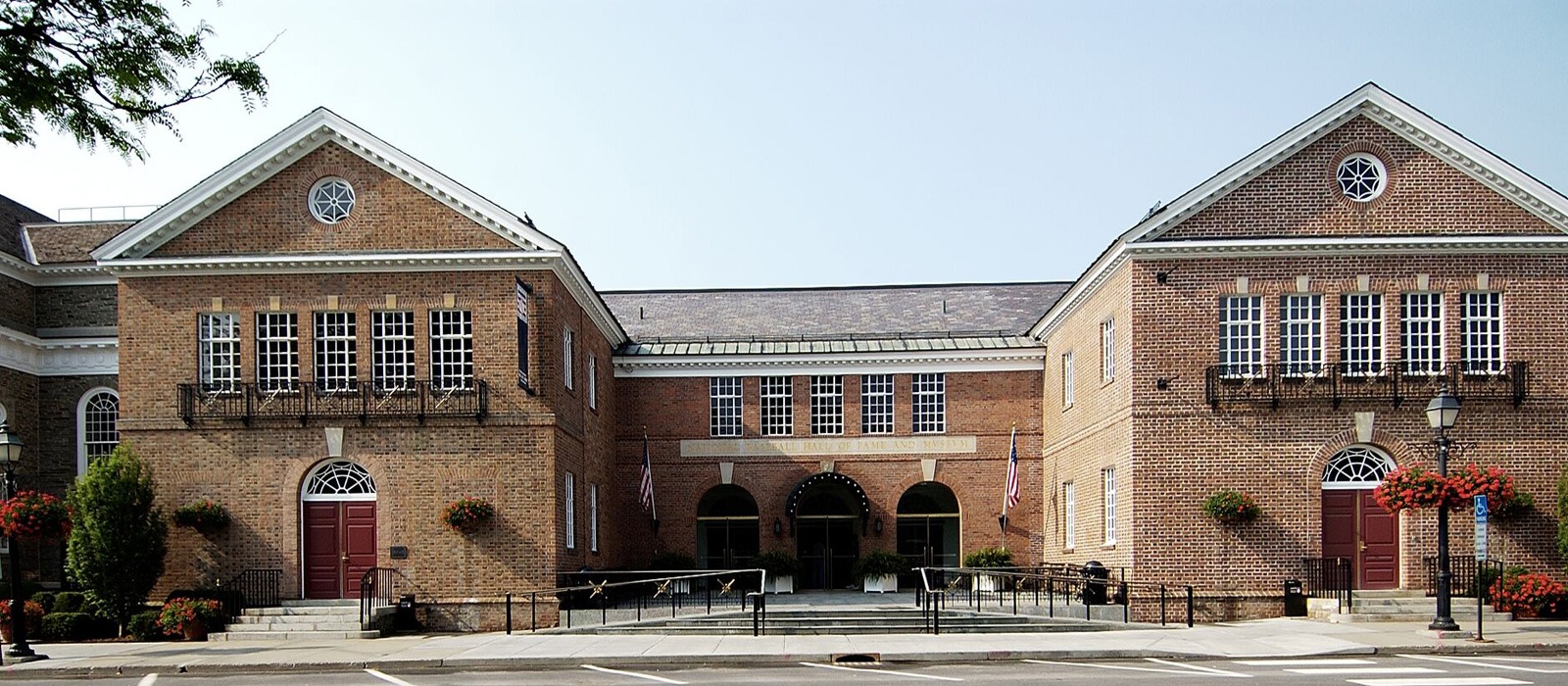
June 12, 1939: The National Baseball Hall of Fame and Museum opens, at 25 Main Street in Cooperstown, Otsego County, in Central New York. It was the official 100th Anniversary of baseball being invented in that town by Abner Doubleday.

Of course, just as most people already knew the world was round long before Christopher Columbus was born, most people already knew that Doubleday, a hero of the American Civil War, who did come from Cooperstown, didn't have a damn thing to do with baseball. The real reason the Hall, and its accompanying museum, were established there is that the Clark family, the unofficial powers-that-be (and still do) in Cooperstown, wanted a tourist attraction during, and that would outlast, the Great Depression. Mission accomplished.

The opening ceremony is presided over by the Commissioner of Baseball, Kenesaw Mountain Landis. It is broadcast nationwide on NBC radio.

In each of the past 4 years, there had been elections for the Hall of Fame. These were the inductees thus far:

* 1936: Ty Cobb, Babe Ruth, Honus Wagner, Christy Mathewson and Walter Johnson. "The First Five," or "The First Class," whose plaques are located in an X pattern, with leading vote-getting Cobb's in the middle, at the center of the back wall of the Hall's Gallery.
Top left: Christy Mathewson. Top right: Honus Wagner.
Center: Ty Cobb.
Bottom left: Babe Ruth. Bottom right: Walter Johnson.

* 1937: Players George Wright, Cy Young, Nap Lajoie and Tris Speaker; managers Connie Mack and John McGraw; and the 1st President of each major league, the National League's Morgan Bulkeley and the American League's Ban Johnson.

* 1938: One player, Grover Cleveland Alexander; and pioneers Alexander Cartwright and Henry Chadwick.

* 1939: Players Candy Cummings, Al Spalding, Cap Anson, Buck Ewing, Charles "Old Hoss" Radbourn, Willie Keeler, Eddie Collins and George Sisler; and executive Charles Comiskey. (Due to the unusual circumstances of his retirement, Lou Gehrig would be elected later in the year, after the Hall's opening.)

So there were 5 inaugural electees, and 25 inaugural inductees. Of these, 11 were still alive: Mack was 76 years old, Young 72, Wagner 65, Lajoie 64, Alexander and Collins 52, Johnson and Speaker 51, Sisler 46, and Ruth 44.

And of those 11 men, 10 posed for a commemorative photograph. Legend has it that Cobb arrived late, in order to spite someone, probably Landis. He was late, arriving a few minutes after the photo was taken, but it was due to circumstances beyond his control: He lived in California, and, transportation links being what they were at the time, he just plain didn't make it.
Top row, left to right: Honus Wagner, Grover Cleveland Alexander,
Tris Speaker, Nap Lajoie, George Sisler and Walter Johnson.
Bottom row, left to right: Eddie Collins, Babe Ruth, Connie Mack and Cy Young.
No, I don't know why the Babe has no tie and has his
collar sticking out over his lapels, like he's in the 1970s.

Sisler is probably the least well-remembered player of these 10, partly because he fell just short of 3,000 hits for his career; and partly because he played most of his career for a team that no longer exists in that form: The St. Louis Browns became the Baltimore Orioles in 1954.

Uniform numbers have only been worn since 1929, so most of the original 25 honorees are not honored with the retirement of their uniform number, because the number, let alone the honor, wasn't available. Wagner wore one as a coach, and was so honored; Johnson wore one as a manager, and Speaker and Collins wore them as coaches, but were not so honored.

Cobb, Johnson, Mack and Sisler are honored with statues at the current ballparks in their cities. Ruth is honored with one at the ballpark in his hometown. Young is honored with one at the site of one of his home ballparks. And Mathewson is honored with the renaming of his school's football stadium for him. (In college, he excelled at that sport as well.) Comiskey was once, but is no longer, honored with the naming of the ballpark he built for him.

In 1949, Ogden Nash, my grandmother's favorite poet, wrote "Line-Up for Yesterday" for Sport magazine, an alphabetical list of star players. For the letter Z, instead of citing a single player, since none with a last name starting with Z has been elected to the Hall of Fame, he wrote:

Z is for Zenith
The summit of fame.
These men are up there.
These men are the game.

For the letter I, he cheated a little:

I is for Me,
Not a hard-hitting man,
But an outstanding all-time
Incurable fan.

*

June 12, 1939 was a Monday. There were no scores on that historic day: MLB got the day off so the ceremony could be the focus, it was the off-season for the NFL and the NHL, and the NBA hadn't been founded yet.

Wednesday, June 8, 2022

June 8, 1968: Don Drysdale Pitches 58 2/3 Consecutive Scoreless Innings:

Don Drysdale, June 8, 1968.
Note the black armband on his left sleeve.

June 8, 1968: So long in the shadow of his teammate Sandy Koufax, Don Drysdale achieves something never done by Koufax, or by any other pitcher before him.

Born in 1936 in Van Nuys, in the San Fernando Valley region of Los Angeles, he seemed destined to star for a Los Angeles sports team, although he didn't start pitching until his senior year at Van Nuys High School, where he was a classmate of actor Robert Redford. The Brooklyn Dodgers signed him, and he debuted with them in 1956. Two years later, they moved to Los Angeles, and the young man who would be nicknamed "Big D" was home.

He made 9 All-Star Games, led the National League in strikeouts 3 times, and won the Cy Young Award (then a both-leagues award) in 1962, going 25-9. He was the Dodgers' ace when they won the 1959 World Series, and was the righthanded half of a devastating duo with lefthander Sandy Koufax, leading the Dodgers to win the World Series in 1963 and 1965, and the NL Pennant in 1966.

In 1965, Drysdale won 23 games and hit 7 home runs. He became only the 3rd pitcher ever to win at least 20 games and hit 7 home runs in the same season, following Wes Ferrell of the 1931 Cleveland Indians and Don Newcombe of the 1955 Brooklyn Dodgers. No pitcher has done it since.

Drysdale was also known as a "headhunter," who hit batters on purpose. His motto was, "If one of our guys gets hit, two of yours get hit. If two of ours get hit, four of yours get hit."

Arthritis forced Koufax to retire after the 1966 season, restoring Drysdale's ace status. That was also the 1st season for Don Sutton, who would join Koufax and Drysdale in the Hall of Fame. Drysdale was nicknamed "Big D" and "Double D," so Sutton became "Little D" -- even though he ended up with more career strikeouts than either Koufax or Drysdale.

On May 10, 1968, the Dodgers lost to the Atlanta Braves, 2-1 at Atlanta Stadium. (That facility was renamed Atlanta-Fulton County Stadium in 1975.) Drysdale allowed a run in the 4th inning, and was removed from the game in the 7th. A runner he allowed on base scored, and was thus charged to him. He was the losing pitcher, and finished the game with no consecutive scoreless innings. But then, in what became known as "The Year of the Pitcher," came 6 straight shutouts:

1. May 14, Dodger Stadium: Dodgers 1, Chicago Cubs 0. He allowed 2 hits and 3 walks. 9 straight scoreless innings.

2. May 18, Dodger Stadium: Dodgers 1, Houston Astros 0. He allowed 5 hits and 2 walks. 18 straight scoreless innings.

3. May 22, Busch Memorial Stadium, St. Louis: Dodgers 2, Cardinals 0. He allowed 5 hits and no walks. 27 straight scoreless innings.

The losing pitcher is Bob Gibson, who finishes this "Year of the Pitcher" with a 1.12 ERA and a record of 22-9. He would have a streak of 47 straight scoreless innings that season, 3rd all-time at the time.

If you want to know how he had the lowest ERA of the post-1920 Lively Ball Era, and still lost 9 games, this is one of the reasons. 

4. May 26, the Astrodome, Houston: Dodgers 5, Astros 0. He allowed 6 hits and 2 walks. 36 straight scoreless innings.

5. May 31, Dodger Stadium: Dodgers 3, San Francisco Giants. He allowed 6 hits and 2 walks. 45 straight scoreless innings.

6. June 4, Dodger Stadium: Dodgers 4, Pittsburgh Pirates 0. He allowed 3 hits and no walks. 54 straight scoreless innings.

In 1913, Walter Johnson pitched 55 2/3 straight scoreless innings. Drysdale was now 6 outs away from breaking that record.

That night, in his victory speech for the California Primary at the Ambassador Hotel in Los Angeles, Senator Robert F. Kennedy of New York mentioned Drysdale, who had campaigned for him. A few minutes later, RFK was shot, and died the next day.

On June 8, a few hours after RFK's funeral, the Dodgers took the field at Dodger Stadium wearing black armbands, in RFK's memory. Whether the sadness of the last 3 days had any effect on Drysdale, or if it was just time for the streak to end, is unclear.

Against the Philadelphia Phillies, Drysdale got through the 1st 2 innings. He struck Clay Dalrymple out to finish the 2nd, giving himself the record at 56 straight. He got through the 4th, making it 58 straight.

Finally, Tony Taylor led off the top of the 5th with a single. Dalrymple followed with another, advancing Taylor to 3rd base. Drysdale struck Roberto Peña out. But Howie Bedell hit a sacrifice fly to left field, and Len Gabrielson was unable to throw Taylor out at the plate. The streak was over, at 58 2/3 consecutive scoreless innings.

The Dodgers still won, 8-3. Despite the streak, and despite this being "The Year of the Pitcher," Drysdale battled injury and finished just 14-12 for the season. After 1 more year, he retired, with a record of 209-166, an ERA of 2.95, and 2,486 strikeouts.

The Dodgers retired his Number 53, and he became an admired broadcaster. His 2nd wife was basketball star Ann Meyers. They are the only married couple ever to both be elected to their respective sports' Halls of Fame. (As of June 8, 2022, he legalization of same-sex marriage has not yet led to this distinction losing its uniqueness.) He died in 1993.

*

June 8, 1968 was a Saturday. It was the day of Robert F. Kennedy's funeral. Because of this, many players asked for postponements of the day's games. The team owners didn't want to lose the revenue of a Saturday crowd, but they also didn't want to antagonize RFK's supporters. Some teams did postpone their games to set up Sunday doubleheaders. Others moved their afternoon games to night games, so they wouldn't coincide with the funeral. So there were only night games, 5 of them:

* The Chicago White Sox beat the Boston Red Sox, 4-0 at Fenway Park in Boston. Gary Peters pitched a 3-hit shutout. Carl Yastrzemski went 0-for-3 with a walk.

* The Baltimore Orioles beat the Oakland Athletics, 8-1 at Memorial Stadium in Baltimore. Brooks Robinson went 2-for-4 with an RBI. Frank Robinson went 1-for-3 with a walk. Dave McNally went the distance for the win. The only run he allowed came on a home run by the opposing pitcher, Jim "Catfish" Hunter. Reggie Jackson went 0-for-3.

* The St. Louis Cardinals beat the Cincinnati Reds, 7-2 at Crosley Field in Cincinnati. Lou Brock went 1-for-5 with an RBI. Roger Maris went 0-for-5. Of the Reds' 9 hits, Pete Rose got 3, and Johnny Bench got 1.

* The Detroit Tigers beat the Cleveland Indians, 3-1 at Tiger Stadium in Detroit. Mickey Lolich outpitched Sam McDowell. Al Kaline did not play.

* And the Houston Astros beat the Pittsburgh Pirates, 3-2 at the Astrodome in Houston. Willie Stargell did not play, but Roberto Clemente went 1-for-3 with an RBI.

* The New York Yankees and the California Angels postponed their game at Yankee Stadium until the next day, as part of a doubleheader. The Yankees swept, 8-1 and 3-2. Mickey Mantle went 1-for-2 with 2 walks and an RBI in the 1st game, and walked as a pinch-hitter in the 2nd game. The Yankees won the 2nd game in the bottom of the 9th, when Charley Smith, the player they got when they traded Roger Maris, singled Bill Robinson home.

The Atlanta Braves and the Chicago Cubs postponed their game at Wrigley Field in Chicago to the next day, as part of a doubleheader. The Braves won the 1st game, 4-0. Ken Johnson pitched an 8-hit shutout, to beat Ferguson Jenkins. Joe Torre hit 2 home runs. The Cubs won the 2nd game, 6-5. Over the 2 games, Hank Aaron went 2-for-8 with a home run and 2 RBIs, and Ernie Banks went 3-for-7 with a walk and an RBI.

* The New York Mets and the San Francisco Giants postponed their game at Candlestick Park in San Francisco. The game was postponed, and played as a doubleheader on August 11. The Giants swept, 2-1 and 5-0. In the 1st game, Ray Sadecki outpitched Tom Seaver. Willie Mays did not play. In the 2nd game, Mike McCormack pitched a 5-hit shutout. He and Willie McCovey each hit a home run. Mays went 2-for-4.

* And the Minnesota Twins and the Washington Senators -- the "Old Senators" and the "New Senators" -- postponed their game at District of Columbia Stadium in Washington -- the stadium that, the following June 8, would be renamed Robert F. Kennedy Memorial Stadium. The game was made up as part of a doubleheader on August 27. The Senators won the 1st game, 2-0. Camilo Pascual, who had starred for the Old Senators and the Twins, pitched a 4-hit shutout for the New Senators. Over the 2 games, Rod Carew went 1-for-7. Harmon Killebrew did not play.

Wednesday, April 27, 2022

April 27, 1983: Nolan Ryan Surpasses Walter Johnson

April 27, 1983: The Houston Astros beat the Montreal Expos, 4-2 at the Olympic Stadium in Montreal. Nolan Ryan of the Astros strikes out Brad Mills of the Expos. It is the 3,509th strikeout of Ryan's career, allowing him to surpass Walter Johnson as the major leagues' all-time leader. Johnson had held the record since surpassing Cy Young in 1921.

Steve Carlton of the Philadelphia Phillies would, however, soon catch and surpass Ryan. They would go back and forth as the all-time leader, until late in the season, when Ryan would begin to pull away. Ryan would end his career with 5,714.

As of April 27, 2022, also ahead of Johnson now are the unrelated Randy Johnson with 4,875, Roger Clemens with 4,672, Carlton with 4,136, Bert Blyleven with 3,701, Tom Seaver with 3,640, Don Sutton with 3,574, and Gaylord Perry with 3,534. The active leader is Max Scherzer with 3,210.

*

April 27, 1983 was a Wednesday. These other games were played in Major League Baseball:

* The New York Yankees beat the Kansas City Royals, 6-0 at Yankee Stadium. Bob Shirley, normally a reliever, allowed 8 hits, but kept the shutout. Roy Smalley hit a home run. Willie Randolph and Jerry Mumphrey each got 3 hits. George Brett went 1-for-4.

* The New York Mets beat the Cincinnati Reds, 2-1 at Riverfront Stadium in Cincinnati. Johnny Bench, in his last season as a player, went 0-for-4.

* The Philadelphia Phillies beat the Atlanta Braves, 6-2 at Atlanta-Fulton County Stadium. Dick Ruthven outpitched Phil Niekro. Mike Schmidt went 1-for-4 with a walk. Pete Rose went 1-for-5 with 2 RBIs.

* The San Francisco Giants beat the Pittsburgh Pirates, 3-2 at Three Rivers Stadium in Pittsburgh.

* The Minnesota Twins beat the Cleveland Indians, 5-3 at Cleveland Municipal Stadium.

* The Chicago Cubs beat the San Diego Padres, 5-4 at Wrigley Field in Chicago. Larry Bowa doubled Jerry Morales home with the winning run in the bottom of the 10th inning.

* The Milwaukee Brewers beat the Chicago White Sox, 6-2 at Milwaukee County Stadium. Robin Yount and Paul Molitor each went 2-for-5.

* The St. Louis Cardinals beat the Los Angeles Dodgers, 7-6 at Busch Memorial Coliseum in St. Louis.

* The Toronto Blue Jays beat the Texas Rangers, 3-2 at Arlington Stadium in the Dallas suburb of Arlington, Texas.

* The California Angels beat the Detroit Tigers, 13-3 at Anaheim Stadium (now Angel Stadium of Anaheim). Rod Carew went 2-for-4 with 2 walks. Fred Lynn and Daryl Sconiers each had 4 RBIs. Reggie Jackson did not play.

* The Baltimore Orioles beat the Oakland Athletics, 6-0 at the Oakland Coliseum. Mike Flanagan pitched 5 innings, Sammy Stewart 4, combining for a 6-hit shutout. Gary Roenicke went 2-for-3 with 2 walks and 3 RBIs. Eddie Murray went 0-for-4 with a walk. Cal Ripken went 1-for-4 with a walk and an RBI.

* And the Boston Red Sox beat the Seattle Mariners, 2-1 at the Kingdome in Seattle.

Football was out of season. The Stanley Cup Playoffs were between rounds. There were 3 games in the NBA Playoffs:

* The Philadelphia 76ers beat the New York Knicks, 98-91 at The Spectrum in Philadelphia. Moses Malone had 30 points and 17 rebounds.

* The Milwaukee Bucks beat the Boston Celtics, 116-95 at the Boston Garden.

* And the San Antonio Spurs beat the Denver Nuggets, 126-109 at the HemisFair Arena in San Antonio. George Gervin scored 30 points.

Thursday, April 14, 2022

April 14, 1910: The 1st Presidential "First Ball"

April 14, 1910: A new baseball season begins at American League Park in Washington, D.C. President William Howard Taft, who had been a catcher on the baseball team at Yale University, attends with his wife Helen, and throws out the ceremonial first ball.

Previously, Washington home openers had begun with a District of Columbia "commissioner" throwing out the first ball. Taft was the 1st President of the United States to do so. Thus, he started a tradition. More about that in a moment.

Standing in a special box set aside in the stands for the Presidential party, Taft threw the ball to the Senators' best player, pitcher Walter Johnson. Johnson, the best pitcher in baseball at the time, proceeded to pitch a a 1-hit shutout against the Philadelphia Athletics. The only hit he allowed was a double to A's 3rd baseman Frank Baker, not yet known as "Home Run" Baker. Johnson also walked 3 batters, and a batter reached base on an error.

The Senators won the game, 3-0. Johnson helped his own cause with a hit. Left fielder Jack Lelivelt went 2-for-3 with 2 RBIs, and 2nd baseman Herman "Germany" Schaefer went 3-for-4 with the team's other RBI. 1st baseman Bob Unglaub also got 3 hits, and center fielder Clyde Milan, one of the top baserunners of the time, also got 2 hits.

Legend has it that, at this game, Taft also invented the 7th inning stretch. In the middle of the 7th inning, he got up to loosen his stiffened limbs, and, out of respect to the office, all the fans got up, too. In fact, the tradition goes back to 1882, when Father Jasper Brennan, the athletic director at Manhattan College in New York, recognizing that having his players not in the game sit absolutely still for 9 innings was impractical, let them stand up in the middle of the 7th.

The 1910 opener was an aberration. The A's, managed by Connie Mack, went 102-48, and won the American League Pennant, finishing 14 1/2 games ahead of the team that finished 2nd, the New York Highlanders, who would become the Yankees in 1913. This began a string of 5 seasons in which the A's won 4 Pennants and 3 World Series.

The Senators, managed by Jimmy McAleer, went 66-85, finishing in 7th place, 36 1/2 games back. Early the next season, American League Park burned down, and was replaced by a new ballpark. In 1920, the Senators were bought by former major league pitcher Clark Griffith, who renamed the ballpark Griffith Stadium.

Taft threw out the first ball again on Opening Day in 1911. He did not do so in 1912, because he was attending a funeral, and Vice President James Sherman did it in his place. Taft's successor, Woodrow Wilson, threw out the first ball for Senators openers in 1913, 1915 and 1916.

There is no record of why he did not do so in 1914, but he didn't in 1917 or 1918, because he thought it unwise to have the President attend a baseball game while troops were fighting in World War I. He didn't do it in 1919, because he was in Europe for the Versailles Peace Conference; or in 1920, due to illness. Vice President Thomas Marshall filled in for him in 1917.

Griffith cultivated the tradition after that: The AL's first game of the season would be at Washington, so that the President could open the season with the ceremonial first ball; and the National League's 1st game would be in Cincinnati, in honor of the 1st openly professional baseball team, the 1869 Cincinnati Red Stockings. From 1921 until 1955, whenever the President would come to the ballpark that bore Griffith's name, the President and the owner would pose together, along with the opposing teams' managers, as the President held up the ball for the photographers, and then the President would throw it for the newsreel cameras.

Warren Harding did it all 3 years that he was President: 1921, 1922 and 1923. Harding died in 1923, and, though he didn't like baseball, his successor, Calvin Coolidge, went to the openers, because his wife, Grace, did like the sport. Coolidge threw out the first ball in 1924, 1925, 1927 and 1928, but not in 1926, for unrecorded reasons.

Despite soon becoming unpopular, Herbert Hoover did it all 4 years he was President: 1929, 1930, 1931 and 1932. Franklin D. Roosevelt did it each of the 1st 9 years he was President, which wasn't easy, since he had polio, and he had to hold onto his seat with his left hand while he stood and threw the ball with his right. In 1940, his awkward throw went over the head of the now-retired Johnson, and hit the lens of the camera used by Washington Post photographer Irving Schlossberg. In 1941, the newsreel's microphone picked up his remark to Griffith about the previous year's mishap; that time, however, FDR's throw was okay.

After that, due to World War II, he didn't do it again. Vice President Henry Wallace did the honors in 1942 and 1944. In 1943, it was Paul McNutt, wartime manpower chief and former Governor of Indiana. In 1945, 4 days after FDR died in office, Sam Rayburn, the Texas Congressman who served as Speaker of the House of Representatives, threw out the first ball.

The war over, Harry Truman resumed the tradition in 1946, becoming the 1st President to throw out the first ball lefthanded. He did that again in 1947, 1948 and 1949. In 1950, he went one better, and threw out 2 balls, 1 with each hand. In 1951 and 1952, he again did it only lefty.

Griffith, now in his 80s, invited new President Dwight D. Eisenhower to throw out the first ball for the 1953 opener. "Ike" refused, saying he was going to play golf at Augusta National in Georgia, home of The Masters. What an insult to the national pastime. But the game was rained out -- Ike's golf date wasn't -- and he was able to do the honors at the rescheduled opener. He threw out the first ball all 8 years of his Presidency.

Griffith died in 1955, and his son, Calvin Griffith, moved the Senators to Minneapolis for the 1961 season, where they became the Minnesota Twins. An expansion team named the Washington Senators took their place. In 1961, John F. Kennedy threw out the first ball, the last one at Griffith Stadium. In 1962, he did it at the new District of Columbia Stadium, and again in 1963. Late that year, he was assassinated. Five years later, while running for President himself, so was his brother. In 1969, D.C. Stadium was renamed Robert F. Kennedy Memorial Stadium. (There was a John F. Kennedy Stadium, a football stadium in Philadelphia, formerly named Municipal Stadium.)

Lyndon B. Johnson threw out the first ball in 1964, 1965 and 1967. He let Vice President Hubert Humphrey do it in 1966 and 1968. In 1969, Richard Nixon did it. In 1970, he was unable to attend, and sent David Eisenhower -- grandson of Ike, husband of Nixon's daughter Julie, and somewhat qualified as the Senators' former team statistician -- to do it, and he was heavily booed. Not wanting a repeat of this, in 1971, Nixon sent someone absolutely unbooable: A recently released prisoner of war from Vietnam, U.S. Army Master Sergeant, and Green Beret, David Pitzer.

The "New Senators" also failed in Washington, and were moved to the Dallas area for the 1972 season, becoming the Texas Rangers. So Nixon didn't do it again in 1972. In 1973, he made the first Opening Day Presidential first pitch outside of D.C., at Anaheim Stadium, home of the California Angels, in Orange County, California, where he was born and raised. Nixon resigned in 1974. In 1976, Gerald Ford threw out the first ball on Opening Day at Arlington Stadium, home of the Rangers, the former Senators.

A few Presidents have attended World Series games, the 1st being Wilson in Philadelphia in 1915. While Jimmy Carter attended many Atlanta Braves games in his native Georgia after leaving the Presidency, he only went to 1 game while he was in office, and it wasn't an Opening Day.

But he picked a good one: Since Game 7 of the 1979 World Series was going to be played at what was then the closed MLB stadium to Washington, Memorial Stadium in Baltimore, he went to that game. The Commissioner of Baseball, Bowie Kuhn, normally resistant to letting politicians throw out ceremonial first balls, not only let Carter do so, he let him participate in the presentation of the trophy to the visiting and victorious Pittsburgh Pirates.

In his previous career as an actor, Ronald Reagan played Hall of Fame pitcher Grover Cleveland Alexander, himself named for the man who was President when he was born in 1887. Ironically, Cleveland didn't like baseball. In 1892, Benjamin Harrison became the 1st President to go to a major league game while in office.

In 1984, at Baltimore, Reagan revived the Presidential first ball tradition. Wearing an Orioles jacket over a bulletproof vest, he walked out to the pitcher's mound, got a standing ovation, and threw a strike. He was 73 years old. He also threw out the first ball at the Orioles' opener in 1986. Presidents, when they have done it, have done it from the mound ever since, always with a bulletproof vest under a jacket.

George H.W. Bush had been an All-American 1st baseman at Yale, and he threw out ceremonial first balls in Baltimore in 1989 and 1990. In 1991, he did it in Arlington, since his son, George W. Bush, had recently bought the Rangers. In 1992, running for re-election in a nasty recession, he threw out the first ball for the first game in the Orioles' new home, Oriole Park at Camden Yards, and it fell well short of the plate. He was vociferously booed. It was not a factor in his defeat that November.

Bill Clinton threw out first balls in Baltimore in 1993 and 1996, and before the first game at Jacobs Field (now Progressive Field) in Cleveland in 1994. George W. Bush did it before the first game at Miller Park (now American Family Field) in Milwaukee in 2001, and made a bad pitch. Before Game 3 of that year's World Series at Yankee Stadium, mere weeks after the 9/11 attacks, he tried again, and threw a strike. He also threw out first balls in Cincinnati in 2003 and 2006, St. Louis in 2004, for the return to the capital for MLB with the Washington Nationals at RFK Stadium in 2005, and for the 1st game at the Nationals' new Nationals Park in 2008.

Barack Obama only threw out one ceremonial first ball on Opening Day, in 2010, in Washington, because it was the 100th Anniversary of the first event. Vice President Joe Biden filled in for him in 2009. Biden did not do so in 2021, his 1st year as President.

Donald Trump has only thrown out one ceremonial first ball, at Fenway Park in Boston, on August 18, 2006. It was the 2nd game of a 5-game sweep of the Boston Red Sox by their arch-rivals, the New York Yankees -- supposedly, Trump's favorite team. But, because he was in Boston, he wore a Red Sox jersey. Appropriate, given that both he and the Red Sox can't seem to win without cheating.

The NBC drama The West Wing closed out its 2003-04 season by showing President Josiah Bartlet throw out a ceremonial first ball on Memorial Day. He was shown practicing his throws, wearing the vest and the jacket, in the hall of the White House, and missing his practice catcher, even breaking priceless furniture.

The show's producers made a deal with MLB management and the Orioles, to have Bartlet's portrayer, Martin Sheen, throw out a pregame first ball. The real-life crowd gave him a standing ovation. While the episode ended with the screen going black just as Sheen released the ball, news footage showed the 63-year-old Sheen throwing a strike.

It also started in 1910, with William Howard Taft. Aside from being the nation's heaviest President ever, at 355 pounds -- Trump may have broken that record, but he will never admit it -- introducing the Presidential first ball tradition might be the thing for which Taft is best known. Certainly, he should be better remembered as the only President to have also served on the Supreme Court of the United States -- and as Chief Justice, no less, after his Presidency, from 1921 until shortly before his death in 1930.

*

April 14, 1910 was a Thursday. These other baseball games were played that day:

* The New York Highlanders, who became the Yankees in 1913, and the Boston Red Sox played 14 innings at Hilltop Park in Upper Manhattan, before the game was called due to darkness, tied 4-4.

* The New York Giants lost to the Boston Braves, 3-2 in 11 innings at the South End Grounds in Boston.

* The Brooklyn Superbas beat the Philadelphia Phillies, 2-0 at Baker Bowl in Philadelphia. Nap Rucker pitched a 2-hit shutout. The following season, the Superbas became the Brooklyn Dodgers.

* The Cincinnati Reds beat the Chicago Cubs, 1-0 in 10 innings at the Palace of the Fans in Cincinnati. Fred Beebe pitched a 3-hit shutout. All 3 Cub hits came from right fielder Fred "Wildfire" Schulte. Between them, the famed double-play combination of shortstop Joe Tinker, 2nd baseman Johnny Evers and 1st baseman (and manager) Frank Chance went 0-for-11.

* The Cleveland Naps beat the Detroit Tigers, 9-7 at Bennett Park in Detroit. "Naps"? Yes, they were named for their manager, who was also their best player: Napoleon "Nap" Lajoie, normally a 2nd baseman, but he played 1st base on this day. He went 1-for-3 with 2 walks and an RBI. For the Tigers, Ty Cobb went 3-for-5, while Sam Crawford went 4-for-5 with 5 RBIs. Addie Joss of Cleveland and George Mullin of Detroit both went the distance.

The season would also end with the focus on Lajoie and Cobb, as automobile company Chalmers promised a new car to the winner of the American League batting title. Cobb infamously sat out the last 2 games of the season, keeping his average at .385. Despite the St. Louis Browns' infield playing way back, allowing Lajoie to bat 8-for-8 including 6 bunt singles, he finished at .384. Due to the suspicious nature of the final day, Chalmers gave both men new cars. (Cobb was fine with it: He didn't care if Lajoie also got one, as long as he was awarded his.)

* The Chicago White Sox beat the St. Louis Browns, 3-0 at South Side Park in Chicago. Frank Smith pitched a 1-hit shutout, allowing only a single to Ray Demmitt. On July 1, the White Sox would move into Comiskey Park, and stay there for 80 years.

* And the Pittsburgh Pirates beat the St. Louis Cardinals, 5-1 at Robison Field in St. Louis. Honus Wagner went 2-for-4 with a walk.

December 31, 1999 & January 1, 2000: The Millennium

December 31, 1999:  The Millennium arrives. The people of planet Earth survived. At a terrible cost. But we hadn't destroyed ourselves. ...