Showing posts with label james garfield. Show all posts

Tuesday, November 1, 2022

November 2, 1880: James Garfield Wins the Closest Presidential Election

November 2, 1880: James Abram Garfield is elected the 20th President of the United States, in one of the narrowest races ever. In fact, in terms of total popular vote, it remains the closest ever.

The Republican nominee, Garfield, 46, had been elected to Congress from Ohio in 1862, was commissioned a General in the Union Army for the American Civil War without losing his seat. In 1880, the Ohio legislature elected him to a seat in the U.S. Senate. But he never took it, because the Republican Convention nominated him for President.

The Democratic nominee was Winfield Scott Hancock, a 56-year-old native of a small town outside Philadelphia, named for the losing Whig Party candidate of 1852, who had already been a war hero since the War of 1812, 40 years before that. Known as Hancock the Superb, and as The Thunderbolt of the Army of the Potomac for his heroism at the Battle of Gettysburg in 1863, had never previously held political office.
Winfield Scott Hancock

Hancock received 4,444,260 votes, losing by a margin of 1,898 votes, to Garfield's 4,446,158. But it's Electoral Votes that matter, although that was also close: Garfield won 214 to Hancock's 155. Each man won 19 States. Whether the Republicans stole the votes of any State, as they had for Rutherford B. Hayes 4 years earlier, has never been seriously suggested, or proven.

No one State would have helped Hancock. Garfield won the 21 Electoral Votes of New York, then the largest State, by 21,033 votes. Had Hancock won the State, that would still have left the Electoral Vote at a 193-176 Garfield victory.

Garfield was inaugurated on March 4, 1881. On July 2, he was shot. He could have survived, but his doctors' incompetence led to an inability to find the bullet, and a subsequent infection that killed him on September 19. Only William Henry Harrison died earlier upon his Inauguration than Garfield's 200 days.

Hancock didn't fare a whole lot better. He developed diabetes, chose not to run again in 1884, and died in 1886.

Chester Arthur, Garfield's Vice President and successor, also got sick, with kidney disease, did not run for a term of his own in 1884, and died in 1886. Samuel Tilden, cheated out of the Presidency in 1876, did not run in 1880 or 1884, and he, too, died in 1886. None of them lived to see what would have been the end of the Garfield-Arthur ticket's 2nd term -- or, had they won, that of Hancock and his running mate, former Congressman William H. English of Indiana. He lived until 1896.

*

November 2, 1880 was a Tuesday. This was before Saturday was standardized as the day for college football. On this day, the College of New Jersey defeated their arch-rivals, Rutgers, 8-0 in Princeton, New Jersey. The College would rename itself for its town in 1896: Princeton University.

Also on the day, Stevens Institute of Technology beat City College of New York, 6-0 at Stevens' field in Hoboken, New Jersey. CCNY would drop football entirely, while Stevens Tech became an NCAA Division III school.

And Harvard, having hosted Montreal's McGill University in 1875, in a game that changed the course of football in North America, traveled to Montreal, and, on this date, played the Montreal Football Club to a 0-0 tie.

Sunday, September 18, 2022

September 19, 1881: President James Garfield Dies

September 19, 1881: President James A. Garfield dies at Francklyn Cottage, on the beach at Long Branch, Monmouth County, New Jersey, 79 days after being shot. He was 49 years old.

James Abram Garfield was elected President in 1880, after being nominated by the Republican Party. A Representative from Ohio since the 1862 election, he was a compromise candidate, after the the Convention couldn't come to agreement.

The "Stalwarts" wanted former President Ulysses S. Grant -- more than Grant wanted it himself. The "Half-Breeds" wanted James G. Blaine, Senator from Maine and former Speaker of the House. Each group rejected the other's choice, due to corruption. Garfield, as far as anyone knew at the time, was clean. The Stalwarts managed to get one of their own into the Vice Presidential nomination: Chester Alan Arthur, Collector of the Port of New York. 

Garfield won a very close election, over the Democratic nominee, Winfield Scott Hancock, a hero General of the Union Army in the Civil War. With 185 Electoral Votes being necessary, Garfield won 214, to Hancock's 155; and got 48.32 percent of the popular vote, to Hancock's 48.21 percent. Not that the popular vote mattered, but Garfield won it by 10,364 votes, and by 0.11 percent, in each case the closest ever.

He was inaugurated as the 20th President of the United States on March 4, 1881, and one of his pet projects was civil service reform. That upset the Stalwarts, who, thinking they were responsible for Garfield's election, wanted the "spoils system" maintained.
And one of the Stalwarts who expected to be rewarded for his role in getting Garfield elected was Charles Julius Guiteau. He actually had nothing to do with it, but he thought he was instrumental in it. This was because he was insane. His family had committed him to a psychiatric asylum in 1875, but he escaped.
Does this look like a sane man to you?
It sure doesn't look like a sane man to me.

He kept visiting the White House, hoping to see Garfield, or at least Blaine, who, as a bone thrown to the Half-Breeds, was appointed Secretary of State. As a bone thrown to them, he was given the leading job in the Cabinet. Guiteau wanted to be named Consul to Vienna, but was willing to "settle" for Paris. He got banned from the White House, but managed to confront Blaine, who told him, "Never again speak to me on the Paris consulship, as long as you live."

So Guiteau bought a .442 Webley British Bulldog revolver, with an ivory handle. He chose it because he thought that, after the assassination, he would be hailed as a hero for getting rid of the corrupt Garfield, and that that particular gun would look great in a museum. Did I mention that he was nuts?

Guiteau gave Garfield one last chance: He wrote a letter saying Garfield should fire Blaine, or "you and the Republican Party will come to grief." Like everything else he sent to the White House, this letter was thrown away without being opened.

And, unintentionally, Guiteau gave Garfield one more "last chance": Knowing that Garfield liked to vacation in Long Branch, Monmouth County, New Jersey, one of America's earliest shore resorts, he followed Garfield to the Baltimore and Potomac Railroad Station, on the southwest corner of 6th Street and B Street Northwest, intending to shoot him there.
But the First Lady, Lucretia Garfield, was with him, and Guiteau didn't want her to see her husband shot dead in broad daylight. Perhaps he remembered how Abraham Lincoln had been shot in the presence of his wife (albeit indoors and at night). John Wilkes Booth didn't care. Nor did Lee Harvey Oswald, decades later, care that Jacqueline Kennedy was with her husband. (That is, if you believe that Oswald did it. Ida McKinley was a few miles away from her husband William when he was shot.)

Washington can get very hot in the Summer. On July 2, the newspapers reported that Garfield was heading off to Long Branch again -- and, this time, Lucretia would not be with him as he left: She had contracted malaria, and had been sent to Long Branch without him to recover.

Who was with him at the Station? His sons, James Rudolph Garfield and Harry Augustus Garfield. And Blaine. Also there, but not going with him like the others, his Secretary of War -- Robert Todd Lincoln, son of the only President who had been assassinated to that point. There was no bodyguard or security detail, and, up to that point in Presidential history, that was not unusual.

At 9:20 AM, Guiteau saw Garfield and Blaine walk in. He waited until they were about 6 feet in front of him, and fired. The shot only grazed Garfield's shoulder. A General in the Union Army, he knew gunfire when he heard it, and called out, "My God, what is that?" No one saw the shot, giving Guiteau the chance to fire again. This bullet lodged in Garfield's back, and he went down.
Artist's depiction of the shooting.
Blaine is the bearded man in the top hat.

Guiteau, unusually for him, was calm throughout the event. He turned to walk out and head for the hansom cab that was waiting for him. But he bumped into a policeman, Patrick Kearney, who had gone into the station after hearing the first shot. As he was carried off to jail, Guiteau yelled out, "I am a Stalwart, and now, Arthur is President!"

Garfield did not die quickly. He would have been better off if he had. The doctors who treated him couldn't find the bullet -- no X-ray machines available at the time -- and subjected him to treatments that led to an infection. In other words, for all of Guiteau's planning, it could be argued that he didn't kill Garfield: Garfield's doctors did.

Mrs. Garfield received a telegram about the shooting in Long Branch, and, with some irony, she got on a train to see him, weak but determined. The President lingered on for weeks -- and, until the 25th Amendment to the Constitution was ratified in 1967, there was no mechanism for replacing a President who was alive but incapacitated -- and the First Lady decided to get him out of the hot capital, and put him on a train for Long Branch, with a specially cushioned bed to protect him from the bumpy ride.
Lucretia Garfield

On September 6, he arrived at Francklyn Cottage, in the Elberon section of Long Branch, at the city's southern end. It didn't work: On September 19, 1881, at 10:35 PM, he reached up for a pain in his chest, and called out for his Chief of Staff, David Swaim: "Oh, Swaim, this terrible pain. Press your hand on it." When he did, Garfield's hands went up, and he yelled, "Oh, Swaim? Can't you stop this? Oh, oh, Swaim!" And he died.

He was only 49 years old, 2 months short of turning 50. To this day, only 1 President has had a shorter lifespan: John F. Kennedy was 46 when he was assassinated. (The shortest-lived President who died of natural causes? James Polk was 53.)

It was after midnight by the time Vice President Arthur received the telegram about Garfield's death at his townhouse, at 123 Lexington Avenue, in the Gramercy Park neighborhood of Manhattan. John R. Brady, a Judge of the Supreme Court of the State of New York, came, and administered the Oath of Office to Arthur as the 21st President of the United States, by candlelight, at 2:15 AM on September 20, 1881.
Arthur took a train to Long Branch to pay his respects to the Garfields, and accompanied them on the funeral train to Washington. On September 22, just to make everything official, he was sworn in again at the Capitol Building, by the Chief Justice of the Supreme Court of the United States, Morrison Waite.

In the 19th Century, Congress usually adjourned upon the completion of its term on March 3, and then didn't reconvene, except for special occasions, until December 3. This was partly due to the long distances required to travel by horse, or horse-drawn vehicle, or boat during the pre-railroad era; and partly due to the nasty Summers of Washington. It would often be until December that a new leaders of the House and Senate were chosen.

This led to the potential for a huge problem. With Arthur having become President, there was, until the passage of the 25th Amendment to the Constitution in 1967, no legal mechanism for filling the vacancy in the office of Vice President.

According to the Presidential Succession Act of 1792, the next man in line was the President Pro Tempore of the Senate. "Pro Tempore" is Latin for "For the time being." In other words, the man who sits in for the Vice President when the Vice President is unavailable. In other words, the Vice Vice President. The next man in line was the Speaker of the House. But on September 19, 1881, both of those offices were, officially, vacant. In other words, had something happened to Arthur, there would have been no President!

On October 10, 1881, Congress met, and Senator Thomas F. Bayard of Delaware was appointed President Pro Tempore of the Senate. Now, there was a "next President" in place, in case of emergency. It would take until December 5 for the House to convene, and elect J. Warren Kiefer of Ohio as Speaker.

But then, on October 13, the Senate held a new election for President Pro Tempore. David Davis of Illinois, a former Justice of the Supreme Court. Before that, he was Abraham Lincoln's campaign manager in 1860. He did not run for re-election to the Senate in 1882, so he was next in line until March 3, 1883. When the Senate met the next day, they chose George F. Edmunds of Vermont, and he was next in line for the remainder of the Garfield-Arthur term.

As a result of not wanting to face this potential problem again, Congress acted, and the Presidential Succession Act of 1886 took the leaders of Congress out of the line of succession, and put the members of the Cabinet, in descending order of their department's establishment, in it. Therefore, had the 1886 Act been in place when Arthur was sworn in, Secretary of State Blaine would have been next in line for the Presidency.

In spite of his lack of experience, Arthur is generally regarded to have run a good Administration. He, too, pursued civil service reform, getting the Pendleton Act passed in 1883. And he appears to have completely avoided any action that could have been described as "corrupt." In other words, he governed very little like a Stalwart.

Had Garfield lived, and done as well as Arthur, he would have had less affection than he got from being martyred, but he might have had more respect from history. But Garfield was beloved for his courage in the face of impending death. And Arthur was admired for not running a Stalwart-style corrupt Administration. And, of course, had Garfield had smarter doctors, he might have recovered. In other words, by shooting Garfield, Guiteau accomplished nothing.

Guiteau was formally indicted for murder on October 14, 1881. A psychiatrist testified that Guiteau was a "morbid egotist" with "a tendency to misinterpret the real affairs of life." The District Attorney for the District of Columbia argued, "There's nothing of the mad about Guiteau: He's a cool, calculating blackguard, a polished ruffian."

(Although Garfield was the elected head of the federal government, and was shot in a place of interstate travel and commerce, his assassin's prosecution was handled by the court system of the District of Columbia, not the U.S. Department of Justice. The fact that the DOJ was then headed by Blaine may have had something to do with it: He was a witness, and a potential victim, therefore a walking conflict of interest.)

Guiteau was convicted and sentenced to death on January 25, 1882; and hanged on June 30. He was 40 years old. All through the trial, and up until the moment the black hood was placed over his head for his execution, he lashed out and remained proud of what he had done, believing it to be the will of God. Indeed, his last words were a poem he had written for the occasion: "I am Going to the Lordy."

The gun that Guiteau thought would look so good in a museum? It's not on display in one. In fact, no one knows where it is, or what happened to it. The Smithsonian Institution did have it on display for a while, but it has since been lost.

The pistol that John Wilkes Booth used to assassinate Lincoln -- an event for which it is a little too far back in history to do a "Scores On This Historic Day" entry -- is on display in the basement of Ford's Theatre in Washington, where the assassination happened.

The pistol that Leon Czolgosz used to kill McKinley is in the Buffalo History Museum. And the rifle that Oswald -- as the official story goes -- used to kill Kennedy is in a National Archives Building in College Park, Maryland, just outside D.C., and is not available for public viewing. The one on display in the Sixth Floor Museum in Dallas is a replica.

Arthur did not run for a term of his own in 1884: He had Bright's disease, a kidney disorder that is still not curable, but is treatable now, but not then. (That same year, it killed Alice Roosevelt, first wife of future President Theodore Roosevelt. In 1912, it killed Vice President James Sherman. In 1914, it killed Ellen Wilson, the first wife of President Woodrow Wilson. She remains the last First Lady to die "in office.") Arthur died in 1886.

Robert Todd Lincoln had been tired from his Civil War service, and declined to accompany his parents to Ford's Theatre on April 14, 1865, but he was in Washington and the time of his father's assassination. He had been with Garfield when he was shot. And he was a guest at the Pan-American Exposition in Buffalo on September 6, 1901, standing just outside the Temple of Music when William McKinley was shot. He didn't see the shooting, but he heard it.

When the Lincoln Memorial was to be dedicated in 1922, the current President, Warren G. Harding, was one of the listed speakers. Also in attendance was the Chief Justice of the United States, former President William Howard Taft. As the only surviving child of Honest Abe, Robert was invited. He refused to come. He was afraid Harding would be assassinated, too. (If he was concerned for Taft's safety, he didn't say so.)

Finally, he was talked into attending the ceremony. Harding was not assassinated, but he was already in poor health (not that the public knew this at the time), and he died in office the next year. Robert was more sure than ever that he was a jinx. He died in 1926, without ever meeting another President.

The Baltimore and Potomac Station was demolished after the opening of Union Station in 1907. In 1931, B Street was renamed Constitution Avenue, and was made part of U.S. Route 50, which it remains today. In 1941, the National Gallery of Art opened on the site of the station. It took until 2019 for the National Park Service to erect interpretive plaques about the assassination on the site.
Francklyn Cottage has long since been demolished. However, in the middle of Long Branch's boardwalk, Seven Presidents Park pays tribute to the 7 Presidents who vacationed there, and there is a statue of Garfield.
Like fellow Presidents George Washington, Thomas Jefferson, Andrew Jackson, Abraham Lincoln, Theodore Roosevelt, Woodrow Wilson, Franklin Roosevelt and Dwight D. Eisenhower, James Abram Garfield has an official memorial in Washington, D.C. -- but not at the site of the assassination. The James A. Garfield Monument, dedicated on May 12, 1887, is in front of the U.S. Capitol Building, in a traffic circle at First Street and Maryland Avenue Southwest.
There are 11 cities in America named for Garfield, in Bergen County, New Jersey. There are Counties named for him in Colorado, Montana, Nebraska, Oklahoma, Utah and Washington. There are 2 high schools named for him in Ohio, 1 in Los Angeles, and 1 in Seattle.

Arthur was the 1st President born in Vermont, but represented New York in politics. He has a statue in New York's Madison Square, not far from his Lexington Avenue apartment, but no towns named for him, and no memorial in the nation's capital.
Arthur Statue, Madison Square Park, Manhattan

Garfield was played by Francis Sayles in The Night Riders in 1939, and Van Johnson in The Price of Power in 1969. Arthur was played by Emmett Corrigan in Silver Dollar in 1932, and Larry Gates in Cattle King in 1963. There have been 2 ships named the SS President Garfield: A hospital ship in service from 1921 to 1948, and an attack transport from 1940 to 1955. There was a transport ship named SS President Arthur from 1922 to 1927.

In a great irony, despite being the sons of the 1st 2 assassinated Presidents, Robert Todd Lincoln turned out to be the last surviving member of the Cabinets of both Garfield and Arthur, living until 1926; and James R. Garfield would be the last surviving member of the Cabinet of Theodore Roosevelt, serving as Secretary of the Interior, and living until 1950 -- 84 years old, and 69 years after his father's death.

Garfield was President for only 200 days -- and he had a bullet in him for 80 of them. His Presidency is the 2nd-shortest, ahead of only William Henry Harrison, who was inaugurated on March 4, 1841, and died on April 4, after 31 days.

*

September 19, 1881 was a Monday. There was only one score on this historic day: The Troy Trojans beat the Buffalo Bisons, 7-5 at Haymakers' Grounds in Troy, New York, named for the Troy Haymakers, the Trojans' predecessors.

The Trojans, who played across the Hudson River from Albany, New York, folded after the 1882 season. In 1883, their place in the NL was taken by the New York Gothams, who became the Giants in 1886, and the San Francisco Giants in 1958. The Bisons went out of business after the 1885 season.

Saturday, September 3, 2022

September 3, 1881: The 1st U.S. Open

Richard D. Sears

September 3, 1881: The Singles Final of the 1st U.S. National Championships -- tennis' 1st U.S. Open -- is held at the Newport Casino in Newport, Rhode Island. Richard Sears defeats William E. Glyn, 6-0, 6-3, 6-2. Both players were American: At the time, the tournament was only open to Americans.

Richard Dudley Sears was born on October 26, 1861 in Boston. He won the U.S. Open the 1st 7 times, 1881 to 1887. He also won its doubles tournament from 1882 to 1887, with James Dwight as his partner, except for 1885, when it was Joseph Clark. After that, he retired from tennis. He died in 1943.

In 1903, Laurence Doherty -- interestingly enough, a native of Wimbledon, in South London -- became the 1st non-American to win the U.S. Open. Sears' 7 wins have been matched by fellow Americans William Larned and Bill Tilden, but no player has managed to win an 8th. In fact, the next-most is 5, by Americans Jimmy Connors and Pete Sampras, and Switzerland's Roger Federer.

The 1st women's tournament was held in 1887. It was won by Ellen Hansell, born in Philadelphia in 1869. She reached the Final again in 1888, but lost, and never got that far again. She lived until 1937. Mabel Cahill, from Ireland but competing for Great Britain, was the 1st non-American woman to win, in 1891. In the Final, she defeated Ellen Roosevelt, a 1st cousin of Franklin Delano Roosevelt.
Ellen Hansell

The woman with the most U.S. Open wins is Molla Bjurstedt Mallory, a Norwegian who came to America to live in 1915, and won 8 titles from that year until 1926. Helen Wills Moody won 7, Chris Evert won 6, and Serena Williams has also won 6.

The Newport Casino hosted the U.S. Open until 1914, and is the home of the International Tennis Hall of Fame. From 1915 to 1920, it was held at the West Side Tennis Club in Forest Hills, Queens. From 1921 to 1923, it was played at the Germantown Cricket Club in Philadelphia.
Newport Casino

In 1923, the West Side Tennis Club built a stadium that still stands, and hosted 2 concerts by The Beatles in 1964. That stadium hosted the U.S. Open from 1924 until 1977. In 1978, the Open moved 3 miles to Flushing Meadow-Corona Park, to the Singer Bowl, which was renamed Louis Armstrong Stadium: The jazz master lived nearby, in Corona, and was a big sports fan, including, unusually for a black man at the time, tennis. The complex was named the National Tennis Center by the United States Tennis Association (USTA).
Forest Hills Stadium

In 1997, a new main venue opened at Flushing Meadow, Arthur Ashe Stadium. Louis Armstrong Stadium was kept as a backup, before being torn down and replaced by a new stadium on the same site, with the same name, in 2018. In 2006, the entire complex was renamed the USTA Billie Jean King National Tennis Center.
Arthur Ashe Stadium

*

September 3, 1881 was a Saturday. The only professional sports league in North America at that point was baseball's National League, and these games were played that day:

* The Boston Red Stockings beat the Worcester Ruby Legs, 3-2 at the 1st version of the South End Grounds in Boston. The Red Stockings eventually became the Braves. In 1883, the Ruby Legs moved, becoming the Philadelphia Phillies.

* The Providence Grays beat the Troy Trojans, 11-1 at the Haymakers' Grounds in Troy, New York, across the Hudson River from the State capital in Albany. In 1883, the Trojans moved, becoming the New York Giants. The Grays had won the NL Pennant in 1879, and would do so again in 1884, but went out of business just 1 year later.

* The Buffalo Bisons beat the Detroit Wolverines, 5-3 at Riverside Park in Buffalo. The Bisons went out of business after the 1885 season. The Wolverines won the Pennant in 1887, but went out of business just 1 year later.

* The Chicago White Stockings beat the Cleveland Blues, 4-2 at Kennard Street Park in Cleveland. The Blues went out of business after the 1884 season, while the White Stockings eventually became the Cubs.

Wednesday, July 13, 2022

July 14, 1881: The Death of Billy the Kid

July 14, 1881: Billy Bonney dies. Billy the Kid, however, lives on. And no one seems to get his story right.

On the 1973 album that launched him to stardom, Piano Man, Billy Joel included a song titled "The Ballad of Billy the Kid." He made the mistake of writing the lyrics first and doing the research second. He continued to play the song live through his tour for his album 52nd Street in 1978-79, saying, "Every word in this song is a lie," and has occasionally played it since.

BJ got the details really wrong. He said the Kid was from Wheeling, West Virginia. No source about him had said that before. He said the Kid started his criminal career by robbing a bank in Colorado, and eventually "robbed his way from Utah to Oklahoma." There is no evidence that he ever robbed a bank, or committed any crime in any of those 3 States. (BJ may have been confused by the fact that Butch Cassidy and the Sundance Kid operated out of Utah. But the Indian Territory wasn't even opened to white settlement, as the Oklahoma Territory, until 1889, 8 years after the Kid died.)

BJ said the Kid "soon put many older guns to shame." There is no evidence that he ever engaged in a classic Wild West gunfight. He said the Kid was hanged in front of a large crowd. He was caught, and he was sentenced to be hanged... but he escaped.

BJ also said, "He never had a sweetheart." Far from the truth: He thought his girlfriend was in the room with him when he was killed.

One thing BJ got absolutely right: "The cowboy and the rancher knew his name."

*

Or, at least, his nickname. He was born on September 17, 1859 in... New York. The same city as Billy Joel, a Bronx native. Apparently, the Kid was born in Manhattan, although Brooklyn was also claimed. At birth, his name was Henry McCarty, so it wasn't William. Or Bill, or Billy, or Mac, or Buddy. (Sorry for drifting into a Sheryl Crow song there.)

After his father died, his mother Catherine moved the family to Indianapolis, where she met William Antrim. They moved to Wichita, Kansas, where Catherine married William. But when she died, William left Henry and his brother Joseph. Desperate, Henry started robbing -- not banks, but groceries, clothing, and, finally, guns. He moved to Arizona and stole horses, and was first mentioned in a newspaper, listed as "Kid Antrim." Because of his stepfather, he began to be listed as "William Antrim." Soon, these were combined into "Billy the Kid."

He reached the New Mexico Territory (it became a State in 1912), and began using the name William H. Bonney. He began working for ranchers, including stealing horses. Those ranch owners were rich, the men working for them were not. The owners were like Mob bosses, and, in what became known as the Lincoln County War, they hired what would now be called hitmen. And Billy the Kid was one of them.

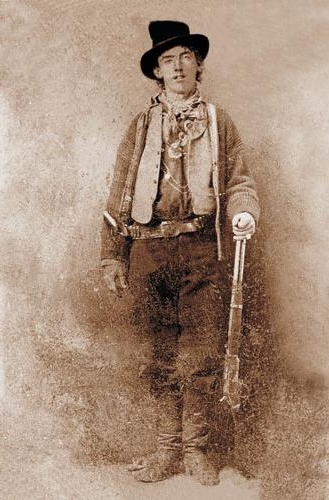
The photograph shown above is the only one of him known to exist. (There is one other alleged to show him and another man, but it hasn't been authenticated.) Usually, this photo shows him holding the rifle with his right hand, and a Colt revolver on his left hip. (The brand of firearm he used was pretty much the only detail the Billy Joel song got right.) This gave rise to the belief that he was lefthanded. In 1958, Paul Newman starred in a movie about him, titled The Left Handed Gun. Except the photo process meant that the image was reversed. The image shown above is how he would have appeared to the photographer. The Kid was righthanded, as were most of the men now remembered as Wild West gunfighters. (In the 1974 movie Blazing Saddles, Gene Wilder played Jim, "The Waco Kid," and he was a lefty.)

But myths about Billy abounded. He was already the subject of "dime novels," telling stories involving him that simply weren't true, or were exaggerations of what he actually did. People who knew him later told interviewers that he didn't like that, but he never killed anybody over it.

He was captured by Sheriff Pat Garrett in 1880, and was sentenced to be hanged. According to records, Judge Warren Bristol said, "You are going to hang until you are dead, dead, dead." Billy responded by saying, "You can go to Hell, Hell, Hell."

His execution was set for May 13, 1881, in Lincoln. But on April 28, he escaped. He is only known, for sure, to have killed 4 men in his life, and 2 of them were in his escape. And that was while his legs were still shackled, before he found an axe and cut the shackles. Whatever else he may have been in real life, Billy the Kid was no dummy, and he was no coward.

The Governor of the Territory was Lew Wallace, who had just published the novel Ben-Hur. He placed a $500 bounty on the Kid's head. Garrett, embarrassed by the Kid having escaped his custody, was determined to get him, as a matter of pride as much as money. He had heard that the Kid was in Fort Sumner, and took 2 deputies with him.

On July 14, 1881, Garrett found Pete Maxwell, son of a land baron and known to be a friend of the Kid. They talked for hours, until midnight. Then Billy walked in. This was less than 2 years after Thomas Edison made the first practical electric light bulb, so the light was poor, and Billy couldn't recognize Garrett. He had a Mexican girlfriend, and thought she might be there, so he asked, in Spanish, "¿Quién es? ¿Quién es?" ("Who is it?")

Garrett couldn't see Billy's face, but he recognized Billy's voice. Garrett fired 2 shots. The 2nd missed. The 1st hit Billy right in the chest, above the heart. He was dead, at age 21.

It took a year for the Territory to grant Garrett the $500 bounty. In the meantime, people glad to be rid of the Kid had contributed over $7,000 to Garrett. In 1882, he published The Authentic Life of Billy, the Kid, and that's where we learned most of what we thought we knew about him. A lot of it was lies, designed to make Billy look more evil and dangerous than he was (including the claim that he'd killed 21 men, one for every year of his life), thus making Garrett look more heroic for taking him down than he really was.

What happened to Garrett? He chose not to run for another term as Sheriff of Lincoln County, and returned to Texas, where he ran for the State legislature, and lost. He went into several businesses, all of which failed. In 1901, President Theodore Roosevelt appointed him Collector of Customs for the border city of El Paso, Texas. He was so bad at that office that people kept writing to TR, telling him to fire Garrett. In 1906, even the Rough Rider had had enough of him, and fired him.

On February 29, 1908, Garrett was shot and killed in Las Cruces, New Mexico, in a dispute over ownership of livestock. He was 57. While not the killer and thief that Billy the Kid was, he was no hero, either.

As is so often the case with teenagers and young adults, TV and movie portrayals of him tend to use actors much too old to play him. Newman was 33, as was Michael J. Pollard in the 1972 film Dirty Little Billy. Jack Beutel was 27 in the 1943 film The Outlaw. Emilio Estevez was 25 in the 1988 film Young Guns. And Kris Kristofferson was 36 in the 1973 film Pat Garrett and Billy the Kid.

And, as with Jesse James and Butch Cassidy, well into the 20th Century, and the rise of Westerns in films and even on TV, there were old men claiming to be Billy the Kid. One, Ollie P. Roberts, even asked Thomas J. Mabry, Governor of New Mexico in 1948, to fulfill his predecessor Lew Wallace's promise of a pardon if he'd turned himself in. Since the promise was only rumored, never confirmed, Mabry turned him down.

*

July 14, 1881 was a Thursday. There was one game played in the National League that day: The Boston Red Stockings beat the Detroit Wolverines, 3-2 at Recreation Park in Detroit.

The Red Stockings became the Boston Beaneaters in 1883, and went through other names before adopting Braves in 1912, moving to Milwaukee in 1953 and Atlanta in 1966. The Wolverines won the Pennant in 1887, but, with team owner Frederick Stearns unable to meet the new salary demands of championship-winning players, went out of business only a year later.

Friday, July 1, 2022

July 2, 1881: President James Garfield Is Assassinated

July 2, 1881: President James Garfield is shot at the Baltimore & Potomac Railroad Station in Washington, while waiting for the train that would take him to a vacation on the Jersey Shore.

James Abram Garfield was elected President in 1880, after being nominated by the Republican Party. A Representative from Ohio since the 1862 election, he was a compromise candidate, after the the Convention couldn't come to agreement. The "Stalwarts" wanted former President Ulysses S. Grant -- more than Grant wanted it himself. The "Half-Breeds" wanted James G. Blaine, Senator from Maine and former Speaker of the House.

Each group rejected the other's choice, due to corruption. In Blaine's case, it was personal: He had been involved in Crédit Mobilier, a scandal over a railroad contract. In Grant's case, it wasn't personal: He was considered completely honest, but a lot of his friends were not, involved in one scandal or another, including the far-ranging Crédit Mobilier.

Garfield, as far as anyone knew at the time, was clean. Indeed, when the Crédit Mobilier scandal unfolded in 1872, Garfield testified before his Congressional colleagues that he had been offered a bribe in connection with it, but he refused it. As far as journalists then and historians since have been able to determine, he was not otherwise involved.

The Stalwarts managed to get one of their own into the Vice Presidential nomination: Chester Alan Arthur, Collector of the Port of New York. This was a position where it was easy to make a lot of dirty money, so some people presumed Arthur had. But he hadn't, and it was widely known that he hadn't, and that was part of his appeal.

Garfield won a very close election, over the Democratic nominee, Winfield Scott Hancock, a hero General of the Union Army in the Civil War. He was named for Winfield Scott, another great General who had been nominated for President, but lost, to Franklin Pierce in 1852. If Garfield hadn't been from Ohio, he might have lost that State, and lost the national popular vote, although he still would have won the Electoral Vote. But he won it, getting 51.7 percent of the vote there.

On the other hand, New York was also very close, and Arthur being on the ticket may well have made the difference in the election, even though he was one of the least qualified candidates any major-party national ticket has ever had. Garfield won the State with 50.3 percent.

Overall, with 185 Electoral Votes being necessary, Garfield won 214, to Hancock's 155; and got 48.32 percent of the popular vote, to Hancock's 48.21 percent. Not that the popular vote mattered, but Garfield won it by 10,364 votes, and by 0.11 percent, in each case the closest ever.

He was inaugurated as the 20th President of the United States on March 4, 1881, and one of his pet projects was civil service reform. That upset the Stalwarts, who, thinking they were responsible for Garfield's election, wanted the "spoils system" maintained.

And one of the Stalwarts who expected to be rewarded for his role in getting Garfield elected was Charles Julius Guiteau. He actually had nothing to do with it, but he thought he was instrumental in it. This was because he was insane. His family had committed him to a psychiatric asylum in 1875, but he escaped.
Does this look like a sane man to you?
It sure doesn't look like a sane man to me.

He kept visiting the White House, hoping to see Garfield, or at least Blaine, who, as a bone thrown to the Half-Breeds, had been appointed Secretary of State. Guiteau wanted to be named Consul to Vienna (the Austro-Hungarian Empire), but was willing to "settle" for Paris (the French Third Republic).

On May 13, having bothered the people at the White House too many times, he was banned from the building. The next day, he waited for Blaine to leave his office, and confronted him. Blaine told him, "Never again speak to me on the Paris consulship, as long as you live."

So Guiteau bought a .442 Webley British Bulldog revolver, with an ivory handle. He chose it because he thought that, after the assassination, he would be hailed as a hero for getting rid of the corrupt Garfield, and that that particular gun would look great in a museum. Did I mention that he was nuts?

Guiteau gave Garfield one last chance: He wrote a letter saying Garfield should fire Blaine, or "you and the Republican Party will come to grief." Like everything else he sent to the White House, this letter was thrown away without being opened.

And, unintentionally, Guiteau gave Garfield one more "last chance": Knowing that Garfield liked to vacation in Long Branch, Monmouth County, New Jersey, one of America's earliest shore resorts, he followed Garfield to the Baltimore and Potomac Railroad Station, on the southwest corner of 6th Street and B Street Northwest, intending to shoot him there.
But the First Lady, Lucretia Garfield, was with him, and Guiteau didn't want her to see her husband shot dead in broad daylight. Perhaps he remembered how Abraham Lincoln had been shot in the presence of his wife (albeit indoors and at night). John Wilkes Booth didn't care. Nor did Lee Harvey Oswald, decades later, care that Jacqueline Kennedy was with her husband. (That is, if you believe that Oswald did it. Ida McKinley was a few miles away from her husband William when he was shot.)

Washington can get very hot in the Summer. On July 2, the newspapers reported that Garfield was heading off to Long Branch again -- and, this time, Lucretia would not be with him as he left: She had contracted malaria, and had been sent to Long Branch without him to recover.

Who was with him at the Station? His sons, James Rudolph Garfield and Harry Augustus Garfield. And Blaine. Also there, but not going with him like the others, his Secretary of War -- Robert Todd Lincoln, son of the only President who had been assassinated to that point. There was no bodyguard or security detail, and, up to that point in Presidential history, that was not unusual.

At 9:20 AM, Guiteau saw Garfield and Blaine walk in. He waited until they were about 6 feet in front of him, and fired. The shot only grazed Garfield's shoulder. A General in the Union Army, he knew gunfire when he heard it, and called out, "My God, what is that?" No one saw the shot, giving Guiteau the chance to fire again. This bullet lodged in Garfield's back, and he went down.
Artist's depiction of the shooting.
Blaine is the bearded man in the top hat.

Guiteau, unusually for him, was calm throughout the event. He turned to walk out and head for the hansom cab that was waiting for him. But he bumped into a policeman, Patrick Kearney, who had gone into the station after hearing the first shot. As he was carried off to jail, Guiteau yelled out, "I am a Stalwart, and now, Arthur is President!"

Garfield did not die quickly. He would have been better off if he had. The doctors who treated him couldn't find the bullet -- no X-ray machines available at the time -- and subjected him to treatments that led to an infection. In other words, for all of Guiteau's planning, it could be argued that he didn't kill Garfield: Garfield's doctors did.

Mrs. Garfield received a telegram about the shooting in Long Branch, and, with some irony, she got on a train to see him, weak but determined. The President lingered on for weeks -- and, until the 25th Amendment to the Constitution was ratified in 1967, there was no mechanism for replacing a President who was alive but incapacitated -- and the First Lady decided to get him out of the hot capital, and put him on a train for Long Branch, with a specially cushioned bed to protect him from the bumpy ride.
Lucretia Garfield

On September 6, he arrived at Francklyn Cottage, in the Elberon section of Long Branch, at the city's southern end. It didn't work: On September 19, 1881, at 10:35 PM, he reached up for a pain in his chest, and called out for his Chief of Staff, David Swaim: "Oh, Swaim, this terrible pain. Press your hand on it." When he did, Garfield's hands went up, and he yelled, "Oh, Swaim? Can't you stop this? Oh, oh, Swaim!" And he died.

He was only 49 years old, 2 months short of turning 50. To this day, only 1 President has had a shorter lifespan: John F. Kennedy was 46 when he was assassinated. (The shortest-lived President who died of natural causes? James Polk was 53.)

It was after midnight by the time Vice President Arthur received the telegram about Garfield's death at his townhouse, at 123 Lexington Avenue, in the Gramercy Park neighborhood of Manhattan. John R. Brady, a Judge of the Supreme Court of the State of New York, came, and administered the Oath of Office to Arthur as the 21st President of the United States, by candlelight, at 2:15 AM on September 20, 1881.
Arthur took a train to Long Branch to pay his respects to the Garfields, and accompanied them on the funeral train to Washington. On September 22, just to make everything official, he was sworn in again at the Capitol Building, by the Chief Justice of the Supreme Court of the United States, Morrison Waite.

In spite of his lack of experience, Arthur is generally regarded to have run a good Administration. He, too, pursued civil service reform, getting the Pendleton Act passed in 1883. In other words, he governed very little like a Stalwart.

Had Garfield lived, and done as well, he would have had less affection than he got from being martyred, but he might have had more respect from history. But Garfield was beloved for his courage in the face of impending death. And Arthur was admired for not running a Stalwart-style corrupt Administration. And, of course, had Garfield had smarter doctors, he might have recovered. In other words, by shooting Garfield, Guiteau accomplished nothing.

Guiteau was formally indicted for murder on October 14, 1881. A psychiatrist testified that Guiteau was a "morbid egotist" with "a tendency to misinterpret the real affairs of life." The District Attorney for the District of Columbia argued, "There's nothing of the mad about Guiteau: He's a cool, calculating blackguard, a polished ruffian."

He was convicted and sentenced to death on January 25, 1882; and hanged on June 30. He was 40 years old. All through the trial, and up until the moment the black hood was placed over his head for his execution, he lashed out and remained proud of what he had done, believing it to be the will of God, his last words a poem he had written for the occasion: "I am Going to the Lordy."

The gun that Guiteau thought would look so good in a museum? It's not on display in one. In fact, no one knows where it is, or what happened to it. The Smithsonian Institution did have it on display for a while, but it has since been lost.

The pistol that John Wilkes Booth used to assassinate Lincoln -- an event for which it is a little too far back in history to do a "Scores On This Historic Day" entry -- is on display in the basement of Ford's Theatre in Washington, where the assassination happened.

The pistol that Leon Czolgosz used to kill McKinley is in the Buffalo History Museum. And the rifle that Oswald -- as the official story goes -- used to kill Kennedy is in a National Archives Building in College Park, Maryland, just outside D.C., and is not available for public viewing. The one on display in the Sixth Floor Museum in Dallas is a replica.

Arthur did not run for a term of his own in 1884: He had Bright's disease, a kidney disorder that is still not curable, but is treatable now, but not then. (That same year, it killed Alice Roosevelt, first wife of future President Theodore Roosevelt. In 1914, it killed Ellen Wilson, the first wife of President Woodrow Wilson. She remains the last First Lady to die "in office.") Arthur died in 1886.

Robert Todd Lincoln had been tired from his Civil War service, and declined to accompany his parents to Ford's Theatre on April 14, 1865, but he was in Washington and the time of his father's assassination. He had been with Garfield when he was shot. And he was a guest at the Pan-American Exposition in Buffalo on September 6, 1901, standing just outside the Temple of Music when William McKinley was shot. He didn't see the shooting, but he heard it.

When the Lincoln Memorial was to be dedicated in 1922, the current President, Warren G. Harding, was one of the listed speakers. Also in attendance was the Chief Justice of the United States, former President William Howard Taft. As the only surviving child of Honest Abe, Robert was invited. He refused to come. He was afraid Harding would be assassinated, too. (If he was concerned for Taft's safety, he didn't say so.)

Finally, he was talked into attending the ceremony. Harding was not assassinated, but he was already in poor health (not that the public knew this at the time), and he died in office the next year. Robert was more sure than ever that he was a jinx. He died in 1926, without ever meeting another President.

The Baltimore and Potomac Station was demolished after the opening of Union Station in 1907. In 1931, B Street was renamed Constitution Avenue, and was made part of U.S. Route 50, which it remains today. In 1941, the National Gallery of Art opened on the site of the station. It took until 2019 for the National Park Service to erect interpretive plaques about the assassination on the site.
Francklyn Cottage has long since been demolished. However, in the middle of Long Branch's boardwalk, Seven Presidents Park pays tribute to the 7 Presidents who vacationed there, and there is a statue of Garfield.
Like fellow Presidents George Washington, Thomas Jefferson, Andrew Jackson, Abraham Lincoln, Theodore Roosevelt, Woodrow Wilson, Franklin Roosevelt and Dwight D. Eisenhower, James Abram Garfield has an official memorial in Washington, D.C. -- but not at the site of the assassination. The James A. Garfield Monument, dedicated on May 12, 1887, is in front of the U.S. Capitol Building, in a traffic circle at First Street and Maryland Avenue Southwest.
*

July 2, 1881 was a Saturday. Baseball was the only sport then that was openly professional, and the National League was the only league. These 4 games were played in it that day:

* The Buffalo Bisons beat the Boston Red Stockings, 7-4 at Riverside Park in Buffalo. The Bisons went out of business after the 1885 season. The Red Stockings were the forerunners of the Atlanta Braves, and bear no relation besides name to the American League's Boston Red Sox.

* The Cleveland Blues beat the Worcester Ruby Legs, 4-0 at Kennard Street Park in Cleveland. The Blues went out of business after the 1884 season. The Ruby Legs went out of business after the 1882 season. In 1883, their place in the NL was taken by the Philadelphia Phillies. (They are not, as I believed before doing research for this post, a continuous franchise.)

* The Providence Grays beat the Detroit Wolverines, 7-5 at Recreation Park in Detroit. In spite of the Grays winning a Pennant in 1884, and the Wolverines doing so in 1887, each would end up lasting just 1 more season.

* And the Chicago White Stockings beat the Troy Trojans, 10-5 at Lakefront Park in Chicago. The White Stockings were the forerunners of the Chicago Cubs, and bear no relation besides name to the American League's Chicago White Sox.

The Trojans, who played across the Hudson River from Albany, New York, folded after the 1882 season. In 1883, their place in the NL was taken by the New York Gothams, who became the Giants in 1886, and the San Francisco Giants in 1958. (As with Worcester and the Phillies, the Trojans and the Giants are not, as I previously believed, a continuous franchise. Unlike Worcester and the Phillies, however, there were players who went from the Trojans to the Giants, 4 of them.)

Saturday, March 12, 2022

March 13, 1881: Czar Alexander II Is Assassinated

March 13, 1881: Czar Alexander II of Russia is assassinated in St. Petersburg, then the capital of the Russian Empire. He was 62 years old.

Note: Like the German word "Kaiser," the Russian word "Czar," meaning "Emperor," comes from the Latin term "Caesar." "Czar" has also been written as "Tsar," but "Czar" is how I first saw it spelled, and that's how I'm spelling it here.

There is an old joke that the Russian Revolution finally happened once the people realized that the Czar, whom they revered, and the Tsar, whom they hated, were one and the same. And there's another old joke, included in the musical Fiddler On the Roof, where a Rabbi says, "May the Lord bless and keep the Czar... far away from us!"

Additional Note: I had wanted to do one of these entries for the publication of Crime and Punishment by Fyodor Dostoyevsky, but it was published in 1866. I had also wanted to do one for the publication of War and Peace by Leo Tolstoy, but that was published in 1867. Both came before my cutoff year of 1869, the year of the 1st openly professional baseball team. If I had records for the games played by the top amateur baseball teams prior to 1869, I would have gone back further than that. So far, I have not found such records, so I can't include events from those years. If I could, I might be particularly overloaded for the years of the American Civil War, 1861 to 1865.

So I haven't included a single Russian novel from the 19th Century. While both Tolstoy and Dostoyevsky continued to publish novels after 1869, the aforementioned were their defining works. I looked for a list of top Russian novels, and these were the others usually included: Eugene Onegin, by Alexander Pushkin, published in 1832; Fathers and Sons, by Ivan Turgenev, 1862; and 2 from the 20th Century, for both of which I will have entries: Doctor Zhivago, by Boris Pasternak, 1957; and One Day in the Life of Ivan Denisovich, by Alexander Solzhenitsyn, 1962.

Alexander II had taken the Imperial throne in 1855, upon the death of his father, Czar Nicholas I. Being "Emperor and Autocrat of All the Russias" meant that he was also "King of Congress Poland" and "Duke of Finland."

And, as Russian rulers go, he was fairly liberal. On March 3, 1861, he issued the Edict of Emancipation, ending serfdom, which bound millions of poor people to the land they were working on. It was one step up from slavery, and it's been estimated that it was the lot in life of 38 percent of the people in the Empire -- more than 1 out of every 3.

And, since both of my grandfathers could trace their ancestry to places ruled by the Russian Empire -- Poland on my father's side, Lithuania on my mother's -- that meant that, like millions of African-Americans, "my people" were not free when Abraham Lincoln was elected President of the United States.

Alexander also reformed the Empire's judicial system, promoted universities, and sold Alaska to America in 1867. But he wasn't all peaches and cream -- or cheese babka and vodka: He instituted universal military service for young men, and stripped Poland of its separate constitution after an 1863 uprising.

He survived an assassination attempt in 1866, and became more reactionary. He abandoned his ally, Emperor Napoleon III of France, during the Franco-Prussian War of 1870, fearing the anger of the Prussians, including his uncle, who thus became Wilhelm I, the first Kaiser of a united Germany; and sealing France's defeat. He approved the Circassian Genocide, killing over 1 million people. He fought a war with the Ottoman Empire in 1877-78, leading to the independence of Romania, Bulgarian, Serbia and Montenegro. There would be another failed assassination attempt in 1880.

His 1st wife, formerly Princess Marie, the daughter of a Grand Duke of Hesse, gave him 8 children, but the eldest son, Tsarevich Nicholas, died of meningitis at age 21 in 1865. That left his brother, Grand Duke Alexander, as heir.

All the while, he had a series of mistresses. In 1866, Catherine Dolgorukova , a Princess and a distant cousin, became one of them. They had 4 children together before Marie died in 1880. Alexander married Catherine just 40 days later, and officially legitimized their children.

That really made the Russian nobility mad: They knew they could keep the affair secret from the Russian people, but marrying another woman so soon after the Czarina's death couldn't be hidden. They had no more children.

So now, the people plotting against the Czar included the nobility. At this point, it was not if he would be removed from power, but when, and how.

March 13, 1881 was a Sunday. As he usually did on Sundays, the Czar rode out of his residence in St. Petersburg, the Winter Palace, heading for the Mikhailovsky Manège, the academy for training cavalry officers, for the military roll call. He was seen by Nikolai Rysakov, a member of a group calling itself Narodnaya Volya, or "People's Will."

It was 2:15 PM. Rysakov told his story: "After a moment's hesitation, I threw the bomb. I sent it under the horses' hooves, in the supposition that it would blow up under the carriage. The explosion knocked me into the fence."

It also killed one of the Czar's mounted Cossack escorts. But the carriage itself, a gift from Napoleon III, was bulletproof. It wasn't quite bombproof, but it only sustained minor damage. The Czar was not hurt. Rysakov was immediately captured, but yelled out to an accomplice, Ignacy Hryniewiecki.

Seeing the damage, the Czar told his escorts, "Thank God, I escaped injury." Hryniewiecki yelled back, "It is too early to thank God yet!" He also had a bomb, and was less than 5 feet away. He threw the bomb at the Czar's feet, and it exploded.

Over 20 people were injured, including the Czar. His legs had been severed. His stomach was ripped open. His face was mutilated. What was left of him was carried back to the Winter Palace on a sleigh, but nothing could be done. He died at 3:30.

Hryniewiecki was captured, but was also badly hurt, and only outlived the Czar by 7 hours. He was 25, but had left a suicide note:

Alexander II must die. He will die, and with him, we, his enemies, his executioners, shall die too...

It is my lot to die young, I shall not see our victory, I shall not live one day, one hour in the bright season of our triumph, but I believe that with my death I shall do all that it is my duty to do, and no one in the world can demand more of me.

Within a month, Rysakov was executed. Grand Duke Alexander became Czar Alexander III, and he became more reactionary than his father ever had, brutally suppressing even the slightest of opposition until his own death. In other words, the assassination of Alexander II did more harm than good.

Alexander III died in 1894, from kidney disease. He was only 49, leaving his son, just 26 and not nearly as intelligent as his father or his grandfather, but every bit as reactionary, as Czar Nicholas II. And he would be the last Czar.

As I said, both of my grandfathers can trace their ancestry to Russian-controlled lands. I tell people that this is why I have a healthy distrust of Russian dictators, including Vladimir Putin. Sometimes, I tell people that the reason my ancestors left the Russian Empire is that they were involved in the conspiracy to assassinate the Czar, or were thought to be, and had to flee. I have absolutely no evidence that either is true. But, knowing how stubborn my family can be, on both sides, it is plausible. And it makes for a great story.

*

March 13, 1881, as I said, was a Sunday. Baseball and football were out of season. Basketball hadn't yet been invented, and hockey barely had. So there were no scores on this historic day.

December 31, 1999 & January 1, 2000: The Millennium

December 31, 1999:  The Millennium arrives. The people of planet Earth survived. At a terrible cost. But we hadn't destroyed ourselves. ...