
Nelson Mandela and Francois Pienaar
June 24, 1995: A nation in search of reconciliation finds a moment to rally around -- as its President knew it could.
During the years of apartheid in South Africa, soccer was seen as the sport of the nation's black people, while cricket and rugby were the sports of its white people. Cricket appealed to the white people of British descent, while rugby appealed to both them and the people of Dutch descent, the Afrikaners whose Afrikaans language was a derivation of Dutch.
But Nelson Mandela, elected President in the country's 1st all-races election in 1994, saw that he was going to host the Rugby World Cup the following year. He knew that sport had the power to bring people together. In some cases -- soccer in Germany in 1954 and England in 1966, hockey in Canada in 1972 and America in 1980 -- it could bring an entire country together, or even the entire world.

So he wanted South Africa's famed rugby team, the green-and-gold-clad "Springboks" (a springbok is an antelope native to southern and western Africa), to bring the country together, by becoming racially integrated for the 1st time in its history, and face the other world powers of rugby, all integrated, and beat them on home soil.
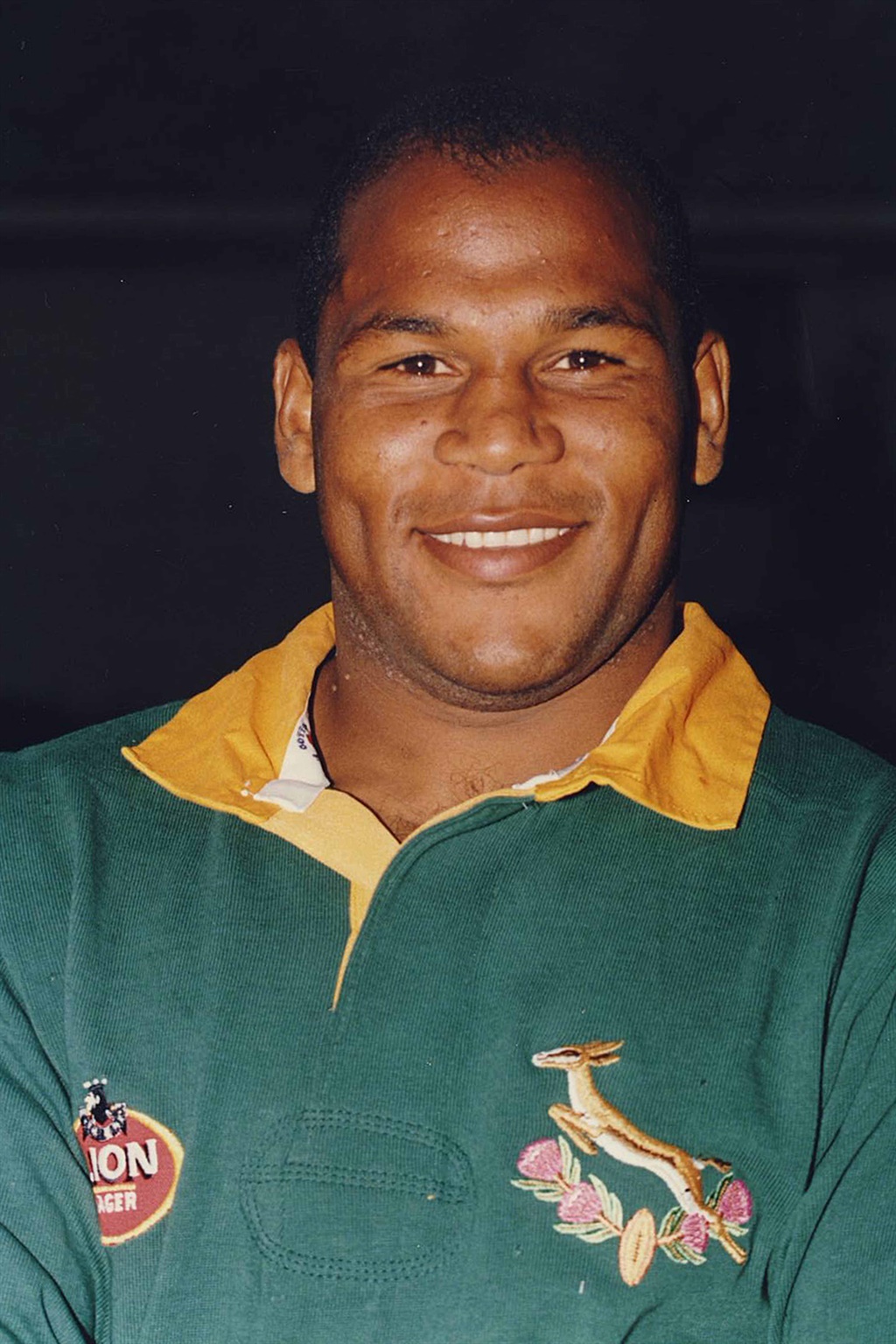
Chester Williams, a 24-year-old left wing from Cape Town, was the 1st black Springbok. In club matches, some opponents had made racist remarks about him. That was not the case when those opponents joined him on the national side: "When we were together as a team, the team-spirit was good. We partied together, we had fun together, we stuck by one another. Those other things happened while we were playing against one another in the Currie Cup, or domestic competitions. But that's in the past now. We have all moved on, and everybody's happy." Mandela could be seen in the stands wearing Williams' Number 11 shirt.
South Africa were put in a group with Australia, Romania and Canada, but beat them all. They beat Western Samoa in the Quarterfinal, 42-14; and a tough France team in the Semifinal, 19-15. They would host the Final on June 24, at Ellis Park in Johannesburg, the home of South African rugby.
But they would have to play New Zealand. They are known as the All Blacks, referring to their uniforms, as they are multicultural, with players of Samoan descent often leading them in a fierce-looking pregame haka dance. (The New Zealand soccer team is the All Whites, again for their uniforms, not their racial makeup.)
The All Blacks had won the 1st Rugby World Cup, in 1987; and finished 3rd in 1991. They came into this edition as the favorites, mainly because they had the man then regarded as the best player in the world: Jonah Lomu. Scotland player Kenny Logan put it this way: "You could talk about Lionel Messi or Cristiano Ronaldo, that's what Jonah was, someone who could change games if you gave him the ball, wherever he was."
A New Zealander of Tongan ancestry, Lomu had been an all-around track and field star as well. At 6-foot-5 and 262 pounds of solid muscle, Lomu was so effective, his playing style attracted attention from NFL scouts and suggested that he might be able to make the transition to American football. He never tried it, though.

Jonah Lomu
(While a few NFL players had played rugby at a scholastic or collegiate level, only 1 professional rugby player has ever played in the NFL: Hayden Smith, an Australian who played 8 seasons for Saracens in London, and 5 games as a tight end for the New York Jets in 2012. Most of those who've tried out have been cut, or only made the practice squad, never getting into a game.)
New Zealand beat Ireland, Wales and Japan in the Group Stage, their win over Japan being a shocking 145-17. They beat Scotland in the Quarterfinal, and England in the Semifinal. So they had beaten all 4 of the United Kingdom's "Home Nations," given that the Ireland team was a combination of players from the Republic of Ireland and British-controlled Northern Ireland. The Semifinal win over England was 45-29, and that 16-point margin was the closest anyone had come to beating them. Lomu scored 4 tries (touchdowns) in that game. He and teammate Mark Ellis had each scored 7 over the course of the tournament.
(For the sake of perspective: In the Spring tournament then known as the Five Nations Championship, England went 4-0, Scotland 3-1, France 2-2, Ireland 3-1, and Wales 0-4. In 2000, Italy were admitted to the competition, giving it the current name: The Six Nations Championship.)
Essentially, it looked like a battle of a great offense against a great defense: New Zealand had outscored their opponents, 315-104; while South Africa had outscored theirs, 129-55. Average that out, and you get New Zealand 180, South Africa 116. Of course, sports usually doesn't work out anywhere near that way, but enough people thought it would that, despite the Springboks being the hosts, the All Blacks were the worldwide betting favorites. The match kicked off at 1:30 PM local time -- 11:30 AM in London, 6:30 AM on the U.S. East Coast, and 11:30 PM in New Zealand.

Ellis Park
South Africa played their own game, relying on their defense. This led to Ruben Kruger, Mark Andrews and Joost van der Westhuizen preventing much progress. Nevertheless, Andrew Mehrtens scored a penalty just 6 minutes in, giving New Zealand a 3-0. In the 11th minute, Joel Stransky tied the game. Each of these men added another penalty to make it 6-6, and in the 32nd minute, Stransky added another, allowing South Africa to take a 9-6 lead into halftime. The policy of "bend, but don't break" seemed to be working.
In the 55th minute, Mehrtens scored another drop goal, to tie it at 9-9. He just missed another late in regular time, but it was still tied at full time, putting the game into extra time. According to the rules, if extra time finished with scores still level, with no side having scored more tries than the other, then the team with the better overall disciplinary record during the tournament would win. That tiebreaker belonged to New Zealand. So South Africa had to score.
But early in the first half, the Springboks were penalized for chasing a Stransky kick from an offside position. From just inside the half-way line, Mehrtens kicked truly to give New Zealand a 12–9 lead. As half-time approached, Stransky put a high kick for his teammates to chase, and from the resultant play, referee Morrison penalized the All Blacks for diving to the ground near the tackle. Right on the stroke of half-time of extra time, Stransky levelled the scores at 12–12.

With 7 minutes remaining, Stransky scored a drop goal from 30 meters out (about 33 yards, in U.S. football terms). No tries were scored in the entire match, but South Africa had won, 15-12. They had held a team that had averaged 63 points a match thus far to 1/5th of that.
After the match, Mandela, wearing a Springbok jersey and cap, as head of state for the host nation, presented the Webb Ellis Cup to Captain Pienaar, to the delight of the diverse crowd of 59,870 people.
The story was depicted in the book Playing the Enemy: Mandela and the Game that Made a Nation, by British journalist John Carlin. A screenplay based on that book was filmed as Invictus in 2009, with Clint Eastwood directing. Morgan Freeman as Mandela, Matt Damon as Pienaar, McNeill Hendricks (who had played 2 matches for the Springboks) as Williams, Eastwood's son Scott Eastwood as Stransky; and Isaac Fe'aunati (credited as Zak Fe'aunati), who made 13 appearances for the Samoa national team, as Lomu.
A surprising number of players from that Final have died young: Ruben Kruger from cancer in 2010, at 39; Joost van der Westhuizen from ALS (known in British Commonwealth countries as "motor neurone disease" and in America as "Lou Gehrig's disease) in 2017, at 45; both James Small and Chester Williams from heart attacks in 2019, at 50 and 49, respectively. South Africa's manager, George "Kitch" Christie, died in 1998, from leukemia, at 58. Mandela died in 2015, at 95.
New Zealand star Jonah Lomu married a white South African woman, but it didn't last. Despite all his fame, and an ability to speak 7 languages, he suffered from kidney disease and lost all his money trying to treat it. He died in 2015, only 40 years old.
*
June 24, 1995 was a Saturday. On this same day, the New Jersey Devils beat the Detroit Red Wings, 5-2, at the Brendan Byrne Arena at the Meadowlands in East Rutherford, New Jersey. This completed a 4-game sweep, and gave the Devils their 1st Stanley Cup. I have a separate entry for this event.
And these Major League Baseball games were played:
* The New York Yankees beat those pesky Toronto Blue Jays, 10-2 at Yankee Stadium. The only home run in the game was hit by the Jays' Joe Carter. But, for the Bronx Bombers, Luis Polonia, Wade Boggs and Dion James each got 2 hits. Boggs got 3 RBIs, and James and Paul O'Neill each got 2. This was in support of Melido Perez.
* The New York Mets, as they so often did in those days, lost to the Atlanta Braves, 5-4 at Atlanta-Fulton County Stadium.
* The Montreal Expos beat the Pittsburgh Pirates, 5-0 at the Olympic Stadium in Montreal. Carlos Perez, brother of Melido and Pascual, pitched a 6-hit shutout.
* The Boston Red Sox beat the Baltimore Orioles, 6-5 at Camden yards in Baltimore.
* The Cincinnati Reds beat the Florida Marlins, 5-2 at Riverfront Stadium in Cincinnati.
* The Detroit Tigers beat the Milwaukee Brewers, 7-2 at Tiger Stadium in Detroit.
* The Chicago White Sox beat the Cleveland Indians, 8-3 at the new Comiskey Park (now Rate Field) in Chicago.
* The Philadelphia Phillies beat the St. Louis Cardinals, 10-9 at Busch Memorial Stadium.
* The Minnesota Twins beat the Kansas City Royals, 6-5 at Kauffman Stadium in Kansas City.
* The Texas Rangers beat the Oakland Athletics, 6-5 at The Ballpark (now Choctaw Stadium) in the Dallas suburb of Arlington, Texas.
* The Chicago Cubs beat the Houston Astros, 5-2 at the Astrodome in Houston.
* The San Diego Padres beat the Colorado Rockies, 2-0 at Jack Murphy Stadium in San Diego. Joey Hamilton pitched a 4-hit shutout.
* The Los Angeles Dodgers beat their arch-rivals, the San Francisco Giants, 7-0 at Dodger Stadium in Los Angeles. Hideo Nomo had the night's best pitching performance, pitching a 2-hit shutout and striking out 13.
* And the Seattle Mariners beat the California Angels, 3-2 at the Kingdome in Seattle.


