Showing posts with label sanford stadium. Show all posts

Thursday, October 20, 2022

October 20, 1962: The Birth of Florida State's "Sod Cemetery"

October 20, 1962: Florida State University beats the University of Georgia, 18-0 at Sanford Stadium in Athens, Georgia, which has a hedge ring surrounding the field, and it is said that, there, football is played "Between the Hedges."

Dean Coyle Moore, a professor at Florida State and a member of the school's athletic board, had told the Seminoles, "Bring back some sod from Between the Hedges at Georgia." The victory complete, team captain Gene McDowell pulled a small piece of grass out, and showed it to Moore at the next football practice. Coach Bill Peterson took the grass to the practice facility, Harkins Field, and planted it. A plaque was made, and the Sod Cemetery was born.

Ever since, every time the Seminoles win an away game in which they are the underdog, or at the University of Florida, or at bowl games, or, since the Atlantic Coast Conference established a championship game, said game, the team captains cut out a small piece of the playing surface, and have it planted inside the gates of Harkins Field.

By 1970, it had been done 23 times in 9 seasons. But in the 5 seasons before Bobby Bowden arrived, 1971 to 1975, it hadn't been done at all. Although the 'Noles lost their 1st 3 games under Bowden, and 6 of their 1st 8, on October 9, 1976, they went up to The Hub and beat Boston College, and took a piece of Alumni Stadium turf home with them -- the 1st artificial turf to be planted there.
Doak Campbell Stadium

The most recent such win was this past September 4, beating Louisiana State (LSU), 24-23 at the Superdome. The Cemetery now includes 106 pieces of sod, from 42 different stadiums (the University of Florida's Ben Hill Griffin Stadium the most frequent victim, with 12), against 39 different opponents (UF the most often, 13), in 20 States (Florida easily the most with 44, Louisiana next with 9), in 10 different bowl games.

*

October 20, 1962 was a Saturday. This was also the day that "Monster Mash" by Bobby "Boris" Pickett hit Number 1. I have a separate entry for that event.

The other college football games played that day included:

Baseball season had ended 4 days earlier, with the New York Yankees beating the San Francisco Giants in Game 7 of the World Series. There were 4 games played in the NBA:

* The New York Knicks lost to the Boston Celtics, 149-116 at the Boston Garden. No Celtic scored more than Sam Jones' 25, but 7 Celtics scored in double figures.

* The Syracuse Nationals beat the Los Angeles Lakers, 108-102 at the Onondaga County War Memorial (now the Upstate University Medical Arena) in Syracuse, New York. Elgin Baylor led all scorerers on the night, with 42 points. This would be the Nationals' last season in Syracuse: For 1963-64, they moved to become the Philadelphia 76ers.

* The Chicago Zephyrs beat the Cincinnati Royals, 113-109 at the Chicago Coliseum. The Zephyrs became the Baltimore Bullets in 1963, the Capital Bullets in 1973, the Washington Bullets in 1974, and the Washington Wizards in 1997. The Royals became the Kansas City-Omaha Kings in 1972, the Kansas City Kings in 1975, and the Sacramento Kings in 1985. Don't worry, there's no test for all of this to be on.

* And the St. Louis Hawks beat the Detroit Pistons, 120-111 at the Kiel Auditorium in St. Louis.

And there were 2 games in the NHL. The Montreal Canadiens beat the Boston Bruins, 7-3 at the Montreal Forum. And the Toronto Maple Leafs beat the Chicago Black Hawks, 3-1 at Maple Leaf Gardens in Toronto. The New York Rangers and the Detroit Red Wings were not scheduled.

Wednesday, October 12, 2022

October 12, 1929: The Athletics' 10-Run Comeback

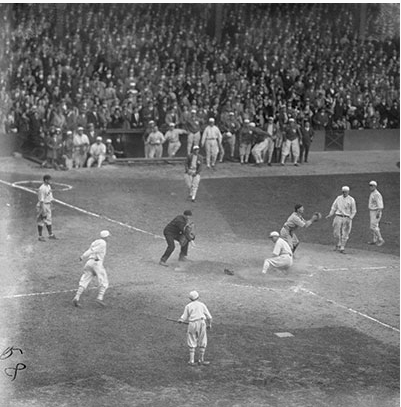
Haas scoring on his inside-the-park homer

October 12, 1929: Game 4 of the 1929 World Series, at Shibe Park in Philadelphia, remains one of the wildest in postseason history. Having started a seemingly washed-up Howard Ehmke in Game 1 and having it work, this time, Philadelphia Athletics owner-manager Connie Mack started 45-year-old Jack Quinn. (Already approaching his 67th birthday, Mack was not yet known as "The Grand Old Man of Baseball," but, apparently, he already had an affinity for veterans.)
Shibe Park

This seemed to work, too, until the 6th inning, when the Chicago Cubs start scoring. By the time they stopped, they led, 7-0. Cub manager Joe McCarthy started Charlie Root, who would later become a victim of McCarthy's Yankees, including Babe Ruth’s "called shot," though this quirk of history/legend does not do Root justice, as he was a fine pitcher for many years. Root entered the bottom of the 7th with an 8-0 lead.

Then the A's came storming back. Slugging left fielder Al Simmons led off with a home run. Jimmie Foxx singled. Edmund "Bing" Miller singled. Jimmy Dykes singled Foxx home. Joe Boley singled Miller home. Mack sent George Burns (a former All-Star outfielder, not the comedian) up to pinch-hit for pitcher Eddie Rommel. He popped up, but Max Bishop singled Dykes home. It was 8-4 Cubs.

McCarthy took Root out, and brought in Art Nehf, the ace pitcher of the New York Giants' 1921 and '22 World Champions. Lewis "Hack" Wilson, a great slugger but not the best of outfielders even when not drunk or hungover, misjudged a fly ball from George "Mule" Haas, and it turned into a 3-run inside-the-park home run, making the score 8-7 Cubs.

Simmons began jumping around in the dugout, yelling, "We're back in the game, boys!" His momentum caused him to crash into Mack – as I said, nearly 67, if not the elderly figure some of us imagine him to have always been. Simmons apologized profusely, but Mack, a former big-league catcher and familiar with ballplayers crashing into him, was just as enthused, and told him, "That's all right, Al."

Mickey Cochrane drew a walk, and McCarthy brought in a 3rd pitcher, John "Sheriff" Blake. The A's had now batted around, and Simmons singled. Foxx singled Cochrane home, and the game was tied. McCarthy brought in a 4th pitcher, Pat Malone. Malone would later help McCarthy win 2 Pennants with the Yankees. This time, he hit with Miller with a pitch, and allowed a double to Dykes that scored Simmons and Foxx.

Malone finally ended the onslaught by striking out Boley and Burns, but 10 runs had scored, and that remains a Series record for a single inning. Mack brought in his ace Lefty Grove, to relieve and finish the Cubs off, and 10-8 remained the final score. The A's closed the shellshocked Cubs down 2 days later -- not being able to play the next day, because sports on Sunday were still illegal in Pennsylvania until 1933.

In 1981, baseball historian John Thorn published Baseball's 10 Greatest Games. He included this game as one of them.

The 1929 Philadelphia Athletics are remembered as one of the greatest teams in baseball history. They might have been the greatest non-Yankee team in American League history. They won the World Series again the next season, beating the St. Louis Cardinals. They won a 3rd straight Pennant in 1931, with 107 regular-season wins, but lost Game 7 of the World Series, to the Cardinals.

They finished a distant 2nd to the Yankees in 1932, and Mack then broke up his team due to the financial constraints of the Great Depression. The team would not win another Pennant until 1972, 41 years -- and two moves to other cities -- later.

In 1978, the Philadelphia Phillies established the Philadelphia Baseball Wall of Fame. From then until 2003, they elected an Athletics figure every year, starting with Mack. From the 1929-31 dynasty, they also elected Jimmie Foxx, Lefty Grove, Al Simmons, Mickey Cochrane, Jimmy Dykes, Eddie Rommel, Bing Miller, George Earnshaw and Rube Walberg. Mack, Foxx, Grove, Simmons, Cochrane and Dykes have also been elected to the Philadelphia Sports Hall of Fame.

UPDATE: The Cubs also have a team Hall of Fame. Inducted from their 1929 Pennant winners have been catcher Charles "Gabby" Hartnett, 1st baseman Charlie Grimm, 2nd baseman Rogers Hornsby, left fielder Riggs Stephenson, center fielder Lewis "Hack" Wilson, right fielder Hazen "Kiki" Cuyler, pitcher Charlie Root, manager Joe McCarthy, team owner William Wrigley Jr., executive Margaret Donahue, and public address announcer Pat Pieper.

*

October 12, 1929 was a Saturday. This was the only baseball game played that day. Pro football was in midweek. Pro basketball was still strictly minor-league. And the NHL season didn't begin until November 14.

But there were college football scores. Most notably, Sanford Stadium opened in Athens, Georgia. The University of Georgia opened it with a 15-0 win over Yale. I have a separate entry for this event. Other notable games played that day:

* The top team in the South, Tulane University, beat Mississippi A&M, 34-0 at Tulane Stadium in New Orleans. (A&M would rename itself Mississippi State in 1932.)

* Notre Dame beat Navy, 14-7 at Municipal Stadium in Baltimore. From 1950 to 1954, piece by piece, it was converted into Memorial Stadium, longtime home of the Orioles and Colts. Notre Dame went 9-0, and were retroactively declared National Champions.

* The University of Pittsburgh also claim a National Championship for this season. They went 9-1, including on this day, winning their annual "Backyard Brawl" with West Virginia, 27-7.

* Purdue beat Michigan, 30-16 at Ross-Ade Stadium in West Lafayette, Indiana. This game decided the Big Ten Conference title.

* The top team on the Pacific Coast, USC beat the University of Washington, 48-0 at Husky Stadium in Seattle.

* In New York City, Fordham beat New York University, 26-0 at the Polo Grounds.

* And City College of New York lost to St. Lawrence University, 22-0 at Weeks Field in Canton, New York.

* In New Jersey, Princeton lost to Brown, 13-12 at Palmer Stadium in Princeton.

* And Rutgers lost to Holy Cross, 20-3 at Fitton Field in Worcester, Massachusetts.

October 12, 1929: Sanford Stadium Opens In Georgia

October 12, 1929: Sanford Stadium opens, on the campus of the University of Georgia in Athens, 72 miles east of downtown Atlanta.

Named for Dr. Steadman Vincent Sanford, an English professor and an early supporter of the school's athletic program, the University of Georgia opens it with 15-0 win over Yale in front of 30,000 fans. Since UGa had been founded by missionaries from Yale, and had also borrowed Yale's team name of Bulldogs, they were the invited guests.

Known for the privet hedges that surround the field, and the end zone containing the crypts for the deceased Uga the Bulldog mascots, Sanford Stadium has seen several expansions and renovations that have put its current seating capacity at 92,746. It hosted the soccer games of the 1996 Olympics, even though Athens and Atlanta, despite being in the same State, are not all that close.
With stars like Frankie Sinkwich, Charlie Trippi, Theron Sapp, Fran Tarkenton, Jake Scott, Herschel Walker, Garrison Hearst, Champ Bailey, Knowshon Moreno and Brock Bowers, the Georgia Bulldogs have won 15 Southeastern Conference Championships since moving in, as well as the 1942, 1980 and 2021 National Championships. They've also had All-Americans named Johnny Carson (not the talk show host), Randy Johnson (not the baseball pitcher) and George Patton (not the general).

UPDATE: They were SEC and National Champions again in 2022, and SEC Champions again in 2024. So that's 17 SEC titles, and 4 National Championships.

*

October 12, 1929 was a Saturday. Napoleon "Nappy" Brown, the original singer of the rhythm & blues songs "Don't Be Angry" and "The Night Time Is the Right Time," was born on this day.

Game 4 of the World Series was played at Shibe Park in Philadelphia. Going into the bottom of the 7th inning, the Chicago Cubs led the Philadelphia Athletics, 8-0. The A's set a Series record by scoring 10 runs in the inning, and won the game, 10-8. Since playing professional sports was still illegal in Pennsylvania until 1933, the A's could not wrap up the Series the next day, so they wrapped it up the day after that, on Monday, October 14, in Game 5.

Pro basketball was still strictly minor-league. And the NHL season didn't begin until November 14. But there were other college football scores, including the following:

* The top team in the South that season, Tulane University, beat Mississippi A&M, 34-0 at Tulane Stadium in New Orleans. (A&M would rename itself Mississippi State in 1932.)

* Notre Dame beat Navy, 14-7 at Municipal Stadium in Baltimore. From 1950 to 1954, piece by piece, it was converted into Memorial Stadium, longtime home of the Orioles and Colts. Notre Dame went 9-0, and were retroactively declared National Champions.

* The University of Pittsburgh also claim a National Championship for this season. They went 9-1, including on this day, winning their annual "Backyard Brawl" with West Virginia, 27-7.

* Purdue beat Michigan, 30-16 at Ross-Ade Stadium in West Lafayette, Indiana. This game decided the Big Ten Conference title.

* The top team on the Pacific Coast, USC beat the University of Washington, 48-0 at Husky Stadium in Seattle.

* In New York City, Fordham beat New York University, 26-0 at the Polo Grounds.

* And City College of New York lost to St. Lawrence University, 22-0 at Weeks Field in Canton, New York.

* In New Jersey, Princeton lost to Brown, 13-12 at Palmer Stadium in Princeton.

* And Rutgers lost to Holy Cross, 20-3 at Fitton Field in Worcester, Massachusetts.

December 31, 1999 & January 1, 2000: The Millennium

December 31, 1999:  The Millennium arrives. The people of planet Earth survived. At a terrible cost. But we hadn't destroyed ourselves. ...