Showing posts with label civil war. Show all posts

Tuesday, September 6, 2022

September 7, 1876: The Great Northfield, Minnesota Raid

The James Brothers: Jesse (left) and Frank

September 7, 1876: Jesse James, his brother, and his friends decide to rob a bank. It doesn't go so well.
Jesse James and his brother Frank were from Kearney, Missouri, outside Kansas City. During the American Civil War, when Missouri remained in the Union but had Southern sympathies, the James Brothers joined William Quantrill and his group, Quantrill's Raiders. They called themselves "bushwhackers," but, in modern terms, they were terrorists. Shortly after the war ended, Union troops shot Quantrill, who took nearly a month to die as a result of his wound.
The James brothers made it back to Missouri, and brought Cole Younger into their operations. He brought in his brothers, Bob and John. They robbed banks and trains all over what would now be called the Midwest. In modern terms, they were an organized crime family. Not Italian, but a Missouri Mafia, a Confederate Cosa Nostra.
The Younger Brothers
John Younger had already been killed in an ambush in 1874. In 1876, Bob Younger wanted to go well outside the James-Younger Gang's usual territory, to the First National Bank in Northfield, Minnesota, about 40 miles south of Minneapolis.
His explanation was its connection to 2 Union Generals who had become Republican politicians: Benjamin Franklin Butler, a Congressman from Massachusetts (and later its Governor), who had famously insulted the women of New Orleans during the war; and Governor Adelbert Ames of Mississippi, who supported civil rights for black people, including freed slaves.
Ames had married Butler's daughter, and his father owned the Ames Mill in Northfield. There was a rumor that the elder Mills had deposited $50,000 in cash in that bank. (About $1.36 million in 2022 dollars, a very tempting sum.)
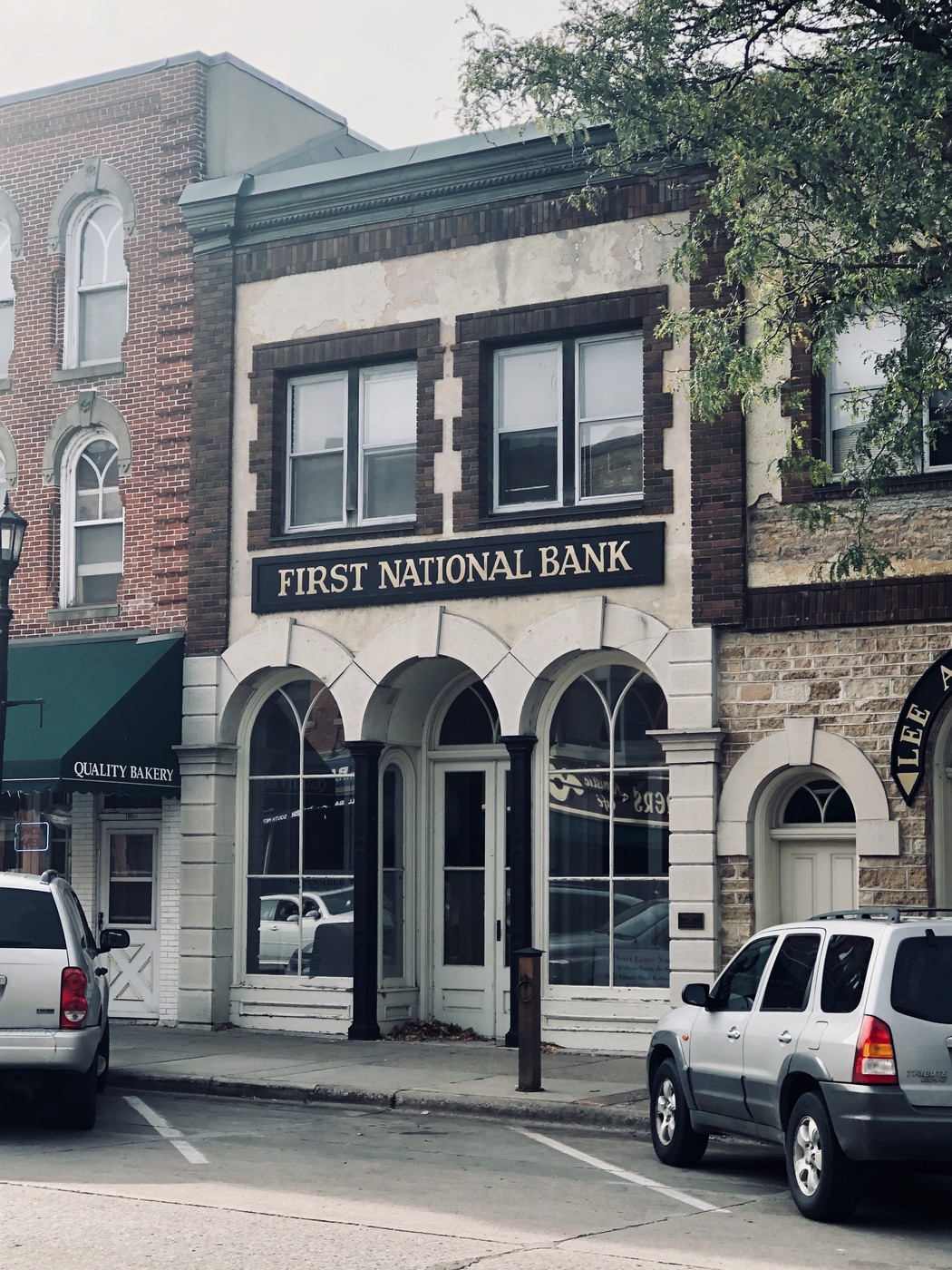
The bank building, preserved
Cole tried to talk his brother out of the plan, thinking it too risky. But Bob refused to back down. Reluctantly, Cole agreed to go, writing to their brother Jim, then in California, to come home. Jim had never wanted anything to do with Cole's outlaw activities, but he agreed to go, out of family loyalty.
Hardware store merchant J.S. Allen saw the outlaws, figured out what was happening, and yelled, "Get your guns boys, they're robbing the bank!" That spurred Northfield men into action, arming themselves with long guns in a street shootout that lasted around 7 minutes, leaving 2 gang members dead in the street: Clell Miller and Bill Caldwell. Bob Younger's horse was killed, and Frank James murdered First National Bank acting cashier Joseph Lee Heywood. Swedish immigrant Nicolaus Gustafson was shot in the head by Cole Younger, and died of his injuries four days later. Bank teller Alonzo Bunker was shot in the shoulder as he tried to escape, but survived.
The James brothers escaped west into the Dakota Territory, while the remaining gang members were killed or taken into custody. The Younger brothers pleaded guilty on November 20, 1876, and were sentenced to life terms in prison.
Jesse James was killed by a supposed ally in 1882. Bob Younger died in prison of tuberculosis in 1889. Cole and Jim Younger were paroled in 1901. Jim committed suicide in 1902. Cole traveled to Missouri, where he joined a "Wild West" show with Frank James. Frank died in 1915, and Cole the following year.
The raid has been portrayed, with varying levels of accuracy, in 3 films: The True Story of Jesse James in 1957, The Great Northfield Minnesota Raid in 1972, and The Long Riders in 1980.
*
September 7, 1876 was a Thursday. The only major sports league in North American was baseball's National League, but no games were played on this day.

Thursday, July 14, 2022

July 15, 1870: The Reunion of the Union Is Completed

The Flag of the United States, with 37 Stars,
in use from July 4, 1867 to July 4, 1877,
including when most of the former Confederate States
were readmitted to the Union.

July 15, 1870: The last of the States that had seceded from the United States of America to form the Confederate States of America is readmitted, completing the reunion of the Union.

Those States seceded over what they called "States' Rights," but each one's Ordinance of Secession mentioned slavery as one of those "rights." The secessions began after the election of Abraham Lincoln, who opposed the future expansion of slavery, as the President of the United States on November 6, 1860.

This was the order of secession:

1. December 20, 1860: South Carolina.
2. January 9, 1861: Mississippi.
3. January 10, 1861: Florida.
4. January 11, 1861: Alabama.
5. January 19, 1861: Georgia.
6. January 26, 1861: Louisiana.
7. February 23, 1861: Texas.

Lincoln was Inaugurated on March 4. On April 12, Confederate ships fired on Fort Sumter in Charleston, South Carolina, starting the American Civil War. This was followed by more secessions:

8. May 6, 1861: Arkansas.
9. May 20, 1861: North Carolina.
10. May 23, 1861: Virginia.
11. June 1, 1861: Tennessee.

On January 3, 1861, Delaware voted not to secede. On January 29, Kansas was admitted as the 34th State in the Union. On March 19, Missouri overwhelmingly vote to remain in the Union. On April 29, Maryland voted not to secede.

This was key: The District of Columbia, the seat of the Union's government, was between Maryland and Virginia, and Virginia was already considering secession. If both had seceded, the federal government would be trapped. As it was, when Virginia seceded, the U.S.A. literally had its capital on the border with an enemy nation. Fortunately, the C.S.A. didn't have engineers capable of building a bridge across the Potomac River to invade. Nor did they have cannons capable of reaching the U.S. Capitol or the White House.

On May 20, Kentucky declared its neutrality. But on November 18, delegates from 68 of Kentucky’s 110 Counties met, passed an ordinance of secession, adopted a new state seal, and elected a secessionist as Governor. Kentucky was admitted to the Confederacy on December 10. However, the elected State government did not secede, and Kentucky remained in the Union.

Still, the Confederate Flag -- and its variation that is more familiar today, the Confederate Battle Flag -- had 13 stars, one for each State that had seceded, and one each for Kentucky and Missouri, which had not. So the States of Delaware, Maryland, Kentucky and Missouri remained in the Union, despite still keeping slavery legal within their borders.

Several Western Counties in Virginia voted to secede from the rest of the State, and on June 20, 1863, those Counties, collectively, were admitted to the Union as West Virginia, the 35th State. This included Harpers Ferry, home to the federal arsenal that abolitionist John Brown tried and failed to capture in 1859.

The idea that Virginia went to the Confederacy and West Virginia stayed loyal to the Union will seem strange to people whose experience watching those States only goes back far enough to know Virginia as a State regularly voting Democratic and West Virginia as one regularly voting Republican.

Nevada was admitted as the 36th State on October 31, 1864. Because it was admitted during the Civil War, and immediately sent troops to the Union Army, the State’s motto is "Battle Born."

The Confederate States of America surrendered, piece by piece, in the Spring of 1865. This was the order of readmission to the Union, based on acceptance of the Constitution of the United States, including the Reconstruction Amendments: The 13th, prohibiting slavery; the 14th, guaranteeing citizenship and equal protection of the laws to all people born in the United States; and the 15th, guaranteeing the right to vote to all male American citizens age 21 and up:

1. July 24, 1866: Tennessee.
2. June 22, 1868: Arkansas.
3. June 25, 1868: Florida.
4. July 4, 1868: North Carolina.
5. July 9, 1868: Louisiana.
6. July 9, 1868: South Carolina (same day as Louisiana).
7. July 13, 1868: Alabama.
8. January 26, 1870: Virginia.
9. February 23, 1870: Mississippi.
10. March 30, 1870: Texas.
11. July 15, 1870: Georgia.

During this process, another State was admitted to the Union: Nebraska, the 37th State, on March 1, 1867. The 38th wouldn’t come until 1876, Colorado.

Of the 33 States in the Union when South Carolina became the 1st to secede, slavery had been banned in 18. Of the 37 States in the Union when Georgia became the last to rejoin, it had been banned in all 37.

So 1870 marked the final reunion of the Union. On October 12, Robert E. Lee, the leading General of the CSA, died from the effects of a stroke, in Lexington, Virginia. He was 63 years old. Jefferson Davis, the one and only President of the C.S.A., previously a U.S. Senator from Mississippi and Secretary of War under President Franklin Pierce, lived on until 1889.

*

July 15, 1870 was a Friday. By an odd coincidence, this was also the day that Manitoba became a Province of Canada, ending the Red River Rebellion. I have a separate entry for this event.

The only organized team sport in America at this point was baseball, and it was just starting the professional era. The difference between those teams that had turned pro and those that hadn't became stark. The only score I can find for this historic day involves the 1st team to openly turn pro, the Cincinnati Red Stockings, who beat the Eagle Base Ball Club of Louisville, Kentucky, 39-8. That season, against pro teams, the Red Stockings went 27-6; against amateur teams, they went 40-0.

Monday, May 30, 2022

May 30, 1922: The Lincoln Memorial Is Dedicated

May 30, 1922: The Lincoln Memorial is dedicated in Washington, D.C. The monument to the 16th President of the United States, who defeated the Confederate States of America, ended slavery, and restored the Union was designed by Henry Bacon. His seated statue inside was sculpted by Daniel Chester French.

Inside the south wall of the statue's chamber is an inscription of his Gettysburg Address of November 19, 1863; inside the north wall, one from his Second Inaugural Address of March 4, 1865. Above the statue is an inscription written by American historian Royal Cortissoz: "In this temple, as in the hearts of the people for whom he saved the Union, the memory of Abraham Lincoln is enshrined forever."
There are a total of 87 steps: 29 from the Reflecting Pool to the Plaza, and 58 steps from the Plaza to the chamber. The Memorial It has 36 columns, representing each of the 36 States in the Union in 1865, including the ones in rebellion. There are 48 festoons above the columns, representing the 48 States in the Union in 1922.

President Warren G. Harding speaks at the dedication ceremony. So does the Chief Justice of the United States, former President William Howard Taft, who had been head of the commission to build it. The other living former President, Woodrow Wilson was ill, and did not attend.

Black people were permitted to attend, in a segregated section guarded by U.S. Marines.

Robert Todd Lincoln, the sole surviving child of Abraham Lincoln, did not want to attend. He had been nearby when his father was assassinated in 1865. He had been in the room when President James Garfield was assassinated in 1881. He had been nearby when President William McKinley was assassinated in 1901. He did not want to jinx another President. Harding and Taft talked him into coming.

On August 2, 1923, Harding died -- not from an assassination, but a heart attack. Robert Todd Lincoln swore he would never meet another President, and died in 1926 without doing so.

In 1929, the $5 bill was redesigned, with Lincoln's portrait on the front, and his Memorial on the back. In 1909, the 100th Anniversary of his birth, the Lincoln Penny replaced the Indian Head Penny. In 1959, the 150th Anniversary of his birth, the back side of the Lincoln Penny, which had stalks of wheat since its introduction in 1909, was replaced with the Memorial.

The Memorial has been the site of many demonstrations, including:

* April 9, 1939: Marian Anderson's nationally-broadcast Easter Concert, after she was denied the right to sing at nearby Constitution Hall.
* August 28, 1963: The March On Washington for Jobs and Freedom, highlighted by the "I Have a Dream" speech by Dr. Martin Luther King, with an inscription now on the spot where he delivered it. Marian Anderson also sang there in that ceremony.
* October 21, 1967: A demonstration against the Vietnam War, a fictionalized version of which was depicted in the film Forrest Gump.
* July 4, 1970: A "counter-counterculture" demonstration, a "celebrate America" event headlined by President Richard Nixon, and clergymen like the Rev. Billy Graham and Bishop Fulton Sheen.

Other notable memorials to Lincoln a statue of him outside the Essex County Courthouse in Newark, New Jersey, sculpted by Gutzon Borghlum, who later had Lincoln's face carved on Mount Rushmore outside Rapid City, South Dakota, along with those of George Washington, Thomas Jefferson and Theodore Roosevelt.
A commemorative issue of Time magazine, 1960,
for the 100th Anniversary of Lincoln's election

The capital of the State of Nebraska is named for Lincoln. Countless other towns are named for him. Schools in black neighborhoods were named for him, as is the high school in Brooklyn that represents the neighborhoods of Brighton Beach and Coney Island. There was a Lincoln Highway, stretching from Times Square in New York to Lincoln Park in San Francisco. The Lincoln Tunnel goes under the Hudson River, connecting Manhattan to Weehawken, New Jersey.

Ford Motor Company issued a line of luxury cars named Lincoln. When he became Vice President in 1973, Gerald Ford -- not related to that Ford family -- told the nation, "I'm a Ford, not a Lincoln." When the laughter inside the Capitol subsided, he added, "My addresses will never be as eloquent as Mr. Lincoln's. But I will do my very best to equal his brevity and his plain speaking."

Ford became President the following year, and, in 1976, running for a term of his own, campaigned aboard a customized Amtrak car named the Honest Abe. Since 1909, the 100th Anniversary of his birth, Lincoln has appeared on the penny, America's one-cent coin. Since 1914, he has appeared on the $5 bill. On October 14, 2004, 139 years after his death, the Abraham Lincoln Presidential Library and Museum opened in his adopted hometown of Springfield, Illinois.

There have been 2 ships named the USS Abraham Lincoln: A submarine in service from 1961 to 1981, and a nuclear-powered aircraft carrier, CVN-72, a.k.a. the Abe, in service since 1988. There was a troop transport named USS President Lincoln, sunk by German torpedoes in World War I in 1918.

Just as more books have been written about Lincoln than any other American, so have more films been made about him. Among the actors who have played him: Francis Ford in 9 silent films from 1909 to 1915, Walter Huston (father of John, grandfather of Anjelica) in Abraham Lincoln in 1930, Frank McGlynn in 5 films in 1936 and '37, John Carradine in Of Human Hearts in 1938, Henry Fonda in Young Mr. Lincoln in 1939, Raymond Massey in Abe Lincoln in Illinois in 1940 and How the West Was Won in 1962, Hal Holbrook in Carl Sandburg's Lincoln in 1974 and North and South in 1985, Gregory Peck in The Blue and the Gray in 1982, Sam Waterston in Gore Vidal's Lincoln in 1988, Lance Henriksen in The Day Lincoln Was Shot in 1998, Brendan Fraser in Bedazzled in 2000, Glenn Beck in National Treasure: Book of Secrets in 2007, and Daniel Day-Lewis in Lincoln in 2012.

Even science fiction, fantasy and time travel stories have gotten in on the act: Austin Green on The Twilight Zone in 1961, Robert Marsden on Doctor Who in 1965, Lee Bergere on Star Trek in 1969, Robert V. Barron in Bill & Ted's Excellent Adventure in 1989, David Selby on Touched By an Angel in 1998, David Livingstone on Supernatural in 2009, Benjamin Walker in Abraham Lincoln: Vampire Hunter, both in 2012, and Michael Krebs on Timeless in 2016.

Though born in Kentucky, Lincoln was the 1st President to represent Illinois. He is usually listed as 1 of the 3 greatest Presidents, along with George Washington and Franklin Delano Roosevelt, so he is still the greatest politician from Illinois.

Hugh McCulloch was the last survivor of Lincoln's Cabinet. He served as Secretary of the Treasury for the length of what was meant to be Lincoln's 2nd term, including under the next President, Andrew Johnson, 1865-69. He briefly returned to the office, 1884-85, under President Chester Arthur. He lived until 1895.

In a 2010 episode of the YouTube series Epic Rap Battles of History, "Nice" Peter Shukoff played Lincoln, against "Epic" Lloyd Ahlquist as actor and martial arts master Chuck Norris.

*

May 30, 1922 was a Tuesday. It was also Memorial Day: Until 1970, Memorial Day was celebrated on May 30, regardless of the day of the week. Since 1971, it has been on the last Monday in May, regardless of the date: It can be anywhere from May 25 to May 31.

Football, basketball and hockey were out of season. These baseball games were played that day, many of them doubleheaders, as was once traditional for baseball on Memorial Day:

* The New York Yankees split a doubleheader with the Philadelphia Athletics at the Polo Grounds. The Yankees won the opener, 3-2, behind Hall of Fame pitcher Waite Hoyt. The A's won the nightcap, 4-3, with Fred Heimach outpitching Bob Shawkey. Babe Ruth went 3-for-8 in the doubleheader, including a home run in a losing cause in the nightcap.

* The New York Giants split a doubleheader with the Philadelphia Phillies at Baker Bowl in Philadelphia. The Phils won the 1st game, 9-8 in 10 innings. The Jints won the 2nd game, 16-7.

* The Brooklyn Robins (as the Dodgers were known during Wilbert Robinson's tenure as manager, 1914-31) swept a doubleheader from the Boston Braves at Ebbets Field, 9-3 and 8-4.

* The Washington Senators swept a doubleheader from the Boston Red Sox at Fenway Park, 7-4 and 5-3. Amazingly, they did it without Walter Johnson pitching in either game.

* A doubleheader was split at Forbes Field in Pittsburgh. The Cincinnati Reds won the 1st game, 9-3. The Pittsburgh Pirates won the 2nd game, 7-3.

* The Chicago White Sox swept a doubleheader from the Cleveland Indians at League Park in Cleveland, 4-0 and 7-6. Gorham "Dixie" Leverett pitched a 6-hit shutout in the opener. Tris Speaker was 1-for-6 with 2 walks over the 2 games.

* The Chicago Cubs swept the St. Louis Cardinals, 4-1 and 3-1 at Cubs Park in Chicago. (It was renamed Wrigley Field in 1926.)

* And a doubleheader was split at Sportsman's Park in St. Louis. The Detroit Tigers won the 1st game, 6-5. The St. Louis Browns won the 2nd game, 2-1 in 16 innings. Over the 2 games, George Sisler went 6-for-10 for the Browns, while Ty Cobb, also the Tigers' manager at the time, was injured and didn't put himself in either game.

December 31, 1999 & January 1, 2000: The Millennium

December 31, 1999:  The Millennium arrives. The people of planet Earth survived. At a terrible cost. But we hadn't destroyed ourselves. ...