Showing posts with label texas. Show all posts

Thursday, December 8, 2022

December 8, 1914: The Southwest Conference Is Founded

December 8, 1914: The Southwest Intercollegiate Athletic Conference is founded at the Rice Hotel in Houston, Texas, after previous organizing meetings in May at the Oriental Hotel in Dallas. L. Theo Bellmont, the athletic director at the University of Texas, convened the meetings that led to the league's foundation. 

The 8 original members were the University of Arkansas, in Fayetteville; Baylor University, of Waco, Texas; the University of Oklahoma, in Norman; Oklahoma A&M University, of Stillwater; Rice University, of Houston; Southwestern University; of Georgetown, Texas; the University of Texas, in Austin; and Texas A&M University, in College Station.

Southwestern dropped out in 1917. Southern Methodist University, a.k.a. SMU, of Dallas, joined in 1918. Oklahoma left for the league that became the Big Eight Conference in 1919, and Oklahoma A&M followed them in 1925, becoming Oklahoma State in 1958. Phillips University, of Enid, Oklahoma, was a member only for the 1920-21 schoolyear. Texas Christian University, a.k.a. TCU, of Fort Worth, joined in 1923.

That membership remained steady until 1956, when Texas Tech University, of Lubbock, were admitted. The University of Houston joined in 1972. So it was a 9-team league, with Arkansas and 8 Texas-based teams.

From its founding in 1937 to 1995, the Cotton Bowl Classic in Dallas usually invited the SWC football champion to participate. Of those 59 appearances: Texas made 16, Texas A&M 9, Arkansas 8, TCU 6, SMU 4, Rice 4, Houston 4, and Baylor and Texas Tech 2 each. There was no SWC team in the 1940 Cotton Bowl.

The Texas Longhorns dominated in football, and so every other school in the league hated them. Their rivalry with Texas A&M, usually on Thanksgiving Weekend, sometimes on Thanksgiving Day, inspired the saying, "If football is a religion in Texas, then this game is a holy war." The Longhorns also built a significant rivalry with Arkansas, culminating in the 1969 "Game of the Century." But many Texas fans consider Oklahoma, then of the Big 8, to be their biggest rival.

The intra-"Metroplex" rivalry of SMU in Dallas and TCU in Fort Worth is pretty intense, and resulted in an earlier "Game of the Century" in 1935. And intra-city rivals Houston and Rice can get pretty heated.

Houston made a pair of NCAA Final Fours before joining the SWC, and then became the league's premier basketball school. Texas, Texas A&M and Rice became great baseball schools, while Arkansas became one of the country's greatest track programs.

In 1991, Arkansas announced it was leaving the SWC for the Southeastern Conference (SEC). That left the SWC with only the 8 Texas schools. They could have added another school from the Lone Star State, possibly the University of Texas at El Paso: UTEP were then a member of the Western Athletic Conference, and their (relative) proximity to New Mexico and New Mexico State made for easier and cheaper travel.

Instead, in the 1995-96 schoolyear, Texas, Texas A&M, Texas Tech and Baylor applied for, and received, membership to the Big 8. The 4 remaining SWC schools -- Texas Christian, Southern Methodist, Houston and its crosstown rival Rice -- joined other leagues: Houston joined Conference USA, and the other 3 joined the WAC, though all would join C-USA at some point.

Thus did 2 of the great college sports leagues, the Big 8 and the SWC, come to an end, but a better league, the Big Twelve Conference, was formed. The 4 Texas schools and the 2 Oklahoma schools formed the South Division, the other teams the North Division.

But that league did not hold: Nebraska went to the Big Ten, Colorado went to the Pac-10, and Texas, Texas A&M and Oklahoma all left for the Southeastern Conference. The Big 12 had a connection to the old SWC, but little remains of that Texas (and Arkansas) collegiate sports tradition.

*

December 8, 1914 was a Tuesday. Baseball season was over. Football was in midweek. Professional basketball barely existed. There was professional hockey, in the forms of Eastern Canada's National Hockey Association, and Western Canada's Pacific Coast Hockey Association.

The NHA season didn't begin until December 26, but the PCHA season opened on December 8, with 1 game: The Vancouver Millionaires beat the Portland Rosebuds, 6-3 at the Portland Ice Arena. The Millionaires would win the PCHA title, and beat the NHA Champion Ottawa Senators for the Stanley Cup. No Vancouver team has won the Cup since.

This was also the day that Philadelphia Athletics manager Connie Mack, needing a quick infusion of cash, sold his best player, 2nd baseman Eddie Collins, ending his 1st dynasty, and beginning the A's tradition of "fire sales." I have a separate entry for that event.

Tuesday, December 6, 2022

December 6, 1969: Texas vs. Arkansas, "The Game of the Century"

December 6, 1969: One of college football's occasional "Games of the Century" is played.

They seemed to be coming every year. 1966 saw Michigan State vs. Notre Dame, in the Big Ten region if not a Big Ten game in its own right. 1967 saw USC vs. UCLA, in the league now known as the Pac-12. Now, it was Texas vs. Arkansas, for the Championship of the Southwest Conference.

Darrell Royal had been a quarterback under Bud Wilkinson at the University of Oklahoma. He never played pro football, but went into coaching. His 1st head coaching job was with the Edmonton Eskimos of the Canadian Football League of 1953. He must have gotten tired of the cold, because he went to Mississippi State University in 1954, and the University of Washington in 1956.

In 1957, he was hired at the University of Texas, one of Oklahoma's main rivals. By 1963, he had made Texas National Champions. In 1967, he installed the wishbone offense, and made his team nearly unstoppable. They won or shared the SWC title in 1959, 1961, 1962, 1963 and 1968.
They roared through the 1969 season, hanging 69 points on Texas Christian (TCU), 56 each on Navy and Baylor, 49 each on Texas A&M and Texas Tech, and 45 on Southern Methodist (SMU). But they only played 1 ranked team all season, beating Number 8 Oklahoma, 27-17 at the Cotton Bowl in Dallas. After beating A&M away on Thanksgiving Day, they were 9-0, and ranked Number 1 in the nation. They went into the game with an 18-game winning streak, their last loss to Texas Tech early in the 1968 season.

Frank Broyles had also been a college quarterback, at Georgia Tech, but not a pro one. He got his 1st head coaching job in 1957, at the University of Missouri. After just 1 year, the University of Arkansas was impressed enough to hire him away.

At the time, the Southwest Conference had 9 teams, and Arkansas, in Fayetteville, was the only 1 of them not in the State of Texas. The others were: Texas, in Austin; Texas A&M, in College Station; Texas Tech, in Lubbock; Texas Christian University (TCU), in Fort Worth; Southern Methodist University (SMU), in Dallas; Baylor, in Waco; and 2 schools in Houston, Rice University and the University of Houston.

But Broyles' Razorbacks held their own, winning the SWC title in 1959, 1960, 1961, 1964, 1965 and 1968, and taking the National Championship in a split poll in 1964. (Alabama won the other poll.) Future Dallas Cowboys head coach Jimmy Johnson and owner Jerry Jones played on his '64 National Champions.
Arkansas also had a fabulous season in 1969. Its offense wasn't as high-powered, but they scored 55 points on the University of Tulsa, 52 on Wichita State, 39 on Oklahoma State, 35 on Texas A&M, 33 on Texas Tech, and 30 on Rice. After beating Texas Tech on Thanksgiving, they were 9-0, and ranked Number 2, behind only Texas. They went into the game with a 15-game winning streak, their last loss being to Texas the season before.

The 1969 season marked the 100th Anniversary of college football, with Rutgers having beaten Princeton in the first game in 1869. Beano Cook, then an executive with ABC Sports, suggested moving the Texas-Arkansas game, normally played in October, to the 1st weekend in December, a week after most other teams had finished playing. The teams agreed, because it meant the entire country would be focused on their game, not on another.

And moving the game turned out to be a lucky break. Because, on November 22, Ohio State, defending National Champions and ranked Number 1, were upset by their arch-rivals, Michigan, handing Michigan the Big 10 title. That moved Texas up to Number 1 and Arkansas up to Number 2, without either of them even playing. All each team had to do was win their respective game on Thanksgiving, which they did: The 'Horns beat A&M 49-12, and the Hogs beat Texas Tech 33-0.

And so, on Saturday, December 6, 47,500 people shoehorned themselves into Razorback Stadium in Fayetteville. That was about 5,000 above normal capacity at the time, and later expansions have made it now a 76,000-seat facility.
Razorback Stadium, 1969. The practice fields in the upper left corner
are where Marine One landed, depositing Nixon.

Among those 47,500 fans, his Marine One helicopter landing on an adjacent practice field a few minutes before the scheduled kickoff, was the nation's Number 1 football fan, a former offensive lineman at Whittier College outside Los Angeles, the President of the United States, Richard Nixon. He had said that week that he would give a plaque to the winning coach, declaring them the National Champions. Of course, this was before the New Year's Day bowl games could have messed that up. 

Also among the fans was the Rev. Billy Graham, who delivered a pregame prayer over the public address system. Graham had a degree from Wheaton College, in Wheaton, Illinois, hometown of football legend Red Grange, although Grange went to the University of Illinois.

Not among the fans was Bill Clinton, then 23 years old, himself a future President, and a future Governor of Arkansas. At some point during his political career, a rumor got out that he had watched the game for free from a tree. The rumor grew, until it involved him flashing Nixon, or holding up an antiwar sign in front of Nixon. But he was then a Rhodes scholar at Oxford University in England, left to listen to the game on the Armed Forces Radio Network.

One time, while he was Governor, a man asked him if it was true he had heckled Nixon that day. Clinton told the truth, and denied it. Disappointed, the man said, "That's one of the reasons I voted for you!"

At the time, both schools had racially integrated student bodies, but all-white football team rosters, all-white bands, and all-white cheerleading corps. How many black fans were in the stands is unknown, but the number probably wasn't very large. In 2002, Terry Frei, who has written many books about football, published one about this game, fittingly titled Horns, Hogs, and Nixon Coming: Texas vs. Arkansas in Dixie's Last Stand, pointing out that, the last month of the 1960s, this was the last major all-white sporting event in America.

It was only 38 degrees at kickoff, and there was still some fog after an early morning rain when the game kicked off at 12:00 noon Central Time (1:00 PM Eastern Time). The game had to be held that early, because Razorback Stadium didn't yet have lights.

Broyles offered to move the game to War Memorial Stadium in Little Rock, which was a secondary home for the Razorbacks, did have lights, was a larger stadium, was in the central part of the State and thus closer to most people in Arkansas, and was closer to Austin, thus making it an easier roadtrip for the Texas fans. But ABC rejected this idea, dismissing that stadium's lights as not bright enough.

Arkansas, in red, kicked off, and benefited from Texas, wearing white, fumbling the ball away on their 2nd play from scrimmage. The Razorbacks converted that into a touchdown run by Bill Burnett. Their 7-0 lead held through halftime.

(If you get a chance to see this game, on a nostalgia network or online, you'll miss the 1st Arkansas touchdown: ABC only managed to save the last 3 quarters of their broadcast. The full game should be available on film.)

The Hogs started the 2nd half by driving through the Longhorn defense, resulting in a 29-yard touchdown pass from Bill Montgomery to Chuck Dicus. With 9:06 left in the 3rd quarter, it was Arkansas 14, Texas 0. And the Longhorns hadn't yet looked like scoring on the afternoon. This "Game of the Century" was not yet living up to the hype.

On the 1st play of the 4th quarter, Texas quarterback James Street made a 42-yard dash for a touchdown. Now, it was 14-6 Razorbacks. Royal, remembering the 1966 "Game of the Century" between Michigan State and Notre Dame that ended in a 10-10 tie, chose to go for a 2-point conversion. Street got over the goal line, to make it 14-8.

The Hogs were not fazed. On their next drive, Montgomery took them down to the Texas 7-yard line. But on 3rd and goal, his pass was intercepted in the end zone by Danny Lester. Had it merely been incomplete, a chip-shot field goal would have made it 17-8, a 2-score game, and probably cinched it for Arkansas.

Instead, it was still 14-8, and, with 4:47 left, Royal rolled the dice again, going for it on 4th and 3 from his own 43. Street threw to Randy Peschel, who caught it and took it deep, to the Arkansas 13. Two plays later, Jim Bertelsen scored a touchdown. The extra point by James "Happy" Feller gave the Longhorns a 15-14 lead. Now, with 3:58 left, the game was living up to the hype.

Arkansas refused to fold. They got to the Texas 40, and Campbell let a pass loose, but it was intercepted by Tom Campbell on the Texas 21 with under a minute to go. The Longhorns ran out the clock, and were 15-14 victors.

In the Longhorn locker room, ABC cameras captured Nixon's presentation of his National Championship plaque to Royal. But the bowl games were still left to play. Texas still had to beat Notre Dame in the Cotton Bowl in Dallas to truly be National Champions. They did, coming back from 10-0 down to win 21-17.
Nixon gives Royal the plaque. Number 24 is tailback Ted Koy.
Number 16 is quarterback James Street.

Arkansas went to the Sugar Bowl in New Orleans, and lost again, to Mississippi, 27-22. USC, undefeated at 9-0-1, beat Michigan in the Rose Bowl in the Los Angeles suburb of Pasadena, California. Undefeated and untied Penn State rose to Number 2 after Arkansas' loss to Texas, and won the Orange Bowl in Miami, 10-3 over Missouri, the Big 8 Champions and previously undefeated and untied.

Being undefeated, but with a tie, USC did not claim to be the National Champions over Texas. Undefeated and untied Penn State did, and felt robbed when both the AP and UPI published final polls listed Texas at Number 1 and Penn State at Number 2.

Penn State have no case. They had their chance. The Cotton Bowl committee invited Penn State, hoping Michigan would upset Ohio State, and thus make the Cotton Bowl to set up a Number 1 vs. Number 2 matchup with the SWC Champion, regardless of whether it turned out to be Texas or Arkansas. But Joe Paterno figured it wouldn't be Number 1 vs. Number 2, because he figured Ohio State would beat Michigan, and would still Number 1, and turned them down.

Paterno later said, "I've wondered how President Nixon could know so little about Watergate in 1973, and so much about college football in 1969." Nixon died in 1994, before everyone found out that Joe Paterno was a lesser human being, and presided over more felonies, than Tricky Dick.

James Street was also a pitcher on the Longhorn baseball team, and pitched a perfect game. He was drafted by the Cleveland Indians, but got hurt, and never played in the major leagues, nor in professional football. He became a successful settlement planner. He died in 2013, having lived to see his son, Huston Street, become a star major league reliever.

Happy Feller kicked in the NFL for Philadelphia in 1971 and New Orleans in 1972 and '73. As of December 6, 2022, he is still alive.

In 1970, Julius Whittier became the 1st black football player at the University of Texas. In 1972, the Longhorns had 1 touchdown pass all season long. Whittier caught it, in their Thanksgiving Day win over Texas A&M. He became a lawyer, and died in 2018.

Darrell Brown had tried to be the 1st black player at Arkansas, and played for their freshman team in 1965, but broke his ankle, and was unable to play a varsity down. Like Whittier, he became a lawyer, and died in 2015.

Due to Brown's injury, Arkansas didn't integrate its football team until 1974, after every other school in both the SWC and the Southeastern Conference had already done so. Leotis Harris was a guard, and played for their 1977 team that nearly won the National Championship. He played 6 seasons for the Green Bay Packers, and is still alive.

"A lot of other coaches from other schools used to talk about that Coach Broyles wouldn't have a black player on his team," Harris said. He found otherwise: "He was a fair guy. Some people said some things about him, about the black-white thing, but he was just a great man."
Broyles and Royal both retired as head coach after the 1976 season. Royal remained the Longhorns' athletic director until 1980. Broyles remained the Razorbacks' athletic director until 2007. Both men became broadcasters for ABC Sports. Royal lived until 2012; Broyles, until 2017.
And that plaque that Nixon gave Royal? Well, as it turned out, Nixon only posed with Royal and the plaque. He didn't give it to Royal. He said he would take it back to Washington, and have "TEXAS LONGHORNS" engraved above the words "NATIONAL CHAMPIONS."
After that, the plaque disappeared. No one knows where it is. The UT athletic department denies that it has possession. No player on the 1969 Longhorn team claims to have it, either. Nor does Royal's widow, Edith. Nor does the Nixon Presidential Library. Nor does the Lyndon B. Johnson Presidential Library, which was then being built across from Texas' Memorial Stadium in Austin. Nor does the White House. Nor does the National Archives. Nor does the Smithsonian Institution. Nor does the College Football Hall of Fame. Nor does the Texas Sports Hall of Fame, which is in Waco. Nor does the Texas State Capitol building, also in Austin.
Bill Little, the Texas football program's official historian, said on the game's 50th Anniversary in 2019, "No one's seen it in 50 years." Cotton Speyrer, a receiver on that Texas team, suggested, "Some Penn State fan had probably gotten the plaque and thrown it into Lake Erie." (Hayden Fox and Jack Geller, noted fictional throwers of football-related things into lakes, couldn't be reached for comment.)
In 2019, to celebrate the 50th Anniversary of the game, a replica of the plaque was made, and put on display at the Longhorn Hall of Fame, in the north end zone of what's now named Darrell K. Royal Texas Memorial Stadium.
*
December 6, 1969 was a Saturday. This was the day of the disastrous rock music festival at the Altamont Speedway in the San Francisco Bay Area. And "Na Na Hey Hey Kiss Him Goodbye," by the "studio group" Steam, hit Number 1. I have separate entries for these events.
There was 1 other college football game played that day: The Pasadena Bowl, held at the Rose Bowl stadium in Pasadena. San Diego State beat Boston University, 28-7.
There were 5 games played in the NBA:
* The New York Knicks beat the Milwaukee Bucks, 124-99 at Madison Square Garden. Rookie Lew Alcindor, later to become Kareem Abdul-Jabbar, scored 26 for the Bucks. But Willis Reed and Bill Bradley each scored 29 for the Knickerbockers.
* The Philadelphia 76ers beat the Cincinnati Royals, 120-102 at The Spectrum in Philadelphia.
* The Seattle SuperSonics beat the Baltimore Bullets, 132-129 in overtime at the Baltimore Civic Center (now the CFG Bank Arena). Bob "Golden" Rule scored 40 for the Sonics.
* The Chicago Bulls beat the Boston Celtics, 116-114 in overtime at the Chicago Stadium.
* And the Los Angeles Lakers beat the San Diego Rockets, 128-115 at the San Diego Sports Arena (now the Pechanga Arena). Elvin Hayes had 40 points and 20 rebounds in a losing effort. The Rockets moved to Houston in 1971.
There were 2 games played in the American Basketball Association. The Denver Rockets beat the Washington Capitols, 108-97 at the Washington Coliseum. (The Rockets became the Denver Nuggets in 1974.) And the New Orleans Buccaneers beat the Miami Floridians, 112-104 at the Miami Beach Convention Center.
There were 5 games played in the NHL:
* The Minnesota North Stars beat the Montreal Canadiens, 4-3 at the Montreal Forum.
* The Boston Bruins beat the Chicago Black Hawks, 6-1 at the Boston Garden.
* The Toronto Maple Leafs beat the Pittsburgh Penguins, 5-0 at Maple Leaf Gardens in Toronto.
* The Detroit Red Wings beat the St. Louis Blues, 5-1 at the St. Louis Arena.
* The Los Angeles Kings beat the Oakland Seals, 5-3 at The Forum outside Los Angeles in Inglewood, California.
* And the New York Rangers and the Philadelphia Flyers were not scheduled.
Also, Arsenal drew 2-2 with Southampton at Highbury in North London.

Wednesday, November 30, 2022

November 30, 1935: The Game That Made Texas Football

November 30, 1935: If, as they say, football is a religion in the State of Texas, then this was their moment of evangelism, when they spread their gospel throughout the land.

Dallas is the largest city in North Texas. Fort Worth is the 2nd-largest. Dallas is home to Southern Methodist University. Fort Worth is home to Texas Christian University, affiliated with a different Protestant sect, the Disciples of Christ. SMU's Ownby Stadium and TCU's Amon G. Carter Stadium are just 40 miles apart, making their schools among the closest major rivals in college football. (For comparison's sake, in the State's biggest football rivalry, Texas and Texas A&M are 104 miles apart.)

Ownby Stadium was named for its benefactor, Jordan C. Ownby. Amon G. Carter was the publisher of the city's largest newspaper, the Fort Worth Star-Telegram, a.k.a. the Startle-gram. Left his fortune, his daughter Ruth Carter Stevenson spent much of it to found Fort Worth's Amon Carter Museum Museum of American Art, the most popular museum dedicated to art about the American West.

As with any other pair of big cities that are relatively close -- such as Minneapolis and St. Paul, Tampa and St. Petersburg, San Francisco and Oakland, etc. -- Dallas and Fort Worth don't like each other, despite all that they have in common. Fort Worthers think Dallasites are stuck-up, what with their nouveau riche money in oil, banking and insurance. Dallasites point to the fact that Fort Worth is known for its stockyards, and think of Fort Worthers as their country cousins, bumpkins.

From 1916 to 1921, interrupted by serving in World War I, Leo Robert Meyer, nicknamed Dutch because he was of German descent and people tended not to be able to tell the difference between "Dutch," from the Netherlands, and "Deutsch," the Germans' name for themselves, played end for TCU.

In 1923, he was named an assistant coach for them. In 1934, he was named head coach, and would remain so until 1952. He also coached baseball there, on and off, from 1926 to 1957; and basketball from 1934 to 1937. He was also their athletic director from 1950 to 1963, and lived until 1982, age 84.

In 1981, TCU graduate Dan Jenkins, the college football expert for Sports Illustrated, wrote an article for their College Preview Issue about growing up in Fort Worth as a TCU fan. He was just about to turn 7 when this game was played, but seemed to remember it well. He also claimed to remember Dutch Meyer once telling his players, "Football is a game played by men! Not by a bunch of damn sissies and city slickers from Dallas!"

And how did the "men" play for the Horned Frogs of TCU in 1935? Pretty well: They came into the game 10-0, their defeated opponents including Texas, Texas A&M and Arkansas. They were led by a quarterback named Sammy Baugh. Slingin' Sammy was the greatest passer Texas had ever seen -- maybe the greatest anybody had ever seen to that point.

And how did the "bunch of damn sissies and city slicers from Dallas" play for the Mustangs of SMU that year? Equally well: They came into the game 10-0, their defeated opponents including Texas, Arkansas, and UCLA at the Los Angeles Memorial Coliseum. They had a game at Texas A&M yet to come. Their best player was halfback Bob Wilson.

They were coached by William Madison "Matty" Bell, who had also played end, although not at the school he was coaching now, but at Centre College in Kentucky. He had been TCU's head coach from 1923 to 1928, with Meyer on his staff. So perhaps Meyer was taking this personally.

So the rivals came into the game undefeated, with the championship of the Southwest Conference on the line. It could have even been for the National Championship, because the Rose Bowl was talking about inviting the winner. Four weeks earlier, Notre Dame had beaten Ohio State in a game that was called "The Game of the Century" by some people. But in Texas, this game was called "The Game of the Century." NBC decided to broadcast it live on radio to the entire country. A crowd of 36,000 packed into Carter Stadium to watch it in person.

The only scoring in the 1st quarter was an SMU touchdown. The Mustangs scored again early in the 2nd quarter. But Baugh led the Frogs on a touchdown drive, and the half ended 14-7 SMU. It remained that way through the 3rd quarter, but Baugh led a touchdown drive early in the 4th quarter, and the game was tied.

With 9 minutes left to play, and a 4th down and long to go, Bob Finley faked a punt and threw to Wilson, who took the ball in for a touchdown. The extra point was missed, so SMU's lead was 20-14, giving TCU fans hope of winning, 21-20.

With the clock winding down, Baugh took the Horned Frogs down the field, and got to the SMU 35-yard line. But on the final play, he threw into the end zone, and his receiver was too well-covered, and SMU's 20-14 lead held. SMU's band played "California, Here I Come."

Grantland Rice, the nation's leading syndicated sports columnist, covered the game, called it "one of the greatest football games ever played." It is credited with elevating the Southwest Conference to the college football equivalent of "major league" status. In 2017, The Dallas Morning News ranked it the greatest game ever played between the 2 rivals. However, having taken place in the age of radio, it tends to get passed over in "Game of the Century" discussions in Texas, in favor of the nationally-televised 1969 game between Texas and Arkansas.

SMU still had to play Texas A&M, but beat them, after which they were, indeed, invited to the Rose Bowl. But they lost it to Stanford. TCU went to San Francisco to play their last scheduled regular-season game, beating Santa Clara University. They were invited to the Sugar Bowl in New Orleans, and beat Louisiana State.

TCU, in spite of their loss to SMU, were named National Champions by the Williamson System. SMU, in spite of their loss to Stanford, were named National Champions by the Dickinson System, the Houlgate System, and, retroactively, by the Berryman System and the Sagarin Ratings. The University of Minnesota were selected as National Champions by United Press (UP, forerunners of United Press International or UPI), the Billingsley Report, the Boand System, the Helms Athletic Foundation, the Litkenhous System, the Poling System, and retroactively by the College Football Researchers Association and the National Championship Foundation.

This system didn't work too well. For the 1936 season, the Associated Press (AP) began polling the sportswriters who covered college football. Usually, they got it right. UP/UPI, which polled the nation's head coaches, usually named a National Champion, and it usually matched the AP's selection. On the occasions when it didn't, their selection was usually justifiable, if not the better choice. Still, this system proved unsatisfying. The Bowl Championship Series made things better, and the current College Football National Playoff system better still, but there have been flaws in every system yet tried.

Baugh went on to a great career with the NFL's Washington Redskins, and was a charter inductee into the College and Pro Football Halls of Fame. TCU won a legitimate National Championship in 1938, with another great quarterback, Heisman Trophy winner Davey O'Brien. But for the rest of the 20th Century, they tended to struggle, before a revival in the early 21st Century.

None of SMU's players did much in the pros, but they had a better record over the next few decades than TCU. In 1982, they nearly won the National Championship with their "Pony Express" backfield of Eric Dickerson and Craig James. But their cheating on top of cheating led them to become the 1st, and still the only, college football program ever to receive the NCAA's "death penalty," in 1986. They started play again in 1989, and they've been what college basketball fans call a "mid-major" school ever since. But then, so have TCU.

Carter Stadium still stands, with significant modernization. Ownby Stadium was demolished in 1998, and Gerald J. Ford Stadium was built on the site. Again, the new stadium was named for its funder. He was not related to Gerald R. Ford, the 38th President of the United States -- although that Gerald Ford was an All-American football player in 1935, a center at the University of Michigan.

*

November 30, 1935 was a Saturday. Comedian and director Woody Allen was born on this day.

These other notable college football games were played that day:

* Army beat Navy, 28-6 at Franklin Field in Philadelphia.

* Georgia Tech beat Georgia, 19-7 at Grant Field in Atlanta.

* Mississippi beat Mississippi State, 14-6 at Hemingway Stadium (now Vaught-Hemingway Stadium) in Oxford, Mississippi.

* Louisiana State beat Tulane, 41-0 at Tulane Stadium.

* Washington University beat crosstown rivals Saint Louis University, 26-0 at Walsh Memorial Stadium.

* Columbia beat Dartmouth, 13-7 at Baker Field in Manhattan.

* And Princeton beat Yale, 38-7 at the Yale Bowl in New Haven, Connecticut.

Actually, most of the big rivalries that weekend were played 2 days earlier, on Thanksgiving Day: Fordham beat New York University 21-0 in front of 72,000 at Yankee Stadium, Pittsburgh and next-door neighbors Carnegie Tech (now Carnegie-Mellon) played to a 0-0 tie, Kentucky beat Tennessee, Missouri and Kansas played to a 0-0 tie, Oklahoma beat Oklahoma State, and Utah and Utah State played to a 14-14 tie.

And, most important from the Lone Star State's perspective, for if football is a religion there, then this is its holy war: Texas A&M beat Texas, 20-6 at Kyle Field in College Station.

Baseball was out of season. The NBA hadn't been founded yet. There were 3 NHL games played that day:

* The New York Americans beat the Boston Bruins, 2-1 at the old (but then still relatively new) Madison Square Garden.

* The Montreal Maroons beat the Detroit Red Wings, 3-2 at the Montreal Forum.

* And the Toronto Maple Leafs beat their arch-rivals, the Montreal Canadiens, 8-3 at Maple Leaf Gardens in Toronto.

And in English soccer, North London team Arsenal went to Yorkshire, and played Huddersfield Town to a draw, 0-0 at Leeds Road in Huddersfield.

Thursday, November 24, 2022

November 24, 1963: JFK's Apparent Assassin Is Killed On Live TV

November 24, 1963: Lee Harvey Oswald, arrested 2 days earlier for having assassinated President John F. Kennedy and murdered Dallas Patrolman J.D. Tippit, is himself murdered in downtown Dallas, by local nightclub owner Jack Ruby. Oswald was 24 years old. It is the 1st murder ever shown on live American television.

A native of New Orleans, when Oswald was 12, a psychiatrist judged him to be "emotionally disturbed." He dropped out of school at age 17, and enlisted in the U.S. Marine Corps. He was twice court-martialed, but did receive a sniper's badge, and was honorably discharged in 1959. At that point, he defected to the Soviet Union. He married a Russian woman, Marina Prusakova, but became disillusioned with life under Communism, and returned to America, and settled in Dallas.

Presuming he was the lone assassin of JFK, we will never know what his motivation was. He was arrested at 1:50 PM Central Time (2:50 Eastern), an hour and 20 minutes after the shooting. He denied being the shooter, and said he was a "patsy."

Two days later, on November 24, he was being escorted from the basement of Dallas Police Headquarters to an armored car to the Dallas County Jail. At 11:21 AM (12:21 PM Eastern), he was about to be loaded into the back of the car, when a man in a suit and a hat walked up to him, shouted, "Oswald!" and fired one shot into his abdomen. One of the detectives recognized the shooter immediately, and yelled, "Jack, you son of a bitch!"

The crowd outside the Headquarters cheered when they heard Oswald was shot. He was taken to the same hospital where JFK was taken, Parkland Hospital. He was even pronounced dead at almost the same time: 1:07 PM, 7 minutes later than JFK was 2 days earlier.

The shooter was Jack Ruby, born Jacob Leon Rubinstein. The Jewish Chicago native owned a local nightclub, which featured strippers. He had organized crime contacts, which helped further conspiracy theories that the Mob was involved in the assassination, and that Ruby was sent to silence Oswald.

By his own admission, Ruby said he wanted to spare Jacqueline Kennedy the agony of sitting through a trial of her husband's killer. For that reason, or even just for killing Oswald, many Americans considered Ruby a hero. 

He was found guilty of the murder, and was sentenced to death. The executioner never got his chance: Ruby died of cancer on January 3, 1967 -- also at Parkland Hospital, under police guard. He was 55 years old.

Robert H. Jackson of the Dallas Times Herald took the photo above, and won the Pulitzer Prize for Photography for it.

As of November 24, 2022, Oswald's widow is still alive, living in Rockwall, Texas, having remarried, and using the name Marina Porter. Having previously testified to her husband's guilt before the Warren Commission, she has since said that she believes he was innocent.

Lee and Marina's elder daughter, Rachel, born in Moscow while her parents were living there, is a nurse. She once said, "Probably the only other people in America who have to routinely see film images of their father being killed are the children of President Kennedy. Kinda strange, huh?"

Their younger daughter, Audrey, was all of 35 days old when her father died. She was born at, you guessed it, Parkland Hospital. I can find no record of what Audrey does for a living. Both daughters have said that they have no memory of Lee Harvey Oswald, and consider Marina's 2nd husband to be their father.

*

November 24, 1963 was a Sunday. When the announcement that JFK was dead reached us at 2:35 PM Eastern Time on November 22, it was a Friday afternoon, and decisions had to be made to play or postpone the following Sunday's professional football games.

The New York Giants and the New York Jets (known as the New York Titans from 1960 to 1962) were, from 1960 to 1969, in separate leagues. American Football League Commissioner Joe Foss was the leading Marine Corps flying ace of World War II (26 shootdowns), a winner of the Congressional Medal of Honor, and a Governor of South Dakota. His political career ended in 1958 when, rather than run for a 3rd term as Governor, he ran for Congress, and was defeated by another WWII pilot, bombardier George McGovern. After his tenure as AFL Commissioner, he became the President of the National Rifle Association. He died in 2003, age 84.

In 1993, interviewed by CBS Sports on the 30th Anniversary of the assassination, Foss made it clear: "The vote of the owners was unanimous: The show must not go on." Although he was a Republican (being rich guys, sports owners tend to be Republicans, even nice guys like Pittsburgh Steelers founder Art Rooney and his family who now run the team), Foss was an American first, and decided that the right way to honor the fallen President was to postpone that week's slate of AFL games.

The owners of the 8 teams the League then had all agreed: Lamar Hunt of the Kansas City Chiefs, Billy Sullivan of JFK's hometown Boston Patriots, Ralph Wilson of the Buffalo Bills, Gerald Phipps of the Denver Broncos, Bud Adams of the Houston Oilers, Wayne Valley of the Oakland Raiders, Barron Hilton of the San Diego Chargers, and Leon Hess and Sonny Werblin of the Jets.

So the 4 games scheduled for November 24 were pushed back to the next Sunday after the regular season ended, December 22. The Patriots and Bills were set for a bye week anyway, and finished their season on December 14. The Chiefs walloped the Jets, 48-0 at Kansas City Municipal Stadium. The Raiders won a shootout with the Oilers, 52-49 at Frank Youell Field in Oakland. And the Chargers smacked the Broncos, 50-28 at Balboa Stadium in San Diego. The Chargers would annihilate the Patriots for the AFL Championship on January 4, 51-10 at Balboa Stadium. It remains San Diego's only major league sports title.

*

The National Football League was a different story. Having less than 48 hours to decide, Pete Rozelle, in only his 4th season as Commissioner, made a phone call to Pierre Salinger, who had been his roommate at the University of San Francisco, and was now the White House Press Secretary and thus close to the Kennedy family. Salinger told Rozelle that JFK wouldn't have wanted the games canceled just because he was dead. So Rozelle announced that the games would go on.

Rozelle and Salinger were both still alive when CBS did that anniversary piece on the games that went on in 1993. Sam Huff, then one of the NFL's top defensive players with the Giants, soon to join the Washington Redskins, and later a longtime broadcaster for them, also sat for an interview for that piece. He still thought that letting the games be played was a mistake.

As the most famous living athlete in the State of West Virginia (even more, at that point, than basketball star Jerry West), he had campaigned with JFK in the 1960 West Virginia Primary, which was so crucial to his winning the Presidential nomination of the Democratic Party. In that CBS retrospective, Huff said, "I think it should have been Jackie's call."

Jacqueline Kennedy was truly remarkable in how she put her husband's funeral together under the most trying of circumstances. But, at that point, I don't think she would have given a damn whether football games were played that Sunday or not.

And in that retrospective, they included an interview done with Rozelle upon his retirement as Commissioner in 1989. In it, he admitted that letting the games be played was his biggest mistake on the job. Rozelle died in 1996, age 70.

For his role in refusing to postpone the games, for his suspensions for that season of superstars Paul Hornung and Alex Karras for gambling, and for his ability to make the NFL more popular than ever in spite of the rise of the AFL, Rozelle was named Sportsman of the Year by Sports Illustrated. He remains the only chief executive of one of the "big four" sports so honored by SI.
Most of these helmets are still recognizable.
The red one near the top is for the Washington Redskins.
The Los Angeles Rams' helmet is barely visible at the bottom.

On the 50th Anniversary of the decision, I did a "Top 5 Reasons You Can't Blame" on the subject for my regular blog, Uncle Mike's Musings. My reasons were:

5. Timing. Rozelle had under 48 hours to make the choice. He said that some of the teams were already on, or getting on, the airplanes that would take them to the cities where their games had been scheduled. Had the shooting happened the day before, Thursday, it might have been a different story. Rozelle had to make a decision on the fly -- almost literally.

He also said that, had either the Redskins (of the city where the funeral would be held) or the Cowboys (of the city where the assassination took place) been playing at home, he might have thought differently. Instead, the Redskins were in Philadelphia to play the Eagles, and the Cowboys were in Cleveland to play the Browns.

4. The Kennedy Mystique. Football had been the Kennedy family's game. From Bobby and Ted making the Harvard varsity to the touch football games at Hyannis and Palm Beach, they reveled in the sport. It was a tribute to them.

3. Official Recognition. Sam Huff had a point: Jackie Kennedy giving Rozelle the go-ahead would have been better, having more moral authority, than Pierre Salinger giving it. Nevertheless, word had been received from the White House, from someone that JFK trusted.

Indeed, the next season, Bobby visited the locker room at an Eagles game, and quarterback King Hill, a Texas native, remembered, "He came into our locker room, and went around shaking our hands. He said he appreciated us playing the games that weekend." If that's how RFK handled it, that makes it quite hard to imagine JFK, or Jackie for that matter, saying, "Don't play the games."

2. The Games Weren't Televised. CBS, then the NFL's sole carrier, went all-Kennedy-all-the-time, and didn't even send broadcast crews to the stadiums. When Lee Harvey Oswald was shot by Jack Ruby, it was caught live on TV, when the pregame show would otherwise have been on the air.

The games were filmed by NFL Films, which caught a banner outside Yankee Stadium saying, "Kennedy dead, the game goes on, shame." But anybody who was watching TV that weekend was watching funeral coverage, not football.

1. People Wanted a Distraction. I talked to someone who was a senior at East Brunswick High when it happened, and he told me that playing those games was the best thing that could have been done. For 3 hours, people could think about something other than the saddest thing that had ever happened to their country in their lifetimes.

Under a million people actually went to the games, but a few million listened on the radio, including many around here who listened to the Giants on WNEW, 1130 AM. The actual funeral would be the next day, Monday, November 25, and the people could pay proper respect that day.

Here's the results of the NFL games for November 24, 1963:

* The Giants were upset by the St. Louis Cardinals (now the Arizona Cardinals), 24-17, at Yankee Stadium.
Giants players, and the Yankee Stadium flag at half-staff

* The Redskins upset the Eagles, 13-10, at Franklin Field in Philadelphia. Hall of Fame Redskin flanker Bobby Mitchell later said the sound of the game was weird, very muted, and that the players on both sides seemed to just be going through the motions.

* The Browns beat the Cowboys, 27-17, at Cleveland Municipal Stadium. In a gesture that may shock Northern Ohioans, used to seeing him as a rotten person, Browns owner Art Modell asked the public-address announcer to refer to the visitors as simply "the Cowboys," and not mention the name "Dallas," for fear of retribution against the representatives of the city where the President had been murdered.

* The Steelers and the Chicago Bears played to a 17-17 tie in Pittsburgh. The game was sold out, although that wasn't hard, as Forbes Field only had 35,000 seats. The Bears would go on to beat the Giants in the NFL Championship Game, 14-10 at Wrigley Field on December 29.

* The Green Bay Packers beat the San Francisco 49ers, 28-10, at Milwaukee County Stadium, where the Packers played 2 home games a year from 1953 to 1977, and 3 a year from 1978 to 1994. Perhaps because the Packers were 120 miles from their Green Bay base, this was one of 3 games not sold out that day.

* The Los Angeles Rams beat the Baltimore Colts, 17-16 at the Los Angeles Memorial Coliseum. Because the Coliseum then seated about 100,000 people, this one was not a sellout. Jack Pardee of the Rams, a Texan, would later say that his car, which had Texas plates, had been vandalized.

* And the Minnesota Vikings beat the Detroit Lions, 34-31, at Metropolitan Stadium in Bloomington, Minnesota. This was the other non-sellout.

There were 2 games played in the NHL on this day. The New York Rangers and the Toronto Maple Leafs played to a tie, 3-3 at the old Madison Square Garden. And the Chicago Black Hawks beat the Montreal Canadiens, 7-3 at the Chicago Stadium. The Boston Bruins and the Detroit Red Wings were not scheduled.

And 1 game was played in the NBA. The Cincinnati Royals beat the St. Louis Hawks, 122-113 at the Cincinnati Gardens. Oscar Robertson scored 32 points.

Friday, November 18, 2022

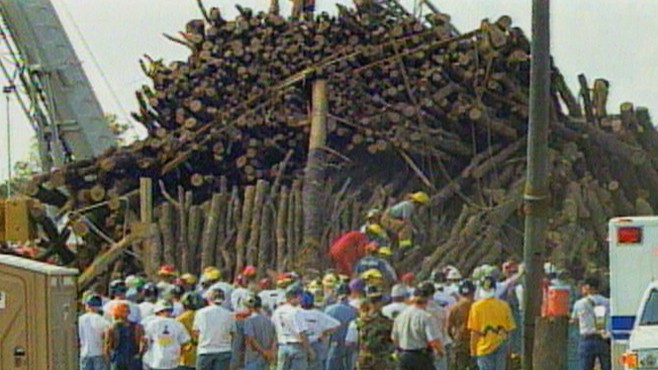
November 18, 1999: The Aggie Bonfire Collapse

November 18, 1999: The annual Aggie Bonfire, under construction at Texas A&M University in College Station, Texas, collapses, killing 12 people and injuring 27 others.

The Bonfire was a long-standing tradition at A&M, as part of their rivalry with the University of Texas. They started it in 1907, and, since the Texas Longhorns and the Texas A&M Aggies have played each other every year since 1915, they've done it every year since 1915, regardless of whether the game is at home in College Station or away in Austin. The game has been played on Thanksgiving Day in 1901, '02, '04, '07, '09, 1918-21, 1924-27, 1929-32, 1935-38, 1940-43, 1946-49, 1952-55, 1957-73, 1976, 1981-82, 1985-88, 1991-3, and 2008-11.

In the musical The Best Little Whorehouse in Texas, and in its 1982 film adaptation with Burt Reynolds and Dolly Parton, the titular, or so to speak, establishment gives freebies to the players on the game's winning team. This doesn't happen in real life -- as far as I know. In the show, it's A&M that wins, and the results produce the story's main conflict.

In 1942, the Bonfire took on a form similar to a teepee: Logs placed at an angle between 23 and 30 degrees, allowing it to grow to a cone over 50 feet high. It symbolizes their "burning desire to beat the hell outta T.U." It's been said that, in Texas, football is a religion, and 'Horns vs. Aggies is its holy war. So the Bonfire is A&M's ritual sacrifice.

It was never a safe idea. Bonfires have been banned in many places, including some entire States. But not Texas. In 1955, a student carrying one of the logs was killed -- not by getting hit with another log, or by a premature burning of a log, but by getting hit by a car. In 1957, the structure collapsed 2 days before it was supposed to be lit. Fortunately, that time, no one was injured, and they were able to rebuild it in time for its scheduled lighting.

In 1978, the design was changed again, to a "wedding-cake" style: Smaller stacks of logs on top of bigger stacks, with a fortified center pole. The design was intended to collapse on itself in a twisting motion, making it safer to remove.

According to tradition, the bonfire would be lit on the night before the game, which would usually be on Thanksgiving Day (to get a national TV audience), and if it burned without falling past midnight, A&M would win. However, the wedding-cake design ended up reducing the time it burned without falling, sometimes for as little as half an hour. But the tradition turned out to be mere superstition: From 1942 to 1977, with the teepee design, 30-5-1. But from 1978 to 1997, with the wedding-cake design, A&M led, 12-7, including an 11-1 stretch from 1984 to 1994.

It was probably largely about coaching and recruiting: Darrell Royal, who led the Longhorns to the National Championship in 1963, 1969 and 1970, retired after the 1976 season; and Fred Akers kept the winning going for a while, nearly winning the National Championship in 1977 and 1983; but R.C. Slocum led the Aggies to 3 straight Southwest Conference titles in 1991, '92 and '93, and, after the death of the SWC and both schools' 1996 move to the Big Eight, making it the Big Twelve, winning that in 1998.

The 1999 game, with the Longhorns 9-2, ranked Number 7, and already Champions of the Big 12 West Division, and the Aggies 7-3 and ranked Number 24, was set for November 26, the day after Thanksgiving. So the intention was to light the Bonfire on the night of Thanksgiving Day, November 25.

But a week before, on November 18, at 2:42 AM, already 59 feet high, the stack collapsed. Remember: It wasn't yet on fire, it was just a lot of heavy wood. But of the 58 people working on it, students and former students, some with previous Bonfire-building experience, 39 were injured, and 12 of those ultimately died. The fact that A&M is known for its "12th Man" tradition made the number of deaths even more poignant.

Upon learning of the disaster, A&M players rushed to the site, and helped remove the debris to look for survivors. Slocum suspended practice for 2 days. In solidarity, the Longhorn football staff held a blood drive to benefit the victims. UT officials also canceled their own annual pregame tradition, the "Hex Rally," in favor of a unity rally that also included hundreds of A&M students. A&M receiver Greg Porter told a sportswriter, "It was a weird time, you know? You're getting ready to play a football game, and the team on the other side is actually being nice."

And when the game was played at A&M's Kyle Field, it attracted a crowd of 86,128, the largest ever to attend a football game in the State of Texas to that point. (Both Kyle Field and Memorial Stadium, and also the Cotton Bowl, now exceed that capacity by thousands.) Thousands of maroon balloons filled the sky, followed by the pregame release of 12 white doves, one for each of the 12 current and former A&M students who were killed in the bonfire collapse. Four F-16 fighters flew overhead in the "missing man formation," a tribute usually saved for pilots killed in the line of duty.

The Longhorns, quarterbacked by freshman Chris Simms, son of New York Giants legend Phil Simms, because usual starter Marshall Applewhite had a stomach ailment, led 16-6 at the half. In another gesture of unity, both bands played together, and at the end of "Amazing Grace," both bands removed their hats, remained silent for a moment, and then marched off the field in silence.

The show seemed to inspire the Aggie crowd, who seemed to inspire the Aggie players, who mounted a comeback. With 5:02 left in regulation, and the ball on the Longhorn 14-yard-line, Randy McCown threw a pass into the end zone. It was caught by his roommate, Matt Bumgardner, and the Aggies won, 20-16.
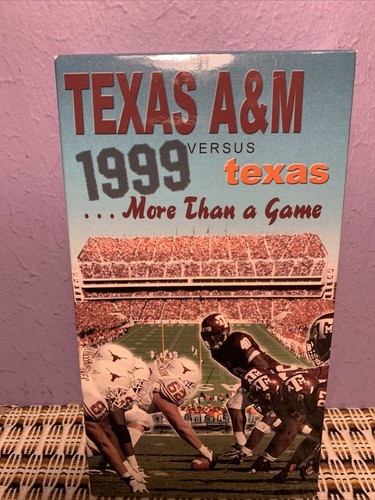
A VHS cassette of the game

Both teams used up all their emotion in those days, and lost their bowl games: The Longhorns lost the Big 12 Championship Game to Nebraska, and lost the Cotton Bowl to another of its old rivals, Arkansas; while the Aggies lost the Alamo Bowl to Penn State.

A&M has never held another official Bonfire. But, since 2002, a student-sponsored coalition has constructed an annual unsanctioned, off-campus "Student Bonfire" in the spirit of its predecessor.

After the 2011 season, Texas A&M left the Big 12 for the Southeastern Conference, ending the rivalry, at least as far as football is concerned. The Longhorns lead it, 76-37-5. In 2021, Texas, along with their other big rival, Oklahoma, announced it would leave the Big 12, and seek admission to the SEC. The SEC unanimously voted to invite both the Longhorns and the Sooners. This will allow them to become SEC members by the 2025 season, opening the door for a resumption of the Longhorn-Aggie football rivalry. (UPDATE: They made an agreement to join in 2024, restarting the rivalry a year earlier.)

*

November 18, 1999 was a Thursday. Baseball season was over. The NFL was in midweek. One college football game was played that day: Colorado State beat the Air Force Academy, 41-21 at Hughes Stadium in Fort Collins, Colorado.

There were 5 games played in the NBA:

* The Washington Wizards beat the Toronto Raptors, 92-81 at the MCI Center (now the Capital One Arena) in Washington.

* The Milwaukee Bucks beat the San Antonio Spurs, 99-88 at the Bradly Center in Milwaukee.

* The Sacramento Kings beat the Houston Rockets, 128-110 at The Summit in Houston. (The arena has since been converted into the Central Campus of the Lakewood Church, Dr. Joel Osteen's "megachurch.")

* The Denver Nuggets beat the Los Angeles Lakers, 93-82 at the new Pepsi Center (now the Ball Arena) in Denver. Shaquille O'Neal scored 36 points in defeat.

* And the Seattle SuperSonics beat the Vancouver Grizzlies, 110-108 at General Motors Place (now the Rogers Arena) in Vancouver.

And there were 7 games in the NHL:

* In an "Original Six" matchup, the New York Rangers lost to the Boston Bruins, 5-3 at the FleetCenter (now the TD Garden) in Boston.

* The Dallas Stars and the Philadelphia Flyers played to a tie, 1-1 at the First Union Center (now the Xfinity Mobile Arena) in Philadelphia.

* The Tampa Bay Lightning beat the Pittsburgh Penguins, 2-1 at the Ice Palace (now the Benchmark International Arena) in Tampa.

* The San Jose Sharks beat the Ottawa Senators, 4-1 at the Corel Centre in the Ottawa suburb of Kanata, Ontario. (It's now the Canadian Tire Centre. The town was absorbed into Ottawa proper in 2001.)

* The Nashville Predators beat the Montreal Canadiens, 6-1 at the Gaylord Entertainment Center (now the Bridgestone Arena) in Nashville.

* The St. Louis Blues beat the Florida Panthers, 3-0 at the Kiel Center (now the Enterprise Center) in St. Louis.

* And the Phoenix Coyotes beat the Los Angeles Kings, 3-2 at the new Staples Center (now the Crypto.com Arena) in Los Angeles.

Tuesday, November 8, 2022

November 8, 1924: Texas' Memorial Stadium Opens

November 8, 1924: War Memorial Stadium opens on the campus of the University of Texas in Austin. Surprisingly, the Longhorns lose to Baylor University, 28-10.

It was renamed simply Memorial Stadium in 1948, Texas Memorial Stadium in 1977, and Darrell K. Royal-Texas Memorial Stadium in 1995, after the coach who led the Longhorns to the 1963, 1969 and 1970 National Championships. It is known as "DKR" for short. Longhorn fans have not given it any other nicknames, either cutesy or tough.
It opened with a capacity of 27,000. It was raised to 40,000 in 1926, 60,000 in 1948, 66,000 in 1968, 78,000 in 1971, and its current 100,119 in 2009. On September 10, 2022, for Texas' 20-19 loss to Alabama, it attracted a record crowd of 105,213. The field was converted to AstroTurf in 1969, back to natural grass in 1996, and to FieldTurf in 2009.
Following the 3 National Championships won under Royal, the Longhorns won a 4th under Mack Brown in 2005. Since the stadium's opening, they've won 26 Conference Championships. In the old Southwest Conference, they won in 1928, '30, '42, '43, '45, '50, '52, '53, '59, '61, '62, '63, '68, '69, '70, '71, '72, '73, '75, '77, '83, '90, '94, '95 and '96. In the Big Twelve Conference, they've won in 2005 and 2009. (UPDATE: They won the Big 12 again in 2023, but are moving to the Southeastern Conference for 2024.)
They've had 2 Heisman Trophy winners: Running backs Earl Campbell in 1977 and Ricky Williams in 1998. Other notable Longhorns include 1940s quarterback Bobby Layne, 1960s linebacker Tommy Nobis, 1980s defensive tackle Kenneth Sims, and 2000s quarterbacks Vince Young and Colt McCoy.
In 1971, the Lyndon B. Johnson Presidential Library and Museum opened, almost right across Robert Dedman Drive from the stadium's east stand. Although he wasn't a UT graduate, it was pretty savvy of LBJ to put his Presidential Library across from, aside from the State Capitol, the Alamo and the Cotton Bowl, the most famous building in Texas. 
*

November 8, 1924 was a Saturday. These other notable college football games were played that day:

* Army beat Florida, 14-7 at Michie Stadium in West Point, New York. This was only the 4th game at their new stadium.

* Navy beat Vermont, 53-0 at Thompson Stadium in Annapolis, Maryland.

* Columbia beat New York University (NYU), 40-0 at Baker Field (now Wien Stadium) in Upper Manhattan.

* Princeton beat Harvard, 34-0 at Harvard Stadium in Boston. For reasons lost to time Rutgers played at arch-rival Princeton's Palmer Stadium, and beat Lafayette, 43-7.

* The University of Illinois and the University of Chicago played to a 21-21 tie at Stagg Field in Chicago. Three weeks earlier, Illinois had dedicated their Memorial Stadium in Champaign by beating Michigan, with Red Grange scoring 5 touchdowns, passing for another, and intercepting 2 passes.

* Notre Dame beat Wisconsin, 38-3 at Camp Randall Stadium in Madison, Wisconsin. Three weeks earlier, Notre Dame had beaten Army at the Polo Grounds, leading the nation's top sportswriter at the time, Grantland Rice, to call their backfield "The Four Horsemen," comparing them to those of the biblical Apocalypse.

There was 1 game played in the fledgling NFL: The Frankford Yellow Jackets beat the Kansas City Blues, 42-7 at Frankford Stadium in Northeast Philadelphia.

Also on this day, Johnny Bower, the Hall of Fame goaltender for the Toronto Maple Leafs' 1960s dynasty, was born. So was actor Joe Flynn.

Saturday, November 5, 2022

November 5, 2017: The Sutherland Springs Church Shooting

November 5, 2017: Devin Patrick Kelley walks into a service at the First Baptist Church in Sutherland Springs, Texas, a suburb of San Antonio, and shoots 46 people, 26 of whom die. He then led the police on a chase, but crashed, and, refusing to be taken alive, killed himself. He was 26, and his motive has never been established.

As of 2021, it is the deadliest mass shooting ever in Texas, and the 5th-deadliest in America. Kelly, of New Braunfels, Texas, did it with a Ruger AR-556 semi-automatic rifle, a weapon which would have fallen under the assault weapon ban of 1994-2004.

A friend from his school days said, "He wasn't always a psychopath," and, "Over the years, we all saw him change into something that he wasn't." He was convicted of domestic violence in a court-martial while he served in the U.S. Air Force, but the USAF failed to record the conviction with the FBI, meaning that he was not, officially, legally prohibited from obtaining a firearm. The system failed, due to negligence.

*

November 5, 2017 was a Sunday. The baseball season was over. But football was played:

* The New York Giants lost to the Los Angeles Rams, 51-17 at MetLife Stadium. It remains the worst defeat either New York team has suffered since moving into the new Meadowlands Stadium.

* The Tennessee Titans beat the Baltimore Ravens, 23-20 at M&T Bank Stadium in Baltimore.

* The Carolina Panthers beat the Atlanta Falcons, 20-17 at the new Mercedes-Benz Stadium in Atlanta.

* The New Orleans Saints beat the Tampa Bay Buccaneers, 30-10 at Raymond James Stadium in Atlanta.

* The Jacksonville Jaguars beat the Cincinnati Bengals, 23-7 at Paul Brown Stadium (now Paycor Stadium) in Cincinnati.

* The Indianapolis Colts beat the Houston Texans, 20-14 at NRG Stadium (as Reliant Stadium was then known) in Houston.

* The Philadelphia Eagles beat the Denver Broncos, 51-23 at Sports Authority Field at Mile High in Denver. (It's now named Empower Field at Mile High, but everyone just calls it Mile High Stadium like the predecessor stadium was named.)

* The Arizona Cardinals beat the San Francisco 49ers, 20-10 at Levi's Stadium in the San Francisco suburb of Santa Clara, California.

* The Washington Redskins beat the Seattle Seahawks, 17-14 at CenturyLink Field in Seattle. (It's now named Lumen Field.)

* The Dallas Cowboys beat the Kansas City Chiefs, 28-17 at Arrowhead Stadium in Kansas City.

* The Oakland Raiders beat the Miami Dolphins, 27-24 at Hard Rock Stadium in the Miami suburb of Miami Gardens, Florida.

* On the preceding Thursday, the New York Jets beat the Buffalo Bills, 34-21 at New Era Field (formerly Rich Stadium and Ralph Wilson Stadium) in the Buffalo suburb of Orchard Park, New York.

* The following day, on ESPN Monday Night Football, the Detroit Lions beat the Green Bay Packers, 30-17 at Lambeau Field in Green Bay.

* The Cleveland Browns, the Los Angeles Chargers, the New England Patriots and the Pittsburgh Steelers had a bye.

There were 10 games played in the NBA:

* The New York Knicks beat the Indiana Pacers, 108-101 at Madison Square Garden. Kristaps Porziņģis scored 40 points.

* The Washington Wizards beat the Toronto Raptors, 107-96 at the Air Canada Centre in Toronto. (It's now named the Scotiabank Arena.) Bradley Beal scored 38 for the Wizards.

* The Boston Celtics beat the Orlando Magic, 104-88 at the Amway Center in Orlando. (It's now named the Kia Center.)

* The Atlanta Hawks beat the Cleveland Cavaliers, 117-115 at the Rocket Mortgage FieldHouse (now the Rocket Arena) in Cleveland.

* The Minnesota Timberwolves beat the Charlotte Hornets, 112-94 at the Target Center in Minneapolis.

* The Houston Rockets beat the Utah Jazz, 137-110 at the Toyota Center in Houston. James Harden scored 56 points.

* The San Antonio Spurs beat the Phoenix Suns, 112-95 at the AT&T Center in San Antonio. (It's now named the Frost Bank Center.)

* The Staples Center in Los Angeles hosted a doubleheader. In the afternoon, the Los Angeles Clippers lost to the Miami Heat, 104-101. At night, the Los Angeles Lakers, 107-102. (The building is now named the Crypto.com Arena.)

* And the Portland Trail Blazers, 103-99 at the Moda Center in Portland. Damian Lillard scored 36 for the Blazers.

There were 4 games played in the NHL:

* The New Jersey Devils lost to the Calgary Flames, 5-4 at the Saddledome in Calgary. The Devils blew leads of 1-0 and 2-1, but came back from deficits of 3-2 and 4-3, and then lost in a shootout, as they frequently have these last few years.

* The New York Islanders beat the Colorado Avalanche, 6-4 at the Barclays Center.

* The Montreal Canadiens beat the Chicago Blackhawks, 2-0 in an "Original Six" matchup at the United Center in Chicago.

* And the Detroit Red Wings beat the the Edmonton Oilers, 4-0 at Rogers Place in Edmonton.

Also, Arsenal lost to Manchester City, 3-1 at the Etihad Stadium in Manchester. 

November 5, 1960: The Death of Johnny Horton

November 5, 1960: Country singer Johnny Horton dies when his band's car collides with a truck on a bridge in Milano, Texas, on their way to a gig in Shreveport, Louisiana. Two other band members were seriously injured.

John LaGale Horton, a.k.a. "The Singing Fisherman," was born on April 30, 1925 in Los Angeles, but grew up in Rusk, a farm community in East Texas. Although best known for his history-novelty song "The Battle of New Orleans," which was Number 1 for 5 weeks in 1959, Horton also sang the themes to the World War II film Sink the Bismarck!, and the Gold Rush film North to Alaska.

Horton was 35, and his wife, Billie Jean, was widowed for the 2nd time in 8 years: She had previously been married to country singer Hank Williams. As of November 5, 2022, she is still alive.

*

November 5, 1960 as a Saturday. British actress Katherine Matilda "Tilda" Swinton was born.

These were among the college football games played that day:

* The big game of the day was the rivalry for Floyd of Rosedale, a trophy in the shape of a bronze pig. Number 1 Iowa were beaten by Number 3 Minnesota, 27-10 at Memorial Stadium in Minneapolis. This all but clinched the Big Ten Conference title for Minnesota.

* Number 2 Missouri beat Number 18 Colorado, 16-6 at Memorial Stadium (later renamed Faurot Field) in Columbia, Missouri. This game all but clinched the Big Eight Conference title for "Mizzou."

* Number 4 Navy were upset by Number 15 Duke, 19-10 at Duke Stadium (later Wallace Wade Stadium) in Durham, North Carolina. It was Navy's only loss of the regular season, and they were invited to the Orange Bowl, where they were beaten by Missouri.

* Number 5 Ohio State beat Indiana, 36-7 at Ohio Stadium in Columbus.

* Number 6 Mississippi beat the University of Chattanooga, 45-0 at Hemingway Stadium (now Vaught-Hemingway Stadium) in Oxford, Mississippi. "Ole Miss" won the Southeastern Conference title.

* Number 7 University of Washington beat the University of Southern California (USC), 34-0 at the Los Angeles Memorial Coliseum. Washington won the Championship of the American Association of Western Universities (AAWU), the league that eventually became the Pacific-12 Conference.

At the time, the National Championship was awarded after the end of the regular season, but before the bowl game. Minnesota were awarded the National Championship. But Washington beat them in the Rose Bowl, tainting their title.

* Number 8 Tennessee were upset by Georgia Tech, 14-7 at Grant Field in Atlanta.

* Number 9 Syracuse were upset by Army, 9-6 in front of 66,000 people at Yankee Stadium.

* Number 10 Rice were upset by Number 16 Arkansas, 3-0 at War Memorial Stadium in Little Rock, Arkansas. This cost Rice the Southwest Conference title. Nevertheless, they were invited to the Sugar Bowl, where they were beaten by Ole Miss. Arkansas won the SWC title, but lost the Cotton Bowl to Duke.

* Number 11 Baylor were upset by Texas, 12-7 at Baylor Stadium (later Floyd Casey Stadium) in Waco, Texas.

* Number 14 University of Pittsburgh beat Notre Dame, 20-13 at Notre Dame Stadium in South Bend, Indiana.

* In a rivalry game, Florida beat Georgia, 22-14 at the Gator Bowl in Jacksonville, Florida.

* In another rivalry game, Montana beat Montana State, 10-6 at Dornblaser Field, UM's home field, in Missoula, Montana.

* And in New Jersey, Rutgers beat Lafayette, 36-8 at Rutgers Stadium in Piscataway; and Princeton beat Harvard, 14-12 at Palmer Stadium in Princeton.

Baseball was out of season. There were 4 games in the NBA:

* The New York Knicks lost to the St. Louis Hawks, 119-104 at the Kiel Auditorium in St. Louis. Cliff Hagan of the Hawks scored 35 points.

* The Cincinnati Royals beat the Boston Celtics, 113-104 at the Boston Garden.

* The Philadelphia Warriors beat the Detroit Pistons, 130-123 at the Olympia Stadium in Detroit. Wilt Chamberlain scored 32 points.

* And the Los Angeles Lakers, newly moved from Minneapolis, beat the Syracuse Nationals, 112-110 at the Los Angeles Memorial Sports Arena. Elgin Baylor led all scorers on the night with 40 points, and also grabbed 25 rebounds.

There were 2 games in the NHL. The New York Rangers lost to the Toronto Maple Leafs, 7-3 at Maple Leaf Gardens in Toronto. And the Montreal Canadiens and the Chicago Black Hawks played to a tie, 4-4 at the Montreal Forum. The Boston Bruins and the Detroit Red Wings were not scheduled.

December 31, 1999 & January 1, 2000: The Millennium

December 31, 1999:  The Millennium arrives. The people of planet Earth survived. At a terrible cost. But we hadn't destroyed ourselves. ...