Showing posts with label utah. Show all posts

Friday, November 18, 2022

November 19, 1915: Joe Hill Is Executed

November 19, 1915: Labor activist Joe Hill is executed by firing squad at Sugar House Prison in Salt Lake City, Utah. He was 36 years old.

Born on October 7, 1879 as Joel Emmanuel Hägglund in Gävle, Sweden, he and his brother Paul immigrated to America in 1902. He went across the country, ending up in San Francisco, and was there when the 1906 earthquake hit.

In 1910, he took the name Joe Hillstrom, began working on the docks in the San Pedro section of Los Angeles, and joined the Industrial Workers of the World (IWW, a.k.a. "The Wobblies"). They were leftists, and were already celebrating labor in song. He took to this, and began writing poems and songs under the name Joe Hill, never knowing that he would be immortalized in song under that name.

In 1868, S. Fillmore Bennett and Joseph P. Webster wrote the Christian hymn "The Sweet By-and-By." It is mostly forgotten today. Better-remembered is Hill's parody of it, "The Preacher and the Slave":

Long-haired preachers come out every night
try to tell you what's wrong and what's right
but when asked, How 'bout something to eat?
they will answer in voices so sweet:

You will eat, bye and bye
in that glorious land above the sky.
Work and pray, live on hay
you'll get pie in the sky when you die.

Thus was coined the phrase "pie in the sky." And whenever Joe sang all 3 verses and 3 full choruses, his audience would respond, "And that's a lie!"

On January 10, 1914, Hill was working in the Silver King Mine in Park City, Utah, outside Salt Lake City. That night, John G. Morrison and his son Arling Morrison were killed in their grocery store in Salt Lake City by two armed intruders, masked in red bandanas. It had not been all that long since the days of the Wild West: Robert LeRoy Parker, a.k.a. Butch Cassidy, had committed his last robbery in his home State of Utah only 13 years earlier.

Nothing was stolen from the store, so the police first considered that the motive was revenge: John Morrison had been a police officer, and had enemies. There were 12 different people arrested before Hill was considered a suspect.

That same night, Hill met a doctor. He said he'd been shot in the chest, in an argument over a woman, though he wouldn't give her name. The doctor reported that Hill had a pistol with him. When his room at a boarding house was searched, a red bandana was found.

Hill denied killing the Morrisons. He denied ever having met them. The murder weapon was never found. The red bandana that was found proved nothing: Lots of men had one. There was no evidence that he was at the store that night. And four other men were treated for bullet wounds in Salt Lake City that night.

At his trial, the prosecution produced 12 eyewitnesses who said the killer resembled Hill. One was Merlin Morrison, age 13, son of one victim and brother of the other. At the trial, he identified Hill as the killer. But when originally question, Merlin said, "That's not him."

The jury took only a few hours to find Hill guilty. Hill appealed, but the Utah Supreme Court upheld the earlier verdict. Orrin Hilton, who represented him in the appeal, said, "The main thing the State had on Hill was that he was a Wobbly, and therefore sure to be guilty."

Hill never testified on his own behalf. A recent biographer has suggested that he saw himself worth more to the movement as a martyr than as a living songwriter and agitator. At any rate, the real killer of the Morrisons has never been identified.

On November 19, 1915, Hill wrote to IWW leader Big Bill Haywood, whom he knew: "Goodbye Bill. I die like a true blue rebel. Don't waste any time in mourning. Organize." He also wrote, "Could you arrange to have my body hauled to the state line to be buried? I don't want to be found dead in Utah."

That day, he was led out to a wall, to be executed by firing squad. The order was given: "Ready, aim... " But, having had so little control over his life, he exercised a sliver of control over his death, shouting the last word: "Fire!"

In 1925, Alfred Hayes wrote the poem, "I Dreamed I Saw Joe Hill Last Night." In 1936, Earl Robinson set it to music, and it became the song "Joe Hill" that is remembered today:

I dreamed I saw Joe Hill last night,
alive as you and me.
Says I, "But Joe, you're ten years dead."
"I never died," says he.

"In Salt Lake City, Joe," says I,
him standing by my bed,
"They framed you on a murder charge."
Says Joe, "But I ain't dead."

"The Copper Bosses killed you Joe,
they shot you Joe," says I.
"Takes more than guns to kill a man."
Says Joe, "I didn't die."

And standing there as big as life
and smiling with his eyes
says Joe, "What they can never kill
went on to organize,
went on to organize."

From San Diego up to Maine,
in every mine and mill,
where workers strike and organize
it's there you'll find Joe Hill,
it's there you'll find Joe Hill!"


Paul Robeson, Woody Guthrie and Pete Seeger all made "Joe Hill" a featured song in their concerts. In his 1939 novel The Grapes of Wrath, John Steinbeck wrote a speech for the character of Tom Joad whose repeated line, "I'll be there" seems to echo "It's there you'll find Joe Hill." Henry Fonda recited it in the 1940 film version. Joan Baez sang the song at the Woodstock concert in 1969. Ken Burns used it in his 1994 miniseries Baseball, whenever the subject turned to the relationship between the players and the team owners.

And the song has become known to millions of people who have no idea about the particulars of who Joe Hill was, or why he died.

*

November 19, 1915 was a Friday. Baseball was out of season. There was no NFL, no NBA, and no NHL. And while there were major college football games played on November 20, none were played on November 19. So there were no scores on this historic day.

Monday, November 7, 2022

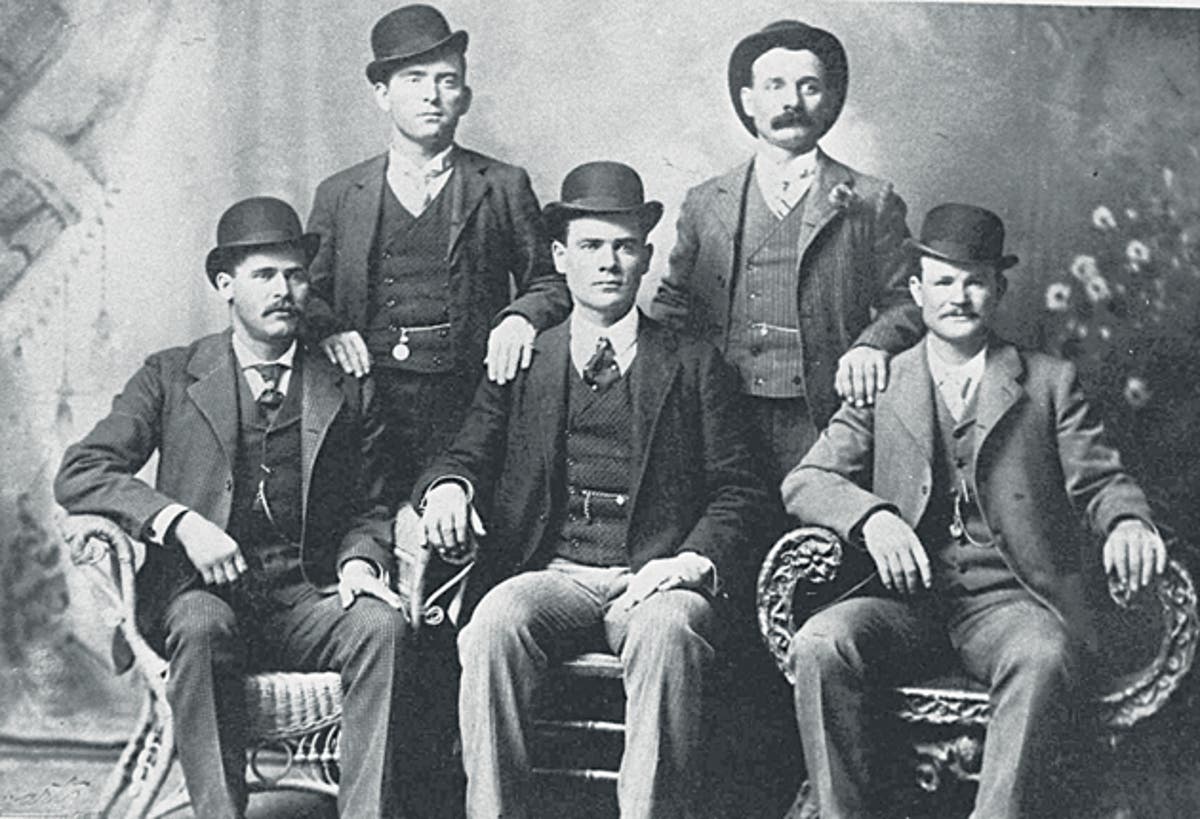
November 7, 1908: The Deaths (?) of Butch Cassidy & the Sundance Kid

The 1899 "Fort Worth Five" photo.
Top row, left to right: William Carver and Harvey Logan.
Bottom row, left to right: Harry Longabaugh (the Sundance Kid),
Ben Kilpatrick, and Robert Parker (Butch Cassidy).

November 7, 1908: In San Vicente, Bolivia, soldiers engage in a shootout with 2 men who had robbed the payroll of a silver mine. The robbers were found dead: Apparently, with both men wounded, one shot the other to put him out of his misery, and then used his last bullet on himself.
The local authorities confirmed that these men were the robbers, but they did not know the men's names. The widely-accepted story is that the men were Robert Leroy Parker and Harry Alonzo Longabaugh -- a.k.a. the American outlaws known as Butch Cassidy and the Sundance Kid, respectively.
Butch and Sundance were the last of the major Wild West outlaws. From 1889 to 1901, with their Wild Bunch gang, they robbed banks and trains throughout the Rocky Mountain States, especially Parker's native Utah (which gained Statehood in 1896). In 1901, along with Longabaugh's girlfriend Etta Place, they escaped to New York, and then took a ship to South America: First to Argentina, then to Chile, and finally to Bolivia, in the hopes of becoming respectable ranchers.
But they couldn't make an honest living, so they turned back to robbery, which is why they had to leave Argentina and then Chile. Finally, in 1906, Place got tired of living on the run, and went back to America. History loses track of her after that.
Attempts to determine whether Butch and Sundance actually were the men killed in the San Vicente shootout have thus far failed. It has been alleged, including by Cassidy's sister, that Butch left Bolivia and was still alive as late as 1937. (He would have been 72.) A suggestion that Sundance was still alive as late as 1936 has been proven by DNA testing to be false, but, so far, that's as close as DNA testing has come to proving anything. Among the stories, it has been suggested that Etta may have been alive as late as 1966.
For all we know, the old Utah and Wyoming bank and train robbers of the 1890s may well have had a good laugh about it all for a long time thereafter.
Among the depictions of Butch and Sundance: The 1951 film The Texas Rangers (played by John Doucette and Ian MacDonald, respectively), the 1956 film The Three Outlaws (Neville Brand and Alan Hale Jr.), a 1958 episode of Tales of Wells Fargo (only Butch appears, played by a young Charles Bronson), the 1969 film Butch Cassidy and the Sundance Kid (Paul Newman and Robert Redford, with Katharine Ross as Etta), the 1979 film Butch and Sundance: The Early Days (Tom Berenger and William Katt), the 1994 TV-movie The Gambler V: Playing for Keeps (Scott Paulin and Brett Cullen, with Mariska Hargitay as Etta), and the 2004 TV-movie The Legend of Butch & Sundance (David Clayton Rogers and Ryan Browning, with Rachelle Lefevre as Etta).
*
November 7, 1908 was a Saturday. Baseball was out of season. Basketball and hockey were not yet professional. But there was college football to be played. Among the games:
* The Polo Grounds in New York hosted a crowd of 10,000, as undefeated Dartmouth (5-0-1) beat previously undefeated Princeton (5-0-3), 10-6.
* Harvard and the Carlisle Indian School (with Jim Thorpe not yet playing) were both 6-0-1 when facing each other in Cambridge, Massachusetts, and Harvard won, 17-0.
* Yale, undefeated, blew a 10-0 lead at home in New Haven, Connecticut, and escaped with a 10-10 with Brown.
* The University of Pennsylvania beat Lafayette, 34-4 at the original Franklin Field (built in 1895, replaced in 1922) in Philadelphia. They finished 11-0-1, and were recognized as the National Champions. A 6-6 tie with Carlisle was the only blemish on their record, though it should be noted that they didn't play either Harvard, Yale or Princeton. They did go on to beat Michigan, though.
* The University of Pittsburgh undefeated, stayed that way, beating the school that would become their arch-rivals, West Virginia, 11-0 at Exposition Park, home of baseball's Pirates. In their 1st 7 games, Pitt had outscored their opponents 128-4. But they lost 3 of their last 4 games, all at home.
* Army beat Springfield, 6-5 at West Point, New York.
* Navy beat Villanova, 30-6 at Annapolis, Maryland.
* Michigan beat Kentucky, 62-0 at Ann Arbor, Michigan.
* Notre Dame beat Indiana, 11-0 at Washington Park in Indianapolis.
* New York University lost to Rensselaer Polytechnic Institute. RPI beat NYU, 11-0 in Troy, New York.
* And Rutgers could only manage a 6-6 tie with Delaware.

Saturday, October 15, 2022

October 15, 1997: Breaking the Sound Barrier On Land

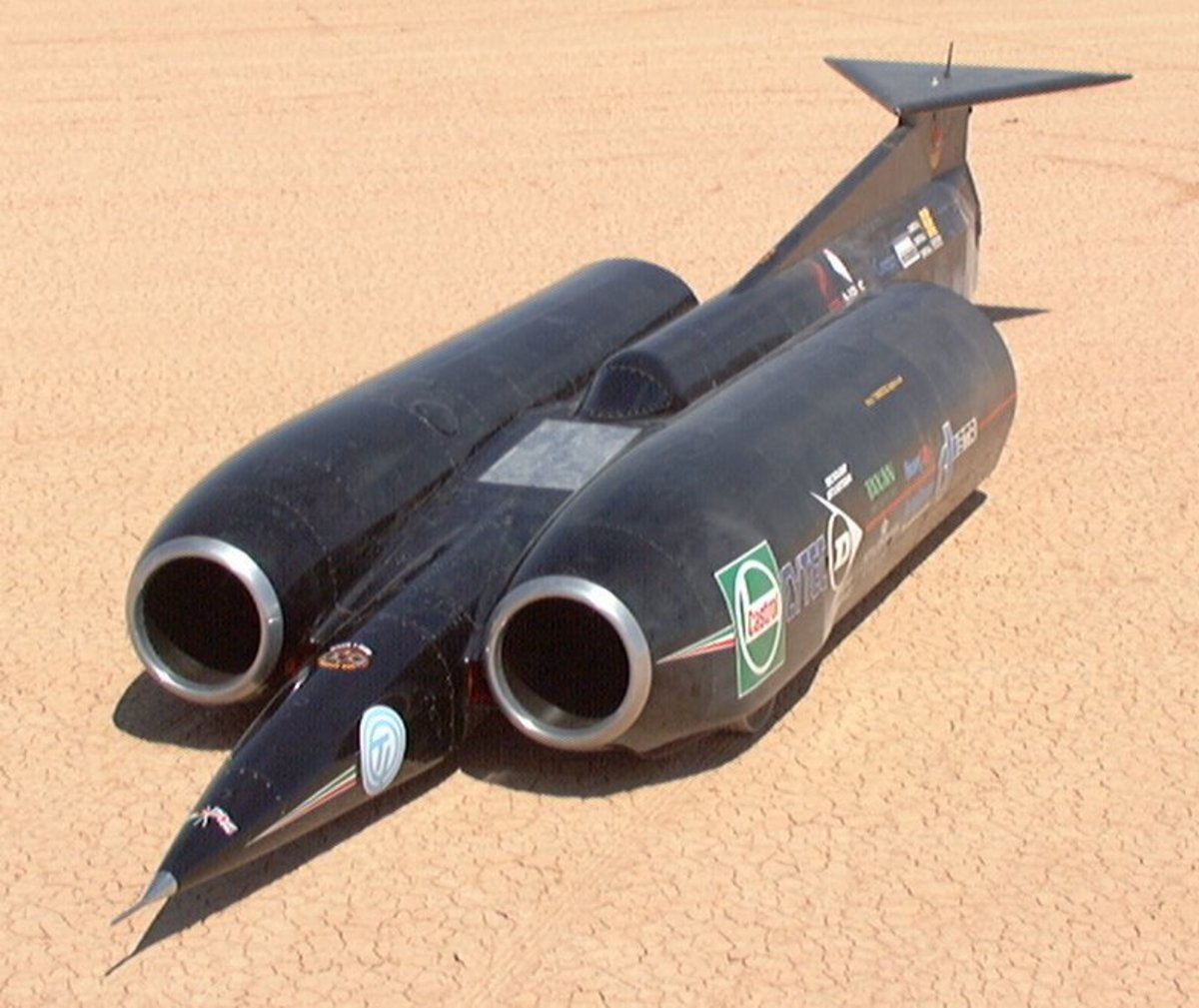
October 15, 1997: The 1st supersonic (faster than the speed of sound) land speed record is set. Wing Commander Andy Green of Britain's Royal Air Force, then 33 years old, had already set a record of 714 miles per hour on September 25, in the jet-powered Thrust SSC (SuperSonic Car), at Black Rock Desert in Utah. He tries again, in the same vehicle, at the same location, and does it: 763 miles per hour. This happens 1 day after the 50th Anniversary of Chuck Yeager becoming the 1st pilot to fly faster than sound.
Thrust SSC

Thrust SSC was designed by Green and Richard Noble, who held the previous record, set in 1983, at age 37. The record of 763 still stands, but it might not for much longer: Green, now 57, and Noble, 73, have designed a new car, Bloodhound SSC, and they think they could break the 1,000 MPH barrier. 

*

October 15, 1997 was a Wednesday. Game 6 of the American League Championship Series is played at Oriole Park at Camden Yards in Baltimore. The Cleveland Indians win it, 1-0, beating the Baltimore Orioles on Tony Fernández's home run in the top of the 12th. I have a separate entry for this event.

The National League Championship Series ended the day before, with the Florida Marlins beating the Atlanta Braves for the Pennant.

Football was in midweek. The NBA season didn't start for another 16 days. There were 9 games played in the NHL:

* The New York Rangers lost to the Ottawa Seantors, 5-1 at the Corel Center in the Ottawa suburb of Kanata, Ontario. (It's now the Canadian Tire Centre. The town was absorbed into Ottawa proper in 2001.)

* The Montreal Canadiens and the Pittsburgh Penguins played to a tie, 1-1 at the Molson Centre (now the Bell Centre) in Montreal.

* The Buffalo Sabres and the Carolina Hurricanes played to a tie, 3-3 at the Greensboro Coliseum.

* The Florida Panthers beat their arch-rivals, the Tampa Bay Lightning, 2-1 at the Miami Arena.

* In an "Original Six" matchup, the Toronto Maple Leafs beat the Detroit Red Wings, 4-3 at the Joe Louis Arena in Detroit.

* The Washington Capitals beat the Chicago Blackhawks, 2-0 at the United Center in Chicago.

* The Colorado Avalanche beat the Edmonton Oilers, 6-2 at the Edmonton Coliseum (as the Northlands Coliseum was named at the time).

* The Philadelphia Flyers and the Mighty Ducks of Anaheim played to a tie, 2-2 at the Arrowhead Pond of Anaheim (now named the Honda Center).

* And the Boston Bruins beat the Los Angeles Kings, 5-3 at The Forum outside Los Angeles in Inglewood, California. 

Wednesday, May 18, 2022

May 18, 1971: A Title for Utah

Zelmo Beaty

May 18, 1971: The Utah Stars beat the Kentucky Colonels, 131-121 at the Salt Palace in Salt Lake City, to win Game 7 and the Championship of the American Basketball Association.

As the Anaheim Amigos, the Stars lost the 1st ABA game to the Oakland Oaks in 1967, then moved up the Freeway to become the Los Angeles Stars. They lost the 1970 ABA Finals to the Indiana Pacers, then moved to Utah and won them. They would reach the ABA Finals again in 1974, losing to the New York Nets. But they kept losing money, and folded after 1 more season.

Bill Sharman, who won 4 NBA Championships playing for the Boston Celtics, coached them to the 1971 title, then took the Los Angeles Lakers to the next season's NBA Championship. He and Alex Hannum are the only coaches to win NBA and ABA titles.

The '71 Stars were led by center Zelmo Beaty, forwards Austin "Red" Robbins and Willie Wise, and guards Ron Boone and Glen Combs. All but Wise were named to that season's ABA All-Star Game.

Sharman and Beaty are in the Basketball Hall of Fame. So are Moses Malone and Roger Brown, who played for the Stars in their last season, 1974-75.

In 1979, the New Orleans Jazz moved to Utah. They reached the NBA Finals in 1997 and 1998, but have never won a title. The only Utah-based team to win a North American professional sports championship since is Major League Soccer’s Real Salt Lake, winners of the 2009 MLS Cup.

*

May 18, 1971 was a Tuesday. American soccer goalkeeper Brad Friedel was born.

This was also the day the Montreal Canadiens defeated the Chicago Black Hawks, 3-2, in Game 7 of the Finals to win the Stanley Cup. I have a separate entry for that event.

The NBA title had been won by the Milwaukee Bucks 18 days earlier. Football was out of season. These games were played in Major League Baseball:

* The Montreal Expos lost the the Pittsburgh Pirates, 3-2 at Three Rivers Stadium in Pittsburgh, in front of 10,226 fans. I wonder if any of them were from Montreal. I wonder if anyone back in Montreal noticed. Dave Cash, who later played for the Expos, singled Gene Alley home to win the game in the bottom of the 9th inning. Roberto Clemente went 2-for-4 with an RBI. Willie Stargell did not play.

* The New York Yankees lost to the Baltimore Orioles, 6-2 at Yankee Stadium. Mike Cuellar outpitched Fritz Peterson. Bobby Murcer went 3-for-4 with a home run. Brooks Robinson and Paul Blair homered for the O's, while Frank Robinson went 2-for-5 with an RBI.

* The New York Mets lost to the Atlanta Braves, 8-6 at Atlanta Stadium (later renamed Atlanta-Fulton County Stadium). Hank Aaron hit his 605th career home run. The Mets got a home run from Tommie Agee, and 2 from Bob Aspromonte, who, that season, retired as the last active former Brooklyn Dodger.

* The Boston Red Sox beat the Detroit Tigers, 5-3 at Fenway Park in Boston. Carl Yastrzemski went 2-for-4. Al Kaline went 1-for-3 with a walk and 2 RBIs.

* The Cleveland Indians beat the Washington Senators, 7-3 at Robert F. Kennedy Memorial Stadium in Washington.

* The Cincinnati Reds beat the Philadelphia Phillies, 4-3 at Riverfront Stadium in Cincinnati. Pete Rose and Johnny Bench each went 1-for-4, with Rose's hit being a solo home run.

* The San Francisco Giants beat the Chicago Cubs, 7-3 at Wrigley Field in Chicago. Willie Mays went 2-for-4 with a walk. Ernie Banks, in his final season, struck out as a pinch-hitter.

* The St. Louis Cardinals beat the Los Angeles Dodgers, 6-5 at Busch Memorial Stadium in St. Louis. Lou Brock went 2-for-4 with a walk. 

* The Houston Astros beat the San Diego Padres, 3-2 at the Astrodome in Houston.

* The California Angels beat the Minnesota Twins, 3-1 at Anaheim Stadium (now Angel Stadium of Anaheim). Harmon Killebrew went 2-for-4. Rod Carew went 1-for-4 with an RBI.

* And the Oakland Athletics beat the Milwaukee Brewers, 5-2 at the Oakland Coliseum. Reggie Jackson went 0-for-4, but the A's got home runs from Rick Monday, Joe Rudi and Sal Bando.

Monday, May 9, 2022

May 10, 1869: The Golden Spike

May 10, 1869: The 1st transcontinental railroad is completed, at Promontory Summit, Utah Territory, connecting the Union Pacific Railroad, which had been building westward from Omaha, Nebraska, with the Central Pacific Railroad, which had been building eastward from Oakland, California.

Leland Stanford, once Governor of California, later one of its U.S. Senators and founder of a university he named for his son ("The Leland Stanford Junior University," usually just called "Stanford University" today), and at this point the President of the Central Pacific, completed the process, using a silver hammer to ceremonially complete the driving in of a golden spike.

The photograph of the event, by Andrew J. Russell, is familiar, more than a century and a half later: Two locomotives facing each other, with the ceremony's participants all around them. One was the Jupiter, of the Central Pacific. The other was simply named Union Pacific No. 119.

The original Golden Spike was replaced, and is now on display at the Cantor Arts Museum at, somewhat appropriately, Stanford University in Palo Alto, California, on "The Peninsula" between San Francisco and San Jose. Russell, who worked as a photographer for the Union Pacific, and had already become famous for his photos of the American Civil War, lived until 1902.

In 1901, the Southern Pacific Railroad, which had bought the Central Pacific and all its assets, sold the original Jupiter for scrap. No. 119 faced the same fate in 1903. Even at the dawn of the 20th Century, when the American Revolution was closer in time than the Golden Spike is to us now, our country had insufficient regard for its history.

Golden Spike National Historical Park is now on the site of the ceremony, with replicas of the two locomotives. Ironically, there is no passenger rail service to it: Service stopped running to and past the site in 1962, a later Amtrak route bypassed it, and the site can only be reached by car.

*

May 10, 1869 was a Monday. Now, you may be thinking that, since there was, as yet, no major league baseball, capitalized or otherwise, there must have been no scores on this historic day. But there was one.

The 1st openly professional baseball team, the Cincinnati Red Stockings, had already begun play. On this day, at the Union Grounds in Cincinnati, they played one of the more established baseball clubs of the Midwest, Kekionga of Fort Wayne, and beat them, 86-8. That is not a misprint: Eighty-six to eight.

"Kekionga," pronounced "Key-KEY-ong-gah," was the original Native name of the place where Fort Wayne was built, and it means "blackberry bush." It became the capital of the Miami tribe, whose name predates not only the small Ohio city with the name, but the much larger Florida city with it.

Unlike the Cincinnati club, Kekionga would survive long enough to enter the 1st professional baseball league, the National Association, in 1871. They played the 1st NA game, at what was officially named the Kekionga Ball Grounds, but nicknamed the Grand Dutchess. They beat Forest City of Cleveland, 2-0.

That would be the highlight of the team's history. Attendance was bad, there weren't enough gate receipts to pay players their agreed-to salaries, the good ones left, the team had a bad season, and then, at the end of it, their ballpark burned down. (Insurance fraud?) 

Saturday, March 26, 2022

March 26, 1979: Magic & Larry Make March Go Mad

March 26, 1979: The Camp David Accords are signed at the White House, by President Jimmy Carter, President Anwar Sadat of Egypt, and Prime Minister Yitzhak Rabin of Israel.

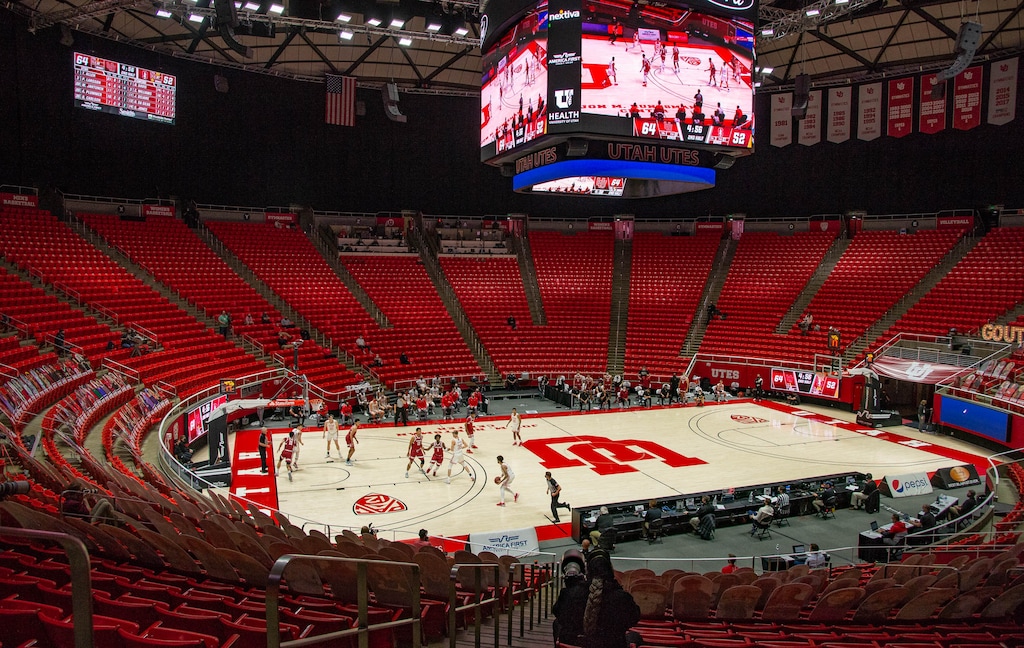
It is a momentous day for another reason, although hardly anybody knew it at the time. The NCAA held the Final of its Division I Basketball Tournament, at the Special Events Center at the University of Utah, in Salt Lake City.

As CBS college basketball analyst Seth Davis put it in the title of a book he wrote, it was When March Went Mad.
Built in 1969, the building is still used by the Utah Runnin' Utes, and has since been renamed the Jon M. Huntsman Center, in honor of the chemical magnate whose son, also named Jon Huntsman, would later serve as Governor of Utah and U.S. Ambassador to Russia.
Indiana State University, of Terre Haute, coached by Bill Hodges, undefeated at 33-0, Champions of the Missouri Valley Conference in both its regular season and its tournament, and in its 1st-ever Final Four (the term had officially been adopted the year before), took on Michigan State University, of East Lansing, coached by George "Jud" Heathcote, 25-6, Co-Champions of the Big Ten Conference (which then had no tournament), and in its 2nd Final Four, the 1st coming in 1957.

A crowd of 15,410 saw it live. About 40 million saw it on NBC, making it the most-watched basketball game ever to that point, college or pro -- and probably the best thing to happen to the Peacock Network all year. The announcers Dick Enberg, Billy Packer, and Al McGuire, who had won this game 2 years earlier in his final game as head coach at Milwaukee's Marquette University.

Why such a huge audience? Because of each team's respective stars. ISU, the Sycamores, had senior forward Larry Bird. Portland Trail Blazers star Bill Walton was so frequently hurt. Ernie DiGregorio had flamed out. And John Havlicek, Dave Cowens, Rick Barry and Pete Maravich were winding down their careers. So white basketball fans wanted to believe in a "Great White Hope." "The Hick from French Lick" seemed to be it.

But MSU, the Spartans, had Earvin Johnson, a sophomore guard nicknamed "Magic." Like Michael Jackson, he had a million-dollar smile -- at a time when the phrase "million-dollar" still meant something. Like Julius "Dr. J" Erving of the Philadelphia 76ers, he had amazing moves and a fabulous nickname. Unlike the moody Los Angeles Lakers star Kareem Abdul-Jabbar, he had a winning personality, and a name that was easy to spell and pronounce.

Both men wore Number 33. When Magic was drafted by the Lakers, Kareem had 33, so Magic switched to 32. Bird was able to keep 33 with the Boston Celtics.

The game was close for a little while, with Michigan State leading 9-8. But the Spartans were able to cover Bird tightly, enabling them to go on a 9-0 run, and led 37-28 at the half. In the 2nd half, they jumped out to a 50-34 lead. 

But Bird got the Sycamores on a good run, and with 10 minutes left (college basketball uses halves but not quarters, but this would have been the end of the 3rd quarter), Indiana State had climbed to within 52-46. The game was far from over.

There was no shot clock in college basketball at the time. For the last 5 minutes, Michigan State held onto the ball as much as they could, eating the clock, stalling. At one point, Johnson tried to inbound the ball, and Bird stole it -- presaging a famous play he would make for the Celtics against the Detroit Pistons in the 1987 NBA Playoffs. But since this was not done for the Celtics in the Boston Garden, the referee applied the rule book, and called Bird for a technical foul.

That was Indiana State's last real gasp. Michigan State won, 75-64. It was Indiana State's only loss of the season. Bird scored 19 points, but only made 7 of his 21 field goal (2-point) attempts. Johnson scored 24, shooting 8 of 15. Following his 29-point performance in the Semifinal win over Bob Weinhauer's University of Pennsylvania (still the last Ivy League team to reach the Final Four), Magic was named the Tournament's Most Outstanding Player.

Many observers credit this game with "saving basketball." This was ridiculous. As I said, the NBA already had Kareem, Dr. J and Walton. It also had Elvin Hayes and Moses Malone. It was not wanting for stars. Just for white stars.

Bird graduated, and the Celtics had traded up to acquire his draft rights, and he signed with them between the end of his eligibility and the deadline for the draft -- which would soon be banned by what became known as "The Larry Bird Rule." Johnson forewent his last 2 years of college eligibility, and made himself eligible for the 1979 NBA Draft. He was the top pick, as the Lakers had acquired the pick from the Utah Jazz.

Johnson would be key to the Lakers winning the NBA Championship in 1980 and 1982; Bird would be key to the Celtics doing so in 1981. They would face each other in 3 out of 4 NBA Finals: The Celtics won in 1984, the Lakers won in 1985 and 1987.

The Celtics also won in 1986, over the Houston Rockets; while the Lakers won in 1988 over the Detroit Pistons, and also lost Finals to the 76ers (with Erving and Malone) in 1983, the Pistons in 1989, and the Chicago Bulls (with Michael Jordan) in 1991, before the Magic Era came to a stunning end, with 3 letters none of us knew in 1979: HIV. Bird played on until 1992. Both of them, and Jordan, played on the U.S. "Dream Team" that won the Gold Medal at the 1992 Olympics in Barcelona, Spain.

The term "March Madness" had been used in high school basketball before 1979. But it began to be applied to the NCAA Tournament as well. The NCAA now owns the trademark.

As of March 26, 2022, the 1979 NCAA Tournament Final remains the most-watched college basketball game of all time, although its 40 million viewership has been surpassed by a few NBA games.

*

March 26, 1979 was a Monday. Baseball was in Spring Training. Football was out of season. No NBA games were scheduled. Nor were any games scheduled in the World Hockey Association.

Only 1 game was played in the NHL: The Buffalo Sabres beat the St. Louis Blues, 4-2 at the Checkerdome in St. Louis. At the time, St. Louis-based Ralston Purina owned the Blues, and they renamed the St. Louis Arena after their "Checkerboard Square" logo. The Arena regained its old name in 1980.

Thursday, February 24, 2022

February 24, 2002: Canada End Their Hockey Gold Medal Drought

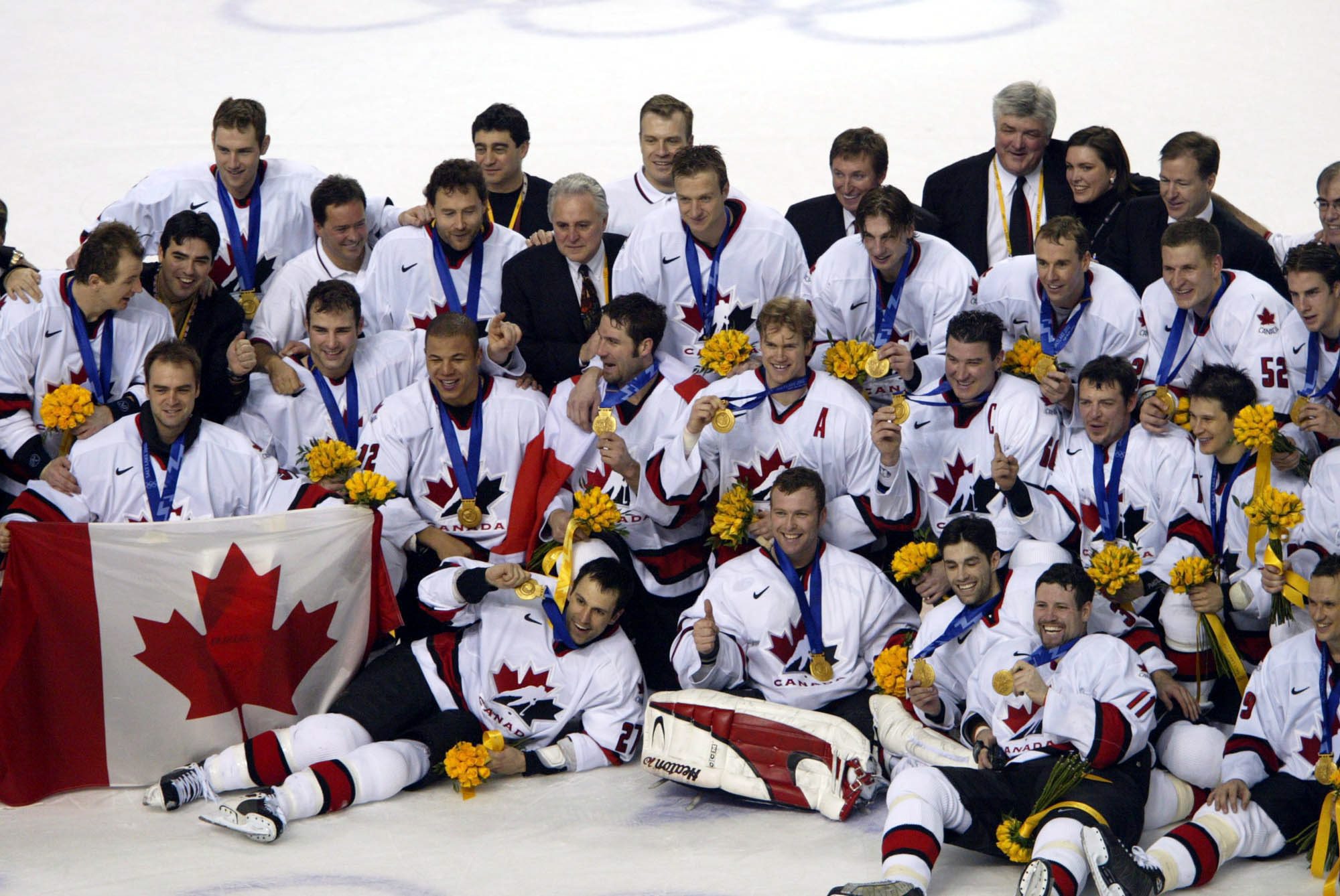
February 24, 2002: Canada wins the Gold Medal in the Winter Olympic hockey tournament, defeating the U.S. team, 5-2 at the E Center (now the Maverik Center) in the Salt Lake City suburb of West Valley City, Utah.

Jarome Iginla and Joe Sakic each score 2 goals. Herb Brooks, the coach who took the U.S. team to the Gold Medal in Lake Placid in 1980, was brought back, but could only lead them to the Silver Medal this time.

Canada's amateur players had fallen short against the "amateur" players of Eastern Europe, especially the Soviet Union and Czechoslovakia, since their last Gold Medal in 1952. And the efforts of NHL teams to sign the best amateur players before they could reach the Olympic team prevented the best players from leading them to Gold Medals.

Bobby Orr and Bobby Clarke in 1964; Guy Lafleur, Ken Dryden and Denis Potvin in 1968; Mike Bossy in 1972; Wayne Gretzky in 1976; Mario Lemieux, Patrick Roy and Steve Yzerman in 1980; Martin Brodeur and Eric Lindros in 1988 -- they weren't ready. Orr and Clarke in 1968; Lafleur, Dryden and Potvin in 1972; Bossy in 1976; Gretzky in 1980; Lemieux, Roy and Yzerman in 1984; Brodeur and Lindros in 1992 -- they were already professionals, and thus ineligible for the Olympics under the rules of the time.

In for Nagano, Japan in 1998, professionals were allowed to play. Canada put together perhaps the most talented group of hockey players ever assembled: Centers Gretzky, Yzerman, Lindros, Joe Nieuwendyk, Keith Primeau, Rod Brind'Amour; left wings Joe Sakic, Brendan Shanahan, Shayne Corson and Rob Zamuner; right wings Theoren Fleury, Trevor Linden and Mark Recchi; defensemen Ray Bourque, Scott Stevens, Al MacInnis, Éric Desjardins, Chris Pronger, Rob Blake, Adam Foote; and goaltenders Roy, Martin Brodeur and Curtis Joseph.

And it was a disaster. After eliminating the United States in the Quarterfinals -- and the American team, also loaded, were badly behaved, including trashing their hotel rooms -- Canada lost the Semifinal to the Czech Republic, which then beat Russia for the Gold Medal.

Gretzky retired as an active player in 1999, and was named general manager for the 2002 team. This team was younger on the average, but also better-coached: Pat Quinn had taken the Philadelphia Flyers and the Vancouver Canucks to the Stanley Cup Finals; Wayne Fleming and Jacques Martin had been assistants to Quinn; and assistant Ken Hitchcock had coached the Dallas Stars to the 1999 Stanley Cup.

The team they assembled to end a half-century's Gold drought was a mixture of '98 players and newcomers: Centers Lemieux, Yzerman, Lindros, Nieuwendyk, Michael Peca and Ryan Smyth; left wings Sakic, Shanahan, Paul Kariya and Simon Gagné; right wings Fleury, Owen Nolan and Jarome Iginla; defensemen MacInnis, Blake, Pronger, Foote, Scott Niedermayer, Eric Brewer and Ed Jovanovski; and goaltenders Brodeur, Joseph and Ed Belfour.

This time, the letdown came in the 1st game, when they were beaten 5-2 by Sweden. They beat Germany 3-2, and were held to a 3-3 tie by the Czech Republic, qualifying for the knockout stage by the skin of their teeth. Then they got serious, beating Finland 2-1 in the Quarterfinal, and Belarus 7-1 in the Semifinal. The Final would have them face a U.S. team, coming off a win over Russia on home ice that had their fans thinking it was 1980 all over again.

It was a weird situation for me. There were Martin Brodeur and Scott Niedermayer of the New Jersey Devils, wearing red and white; and Brian Leetch and Mike Richter of the New York Rangers, wearing red, white and blue. Both what I was used to. And yet, this was international hockey, so my usual rooting was reversed: I had to root for the American Rangers against the Canadian Devils.

Tony Amonte opened the scoring at 8:49 of the 1st period. But it was mostly Canada from then onward. Kariya scored at 14:50, and Iginla gave Canada the lead at 18:33.

Brian Rafalski, the only Devils player on the U.S. team, tied the game at 15:30 of the 2nd period, but Sakic gave Canada the lead back at 18:19. It was still only 3-2 Canada with 4 minutes left in regulation, but Iginla put the game away. With 1:20 left, Sakic put the cherry on the sundae.

Canada won, 5-2. It was their 1st Gold Medal in the sport they invented in 50 years. And it was the happiest moment for Canadian hockey since the 1972 Summit Series against the Soviet Union.

Canada beat the U.S. in the Final again in 2010, on home ice in Vancouver; and beat Sweden in the Final in Sochi, Russia in 2014.

*

February 24, 2002 was a Sunday. Baseball and football were out of season. The NHL had, naturally, suspended play for the length of the Olympic Games.

There were 8 games in the NBA:

* The New York Knicks lost to the Los Angeles Lakers, 107-91 at Madison Square Garden.

* The New Jersey Nets beat the Charlotte Hornets, 95-93 at the Continental Airlines Arena at the Meadowlands.

* The Miami Heat beat the Washington Wizards, 92-80 at the American Airlines Arena (now the Kaseya Center) in Miami.

* The Seattle SuperSonics beat the Toronto Raptors, 101-92 at the Air Canada Centre (now the Scotiabank Arena) in Toronto.

* The Cleveland Cavaliers beat the Orlando Magic, 111-96 at the Gund Arena (now the Rocket Arena) in Cleveland.

* The Milwaukee Bucks beat the Detroit Pistons, 89-82 at the Bradley Center in Milwaukee.

* The Atlanta Hawks beat the Denver Nuggets, 89-84 at the Pepsi Center (now the Ball Arena) in Denver.

* And the Phoenix Suns beat the San Antonio Spurs, 92-83 at the America West Arena (now the Mortgage Matchup Center) in Phoenix. Stephon Marbury of the Suns led all scorers on the day with 36 points.

Tuesday, February 22, 2022

February 22, 1956: John Wayne's Cursed Film

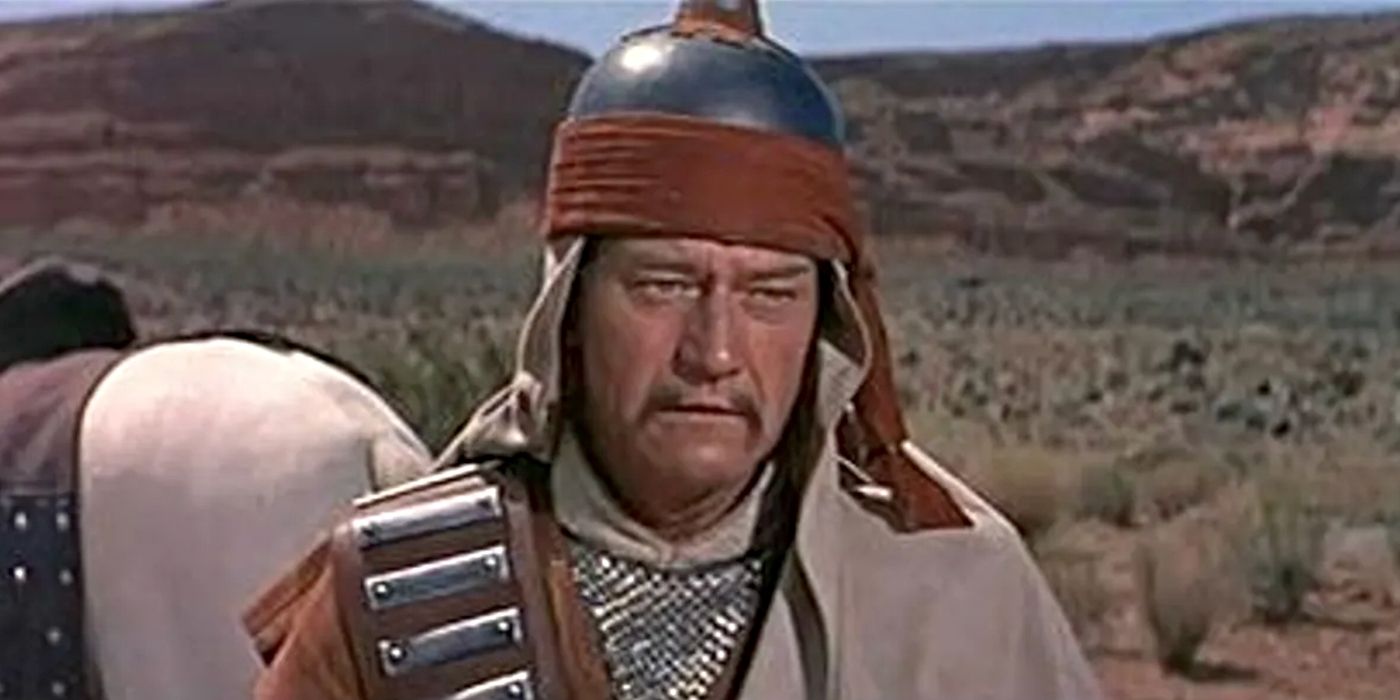
February 22, 1956: The Conqueror premieres, starring John Wayne as Genghis Khan. I swear, I’m not making that up. It is often considered the worst film of its era, and it was the last John Wayne film to have been shown on television.

From 1203 until his death in 1227, Genghis Khan ruled the Mongol Empire in East Asia, having conquered more land than any human being, before or since. Tales of his savagery are legend, but he was also a smart politician: Any city willing to submit to his rule and his taxes was left to live in peace. Just as just about every person of European ancestry alive today is said to be descended from Charlemagne, just about every person of East Asian ancestry alive today is said to be descended from Genghis Khan.

But John Wayne, best known as the most iconic star of American Western films, was the wrong actor to play him: Not only was he not the least bit Asian, but his hatred of Asians was well established before the film was made. He made that clear in his World War II films, which showed him fighting the Japanese more than the Nazis; and, later on, the Vietnamese in the 1968 film The Ballad of the Green Berets.

The Conqueror was produced by Howard Hughes. Since the airline and film studio mogul was, by then, living in seclusion in Las Vegas, he wanted it filmed near Vegas. Well, in the American West, "near" is relative. It was filmed near St. George, Utah, 117 miles northeast of Las Vegas -- and 137 miles downwind of the federal government's Nevada National Security Site.

Director Dick Powell died of cancer in January 1963, 7 years after the film's release. Pedro Armendáriz, a Mexican actor who was nearly as iconic in his homeland as Wayne was in America, was diagnosed with kidney cancer in 1960, and committed suicide in June 1963 after he learned his condition had become terminal, shortly after he completed filming on the James Bond film From Russia with Love. Wayne, female lead Susan Hayward, and Agnes Moorehead all died of cancer in the 1970s.

The cast and crew totaled 220 people. By the end of 1980, as ascertained by People magazine, 91 of them had developed some form of cancer, and 46 had died of the disease. That's 41 percent developing cancer, and 21 percent dying from it. In addition, several of Wayne's and Hayward's relatives also had cancer scares after visiting the set. Michael Wayne developed skin cancer, his brother Patrick had a benign tumor removed from his chest, and Hayward's son Tim Barker had a benign tumor removed from his mouth.

Dr. Robert Pendleton, professor of biology at the University of Utah, stated, "With these numbers, this case could qualify as an epidemic. The connection between fallout radiation and cancer in individual cases has been practically impossible to prove conclusively. But in a group this size, you'd expect only 30-some cancers to develop. With 91 cancer cases, I think the tie-in to their exposure on the set of The Conqueror would hold up in a court of law."

Bigotry is also a disease. Cultural appropriation, less so, but bad enough. Casting white actors in Asian roles continued, with one of the worst examples being Mickey Rooney as nasty landlord Mr. Yunioshi in Breakfast at Tiffany's in 1961. In 1964, with heavy makeup and a heavier accent, Marlo Thomas, a white actress of Lebanese descent (as was her father, Danny Thomas), played a Chinese woman on the TV Western Bonanza.

By the time the TV shows Hawaii Five-O and M*A*S*H premiered, in 1968 and 1972, respectively, TV studios had begun to cast Asian actors in Asian roles, even if the actors weren't specifically Hawaiian (as on the former) or Korean (as on the latter).

*

February 22, 1956 was a  Wednesday. Baseball and football were out of season. There were 3 games played in the NBA. Two of them were a doubleheader, at the Philadelphia Arena in West Philadelphia. In the opener, the Rochester Royals beat the St. Louis Hawks, 110-109. In the nightcap, the New York Knicks beat the Philadelphia Warriors, 117-108. In the other game, the Boston Celtics beat the Minneapolis Lakers, 93-90 at the Minneapolis Auditorium.

And there was 1 game in the NHL: The Toronto Maple Leafs beat the New York Rangers, 4-2 at the old Madison Square Garden.

Sunday, February 13, 2022

February 13, 1964: The Crash of Ken Hubbs

February 13, 1964: Chicago Cubs 2nd baseman Ken Hubbs is killed in a plane crash. He was only 22 years old.

Kenneth Douglas Hubbs was born on December 23, 1941 in the Los Angeles suburb of Riverside, California, and grew up in nearby Colton. In 1954, then a shortstop, he helped the Colton team reach the Final of the Little League World Series, losing to Schenectady, New York.

Ara Parseghian wanted him to come to the University of Notre Dame and play quarterback. John Wooden wanted him to come to the University of California at Los Angeles and play guard. Instead, he signed with the Chicago Cubs, knowing they already had Ernie Banks at shortstop. It was off to 2nd base for him.

Hubbs and Lou Brock each made their major league debut with the Cubs on September 10, 1961, a 12-5 loss to the Philadelphia Phillies. By June 15, 1964, neither would be with the Cubs anymore. Brock was traded to the St. Louis Cardinals for Ernie Broglio.

The New York Mets selected Don Zimmer in the 1962 National League expansion draft, allowing Hubbs to become the Cubs' regular 2nd baseman at the age of 20. He was named the NL Rookie of the Year, as he set major league records with 78 consecutive games and 418 total chances without an error. The Gold Glove Award began in 1957, and he became the 1st rookie to win one. His batting average dropped from .260 to .235 in 1963, but his fielding remained excellent.

He had a fear of flying, so he decided to take flying lessons, and got his pilot's license in January 1964. On February 12, he flew a Cessna 172 to Provo, Utah, with a friend, Denny Doyle (not the later Boston Red Sox player), who lived there. That night, Hubbs played in a charity basketball game sponsored by Brigham Young University. Hubbs was a member of the Church of Jesus Christ of Latter-Day Saints, a.k.a. the Mormons, which runs BYU.

Learning that a snowstorm was on the way, Hubbs tried to beat it the next day, February 13. But on the morning of February 14, he and Doyle, who was flying back with him, hadn't yet landed in Colton. The wreckage was found in Utah Lake (not to be confused with the much larger Great Salt Lake), outside Provo. Both Hubbs and Doyle were dead.

Lou Boudreau, Hall of Fame shortstop for the Cleveland Indians, and by then a broadcaster for the Cubs, said, "At the time he died, I felt he was on his way to a Hall of Fame career. His bat hadn't come around, but it would have."

In 1993, Sports Illustrated published a "What If?" article, suggesting that, if Hubbs hadn't been killed, the Cubs might not have made the infamous Brock-for-Broglio trade, and that, with Billy Williams in left field, Brock would have been moved to center field, which turned out to be a weak spot for the Cubs in their 1969 "September Swoon."

The article suggested that not only would it have been the Cubs, rather than the Cardinals, who won the Pennant in 1964, 1967 and 1968; but also would have won that elusive 1969 Pennant; and that they would also have prevented the Cincinnati Reds' dynasty, becoming "The Big Blue Machine." They even speculated that it would have been Hubbs, rather than Carlton Fisk, hitting the home run that won Game 6 of the 1975 World Series -- and the Series itself. (Of course, it would have been in the top half of an inning, and not a "walkoff" homer.)

Hubbs wore Number 16. Unlike many teams that retire numbers for players still active, the Cubs have never retired it.

*

February 13, 1964 was a Thursday. Baseball and football were out of season. There was 1 game played in the NBA: The San Francisco Warriors beat the Boston Celtics, 106-95 at the Cow Palace, outside San Francisco in Daly City, California. Wilt Chamberlain scored 30 points and grabbed 24 rebounds. This turned out to be a preview of the NBA Finals, but the Celtics would win that.

And there was 1 game in the NHL: The Detroit Red Wings beat the Boston Bruins, 4-1 at the Olympia Stadium in Detroit. 

Monday, January 17, 2022

January 17, 1977: The Execution of Gary Gilmore

January 17, 1977: Gary Gilmore is executed by firing squad at the Utah State Prison in Draper. He was 36 years old.

On June 2, 1967, Luis Monge was executed in a gas chamber in Colorado, for 4 murders. No more prisoners were executed, anywhere in America before June 29, 1972, when the U.S. Supreme Court ruled, in the case of Furman v. Georgia, that arbitrary and inconsistent imposition of the death penalty violated the 8th and 14th Amendments, and constitutes cruel and unusual punishment. All existing prisoners on "Death Row," anywhere in the country, had their sentences commuted to life.

On July 2, 1976, in Gregg v. Georgia, the Supreme Court reversed itself, given that the circumstances in the sentence handed on Troy Leon Gregg for a triple murder in North Carolina in 1973 had been properly decided, rather than being arbitrary. Gregg would be executed, in 1980, but would not be the next prisoner executed after the case named for him.

That would be Gilmore. The son of a con man, he was moved around a lot as a kid, as his father avoided the law. It was inevitable that he would become a criminal, and he went far beyond his father's petty con games, stealing cars and committing armed robberies.

On the evening of July 19, 1976, 17 days after the Gregg ruling (and thus making his case eligible for the death penalty), Gilmore robbed and murdered Max Jensen, a gas station employee in Orem, Utah. The next evening, 6 miles away in Provo, he robbed and murdered Bennie Bushnell, a motel manager. But while trying to dispose of his gun in the Provo garage where he parked his truck, Gilmore accidentally shot himself in the hand, leaving a trail of blood where the police could find it.

Gilmore's cousin, Brenda, turned him in to police shortly after he phoned her asking for bandages and painkillers for the injury to his hand. The Utah State Police apprehended Gilmore as he tried to drive out of Provo, and he gave up without attempting to flee. Although he was charged with the murders of Jensen and Bushnell, the Jensen case was never brought to trial, apparently due to there being no eyewitnesses.

His trial began at the Utah County Courthouse in Provo on October 5. Two days later, a guilty verdict and a death sentence were handed down. He chose not to appeal, and was resigned to his fate. Allowed to choose his method of execution, between hanging and shooting, Gilmore chose shooting, believing a hanging could be botched.

It was carried out on January 17, 1977. When a guard asked him if he had any last words, he said, "Just do it." Dan Wieden, founder of advertising agency Wieden+Kennedy, credits Gilmore with inspiring Nike sneakers' "Just Do It" slogan.

The Rev. Thomas Meersman, the Catholic prison chaplain, administered the last rights. After the prison physician cloaked him in a black hood, Gilmore uttered his last words to Meersman: "Dominus vobiscum" -- Latin for "The Lord be with you." Meersman replied, "Et cum spiritu tuo." ("And with your spirit.") Five riflemen -- against tradition, all with live ammunition, instead of the usual one man with blanks, allowing each shooter to believe, "Maybe I didn't actually kill a man" -- fired at 8:07 AM Mountain Time. Gilmore died instantly.

In 1979, Norman Mailer published a novel about Gilmore, The Executioner's Song. In 1982, he turned it into a screenplay for an NBC movie starring Tommy Lee Jones, who won an Emmy Award for playing Gilmore.

*

January 17, 1977 was a Monday. This was also the day of the U.S. Navy's Barcelona collision. I have a separate entry for that event.

Baseball and football were out of season. No games were scheduled for the NBA or the World Hockey Association. There was 1 game in the NHL, and it was an "Original Six" matchup: The Boston Bruins beat the Montreal Canadiens, 7-3 at the Boston Garden.  

Monday, January 3, 2022

January 4, 1896: Utah Is Admitted As the 45th State

January 4, 1896: Utah is admitted to the Union as the 45th State.

Utah was in the Rocky Mountains. It had been acquired as part of the Mexican Cessation of 1848, after the Mexican-American War. The year before, Brigham Young led the Church of Jesus Christ of Latter-Day Saints there. As a result, it has become known for being home to the Church, a.k.a. the Mormons.

The Mormons have led to Utah having traditionally conservative politics. The State's highest-ranking politician was George H. Dern, who was President Franklin D. Roosevelt's 1st Secretary of War. But the State hasn't voted for a Democratic nominee for President since 1964.

Salt Lake City is the State's capital, and easily its largest city, home to the NBA's Utah Jazz and Major League Soccer's Real Salt Lake. It is also home to the University of Utah. Utah State University is in Logan, and Brigham Young University is in Provo.

*

January 4, 1896 was a Saturday. Everett McKinley Dirksen was born. He became a longtime U.S. Senator from Illinois and Minority Leader from 1959 until his death in 1969.

Baseball was out of season. Football season had just ended. Basketball barely existed. There was 1 hockey game of note: The Ottawa Hockey Club, forerunners of the original Ottawa Senators, beat the Montreal Shamrocks, 2-1 at the Rideau Rink in Ottawa.

In English soccer, Woolwich Arsenal, which would evolve into the North London team I would one day support, beat Loughborough F.C., of Leicestershire in the West Midlands, 5-0 at the Manor Ground in Plumstead, then in Kent, now in South-East London.

December 31, 1999 & January 1, 2000: The Millennium

December 31, 1999:  The Millennium arrives. The people of planet Earth survived. At a terrible cost. But we hadn't destroyed ourselves. ...