Showing posts with label liberal party. Show all posts

Friday, November 4, 2022

November 4, 2015: The Trudeaus: Like Father, Like Son

November 4, 2015: Having led the Liberal Party to victory in Canada's general election, Justin Trudeau is sworn in as Prime Minister in the national capital of Ottawa, Ontario. At 44, he is not quite the youngest in the country's history. But, as the son of Pierre Trudeau, he is the 1st child of a Prime Minster to also reach the post.

Justin Pierre James Trudeau was born on a Christmas Day, December 25, 1971, in Ottawa, during his father's 1st term in the office. He graduated from McGill University, in the family's seat of Montreal, and also got a degree from the University of British Columbia in Vancouver. He taught in Vancouver and then Montreal, before being appointed as chair of the Liberal Party's Task Force on Youth Renewal.

Like his father before him, he ran for the House of Commons from a riding (what Americans would call a district) in Montreal (albeit in one adjoining his father's), and was elected on his 1st try, in 2008. Over the next 3 years, he was appointed his Party's "official critic" for 3 different topics in the House, addressing the House on those topics.

In 2013, 13 years after his father's death, 29 years after he last held the post, and 6 years younger than he first held it, Justin was elected Leader of the Liberal Party. He took it to victory in the October 19, 2015 general election, defeating the Conservative Party led by Stephen Harper. At 44, he was the 2nd-youngest Prime Minister in the country's history. With some irony, the youngest was Joe Clark, who was just short of 40 when, for a few months in 1979 and 1980, he interrupted Pierre Trudeau's tenure (1968-1984).

Because Canada is a huge country in area, but not one in population -- just under 37 million people in its most recent Census, in 2021 -- they are more dependent upon trade than the United States. In office, Justin Trudeau negotiated new trade agreements, with the U.S. and Mexico, and another with various "Pacific Rim" nations like China, Japan and Australia and the South American nation of Peru.

He also established a national ban on assault weapons, a federal carbon tax, and marijuana reform. He was very aggressive in handling the COVID pandemic of 2020, and has joined with President Joe Biden in sending military and economic aid to Ukraine in the face of Russia's invasion. (Despite its much lower population, Canada has more people of Ukrainian descent than America does.)

The Conservative Party -- like its British progenitor, known as the Tories -- has accused him of ethics violations, although nothing has stuck. They made gains in the national elections of 2019 and 2021, each time resulting in Trudeau having to form a coalition to sustain a "minority government." (The next Canadian general election can come no later than October 20, 2025.)

In 2005, Trudeau married Sophie Grégoire. They have 2 sons and a daughter. (UPDATE: In 2023, the Trudeaus separated, but did not yet begin divorce proceedings.)
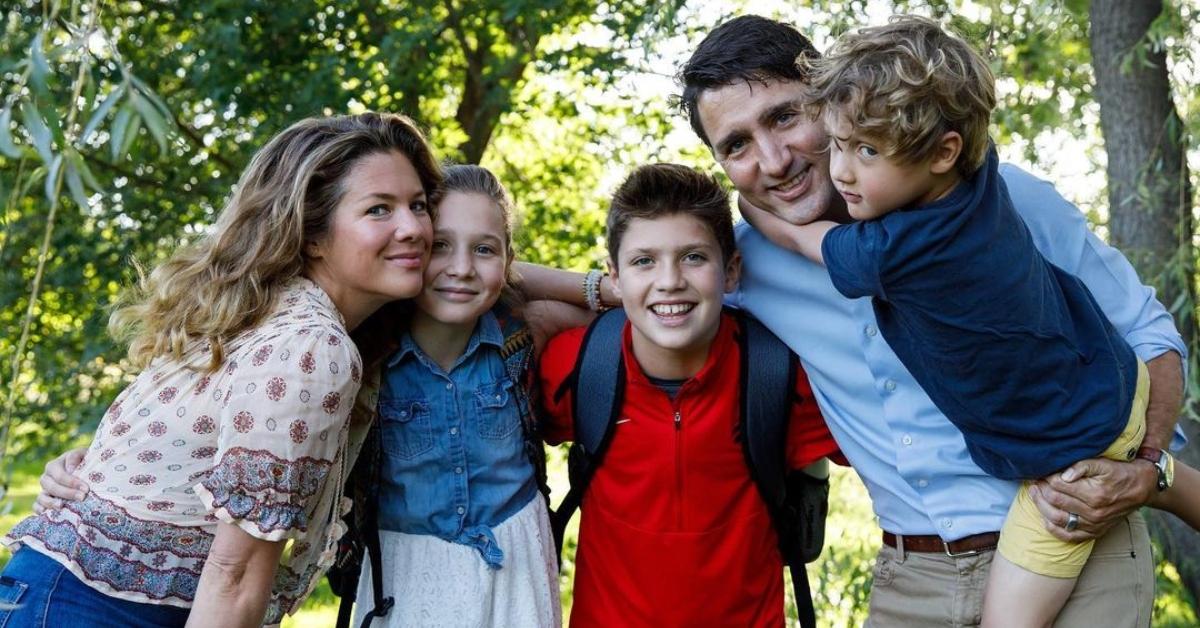
Pierre Trudeau had been Prime Minister through the Administrations of 5 Presidents of the United States, but only one head of State, Queen Elizabeth II, as Canada is still a member of the British Commonwealth. Justin Trudeau has been Prime Minister through 3 Presidents: Barack Obama, Donald Trump and Joe Biden; but also through 2 monarchs, as he was in office when the Queen died, and her son became King Charles III.

People in North America liked to contrast Trudeau: Young, handsome, charismatic, smart, hands-on with policy, and quite liberal; with Trump: Old, gross, stupid, delegating to get his demands met, and quite bigoted, although also, one must admit, charismatic. Trudeau always comes out looking better.
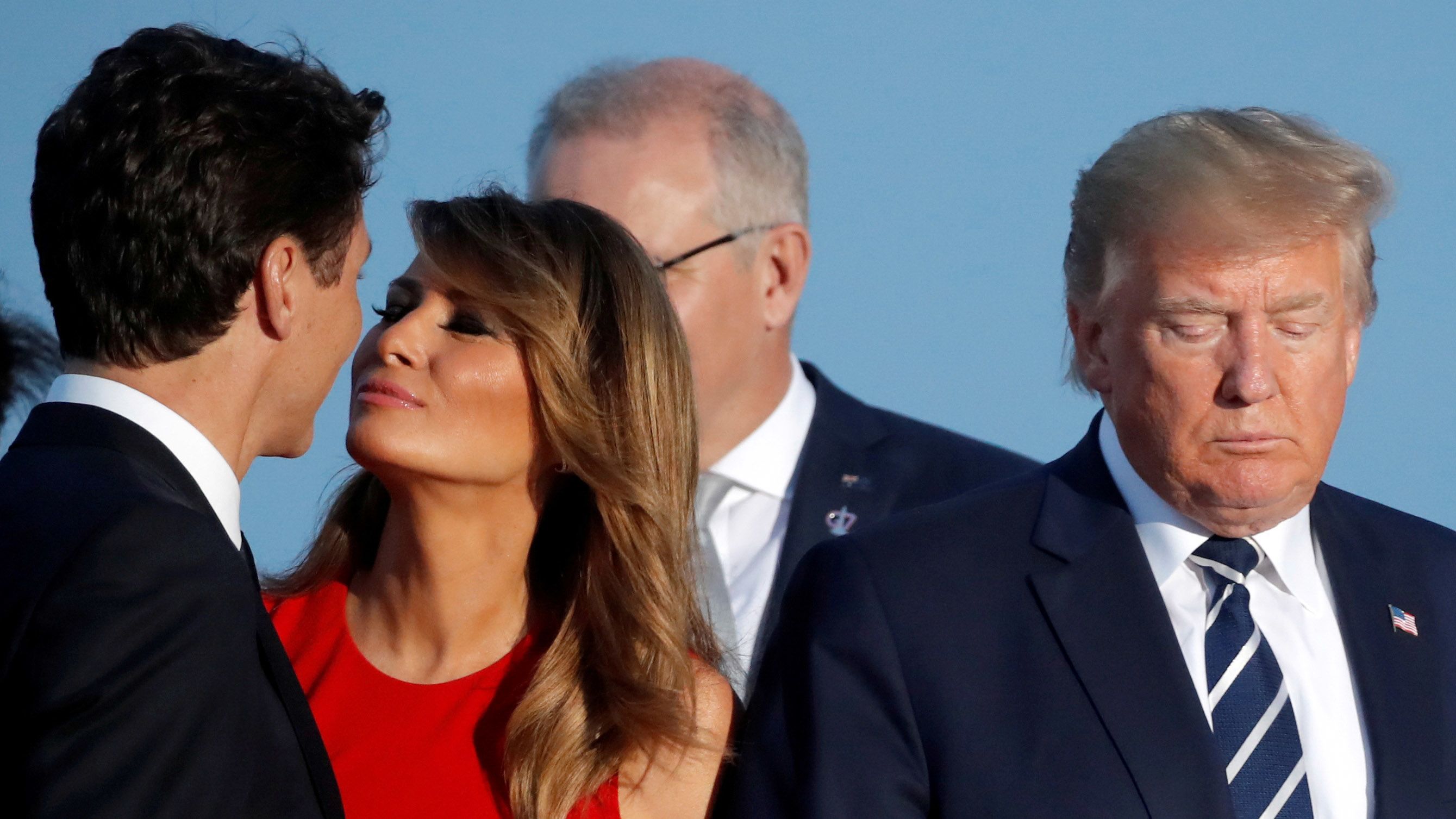
Even Melania Trump thinks so.

But, as with opponents of liberal Presidents in the Democratic Party, Trudeau has had to face stupid charges from conservatives that he is "destroying the country" with his policies. When people in America say they don't like the results of an election, they often say they'll move to Canada. Where do Canadians threaten to go?

In the 2019 election, Trudeau's Liberals lost 20 seats and their majority, but were still the leading Party. Trudeau formed a coalition to stay in power. In 2021, the Liberals gained 5 seats, and Trudeau again had to form a coalition government.

(UPDATE: With the Liberals trailing badly in the polls, Trudeau resigned as Leader of the Liberal Party on January 26, 2025, pending the election of a new Party Leader, though he would keep his seat in the House of Commons. On March 9, Mark Carney was chosen. He took office as Prime Minister on March 14.)

*

November 4, 2015 was a Wednesday. Baseball season had ended 3 days earlier, when the Kansas City Royals beat the New York Mets in the World Series. Football was in midweek. There were 10 games played in the NBA:

* The New York Knicks lost to the Cleveland Cavaliers, 96-86 at the Quicken Loans Arena (now the Rocket Arena) in Cleveland.

* The Brooklyn Nets lost to the Atlanta Hawks, 101-87 at the Philips Arena (now the State Farm Arena) in Atlanta.

* The Washington Wizards beat the San Antonio Spurs, 102-99 at the Verizon Center (now the Capital One Arena) in Washington.

* The Indiana Pacers beat the Boston Celtics, 100-98 at the Bankers Life Fieldhouse (now the Gainbridge Fieldhouse) in Indianapolis.

* The Milwaukee Bucks beat the Philadelphia 76ers, 91-87 at the Bradley Center in Milwaukee.

* The Oklahoma City Thunder beat the Toronto Raptors, 103-98 at the Chesapeake Energy Arena (now the Paycom Center) in Oklahoma City.

* The Houston Rockets beat the Orlando Magic, 119-114 in overtime at the Toyota Center in Houston.

* The Portland Trail Blazers beat the Utah Jazz, 108-92 at the Delta Center (then named the Vivint Smart Home Arena) in Salt Lake City. Damian Lillard led all players on the night with 35 points.

* The Phoenix Suns beat the Sacramento Kings, 118-97 at the Talking Stick Resort Arena (now the Mortgage Matchup Center) in Phoenix.

* And the Golden State Warriors beat the Los Angeles Clippers, 112-108 at the Oakland Coliseum Arena (then named the Oracle Arena).

And there were 4 games in the NHL:

* In an All-Canadian matchup, the Winnipeg Jets beat the Toronto Maple Leafs, 4-2 at the Air Canada Centre (now the Scotiabank Arena) in Toronto.

* The St. Louis Blues beat their arch-rivals, the Chicago Blackhawks, 6-5 at the United Center in Chicago. Vladimir Tarasenko scored the winning goal with 1:06 left in overtime.

* The Anaheim Ducks beat the Florida Panthers, 3-2 in a shootout at the Honda Center in Anaheim.

* And the Pittsburgh Penguins beat the Vancouver Canucks, 3-2 at the Rogers Arena in Vancouver.

November 4, 1969: John Lindsay's Upset Win

November 4, 1969: John Lindsay, denied renomination by the Republican Party, and running as the nominee of the Liberal Party, is re-elected Mayor of New York City.
The opposition to him had fragmented: The Democratic nominee was Mario Procaccino, a conservative serving as City Comptroller, and widely viewed as a racist; while the nominee of the Republican and Conservative Parties was John Marchi, a State Senator from Staten Island, who was so conservative, he made Barry Goldwater look like Bobby Kennedy.
When Lindsay was denied renomination, he looked finished. The fact that he had presided over race riots and municipal strikes while calling New York "Fun City" didn't help. He may have been the 1st major politician to run having used the expression "Mistakes were made" -- used many times by many people since, without specifically saying, "I have made mistakes" -- and used an expression that would later be used by some of his successors, calling the job of Mayor of New York "the second-toughest job in America."
On this day, Lindsay got 42.4 percent of the vote -- not a majority, but a plurality, and over the 40 percent threshold for a runoff -- while Procaccino got 34.8 percent and Marchi got 22.7 percent. The Borough tallies were as follows:
* Manhattan: Lindsay 67 percent, Procaccino 20, March 12.
* Bronx: Procaccino 41, Lindsay 40, Marchi 19.
* Brooklyn: Procaccino 42, Lindsay 36, Marchi 25.
* Queens: Lindsay 36.3, Procaccino 35.8, March 28.
* Staten Island: March 62, Procaccino 20, Lindsay 17.
What saved Lindsay? It wasn't just liberals and minorities, afraid of what Procaccino or Marchi would do. It was the New York Mets. Their run to a World Series win allowed him to identify with them, and he was in the locker room when they won the Series at Shea Stadium on October 16, 19 days before the election. He then gave them a ticker-tape parade and a big ceremony at City Hall. (He gave the Super Bowl-winning Jets a ceremony, too, but not a parade.)
Lindsay in the Mets' locker room, October 16, 1969
Lindsay's 1st term was hard. His 2nd term was a bit more peaceful in terms of civil strife, but harder in terms of holding the City's government and economy together. He might have wished he had lost. He did not run for a 3rd term in 1973 -- he wouldn't have had a chance -- and he died in 2000.
Procaccino never won another election, and died in 1995. Marchi won the Republican and Conservative nominations for Mayor in 1973, but lost to Abe Beame, the Comptroller that Lindsay had beaten for Mayor in 1965. Marchi set a record that has never been surpassed in any State: 50 years in the State Legislature, January 1, 1957 to December 31, 2006. He died in 2009.
Also on this day, William T. Cahill, a Republican Congressman representing Camden County, is elected Governor of New Jersey. After 16 years of Democratic Governors, under Robert Meyner and, since a Governor of New Jersey can't serve 3 consecutive terms, Richard J. Hughes, people wanted something different, and when Meyner was nominated to regain the office, he couldn't get any traction.
Cahill got the State legislature to pass the bill creating the New Jersey Sports and Exposition Authority, which built the Meadowlands Sports Complex. But he raised taxes, and 3 major Republican officials were convicted of crimes. He was denied renomination by his own Party in 1973. He went on to teach at Princeton University, and died in 1996. Meyner died in 1990.
Also on this day, The Allman Brothers Band release their self-titled debut album. It includes the song "Whipping Post."
Also on this day, Matthew McConaughey (no middle name) is born in Uvalde, Texas. Admit it: After playing a stoner in Dazed and Confused, a lawyer in A Time to Kill, winning an Oscar as an AIDS patient in Dallas Buyers Club, and apparently playing another stoner in some Cadillac commercials, you forgot he was in a baseball movie, playing left fielder Ben Williams in the 1994 remake of Angels In the Outfield.
Also on this day, Sean John Combs is born in Manhattan, and grows up in nearby Mount Vernon, Westchester County, New York. The rapper, music producer, and fashion designer is known by many names: Sean John, Puff Daddy, Puffy, P. Diddy, or just Diddy. Personally, I will always think of him as The Guy Who Got Jennifer Lopez Arrested.
*
November 4, 1969, like all modern American Election Days, was a Tuesday. Actor Matthew McConaughey and hip-hip mogul Sean Combs (Puff Daddy, P. Diddy, Diddy) were born on this day.
The baseball season was over. Football was in midweek. There were 4 games played in the NBA:
* The New York Knicks beat the Phoenix Suns, 116-99 at the Arizona Veterans Memorial Coliseum. Despite the Suns' defeat, Connie Hawkins led all scorers on the night with 39 points.
* The Baltimore Bullets beat the San Francisco Warriors, 124-105 at the Baltimore Civic Center (now the CFG Bank Arena). This was actually part of a doubleheader that also included this game:
* The Philadelphia 76ers beat the Chicago Bulls, 113-109.
* And the Seattle SuperSonics beat the Detroit Pistons, 116-102 at Cobo Hall (now the Huntington Center) in Detroit.
There was 1 game in the American Basketball Association: The Washington Capitols beat the Carolina Cougars, 117-107 at the Washington Coliseum.
Only 1 game was played in the NHL: The Toronto Maple Leafs beat the Oakland Seals, 5-2 at the Oakland Coliseum Arena.

Tuesday, October 25, 2022

October 25, 1993: Canada's Tories Are Nearly Wiped Out

October 25, 1993: Canada holds a federal election. Brian Mulroney had resigned as Prime Minister and Leader of the Progressive Conservative Party 4 months earlier, because he knew that the PCs, or "Tories," were going to get clobbered. So he asked the Party to approve his Minister of Justice, Kim Campbell as Leader, thus making her the 1st female head of government in North America. She was also the 1st Prime Minister from the Province of British Columbia.
If Mulroney thought this might gain the Tories some female voters, he was very, very wrong. The Liberal Party gained 96 votes to achieve 177 seats and a majority, and make their Leader, Jean Chrétien, the new Prime Minister. The Tories went from 156 seats to only 2 -- and Campbell's, for Vancouver Centre, was not one of them. Nor was Mulroney's, in Charlevoix, Quebec. They fell from 43 percent of the popular vote to 16 percent.
Campbell's 133-day tenure as Prime Minister was one of the shortest in the nation's history, and it was not her fault at all that it ended so soon. After 9 years of Mulroney, the countries was sick of the Tories. They went from the most seats in the House of Commons to 5th place.
The Bloc Québécois, essentially representing the interests of people who didn't even want to be in Canada anymore, were now in 2nd place, and thus the official Opposition, with 54. The Reform Party was now the leading right-of-center party, going from just 1 seat to 52. And the New Democratic Party, the largest openly socialist party in North America, actually lost seats, retaining 35. Left parties now outnumbered right parties 266-54, getting 75 percent of the popular vote.
Chrétien remained in office for 10 years, his party for nearly 13. The PCs and the Reform Party would merge to form a new Conservative Party, and it would regain power under Stephen Harper in 2006.

*

October 25, 1993 was a Monday. The baseball season had ended 2 days earlier, with the Toronto Blue Jays, Canada's own, repeating as World Champions, defeating the Philadelphia Phillies, 8-6 in Game 6 of the World Series at the SkyDome (now the Rogers Centre) in Toronto. On ABC Monday Night Football, the Minnesota Vikings beat the Chicago Bears, 19-12 at Soldier Field in Chicago.

The NBA season wouldn't start for another 11 days. There were 3 games played in the NHL that day:

* The Ottawa Senators beat the Mighty Ducks of Anaheim, 4-1 at the Ottawa Civic Center (now the TD Place Arena) in Ottawa.

* The Dallas Stars beat the Detroit Red Wings, 5-3 at the Joe Louis Arena in Detroit.

* And the Calgary Flames beat the Washington Capitals, 3-2 at the Saddledome in Calgary. Ted Drury scored the winning goal with 2:03 left in overtime.

Wednesday, September 14, 2022

September 14, 1926: The King-Byng Affair

William Lyon Mackenzie King

September 14, 1926: Canada holds a general election. It is won by the Liberal Party, which means that its Leader, former Prime Minister William Lyon Mackenzie King, will be returned to the job. And that means that the people of Canada were sending a message to their "mother country," Great Britain: We may still be a part of your Empire, but we will decide our own fate.

Since "Confederation" gave Canada a partial independence in 1867, the nation's head of state had been the British monarch, represented in-country by a Governor-General; and the head of government had been the Prime Minister, the Leader of the party with the most seats in the House of Commons.

In 1921, Julian Byng, 1st Baron Byng of Vimy, was named Governor-General of Canada by King George V. Lord Byng had been the commanding officer of the Canadian Corps at the Battle of Vimy Ridge in Vimy, France during World War I. As a result, he was called Canada's greatest military hero, and he replaced the Duke of Devonshire as Governor-General.
Julian Byng

The titles of the outgoing and incoming Governors-General was not unusual: From 1867 to 1952, the Governors-General included 2 Dukes, 6 Earls, 2 Lords who went on to become Earls after their fathers died, 3 Marquesses, 2 Viscounts, and 2 Barons.

Among them were the donors of the trophies for the championships of ice hockey and Canadian football, respectively: Frederick Stanley, who had to resign as Governor-General because his father had died, and passed to him the title of Earl of Derby; and Albert Grey, the 4th Earl Grey, grandson of Charles Grey, for whom Earl Grey tea was named.

In 1920, Robert Borden, who had been Prime Minister through World War I, retired, and handed the office off to Arthur Meighen. But in the next election, in 1921, his Conservative Party lost to the Liberal Party, and Mackenzie King -- usually referred to by his 3rd and 4th names, not by all 4 -- became the new Prime Minister. On October 29, 1925, Meighen returned to power with a coalition government, as he took the Tories to a lead in the Commons, but not a majority.
Arthur Meighen

King, however, thought he could retake the government by peeling off some members of the coalition. He combined the Liberal and Progressive caucuses to gain a plurality, and hung on to power. But the following year, due to a scandal that didn't involve King himself, the coalition fell apart.

King turned to Lord Byng, and asked him to exercise his power and dissolve Parliament, so that a new election could be called. Byng refused, citing the will of the people that had given Meighen the lead in the most recent election, and the right to form his coalition. On June 29, 1926, Byng asked Meighen to form a government, and he did.

Because of the possibility of losing a vote in the Commons, Meighen advised Byng to appoint the ministers of the Crown in an "acting" capacity only, to avoid triggering the automatic by-elections Ministers faced when accepting their appointments at the time. King used the technique to mock the government, and to further his accusation that Meighen had acted irresponsibly by accepting Byng's appointment, attracting Progressive support to take down the fledgling government. The government lost a motion regarding the "acting" Ministers by one vote, only 3 days after Meighen's appointment. With no other parliamentary leader to call upon, Byng called a new election for September 14.

King effectively campaigned against Byng, instead of against Meighen, and won the most seats in the House of Commons, although his party won a smaller proportion of the popular vote than the Conservatives. However, this was largely because the Liberals did not run candidates in all ridings, and had an informal electoral pact with the Progressives and Liberal-Progressives. In particular, the election results in the Province of Manitoba had the Conservatives capture almost 40 percent of the vote, twice the vote share of any other party, but not finishing 1st in a single riding, so they won no seats. Thus, King's Liberals were able to govern.

It became known as "The King-Byng Affair," and Byng returned to Britain at the end of the year. He was raised to the rank of Viscount. Meighen resigned as Conservative Leader. He ended up being knighted for his service to the British Empire. He was the last Prime Minister of Canada who saw himself as being a member of the British Empire, and so he was the last Prime Minister of Canada to be knighted as a result. He became Sir Arthur Meighen, despite the fact that his 1st government lasted 527 days, and his 2nd government lasted 89 days.

The incoming Prime Minister had not only defeated his predecessor: He had, for all intents and purposes, forced the Governor-General to resign, showing the Crown that Canada was its own nation, with its own government, speaking for its own people. Since 1926, no Governor-General of Canada, and no monarch of Great Britain, has tried to impose his or her will on the Prime Minister. All of which makes it weirder that the Prime Minister would be named "King."

With the Great Depression having started, Mackenzie King would lose the 1930 election, to a Conservative Party now led by Richard B. Bennett. But Bennett could not get Canada out of the Depression, and held off calling a new election for as long as he constitutionally could, finally standing for one in 1935. King and the Liberals won it.

Canada entered World War II along with Britain in 1939. Despite this, an election was held on time in 1940, and the Liberals slightly increased their majority. Another was held on time in 1945 -- between V-E Day and V-J Day, as it turned out, just as Britain's was -- and the Liberals lost seats, but hung on to enough seats to keep their majority. King retired in 1948, as Canada's longest-serving Prime Minister.

Julian Byng died in 1935, Mackenzie King in 1950, Arthur Meighen in 1960. Today, when Lord Byng is remembered, it is mainly as the husband of Evelyn Byng. During her time in Canada, she became a fan of the sport of ice hockey, and the Byngs attended Ottawa Senators games together in the nation's capital.
Evelyn Byng

In 1925, Evelyn donated the Lady Byng Trophy, to be awarded to "the player adjudged to have exhibited the best type of sportsmanship and gentlemanly conduct combined with a high standard of playing ability." After her death in 1949, the NHL changed the trophy's name to the Lady Byng Memorial Trophy.
The process of Canada becoming self-governing was further affirmed in 1982, when Prime Minister Pierre Trudeau and Queen Elizabeth II signed the Constitution Act, "repatriating" Canada's Constitution, meaning that Canada can amend the document as it sees fit, without getting the permission of Britain's Parliament. The British monarch remains Canada's head of state, but has little say over Canada's governance.

In 1952, right after becoming Queen of the United Kingdom, and thus also the Queen of Canada, Elizabeth II had to appoint a new Governor-General of Canada. She chose Vincent Massey. He had the diplomatic credentials, but he was not of noble birth, the 1st Governor-General for whom this was true. Indeed, from Massey onward, no Governor-General of Canada has even received a knighthood.

In 1959, upon Massey's retirement, Queen Elizabeth appointed Georges Vanier, the 1st Francophone Governor-General. The Vanier Cup, the championship of Canadian college football, is named for him. In 1984, the Queen appointed Jeanne Sauvé, who became not only the 1st female Governor-General, but also the 1st lifelong civilian.

In 1999, the Queen appointed Adrienne Clarkson, who is of Chinese descent, making her the 1st nonwhite Governor-General. Given the strong Asian presence in Canada, especially in the West, it is not surprising that the country had an Asian head of state before it had a black one. It is also not surprising that the 1st black head of state was a Francophone: In 2005, following Clarkson's retirement, the Queen appointed Michaëlle Jean, who was born in Haiti.

As of September 14, 2022, 4 of the last 5 Governors-General have been women, including the incumbent, Mary Simon, the last of the 13 appointed by Queen Elizabeth. All previous British monarchs had appointed 17.

*

September 14, 1926 was a Tuesday. Dick Dale, the lefthanded guitarist whose instrumentals helped launch "surf rock," was born on this day.

Only 3 baseball games were played that day:

* The New York Giants lost to the Pittsburgh Pirates, 5-0 at the Polo Grounds. Ray Kremer pitched a 4-hit shutout, backed by a home run from Paul Waner.

* The Brooklyn Robins (as the Dodgers were known from 1914 to 1931, when Wilbert Robinson managed them) lost to the Cincinnati Reds, 5-1 at Ebbets Field.

* And the Philadelphia Phillies beat the Chicago Cubs, 5-4 at Baker Bowl in Philadelphia.

Sunday, August 14, 2022

August 15, 1892: William E. Gladstone Forms His Last Government

August 15, 1892: Having led his Liberal Party to the lead, but not a majority, in the recent general election, William Ewart Gladstone brings the Members of the House of Commons who belong to the Irish Nationalist Party into his coalition, forming a majority. He goes to Queen Victoria, and tells her, "I can form a government." Not really having the power to stop him, she lets him.

The Queen was 73 years old. The Prime Minister was 82, the oldest man ever to hold that office. (For comparison's sake, Joe Biden was elected President in 2020, just short of turning 78.) It is the 4th separate time that Gladstone had held the office.

Gladstone (the E was silent) was born on December 29, 1829 in Liverpool, the son of John Gladstone, a Scot who served in Parliament in the 1810s and 1820s. William was first elected to the House of Commons in 1832, to Robert Peel's faction of the Conservative Party. In 1846, Peel's faction broke away, and formed the Liberal Party.

He served in the Cabinets of 3 Liberal Prime Ministers: George Hamilton-Gordon, 4th Earl of Aberdeen; Henry John Temple, 3rd Viscount Palmerston; and John Russell, 1st Earl Russell. Under each of them, it included tenure as Lord of the Exchequer, Britain's equivalent to the Secretary of the Treasury.

His policies emphasized equality of opportunity and opposition to trade protectionism, which would eventually, as he became Prime Minister, became known as Gladstonian Liberalism, and earned him the nickname "The People's William." It also earned him initial nicknames, long before America ever had FDR or JFK: He was known by his actual initials as "WEG," and, eventually, as "the GOM," short for "the Grand Old Man."

When the Liberal Party gained a majority in the 1868 general election, Gladstone was named Prime Minister, taking office for the 1st time on December 3, succeeding the Conservative Leader, Benjamin Disraeli. The rivalry between the 2 men defined an era in British politics, and on February 17, 1874, having lost an election, Gladstone had to give way to Disraeli.

He regained the office on April 23, 1880, his election victory putting an end to Disraeli's career, and starting those of his sons Henry and Herbert Gladstone, who were also elected to Parliament. As in his first term, he pushed for easing of poverty, university reform, fairness toward Ireland, and a conciliatory foreign policy.

This time, what became known as "the Scramble for Africa" was on, and he opposed it. The victory in the Anglo-Egyptian War of 1882 was the highlight of his tenure, but the fall of Khartoum in the Sudan, including the death of the popular British commander George Gordon, led to the worst press treatment of his career. Critics inverted his nickname "GOM" into "MOG," for "Murderer of Gordon." Queen Victoria herself wrote him a telegram rebuking him, but offered him an earldom if he would resign. He resigned on June 9, 1885, but refused the earldom, which won him back some admirers.

But the new Conservative government of Robert Arthur Talbot Gascoyne-Cecil, 3rd Marquess of Salisbury, fell apart quickly over the issue of Irish Home Rule, in part due to a press release by Herbert Gladstone. (And you had a problem with Hunter Biden?) On February 1, 1886, Charles Stewart Parnell, known as "the Uncrowned King of Ireland," took his Irish Parliamentary Party out of Lord Salisbury's government, and allied with the elder Gladstone, who became Prime Minister for the 3rd time.

But rural voters in what had been Gladstone constituencies were not ready to support anything other than London domination of Ireland, and several Liberal Party members left, forming the Liberal Unionist Party. On July 21, 1886, not even 6 months after taking charge again, Gladstone was out for the 3rd time, and Salisbury was in for the 2nd.

But the Grand Old Man was not done. In 1889, he supported the London dockers' strike, regaining much of his former working-class support. An election in 1892 resulted in a minority government, and Gladstone once again cut a deal with Irish Members of Parliament to become Prime Minister for the 4th time on August 15. He got a Home Rule bill through the Commons on September 1, 1893, but the House of Lords overwhelmingly rejected it on September 8. He wanted to call a general election, on the sole subject of that bill, immediately, but was talked out of it.

Gladstone was the first Prime Minister to make it a condition of ministers to resign directorships of public companies in 1892. This was abandoned by Salisbury in 1895, but was restored by Liberal Henry Campbell-Bannerman in 1905, and has been observed ever since.

Gladstone decided to resign the Premiership, ostensibly on health grounds, on March 2, 1894. At 84, he remains the oldest person ever to hold the office. He had held the post for roughly 12 of the preceding 24 years. He resigned from Parliament the next year, after 63 years.

In his last years, he warned against "militarism" and "jingoism," apparently foreseeing the crisis that would result in World War I. He did not, however, foresee the Liberal Party's collapse, and its effective replacement by the Labour Party, in the decade after that. He died on May 19, 1898, at the age of 88, and was laid to rest in Westminster Abbey.

*

August 15, 1892 was a Monday. These games were played in baseball's National League:

* The New York Giants beat the Cincinnati Reds, 9-2 at League Park in Cincinnati.

* The Brooklyn Bridegrooms lost to the St. Louis Browns, 3-2 at an early version of Sportsman's Park in St. Louis. In the 1887-88 off-season, 6 players from the team formerly known as the Brooklyn Grays got married, so people began calling the team the Bridegrooms. In 1911, they took the name Dodgers. In 1900, the Browns became the Cardinals.

* The Washington Senators beat the Pittsburgh Pirates, 4-2 at Exposition Park in Allegheny, across the River of the same name from Pittsburgh proper. In 1907, Allegheny was annexed into Pittsburgh.

* The Boston Beaneaters beat the Cleveland Spiders, 5-0 at the 1890-1909 version of League Park in Cleveland. The Beaneaters went threw a few name changes before settling on "Braves" in 1912.

* The Philadelphia Phillies beat the Louisville Colonels, 2-1 at Eclipse Park in Louisville, Kentucky.

* And the Baltimore Orioles beat the Chicago Colts, 9-2 at South Side Park in Chicago. The Orioles, the Senators, the Spiders and the Colonels were all consolidated out of business by the NL after the 1899 season. In 1903, the Chicago franchise became the Cubs.

Wednesday, June 22, 2022

June 22, 1960: Quebec's Quiet Revolution Begins

Jean Lesage

June 22, 1960: The Liberal Party wins the Provincial election in Quebec, gaining a net 31 seats in the National Assembly, and taking control of Canada's most French Province for the 1st time in 16 years. It ends Le Grande Noirceur: The Great Darkness; and begins what becomes known as La Révolution Tranquille: The Quiet Revolution.

For much of Quebec's history, there were 2 dominant forces: The Roman Catholic Church and the English-speaking banks of Montreal. They were opposed to each other, but neither ever seemed to emerge as more powerful, with the result that the people were the losers.

Lionel Groulx, a priest and historian, thought the best way for the people of Quebec to triumph over the bankers was "the revenge of the cradles": Simply have so many babies that Francophones would overwhelm Anglophones, and, once they were of voting age, vote into office a government that would force the bankers to do their bidding, or get out. Groulx was a doctrinaire, pre-Vatican II Catholic, authoritarian and very anti-Semitic, and by 1960, 7 years before his death, already seen by many as a crank.

In 1936, Maurice Duplessis led his party, the Union Nationale, to victory in the Provincial election, making him the Province's Premier, the equivalent to the Governor of an American State -- but, given the proportional size of the Provinces, he had more power than most American Governors.

He lost in 1939, but won again in 1944, and kept winning. Aside from being a lifelong bachelor and a womanizer, he was Groulx's kind of man, becoming a virtual dictator. He ran the Province like an American big-city Mayor, to the point where his nickname was "Le Chef" (the Boss): Taking care of only those constituencies that had supported him. But it was a very conservative government, and being anti-Communist meant that he could count on American support.

In the French-language Montreal newspaper Le Devoir (The Duty)André Laurendeau wrote an editorial, The Theory of the Negro King. It posited that foreign capital allowed Duplessis to stay in power so that he could officially allow outsiders to ruthlessly exploit Quebec. In this theory, the role of Duplessis was along the lines of the "Negro Kings," the local chieftains in Africa -- as well as the princes, sultans and maharajahs of Asia -- whom the British allowed some control over their area, but who had to recognize the supremacy of their overlords. Quebec Liberals called the Duplessis era Le Grande Noirceur: The Great Darkness.

Duplessis died on September 7, 1959. This elevated Paul Sauvé to the Premiership 3 days later, and he saw the need to modernize a government that had long been one of the most conservative provincial governments in Canada. He initiated a "hundred days of change" that began to transform Quebec society, but he died on January 2, 1960, the 114th day of his administration, leaving Antonio Barrette in charge. An election had to be held, and on June 22, the Liberals won, making their Leader, Jean Lesage, the new Premier.

A primary change was an effort by the provincial government to assume greater control over health care and education, both of which had previously been under the purview of the Church. To achieve this, the government established ministries of Health and Education, expanded the public service, made substantial investments in the public education system, and permitted the unionization of the civil service.

Additionally, measures were taken to enhance Quebecois control over the Provincial economy, including the nationalization of electricity production and distribution, the creation of the Canada/Québec Pension Plan, and the establishment of Hydro-Québec in an effort to nationalize Quebec's electric utilities.

Furthermore, during this period, French Canadians in Quebec adopted the term "Québecois" -- feminine form, "Québecoise" -- to distinguish themselves from both the rest of Canada and France, solidifying their identity as a reformed Province.

The Quiet Revolution ushered in a period of significant economic and social development not only in Quebec but also in French Canada and Canada as a whole. This transformation coincided with similar developments occurring in the Western world in general. Notably, it brought about noticeable changes to the physical landscape and social structures of Montreal, Quebec's principal city.

The impact of the Quiet Revolution extended beyond Quebec's borders, influencing contemporary Canadian politics. Concurrent with the rise of Québec nationalism at the time, French Canadians made substantial strides in shaping the structure and direction of the federal government and national policies.

The Liberals won the 1962 election, but lost in 1966. Notably, Daniel Johnson Sr., now Leader of the Union Nationale, did not try to reverse the gains of the Quiet Revolution. He didn't have much time to do so as Premier, dying in 1968, and the Liberals won the 1970 election. When the Parti Québecois won in 1976, new Premier René Lévesque saw the Quiet Revolution as part of his bid for Quebec nationalism, and indeed his drive for independence, which ultimately failed.

Lesage died in 1980. In 1994, Quebec City named its International Airport for him. That year, Daniel Johnson Jr., son of Daniel Sr., also briefly served as Premier, as Leader of the provincial Liberal Party. His brother, Pierre-Marc Johnson, was yet another briefly-serving Premier, in 1985, leading the PQ. So, 3 members of the Johnson family, 3 different parties, serving as Premier for a combined 1,161 days.

*

June 22, 1960 was a Wednesday. Actress Tracy Pollan, better known as the wife of actor Michael J. Fox, was born. So was environmental activist Erin Brockovich, whose portrayal in the movie of the same name by Julia Roberts won Roberts her only Oscar.

And these baseball games were played:

* The New York Yankees beat the Detroit Tigers, 7-3 at Briggs Stadium in Detroit. The ballpark was renamed Tiger Stadium the next year. Kent Hadley, filling in at 1st base for Moose Skowron, hit 2 home runs. Roger Maris also hit a home run, while Mickey Mantle went 2-for-4 with a walk and an RBI. Art Ditmar was the winning pitcher. For the Tigers, Rocky Colavito and Al Kaline homered.

* The Philadelphia Phillies beat the Chicago Cubs, 6-3 at Connie Mack Stadium in Philadelphia. Ernie Banks went 0-for-4.

* The Pittsburgh Pirates beat the St. Louis Cardinals, 5-0 at Forbes Field in Pittsburgh. Bob Friend allowed 8 hits, but kept the shutout. Roberto Clemente went 1-for-4 with a walk and 2 RBIs. Stan Musial did not play for the Cardinals.

* The Cleveland Indians beat the Washington Senators, 1-0 at Cleveland Municipal Stadium. Ted Bowsfield pitched a 5-hit shutout.

* The Chicago White Sox beat the Baltimore Orioles, 3-1 at Comiskey Park in Chicago. Brooks Robinson went 0-for-3.

* The Milwaukee Braves beat the San Francisco Giants, 7-4 at Milwaukee County Stadium. Hank Aaron went 1-for-3 with a walk. Willie Mays went 2-for-4 with 2 RBIs.

* The Kansas City Athletics beat the Boston Red Sox, 2-1 at Kansas City Municipal Stadium. Ted Williams, in his final season, went 0-for-4.

* And the Cincinnati Reds and the Los Angeles Dodgers were rained out at Crosley Field in Cincinnati. The game was made up as part of a doubleheader on August 14. The Reds won the opener, 2-0. Cal McLish allowed 9 hits, but kept the shutout. Duke Snider went 1-for-4, but did not play in the nightcap. The Dodgers won that game, 9-5. Over the 2 games, Frank Robinson went 4-for-7 with 2 home runs and 4 RBIs.

Friday, April 22, 2022

April 22, 1963: The Rise of Lester Pearson

April 22, 1963: A general election is held in Canada. Following the previous year's election that reduced the Conservative Party's government, led by Prime Minister John Diefenbaker, to a minority, forcing it to form a coalition to stay in power, and a vote of no confidence having recently taken place in the House of Commons, Canadians vote the "Tories" out of office, resulting in a minority/coalition government led by the Liberal Party.

Lester Pearson becomes the new Prime Minister. Born in 1897 in Toronto, he was Canada's Ambassador to the United States at the end of World War II. He was named Foreign Minister under the last Liberal government, led by Prime Minister Louis St. Laurent, and had won the Nobel Peace Prize for mediating the Suez Crisis of 1956.

After Diefenbaker won the 1957 election, St. Laurent stepped aside as Leader of the Liberal Party, and Pearson was elected its Leader. He never won a majority, but won a minority election in 1963, and a second minority election in 1965, before stepping aside for Pierre Trudeau in in 1968.

He was Prime Minister for just short of 5 full years, but was one of the most accomplished holders of that office. Beyond the symbolism of overseeing Canada's adoption of the new Maple Leaf Flag in 1965 and the nation's Centennial celebrations in 1967, he introduced the Canada Student Loan Program, the Canada Pension Plan, the Canada Assistance Plan, the Canada Labour Code, and universal health care.

He established royal commissions on bilingualism and biculturalism, and the status of women. He worked with the United States to sign the Auto Pact, but refused to get Canada mixed up in the Vietnam War. (In contrast, another nation in the British Commonwealth, Australia, did.)

Pearson died in 1972. Diefenbaker would outlive him by 7 years, but had already become increasingly erratic and irrelevant in his declining years. More recently, Conservatives have worked hard to revive his memory. He's essentially Canada's Ronald Reagan or Margaret Thatcher, while Pearson was more an Adlai Stevenson who was able to win because never had to run against an overwhelmingly popular Eisenhower. In 1984, Toronto's international airport was named for Pearson.

*

April 22, 1963 was a Monday. Football was out of season. The NBA Finals was between Games 5 and 6, and the Boston Celtics would defeat the Los Angeles Lakers in Game 6, 2 days later. The hockey season had ended 4 days earlier, when the Toronto Maple Leafs beat the Detroit Red Wings in 5 games for the Stanley Cup.

And these baseball games were played:

* The New York Mets lost to the Philadelphia Phillies, 8-6 at Connie Mack Stadium in Philadelphia. Phils starter Paul Brown fell behind 3-0, allowing 4 hits and 2 walks, and manager Gene Mauch took him out. Ray Culp pitched the next 7 innings and was the winning pitcher. Tony Taylor went 3-for-4 with a walk and 3 RBIs.

* The Washington Senators beat the Los Angeles Angels, 4-1 at District of Columbia Stadium (later Robert F. Kennedy Stadium) in Washington.

* The Pittsburgh Pirates beat the Chicago Cubs, 2-0 at Forbes Field in Pittsburgh. Earl Francis allowed 6 hits in 7 1/3rd innings, and Bob Veale and Roy Face finished the 7-hit shutout. Willie Stargell went 1-for-3 with a walk. He was playing right field, giving Roberto Clemente a day off. Ernie Banks (already a star) and Lou Brock (not yet one) each went 1-for-4.

* The Chicago White Sox and the Cleveland Indians were postponed due to cold weather. The game was made up on May 16. The Indians won, 5-3. Max Alvis hit a home run.

* The Kansas City Athletics beat the Detroit Tigers, 6-5 at Kansas City Municipal Stadium. Al Kaline went 1-for-4 with 2 RBIs.

* The St. Louis Cardinals beat the Houston Colt .45s, 5-2 at Colt Stadium in Houston. Stan Musial, starting his final season, did not play. In 1965, the Houston team moved into the Astrodome, and changed their name to the Houston Astros.

* The Milwaukee Braves beat the Los Angeles Dodgers, 10-2 at Dodger Stadium in Los Angeles. Bob Hendley went the distance for the win, while Don Drysdale only went 5 innings. Hank Aaron, Eddie Mathews and Denis Menke hit home runs for the Braves. Ken McMullen had 3 of the Dodgers' 6 hits.

* The Cincinnati Reds beat the San Francisco Giants, 7-4 at Candlestick Park in San Francisco. Frank Robinson, Marty Keough and Jerry Lynch hit home runs for the Reds. Rookie Pete Rose drew a walk as a pinch-hitter. Orlando Cepeda and Tom Haller hit them for the Giants. Willie Mays went 0-for-3 with a walk. Willie McCovey went 1-for-5.

* And the New York Yankees, the Baltimore Orioles, the Boston Red Sox and the Minnesota Twins were not scheduled.

December 31, 1999 & January 1, 2000: The Millennium

December 31, 1999:  The Millennium arrives. The people of planet Earth survived. At a terrible cost. But we hadn't destroyed ourselves. ...