Showing posts with label sportsman's park. Show all posts

Saturday, October 15, 2022

October 15, 1946: Enos Slaughter's Mad Dash

October 15, 1946: The World Series goes to a deciding Game 7 at Sportsman's Park in St. Louis. Fans of the Boston Red Sox are confident: After all, no Boston team has ever lost a World Series. The Braves won one in 1914; the Red Sox won them in 1903, 1912, 1915, 1916 and 1918. Fans of the St. Louis Cardinals are also confident: They have Game 7 at home.

In the top of the 8th inning, Sox center fielder Dom DiMaggio, brother of Joe, ties the game 3-3 with a 2-run double, but pulls his hamstring on the play, and has to be replaced by Leon Culberson. In the bottom of the 8th, Enos Slaughter is on 1st for the Cards, and Harry Walker is up.

Slaughter takes off for 2nd on the hit-and-run. "Harry the Hat" drives the ball to center. Slaughter sees Culberson bobble the ball, and thinks he can score. He does.

It became known as "the Mad Dash" or "Slaughter's Sprint," and in the telling of the legend, Slaughter is usually said to have scored from 1st on a single. Not really: Walker did make it to 2nd and was credited with a double. But it is the go-ahead run, and the Cardinals win, 4-3.

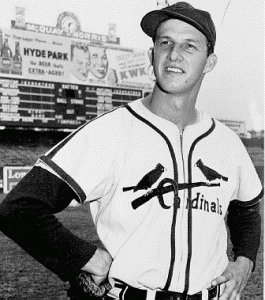
For the Cardinals, led by Slaughter and the sensational Stan Musial, it is their 6th World Championship, their 3rd in 4 tries in the last 5 seasons. For the Red Sox, it is not only their 1st-ever World Series defeat, after not getting that far for 28 years, and the 1st-ever World Series loss for any Boston team, but it is the beginning of a stretch of 4 seasons in which they will end up bitterly disappointed 3 times.

Billed as the duel between the 2 best hitters in baseball‚ the Series sees Musial go 6-for-27 (.222) and Boston's Ted Williams 5-for-25 (.200 -- combined, the Splendid Splinter and Stan the Man batted .212). This will be the only Series of Williams' career, and the only one the Red Sox will play in a 49-year stretch from 1918 to 1967.

The Cardinals, at first, will fare little better, as they won’t play in another Series for 18 years. Musial, who spent the '45 season in the Navy, and that was the only season from '42 to '46 when the Cards didn't win at least the Pennant, had won a Pennant in each of his 1st 4 full seasons, he will play another 17 seasons without winning one, despite close calls in '47, '48 and '49 and 2nd-place finishes in '56 and his final season of '63.

Harry Brecheen wins 3 games for the Cardinals‚ the 1st lefthander ever to accomplish this. It is a feat that has been matched only by Mickey Lolich in 1968 and Randy Johnson in 2001. Brecheen won Games 6 and 7‚ a feat matched only by the Big Unit.

In the telling of the legend of the Mad Dash, Culberson threw the ball to the cutoff man, shortstop Johnny Pesky, who "hesitated" or "held the ball," and threw home too late. In 1986, in an interview on the 40th Anniversary -- and right before Bill Buckner committed an even more shocking World Series defensive miscue for the Sox -- Pesky said, "Even now, people look at me like I'm a piece of shit."
When the Sox finally won the Series again in 2004, all the old goats and ghosts began to be forgiven, and Pesky, a longtime player, coach, broadcaster and scout with the team, became known as "Mr. Red Sox." He would receive standing ovations at Fenway Park, the last on the ballpark's Centennial in 2012, as he died 4 months later, at the age of 93.

The truth is, he never should have been blamed in the first place. DiMaggio's injury meant that it wasn't him playing center field to handle Walker's drive. Culberson was, and he not only bobbled the ball, but his throw to Pesky was a bit off. If Pesky had hesitated, that may have been the reason.

Culberson was a decent player, playing 6 seasons in the major leagues, and batting .266. He hit for the cycle in a game in his rookie season, 1943. Unfortunately, this is all he's remembered for -- if that. (After all, Pesky is the one who tends to get the blame, or else this sequence wouldn't be necessary.)

You can also blame the Boston bats. The Sox scored a grand total of 20 runs in the 7 games. They got shut out on 4 hits in Game 2. As I said, Ted Williams, the so-called "greatest hitter that ever lived," went 5-for-25 (.200) in his only postseason appearance. Roy Partee went 1-for-10 (.100). Tom McBride went 2-for-12 (.167). Pinky Higgins went 5-for-24 (.208). Culberson went 2-for-9 (.222). If you're looking to blame Pesky for something, look not at his fielding, but at his batting: 7-for-30 (.233). If any one of those guys had had a good Series at the plate, the result might have been different.

Also, Slaughter would have scored anyway. I've seen the film of the play many times. Culberson gets the ball to Pesky, and I simply cannot see that with which Pesky has been accused for the last 76 years: "Hesitating" or "holding the ball." And I don't think it would have mattered, as Slaughter scored by plenty.

Besides, the Cardinals were better. Certainly, they were more experienced. This was their 4th World Series in the last 5 years. They'd won in 1942, lost in 1943, and won in 1944. They'd just missed Pennants in 1941 and 1945. It could have been 6 straight Pennants with a few breaks.

In contrast, most of the Red Sox had never been in a Series before. And most of them would never get into another. The Sox fell off in 1947, lost a 1-game Playoff for the Pennant to the Cleveland Indians in 1948, went into the last 2 games of the 1949 season needing to win just 1 against the Yankees and lost them both, and hung close for most of 1950 and 1951 but didn't win either time.

Johnny Pesky was a .307 lifetime hitter, a good shortstop, and a good guy. The Red Sox rightfully retired his Number 6, and elected him to their team Hall of Fame. If he were ever to be elected to the Baseball Hall of Fame, in Cooperstown, New York, I wouldn't mind at all.

He deserves better than to be remembered for a mistake, especially when it's not completely clear that he made a mistake -- and when, if he made a mistake, it was hardly all his fault, and not at all the biggest reason his team lost that World Series.

UPDATE: The Red Sox have a team Hall of Fame. From their 1946 American League Pennant, they have inducted team owner Tom Yawkey, general manager Eddie Collins, manager Joe Cronin, scout George Digby, 2nd baseman Bobby Doerr, shortstop Johnny Pesky, left fielder Ted Williams, center fielder Dom DiMaggio, and pitchers Tex Hughson, Joe Dobson and Dave "Boo" Ferriss.

The Cardinals also have a team Hall of Fame. From their 1942, 1944 and 1946 World Champions, and their 1943 Pennant winners, they have inducted team owner Sam Breadon, general manager Branch Rickey (who left after 1942 to become president of the Brooklyn Dodgers), manager Billy Southworth, scout George Kissell, left fielder Stan Musial, center fielder Terry Moore, right fielder Enos Slaughter, 2nd baseman Albert "Red" Schoendienst, shortstop Marty Marion, 3rd baseman George "Whitey" Kurowski; and pitchers Mort Cooper, Max Lanier and Harry Brecheen. Eddie Dyer succeeded Southworth, and managed them to the 1946 title, but has not yet been inducted.

Kissell, Musial, Marion and Schoendienst were elected to the St. Louis Sports Hall of Fame. Rickey, Kissell, Musial, Slaughter, Marion, Moore, Schoendienst, catcher Joe Garagiola and team scorekeeper Lou Adamie were elected to the Missouri Sports Hall of Fame.

*

October 15, 1946 was a Tuesday. The baseball season was now over. No pro football games were played. The NBA was just founded, and wouldn't play its 1st regular-season game -- ever -- until November 1. And the NHL season began the next day. So there were no other scores on this historic day.

Singer-musician Richard Carpenter, who had a musical act with his sister Karen, was born on this day.

Friday, October 14, 2022

October 14, 1964: The Fall of Walter Jenkins -- and of Nikita Khrushchev

October 14, 1964: Walter Jenkins, unofficially the White House Chief of Staff (officially, the office was vacant) to President Lyndon B. Johnson, resigns his post under pressure, following an arrest on what would once have been quaintly called a "morals charge."
He began working for Johnson, then a Congressman from Texas, in 1939, and remained with him through serving in the House of Representatives, the Senate (including LBJ's tenures as Minority Leader and Majority Leader), the Vice Presidency, and finally the Presidency.
He became a close friend to both Johnson and his wife, Claudia "Lady Bird" Johnson. Another LBJ aide from Texas, Bill Moyers, said, "If Lyndon Johnson owed everything to one human being other than Lady Bird, he owed it to Walter Jenkins."
But on October 7, Jenkins and another man are arrested in the men's room of a YMCA in Washington, for what was officially labeled "disorderly conduct." In spite of Jenkins being a married Catholic with 6 children, this was code for saying that he had been caught in a homosexual act.
It was difficult to keep the story quiet, especially when reporters found out he had previously been arrested on such a charge in 1959. That made it much harder to explain away as the result of overwork or, as one journalist wrote, "combat fatigue."
On October 14, The Washington Star called the White House for comment. His hand forced, LBJ told White House Press Secretary George Reedy to make a statement that the Administration was coming clean about the story -- 20 days before the Presidential election.
Jenkins had to resign, and the Republican Party wanted to make hay out of this. They knew LBJ was soundly beating their nominee for President, Senator Barry Goldwater of Arizona, at the polls. Goldwater, unofficially the leader of the Party, refused to go along with it, and told them to back off. In his memoir, he said, "It was a sad time for Jenkins' wife and children, and I was not about to add to their private sorrow."
Indeed, it was a bad month for Presidents of the United States. The incumbent, Johnson, had lost his most trusted advisor. The day before, former President Harry S Truman, 80 years old, had tripped and fallen at his home in Independence, Missouri, and had to be hospitalized. Those who knew him said that, physically, he never really recovered, although he lived another 8 years.
On October 20, former President Herbert Hoover died at the age of 90. And on October 22, the other living former President, Dwight D. Eisenhower, was hospitalized in Washington for acute tracheobronchitis.
*
Walter Jenkins had bad luck. But, as a President running what amounted to a re-election campaign, Lyndon Johnson had good luck: The same day that Jenkins' resignation was announced, Nikita Khrushchev was ousted as Soviet leader. Apparently, he had become too liberalizing for the Supreme Soviet. They allowed him to live at his dacha (vacation home) outside Moscow, and he was able to get his memoir smuggled out of the country. But he died in 1971, officially disgraced by the country that, 10 years earlier, he had raised to its greatest height.
He once said, "If you feed the people with slogans, they will be with you today, and they will be with you tomorrow, and they may be with you the day after tomorrow. But the next day, they will say, 'To Hell with you.'"
The day after the Jenkins resignation and the Khrushchev ouster, Britain had a previously-scheduled national election. It changed the party of government: The Labour Party beat the Conservative Party, so Alec Douglas-Home was out as Prime Minister, and Harold Wilson was in. That same day, Game 7 of the World Series was played, which also helped take attention away from the Jenkins scandal.
The next day, October 16, China announced it had The Bomb. Two days after that, Johnson gave a televised Oval Office speech, addressing the world situation; and comedian Jackie Mason appeared on The Ed Sullivan Show, fell flat (under the circumstances, "bombed" would be a bad analogy), and was banned from the show by Sullivan, who accused Mason of giving him the middle finger onstage. That became a big story.
And, as I said, two days after that, on October 20, Hoover died, and both Johnson and Goldwater suspended their campaigns until after his funeral, on October 25 -- which both Truman and Eisenhower had wanted to attend, but couldn't due to their infirmities, but Johnson and Goldwater did.
Between the media's reluctance to divulge details of a sex scandal, particularly what would later be called a gay sex scandal, and the preponderance of other news over the next few days, the Jenkins story couldn't gain any traction. Indeed, many people never even knew it had happened. On November 3, LBJ won 44 States.
Jenkins returned to his hometown of Austin, Texas, and worked as an accountant until his death in 1985. Moyers got Jenkins' job, but proved to be less skillful at it, and some historians believe that not having Jenkins to talk to may have hurt LBJ in his full term in office. Indeed, a lack of continuity hurt Johnson. Moyers only filled the job until July 8, 1965, before succeeding Reedy as White House Press Secretary, and, like many other former White House officials, later became a prominent journalist.
Both a fellow Texan, pleasing Johnson, and a Harvard man, which Johnson usually distrusted, Jack Valenti, the White House Appointments Secretary, became the de facto Chief of Staff, but only held the post until June 1, 1966, leaving to accept the Chairmanship of the Motion Picture Association of America, which he held for 38 years, including the implementation of the new movie rating system that replaced the Hays Code in 1968.
Having succeeded Valenti as Appointments Secretary, Marvin Watson, yet another Texan, also succeeded him as Chief of Staff, until April 26, 1968, and served as U.S. Postmaster General for the remainder of the Johnson Administration. And against the Appointments Secretary became the Chief of Staff, James R. Jones, serving until LBJ left office. Jones was later elected to Congress from a District in Oklahoma, and President Bill Clinton appointed him U.S. Ambassador to Mexico.
Valenti died in 2007, Watson in 2017. As of October 14, 2022, Moyers and Jones are still alive. (UPDATE: Moyers died in 2025.)
Times have changed: If something like the Jenkins scandal had stricken a Presidential Administration in an election year from the 1980s onward, the American media would have led every broadcast with it, no matter what other news was going on, at home or abroad.
*
October 14, 1964 was a Wednesday. Joe Girardi was born. He was a good catcher, who reached the postseason with the 1989 Cubs and the 1995 Colorado Rockies, and 4 times with the New York Yankees. In 1996, he caught Dwight Gooden's no-hitter, and his triple off Greg Maddux got the Yankees on the scoreboard in Game 6 of the World Series. He mentored Jorge Posada, and while Posada caught David Wells' perfect game in 1998, Girardi caught David Cone's perfect game in 1999.

Joe was named National League Manager of the Year with the 2006 Florida Marlins, but was fired after just 1 year anyway. After a year in the YES Network broadcast studio, the Yankees named him manager. As a Yankee player, he wore Number 25; as manager, he switched to 27, a sign that he was determined to win the Yankees their 27th World Championship. In 2009, he did, joining Billy Martin and Ralph Houk as the only men to win World Series with the Yankees as both player and manager.

He then switched to 28, but he wasn't able to get that 28th World Championship, and, his contract running out after the 2017 season, he was not rehired.
Also on this day, English soccer star Paul Stewart was born. The Manchester native scored in the 1991 FA Cup Final for Tottenham Hotspur -- the last major trophy that "Spurs" have won. He also played for Manchester City, Liverpool and Sunderland, making him one of the few players to play in a Manchester Derby (City vs. United), a North London Derby (Arsenal vs. Tottenham), a Merseyside Derby (Liverpool vs. Everton) and a North-East Derby (Newcastle United vs. Sunderland).

Game 6 of the World Series was played at Busch Stadium (formerly Sportsman's Park) in St. Louis. Roger Maris and Mickey Mantle hit home runs on back-to-back pitches from Curt Simmons‚ and Joe Pepitone belted Gordie Richardson for a grand slam. The Yankees won, 8-3, and sent the World Series to a deciding Game 7. With all the home runs that Mickey and Roger hit, this is the only time they hit back-to-back homers in a postseason game.

Football was in midweek. The NBA season began 2 days later. One game was played in the NHL: The Chicago Black Hawks beat the Boston Bruins, 3-0 at the Chicago Stadium.

Tuesday, October 11, 2022

October 11, 1943: Yankees: No Superstars, No Problem

Spud Chandler

October 11, 1943: Game 5 of the World Series is played at Sportsman's Park in St. Louis. The New York Yankees beat the St. Louis Cardinals, 2-0. Spurgeon "Spud" Chandler completes his MVP season -- 20-4 with a 1.74 ERA -- with a shutout in Game 5, after he had already won Game 1, and the Yankees win their 10th World Championship, avenging the previous year's Series defeat.

The Yankees had won Game 1 of the 1942 World Series in St. Louis, but the Cards won the next 4 straight, including 3 at Yankee Stadium. This time, wartime travel restrictions led to a new format: The 1st 3 games would be in New York, and any remaining games would be in St. Louis. The Yankees won Game 1, the Cards Game 2, and the Yankees the next 3.

The key play came in Game 3: With the Cards leading 2-1, Johnny Lindell led off the bottom of the 8th, and got to 2nd base when center fielder Harry Walker mishandled the ball. George "Snuffy" Stirnweiss tried to bunt Lindell over, and 1st baseman Ray Sanders tried to get lead runner Lindell out at 3rd. As Lindell slid, 3rd baseman Whitey Kurowski lowered his head, and the men's heads collided, causing Kurowski to drop the ball. Frank Crosetti was intentionally walked to load the bases and set up an out at any base, but Billy J tripled all 3 runs home, and the Yankees ended up winning, 6-2.

The Yankees won despite the manpower drain of World War II having cost them center fielder Joe DiMaggio, right fielder Tommy Henrich, shortstop Phil Rizzuto, and pitcher Red Ruffing. In addition, pitcher Lefty Gomez retired, and an illness forced 3rd baseman Red Rolfe to retire, though Johnson filled in admirably for the rest of the 1940s.

It's a little unfair to say that they had no superstars: They still had the best catcher in the game, Bill Dickey, who had been the team's de facto Captain since the illness-forced retirement of Lou Gehrig -- who would have been only 40 years old at this point, and likely still playing.

They also had slugging left fielder Charlie Keller, known as "King Kong" because he was not just very strong, but very hairy. Like former Cardinals star Joe Medwick with "Ducky," he hated the nickname.) They also had the previous season's American League Most Valuable Player, 2nd baseman Joe Gordon.

Chandler, Marius Russo, Ernest "Tiny" Bonham and Hank Borowy filled out the rotation, while Johnny Murphy was still baseball's best relief pitcher. With the rest of the American League more affected by the manpower drain, the Yankees won the Pennant, finishing 13 1/2 games ahead of the Washington Senators. It was their 3rd straight Pennant, their 7th in the last 8 seasons, and their 14th in the last 23. The AL could have been called "The Yankees and the Seven Dwarfs."

In contrast, the Cardinals kept most of their stars, including Stan Musial, who would spend 1945 in the Navy -- the one season between '42 and '46 that the Cards didn't win the National League Pennant. Enos Slaughter would also miss '44 and '45, but not '42 or '43. They had won the '43 Pennant by 18 games over the Cincinnati Reds.

With The War -- as my grandmother taught me, always Capital T, Capital W -- going on, this was the first time that the Office of the Commissioner of Baseball (basically, the name for the organization that would one day be called "Major League Baseball") authorized an official highlight film for the World Series, to be distributed to American military personnel, and later to civilian movie theaters. It included a filmed message from Babe Ruth, which he had previously delivered over national radio.

Nobody knew it at the time, but Dickey was about to be joining the Navy, as had the man then considered the other major contender for the title of the greatest catcher ever, Mickey Cochrane. Also unknown at the time was that Seaman Lawrence P. Berra, already nicknamed Yogi, was already in the Navy, and would not only become the only man to serve in the D-Day invasion and also play in Major League Baseball, but would replace Dickey as Yankee catcher -- and as the greatest catcher ever.

*

October 11, 1943 was a Monday. There were no other scores on this historic day: The NBA hadn't been founded yet, the NHL season was 19 days away from starting, and the NFL was 26 years away from debuting Monday Night Football

Monday, October 10, 2022

October 10, 1931: The Wild Hoss of the Osage

October 10, 1931: With Pepper Martin tying a World Series record with 12 hits, the St. Louis Cardinals defeat the Philadelphia Athletics, 4-2 in Game 7, and take the Series, denying the A's the chance to become the 1st team to win 3 straight Series.
Burleigh Grimes, the last pitcher legally allowed to throw a spitball, had a shutout going in the 9th, but he tired, and Cardinal manager Gabby Street had to call on Bill Hallahan to nail down the win. "Wild Bill" did not live up to his nickname, and finished the A's off.
The A's would not win another Pennant for 41 years, and that would only come after moving twice. By that point, the Cards had won another 8 Pennants.
Johnny Leonard Roosevelt Martin was a Leap Year baby, born on February 29, 1904 in Temple, Oklahoma, and grew up in Oklahoma City. Known as "Pepper" and "The Wild Hoss of the Osage," his scrappy style of play, and his tendency toward practical jokes, were symbolic of the Cardinal teams of the 1930s, who eventually became known as "The Gashouse Gang," winning the World Series again in 1934.
He appeared in 4 of the 1st 5 All-Star Games, and batted .298 for his career, although his low power numbers have prevented him from becoming a serious candidate for the Baseball Hall of Fame.
Having gotten 12 hits in a single World Series, Martin matched Buck Herzog of the 1912 New York Giants and Shoeless Joe Jackson of the 1919 Chicago White Sox. Unlike them, Martin's 12 hits helped his team win the Series. This would also be the case with the next player to do it, one very much in Martin's scrappy style: Billy Martin of the 1953 New York Yankees.
There have since been 3 players to top this total, with 13 hits in a single World Series, but all 3 of their teams lost: Bobby Richardson of the 1964 Yankees (to the Cardinals), Lou Brock of the 1968 Cardinals, and Marty Barrett of the 1986 Boston Red Sox.
Martin died in 1965. Infielder Ray Cunningham, who played just 3 games that season, and not at all in the Series, plus 11 more games the next season before fading, was the last survivor of the 1931 World Champion Cardinals, dying in 2005, age 100.
UPDATE: The Cardinals have a team Hall of Fame. From their 1931 World Champions, they have inducted team owner Sam Breadon, general manager Branch Rickey, 2nd baseman and manager Frankie Frisch, 1st baseman Jim Bottomley, left fielder Charles "Chick" Hafey and pitcher Jesse Haines.
Bottomley and Frisch were elected to the St. Louis Sports Hall of Fame. Rickey, Frisch, and manager Charles "Gabby" Street were elected to the Missouri Sports Hall of Fame.
*
October 10, 1931 was a Saturday. The NBA hadn't been founded yet. The NHL season wouldn't begin for another month. There was 1 game played in the NFL: The Providence Steam Roller beat the Frankford Yellow Jackets, 6-0 at Baker Bowl in Philadelphia. The Yellow Jackets had to play home games on Saturdays, because Pennsylvania's ban on professional sports on Sunday wouldn't be overturned for another 2 years. Both the Steam Roller (never with an S on the end) and the Yellow Jackets folded at the end of this Depression-wracked season.

Among the notable college football games played that day were these:

* The University of Georgia came north and beat the school of their founders, Yale University, 26-7 at the Yale Bowl in New Haven, Connecticut.

* Army beat Michigan State, 20-7 at Michie Stadium in West Point, New York.

* New York University (NYU) beat Georgetown, 34-0 at Yankee Stadium.

* Princeton lost to Brown, 19-7 at Palmer Stadium in Princeton, New Jersey.

* Maryland beat Navy, 6-0 at Griffith Stadium in Washington.

* Tulane beat Spring Hill, 40-0 at Tulane Stadium in New Orleans.

* In a rivalry that will one day be known as the Backyard Brawl, the University of Pittsburgh beat West Virginia, 34-0 at Pitt Stadium in Pittsburgh.

* Vanderbilt, a good team at the time, came north and beat Ohio State, 26-21 at Ohio Stadium in Columbus.

* Michigan beat the University of Chicago, 13-7 at Michigan Stadium in Ann Arbor.

* Notre Dame and Northwestern played to a tie, 0-0 at Soldier Field in Chicago.

* In a rivalry that will one day become major, Nebraska beat Oklahoma, 13-0 at Memorial Stadium in Lincoln, Nebraska.

* The University of Southern California beat Washington State, 38-6 at the Los Angeles Memorial Coliseum. USC beat Tulane in the Rose Bowl, and were awarded the National Championship.

* And in what would have been a good Rose Bowl matchup in that era, Stanford beat Minnesota, 13-0 at Stanford Stadium in the San Francisco suburb of Palo Alto, California.

Sunday, October 9, 2022

October 9, 1944: The Trolley Series

The 1944 World Series game program. "Worlds" is incorrect.
The Browns' logo featured the statue of the city's namesake,
the "Crusader King" Louis IX of France.

October 9, 1944: The only all-St. Louis World Series comes to an end. While the World Series that have been played between the New York Yankees and either the New York Giants or the Brooklyn Dodgers have been labled "Subway Series," this one, because of St. Louis' streetcars, is known as "The Trolley Series."

(The musical film Meet Me in St. Louis, with its "Trolley Song," did not premiere until November 22, 6 weeks later, so that had no effect on the coverage of the Series.)

The St. Louis Browns had been, along with the Washington Senators, symbolic of futility in the American League. The Senators, to go along with George Washington, for whom their city was named, were said to be "First in war, first in peace, and last in the American League." With St. Louis being a major city for shoemaking and brewing, observers of the Browns countered that St. Louis was "First in shoes, first in booze, and last in the American League."

In 1902, their 1st season, the Browns finished 2nd to the Philadelphia Athletics, 5 games out of 1st place. In 1908, they were 4th, 6 1/2 behind the Detroit Tigers. In 1922, they were 2nd, just 1 game behind the New York Yankees. Indeed, up until 1926, they were usually the better team in town. What's more, they owned Sportsman's Park, built in 1909, the latest in a series of ball grounds on the same site that had stood since 1866; while, after leaving tiny Robison Field in 1920, the Cardinals were not only their tenants, but the much weaker team.

But in 1926, with Branch Rickey as their general manager and Rogers Hornsby as both their manager and their big hitting star, the Cardinals won their 1st Pennant in 40 years, and beat the Yankees in the World Series. Rickey and Hornsby had a falling-out, but Rickey rebuilt, and the Cards won Pennants in 1928, 1930, 1931 and 1934, taking the World Series in 1931 and 1934.

Rickey had just rebuilt the Cardinals again when he was hired to run the Dodgers. The team he left behind would win National League Pennants in 1942, 1943, 1944 and 1946. They beat the Yankees in the 1942 World Series, before losing to them in the 1943 edition.

Meanwhile, the Browns fell apart -- mainly because they had fired Rickey in 1916, allowing him to be signed by the Cardinals. After 1922, they didn't get closer than 15 games of 1st place again until 1944, including losing 108 games in 1937 and 111 in 1939. They weren't just bad, they were boring, compared to the hard-hitting, hard-running, hard-pitching and hard-drinking Cardinals, known as "the Gashouse Gang." And still, the Cards paid monthly rent to the Browns, which, at times, especially during the Great Depression of the 1930s, seemed to be the only thing keeping the Browns afloat.

After the 1941 season, the Browns' owners wanted to move the team to Los Angeles, so they would no longer have to compete with the Cardinals for St. Louis fans' attention. A meeting of American League owners was set to discuss how this could be done, given that there was no team west of St. Louis, and coast-to-coast travel was still iffy, given the length of train rides and the condition of airplanes. The meeting was scheduled for December 8. The day before, Pearl Harbor was bombed, America was in World War II, and the meeting was never held. The Browns stayed in St. Louis -- for now.

But The War's manpower drain meant that every team lost good players, though some lost more than others. The Browns went 89-65 in 1944, and that was enough to finish 1 game ahead of the Detroit Tigers and 6 ahead of the Yankees. They finally had their 1st Pennant. And they would play the Cardinals. With the exception of 2020, when COVID restrictions meant that all games were played at Globe Life Field in the Dallas suburb of Arlington, Texas, the 1944 edition remains the last World Series where all games were played at a single venue, Sportsman's Park.
Cardinal pitcher Mort Cooper had been one of the heroes of the 1942 World Series. Denny Galehouse has gone down in history for his poor performance for the Boston Red Sox in the 1948 AL Playoff against the Cleveland Indians. But in Game 1 of the 1944 World Series, Galehouse outpitched Cooper, and was supported by a home run from 1st baseman George McQuinn. The Browns won, 2-1. 

The Cards struck back in Game 2, with Ken O'Dea's pinch-hit single winning it in the 11th. Game 3, on October 6, 1944, marked the all-time peak of the history of the St. Louis Browns. Jack Kramer -- no relation to the man of the same name who was then America's best tennis player -- struck out 10 batters, and the Browns won, 6-2. They now led the Series, 2 games to 1.
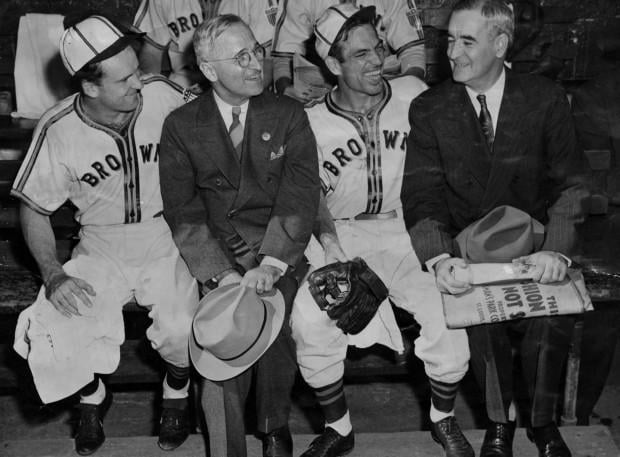
Left to right: George McQuinn, U.S. Senator Harry S Truman of Missouri,
Don Gutteridge, and State Senator Phil Donnelly, before Game 3.
A month later, Truman was elected Vice President of the United States,
and Donnelly was elected Governor. Shortly before the next Opening Day,
President Franklin D. Roosevelt died, and Truman became President.

But the Cardinals had Stan Musial. Not yet known as "Stan the Man," he had been in the majors 3 full seasons, and the Cards had won the Pennant all 3 times. He hit a home run of Sigmund "Sig" Jakucki, to help pitcher Harry "the Cat" Brecheen. The Cards won, 5-1, and they never looked back: They took Game 5, 2-0, with Cooper getting revenge on Galehouse; and Game 6, 3-1, with Emil Verban driving in all 3 runs, Max Lanier as the starting and the winning pitcher, and Ted Wilks retiring all 11 Browns he faced in relief.
Stan the young man

In the International League, the Baltimore Orioles saw their home, Oriole Park, burn down on the 4th of July. They had to move to Municipal Stadium, a football stadium a few blocks away. Somehow, they recovered and won the IL Pennant. At the exact same time that the Cards were dusting off the Browns, in front of a full house of 31,630, a crowd of 52,833, then a record for a minor league game, saw the Orioles fall to the Louisville Colonels, 5-4 in Game 4 of the "Junior World Series." But the Orioles would win that series in 6 games.

This team, and how well it drew, raised Baltimore's profile, and made its return to the majors for the first time since 1902 (unless you count the Federal League of 1914 and '15) possible.

In 1945, the Browns came close to following up, but finished 3rd, 6 games behind the Tigers. The Cardinals didn't win the Pennant, either, as their 2 best players, Musial and Enos Slaughter, were in the service, in the final year of The War. In 1946, everybody was back, and the Cards won another Series. In terms of Pennants, Musial was now 4-for-4. Nobody knew it yet, but he would play another 17 seasons, putting together a record that makes him perhaps the best lefthanded hitter in NL history, but would never win another Pennant.

At least the Cardinals were occasionally in contention in those years. The Browns went back to their losing ways. Even Bill Veeck, who owned the Cleveland Indians and won the 1948 World Series, could not buy the Browns and make them contend, or, despite all kinds of promotions and stunts, get big crowds out to the North Side of St. Louis.

In 1953, Gussie Busch, owner of Anheuser-Busch Breweries and maker of Budweiser beer, bought the Cardinals. With billions in beer bucks behind Busch, Veeck knew that the game was up: St. Louis and its metropolitan area were only big enough for 1 Major League Baseball team, and he didn't have the money to compete.

He sold Sportsman's Park to Busch, who renamed it Busch Stadium. Ironically, Veeck sold the Browns to another brewing tycoon, Jerrold Hoffberger of Baltimore, another city with a beermaking tradition. In 1954, the team took the field as the Baltimore Orioles. It took them until 1966 to win another Pennant, and to become the last of the classic 8 AL franchises to win a World Series.

The 1944 season would remain the only time the Cardinals and the Browns/Orioles franchise both made the postseason until 1996, when each team lost its respective League Championship Series. They both made it again in 2012 and 2014. But, despite winning 17 Pennants between them since 1944, they have never faced each other in another World Series.

The last survivor of the 1944 Cardinals was Musial, living until 2013. The last survivor of the only Browns Pennant winner was Don Gutteridge, who lived until 2008.

*

October 9, 1944 was a Monday. Football was in midweek. Hockey was out of season. And the NBA hadn't been founded yet. So there were no other scores on this historic day.

Three rock and roll legends were born on this day: John Entwistle, the bass guitarist for The Who; Nona Hendryx, who sang with Patti LaBelle's group Labelle; and reggae singer Peter Tosh.

Thursday, October 6, 2022

October 6, 1926: The Legend of the Babe and the Sick Kid

October 6, 1926: Game 4 of the World Series is held at Sportsman's Park in St. Louis. Someone got a message to New York Yankees superstar Babe Ruth, asking him to hit a home run for a sick kid in a hospital.

He hit one. It came in the 1st inning, off St. Louis Cardinals pitcher Flint Rhem. (His name was Charles Flint Rhem, but he went by his middle name.)

He hit another, in the 3rd inning, also off Rhem.

And he hit another, in the 6th inning, off Herman "Hi" Bell. It was the 1st time a player had hit 3 home runs in a World Series game.

Ruth, who had 4 RBIs on the day, did have his chances to hit a 4th homer. He drew a walk in the 5th inning, drew another walk in the 8th, and was on deck when the Yankees made their last out in the 9th. Despite all his accomplishments in baseball, he never hit 4 home runs in a game. In fact, only 1 Yankee has ever done that: Lou Gehrig, in 1932. On this day, Gehrig went 2-for-3 with a walk and an RBI.

Billy Southworth, later to manage the Cardinals to 3 straight Pennants, went 3-for-5. Rogers Hornsby, also the Cardinals' manager this season, went 2-for-5 with an RBI. But despite allowing 5 runs on 14 hits, Waite Hoyt went the distance, and the Yankees won, 10-5, and tied up the Series.

The boy's name was Johnny Sylvester. That Summer, he was staying at a rented house in Bay Head, on the Jersey Shore, when he was thrown from his horse, and the horse kicked him in the head. He was taken back to his family home in Essex Fells, New Jersey, but the injury got worse, and he developed osteomyelitis in his skull. (Twenty years later, while playing high school football, Mickey Mantle was injured and developed osteomyelitis in his ankle, and nearly lost his leg before he could begin his Hall of Fame career with the Yankees.)

Once Sylvester's story became connected with Ruth, the story was mixed up, as what he had depended on who was telling the story. It's usually been written as "blood poisoning." The confusion led some later observers to say the whole story was a hoax. It wasn't.

It's also not clear whose idea it was to contact Ruth: Johnny himself, his father, or his uncle. But the message did get to Ruth, who sent a package to the Sylvester house, including two balls, each autographed by the one of the entire teams involved in the World Series. Next to his own autograph, Ruth wrote, "I'll knock a homer for you on Wednesday." Which he did. (So who were the other 2 homers for?)

After the game, Johnny's condition improved. The Yankees' condition didn't: The Cardinals won the Series in 7 games. After the Series, Ruth visited the Sylvester home, and Johnny told him, "I'm sorry the Yanks lost."

When Johnny's story hit the national news, he also received an autographed football from Red Grange, and an autographed tennis racket from Bill Tilden. That was half of "The Golden Age of Sports" right there. I wonder if he ever met boxing's Jack Dempsey, hockey's Howie Morenz or golf's Bobby Jones?

At any rate, Johnny grew up, graduated from Yale University, served as a Lieutenant in the U.S. Navy during World War II, and met Ruth one more time, in 1948. This time, it was as a publicity stunt in connection with the film The Babe Ruth Story, starring William Bendix in a ridiculous account of Ruth's life. At this meeting, it was Ruth who was sick, with throat cancer, and died later in the year.
Sylvester settled in Garden City, Long Island, New York, and ran a company that manufactured packing machinery. He lived until 1990, age 74, and was survived by a son and 3 grandchildren. In 2014, a ball that Ruth gave him was sold at auction for $250,641.

The legend of the Babe and the sick kid has gotten into every movie made about the Babe. The truth is great enough, is Ruthian enough.

*

October 10, 1926, as Ruth said, was a Wednesday. That was the only baseball game played that day, it was midweek for football, it was too soon for the hockey season to begin, and pro basketball was strictly minor-league at the time. (Hence, no basketball player is ever included with Ruth, Grange, et al. in "The Golden Age of Sports.) So there were no other scores on this historic day.

Friday, September 30, 2022

September 30, 1964: The Phillie Phlop Is Completed

Unused game program from the 1964 World Series,
which was to be sold at Connie Mack Stadium,
with the other flag blank, since the opponent was yet to be determined.

September 30, 1964: The Philadelphia Phillies complete what remains the most stunning regular-season collapse in Major League Baseball history, losing their 10th straight game, 8-5 to the St. Louis Cardinals at Busch Stadium (formerly Sportsman's Park) in St. Louis. 
Going into the games of September 21, the Phillies led the National League by 6 1/2 games. There were 12 games left. Their Magic Number to clinch the Pennant was 6: All they had to do was win half of their remaining games, 6 out of 12, and it wouldn't have mattered what any other team did. The Phils would have won the Pennant.
Unused 1964 World Series press pin for the Phillies
Instead, the following happened:
* 1. September 21, at Connie Mack Stadium in Philadelphia: Cincinnati Reds 1, Phillies 0. The only run came in the top of the 6th inning, when Hiraldo "Chico" Ruiz stole home plate, while Frank Robinson, the greatest power hitter the Reds franchise has ever had, was at the plate. It would have been an incredibly dumb move had it failed. But it worked. "The Chico Ruiz Game" has haunted Phillies fans ever since.
* 2. September 22, at Connie Mack Stadium: Reds 9, Phillies 2. This time, Robinson did hit a home run, and Chris Short, 17-7 going into the game, didn't get out of the 5th inning.
* 3. September 23, at Connie Mack Stadium: Reds 6, Phillies 4. This time, it was Ruiz hitting a home run, and Vada Pinson 2 of them.
* 4. September 24, at Connie Mack Stadium: Milwaukee Braves 5, Phillies 3. Jim Bunning came into the game 18-5, but lost.
* 5. September 25, at Connie Mack Stadium: Braves 7, Phillies 5. Manager Gene Mauch seemed to have pushed the right buttons all season long, until now. In this game, he started Short on just 2 days' rest, and he pitched 6 shutout innings, but allowed 2 runs in the 7th and 1 in the 8th. Johnny Callison homered for the Phils in the bottom of the 8th, momentarily saving them.
Both teams scored 2 runs in the 10th, the Braves on a home run by Joe Torre, the Phils on an inside-the-park home run by eventual NL Rookie of the Year Richie Allen (who hadn't yet begun to insist upon being called "Dick Allen"). But a bad throw by catcher Clay Dalrymple on a stolen base by Gene Oliver allowed the Braves to win it the 12th.
* 6. September 26, at Connie Mack Stadium: Braves 6, Phillies 4. The Phils led 4-0 after 2 innings, and 4-3 going into the 9th, with Art Mahaffey putting in a good start on full rest. But Bobby Shantz, the former Philadelphia Athletics ace back in his hometown, couldn't hold the lead, due in part to an error by 2nd baseman Tony Taylor, and Rico Carty hit a bases-loaded triple. It was Shantz's 39th birthday, and he made only 1 more big-league appearance, 3 days later. Hank Aaron went 2-for-5. Joe Torre went 3-for-4.
* 7. September 27, at Connie Mack Stadium: Braves 14, Phillies 8. Callison hit 3 home runs, helping to cement his case as the NL Most Valuable Player, should the Phils win the Pennant. But Bunning, sent out by Mauch on 2 days' rest, didn't get out of the 4th inning. He and his replacement 7 allowed straight hits, and allowed runs to score on 6 straight plays. Torre hit a home run (although not in the 4th).

There was a small omen for the Phillies: The pitcher who relieved Bunning would go on to become one of the most important figures in team history. He was a 20-year-old righthander from nearby Newport, Delaware. His name was Dallas Green.

* 8. September 28, at Busch Stadium in St. Louis: Cardinals 5, Phillies 1. Again, Mauch sent Short out on 2 days' rest, against Bob Gibson. Future Yankee broadcaster and NL President Bill White went 3-for-4 with an RBI. Future Cardinal broadcaster Mike Shannon went 1-for-3 with 3 RBIs.

* 9. September 29, at Busch Stadium: Cardinals 4, Phillies 2. Dennis Bennett was fully-rested, but didn't get out of the 2nd inning. For the Cards, Ray Sadecki got his 20th win of the season.

* 10. September 30, at Busch Stadium: Cardinals 8, Phillies 5. Tim McCarver hits a home run for the Cards, while Alex Johnson hits one for the Phils. Ironically, the winning pitcher for the Cards is Curt Simmons, whose drafting into the Korean War in 1950 cost him the chance to pitch for the Phils in their last World Series to this point, in 1950. Simmons also turned out to be the last surviving player from those 1950 Phillies "Whiz Kids."

None of it would have mattered if the Reds hadn't won 9 straight from September 20 to 27 (3 of them over the Phillies); and the Cardinals hadn't won 8 straight from September 24 to 30 (the last 3 over the Phillies). The Cards' Ken Boyer ended up winning the MVP.

Now, despite a Rookie of the Year season from Allen, a near-MVP season from Callison, and a near-Cy Young Award season from Bunning, they are 2 1/2 behind the Cardinals, while the Cincinnati Reds are 1 game back. The Phils have 2 games left, the Cards 3, the Reds 4. The Phils could still win the Pennant if they win their last 2 games, although a 3-way tie for the Pennant is still possible.

It was not to be. And, for those people in the Delaware Valley old enough to remember the Phillie Phlop of '64, not even the World Series wins of 1980 and 2008 could erase the scar on their hearts with "1964" branded onto it.

In 1978, the Phillies founded the Philadelphia Baseball Wall of Fame, electing a Phillies figure every year since, and a Philadelphia Athletics figure every year from 1978 to 2003. From the 1964 team, they have elected Jim Bunning, Chris Short, Dick Allen, Johnny Callison, Tony Taylor, general manager John Quinn, and, for what he did as their later manager, Dallas Green. Richie Ashburn, by then a broadcaster, has also been elected. Interestingly, they have not elected manager Gene Mauch. Allen, Callison, Ashburn and Campbell have also been elected to the Philadelphia Sports Hall of Fame.

*

September 30, 1964 was a Wednesday. These other baseball games were played that day:

* The New York Yankees swept a doubleheader from the Detroit Tigers at Yankee Stadium. This was crucial, because the American League race was also coming down to the wire with multiple teams still in it. The Yankees would end up winning the Pennant by just 1 game over Chicago and 2 over Baltimore.

The Yankees won the opener, 7-6. Mickey Mantle and Joe Pepitone hit home runs for the Yankees, Al Kaline for the Tigers. Ralph Terry was the winning pitcher, in relief of Al Downing. The Yankees won the nightcap, 11-8. Kaline homered for the Tigers again, and Bill Roman also hit one. But Tom Tresh hit one for the Pinstripes. Jim Bouton, later the author of Ball Four, started and won.

* The New York Mets lost to the Milwaukee Braves, 6-5 at Milwaukee County Stadium. Denis Menke won the game with a home run off Willard Hunter in the bottom of the 12th inning. Hank Fischer started, Warren Spahn pitched the 9th and 10th innings in relief, and Clay Carroll, later a bullpen mainstay of the Cincinnati Big Red Machine, was the winning pitcher.

Hank Aaron went 0-for-4, but he did draw 2 walks. Joe Torre went 1-for-6 with an RBI. Jim Hickman went 5-for-6 with an RBI for the Mets, and Charley Smith went 3-for-6 with 2 RBIs, but it wasn't enough.

* The Cleveland Indians shut the Boston Red Sox out for the entirety of a doubleheader at Fenway Park, 5-0 and 3-0. A young Luis Tiant, later to pitch so well for the Red Sox, allowed them just 4 hits in the 1st game, 2 of them by Félix Mantilla.

Carl Yastrzemski went 0-for-4 in the 1st game, and didn't play in the 2nd; while Tony Conigliaro, just 19 years old, didn't play in the 1st game, and went 2-for-4 in the 2nd. But the rest of the Red Sox only got 5 hits off Sam McDowell in that 2nd game.

* A doubleheader was split at Memorial Stadium in Baltimore, but the 2 teams then in the Chesapeake region. The Baltimore Orioles won the 1st game, 8-4, with Jerry Adair hitting 2 homers. The Washington Senators won the 2nd game, 6-3. Brooks Robinson went 2-for-4 in each game, and had an RBI in the 1st one.

* The Pittsburgh Pirates beat the Cincinnati Reds, 1-0 at Crosley Field in Cincinnati. Jerry May singled home future Met World Series hero Donn Clendenon with the winning run -- in the top of the 16th inning. Roberto Clemente did not play. Nor did Willie Stargell. Jerry May got 3 hits, the entire rest of the Pirates only 2 -- in 16 innings. Chico Ruiz went 4-for-8, but the rest of the Reds lineup got only 5 hits. Pete Rose went 0-for-7. Frank Robinson went 1-for-4, and drew 3 walks.

The Reds' Jim Maloney, who would go on to take 2 no-hitters into the 10th inning the next season, keeping 1 but losing the other game in the 11th inning, here went 11 innings allowing no runs on 3 hits. The Pirates' Bob Veale went 12 1/3rd, allowing no runs on 7 hits. Veale struck out 16 batters, Maloney 13. The winning pitcher was Al McBean, the losing pitcher Lou Tsitouris.

* The Minnesota Twins beat the Kansas City Athletics, 6-1 at Metropolitan Stadium in the Minneapolis suburb of Bloomington, Minnesota. Harmon Killebrew went 0-for-4, but Jimmie Hall and Don Mincher homered for the Twins.

* The Los Angeles Dodgers beat the Chicago Cubs, 2-0 at Dodger Stadium in Los Angeles. A 2-hit shutout was pitched by -- no, not Sandy Koufax, and not Don Drysdale, but John Purdin. It was his 1st major league win. There would be only 5 more. Both Cub hits were by catcher Dick Bertell.

* The San Francisco Giants beat the Houston Colt .45s, 2-1 at Candlestick Park in San Francisco. Houston 3rd baseman Bob Aspromonte made an error on Jim Davenport's grounder in the bottom of the 11th, allowing Tom Haller, who had homered earlier, to score the winning run. Willie Mays went 0-for-4, but did draw a walk. The next season, the Colt .45s would rename themselves the Houston Astros.

* And the Chicago White Sox and the Los Angeles Angels were not scheduled for this day. The White Sox won their last 9 to finish within 1 of the Yankees, but it wasn't enough.

And in one of the best things that could have happened on any day, Italian actress Monica Bellucci was born.

September 30, 1945: Lieutenant Hank Greenberg Clinches the Pennant

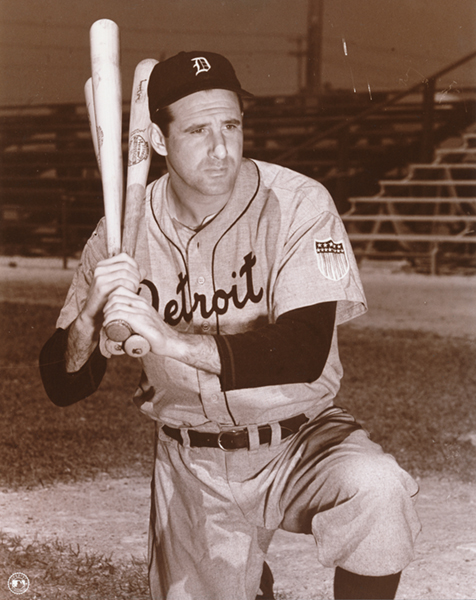
Swinging two bats in the on-deck circle
was a common sight before the Yankees' Elston Howard
invented the "bat donut" in the 1960s.
Hank Greenberg was one of the few players
who was strong enough to swing three bats.

September 30, 1945: Hank Greenberg, recently discharged from the U.S. Army, hits a grand slam off Nelson Potter in the top of the 9th inning, and gives the Detroit Tigers a 6-3 win over the St. Louis Browns at Sportsman's Park, clinching the American League Pennant, which the Browns had won the previous season, for the only time in their history. The Tigers go on to win the World Series over the Chicago Cubs in 7 games.
The 1st player to go into the service was Philadelphia Phillies pitcher Hugh Mulcahy, drafted on March 8, 1941, and he served for the duration of The War. As my grandmother taught me, she and everyone else who lived through it, even if they never left "the home front," always called it "The War," Capital T, Capital W. 
Greenberg had been the 1st major baseball star to volunteer for the U.S. armed forces in preparation for World War II, inducted into the Army on May 7, 1941. So it was only natural that he was the 1st player to return, discharged on June 14, 1945, with Nazi Germany having surrendered, but not, as yet, Imperial Japan. He had scouted bombing targets for B-29 bombers in the China/India/Burma Theater of Operations, and was discharged with the rank of 1st Lieutenant.
Already known as Hammerin' Hank before Henry Aaron was even born, he had lost his seasons of age 31, 32 and 33, and the 1st half of his age 34 season. He finished his career with a lifetime batting average of .313 and 331 home runs. He should have had at least 150 more home runs. He never regretted it, saying, "My country comes first."
Nor did Chief Petty Officer Bob Feller, U.S. Navy, who lost his seasons of ages 23, 24, 25 and most of 26. He won 266 games and struck out 2,581 batters, all for the Cleveland Indians. Based on his 1941 and 1946 performances, he should have had at least another 90 wins and 1,000 strikeouts, which could have made him the all-time strikeout leader, and, with another 98 wins, the pitcher with the most in the post-1920 Lively Ball Era.
He knew The War was more important. He also knew that people like Ty Cobb and Ohio State football coach Woody Hayes, who compared sports to war, were blowhards, saying, "Anybody who says sports is war has never been in a war."
Warren Spahn had appeared in 4 games before going into the service, and was the winning pitcher in exactly none of them. By the time he rejoined the Boston Braves, 1st Lieutenant Warren Spahn, U.S. Army, had missed his age 22, 23 and 24 seasons, and had gotten frostbite in the Battle of the Bulge and been wounded at the Remagen Bridge.
But his wartime experience may have matured him. From age 25 to 44, he did become the Lively Ball Era's winningest pitcher, and the winningest lefthanded pitcher regardless of era, with 363. So maybe his stats didn't suffer.
The stats of Sergeant Joe DiMaggio, U.S. Army Air Force, did suffer, as he lost his age 28, 29 and 30 seasons. He finished with a .325 batting average, and 2,214 hits including 361 home runs. He should have had at least another 550 hits and another 75 home runs.
And then there was Ted Williams, who served as a flight instructor in World War II and a fighter pilot in the Korean War. By the time he left the service for the last time in 1953, Captain Theodore S. Williams, U.S. Marine Corps, had damaged hearing, and had lost his seasons of age 24, 25 and 26, and most of those of age 33 and 34.
He batted .344 for his career, with 2,654 hits and 521 home runs. It shouldn't surprise people who know a little about baseball history that Ted reached 500 homers, only the 4th to do so after Babe Ruth, Jimmie Foxx and Mel Ott. But it is surprising that the man often called "The Greatest Hitter Who Ever Lived" didn't even get close to 3,000 hits. (He also never got 200 hits in a season.) By missing 4 1/2 prime seasons, he may have missed out on as many as 600 hits and 200 home runs, which would have put him past the 714 of Ruth, the record before Aaron reached 755.
In contrast, Ruth only missed 1 month due to World War I, September 1918, and that was because everybody missed at least that much, since the season was cut short. And Aaron was never drafted. Mickey Mantle was classified 4-F, medically unfit for service.
Willie Mays did serve in the Korean War, missing most of his age 21 season and all of his 22, probably costing him around 350 hits on top of his 3,293, and at least 50 homers on top of his 660, meaning he might have gotten to 715 before Aaron did. Yankee pitcher Whitey Ford (1951 and '52) and Brooklyn Dodger pitcher Don Newcome (1952 and '53) also missed 2 seasons serving in Korea.)
Seaman 1st Class Stan Musial, U.S. Navy, the best hitter in the National League while Ted was the best in the American League, only missed 1945, his age 24 season, due to World War II. He had 3,630 hits and 475 home runs, so he may have missed 200 hits and maybe the 25 homers that would have put him over 500.
One man was a veteran of both D-Day and Major League Baseball. In his case, he was just 19 when he was in a U.S. Navy ship off the coast of Normandy, and his service probably didn't delay his entry into the major leagues by much. He may have been the calmest man in the battle, later saying that the exploding shells looked like fireworks. He was Seaman 2nd Class Lawrence Peter Berra. Yogi.
Yankee shortstop and Seaman 1st Class Phil Rizzuto missed his age 25, 26 and 27 seasons due to those huckleberries Hitler and Tojo. His Dodger counterpart, Chief Petty Officer Harold "Pee Wee" Reese, missed his age 24, 25 and 26 seasons. And Army 1st Lieutenant Jack Roosevelt Robinson missed his age 24, 25 and 26 seasons in the Army. Of course, at that point, he had no idea that he would ever play professional baseball in any capacity, much less the one that would make him the most important player of all time.
UPDATE: Bobby Shantz, who turned 100 on September 26, 2025, became the last remaining veteran of both World War II and Major League Baseball. 
*
September 30, 1945 was a Sunday. These other baseball games were played that day:
* The New York Yankees beat the Boston Red Sox, 12-2 at Yankee Stadium. Tuck Stainback and Charlie Keller hit home runs. Keller had also recently returned, from the U.S. Merchant Marine. Joe Page, who would go on to be much better known as a reliever, started and went the distance for the win.
* The New York Giants beat the Boston Braves, 1-0 at Braves Field in Boston, in the 1st game of a doubleheader. Napoleon "Nap" Reyes, a 3rd baseman, light-skinned enough to be allowed to play even though he was Hispanic, and from Cuba so he wouldn't be drafted to fight in The War, hit a home run in the top of the 13th inning. Don Fisher pitched all 13 innings for the shutout. The nightcap was tied 2-2 after 7 innings, when Massachusetts' 7:00 PM curfew for Sunday sports kicked in and stopped the game.
* The Brooklyn Dodgers beat the Philadelphia Phillies, 4-1 at Shibe Park in Philadelphia.
* The Chicago Cubs beat the Pittsburgh Pirates, 5-3 at Forbes Field in Pittsburgh.
* The St. Louis Cardinals beat the Cincinnati Reds, 3-2 at Crosley Field. Del Rice won the game with a home run in the top of the 12th inning.
* The Washington Senators completed their 154-game schedule, but played their 154th game on September 23, a week before the regular season was supposed to end. Wartime travel restrictions, and the desire to get Griffith Stadium ready for the NFL's Washington Redskins, led to the Senators' condensed schedule. As a result, when their season ended, the Senators were 1 game behind the Tigers for the AL Pennant; but when the season finally ended, the Tigers were a game and a half ahead.
* The Chicago White Sox played their 149th game on September 25, and never played their last 5 games. The Philadelphia Athletics played their 150th game on September 27, and never played their last 4. The Cleveland Indians played their 145th game on September 28, and never played their last 9. Most likely, these were also due to wartime travel restrictions, even though The War had ended with the Japanese' official surrender on September 2 (following their unofficial surrender on August 14, which is recognized as V-J Day).
There were 2 NFL games played that day. The Green Bay Packers beat their arch-rivals, the Chicago Bears, 31-21 at Green Bay City Stadium. And the Cleveland Rams beat the Chicago Cardinals, 21-0 at League Park in Cleveland.
And Ehud Olmert, who served as Prime Minister of Israel from 2006 to 2009, was born on this day.

Wednesday, September 28, 2022

September 28, 1947: Ol' Diz Makes His Point

This photo is not a mockup for an "alternate history" website.
This actually happened.

September 28, 1947: The St. Louis Browns start Dizzy Dean against the Chicago White Sox at Sportsman's Park in St. Louis. Dean had been retired for 6 years due to an arm injury, and was broadcasting for the Browns. A few days earlier, frustrated with their pitching, he said, on the air, "Doggone it, I can pitch better than 9 out of the 10 guys on this staff." (He never did say who the 10th guy was, the one who could pitch better than he could.)

The Brown pitchers' wives complained to management, and they decided to put their money where Dean's mouth was. Since Dean was still only 37, they chose the last day of the season, when the spectator-poor Browns would have even more trouble than usual filling Sportsman's Park, to have Dean pitch for the Browns. It doesn't work: Attendance is only 15,910, about half the ballpark's capacity.

He goes 4 innings, and gets a hit off future Yankee All-Star Eddie Lopat, but pulls a muscle rounding 1st base, and has to leave the game. The Browns' bullpen proves Ol Diz' point as much as he does, losing the game for him: Although the game is scoreless going into the 9th inning, it ends White Sox 5, Browns 2. Lopat goes the distance for the win for the Pale Hose.

Interviewed on what would normally be his own postgame radio show, Diz says, "I said I can pitch better than 9 out of the 10 guys on this staff, and I can. But I'm done playing. Talking's my game now, and I'm glad that muscle I pulled wasn't in my throat."

He broadcast for the Cardinals from 1941 to 1946, the Browns from 1941 to 1948, the Yankees in 1950 and 1951, Mutual Broadcasting in 1952, ABC in 1953 and 1954, CBS from 1955 to 1965 (doing the Game of the Week with former Brooklyn Dodger shortstop Pee Wee Reese), and the Atlanta Braves -- probably since he was the best-known living Southern-born baseball figure -- from their debut in 1966 to 1968.

He was known for his fractured syntax ("Zarilla slud into third" being the best-remembered example), and was the template for football quarterback turned broadcaster Terry Bradshaw: The redneck who wasn't nearly so dumb as he appeared. He died in 1974.

*

September 28, 1947 was a Sunday. In other baseball games:

* The New York Yankees beat the Philadelphia Athletics, 5-3 at Yankee Stadium, in a game played after holding their 1st official Old-Timers Day. Johnny Lindell hits a home run off Lou Brissie, the war hero who has to wear a metal plate on his shin to protect his surgically-repaired leg. The winning pitcher is Bill Wight -- not to be confused with Bill White, later a fine 1st baseman, a longtime Yankee broadcaster, and a President of the National League.

* The Brooklyn Dodgers, having already clinched the National League Pennant, lose their meaningless regular-season finale, 3-2 to the Boston Braves at Braves Field. Johnny Sain pitches 5 innings in relief to pick up his 21st win of the season.

The game ends on a run scored due to an error by the Dodgers' 1st baseman. It's not Jackie Robinson, who got the day off. With poetic justice, it is Ed Stevens, one of the Southerners who'd signed the petition to keep Robinson off the Dodgers in Spring Training. He never appears for the Dodgers again: In the off-season, he's traded to Pittsburgh.

* The New York Giants split a doubleheader with the Philadelphia Phillies at Shibe Park in Philadelphia. The Jints win the opener, 4-1. The Phils win the nightcap, 3-1. Despite having hit a major league record 221 home runs this season, led by the 51 of Johnny Mize, the Giants hit no homers in this doubleheader, and only finished 4th in the NL, 13 games behind the Pennant-winning Dodgers.

* The Washington Senators beat the Boston Red Sox, 5-1 at Griffith Stadium in Washington. Ted Williams of the Red Sox goes 2-for-4. With the regular season over, Williams has won the Triple Crown for the 2nd time: He batted .343, hit 32 home runs, and had 114 RBIs. But Joe DiMaggio had led the Yankees to the Pennant, and ended up leading them to the World Championship. Again, DiMaggio, not Williams, is named the American League's Most Valuable Player.

* The Pittsburgh Pirates beat the Cincinnati Reds, 7-0 at Forbes Field in Pittsburgh. Former Yankee Ernest "Tiny" Bonham pitches a 2-hit shutout. Ralph Kiner finishes 1-for-4 with a RBI. He does not hit a home run, finishing with 51 on the season, tying Mize for the NL and major league lead. Not entering the game for the Pirates is Hank Greenberg, who is retiring, and played his last game 10 days earlier.

* The Detroit Tigers beat the Cleveland Indians, 1-0 at Cleveland Municipal Stadium. Fred Hutchinson, later to manage the Reds to a Pennant, pitches a 6-hit shutout, to beat Bob Feller.

* And the Chicago Cubs beat their arch-rivals, the St. Louis Cardinals, 3-0 at Wrigley Field in Chicago. Bill Nicholson, known as "Swish" because he struck out a lot by the standards of the era, was kind of a precursor to Dave Kingman: All or nothing. This time, he got all of one, hitting the game's only homer. Johnny Schmitz pitched a 5-hit shutout. Stan Musial did not enter the game for the Cards.

Since it was a Sunday, there were also NFL games played, but only 3 of them:

* The Philadelphia Eagles beat the Washington Redskins, 45-42. Wikipedia and Pro-Football-Reference.com agree that the game was played at Shibe Park. Except it couldn't have been, unless it was played at night, after the Phillies finished their doubleheader with the Giants. It's much more likely that the game was moved to Municipal Stadium (later renamed John F. Kennedy Stadium) or Franklin Field.

* The Chicago Cardinals beat the Detroit Lions, 45-21 at Comiskey Park in Chicago. This one is possible, since the White Sox were in St. Louis -- oddly, the city the football Cardinals would move to in 1960.

* And The Green Bay Packers beat their arch-rivals, the Chicago Bears, 29-20 at Green Bay City Stadium. 

December 31, 1999 & January 1, 2000: The Millennium

December 31, 1999:  The Millennium arrives. The people of planet Earth survived. At a terrible cost. But we hadn't destroyed ourselves. ...