
The 1944 World Series game program. "Worlds" is incorrect.
The Browns' logo featured the statue of the city's namesake,
the "Crusader King" Louis IX of France.
(The musical film Meet Me in St. Louis, with its "Trolley Song," did not premiere until November 22, 6 weeks later, so that had no effect on the coverage of the Series.)
The St. Louis Browns had been, along with the Washington Senators, symbolic of futility in the American League. The Senators, to go along with George Washington, for whom their city was named, were said to be "First in war, first in peace, and last in the American League." With St. Louis being a major city for shoemaking and brewing, observers of the Browns countered that St. Louis was "First in shoes, first in booze, and last in the American League."
In 1902, their 1st season, the Browns finished 2nd to the Philadelphia Athletics, 5 games out of 1st place. In 1908, they were 4th, 6 1/2 behind the Detroit Tigers. In 1922, they were 2nd, just 1 game behind the New York Yankees. Indeed, up until 1926, they were usually the better team in town. What's more, they owned Sportsman's Park, built in 1909, the latest in a series of ball grounds on the same site that had stood since 1866; while, after leaving tiny Robison Field in 1920, the Cardinals were not only their tenants, but the much weaker team.
But in 1926, with Branch Rickey as their general manager and Rogers Hornsby as both their manager and their big hitting star, the Cardinals won their 1st Pennant in 40 years, and beat the Yankees in the World Series. Rickey and Hornsby had a falling-out, but Rickey rebuilt, and the Cards won Pennants in 1928, 1930, 1931 and 1934, taking the World Series in 1931 and 1934.
Rickey had just rebuilt the Cardinals again when he was hired to run the Dodgers. The team he left behind would win National League Pennants in 1942, 1943, 1944 and 1946. They beat the Yankees in the 1942 World Series, before losing to them in the 1943 edition.
Meanwhile, the Browns fell apart -- mainly because they had fired Rickey in 1916, allowing him to be signed by the Cardinals. After 1922, they didn't get closer than 15 games of 1st place again until 1944, including losing 108 games in 1937 and 111 in 1939. They weren't just bad, they were boring, compared to the hard-hitting, hard-running, hard-pitching and hard-drinking Cardinals, known as "the Gashouse Gang." And still, the Cards paid monthly rent to the Browns, which, at times, especially during the Great Depression of the 1930s, seemed to be the only thing keeping the Browns afloat.
After the 1941 season, the Browns' owners wanted to move the team to Los Angeles, so they would no longer have to compete with the Cardinals for St. Louis fans' attention. A meeting of American League owners was set to discuss how this could be done, given that there was no team west of St. Louis, and coast-to-coast travel was still iffy, given the length of train rides and the condition of airplanes. The meeting was scheduled for December 8. The day before, Pearl Harbor was bombed, America was in World War II, and the meeting was never held. The Browns stayed in St. Louis -- for now.
But The War's manpower drain meant that every team lost good players, though some lost more than others. The Browns went 89-65 in 1944, and that was enough to finish 1 game ahead of the Detroit Tigers and 6 ahead of the Yankees. They finally had their 1st Pennant. And they would play the Cardinals. With the exception of 2020, when COVID restrictions meant that all games were played at Globe Life Field in the Dallas suburb of Arlington, Texas, the 1944 edition remains the last World Series where all games were played at a single venue, Sportsman's Park.

The Cards struck back in Game 2, with Ken O'Dea's pinch-hit single winning it in the 11th. Game 3, on October 6, 1944, marked the all-time peak of the history of the St. Louis Browns. Jack Kramer -- no relation to the man of the same name who was then America's best tennis player -- struck out 10 batters, and the Browns won, 6-2. They now led the Series, 2 games to 1.
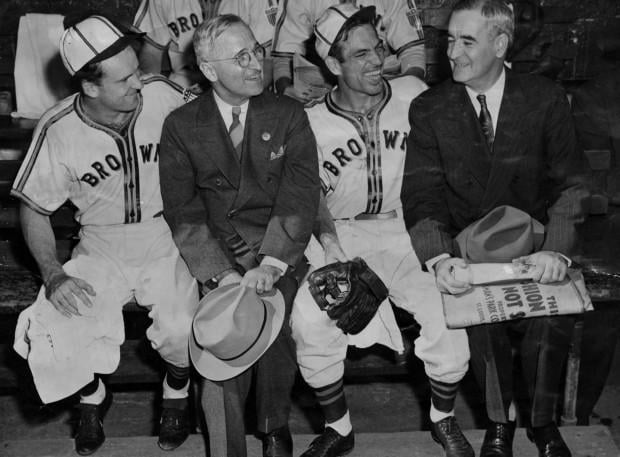
Left to right: George McQuinn, U.S. Senator Harry S Truman of Missouri,
Don Gutteridge, and State Senator Phil Donnelly, before Game 3.
A month later, Truman was elected Vice President of the United States,
and Donnelly was elected Governor. Shortly before the next Opening Day,
President Franklin D. Roosevelt died, and Truman became President.
But the Cardinals had Stan Musial. Not yet known as "Stan the Man," he had been in the majors 3 full seasons, and the Cards had won the Pennant all 3 times. He hit a home run of Sigmund "Sig" Jakucki, to help pitcher Harry "the Cat" Brecheen. The Cards won, 5-1, and they never looked back: They took Game 5, 2-0, with Cooper getting revenge on Galehouse; and Game 6, 3-1, with Emil Verban driving in all 3 runs, Max Lanier as the starting and the winning pitcher, and Ted Wilks retiring all 11 Browns he faced in relief.
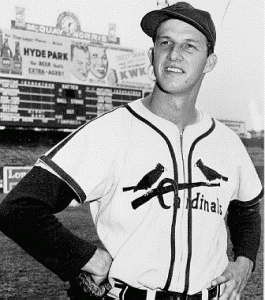
Stan the young man
In the International League, the Baltimore Orioles saw their home, Oriole Park, burn down on the 4th of July. They had to move to Municipal Stadium, a football stadium a few blocks away. Somehow, they recovered and won the IL Pennant. At the exact same time that the Cards were dusting off the Browns, in front of a full house of 31,630, a crowd of 52,833, then a record for a minor league game, saw the Orioles fall to the Louisville Colonels, 5-4 in Game 4 of the "Junior World Series." But the Orioles would win that series in 6 games.
This team, and how well it drew, raised Baltimore's profile, and made its return to the majors for the first time since 1902 (unless you count the Federal League of 1914 and '15) possible.
In 1945, the Browns came close to following up, but finished 3rd, 6 games behind the Tigers. The Cardinals didn't win the Pennant, either, as their 2 best players, Musial and Enos Slaughter, were in the service, in the final year of The War. In 1946, everybody was back, and the Cards won another Series. In terms of Pennants, Musial was now 4-for-4. Nobody knew it yet, but he would play another 17 seasons, putting together a record that makes him perhaps the best lefthanded hitter in NL history, but would never win another Pennant.
At least the Cardinals were occasionally in contention in those years. The Browns went back to their losing ways. Even Bill Veeck, who owned the Cleveland Indians and won the 1948 World Series, could not buy the Browns and make them contend, or, despite all kinds of promotions and stunts, get big crowds out to the North Side of St. Louis.
In 1953, Gussie Busch, owner of Anheuser-Busch Breweries and maker of Budweiser beer, bought the Cardinals. With billions in beer bucks behind Busch, Veeck knew that the game was up: St. Louis and its metropolitan area were only big enough for 1 Major League Baseball team, and he didn't have the money to compete.
He sold Sportsman's Park to Busch, who renamed it Busch Stadium. Ironically, Veeck sold the Browns to another brewing tycoon, Jerrold Hoffberger of Baltimore, another city with a beermaking tradition. In 1954, the team took the field as the Baltimore Orioles. It took them until 1966 to win another Pennant, and to become the last of the classic 8 AL franchises to win a World Series.
The 1944 season would remain the only time the Cardinals and the Browns/Orioles franchise both made the postseason until 1996, when each team lost its respective League Championship Series. They both made it again in 2012 and 2014. But, despite winning 17 Pennants between them since 1944, they have never faced each other in another World Series.
The last survivor of the 1944 Cardinals was Musial, living until 2013. The last survivor of the only Browns Pennant winner was Don Gutteridge, who lived until 2008.
*
October 9, 1944 was a Monday. Football was in midweek. Hockey was out of season. And the NBA hadn't been founded yet. So there were no other scores on this historic day.
Three rock and roll legends were born on this day: John Entwistle, the bass guitarist for The Who; Nona Hendryx, who sang with Patti LaBelle's group Labelle; and reggae singer Peter Tosh.


No comments:
Post a Comment