
March 25, 1911: A fire strikes the Triangle Shirtwaist Factory in New York's Greenwich Village, killing 146 people, and sparking the modern labor rights movement.
Since the 1930s, "the Garment District" has been considered to be between 5th and 9th Avenues, from 34th to 42nd Streets. Before that, it was at the northern edge of Greenwich Village. This included the Triangle Waist Company -- the official name of the company -- on the 8th, 9th and 10th floors, the top 3, of the Asch Building, at 23 Washington Place (roughly, 5th Street), on the corner of University Place between 4th and 5th Avenue, a block east of Washington Square Park.
Owned by Max Blanck and Isaac Harris, Triangle produced women's blouses, then called "shirtwaists," hence it was widely known as "The Triangle Shirtwaist Factory." Blanck was the contractor who got the material into the factory, Harris the design expert. Harris married a cousin of Blanck's wife.
They went into business together in 1900, and opened the factory in 1902. It normally employed about 500 workers, almost all women and teenage girls, most of them immigrants from Italy and the Jewish sectors of Central and Eastern Europe. By 1908, they had made over $1 million, and were making 1,000 shirtwaists a day.
Harris lived in a townhouse on West 101st Street, when the Upper West Side was pretty much still being built, and had the cachet that the Upper East Side would later have. Blanck bought a mansion on Ocean Parkway in Brooklyn. Both were chauffered in automobiles, which most people didn't have yet.
There was a labor movement in America at the time, but it was weak. As a result, there were what came to be called "sweatshops," and Triangle had one of them. These women worked 9 hours a day, plus 7 more on Saturdays, 52 hours a week. They got between $7.00 and $12.00 for that week -- in today's money, $201 to $345. Multiply that by 4 weeks, and it's $804 to $1,380 a month. Not enough to rent an apartment anywhere in the New York Tri-State Area, especially in Manhattan. They had already gone on strike in 1909, and in early 1910 caved in to most of the women's demands, but still refused to let union organizers into the building.
And the women were working on a Saturday, March 25, 1911. Blanck was then 42 years old, Harris was 46, and most of the women working there were half their age or less, some as young as 14.
At 4:40 PM, 20 minutes before quitting time, a fire started on the 8th floor. As with the General Slocum fire on the East River 7 years earlier, the Fire Marshal concluded that it was probably an unextinguished cigarette or match that started it all. And with all the scraps of cloth, it was easy for the fire to spread.
There was no fire alarm inside the building. At 4:45, a passerby on Washington Place saw the smoke, and found a fire alarm. A bookkeeper on the 8th floor used a telephone to contact the 10th floor, but there was no connection to the 9th floor. Yetta Lubitz, a survivor, said that the 1st warning on the 9th floor was the fire itself.
There was a stairway to Greene Street, but the fire had already gotten to it. That's circumstance. The door to the stairway to Washington Place had been locked, to prevent early exits by the workers, for managers to check the women's purses for thefts, and to prevent union organizers from getting onto the factory floor. That's negligence.
The foreman and some employees escaped quickly. A few others got into the elevators and got down to the ground floor before the elevators were shut down. (Using an elevator to get out of a fire is dangerous, because smoke and flames can go up the shaft. In this case, it was the only available option.) There was one exterior fire escape, but it collapsed under the weight of would-be escapees, and 20 of them died.
The fire department, still using horse-drawn engines, got there quickly, but had trouble getting close to the building because of the dead bodies at the building's foot. And their ladders were only long enough to reach the 7th floor.
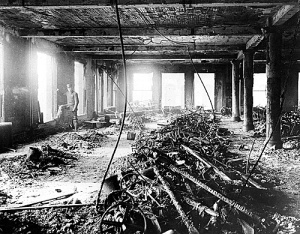
One hundred and forty-six deaths in a matter of minutes. To put that in perspective: According to the 1910 Census, New York City had a population of 4.7 million. According to the 2020 Census, it's 8.8 million. So it would be as if 270 people died today. That's about 1/10th as many as in the worst building fire in the City's history, on 9/11.
Blanck and Harris, themselves Jewish immigrants, got out early. They were indicted on manslaughter charges, but were acquitted, because the jury believed the prosecution had failed to prove that the owners knew the key doors were locked. In 1913, a civil suit found them liable of wrongful death, and were fined $75 per family of suing victim. Not much of a price to pay.

Blanck (left) and Harris
Peter Liebhold, a historian with the Smithsonian Institution in Washington, has said, "What is rarely told, and makes the story far worse, is Triangle was considered a modern factory for its time. It was a leader in the industry, not a rogue operation." In other words, if this was the best that the industry could do, then how bad was the worst?
Triangle went out of business in 1918, not so much because of World War I, but because fashions had changed to the point that not enough women were still wearing "shirtwaists." Finally, in 1923, Blanck was convicted on grand larceny charges, and sentenced to 6 months to 3 years in State Prison. I can find no record of when Blanck and Harris died, but both did so well after 1911, unlike 146 of their employees.
The International Ladies' Garment Workers' Union organized a march on April 5, 11 days after the fire. It was attended by 80,000 people. The New York State legislature formed a Committee on Public Safety, which included an eyewitness to the fire, Frances Perkins.
From the 1850s to the 1960s, the Democratic Party in the State of New York, and especially in the City of New York, was run by a "political machine" called Tammany Hall, which got a lot of things done, often with corrupt means. In 1911, it was run by Charles F. Murphy, who saw a chance to strike at Republican leaders in both City Hall and the State capital of Albany.
The Assembly's Majority Leader was one of Murphy's guys, Alfred E. Smith. The State Senate's Majority Leader was Robert F. Wagner. They held hearings in Albany, inviting would-be social reformers to testify, and subpoenaing the negligent bosses. They got several labor and fire reforms passed into law.
Smith was elected Governor in 1918, and made Perkins one of his chief advisors. Wagner was elected to the U.S. Senate in 1926. When Smith was nominated for President in 1928, Franklin D. Roosevelt was nominated for Governor. Smith lost in a landslide, FDR won in a squeaker. In 1932, FDR was elected President, and named Perkins Secretary of Labor, the 1st woman in the Presidential Cabinet. Wagner wrote the bills that became the Social Security Act and the National Labor Relations Act, and FDR signed them into law. Wagner's son, Robert F. Wagner Jr., was elected Mayor of New York in 1953, 1957 and 1961.
Rose Freedman, the last survivor of the Triangle Shirtwaist Factory Fire, died on February 15, 2001, at the age of 107.
You might guess that the City ordered the demolition of the Asch Building as unsafe. Asch to ashes, dust to dust, as it were. But that guess would be wrong. In fact, it still stands today, and hosted a 100th Anniversary commemoration on March 25, 2011.

*
March 25, 1911, as I said, was a Saturday. Jack Ruby, assassin of Lee Harvey Oswald, the accused assassin of President John F. Kennedy, was born on this day.
Professional football was in its infancy, college football was the dominant form of the game, and both were in their off-season anyway. There was hardly any professional hockey, almost no hockey at all in the United States. There was no professional basketball at all. And baseball? Its season wouldn't start for another 3 weeks.
But there was a score on this historic day. It was a postseason exhibition. The team that had won the Stanley Cup on March 10, the original version of the Ottawa Senators, who had also won it in 1903, 1904, 1905 and 1909, invited the Montreal Wanderers, who had won the Cup in 1906, 1907, 1908 and 1910, on a postseason tour of the United States, to help grow the game here.
On March 20, they played at the St. Nicholas Rink in New York, also known as the St. Nicholas Arena, at 66th Street and Broadway, off Lincoln Square. It was demolished in the 1980s, to make way for the current ABC network studios. The Senators won, 7-2. The next day, also at St. Nicholas, the Wanderers won 8-5.

Then they headed north, to play at the Boston Arena, now the oldest active sports arena in North America, known as Matthews Arena and run by Northeastern University. On March 22, the Wanderers won 7-5. And on March 25, mere hours after the Triangle Fire, the Senators beat the Wanderers, 8-4. I wish I could find a record of the attendance at these matches, but I can't.
Also on that day, Woolwich Arsenal beat Bristol City, 3-0 at the Manor Ground in Plumstead, Southeast London.


