Showing posts with label ted turner. Show all posts

Saturday, September 17, 2022

September 17, 1976: Bill Lucas Becomes the 1st Black GM In MLB

September 17, 1976: The Atlanta Braves promote Bill Lucas to the office of general manager. This makes him the 1st black man to hold that position in Major League Baseball. This came 2 years after Frank Robinson was appointed the 1st black manager, 14 years after Buck O'Neil became the 1st black coach, and 29 years after Jackie Robinson became the 1st black player since 1884.

William DeVaughn Lucas was born on January 25, 1936 in Jacksonville, graduated from the historically black Florida A&M University, and signed with the Milwaukee Braves in 1957 -- partly because his sister, Barbara, was married to Braves star Hank Aaron. (They later split up, and Aaron remarried.) An infielder, he never reached the major leagues, although he did miss 2 years as an officer in the U.S. Army. He joined the Braves' front office in 1965, as they were preparing their move to Atlanta for the next season.

In 1972, he was named director of their farm system, a common position from which teams have promoted men to the GM position. Atlanta was the hometown of Dr. Martin Luther King Jr., former Mayor William Hartsfield had billed it as "the City Too Busy to Hate," Maynard Jackson had been elected as its 1st black Mayor in 1973, and Aaron had broken the career home run record at Atlanta Stadium in 1974. (It was renamed Atlanta-Fulton County Stadium the following year.)

Lucas was in the process of building the team that would become the centerpiece of team owner Ted Turner's national "SuperStation TBS" over the next few years, including Dale Murphy, Bob Horner, Brett Butler and Steve Bedrosian.

But Lucas would not live to see his work come to fruition. On May 1, 1979, shortly after congratulating Braves ace Phil Niekro on his 200th career win (by phone, as Lucas was in Atlanta and the game was in Pittsburgh), he suffered a cerebral hemorrhage. He died 4 days later, only 43 years old.

Murphy said, "Bill's dream was for this organization to become a success. It is our sacred honor to be chosen to fulfill his dream." Maybe it would have been fulfilled had he lived. But it didn't happen: They won the National League Western Division title in 1982, and almost won another in 1983, but that's as close as they got. The Braves did not win a Pennant between 1958, when they were still in Milwaukee, and 1991, when a new GM, John Schuerholz, put together the team that dominated the NL in the 1990s.

For his contributions to their organization, the Braves named Lucas to their team Hall of Fame.

*

September 17, 1976 was a Friday. These games were played in Major League Baseball that day:

* The aforementioned Atlanta Braves split a doubleheader with the Los Angeles Dodgers at Atlanta Stadium. The Braves won the opener, 1-0. The winning run scored in the bottom of the 12th inning, when Ellie Rodriguez committed a passed ball on a pitch from Charlie Hough, after Don Sutton had pitched 11 shutout innings. The Dodgers won the nightcap, 11-7.

* The Baltimore Orioles and the Cleveland Indians were rained out at Cleveland Municipal Stadium. The game was made up as part of a doubleheader the next day. The Indians won the 1st game, 5-1. The Orioles won the 2nd game, 3-2.

I mentioned Frank Robinson earlier. At this point, he was managing the Indians, but not yet retired as a player. Best remembered as an Oriole, he did not put himself into the 1st game against his former team. He did put former Oriole John "Boog" Powell in, and he hit a home run off Jim Palmer. Frank did put himself in the 2nd game, and pinch-hit an RBI single. It was his 2,808th career game, his 2,943rd hit, and his 1,812th RBI. In each case, it turned out to be his last, as he did not put himself into any more games, and retired as a player after the season. He hit 586 home runs.
Brooks Robinson did not play in the 1st game, but went 1-for-4 in the 2nd game. Reggie Jackson, in his only season with the Orioles, went 3-for-3 with a walk in the 1st game, but 0-for-4 in the 2nd game.

* The New York Yankees beat the Milwaukee Brewers, 5-3 at Milwaukee County Stadium. Graig Nettles hit a home run to win the game in the top of the 11th inning. Ed Figueroa went 10 innings, and Dick Tidrow pitched the 11th to get the win. In one of his last major league games, Hank Aaron went 0-for-5.

* The New York Mets lost to the Pittsburgh Pirates, 4-1 at Shea Stadium. George "Doc" Medich outpitched Jon Matlack. Willie Stargell went 1-for-4. 

* The Montreal Expos beat the St. Louis Cardinals, 9-5 at Jarry Park in Montreal. Lou Brock went 1-for-2 with 2 walks and an RBI.

* The San Francisco Giants beat the Cincinnati Reds, 4-2 at Riverfront Stadium in Cincinnati. Pete Rose went 1-for-4 with a walk. Johnny Bench only appeared as a defensive replacement, at 1st base.

* The Boston Red Sox beat the Detroit Tigers, 8-3 at Tiger Stadium in Detroit. Carl Yastrzemski went 1-for-2 with an RBI, before being replaced by Fred Lynn as a pinch-runner.

* The Chicago Cubs beat the Philadelphia Phillies, 4-3 at Wrigley Field in Chicago. Jerry Morales singled home the winning run in the bottom of the 12th inning. Mike Schimdt went 0-for-5.

* The Kansas City Royals beat the Chicago White Sox, 3-2 at Royals Stadium (now Kauffman Stadium) in Kansas City. George Brett went 1-for-3 with 3 RBIs.

* The Minnesota Twins beat the California Angels, 11-2 at Anaheim Stadium (now Angel Stadium of Anaheim). Rod Carew went 1-for-4 with a walk.

* The Texas Rangers beat the Oakland Athletics, 4-3 at the Oakland Coliseum.

* And the Houston Astros and the San Diego Padres were not scheduled.

Wednesday, September 14, 2022

September 14, 1978: Jim Bouton Completes His Comeback

September 14, 1978: The Atlanta Braves beat the San Francisco Giants, 4-1 at Candlestick Park in San Francisco. The winning pitcher is Jim Bouton.
In 1962, '63 or '64, seeing Bouton listed as the winning pitcher of a game would not have been a surprise. From 1965 to 1970, it would have been a surprise, but not a big one.
Bouton hadn't won a game in 8 years. And it wasn't because he'd been losing for 8 years straight.
He was born in Newark, New Jersey in 1939, and grew up in nearby Bergen County until the family moved to the suburbs of Chicago. He pitched at Western Michigan University, and was signed by the New York Yankees. When he reached the major leagues in 1962, he was given uniform Number 56, a very high number for the time. Later that season, clubhouse manager Pete Sheehy said he could now receive a smaller number, recommending 29. Jim said that he would rather keep 56, to remind him of just how difficult it is to stay in the major leagues.
The Yankees won the World Series in 1962, and Bouton, 7-7 that season, got a ring. They won the Pennant in 1963, and he went 21-7. The won the Pennant again in 1964, and he went 18-13, winning 2 more games in the World Series, but the Yankees lost. Still, at age 25, his future looked limitless.
Then the limits came. In 1965, all the Yankee stars seemed to get old or hurt, or both, all at once. Bouton hurt his elbow, and his great fastball was gone. He was left exposed in the 1969 expansion draft, and the Seattle Pilots chose him, converting him to a reliever with a knuckleball that they didn't really trust.
Jim began keeping a diary of the 1969 season. In it, he noted that, contrary to their public image, where ballplayers were all nice guys who never swore, never cheated on their wives, never drank anything stronger than a milkshake, had normal hobbies like hunting and fishing, and were always pro-God and pro-America, could be the other way around. There had always been a great amount of immaturity among athletes, and Jim wrote about it. He also wrote about how team management hurt players, in ways large and small.
He also wrote about how he was frustrated that the Pilots only used him in non-pressure situations, until trading him to the Houston Astros in late August. The Astros were only a little better in this regard, but Jim seemed happier. The Pilots went bankrupt, were bought, and moved, and became the Milwaukee Brewers for 1970.
The diary, under the title Ball Four, was published the next June, with saucy excerpts printed in Look magazine in May. The public reaction was horrible. Jim was booed in every ballpark. When they played the Cincinnati Reds, Pete Rose yelled from one dugout to the other, "Fuck you, Shakespeare!"
When the Astros came into New York to play the Mets, Daily News sports columnist Dick Young, once liberal but grown conservative and nasty in his middle age -- his backstab of Tom Seaver on behalf of Mets management was yet to come -- wrote that Jim had become "a social leper." That night, before the game, Dick came to Jim, and Jim said the comment didn't bother him. Dick said, "I'm glad you didn't take it personally." That became the title of Jim's sequel book.

Baseball Commissioner Bowie Kuhn summoned Jim to his Midtown office. He told Jim to disavow the book before it could be published in full form, say that he'd made a lot of it up, or that Shecter had made a lot of it up, or that Shecter had manipulated him into saying the controversial things.
Jim refused to lie, and wouldn't back down. He said it was all true. He said that any player whose marriage was now on the rocks because of what he wrote was probably not in a particularly strong marriage anyway. He struck back, and said that he purposely left a lot of things out, like certain players going for underage girls (which as we have since seen, may have included the aforementioned Rose), or spouting racist and anti-Semitic remarks, and that he was actually trying to protect the sport from what would have happened had he named names with such things.
Like boxer Muhammad Ali, track star Tommie Smith and baseball player Curt Flood at the time, and like football quarterback Colin Kaepernick many years later, Jim was willing to stand for something, even if it meant sacrificing everything.

He said the backlash wasn't getting to him. But on July 29, with a record of 4-6 and an ERA of 5.40, despite having pitched decently in 9 of his last 11 outings, he was sent down to the minor leagues. The knuckleball didn't work there, either.

Finally, Jim got an interesting offer: Al Primo, inventor of the "Eyewitness News" format, had gone to WABC-Channel 7 in New York, and wanted Jim, with his willingness to tell the truth and use his sense of humor, to be his sports anchor. On August 12, the Astros, probably glad to be rid of the bad publicity, gave Jim his unconditional release, and he spent the next 5 years doing sports behind anchors Roger Grimsby and Bill Beutel.

He left TV journalism, and announced a comeback. In 1977, he went back to the Pacific Northwest, and signed with the Portland Mavericks, in the Class A Northwest League. Getting the knuckleball to work again, he did well enough there that Ted Turner signed him to a contract with the Atlanta Braves. Jim was assigned to the Savannah Braves of the Class AA Southern League, and did well enough there to become a September callup. He had become, in his own words, the 1st player to make the major leagues twice.

On September 10, 1978, at age 39, he put on Braves uniform Number 56, took the mound at Atlanta-Fulton County Stadium, started against the defending National League Champion Los Angeles Dodgers, and went 5 innings, allowing 6 runs, and ended up as the losing pitcher.

Four days later, the experiment was redeemed: He started against the San Francisco Giants at Candlestick Park, allowed 1 run, unearned, in 6 innings, and the Braves beat the Giants 4-1. Ironically, while the Giants' run was unearned, it was on a throwing error by Jim. The Braves got a run on a suicide squeeze bunt by Glenn Hubbard, another on a single by a rookie named Dale Murphy, another on a double by Jerry Royster, and one more on a single by Hubbard. Jim had gone without a major league win between July 11, 1970 and September 14, 1978 -- 8 years, 2 months and 3 days.

He made 3 more starts: A no-decision against the Astros in Houston, a tough loss to the Reds in Atlanta, and a battering against the Reds in Cincinnati. That was on September 29, 1978, his true major league finale. In one of those games, Rose, who, earlier in the season, had collected his 3,000th career hit and had a 44-game hitting streak, hit a home run off Bouton, seemingly making his point.

But, much more so, Bouton had made his point. But an unintended consequence of his comeback was that he fell below .500 for his career: His 1978 record of 1-3 (with an ERA of 4.97, an ERA+ of 83, and a WHIP of 1.586) dropped him, lifetime, from 61-60 to 62-63. His final ERA was 3.57, his ERA+ 99, his WHIP 1.264.
So Rose got the last laugh, right? Well, Bouton spent the rest of his life still eligible to participate in professional baseball. In 1989, Rose was permanently banned from the sport. He still is.

Jim continued to be an iconoclast, accepting interviews about Ball Four, until stricken with a debilitating illness in 2012. He died in 2019, 50 years after starting the book.

UPDATE: Rose died in 2024. Shortly thereafter, Baseball Commissioner Rob Manfred reinstated him.

*

September 14, 1978 was a Thursday. This was also the day that the ABC sitcom Mork & Mindy premiered. I have a separate entry for that event. Also, Ron DeSantis, a Republican elected Governor of Florida in 2018, and definitely not a man that Jim Bouton would have liked, was born on this day.

These other Major League Baseball games were played that day:

* The New York Yankees beat the Detroit Tigers, 4-2 at Tiger Stadium in Detroit. Graig Nettles hit 2 home runs, and Reggie Jackson went 1-for-4, in support of Ed Figueroa. It was his 15th win of the season, on the way to becoming the 1st, and still the only, Puerto Rican pitcher to win 20 games in a season.

* The New York Mets beat the Montreal Expos, 7-6 at Shea Stadium.

* The Philadelphia Phillies beat the Chicago Cubs, 11-5 at Veterans Stadium in Philadelphia. Mike Schmidt went 2-for-2 with 2 walks.

* The Pittsburgh Pirates beat the St. Louis Cardinals, 7-4 at Three Rivers Stadium in Pittsburgh. Willie Stargell went 3-for-4 with 2 RBIs. Lou Brock did not play.

* The Cleveland Indians beat the Boston Red Sox, 4-3 at Cleveland Municipal Stadium. The Sox were still choking, before rebounding to get back into a last-day tie with the Yankees in the American League Eastern Division. Carl Yastrzemski went 1-for-4.

* The Milwaukee Brewers beat the Baltimore Orioles, 4-3 at Milwaukee County Stadium. Robin Yount hit a home run. Rookie Paul Molitor did not play. Eddie Murray went 0-for-3 with a walk.

* The Kansas City Royals beat the Oakland Athletics, 5-1 at Royals Stadium (now Kauffman Stadium) in Kansas City. George Brett went 1-for-4 with a walk and an RBI.

* The California Angels beat the Texas Rangers, 16-1 at Arlington Stadium in the Dallas suburb of Arlington, Texas. The Angels scored 13 runs in the top of the 9th inning. Lyman Bostock, Rick Miller, Brian Downing and Ron Jackson each had 3 hits for the Halos, including a home run by Jackson. Just 10 days later, Bostock would be dead, shot in a case of mistaken identity.

* The San Diego Padres beat the Cincinnati Reds, 8-1 at San Diego Stadium (later renamed Jack Murphy Stadium and Qualcomm Stadium). Dave Winfield went 3-for-4. Johnny Bench went 1-for-4. Pete Rose? He went 2-for-4, and probably didn't notice that Bouton was pitching that night.

* The Los Angeles Dodgers beat the Houston Astros, 2-1 at Dodger Stadium in Los Angeles.

* The Chicago White Sox beat the Seattle Mariners, 6-5 at the Kingdome in Seattle.

* And the Minnesota Twins and the Toronto Blue Jays were not scheduled.

Monday, July 4, 2022

July 4, 1985: The Rick Camp Game

July 4, 1985: For anybody who watched this baseball game, it was a 4th of July that will never, ever be forgot.

The Atlanta Braves were hosting the New York Mets at Atlanta-Fulton County Stadium, and Braves owner Ted Turner, showman that he was, scheduled a postgame 4th of July fireworks show. Paid attendance at the 52,007-seat concrete ashtray just south of downtown Atlanta was 44,947.

But the game was delayed by rain, and didn't start until 9:04 PM. Rick Mahler started for the Braves, and the Mets hit him hard, and he didn't get out of the 4th inning. Dwight Gooden started for the Mets, and, in a year when he seemed to be touched by God, he was no better. A second rain delay came in the bottom of the 3rd inning, lasting 41 minutes. When it ended, Met manager Davey Johnson -- who hit 41 home runs as a 2nd baseman for the Braves in 1973 -- didn't take any chances, and he took Doctor K out.

Did I say Davey didn't take any chances? When they came back from the rain delay, he let Roger McDowell, normally a late-inning reliever, finish the bottom of the 3rd. Terry Leach pitched the 4th through the 8th, but Davey brought in Doug Sisk, and he let the Braves score 4 runs in that inning to take the lead, 8-7. This included a Keith Hernandez home run. But future Hall-of-Famer Bruce Sutter blew it in the 9th, and the game went to extra innings. At one point, Davey got thrown out of the game.

The Braves got 2 men on with 1 out in the bottom of the 11th, but the Mets got out of it with a double play. In the top of the 13th, with 2 out, Ray Knight singled, and Howard Johnson hit a home run. 10-8 Mets. But in the bottom of the 13th, Tom Gorman -- the only reliever the Mets had left -- allowed a leadoff single to Rafael Ramirez. He struck out Dale Murphy and Gerald Perry, but then gave up a home run to Terry Harper. 10-10. More "free baseball."

Gene Garber walked Lenny Dykstra and Hernandez in the top of the 14th, but got out of it. Knight singled for the Mets in the top of the 15th, but got no farther than 1st base. With 2 out in the bottom of the 16th, Ken Oberkfell singled off Gorman, and Bruce Benedict drew a walk. But Gorman got out of it.

Rick Camp, the Braves' last remaining reliever, came into the game in the top of the 17th, and walked Gary Carter, but then struck out Darryl Strawberry and Gorman, and got Knight to ground into a force play. Ramirez singled with 2 outs in the bottom of the 17th, but Gorman got out of it.

Top of the 18th. HoJo led off with a single. Danny Heep bunted, and Camp rushed it, and threw it away. 1st and 3rd, nobody out. Dykstra hit a sacrifice fly, and it was 11-10 Mets. There was nothing that Braves manager Eddie Haas could do, as Camp was it: The only pitchers he had left were starters, the same as the Mets.

Bottom of the 18th. Perry and Harper grounded out. That brought up Camp, as Haas couldn't pinch-hit for him. He had nobody left to bat or pitch. This pudgy bearded guy, wearing Number 37 for his home-State team, came up to bat. He came into that game 10-for-168 for his career -- a lifetime batting average of .060. He was 0-for-his-last-13. He hadn't gotten a hit since September 1, 1984, 10 months earlier.

John Sterling, who became the main voice for the New York Yankees in 1989, but then doing games for the Braves -- and celebrating his 47th birthday -- turned to his broadcast partner, Ernie Johnson, who had pitched for the Braves in Milwaukee, and was the father of basketball announcer Ernie Johnson Jr., and said, "I'll tell you, Ernie: If hits a home run to tie this game, this game will be certified as absolutely the nuttiest in the history of baseball."

What do you think happened? Have you ever heard 8,000 people make as much noise as 50,000? You did if you were watching TBS -- or WOR-Channel 9 -- that middle-of-the-night. I was watching on WOR, but, because of Sterling's call, it's the TBS version that seems to have been preserved for posterity and shown on highlights.

The time was 3:30 AM, and here is what Sterling said:

And he hits it to deep left! Heep goes back! It is... GONE! Holy cow! Oh my goodness! I don't believe it! I don't believe it! Rick Camp! Rick Camp! I told you Ernie, if he hits it out... That certifies this game as the wildest, wackiest, most improbable game in history!

Mets 11, Braves 11. And to make matters worse, Gorman walked the next batter, Benedict. But he got Paul Runge to ground into a force play, and we went to the 19th inning. (This Paul Runge is not related to the umpire of the same name, whose father Ed and son Brian have also been MLB umpires.)

The Mets play a game this long every few years. In 1964, they went 23 innings in a loss to the San Francisco Giants -- in the 2nd game of a doubleheader. In 1965, they went 18 innings in Philadelphia against the Phillies, before the game was called due to a curfew, and it was replayed. In 1968, they went 24 innings in a loss to the Houston Astros. In 1974, they went 25 innings in a loss to the St. Louis Cardinals.

In 1986, they played what was then the longest game in NLCS history, going 16 innings in beating Houston to clinch the Pennant. They went 20 innings in a 2010 win in St. Louis, 20 in a 2013 loss to the Miami Marlins, 18 in a 2015 loss in St. Louis, and 18 in a 2019 loss in Milwaukee to the Brewers. The 2020 introduction of the "ghost runner" rule makes another such marathon unlikely.

At some point in all this, Ralph Kiner, the great Pittsburgh Pirates slugger who'd been broadcasting for the Mets since the franchise began in 1962 (and still did one game a week until he died in 2014), left the stadium, returned to his hotel, and turned on the TV. He saw the game, and during the next Met broadcast, said that he thought that what he was watching was a recap. Nope, the game was still going on.

Finally, at about 3:40 in the morning, with only about 8,000 people left in the stands, the Mets decided enough was enough, that they'd had it with these mother-freaking Braves in this mother-freaking game. They pounded Camp, who could not be relieved. Carter led off with a single. John Christensen, who'd pinch-hit for Strawberry, bunted him over to 2nd.

Whoever was managing the Mets at that point -- it might have been 1st base coach Bill Robinson -- decided to let the next day's starter, Ron Darling, pitch the bottom of the 19th, and a few innings thereafter if necessary, since who knew if this game had another 9 innings in it, and sent Rusty Staub, playing one of his last games, up to pinch-hit for the exhausted Gorman.

Haas ordered Camp to walk Staub intentionally to set up a double play, but it didn't work: Knight doubled home Carter and sent Staub to 3rd.  (Daniel Joseph Staub was known as Rusty for his hair, and Montreal Expos fans called him "Le Grand Orange." He wasn't fast even before he turned into a flame-haired Fat Elvis -- or, as Sterling called him in this game, "Babe Ruth.") HoJo was intentionally walked, and that didn't work, either: Heep singled home Staub and Knight, and the throw from the outfield was mishandled, and HoJo scored, too. Dykstra flew out, getting Heep to 3rd, and Wally Backman singled Heep home, before Camp finally got Hernandez to ground out.

Hernandez had doubled and scored in the 1st inning, flown out to center in the 3rd, tripled home a run and scored in the 4th, lined out to center in the 6th, homered in the 8th, flown out to left in the 9th, singled in the 12th to complete "hitting for the cycle," was intentionally walked in the 14th (I don't think there's a term for hitting for the cycle and drawing a walk in the same game), grounded to 2nd in the 16th, flew to center in the 18th, and grounded to 2nd again in the 19th. Total: 4-for-10 with a home run, a walk, and 3 RBIs. Wally Backman also had 4 hits for the Mets, while Terry Harper had 5 hits and 4 RBIs for the Braves.

So, going to the bottom of the 19th inning, the score was Mets 16, Braves 11. This was the mid-1980s Mets. Surely, these Mets could hold a 5-run lead. Surely, the Braves wouldn't score 6 runs and win it in the bottom of the 19th. Or, potentially worse, score 5 runs and send the game to a 20th inning!

They were determined to give it a good shot. Darling came out, and got the 1st out, a groundout by Paul Zuvella. But Claudell Washington hit a bouncer to 1st that Hernandez mishandled. (No, Kramer and Newman from Seinfeld were not in the stands to yell, "Nice game, pretty boy!") Claudell and his long neck got to 2nd.

No problem, Darling would get out of it, right? Sure enough, he got Ramirez to pop up. One more out. That left only the dangerous Murphy, the 1982 & '83 National League Most Valuable Player, and still one of the most dangerous hitters in the game. But what could he do? A home run would only make it 16-13.

But Darling walked him. And then he walked Perry. And now the bases were loaded for Harper, who had already homered. And Harper singled. Washington and Murphy scored. Perry was on 3rd. It was 16-13 Mets. Men on 1st and 3rd. A home run would tie the game. Again.

And who was up? Rick Camp. Surely, he wouldn't do it again...

He didn't: Darling struck him out on a high fastball. Finally, mercifully, at long last, ballgame over.

Camp was the losing pitcher, but he won something more important than a single baseball game. He won a place in baseball lore. After all these years, we're still talking about this mind-boggling game, and not about any other game in which he ever pitched.

Oh yeah: Although the game was over, the night wasn't. The game ended at 3:55 AM. At 4:01, Ted Turner kept his promise: The fireworks went off. The 8,000 or so fans who hadn't left cheered.

People living near the stadium did not. They heard booms and saw flashes of light, and they called the police, thinking that Atlanta was under attack.

Incredibly, Camp got 2 more hits that season, for a batting average of .231. He closed his career 13-for-175, .074. On-base percentage, .109. Slugging percentage, .114. OPS, .224. OPS+, -39. RBIs, 7. Home runs, 1.

After leaving baseball, Camp became a lobbyist. He got into legal trouble in 2005, indicted by a federal grand jury for conspiring to steal over $2 million from a mental health agency. He was convicted, and served 3 years in prison. But everyone who met him seemed to say he was a wonderful guy. Is it possible that, like Denny McLain, a pitcher who went to prison on a similar charge, he simply got in with the wrong people?

Camp died in 2013. He was 59 years old. He gave baseball fans a memory they might cherish, or they might not, but it is one that they will never, ever forget.

*

July 4, 1985 was a Thursday. These other games were played in Major League Baseball that day:

* The New York Yankees beat the Minnesota Twins, 3-2 at Yankee Stadium. Ron Guidry went the distance. Rickey Henderson went 2-for-4. So did Don Mattingly, adding an RBI.

* The Philadelphia Phillies beat the Cincinnati Reds, 3-1 at Veterans Stadium in Philadelphia. For the Phils, Mike Schmidt went 1-for-4, and home runs were hit by Juan Samuel, Von Hayes and Ozzie Virgil Jr. For the Reds, manager Pete Rose put 1st baseman Pete Rose into the game, but he went 0-for-3.

* The San Diego Padres beat the Pittsburgh Pirates, 9-1 at Three Rivers Stadium in Pittsburgh. Tony Gwynn went 2-for-4 with an RBI.

* The Chicago White Sox beat the Cleveland Indians, 5-0 at Cleveland Municipal Stadium. Britt Burns pitched a 4-hit shutout. It was the 60th win of his career, and he was only 26. He would win 10 more that season, finishing at 18-11. But, due to injury, he never pitched again.

* The San Francisco Giants beat the Chicago Cubs, 6-4 at Wrigley Field in Chicago.

* The St. Louis Cardinals beat the Los Angeles Dodgers, 3-2 at Busch Memorial Stadium in St. Louis.

* The Baltimore Orioles beat the Kansas City Royals, 5-3 at Royals Stadium in Kansas City. (It was renamed Kauffman Stadium in 1993.) Cal Ripken went 1-for-4. So did Eddie Murray, with 2 RBIs. George Brett went 2-for-3 with a walk.

* The Texas Rangers beat the Detroit Red Wings, 4-1 at Arlington Stadium in the Dallas suburb of Arlington, Texas.

* The Montreal Expos beat the Houston Astros, 9-3 at the Astrodome in Houston. This was the only other extra-inning game of the day: With 1 out in the top of the 12th, the Expos got a single from Sal Butera, a flyout from Jim Wohlford, a single from Tim Raines, an RBI double from Vance Law, a walk from Andre Dawson, a 2-RBI single from Hubie Brooks, and a 3-run home run from Tim Wallach.

* The California Angels beat the Boston Red Sox, 5-4 at Anaheim Stadium. (It was renamed Edison International Field in 1997, and Angel Stadium of Anaheim in 2004.) Reggie Jackson and Rod Carew both went 0-for-4, but Jerry Narron, best known as Thurman Munson's immediate emergency replacement as Yankee catcher, hit a home run for the Halos, 1 of only 21 he would hit in his career. Wade Boggs went 1-for-4.

* The Oakland Athletics beat the Toronto Blue Jays, 3-2 at the Oakland Coliseum.

* And the Seattle Mariners beat the Milwaukee Brewers, 7-1 at the Kingdome in Seattle. Robin Yount and Paul Molitor both went 0-for-4.

Wednesday, May 11, 2022

May 11, 1977: Ted Turner Manages the Atlanta Braves

May 11, 1977: The Pittsburgh Pirates beat the Atlanta Braves, 2-1 at Three Rivers Stadium in Pittsburgh. That was not unusual. What was unusual was the Braves' manager, a man who once said, "There's a fine line between being colorful and being an asshole, and I hope I'm still just colorful."

Robert Edward Turner III was born on November 19, 1938 in Cincinnati, and grew up in Savannah, Georgia. Expelled from Ivy League school Brown University for being caught with a woman in his dorm, he enlisted in the U.S. Coast Guard, so he wouldn't be drafted to fight in Vietnam during the early phase of that war. He later admitted, "I like boats," and was "deployed to some pretty sweet places -- Charleston and Fort Lauderdale."

How much did he like boats? In 1964, he competed in the U.S. Olympic Trials for yacht racing. In 1974, he entered the defender's trials for the America's Cup. On September 18, 1977,  commanding
Courageous, Ted Turner won the America's Cup, defeating Australia in a 4-race sweep.

His father committed suicide in 1963, and 24-year-old Ted took over his father's business, producing advertising billboards. Like another young man who would become a baseball mogul, George Steinbrenner, he took his father's business and grew it far beyond anything his father had imagined, making it "the largest outdoor advertising company in the Southeast."

He began buying radio stations, and, in 1969, traded them for a struggling Atlanta TV statin, WJRJ-Channel 17. He changed the call sign to WTCG, for Turner Communications Group, although he advertised it as "Watch This Channel Grow."

Initially, the station ran old movies from prior decades, along with theatrical cartoons and bygone sitcoms and drama programs. As a better syndicated product fell off the VHF stations, Turner would acquire it for his station at a very low price. WTCG ran mostly second- and even third-hand programming of the time, including fare such as I Love Lucy, Gilligan's Island and Star Trek.

In 1972, he bought the rights to broadcast the games of baseball's Atlanta Braves and the NBA's Atlanta Hawks. In 1976, he bought those teams outright, thinking that his broadcast revenue would allow him to buy better players, and the teams would help the station grow further

On May 2, 1976, Turner announced that, instead of their surnames, the Braves players would have their nicknames above their uniform numbers on their backs. Darrell Evans had "HOWDY." Darrel Chaney had "NORT." Jimmy Wynn's nickname, "The Toy Cannon" (because he was short but powerful), was too long to fit, so his was just "CANNON." And pitcher Andy Messersmith had "CHANNEL."

Bowie Kuhn, the Commissioner of Baseball, saw through this blatant attempt by Turner to advertise for his station, and prohibited it thereafter. Turner and Kuhn were now at odds, and would remain so. (Not that he was the only owner with whom Kuhn was at odds.) On January 3, 1977, Kuhn suspended Turner for a year, for his actions in signing free agent outfielder Gary Matthews. Turner appealed the suspension, and it was overturned.

On May 11, 1977, with the team mired in a 16-game losing streak, Turner sent manager Dave Bristol on a 10-day "scouting trip," and installed himself took over as interim manager. This made him the 1st owner/manager in the major leagues since Connie Mack stepped down as manager of the Philadelphia Athletics in 1950.

That night, the Braves lost 2-1 to the Pirates. Phil Niekro went the distance, and pitched well, but fell to 0-7 on the season. He would end it 16-20. John Candelaria held the Braves to 1 run on 8 hits, 3 of them by rookie outfielder Barry Bonnell, who ended up batting .300 for the season. Dave Parker hit a home run for the Pirates, and that made the difference. Willie Stargell went 1-for- 2 with 2 walks.

The next day, National League President Charles "Chub" Feeney ordered Turner to step down as manager, citing MLB's Rule 20(e), which prohibits managers from owning any stock in the team that employs them, unless specifically granted an exemption by the Commissioner. This rule was put in place in 1927, after a situation regarding Rogers Hornsby. Mack, and also John McGraw of the New York Giants, who owned stock in their teams, were "grandfathered in." Turner appealed to Kuhn, but was never going to get anywhere with him.

The next day, with 3rd base coach Vern Benson running the team, the Braves broke their 17-game losing streak, beating the Pirates, 6-1. Bristol returned for the next game, and the team finished 61-101, in 6th and last place in the NL Western Division, 37 games behind the Los Angeles Dodgers.

Turner fired Bristol after the season, and replaced him with New York Yankees coach Bobby Cox. He got nowhere with the Braves, but their next manager, Joe Torre, led them to the NL West title in 1982, and almost did it again in 1983.

That 1982 season was the year that made the Braves a national phenomenon: Not only had Turner changed Channel 17's call letters to WTBS, for "Turner Broadcasting System," but he'd made it a national "SuperStation." Like the Chicago Cubs on WGN, his games were now broadcast nationwide, and they got a national following, not just a regional one. He even billed the Braves as "America's Team," just as football's Dallas Cowboys had done. They lost the NL Championship Series to the St. Louis Cardinals, whose vast radio network had made them something like a national team.

Cox went on to the Toronto Blue Jays, and led them to their 1st Division title in 1985, but they lost the American League Championship Series to the Kansas City Royals.

In 1990, Turner lured away the Royals' general manager, John Schuerholz. He brought Cox back to the Braves, and the next year, they began one of the most successful runs in NL history. Not counting the strike-shortened 1994 season, the Braves won their Division -- the NL West through 1993, the NL East thereafter -- every season from 1991 to 2005. They won their 1st Pennant in Atlanta in 1991, and also won in 1992, 1995, 1996 and 1999. And they won the 1995 World Series, although they lost the others, including in 1996 and 1999 to the Yankees, who were managed by... Joe Torre.

Turner sold the Braves in 2007. As of May 11, 2022, he is still alive, but has had medical issues, and has withdrawn from the public eye.

UPDATE: Turner died on May 6, 2026, at the age of 87.

*

May 11, 1977 was a Wednesday. Football was out of season. There was 1 game played in the NBA Playoffs: The Houston Rockets beat the Philadelphia 76ers, 118-94 at The Summit in Houston. (The arena would be converted into the "Central Campus" of televangelist Joel Osteen's Lakewood Church.)

The Stanley Cup Playoffs were between Games 3 and 4. The Montreal Canadiens would sweep the Boston Bruins in 4 straight. And Game 1 of the World Hockey Association Finals was played. The Winnipeg Jets beat the Quebec Nordiques, 2-1 at the Colisée de Québec. But the Nordiques would win the series in 7 games.

And these other games were played in Major League Baseball:

* The New York Yankees lost to the Seattle Mariners, 5-2 at the Kingdome in Seattle. Reggie Jackson hit a home run, but Ken Holtzman, who had been his teammate on the recent Oakland dynasty, did not pitch well. This was the Yankees' 1st visit to that stadium, as the Mariners were a 1st-year expansion team. They ended up losing the next night, too, before salvaging the series finale.

The next year, at the age of 8, I read the The Best Team Money Could Buy, which Steve Jacobson, Newsday's Yankees beat reporter, had written. This was not a book for kids. He quoted left fielder Lou Piniella objecting to the Kingdome and "losing to a horseshit ballclub." Ironically, the 1st 4 times the Mariners ended up making the Playoffs, their manager would be Lou Piniella, and the 1st 2 times would be at the Kingdome, before Safeco Field (now T-Mobile Park) opened.

* The New York Mets were swept in a doubleheader by the San Diego Padres, 6-3 and 4-3 at Shea Stadium. Dan Spillner outpitched Tom Seaver in the opener, and Randy Jones beat Craig Swan in the nightcap. The Mets got home runs from Mike Phillips and Dave Kingman.

* The Los Angeles Dodgers beat the Montreal Expos, 5-1 at the Olympic Stadium in Montreal.

* The San Francisco Giants beat the Philadelphia Phillies, 4-2 at Veterans Stadium in Philadelphia. Mike Schmidt went 0-for-4.

* The Cleveland Indians beat the Milwaukee Brewers, 4-3 at Cleveland Municipal Stadium. Robin Yount went 0-for-4.

* The Detroit Tigers beat the Minnesota Twins, 8-3 at Tiger Stadium in Detroit. Rod Carew went 1-for-4.

* The Cincinnati Reds beat the St. Louis Cardinals, 5-1 at Busch Memorial Stadium in St. Louis. Pete Rose went 2-for-4 with a walk and an RBI. Johnny Bench went 1-for-4 with an RBI.

* The Chicago White Sox beat the Texas Rangers, 4-3 at Arlington Stadium in the Dallas suburb of Arlington, Texas. Chet Lemon singled Richie Zisk home with the winning run in the top of the 10th inning.

* The Houston Astros beat the Chicago Cubs, 8-2 at the Astrodome in Houston.

* The California Angels beat the Baltimore Orioles, 6-0 at Anaheim Stadium (now Angel Stadium of Anaheim). Frank Tanana pitched a 6-hit shutout.

* And the Oakland Athletics beat the Boston Red Sox, 3-1 at the Oakland Coliseum.

Sunday, January 16, 2022

January 16, 1991: The Persian Gulf War Begins

January 16, 1991: After 5 months of warning, President George H.W. Bush launches the Persian Gulf War against Iraq.

In 1968, the Ba'ath Party had taken power in Iraq. The new President was Ahmed Haasan al-Bakr. His Vice President was Saddam Hussein. Through a combination of oil wealth and socialist policies, the country grew, but was not exactly free.

In 1979, after 11 years of strengthening his case with the country's national security apparatus, and 3 years of doing so through the country's military, Saddam was strong enough to show al-Bakr that, due to his failing health, it was time to "retire." Fearing what would happen if he didn't take the hint, he took it, and died 3 years later.

In 1980, Iraq went to war with Iran, which was then holding Americans hostage. Naturally, America took Iraq's side. The release of the hostages and the change of power in America, both happening on January 20, 1981, did not change this support: The new President, Ronald Reagan, looked on Iraq as a check on Iran's power.

The war lasted 8 years, before both sides finally accepted that it was a stalemate. Saddam, leading the much smaller nation, had some justification to treat this like a victory. He emerged with the 4th-largest army in the world (behind the Soviet Union, China and America), and a great deal of popularity, not just at home, but in the Arab world. (Something a lot of Americans forget: Iran's largest ethnic group is Persians, and they are not Arabs. Most of them don't even speak Arabic: The country's 1st language is Farsi, although they do use the Arabic alphabet.)

Shortly after the Iran-Iraq War ended in 1988, Vice President George H.W. Bush won the election to succeed Reagan as President. For the 1st year and a half of his Administration, he saw no need to treat Iraq, or Saddam in particular, as an enemy. Surely, as President, with access to all national-security-connected information (and, as a former Director of the CIA, he would have been keenly interested in such), he knew of Saddam's civil liberties violations within his own borders. But he acted as though they didn't matter.

But on August 2, 1990, the Iraqi Army invaded the much-smaller neighboring nation of Kuwait. It was a move by Saddam to gain control of Kuwait's oil, to further enrich both himself and his country. Indeed, by ruling Iraq and Kuwait, Saddam now controlled about 10 percent of the world's oil production. But it was also a matter of national pride: Iraq has 18 provinces, and he called Kuwait "the 19th Province."

Bush guessed -- with some justification -- that neighboring Saudi Arabia might be next. This would have resulted in an energy and economic nightmare for the world. It would also have caused a huge civil war within the Muslim world, as Saudi Arabia is home to the 2 holiest sites in Islam: Mecca and Medina. An Iraqi invasion of Saudi Arabia could have meant complete chaos. And with the Soviet Union falling apart, America was now the only nation that could do something about it.

Or... was it? America had been aiding the Saudis for decades, in exchange for cheap oil. (It didn't always work: The Saudis had authorized gas price hikes in 1973 and 1979 that triggered gas shortages, inflation, and recessions.) Famously, in 1981, Reagan had sold the Saudis some AWACS (Airborne Warning And Control System) planes, with the most advanced radar in the world. In return, the Saudis brought their oil prices back down. Even as a Democrat, I have to concede that this was a good move on Reagan's part, as it stopped the nasty inflation of 1979-81.

So the question of late 1990 was, could the Saudis have defended themselves in a war against Iraq? Iraq had the better army. But the Saudis had the far superior navy and air force. Many Americans, myself included, thought that America shouldn't risk its soldiers' lives for the protection of Saudi Arabia or what Bush called "the liberation of Kuwait." (Some liberation: Kuwait did not give women the right to vote until 2005.)

Bush decided that the question of whether the Saudis could defend themselves did not need to be answered. He immediately withdrew America's support for Iraq, stood up for Kuwait, and said, "This naked aggression will not stand." He interrupted his vacation at Walker's Point, the home from his mother's side of the family at Kennebunkport, Maine, launched Operation Desert Shield, and warned Saddam that he had to withdraw his troops from Kuwait, or America and its allies would inflict consequences.

Yes, allies. The nations of NATO, nearby Egypt, and, of course, the Saudis mobilized their troops for this alliance. Britain did so despite a split in the Conservative Party that led to Margaret Thatcher's replacement as Prime Minister by John Major on November 28.

The Soviets, who made semi-socialist Iraq one of the few countries that both they and America supported, were in no position to help them. But, within the Warsaw Pact (which was dissolved on February 25, 1991, as the war was entering its endgame), Poland and Czechoslovakia (it split into 2 nations 2 years later) sent troops. From the Far East, so did Australia, New Zealand, the Philippines and South Korea.

Iran was not going to get on the side of one enemy against another, and so they stayed out of it. And no other major Arab country was going to help Iraq: King Hussein I of Jordan, the leading Arab monarch outside Saudi Arabia, stood up for the Saudis, and stayed out of it. President Hafez al-Assad of Syria, already an ally of Iran, sent troops. (It's hard to believe now, given what Assad and his son Bashar al-Assad have done since, but they helped the official U.S. cause then.)

At first, the American people were split on whether such a war would be worth it. On October 10, 1990, testimony was given before the non-governmental Congressional Human Rights Caucus, by a 15-year-old girl who provided only her first name, Nayirah. The testimony was widely publicized, and was cited numerous times by Bush and some Senators in their rationale to back Kuwait.

In 1992, it was revealed that Nayirah's last name was Al-Ṣabaḥ, and that she was the daughter of Saud Al-Nasir Al-Sabah, the Kuwaiti Ambassador to the United States, and a cousin of the nation's monarch, Emir Jaber Al-Ahmad Al-Sabah. Furthermore, it was revealed that her testimony was organized as part of the Citizens for a Free Kuwait public relations campaign, which was run by Hill & Knowlton for the Kuwaiti government. They thought the American people wouldn't know any better -- and they didn't.

A protest against the coming war was held in New York on October 20, 1990: About 25,000 people, including myself, marched down Broadway from Columbus Circle, through Times Square to Herald Square. We were afraid that this war would be another "Vietnam" -- the word "quagmire" was being used by opponents of the would-be war -- leading to the restoration of the draft, and tens of thousands of Americans dead, and hundreds of thousands wounded.

But, like the protests during the Vietnam War, our patriotism was questioned. Those who supported the idea were accused of "rooting for the enemy." And, also like the Vietnam-era protests, it was useless: The war was going to begin when the President of the United States wanted it to, and it was going to end when the President of the United States wanted it to.

Bush set January 16, 1991 as the deadline. Saddam stayed put. At 2:38 AM on January 17, Baghdad time -- 6:38 PM on January 16, New York and Washington time -- Operation Desert Storm was launched. (Bush originally wanted to call it "Desert Sword," but was talked out of it, due to the symbolism of swords in Muslim imagery.) In a display of what his son would call "shock and awe" against Saddam 12 years later, U.S. planes bombarded the Iraqi capital of Baghdad, and did the same to Iraqi military bases.

Dictators always think they're smarter than they actually are, and Saddam thought he had a brilliant way of turning the war in his favor: On January 18, Iraq fired 12 "Scud" missiles at the Israeli cities of Tel Aviv and Haifa. (As Jerusalem is the 3rd-holiest city in Islam, as well as the holiest in Christianity and Judaism, he could not attack that city.)

The Scuds were largely ineffective as a tactic. But as strategy, the idea was that the Israeli government would overreact, and attack Iraq. Why did Saddam want this? Because it would make the Muslim world rally to him, and attack not only American troops, but Israel itself. That was the theory.

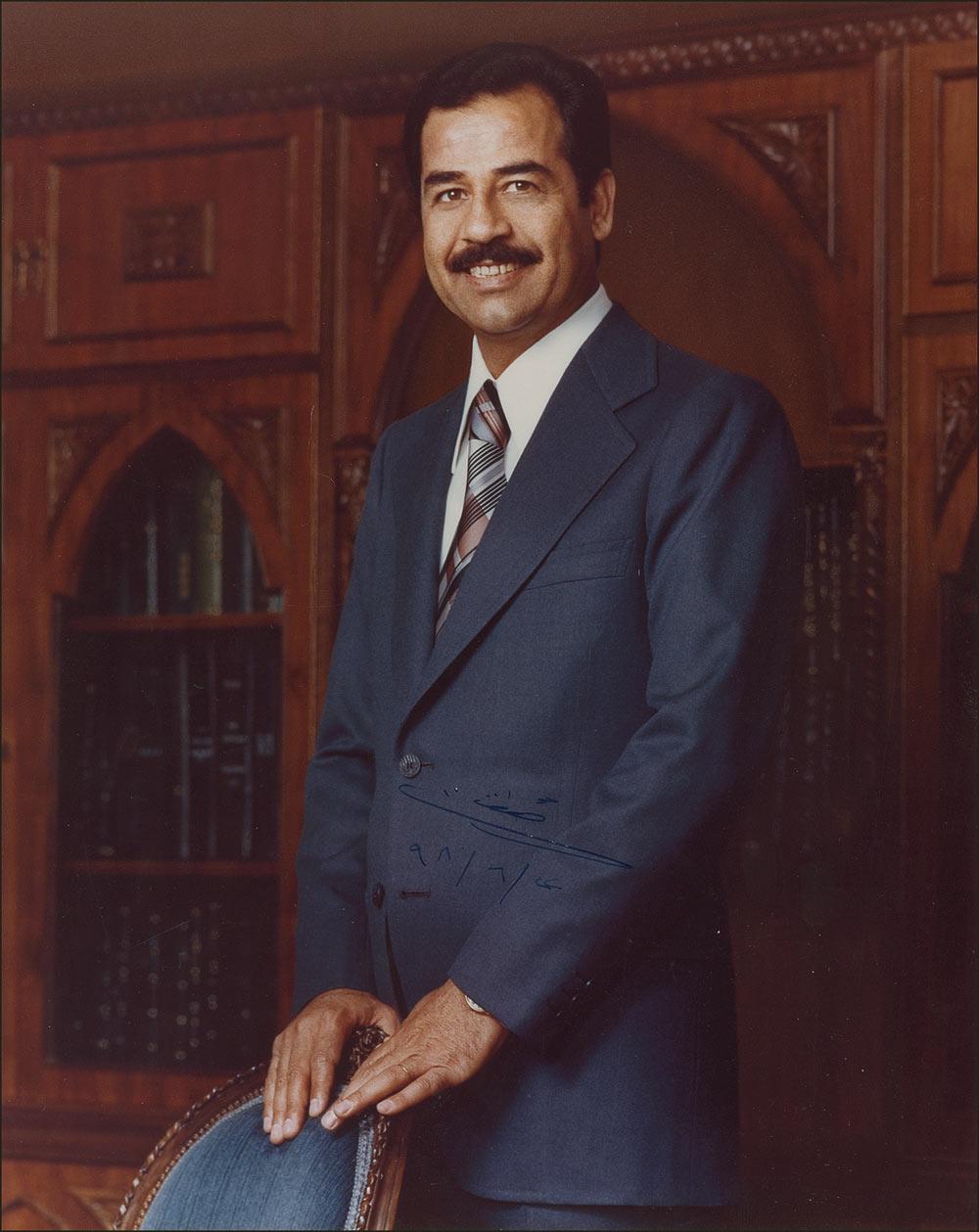
Saddam was a chameleon. He was willing to appear to be whatever people wanted him to be, to keep their support. Put on a suit, and look like a man capable of dealing with Western businessmen? Check.
Put on a uniform, and look like a great military leader? Check.
Dress like a faithful Muslim, and appeal to people's religion? Check. Smile like a man who was a father to his country, and not a bloodthirsty dictator who would do anything, and kill anybody, to maintain power? Check. 
Like many Middle Eastern dictators, he was copying Gamal Abdel Nasser, who ruled Egypt with an iron fist and a cult of personality from 1953 until his death in 1970, right down to making himself appear to be a healthy, good-looking guy with a great mustache. Nasser, of course, was copying his idol, Soviet dictator Joseph Stalin. Neither Stalin, nor Nasser, nor Saddam was ever quite as physically strong as they appeared to be. But, as with any dictator or would-be dictator, from Alexander the Great to Henry VIII, from Napoleon Bonaparte to Adolf Hitler, reality didn't matter: Image was everything. Or, as would-be dictator Donald Trump would say, the "optics."

Prime Ministers of Israel, knowing that the Torah insists upon facial hair, but also seeing what men with facial hair had done to the Jewish people just in the 20th Century -- including Czar Nicholas II of Russia, Vladimir Lenin, Hitler, Stalin and Nasser -- have tended to be clean-shaven. But in 1990 and '91, the Prime Minister was Yitzhak Shamir, a hard-right leader (though not a dictator), and he had a mustache. He was pissed off, and he knew Israel had the capability to end Saddam's reign in a matter of days, and he wanted to do it.
Bush talked him out of it, telling him that he could beat Saddam, but he could not beat the entire Muslim world, even with America's help. Shamir was angry, but he was not suicidal, politically or otherwise. He accepted that the Scuds wouldn't hurt Israel much, and stayed out of it.

Saddam had played his best card, and didn't even know he was bluffing.

During the Vietnam War, there had been film cameras capturing the shooting, killing and dying as it was happening, and then sending the film to the networks for airing on the next available evening news broadcast. It helped turn the public's opinion against the war.

Bush had been a Congressman from Texas from 1965 to 1970, and had seen this. He knew that, if he was to keep public opinion on his side, he had to control what the public saw from this war. So, at first, he kept up the aerial assault, instead of launching a ground war. It looked spectacular on television. Critics called it "The Video Game War": Beat the enemy, and never lose a life. (Except it cost a lot more than a quarter: The war ended up costing $60 billion, or about $129 billion in 2022 money. The Saudi royal family reimbursed half of that cost.)

The coverage of the war was in-depth, but mostly positive: Unlike in Vietnam, the government encouraged the TV networks to show positive things, and, believing it would mean higher ratings, they did. CNN, in particular, went all-in and went all-out, and its boss, Ted Turner, would be named Time magazine's Man of the Year, ahead of Bush, Powell, Schwarzkopf, Saddam, and anybody else directly involved.

Keep it sanitary, no blood, no screams, no death on our side; and you'll keep it watchable. Keep it sellable.

And Bush, a businessman before running for public office (oil), knew who to assign to sell it: His Chairman of the Joint Chiefs of Staff, the 1st black man to hold that post, Colin Powell, who was charming and personable, and, when he said, "Trust me," people wanted to; and the lead General in the field, "Stormin'" Norman Schwarzkopf, a huge man who had just the right combination of respect for his troops (which was heavily returned) and bluster for the press. John Wayne one minute, a Santa Claus in camo gear the next.

Most Americans were buying it. Some weren't. Many were terrified that this war was going to be another "Vietnam," On January 26, 300,000 people, myself included, went to Washington, braved a bitter cold, and marched from the Capitol to the White House to protest it. Most of the country didn't want to hear any dissent. Our patriotism was questioned harder than ever. After all, as the saying was during World War II, "There's a war on."

The next day, Super Bowl XXV was held in Tampa. Stormin' Norman attended. And Whitney Houston sang what became treated as the most famous rendition of "The Star-Spangled Banner" ever. Never mind that Whitney had one of the greatest voices on Earth: It was lip-synched. Even that was a fake -- or, at the very least, an insincere -- means of selling the war. The country moved on as if the protest the day before hadn't even happened. (Oh yes, the game: The Giants beat the Buffalo Bills, 20-19.)

The air attacks continued, unrelentingly. On February 22, Bush issued a 24-hour ultimatum: Get out of Kuwait, or there will be a ground war. Again, Saddam refused to give in. Pride? Maybe. It led to a situation of, "Fool me once, shame on you. Fool me twice, shame on me." (A saying that Bush's son once famously messed up in a press conference.) On February 24, Bush sent ground troops in.

On February 25, 20,000 Iraqis surrendered to U.S. troops. The world's 4th-largest army collapsed, almost literally overnight. Hearing about this, Saddam ordered a missile attack on a U.S. base in Dhahran, Saudi Arabia, killing 28 Americans.

Like a boxer for whom the worst thing you can do is knock him down, because all it does is make him mad, the U.S. Army just pushed harder. They killed about 10,000 Iraqi troops as they were retreating from Kuwait City down Highway 80 to Basra, Iraq's 2nd-largest city behind Baghdad. The road became known as the Highway of Death. On February 27, U.S. Marines and Saudi troops entered Kuwait City. Later that day, it was announced that 500,000 Iraqi soldiers had been taken as prisoners of war.

On February 28, Iraq announced that it would accept all United Nations resolutions. Bush spoke from the Oval Office at the White House, announcing, "Kuwait is liberated. Iraq's army is defeated. Our military objectives are met." (Kuwait was liberated? As the singer Meat Loaf would have said, Two out of three ain't bad.)
Except for some metaphorical T-crossings and I-dottings, the war was over, after 43 days of aerial bombardment, and 4 days of ground fighting. It rivaled Israel's June 1967 Six-Day War against its Arab neighbors in terms of quick effectiveness, and easily surpassed the most recent notable victory of a NATO nation, Britain's 74-day Falklands War against Argentina in the Spring of 1982.

Many people, especially neoconservatives, wanted Bush to keep the war going, to send U.S. troops on to Baghdad, and to topple Saddam. He wouldn't do it. A seasoned diplomat who understood the world, he knew that, under those conditions, it would be harder to "win the peace" than to win the war.

He also knew that having Saddam in place as a check on Iran -- what was in place before the war, known by the Latin phrase Status quo ante bellum -- would save American lives and resources. To paraphrase a stage play that had recently been on Broadway, and was being adapted into a film, Aaron Sorkin's A Few Good Men, Bush needed Saddam "on that wall."

It would also save the enormous popularity he had gained. Never as popular as Reagan, even after winning 426 Electoral Votes in the 1988 election, and (despite being a genuine hero as the U.S. Navy's youngest fighter pilot in World War II) having a reputation as a "wimp," Bush now had an approval rating of 91 percent.

That rating scared several Democrats out of running against him in 1992. One that it didn't scare was Governor Bill Clinton of Arkansas, who pointed out that the war hadn't helped to lift the American economy out of the worst recession the nation had seen since the Great Depression. One of the smartest politicians of the modern era, Clinton exercised what could be called political jujitsu: He used Bush's claims of leadership and experience against him, arguing, "The same old experience is not relevant." The Soviet Union had fully collapsed, and there was a new order in the Middle East as well. Instead of riding a victorious war to a landslide re-election, Bush became a victim of his own success.

In what turned out to be a 3-way race, with businessman Ross Perot running a 3rd-party (or, rather, an independent) campaign and earning 19 percent of the popular vote (but not coming close to winning a single State or its Electoral Votes), Clinton was elected, taking 370 Electoral Votes. Bush only won 37 percent of the popular vote, the lowest total for a major-party candidate in 80 years. The Gulf War didn't help him at all.

Hearing that news, Saddam stood on the balcony of his presidential palace, acknowledged the cheers of the crowd that had gathered below, and fired a pistol into the air. He had lost the war, but had outlasted the victor.

In 1996, Margaret Thatcher sat for an interview for a PBS Frontline documentary about the Gulf War. She set up a big question: "There is the aggressor, Saddam Hussein, still in power. There is the President of the United States, no longer in power. There is the Prime Minister of Great Britain, no longer in power. I wonder: Who won?" The documentary immediately cut to an interview with Brent Scowcroft, Bush's National Security Adviser, saying, "We did. We did." He said it very nervously, as if he didn't quite believe it, and was hoping against hope that the viewer would believe it.

In 1994, Bush's son, George W. Bush, was elected Governor of Texas. In 2000, he emerged victorious (I won't say "won") in the Presidential election. In 2002, he copied his father's run-up to war, this time insisting that Saddam had "weapons of mass destruction" that he was ready to use on the free world, and thus had to be stopped.

Now, Colin Powell was Secretary of State, and was sent to the United Nations with the accusation. Once again, he basically said, "Trust me." Unlike Adlai Stevenson, whom President John F. Kennedy had sent to the UN as America's Ambassador to it 40 years earlier, with proof of Soviet missiles in Cuba, Powell had no proof, only the value of his word. Except the value of his word was meaningless, because he was counting on the value of the younger Bush's word. Which, as it turned out, was no good.

Once again, Saddam Hussein refused the demands and ignored the deadlines of an American President named George Bush. Once again, on March 19, 2003, he was made to pay for it. This time, the President named George Bush did go all the way to Baghdad, and did remove Saddam from power. Saddam was executed in 2006.

Except this President named George Bush didn't figure out that he also had to win the peace, and that being an occupying power would prevent that. He wasn't as smart as his father. He was just smart enough to use the continuing situation in Iraq to get himself narrowly re-elected in 2004, but by the Congressional elections of 2006, America had had enough of his incompetence, his Administration's lies, and his Party's lying about the patriotism of Democratic candidates, and elected Democratic majorities in both houses of Congress.

That same year, on an episode of NCIS, Special Agent Leroy Jethro Gibbs (played by Mark Harmon) was hospitalized with a head injury that temporarily cost him his memory of everything that had happened since his service in the Gulf War. He had been watching coverage of the current Iraq War, and his doctor told his friend, Dr. Donald "Ducky" Mallard (David McCallum), that Gibbs wants to know why we're still at war with Iraq. Ducky said, "He's not the only one."

On December 31, 2011, 3 years after another election ended the Republican Party's hold on the White House, the last American troops left Iraq.

*

January 16, 1991 was a Wednesday. Baseball was in its off-season. The NFL was wrapping up its season, with the Super Bowl 11 days away. There were 8 NBA games played that day:

* The New York Knicks lost to the Minnesota Timberwolves, 93-89 at Madison Square Garden. Kiki Vandeweghe led all scorers with 26 points, but it wasn't enough.

* The Golden State Warriors beat the Boston Celtics, 110-105 at the Boston Garden. The trio known as "Run TMC" ran riot: Tim Hardaway Sr. scored 37, Mitch Richmond 26, Chris Mullin 14. For the Celtics, Kevin Gamble scored 26 and Kevin McHale 22, but it wasn't nearly enough. Larry Bird was injured, and didn't play.

* The Chicago Bulls beat the Orlando Magic, 99-88 at the Orlando Arena. Michael Jordan scored 29 points. In his 7th season with Da Bulls, Jordan led them to their, and his, 1st NBA Championship that June.

* The Cleveland Cavaliers beat the Miami Heat, 108-94 at the Coliseum in the Cleveland suburb of Richfield, Ohio. LeBron James did not play for either team. He had just turned 6 years old.

* The Milwaukee Bucks beat the Indiana Pacers, 126-119 at the Bradley Center in Milwaukee. For the Bucks, Jay Humphries scored 33 and Ricky Pierce scored 31. For the Pacers, Reggie Miller scored 26.

* The San Antonio Spurs beat the Dallas Mavericks, 100-94 at the HemisFair Arena in San Antonio. David Robinson scored 30.

* The Denver Nuggets beat the Charlotte Hornets, 111-104 at the McNichols Sports Arena in Denver.

* And the Washington Bullets beat the Los Angeles Clippers, 101-99 at the Los Angeles Memorial Sports Arena. Former Knicks star Bernard King scored 32 for the Wizards-to-be.

And there were 4 NHL games played:

* The New Jersey Devils played the Chicago Blackhawks to a tie, 2-2 at the Brendan Byrne Arena at the Meadowlands. The Devils trailed 2-0 going into the 3rd period, but got goals from Tommy Albelin and Captain Kirk Muller.

* The Hartford Whalers beat the Los Angeles Kings, 4-3 at the Hartford Civic Center (now the PeoplesBank Arena).

* The Buffalo Sabres beat the Detroit Red Wings, 5-3 at the Buffalo Memorial Auditorium.

* And the Winnipeg Jets beat the Vancouver Canucks, 2-1 at the Pacific Coliseum in Vancouver. 

December 31, 1999 & January 1, 2000: The Millennium

December 31, 1999:  The Millennium arrives. The people of planet Earth survived. At a terrible cost. But we hadn't destroyed ourselves. ...