Showing posts with label memorial stadium. Show all posts

Saturday, December 24, 2022

December 24, 1977: The Dave Casper Game, "Ghost to the Post"

December 24, 1977: An NFL Playoff game is played on Christmas Eve, at Memorial Stadium in Baltimore. The Baltimore Colts, Champions of the AFC Eastern Division, face the Oakland Raiders, Champions of the AFC Western Division and defending World Champions.

The only score of the 1st quarter was a 30-yard touchdown run by the Raiders' Clarence Davis. In the 2nd quarter, the Colts' Bruce Laird intercepted Ken Stabler, and returned it 62 yards for a touchdown. Later in the quarter, Toni Linhart, the Colts' Austrian kicker, kicked a 36-yard field goal, and it was 10-7 Baltimore at the half.

Stabler capped the Raiders' 1st drive of the 2nd half with an 8-yard touchdown pass to tight end Dave Casper. He was nicknamed "Ghost," after the cartoon character Casper the Friendly Ghost. That touchdown was immediately canceled out by Marshall Johnson returning the ensuing kickoff 87 yards for a touchdown, and the Colts were back up, 17-14. Later in the 3rd quarter, former Colt Ted Hendricks, a linebacker known as "The Mad Stork," blocked a punt, setting up another Stabler-to-Casper touchdown, and it was 21-17 Oakland.

Early in the 4th quarter, Ron Lee ran the ball in to make it 24-21 Baltimore. The Raiders struck back, and Pete Banaszak scored to make it 28-24 Oakland. With less than 8 minutes to go, Lee ran the ball in to make it 31-28 Colts.

Stabler went to work, and got into Colt territory with 2:17 left. Tom Flores, a former Raider quarterback, now the offensive coordinator under head coach John Madden, and later his replacement as head coach, told Stabler, "Take a peek at the Ghost to the post," meaning a deep pattern by Casper, who would then turn toward the goalpost, a play designed to draw the Colts' safeties away so that the receivers could catch the ball. Casper later said that the play had been effective, but he hadn't caught a pass on it in the entire regular season.

Stabler threw a pass that looked like it would fall well beyond Casper. But Casper changed direction, and made a sensational catch, going down at the Colts' 14-yard line. With 29 seconds left, Errol Mann kicked a 31-yard field goal, and the game went to overtime.

The 1st overtime, the 5th quarter, was scoreless. The game went to a 2nd overtime, a 6th quarter, making it the 3rd-longest game in NFL or AFL history to that point. (As of the 2022 season, it is the 5th-longest.) Just 43 seconds into that period, Stabler ended the game with his 3rd touchdown pass of the game to Casper: Raiders 37, Colts 31.

This would be the last Playoff game that Memorial Stadium would ever host: After 3 straight Division titles, the Colts never made the Playoffs in Baltimore again, and moved to Indianapolis in 1984. The original version of the Cleveland Browns became the Baltimore Ravens in 1996, played 2 seasons at Memorial Stadium, and then moved into what is now known as M&T Bank Stadium.

By that point, the Raiders had gone to the 1977 AFC Championship Game, lost it to the Denver Broncos, won Super Bowl XV, moved to Los Angeles, won Super Bowl XVIII, and moved back to Oakland.

A 5-time Pro Bowler, Casper became a financial planner, and was elected to the Pro Football Hall of Fame in 2002. As of December 24, 2022, he is still alive. A 4-time Pro Bowler, Stabler became a broadcaster, died in 2015, and was elected to the Hall of Fame the next year.

*

December 24, 1977 was a Saturday. Baseball was out of season. There were no college football bowl games on this day. Neither the NHL nor the WHA played any games, as usual for Christmas Eve and Christmas Day. The NBA usually plays on Christmas Day, but not on Christmas Eve, and didn't play on this day, either. Neither did the ABA.

There was 1 other NFL Playoff game that day: The Denver Broncos beat the Pittsburgh Steelers, 34-21 at Mile High Stadium in Denver. The next day being a Sunday, but also being Christmas Day, the NFL had previously been ripped for playing a 1971 Playoff game on Christmas.

So they pushed these games back to Monday, the 26th: The Dallas Cowboys beat the Chicago Bears, 37-7 at Texas Stadium in the Dallas suburb of Irving, Texas; and the Minnesota Vikings beat the Los Angeles Rams, 14-7 at the Los Angeles Memorial Coliseum. That's one of the first football games I can ever remember seeing on television. Despite Southern California being known for not much rain, this game became was known as the Mud Bowl: The players got so muddy, I couldn't tell the difference between the blue and gold Rams and the purple and white Vikings.

In the Conference Championship Games, the Broncos beat the Raiders, and the Cowboys beat the Vikings. In Super Bowl XII, the Cowboys beat the Broncos.

Monday, December 19, 2022

December 19, 1976: A Plane Crash at an NFL Playoff Game

December 19, 1976: An AFC Divisional Playoff is played at Memorial Stadium in Baltimore. The Baltimore Colts hosted the Pittsburgh Steelers, winners of the last 2 Super Bowls, eliminating the Colts on the way to winning the previous season.

The game is no contest. Terry Bradshaw completed 14 of 18 passes for 267 yards and 3 touchdowns. Don't ask me how the NFL's "passer rating" system works, because I have no idea, and I certainly don't know why a rating of 158.3 is considered a "perfect score." But Bradshaw had the 1st such rating since the system's debut. And Franco Harris ran for 132 yards, and caught 3 passes for 24 yards, despite leaving the game with an injury early in the 2nd half.

The game ended with the Steelers winning, 40-14, and many fans had left early. It's a good thing they did: Less that 10 minutes after the game ended, a small propeller-driven airplane, a Piper PA-28 Cherokee, crashed into the mostly-empty upper deck in the south end zone, what would be behind home plate in the stadium's baseball configuration. Had there still been fans there, it could have been catastrophic.

The plane was wrecked, but there wasn't much damage to the stadium. The crash happened about halfway up the upper deck, where the seats gave way to aluminum benches. About 30 seats were wrecked, but that was it. Given that it was the last home game of the season (the Colts would have traveled to Oakland for the AFC Championship Game had they won this one), and the seats wouldn't be necessary again until early April of the next year, it wasn't hard to get them replaced in time.

The pilot was Donald Kroner, 33, and he sustained cuts and bruises, but only spent 1 night in a hospital. He spent more time in jail. He had previously spent 4 years grounded for psychiatric reasons, and had been arrested just 5 days before the game, on charges of reckless flying, littering, and making a bomb threat against the Iron Horse Restaurant owned by former Colt linebacker, Bill Pellington. He had recently been thrown out of it for being abusive.

Kroner was not that bad of a pilot: He managed to fly his plane between the light towers of the north end zone (center field in the baseball configuration). Fans who witnessed the crash said that it looked like he was trying to make an emergency landing on the field. He was only 10 feet off the ground at the 50-yard line, but he suddenly accelerated and climbed, the engine stalling just before smashing into the upper deck. The stall may have prevented a fuel explosion that could have injured people and caused additional damage to the stadium.

Kroner, of German descent, liked to call himself the Blue Max, after a military decoration given to German soldiers up until World War I. Indeed, his plane was white with blue trim, which, of course, were also the Colts' colors.

Kroner was sentenced to 2 years in prison, for "malicious destruction of property" and "violation of aviation ordinances." He ended up serving only 3 months. He was jailed again in 1980, for stealing 2 Greyhound buses from Dulles International Airport in the Virginia suburbs of Washington.

He died in 2013, at age 70, 37 years after the crash, 29 years after the Colts were moved to Indianapolis, 17 years after they were replaced by the Baltimore Ravens, 15 years after the opening of the new M&T Bank Stadium, and 11 years after Memorial Stadium was demolished -- without his "help." He is a footnote in the history of the team that could, legitimately, be called football's answer to baseball's Brooklyn Dodgers, a team once celebrated as heroes of the working class who brought glory to their place, and were then heartlessly moved, before being replaced.

In 1972, flying a Piper Cherokee in a competition, Prince William of Gloucester, a 1st cousin of Queen Elizabeth II of Britain, was killed in a crash.

*

December 19, 1976 was a Sunday. There was 1 other Playoff game in the NFL that day: The Los Angeles Rams beat the Dallas Cowboys, 14-12 at Texas Stadium in the Dallas suburb of Irving, Texas.

The college bowl games were underway, but none were played on this day. There were 6 games in the NBA:

* The New York Knicks lost to the Boston Celtics, 94-87 at Madison Square Garden.

* The Detroit Pistons beat the New Orleans Jazz, 125-110 at the Superdome in New Orleans. Bob Lanier had 34 points and 15 rebounds.

* The Cleveland Cavaliers beat the San Antonio Spurs, 106-105 at The Coliseum in the Cleveland suburb of Richfield, Ohio.

* The Milwaukee Bucks beat the Atlanta Hawks, 126-109 at the Milwaukee Exposition, Convention Center and Arena, or "The MECCA." Since 2014, it has been named the UW-Panther Arena. Swen Nater had 30 points and 33 rebounds.

* The Los Angeles Lakers beat the Kansas City Kings, 103-92 at The Forum outside Los Angeles in Inglewood, California.

* And the Buffalo Braves beat the Seattle SuperSonics, 99-98 at the Seattle Center Coliseum.

There were 5 games in the NHL:

* The New York Rangers beat the Cleveland Barons, 3-2 at Madison Square Garden.

* The Boston Bruins beat the Pittsburgh Penguins, 6-3 at the Boston Garden.

* The Philadelphia Flyers beat the Colorado Rockies, 4-3 at The Spectrum in Philadelphia.

* The Buffalo Sabres beat the Detroit Red Wings, 6-1 at the Buffalo Memorial Auditorium.

* And the St. Louis Blues beat their arch-rivals, the Chicago Black Hawks, 6-4 at the Chicago Stadium.

And there were 4 games in the World Hockey Association:

* The Indianapolis Racers beat the Birmingham Bulls, 3-2 in overtime at the Market Square Arena in Indianapolis.

* The Edmonton Oilers beat the Cincinnati Stingers, 4-2 at the Northlands Coliseum in Edmonton.

* The Houston Aeros beat the Phoenix Roadrunners, 6-4 at the Arizona Veterans Memorial Coliseum in Phoenix.

* And the San Diego Mariners beat the Quebec Nordiques, 5-3 at the San Diego Sports Arena (now the Pechanga Arena).

Sunday, December 4, 2022

December 4, 1976: Royal & Broyles Hang Up Their Whistles

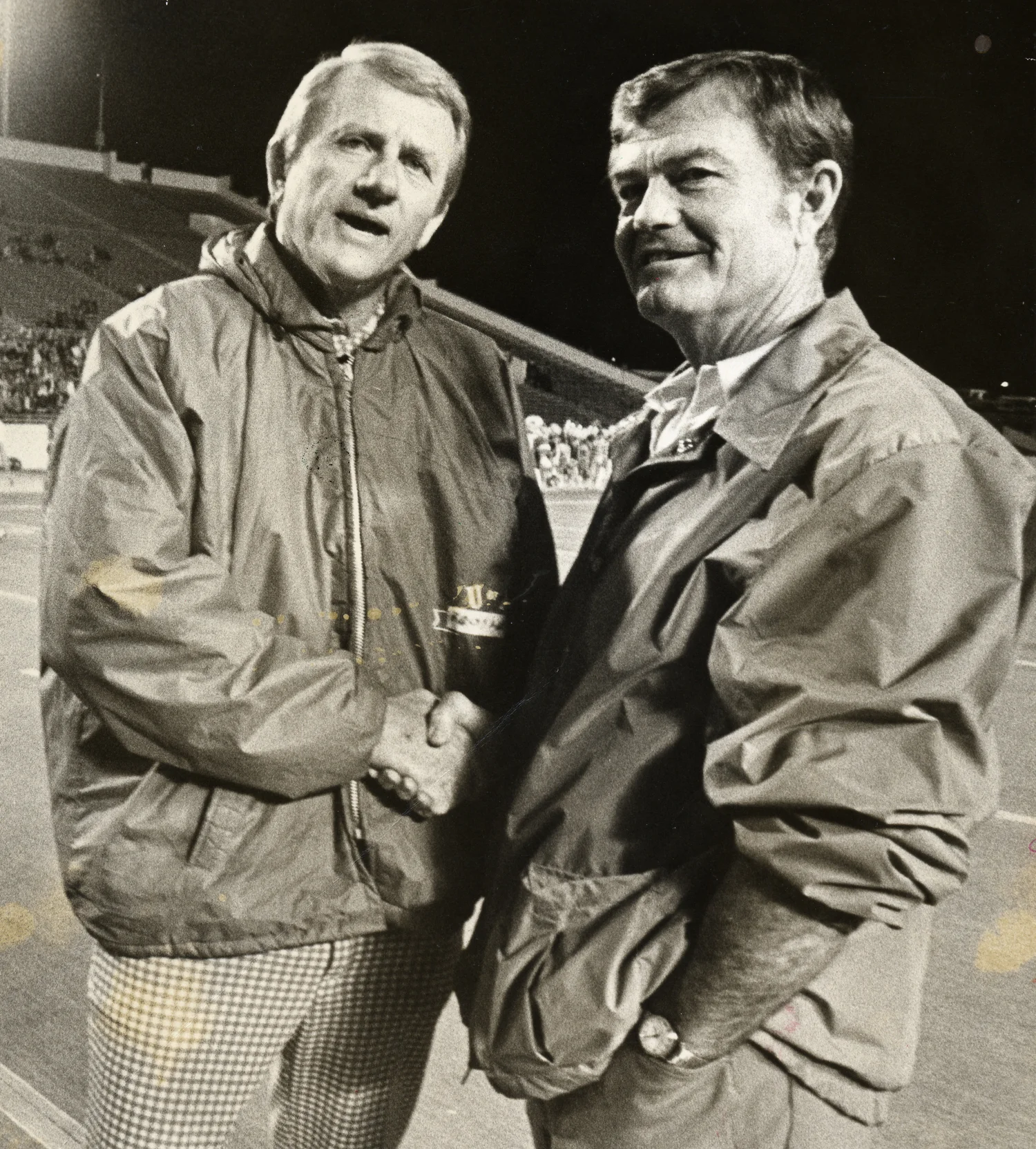
Frank Broyles (left) and Darrell Royal,
Memorial Stadium, Austin, 1976

December 4, 1976: In front of a national television audience on ABC, the University of Texas football team defeats the University of Arkansas, 29-12 at Memorial Stadium in Austin, Texas. The stadium will later be renamed for Texas' head coach, Darrell Royal.

It was the last game for Royal as the Longhorns' coach. Hired in 1957, he had won National Championships for them in 1963 and 1969, and 11 Southwest Conference Championships. But they finished the season 5-5-1, and it felt like other teams were catching up to his. Even though he was just 52 years old, he felt it was time to move on -- and a lot of Longhorn fans came to that conclusion before he did.

It was also the last game for Frank Broyles as head coach at Arkansas. Hired in 1958, he had won a share of the National Championship in 1964, and 7 Southwest Conference titles. Officially, Broyles led the Razorbacks to the SWC title outright in 1960, 1964 and 1965; Royal led the Longhorns to i outright in 1962, 1969, 1970, 1971, 1972 and 1973; they shared the SWC title in 1959, 1961, 1968 and 1975.

Razorback Stadium in Fayetteville, seat of the UA system, is 525 miles northeast of what's now named Darrell K Royal-Memorial Stadium in Austin, UT's seat. (Like President Harry S Truman, Royal's middle name was just an initial, without a period after it.) Texas won the game between them in 1959, 1961, 1962, 1963, 1967, 1968, 1969, 1970, 1972, 1973, 1974, 1975 and 1976. Arkansas won in 1960, 1964, 1965, 1966 and 1971, giving Royal a 13-5 advantage. Overall, through the 2022 season, Texas leads, 56-23. (UPDATE: Through 2025, the Longhorns lead, 58-23.)

Despite their on-field rivalry, Royal and Broyles were close friends, probably due to their similarities. They were born 6 months apart in 1924. Both were Southerners, but not from the State where they would do their most famous coaching: Royal from Hollis, Oklahoma, Broyles from Decatur, Georgia. Both were quarterbacks in college, themselves trained by a Hall of Fame coach, but not at a school they would later coach: Royal by Bud Wilkinson at Oklahoma (another major rival for Texas, along with Texas A&M), Broyles by Bobby Dodd at Georgia Tech.

They famously agreed to move their 1969 game to the last week of the regular season, to get a national audience on ABC. When Number 1 Ohio State were upset by Michigan 2 weeks earlier, that made Texas Number 1 and Arkansas Number 2, and their game, for the SWC title, a berth in the Cotton Bowl, and the inside track to the National Championship, became one of a few college football games to gain the headline "Game of the Century." Texas came from 14-0 down to win, 15-14, and beat Notre Dame in the Cotton Bowl to win the National Championship.

Both men continued to serve as their school's athletic director for a while: Royal until 1980, Broyles until 2007. Royal lived until 2012, Broyles until 2017.
Frank Broyles (left) and Darrell Royal,
Darrel K Royal Memorial Stadium, Austin, 2008

Arkansas left the Southwest Conference for the Southeastern Conference in 1990. In 1996, the SWC folded, and Texas joined the Big 12 Conference. In 2021, Texas made a deal to join the SEC for the 2024 season.

*

December 4, 1976 was a Saturday. Betty Lennox, the basketball player known as "Betty Big Buckets" for her baskets that helped the Seattle Storm win the 2004 WNBA Championship, was born.

There were 3 other college football games that day. Unlike Texas vs. Arkansas, where, unusually, neither team was nationally ranked, at least 1 team was in each of the other games, including 3 other Texas teams then in the SWC:

* Number 6 University of Houston beat the University of Miami, 21-16 at the Astrodome in Houston. UH had lost to Arkansas, but beaten Texas, and won the SWC title. Despite this, only 20,849 fans came to see this game. Coach Bill Yeoman's Cougars stayed Number 6, and beat Number 4 Maryland in the Cotton Bowl, to finish 10-2 and ranked Number 4.

* Number 9 Texas Tech beat Number 18 Baylor, 24-21 at Clifford B. and Audrey Jones Stadium (now Galaxy Stadium) in Lubbock, Texas. Officially, Tech tied Houston for the SWC title, Technically (pun intended, UH won it by beating Tech in Lubbock 2 weeks earlier.

* And Number 13 Nebraska beat Hawaii, 68-3 at Aloha Stadium in Honolulu. Only 33,737 saw that game, unlike in 1982, when Nebraska brought 16,000 fans to Aloha Stadium, and boosted the attendance to 46,876. Nebraska went on to beat Texas Tech in the Bluebonnet Bowl at the Astrodome. (It's 539 miles from the Tech campus to the Astrodome, so it's not like being in the same State gave Tech any real home-field advantage.)

There were 2 NFL games on the day. The football version of the St. Louis Cardinals beat the Baltimore Colts, 24-17 at Busch Memorial Stadium in St. Louis. And the Los Angeles Rams beat the Atlanta Falcons, 59-0 at the Los Angeles Memorial Coliseum. The Falcons finished 4-10, fired head coach Marion Campbell, then hired Leeman Bennett. With his "Gritz Blitz" defense, they improved to 7-7 in 1977, and made the Playoffs in 3 of the next 5 years.

Baseball was out of season. There were 7 games in the NBA:

* The New York Knicks beat the Seattle SuperSonics, 103-96 at Madison Square Garden.

* The New York Nets beat the Atlanta Hawks, 107-105 at The Omni in Atlanta.

* The Washington Bullets beat the Denver Nuggets, 100-95 at the Capital Centre in the Washington suburb of Landover, Maryland.

* The Houston Rockets beat the Indiana Pacers, 120-108 at The Summit in Houston. It's now the Central Campus of televangelist Joel Osteen's Lakewood Church.

* The Chicago Bulls beat the New Orleans Jazz, 107-99 at the Chicago Stadium. As usual, the Jazz were a one-man show: "Pistol" Pete Maravich scored 34 points, but no other player scored more than 16.

* The Golden State Warriors beat their arch-rivals, the Los Angeles Lakers, 116-114 at the Oakland Coliseum Arena. Jamaal Wilkes scored 31 points. Having already won an NBA Championship with the Warriors, he would win 3 more with the Lakers.

* And the Portland Trail Blazers beat the Milwaukee Bucks, 112-108 at the Portland Memorial Coliseum.

There were 6 games in the NHL:

* The New York Rangers beat the Minnesota North Stars, 11-4 at the Metropolitan Sports Center in the Minneapolis suburb of Bloomington, Minnesota. It was actually only 2-2 until 5:13 left in the 1st period, but the Broadway Blues took off from there. Rod Gilbert had 2 goals and 3 assists. Don Murdoch had 2 goals and 2 assists. Ken Hodge had a goal and 3 assists. Wayne Dillon had 3 assists. Even North Star legend Bill Goldsworthy had a goal for the Rangers.

* The New York Islanders beat the Buffalo Sabres, 3-0 at the Nassau Coliseum.

* The Montreal Canadiens beat the Pittsburgh Penguins, 3-1 at the Montreal Forum.

* The Chicago Black Hawks and the Toronto Maple Leafs played to a tie, 2-2 at Maple Leaf Gardens in Toronto.

* The Atlanta Flames beat the St. Louis Blues, 1-0 at the St. Louis Arena.

* And the Los Angeles Kings beat the Detroit Red Wings, 4-1 at The Forum outside Los Angeles in Inglewood, California.

There were 3 games in the World Hockey Association:

* The Winnipeg Jets beat the New England Whalers, 6-2 at the Hartford Civic Center (now the PeoplesBank Arena) in Hartford, Connecticut.

* The Indianapolis Racers beat the Edmonton Oilers, 5-3 at the Market Square Arena in Indianapolis.

* And the San Diego Mariners beat the Phoenix Roadrunners, 4-3 at the Arizona Veterans Memorial Coliseum in Phoenix.

And in English soccer, Arsenal defeated Newcastle United, 5-3 at the Arsenal Stadium, nicknamed Highbury for its North London neighborhood. Arsenal had just signed Malcolm Macdonald from Newcastle, and on a frozen field following a snowstorm that week, he scored 3 goals against his former team. He hadn't wanted to leave, and Newcastle fans knew that, so when he ran over to their traveling support after the game, they cheered him as much as the Arsenal fans did. 

Tuesday, November 8, 2022

November 8, 1924: Texas' Memorial Stadium Opens

November 8, 1924: War Memorial Stadium opens on the campus of the University of Texas in Austin. Surprisingly, the Longhorns lose to Baylor University, 28-10.

It was renamed simply Memorial Stadium in 1948, Texas Memorial Stadium in 1977, and Darrell K. Royal-Texas Memorial Stadium in 1995, after the coach who led the Longhorns to the 1963, 1969 and 1970 National Championships. It is known as "DKR" for short. Longhorn fans have not given it any other nicknames, either cutesy or tough.
It opened with a capacity of 27,000. It was raised to 40,000 in 1926, 60,000 in 1948, 66,000 in 1968, 78,000 in 1971, and its current 100,119 in 2009. On September 10, 2022, for Texas' 20-19 loss to Alabama, it attracted a record crowd of 105,213. The field was converted to AstroTurf in 1969, back to natural grass in 1996, and to FieldTurf in 2009.
Following the 3 National Championships won under Royal, the Longhorns won a 4th under Mack Brown in 2005. Since the stadium's opening, they've won 26 Conference Championships. In the old Southwest Conference, they won in 1928, '30, '42, '43, '45, '50, '52, '53, '59, '61, '62, '63, '68, '69, '70, '71, '72, '73, '75, '77, '83, '90, '94, '95 and '96. In the Big Twelve Conference, they've won in 2005 and 2009. (UPDATE: They won the Big 12 again in 2023, but are moving to the Southeastern Conference for 2024.)
They've had 2 Heisman Trophy winners: Running backs Earl Campbell in 1977 and Ricky Williams in 1998. Other notable Longhorns include 1940s quarterback Bobby Layne, 1960s linebacker Tommy Nobis, 1980s defensive tackle Kenneth Sims, and 2000s quarterbacks Vince Young and Colt McCoy.
In 1971, the Lyndon B. Johnson Presidential Library and Museum opened, almost right across Robert Dedman Drive from the stadium's east stand. Although he wasn't a UT graduate, it was pretty savvy of LBJ to put his Presidential Library across from, aside from the State Capitol, the Alamo and the Cotton Bowl, the most famous building in Texas. 
*

November 8, 1924 was a Saturday. These other notable college football games were played that day:

* Army beat Florida, 14-7 at Michie Stadium in West Point, New York. This was only the 4th game at their new stadium.

* Navy beat Vermont, 53-0 at Thompson Stadium in Annapolis, Maryland.

* Columbia beat New York University (NYU), 40-0 at Baker Field (now Wien Stadium) in Upper Manhattan.

* Princeton beat Harvard, 34-0 at Harvard Stadium in Boston. For reasons lost to time Rutgers played at arch-rival Princeton's Palmer Stadium, and beat Lafayette, 43-7.

* The University of Illinois and the University of Chicago played to a 21-21 tie at Stagg Field in Chicago. Three weeks earlier, Illinois had dedicated their Memorial Stadium in Champaign by beating Michigan, with Red Grange scoring 5 touchdowns, passing for another, and intercepting 2 passes.

* Notre Dame beat Wisconsin, 38-3 at Camp Randall Stadium in Madison, Wisconsin. Three weeks earlier, Notre Dame had beaten Army at the Polo Grounds, leading the nation's top sportswriter at the time, Grantland Rice, to call their backfield "The Four Horsemen," comparing them to those of the biblical Apocalypse.

There was 1 game played in the fledgling NFL: The Frankford Yellow Jackets beat the Kansas City Blues, 42-7 at Frankford Stadium in Northeast Philadelphia.

Also on this day, Johnny Bower, the Hall of Fame goaltender for the Toronto Maple Leafs' 1960s dynasty, was born. So was actor Joe Flynn.

Thursday, November 3, 2022

November 3, 1962: The Birth of Nebraska's Red Sea

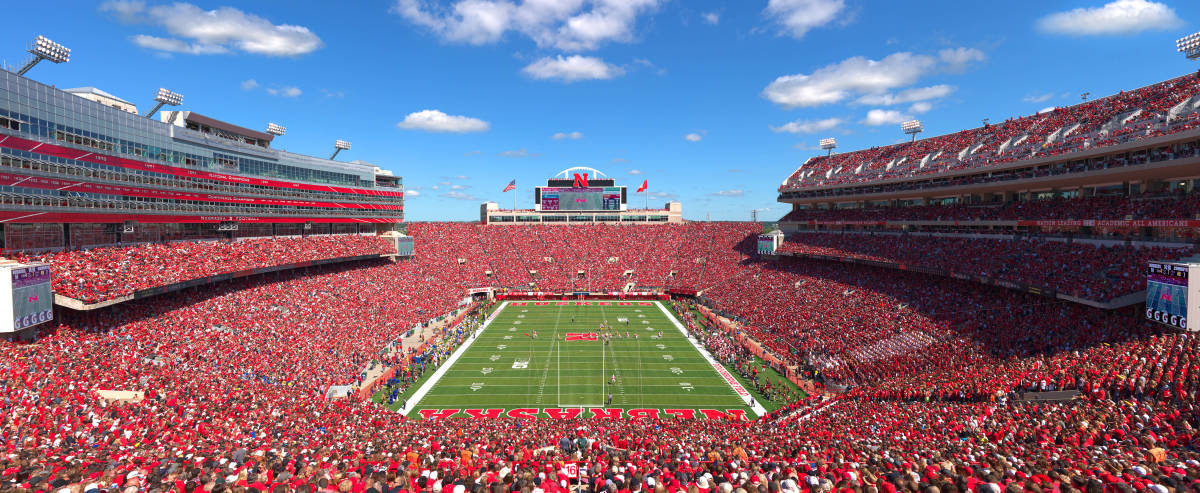
November 3, 1962: The University of Nebraska loses its Homecoming game, to Missouri, 16-7, at Memorial Stadium in Lincoln. The attendance is 36,501, a sellout. Despite Memorial Stadium now officially seating 85,458, the Cornhuskers sold out every home game for the next 57 years.
The Nebraska home crowd is known as the Red Sea. With no major league teams in the State -- the highest-ranking professional team is the Omaha Storm Chasers of Class AAA baseball -- Cornhusker football is it in the Cornhusker State. This is true for many States were there is no major league team, including Alabama, Arkansas and West Virginia.
The Nebraska fan base is devoted. How devoted is it? On December 4, 1982, 16,000 Nebraska fans showed up for a game against the University of Hawaii -- in Honolulu, a game they couldn't drive to. Nebraska won, 37-16, against a Hawaii team that were 6-4 going in, so it's not like they were a bad team.
Due to COVID-19 restrictions preventing fans from attending games in the 2020 season, Nebraska hosted 3 games there, with a combined attendance of exactly zero. The NCAA has chosen to exempt those games from the streak.
In 2021, despite a 3-9 season, one of the worst in Nebraska's modern history, the Cornhuskers played 6 home games, each with an attendance of at least 85,663. As of October 29, 2022, Nebraska's home sellout streak is officially 387 straight games. Since any other school with a sellout streak would also have seen it snapped in 2020, for the same reason, if you consider the 372 straight games from 1962 to 2019 to be the record and now over, that record is unlikely ever to be broken -- at least, not until the 2078 season.
*
November 3, 1962 was a Saturday. Among the other college football games played that day were these:
* Number 1 Northwestern beat Indiana, 26-21 at Seventeenth Street Stadium (now Memorial Stadium) in Bloomington, Indiana. Yes, Northwestern were ranked Number 1 in November. But they lost their next 2 games, to Wisconsin and Michigan State. They did go to the Orange Bowl stadium, but that was for a scheduled game with the University of Miami, which they won.
* Number 2 Alabama beat Mississippi State, 20-0 at Scott Field (now Davis Wade Stadium) in Starkville, Mississippi. Alabama blew its chances at the Southeastern Conference and National Championships by losing to Georgia Tech 2 weeks later. They were still invited to the Orange Bowl.
* Number 3 Southern California beat Number 9 Washington, 14-0 at the Los Angeles Memorial Coliseum. USC won the title of the Athletic Association of Western Universities (AAWU, a precursor to the Pacific-Twelve Conference).
* Number 4 Louisiana State were beaten by Number 6 Mississippi, 15-7 at Tiger Stadium in Baton Rouge, Louisiana. This was LSU's only loss of the season, although they had also been tied by Rice University. "Ole Miss" won the SEC Championship.
* Number 5 Texas beat Southern Methodist (SMU), 6-0 at Memorial Stadium in Austin, Texas. Texas won the Southwest Conference title, but lost the Cotton Bowl to LSU.
* Number 7 Michigan State were upset by Minnesota, 28-7 at Spartan Stadium in East Lansing, Michigan.
* Number 8 Arkansas beat Texas A&M, 17-7 at Kyle Field in College Station, Texas. Arkansas had already lost their shot at the SWC title by losing to Texas, but were invited to the Sugar Bowl, where they lost to Ole Miss.
* Number 10 Auburn were upset by Florida, 22-3 at Florida Field in Gainesville.
* Wisconsin, then unranked, beat Michigan, 34-12 at Michigan Stadium in Ann Arbor. Wisconsin won the Big Ten Conference title, but lost the Rose Bowl to USC, making USC the National Champions.
* Oklahoma, then unranked, beat Colorado, 62-0 at Folsom Field in the Denver suburb of Boulder, Colorado. Oklahoma won the Big Eight Conference title, then beat Alabama in the Orange Bowl.
* Among the service academies, Army beat Boston University, 26-0 at Nickerson Field in Boston; Navy lost to Notre Dame, 20-12 at Municipal Stadium (later John F. Kennedy Stadium) in Philadelphia; and Air Force beat Wyoming, 35-14 at Falcon Stadium in Colorado Springs.
* And among New Jersey teams, Rutgers beat Lafayette, 40-0 at the old Rutgers Stadium in Piscataway; and Princeton beat Brown, 28-12 at Palmer Stadium in Princeton.
There were 4 games played in the NBA that day:
* The Boston Celtics beat the Detroit Pistons, 125-11 at the Boston Garden.
* The Syracuse Nationals beat the Cincinnati Royals, 130-111 at the Onondaga County War Memorial (now the Upstate Medical University Arena) in Syracuse, New York. This would be the last season for the Nationals: The next season, 1963-64, they moved, becoming the Philadelphia 76ers.
* The St. Louis Hawks beat the Chicago Zephyrs, 114-109 at the Kiel Auditorium in St. Louis. The next season, the Zephyrs moved, becoming the Baltimore Bullets. They moved to Washington in 1973, and became the Washington Wizards in 1997.
* And the Los Angeles Lakers beat the San Francisco Warriors, 127-115, despite Wilt Chamberlain scoring 72 points -- yes, seventy-two -- for the Warriors, in their 1st season in the San Francisco Bay Area, having previously been the Philadelphia Warriors.
And there were 2 games played in the NHL. The New York Rangers and the Montreal Canadiens played to a tie, 3-3 at the Montreal Forum. And the Detroit Red Wings beat the Toronto Maple Leafs, 7-3 at Maple Leaf Gardens in Toronto. The Boston Bruins and the Chicago Black Hawks were not scheduled.

Monday, October 17, 2022

October 18, 1924: Red Grange & the Four Horsemen

This photo of Red Grange is colorized, but is otherwise real.

October 18, 1924: Two of the most iconic games in the history of college football are played.

Harold Edward Grange was born on June 13, 1903, in Forksville, in the mining country of Northeastern Pennsylvania -- 6 days before Lou Gehrig was born 200 miles to the southeast in East Harlem, Manhattan. He was born 15 days after entertainer Bob Hope, 5 days before early film singer Jeannette MacDonald, 9 days before Baseball Hall of Fame pitcher Carl Hubbell and bank robber John Dillinger, and 12 days before British writer George Orwell.

His father was the foreman on a lumber camp, and eventually moved the family to Wheaton, Illinois, about 30 miles west of Chicago, where 4 of his brothers lived, and he became that small city's Chief of Police. His son Harold, nicknamed Red because of his hair, got a job delivering ice, a hard job because ice is heavy. (A gallon of water weighs over 8 pounds. Now imagine it hard as a rock.) It made him strong, and he was fast, too. He was nicknamed "The Wheaton Iceman" well before "The Galloping Ghost." He made $37.50 a week -- about $548 in today's money.

Red lettered in football, baseball, basketball and track at Wheaton High School, all 4 years, 16 varsity letters. He was a State Champion in the high jump, the long jump and the 100-yard dash.

The school is now known as Wheaton Warrenville South High School, and also counts astronomer Edwin Hubble, journalist Bob Woodward, and the comedian brothers John and Jim Belushi among its alumni. The colors are orange and black -- not quite the same colors as Red would wear for the Illini and the Bears, but close. The school's stadium is named Red Grange Field.

In his 1st game at the University of Illinois, in Champaign in the east-central part of the State, on October 6, 1923, Grange scored 3 touchdowns against Nebraska, a very strong team at the time. Coached by Bob Zuppke, Illinois went 8-0, beating teams by an average score of 17-3. After a 9-6 win away to Iowa, they didn't allow a point for the rest of the season.

The Helms Athletic Foundation awarded Illinois the National Championship. This notoriety allowed Illinois to raise the money to build a new stadium, as a memorial to the school's alumni who had fallen in World War I a few years earlier.

On October 18, 1924, Red Grange led the Illini onto the field at Memorial Stadium in Champaign for its dedication game against the University of Michigan. A player now largely forgotten outside Michigan, Bennie Oosterbaan, led the Wolverines, who were favored to win the National Championship. (Michigan and Notre Dame did not play each other that season. They have not always played, occasionally feuding, and this was during one of the feuds.)

Grange returned the opening kickoff 95 yards for a touchdown. He ran 67 yards for a touchdown. He ran 56 yards for a touchdown. He ran 44 yards for a touchdown.

All this was accomplished in the 1st 12 minutes of the ballgame.

He later passed for another touchdown, and returned a kick for another. He accounted for 6 touchdowns in Illinois' 39-14 victory.

Keep in mind: Michigan was already the most honored college football program west of the Ivy League. In spite of the achievements of Knute Rockne and George Gipp, Notre Dame was not yet Notre Dame. But Michigan, under the guidance of legendary coach Fielding Yost (and, this season only, George Little), was already Michigan, which, despite their recent struggles to beat arch-rival Ohio State, remains the defining football school of that league.

*

Grange's performance is often called the best one-man game in college football history. But it wasn't even the most talked-about game played that day. There was another game that made this day, as far as college football was concerned, the peak of the "Roaring Twenties." Did I mention Notre Dame? Yes, yes, I did:

At the Polo Grounds in New York, the South Bend, Indiana-based University of Notre Dame beats Army -- the U.S. Military Academy at West Point, New York -- 13-7. The Fighting Irish were led by their 4-man backfield: Quarterback Harry Stuhldreher, left halfback Jim Crowley, right halfback Don Miller and fullback Elmer Layden. Layden scored a touchdown in the 2nd quarter, Crowley in the 3rd.

Army were favored to win, but there was precedent: Notre Dame had shocked them in 1913, with quarterback Gus Dorais and end Knute Rockne, for all intents and purposes, introducing the passing game to a wide audience, and making Notre Dame more than just what we would now call a "mid-major" Catholic school in the Midwest like DePaul or Marquette. Now, with Rockne as head coach, the Fighting Irish -- although Miller was of English descent, and Stuhldreher, German -- pulled off a much less surprising upset.

George Strickler, a Notre Dame student, was what we would now call a publicity director. At halftime, he mentioned Rudolph Valentino's 1921 silent film epic The Four Horsemen of the Apocalypse (although that term comes from the Bible's Book of Revelation), in the press box. The great syndicated sports columnist Grantland Rice, based out of the New York Herald Tribune, ran with it, and wrote this opening paragraph, the most famous piece of sportswriting ever:

Outlined against a blue-gray October sky, the Four Horsemen rode again. In dramatic lore their names are Death, Destruction, Pestilence, and Famine. But those are aliases. Their real names are: Stuhldreher, Crowley, Miller and Layden. They formed the crest of the South Bend cyclone before which another fighting Army team was swept over the precipice at the Polo Grounds this afternoon as 55,000 spectators peered down upon the bewildering panorama spread out upon the green plain below.

They don't write 'em like that anymore: Not only was the 1920s, as Rice himself later billed it, the Golden Age of Sports, it was the golden age of sportswriting, with Rice joined by such men as Ring Lardner, Paul Gallico, Jimmy Cannon and Damon Runyon.

To further plant the idea of the Four Horsemen in people's minds, the 4 of them were posed on horseback, wearing full uniforms and holding footballs. From left to right: Miller, Layden, Crowley, Stuhldreher. A set of statues representing that photo is now at Notre Dame's Guglielmo Athletic Complex.
(As far as I know, nobody ever asked Red Grange to pose as a ghost, or with a man dressed as a ghost, or on a galloping horse.) 

Over the Horsemen's 3 seasons -- freshmen were not eligible to play varsity football at the time -- Notre Dame won 27 games and lost only 2, both away to Nebraska, plus a tie in an earlier game with Army. They won the 1924 National Championship, defeating Ernie Nevers' Stanford squad in the 1925 Rose Bowl, with Layden returning 2 interceptions for touchdowns. (Notre Dame would then refuse all bowl invitations until the 1969 season.)

None of the Four Horsemen was over 6 feet tall, and none was listed as weighing more than 162 pounds. But this was typical of football players of the Roaring Twenties. And no one today can question their toughness: In their 30 games together, they played in primitive protective equipment, played offense and defense, excelling on both sides, and played all 60 minutes, with no substitutions. The offensive line that protected them was nicknamed the "Seven Mules," to emphasize their crucial but less glamorous function.

(The Mules didn't become famous in their own right, with one exception: The center, Adam Walsh, would go on to coach the Cleveland Rams to the 1945 NFL Championship, and then become their 1st head coach in Los Angeles the following season.)

It was the Four Horsemen, and Rockne's subsequent publicity campaigns through the beginnings of mass media in the 1920s, that made Notre Dame iconic. Even George Gipp wasn't as famous in life as the 1928 Notre Dame-Army game, in which Rockne made up the "Win one for the Gipper" story, and the later film Knute Rockne, All-American, with Pat O'Brien as Rockne and young Ronald Reagan as Gipp, would make him in death.

*

Having made legends out of the Four Horsemen, Grantland Rice took pen in hand (or, more likely, tapped out on his typewriter), and wrote this about Grange:

A streak of fire, a breath of flame
Eluding all who reach and clutch;
A gray ghost thrown into the game
That rival hands may never touch;
A rubber bounding, blasting soul
Whose destination is the goal

Red Grange of Illinois!

Although Rice had called Grange "a gray ghost" (and he certainly appears as such in the few surviving film clips of him playing, all black and white, of course), Warren Brown, writing for the Chicago American, gave him the nickname "the Galloping Ghost."

A year later, on Halloween, October 31, 1925, Illinois traveled to Philadelphia to play the University of Pennsylvania at Franklin Field. The playing surface was a muddy mess, and few expected Grange to move well on it. He did, scoring 3 touchdowns and setting up the Illini's other touchdown, in a 24-2 win. Rice covered this game as well, and wrote:

There are two shapes now moving
Two ghosts that drift and glide
And which of them to tackle
Each rival must decide.
They shift with spectral swiftness
Across the swarded range
And one of them's a shadow
And one of them is Grange.

Runyon added, "This man Red Grange of Illinois is three or four men and a horse rolled into one for football purposes. He is Jack Dempsey, Babe Ruth, Al Jolson, Paavo Nurmi and Man o' War. Put them all together, they spell Grange."

Zuppke would later say, "An All-American consists of a fast back, weak opposition, and a poet in the press box." But he also said, "I will never have another Grange, but neither will anyone else. They can argue all they like about the greatest football player who ever lived, but I was satisfied I had him when I had Red Grange." A statue of Grange now stands outside Memorial Stadium -- essentially, the house than Zuppke and Grange built.

Grange's 77 became the 1st celebrated uniform number in American sports -- especially since Major League Baseball wouldn't have uniform numbers until 1929. When asked how he got the famous double-digit, he said, "The guy in front of me got 76, and the guy behind me got 78." It wasn't a choice, and it's not like Wheaton had uniform numbers at the time. (In case you're wondering about the Four Horsemen, I looked it up: Layden wore 5, Miller 16, Crowley 18 and Stuhldreher 32. And George Gipp wore 66.)

*

How did the Four Horsemen do in the pros? Not especially well. Pro football was then still frowned upon, as a backwater game at best, and as outright dishonorable at worst. Zuppke himself was of two minds about it: George Halas, who had helped Illinois gain a share of the 1918 Big Ten title (before going into the U.S. Navy and helping the Chicago-based Great Lakes Naval Training Center team win the 1919 Rose Bowl), remembered him lamenting that players graduated just as they were really learning how to play. But Zuppke also stopped speaking to Halas and Grange for many years after they turned pro, eventually reconciling with both of them.

The Horsemen only played 1 professional game together, at the end of the 1925 season, for the Waterbury Blues against a team from Adams, Massachusetts, at Hartford, Connecticut (about halfway between), and won 34-0. (Imagine Patrick Mahomes passing to Stefon Diggs, with Derrick Henry and Dalvin Cook in his backfield, and the other 7 players on his own team and the 11 on the other side being college players, and you'll get the idea of what it was like.) The Horsemen were paid $5,000 apiece -- about $78,000 in today's money, for a little over 2 hours' performance. Then as now, nice work if you can get it.

Stuhldreher, from the football-crazy town of Massillon, Ohio (also hometown of Yankee Legend Tommy Henrich), and Layden, from Davenport, Iowa (part of the "Quad Cities" that were then represented in the NFL by Illinois' Rock Island Independents), had a team built around them and named for them, the Brooklyn Horsemen. They played in the original American Football League in 1926. When that league folded, the Brooklyn Horsemen were absorbed into the NFL, which still needed the publicity, and played 3 games in that league's '26 season.

Stuhldreher ended his playing career after that season, and was named head coach at Villanova, and later at the University of Wisconsin, managing a decent record but no conference titles in 24 years. He then worked for U.S. Steel, and wrote a couple of books about football. He died in 1965, only 63 years old.

Layden went on to be the head coach at Pittsburgh's Duquesne University, getting them into the 1934
Festival of Palms Bowl, the forerunner of Miami's Orange Bowl. He then became head coach at Notre Dame, and in 1941 was offered the post of Commissioner of the NFL, serving 5 seasons and guiding them through the difficulties caused by the manpower shortage from the World War II draft. He then went into business in Chicago, and died in 1973, age 70.

Miller, from Defiance, Ohio, about halfway between Toledo and Fort Wayne (and the only 1 of the 4 from anywhere near South Bend), coached at Georgia Tech, and then practiced law. He was appointed a U.S. Attorney for the Cleveland area by President Franklin D. Roosevelt, and died in 1979, age 77.

Crowley, from the football-crazy town of Green Bay, Wisconsin -- Packer co-founder Earl "Curly" Lambeau had played for Rockne at Notre Dame -- became an assistant coach at Georgia, and head coach at Michigan State and Fordham.

At Fordham, in The Bronx, he coached a team that challenged for the National Championship in 1937 and '38, with a line known as the Seven Blocks of Granite, including 2 future Pro Football Hall-of-Famers. Alex Wojciechowicz starred for the Philadelphia Eagles and the Detroit Lions. The other never played a down of pro ball, and is in the Hall as a coach: Vince Lombardi. (Longtime Giants owner Wellington Mara didn't play, but was also a student at Fordham at this time.)

Crowley enlisted in the Navy in World War II, and coached the Navy's renowned North Carolina Pre-Flight School team at Chapel Hill, with Paul "Bear" Bryant and Johnny Vaught, later to become coaching legends at Alabama and Mississippi, respectively, as assistant coaches.

Crowley then coached the Chicago Rockets of the All-America Football Conference, including receiving legend Elroy "Crazy Legs" Hirsch. He later became chairman of the Pennsylvania State Athletic Commission, and was the last survivor of the Four Horsemen, living until 1986, at the age of 83.

Grange played his last college game on November 21, 1925, a 14-9 Illinois win away to Ohio State. His collegiate obligation complete, he signed with Halas' Chicago Bears. At the time, this was legal: There was no NFL Draft, nor any rule preventing the signing. Five days after his college finale, he suited up for the Bears against the Chicago Cardinals at Wrigley Field (in its last season under the name Cubs Park) on Thanksgiving Day, resulting in a 0-0 tie.

The Bears went to New York to play the Giants on December 6, and the gate receipts from that full house at the Polo Grounds -- New Yorkers coming to see Grange, not the home team -- may have saved the Giant franchise, and possibly even the League. He would play in the NFL until 1934, helping the Bears win the NFL Championship in 1932 and 1933, teaming with Bronislau "Bronko" Nagurski.

Grange became the template for the speedy halfback, Nagurski that for the big bruising fullback. Think of Grange's "descendants" as being Steve Van Buren, Doak Walker, Lenny Moore, Paul Hornung, Gale Sayers, Walter Payton, Barry Sanders and Christian McCaffrey; and Nagurski's as being Marion Motley, Tank Younger, Jim Brown, Jim Taylor, Larry Csonka, Franco Harris, John Riggins, Emmitt Smith, Terrell Davis, Jerome Bettis, Adrian Peterson and Derrick Henry.

Grange went on to become a broadcaster. In 1963, he was a charter inductee into the Pro Football Hall of Fame. He died on January 28, 1991, at the age of 87.

*

October 18, 1924 was a Saturday. The baseball season had ended 8 days earlier, with the Washington Senators beating the New York Giants in the World Series, the only World Championship that a Washington baseball team would win until 2019. There was no NBA yet. The NHL season didn't start until November 29.

Despite it being a Saturday, there was NFL action on the day. The Frankford Yellow Jackets beat the Columbus Tigers, 23-7 at Frankford Stadium in Northeast Philadelphia. The Jackets had to play on Saturdays because, until 1933, playing professional sports on Sundays was illegal in Pennsylvania.

The Tigers had been known as the Columbus Panhandles, and went out of business after the 1926 season. That year, the Yellow Jackets won the NFL Championship. But the Great Depression did them in, and they folded in 1931. Philadelphia returned to the NFL in 1933, with the Eagles, but there is no connection between them and the Jackets.

Among the other college games played that day:

* The University of Chicago beat Indiana, 23-0 at Stagg Field in Chicago.

* Purdue beat Northwestern, 7-3 at Northwestern Field in Evanston, Illinois.

* Ohio State beat Ohio Wesleyan, 10-0 at Ohio Stadium in Columbus.

* Iowa beat Lawrence University of Appleton, Wisconsin, 13-5 at Iowa Field in Iowa City.

* Minnesota and Wisconsin played to a 7-7 tie at Camp Randall Stadium in Madison, Wisconsin.

* Nebraska beat Colgate, 35-7 at Memorial Stadium in Lincoln, Nebraska.

* USC beat Oregon Agricultural, 17-3 at Multnomah Stadium in Portland, Oregon. Oregon Agricultural would become Oregon State, and what's now Providence Park would be built on the site of Multnomah Stadium.

* Alabama beat Sewanee, of Sewanee, Tennessee, 14-0 at Rickwood Field in Birmingham, Alabama.

* Georgia Tech beat Penn State, 15-13 at Grant Field in Atlanta.

* Southern Methodist University beat Texas, 10-6 at Armstrong Field, SMU's home, in Dallas.

* Harvard beat Holy Cross, 12-6 at Harvard Stadium in Boston.

* Yale and Dartmouth played to a tie, 14-14 at the Yale Bowl in New Haven, Connecticut.

* Among New York City teams, New York University beat their arch-rivals, City College of New York. NYU beat CCNY, 7-0 , at NYU's home field, Ohio Field in The Bronx.

* Columbia lost to Penn, 10-7 at Franklin Field in Philadelphia.

* Fordham beat St. Stephen's College, 26-0 at Fordham Field in The Bronx. St. Stephen's, of Annandale-on-Hudson, New York, later became Bard College, and now compete in NCAA Division III.

* In New Jersey, Princeton beat Navy, 17-14 at Palmer Stadium.

* And Rutgers beat Cornell, 10-0 at Schoellkopf Field in Ithaca, New York.

Also, Arsenal drew with Aston Villa, 1-1 at the Arsenal Stadium, a.k.a. Highbury, in North London.

October 17, 1979: The Pittsburgh Pirates' "Family"

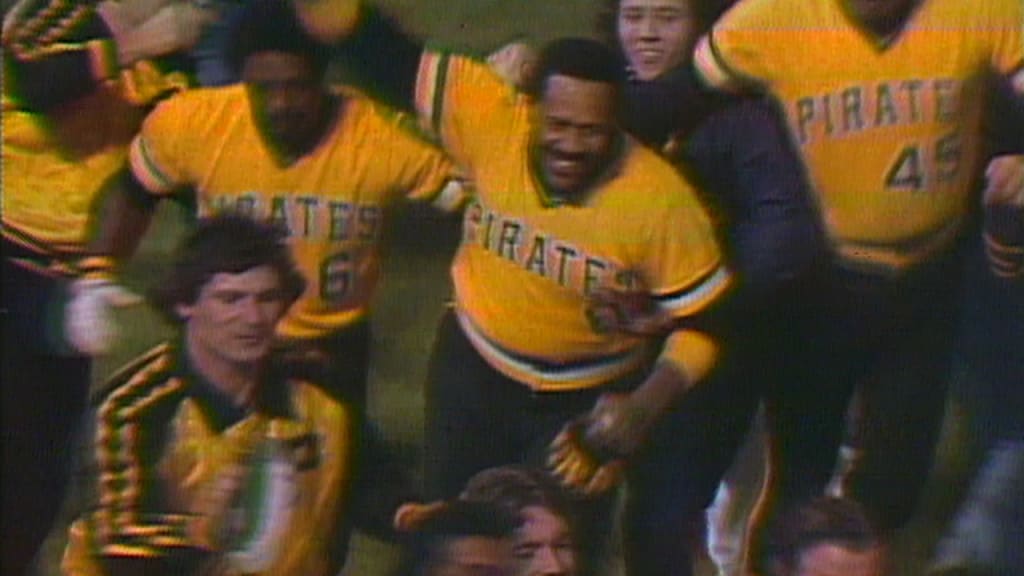
October 17, 1979: As in 1971, the Pittsburgh Pirates win the World Series by beating the Baltimore Orioles in Game 7 at Memorial Stadium, winning 4-1 to complete a comeback from 3 games to 1 down.
Willie Stargell, the 1st baseman known as "Pops" not just for his age (39) but because of his playing of Sister Sledge's hit disco song "We Are Family," hits his 3rd home run of the Series, and is named Series MVP, after having also been named MVP of the National League Championship Series.
Despite the group being from Philadelphia, and being about sisters rather than brothers, the song was adopted by the baseball team across Pennsylvania, the Pittsburgh Pirates, as they made their postseason run. It did not quite hit Number 1, getting stuck in June behind another iconic disco track, “Hot Stuff” by Donna Summer.
An online friend and fellow Yankee Fan, Paul Louis, once told me, "Part of me has come to suspect it might have been a subtle swipe at the dysfunctional image of the previous two seasons' World Series winning teams."
After the season, it was be announced that there was a tie vote for the regular-season MVP, between Stargell and the NL's batting champion, St. Louis Cardinals 1st baseman Keith Hernandez. Despite the only tie vote for an MVP in either League, Stargell became the 1st man, and remains the only one, ever to sweep the regular season, LCS and World Series MVPs in a single season.
This was the worst-looking World Series of all time. I don't mean it was poorly-played; that was hardly the case. I mean it looked bad. The Orioles had those bright orange home jerseys with the black lettering, and those dumb black caps with the white front panels and the Oriole head; the all-black caps with that head, which they wore from 1966 to 1974, looked a lot better.
Six of the NL's 12 teams wore 19th Century-style caps to celebrate the League's 100th Anniversary in 1976, and the Pirates were the only team to keep them, and continued to wear them until 1986. I didn't mind that. But their mix-and-match of white, white with yellow pinstripes, gold, and black, sometimes mixing up the jerseys and pants, was atrocious.
The stadiums were little better: I saw 3 games at Memorial Stadium, and liked it, but it had terrible lighting, and a grass field that was already chopped up by Colts games; while Three Rivers Stadium was a concrete ashtray with a hideous pea-green carpet of artificial turf. This was a World Series made for radio, not television.
The 1979 season was an outlier in its era. In the American League Eastern Division, the Yankees won in every season from 1976 to 1981, except 1979, when the Orioles won it. In the Western Division, the Kansas City Royals won in every season, except 1979, when the California Angels won it, for the 1st time in their 19-season history.
In the National League Eastern Division, the Philadelphia Phillies won it every year from 1976 to 1980, except 1979, when the Pirates won it, before giving way to the Montreal Expos in 1981. And in the NL West, the Cincinnati Reds completed their "Big Red Machine" era of dominance in 1976, and then the Los Angeles Dodgers won it in 1977, 1978 and 1981, losing a Playoff for it to the Houston Astros in 1980,  with the Reds winning again in 1979.
In the League Championship Series, the Pirates swept the Reds in 3 straight, gaining revenge for NLCS losses in 1970, 1972, 1974 and 1975, though they'd beaten the San Francisco Giants in the series since 1971; while the Orioles, having won the Pennant in 1969, 1970 and 1971, and lost the ALCS in 1973 and 1974, beat the Angels 3 games to 1.
Stargell, pitcher Bruce Kison and catcher Manny Sanguillen were the only players to have played for the Pirates in both the '71 and the '79 Series, although Sanguillen had left and since returned.
Game 1 of the World Series was supposed to be played in Baltimore on October 9, but was postponed due to rain and snow. The temperature for the postponed Game 1 was 41 degrees, the coldest on record, although there had been snow at a Series game in 1907. The O's won, 5-4, behind the pitching of Mike Flanagan, despite a Stargell home run. The Pirates scored in the 9th to win Game 2, 3-2.
Game 3 in Pittsburgh had a midgame rain delay, and the Pirates blew a 3-0 lead. Scott McGregor outpitched John Candelaria, as the O's won, 8-4. Despite another Stargell homer, the Bucs blew a 4-0 lead in Game 4, and the O's won, 9-6. Coming back from being down 3 games to 1 had only happened 3 times in World Series history to this point -- but the Pirates had done it twice, in 1925 against the Washington Senators, and in 1971 against the Orioles, with a few of the same people involved.
Pirate manager Chuck Tanner had planned to start Jim Rooker on short rest in Game 5, and then go to curveball master Bert Blyleven. That morning, his mother died. According to Kent Tekulve, the Pirates' submarine-pitching reliever, Tanner told the team before the game that his mother "knew we needed some help, so she went to get us some." Whatever the cause, Rooker had a no-hitter for the 1st 4 innings, and Tanner brought Blyleven in for the 6th, with the Orioles leading, 1-0. Then the Pirates got to Flanagan, and won the game, 7-1.
Back in Pittsburgh for Game 6, Candelaria and Jim Palmer traded goose eggs for 6 innings, before the Pirates reached Palmer, and they won, 4-0.
For what turns out to be the only time in his Presidency, Jimmy Carter attends a Major League Baseball game, and he picks a good one. He threw out the ceremonial first ball, saw Stargell homer off McGregor, saw Tekulve get his 3rd save in relief of Grant Jackson, and was among those congratulating the Pirates in the locker room afterward.
And, with the Pittsburgh Steelers having won Super Bowl XIII 9 months earlier, it gave the Steel City a rare MLB-NFL double, and the nickname "City of Champions." This was maintained 3 months later, when the Steelers won Super Bowl XIV. Sports Illustrated named Stargell and Steeler quarterback Terry Bradshaw "Sportsmen of the Year."
But in the 43 years since -- 2 full generations -- the Pirates have never won another Pennant, though they reached Game 7 of the NLCS in 1991 and '92, losing to the Atlanta Braves both times. The Steelers have since won 3 Super Bowls and appeared in 2 others; the Penguins have reached the Stanley Cup Finals 6 times, winning 5; and the University of Pittsburgh football team has won some bowl games and has usually been a contender for their conference title (formerly the Big East, now the Atlantic Coast Conference).
The Pirates? After 21 years out of the postseason, they made it for 3 straight seasons, 2011 to '13, but, so far, they can't get beyond the NLDS. So they're still waiting for the next generation of the Family to make good.
One more note about the '79 Series: When the Orioles won Game 4, the winning pitcher was Tim Stoddard. By simply appearing in the game, he became the 1st man ever to appear in both a World Series game and an NCAA basketball Final Four game. He was a member of the North Carolina State team that won the 1974 National Championship. He was still with the Orioles when they won the World Series in 1983.
He has since been joined only by Kenny Lofton, who reached the Final Four with Arizona in 1988, and the World Series with 3 different teams, the 1st being the Cleveland Indians in 1995.

Stargell retired after the 1982 season, and was elected to the Baseball Hall of Fame in 1988. The Pirates retired his Number 8. He threw out the ceremonial first ball before the last game at Three Rivers Stadium in 2000. He was invited to do it again for the first game at the new PNC Park, scheduled for April 9, 2001, with the dedication of a statue of him outside the park 2 days earlier. But his health declined, and he died the morning of the regular-season opener. He was only 61 years old.

Sister Sledge weren't quite "one-hit wonders," also hitting the Top 10 with their follow-up, "He's the Greatest Dancer." But they were one-shot wonders, as later albums failed to make much chart impact.

Nile Rodgers, leader of the disco band Chic, was their main songwriter and producer, and made them the 1st major music act to namecheck different fashion designers in music. He said, "They didn't even know what we were talking about when we wrote the lyric 'Halston, Gucci, Fiorucci'. First time anybody had ever name checked fashion designers." 

From oldest to youngest, the sisters were Debbie, Joni, Kim and Kathy. Joni passed away in 2017. As of October 17, 2022, the others are still alive. Debbie's daughters Amber and Camille, and Kim's daughter Julie, have toured with their mother and aunts. Kathy's daughter Kristen has not. Joni was the only sister to have had a son and no daughters.

UPDATE: The Pirates have a team Hall of Fame. From their 1979 World Champions, they have inducted 1st baseman Willie Stargell, catcher Manuel "Manny" Sanguillén, and pitcher Kent Tekulve -- but not yet manager Chuck Tanner, right fielder Dave Parker, or pitcher Bert Blyleven.
*
October 17, 1979 was a Wednesday. Football was in midweek. There were 7 games played in the NBA that night:
* The New Jersey Nets lost to the Philadelphia 76ers, 113-88 at the Rutgers Athletic Center (now the Jersey Mike's Arena) in Piscataway, New Jersey. Julius "Dr. J" Arena scored 22 points against his former team.
* The Boston Celtics beat the Cleveland Cavaliers, 127-108 at the Boston Garden.
* The Washington Bullets beat the Atlanta Hawks, 100-97 at the Capital Centre in the Washington suburb of Landover, Maryland.
* The Houston Rockets beat the Indiana Pacers, 116-112 at The Summit in Houston. Moses Malone had a monster game, 44 points and 29 rebounds. (The arena has since been converted into the Central Campus of the Lakewood Church, Dr. Joel Osteen's "megachurch.")
* The Milwaukee Bucks beat the Denver Nuggets, 125-97 at the Milwaukee Exposition, Convention Center and Arena, or "The MECCA." Since 2014, it has been named the UW-Panther Arena.
* The Golden State Warriors beat the Kansas City Kings, 107-94 at the Kemper Arena (now the Hy-Vee Arena) in Kansas City.
* And the Seattle SuperSonics beat the Los Angeles Lakers, 112-110 at the Seattle Center Coliseum.
And there were 6 games played in the NHL:
* The New York Islanders lost to the Boston Bruins, 3-2 at the Boston Garden.
* The Toronto Maple Leafs beat the Minnesota North Stars, 6-2 at Maple Leaf Gardens in Toronto.
* The Buffalo Sabres beat the Hartford Whalers, 3-1 at the Buffalo Memorial Auditorium.
* The Los Angeles Kings beat the Pittsburgh Penguins, 5-4 at the Civic Arena in Pittsburgh.
* In an "Original Six" matchup, the Chicago Black Hawks beat the Montreal Canadiens, 3-2 at the Chicago Stadium.
* The Vancouver Canucks beat the St. Louis Blues, 5-1 at the Checkerdome, as the St. Louis Arena was then known.
* And the Detroit Red Wings beat the Winnipeg Jets, 5-1 at the Winnipeg Arena.

October 17, 1971: Roberto Clemente Deja Claro Su Punto

October 17, 1971: Game 7 of the World Series is played at Memorial Stadium in Baltimore. The Baltimore Orioles were set to play the Pittsburgh Pirates. The Orioles were the defending World Champions. The Pirates last won in 1960, and 2 players from that team were left: 2nd baseman Bill Mazeroski, whose home run won that Series; and right fielder Roberto Clemente. Danny Murtaugh managed them in both, and 1960 player Bill Virdon was one of Murtaugh's 1971 coaches.
Earlier in the season, the Pirates had become the 1st team ever to field an all-black-and/or-Hispanic starting lineup, leading author Bruce Markusen to title his book about the '71 Bucs The Team That Changed Baseball.
Clemente was 37, the most popular Hispanic player in baseball, and the Pirates' greatest player since Honus Wagner. But English-speaking baseball fans -- especially white ones -- weren't as interested in him as they were in some others. To a racist, Willie Mays, Hank Aaron and Frank Robinson might be black, but at least they spoke English.
Of course, Clemente spoke English, too, even though it was his 2nd language. And he dared to insist upon being called "Roberto." His Topps baseball cards usually listed him as "Bob Clemente." And Pirates broadcaster Bob Prince, a.k.a. "The Gunner," called him "Bobby."
What's more, he played in Pittsburgh. He had never played in New York, like Mays and Mickey Mantle. He wasn't playing in Los Angeles, like Sandy Koufax and Maury Wills had. He wasn't playing in Chicago, like the newly-retired Ernie Banks. He wasn't playing in San Francisco, like Mays. He wasn't playing in the nation's capital, Washington, like Frank Howard. He wasn't playing in the strong-media city of Boston, like Carl Yastrzemski. And he wasn't playing in the baseball-beloved city of St. Louis, like Bob Gibson and Lou Brock. So he wasn't celebrated in the media as those men were. He had to deal with both the ignorance of racism and simply being ignored.
But the World Series is a national showcase. Every baseball fans watches. It helped launch Koufax to superstardom in 1963, Gibson and Brock in 1964, Frank Robinson in 1966, Al Kaline in 1968, and Brooks Robinson in 1970. In 1971, Roberto Clemente, already with 14 All-Star Game berths, 10 Gold Gloves, 4 National League batting titles, and a regular-season Most Valuable Player award, but without stardom outside Western Pennsylvania, wanted to show the country that he was as good as any of them.
But to do it, he and the Pirates would have to go through the Orioles, the defending World Champions, with Brooks Robinson, Frank Robinson, John "Boog" Powell, and pitchers Jim Palmer, Mike Cuellar and Dave McNally. And, being an odd-numbered year, the O's, as AL Champions, would have the home-field advantage for Games 1 and 2, and, if necessary, Games 6 and 7.
The Orioles won Game 1, 5-3, McNally outpitching Dock Ellis. They also won Game 2, 11-3, Palmer outpitching Bob Johnson. But when the Series went to Pittsburgh, the Pirates won Game 3, 5-4, with Steve Blass outpitching Cuellar; and Game 4, 4-3, Bruce Kison outpitching Eddie Watt. And in Game 5, Nelson Briles pitched a 2-hit shutout, beating McNally, and the Pirates won, 4-0. But, back at Memorial Stadium, the Orioles won Game 6, 3-2. Clemente hit a home run, but Brooks Robinson hit a sacrifice fly to score Frank Robinson with the winning run in the bottom of the 10th inning.
Hank Bauer of the Yankees still holds the record for the longest hitting streak in World Series play, 17 games. Clemente had gotten a hit in all 7 games in 1960, and had now gotten hits in all 6 games in 1971, for 13, the 2nd-longest such streak. But the Pirates had to win Game 7 on the road.
Prior to Game 7, Briles did something that no active player had ever done before: He sang the National Anthem before a competitive Major League Baseball game, and a Game 7 of the World Series, no less. It would not happen again until 2019, when another Pirates pitcher, Steven Brault, sang the Anthem before a regular-season game.
Blass started against Cuellar, the lefthanded screwball specialist from Cuba. The game was scoreless until the top of the 4th, when Clemente hit a home run off Cuellar. The teams exchanged runs in the 8th, but Blass went the distance. The outcome was still in doubt on the final play: Merv Rettenmund hit a bouncer that ricocheted off the pitcher's mound. Pirate shortstop Jacinto "Jackie" Hernández handled it, and threw Rettenmund out.
The Pirates had become World Champions for the 4th time, previously doing so in 1909, 1925 and 1960. In 1901 and 1902, they won the NL Pennant, and had a better record than the AL Champions both times, but there was no World Series until 1903, which they reached, losing to the team soon to be known as the Boston Red Sox.
Clemente played in all 7 games in '60 and in all 7 games in '71, and got hits in all 14 World Series games in which he played. In fact, all 5 of the Pirates' World Series wins, including the 1979 win that was yet to come, have been in 7 games.
Interviewed for Sports Illustrated, Pirate general manager Joe Brown said, "People said to me, 'My God, does he always play like that?' And I said, 'Yes. Always. You're not seeing anything that we don't see day in and day out.'" Clemente had shown the world what he not only could do, but had always done.
After the game‚ 40‚000 people rioted in celebration in downtown Pittsburgh. At least 100 people wre injured‚ some seriously, although no deaths were reported.
Immediately after the Game 7 victory, rookie hurler Bruce Kison and his champagne-soaked best man Bob Moose were whisked away from Memorial Stadium by helicopter to a waiting Lear Jet, to attend the 21 year-old Kison's 6:30 PM wedding in Pittsburgh, for which the groom arrived 33 minutes late.
Also after the game, NBC did what it usually did when covering the World Series, and not only hired the leading announcer for each participating team -- in this case, Prince for the Pirates and Chuck Thompson for the Orioles -- but sent the announcer for the winning team into the locker room to interview the victorious.
Clemente had become the 1st Spanish-speaking player to be named the World Series MVP. Prince called him over to the TV camera, and called him "Bobby." Roberto was 37 years old. He told Prince that he had something he wanted to say, in Spanish. He said: << En el día más orgulloso de mi vida, a mis hijos, les doy mi bendición. Y a mis padres pido su bendición desde Puerto Rico. >> 
They were the first words ever spoken in Spanish live on national television in America. In English, "In the proudest day in my life, to my children, I give my blessing. And from my parents, I ask their blessing from Puerto Rico."
At that point, with Honus Wagner dead, the Steelers yet to rise to dynasty status, and Mario Lemieux having just turned 6, Bob Prince might have been the one living person connected with Pittsburgh sports more popular than Roberto Clemente. But in that moment, Clemente transcended not just Pittsburgh, but his entire sport. He had shown the world how he always played. And he had shown Prince, and the world, that he was a human being, an adult, an American, a Puerto Rican, and a Spanish speaker, as well as a great baseball player, and that each status deserved respect.
He had made his point -- Había dejado claro su punto.
The following year, he collected his 3,000th career hit. Two months later, trying to fly relief supplies to earthquake-devastated Nicaragua, he was killed in a plane crash. In a span of 14 months, he had gone from local star to baseball icon to secular saint.
UPDATE: The Pirates have a team Hall of Fame. From their 1971 World Champions, they have inducted right fielder Roberto Clemente, 2nd baseman Bill Mazeroski, center fielder Al Oliver, catcher Manuel "Manny" Sanguillén, pitcher Steve Blass, and manager Danny Murtaugh.
*
October 17, 1971 was a Sunday. Byron Chamberlain, a Super Bowl-winning linebacker with the Denver Broncos and a Pro Bowl selection with the Minnesota Vikings, was born on this day. And this was the day what's now named the Azadi Stadium opened in Tehran, Iran. I have a separate entry for that event.

These NFL games were played:

* The New York Giants lost to the Baltimore Colts, 31-7 at Yankee Stadium.

* The New York Jets beat the Buffalo Bills, 28-17 at Shea Stadium. Both New York teams being at home on the same day could have been due to the baseball teams having scheduling priority at the stadiums, thus compressing each football team's home schedule to being from mid-October to late December.

* The Washington Redskins beat the football version of the St. Louis Cardinals, 20-0 at Robert F. Kennedy Memorial Stadium in Washington.

* The Los Angeles Rams beat the Atlanta Falcons, 24-16 at Atlanta Stadium (later renamed Atlanta-Fulton County Stadium).

* The Miami Dolphins beat the New England Patriots, 41-3 at the Orange Bowl in Miami.

* The New Orleans Saints beat the Dallas Cowboys, 24-14 at Tulane Stadium in New Orleans. This was an outlier: The Saints, as they usually did in their early days, finished below .500; while the Cowboys went on to win their 1st Super Bowl.

* The Detroit Lions beat the Houston Oilers, 31-7 at the Astrodome in Houston.

* The Cleveland Browns beat the Cincinnati Bengals, 27-24 at Riverfront Stadium in Cincinnati.

* The Minnesota Vikings beat their arch-rivals, the Green Bay Packers, 24-13 at Lambeau Field in Green Bay. Of course, the Packers consider their arch-rivals to be the Chicago Bears, not the Vikings.

* The Denver Broncos beat the San Diego Chargers, 20-16 at Mile High Stadium in Denver.

* The San Francisco 49ers beat the Chicago Bears, 13-0 in San Francisco. It turns out to be the last game for inured Bears star Gale Sayers. So, like the Beatles, Sayers' last paid performance was at Candlestick Park. Injuries limited Sayers to only enough games that it amounted to 4 full seasons. But he was still great enough to be elected to the Pro Football Hall of Fame.

* The Oakland Raiders beat the Philadelphia Eagles, 34-10 at the Oakland Coliseum.

* And the following day, on ABC Monday Night Football, the Kansas City Chiefs beat the Pittsburgh Steelers, 38-16 at Kansas City Municipal Stadium.

There were no games in the American Basketball Association that day, but there were 3 in the NBA:
* The New York Knicks beat the Cleveland Cavaliers, 121-120 in overtime at the Cleveland Arena.
* The Detroit Pistons beat the Houston Rockets, 112-99 at Cobo Hall (now Huntington Place) in Detroit.
* And the Milwaukee Bucks beat the Portland Trail Blazers, 127-94 at the Portland Memorial Coliseum.
There were 6 games in the NHL:
* The New York Rangers beat the Montreal Canadiens, 8-4 at Madison Square Garden.
* The Toronto Maple Leafs and the Boston Bruins played to a tie, 2-2 at the Boston Garden.
* The Minnesota North Stars beat the Buffalo Sabres, 3-2 at the Buffalo Memorial Auditorium.
* The Detroit Red Wings beat the St. Louis Blues, 5-3 at the Olympia Stadium in Detroit.
* The Chicago Black Hawks beat the Los Angeles Kings, 4-0 at the Chicago Stadium.
* The Pittsburgh Penguins beat the California Golden Seals, 4-2 at the Oakland Coliseum Arena.
* And the Philadelphia Flyers and the Vancouver Canucks were not scheduled. 

December 31, 1999 & January 1, 2000: The Millennium

December 31, 1999:  The Millennium arrives. The people of planet Earth survived. At a terrible cost. But we hadn't destroyed ourselves. ...