Showing posts with label stan musial. Show all posts

Thursday, October 27, 2022

October 27, 1948: The Donora Smog

October 27, 1948: The zinc works in Donora, Pennsylvania, about 30 miles south of Pittsburgh, combine with the rest of the pollution in the area to form a smog so thick and noxious that it ends up killing about 70 people.
The zinc works had 10 smelters. There was also a steel mill that used the zinc to galvanize its products. While the zinc works provided thousands of residents with good-paying jobs, there was a major downside. Workers were paid a full day's wage for just a few hours of work, because too much exposure to the zinc could make them ill. The layman's term was "the zinc shakes."
The plant also continuously released billowing emissions into the local sky, laden with a soup of pollutants that included hydrogen fluoride, carbon monoxide, nitrogen dioxide, multiple sulfur compounds, and heavy metals within fine particulate matter.
In the last week of October 1948, the Monongahela-Ohio valley experienced an unusually severe temperature inversion, a weather phenomenon that in Donora trapped smoke from the plants at ground level.
President Harry S Truman ordered the creation of a government committee to study the air pollution problem. It was the start of a research effort that ultimately led to passage of the Clean Air Acts of 1963 and 1970.
The Donora zinc works was closed in 1957, not so much because of the backlash -- they settled a lawsuit for $200,000, not much when divided among the victims' families -- but because advancing technology made the plant obsolete. The steel mill closed 10 years later, and the town never recovered. But the town still proudly claims, "Clean Air Started Here."
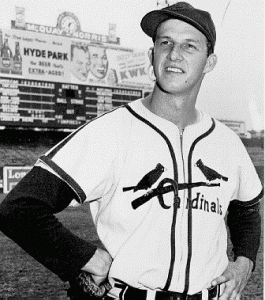
One of the people killed was Lukasz Musial, age 58. His son, Stan Musial of the St. Louis Cardinals, has just put together one of the greatest offensive seasons in baseball history, batting .376, hitting a career-high 39 home runs, with 131 RBIs, and an OPS+ of 200 -- meaning that he was 100 percent better at producing runs than the average hitter was that season. He was awarded his 3rd National League Most Valuable Player award.
In Donora, Stan had a black friend, George Kenneth Griffey, a.k.a. Buddy Griffey, whose son Ken would become a major league star. Ken's son, Ken Griffey Jr., became, like Stan, a Hall-of-Famer whose birthday was November 21. And Junior's son, George Kenneth Griffey III, a.k.a. Trey Griffey, was a wide receiver for the University of Arizona, although he never played in the NFL.
Although Stan never lived in Donora after making it to the major leagues, he frequently visited, supported local charities, and gave free meals at his St. Louis restaurant to anyone with a valid Pennsylvania ID proving they were from Donora.
*
October 27, 1948 was a Wednesday. Telma Hopkins was born. She and Joyce Vincent Wilson formed singer Tony Orlando's backing duo, Dawn. Telma went on to become one of the stars of the ABC sitcom Family Matters.
Baseball season had ended 16 days earlier, with the Cleveland Indians beating the Boston Braves in the World Series. Football was in midweek. Basketball season started 5 days later.
There were 2 games played in the NHL. The New York Rangers lost to the Detroit Red Wings, 3-2 at the old Madison Square Garden. And the Toronto Maple Leafs beat the Montreal Canadiens, 3-2 at Maple Leaf Gardens in Toronto. The Boston Bruins and the Chicago Black Hawks were not scheduled.

Saturday, October 15, 2022

October 15, 1946: Enos Slaughter's Mad Dash

October 15, 1946: The World Series goes to a deciding Game 7 at Sportsman's Park in St. Louis. Fans of the Boston Red Sox are confident: After all, no Boston team has ever lost a World Series. The Braves won one in 1914; the Red Sox won them in 1903, 1912, 1915, 1916 and 1918. Fans of the St. Louis Cardinals are also confident: They have Game 7 at home.

In the top of the 8th inning, Sox center fielder Dom DiMaggio, brother of Joe, ties the game 3-3 with a 2-run double, but pulls his hamstring on the play, and has to be replaced by Leon Culberson. In the bottom of the 8th, Enos Slaughter is on 1st for the Cards, and Harry Walker is up.

Slaughter takes off for 2nd on the hit-and-run. "Harry the Hat" drives the ball to center. Slaughter sees Culberson bobble the ball, and thinks he can score. He does.

It became known as "the Mad Dash" or "Slaughter's Sprint," and in the telling of the legend, Slaughter is usually said to have scored from 1st on a single. Not really: Walker did make it to 2nd and was credited with a double. But it is the go-ahead run, and the Cardinals win, 4-3.

For the Cardinals, led by Slaughter and the sensational Stan Musial, it is their 6th World Championship, their 3rd in 4 tries in the last 5 seasons. For the Red Sox, it is not only their 1st-ever World Series defeat, after not getting that far for 28 years, and the 1st-ever World Series loss for any Boston team, but it is the beginning of a stretch of 4 seasons in which they will end up bitterly disappointed 3 times.

Billed as the duel between the 2 best hitters in baseball‚ the Series sees Musial go 6-for-27 (.222) and Boston's Ted Williams 5-for-25 (.200 -- combined, the Splendid Splinter and Stan the Man batted .212). This will be the only Series of Williams' career, and the only one the Red Sox will play in a 49-year stretch from 1918 to 1967.

The Cardinals, at first, will fare little better, as they won’t play in another Series for 18 years. Musial, who spent the '45 season in the Navy, and that was the only season from '42 to '46 when the Cards didn't win at least the Pennant, had won a Pennant in each of his 1st 4 full seasons, he will play another 17 seasons without winning one, despite close calls in '47, '48 and '49 and 2nd-place finishes in '56 and his final season of '63.

Harry Brecheen wins 3 games for the Cardinals‚ the 1st lefthander ever to accomplish this. It is a feat that has been matched only by Mickey Lolich in 1968 and Randy Johnson in 2001. Brecheen won Games 6 and 7‚ a feat matched only by the Big Unit.

In the telling of the legend of the Mad Dash, Culberson threw the ball to the cutoff man, shortstop Johnny Pesky, who "hesitated" or "held the ball," and threw home too late. In 1986, in an interview on the 40th Anniversary -- and right before Bill Buckner committed an even more shocking World Series defensive miscue for the Sox -- Pesky said, "Even now, people look at me like I'm a piece of shit."
When the Sox finally won the Series again in 2004, all the old goats and ghosts began to be forgiven, and Pesky, a longtime player, coach, broadcaster and scout with the team, became known as "Mr. Red Sox." He would receive standing ovations at Fenway Park, the last on the ballpark's Centennial in 2012, as he died 4 months later, at the age of 93.

The truth is, he never should have been blamed in the first place. DiMaggio's injury meant that it wasn't him playing center field to handle Walker's drive. Culberson was, and he not only bobbled the ball, but his throw to Pesky was a bit off. If Pesky had hesitated, that may have been the reason.

Culberson was a decent player, playing 6 seasons in the major leagues, and batting .266. He hit for the cycle in a game in his rookie season, 1943. Unfortunately, this is all he's remembered for -- if that. (After all, Pesky is the one who tends to get the blame, or else this sequence wouldn't be necessary.)

You can also blame the Boston bats. The Sox scored a grand total of 20 runs in the 7 games. They got shut out on 4 hits in Game 2. As I said, Ted Williams, the so-called "greatest hitter that ever lived," went 5-for-25 (.200) in his only postseason appearance. Roy Partee went 1-for-10 (.100). Tom McBride went 2-for-12 (.167). Pinky Higgins went 5-for-24 (.208). Culberson went 2-for-9 (.222). If you're looking to blame Pesky for something, look not at his fielding, but at his batting: 7-for-30 (.233). If any one of those guys had had a good Series at the plate, the result might have been different.

Also, Slaughter would have scored anyway. I've seen the film of the play many times. Culberson gets the ball to Pesky, and I simply cannot see that with which Pesky has been accused for the last 76 years: "Hesitating" or "holding the ball." And I don't think it would have mattered, as Slaughter scored by plenty.

Besides, the Cardinals were better. Certainly, they were more experienced. This was their 4th World Series in the last 5 years. They'd won in 1942, lost in 1943, and won in 1944. They'd just missed Pennants in 1941 and 1945. It could have been 6 straight Pennants with a few breaks.

In contrast, most of the Red Sox had never been in a Series before. And most of them would never get into another. The Sox fell off in 1947, lost a 1-game Playoff for the Pennant to the Cleveland Indians in 1948, went into the last 2 games of the 1949 season needing to win just 1 against the Yankees and lost them both, and hung close for most of 1950 and 1951 but didn't win either time.

Johnny Pesky was a .307 lifetime hitter, a good shortstop, and a good guy. The Red Sox rightfully retired his Number 6, and elected him to their team Hall of Fame. If he were ever to be elected to the Baseball Hall of Fame, in Cooperstown, New York, I wouldn't mind at all.

He deserves better than to be remembered for a mistake, especially when it's not completely clear that he made a mistake -- and when, if he made a mistake, it was hardly all his fault, and not at all the biggest reason his team lost that World Series.

UPDATE: The Red Sox have a team Hall of Fame. From their 1946 American League Pennant, they have inducted team owner Tom Yawkey, general manager Eddie Collins, manager Joe Cronin, scout George Digby, 2nd baseman Bobby Doerr, shortstop Johnny Pesky, left fielder Ted Williams, center fielder Dom DiMaggio, and pitchers Tex Hughson, Joe Dobson and Dave "Boo" Ferriss.

The Cardinals also have a team Hall of Fame. From their 1942, 1944 and 1946 World Champions, and their 1943 Pennant winners, they have inducted team owner Sam Breadon, general manager Branch Rickey (who left after 1942 to become president of the Brooklyn Dodgers), manager Billy Southworth, scout George Kissell, left fielder Stan Musial, center fielder Terry Moore, right fielder Enos Slaughter, 2nd baseman Albert "Red" Schoendienst, shortstop Marty Marion, 3rd baseman George "Whitey" Kurowski; and pitchers Mort Cooper, Max Lanier and Harry Brecheen. Eddie Dyer succeeded Southworth, and managed them to the 1946 title, but has not yet been inducted.

Kissell, Musial, Marion and Schoendienst were elected to the St. Louis Sports Hall of Fame. Rickey, Kissell, Musial, Slaughter, Marion, Moore, Schoendienst, catcher Joe Garagiola and team scorekeeper Lou Adamie were elected to the Missouri Sports Hall of Fame.

*

October 15, 1946 was a Tuesday. The baseball season was now over. No pro football games were played. The NBA was just founded, and wouldn't play its 1st regular-season game -- ever -- until November 1. And the NHL season began the next day. So there were no other scores on this historic day.

Singer-musician Richard Carpenter, who had a musical act with his sister Karen, was born on this day.

Sunday, October 9, 2022

October 9, 1944: The Trolley Series

The 1944 World Series game program. "Worlds" is incorrect.
The Browns' logo featured the statue of the city's namesake,
the "Crusader King" Louis IX of France.

October 9, 1944: The only all-St. Louis World Series comes to an end. While the World Series that have been played between the New York Yankees and either the New York Giants or the Brooklyn Dodgers have been labled "Subway Series," this one, because of St. Louis' streetcars, is known as "The Trolley Series."

(The musical film Meet Me in St. Louis, with its "Trolley Song," did not premiere until November 22, 6 weeks later, so that had no effect on the coverage of the Series.)

The St. Louis Browns had been, along with the Washington Senators, symbolic of futility in the American League. The Senators, to go along with George Washington, for whom their city was named, were said to be "First in war, first in peace, and last in the American League." With St. Louis being a major city for shoemaking and brewing, observers of the Browns countered that St. Louis was "First in shoes, first in booze, and last in the American League."

In 1902, their 1st season, the Browns finished 2nd to the Philadelphia Athletics, 5 games out of 1st place. In 1908, they were 4th, 6 1/2 behind the Detroit Tigers. In 1922, they were 2nd, just 1 game behind the New York Yankees. Indeed, up until 1926, they were usually the better team in town. What's more, they owned Sportsman's Park, built in 1909, the latest in a series of ball grounds on the same site that had stood since 1866; while, after leaving tiny Robison Field in 1920, the Cardinals were not only their tenants, but the much weaker team.

But in 1926, with Branch Rickey as their general manager and Rogers Hornsby as both their manager and their big hitting star, the Cardinals won their 1st Pennant in 40 years, and beat the Yankees in the World Series. Rickey and Hornsby had a falling-out, but Rickey rebuilt, and the Cards won Pennants in 1928, 1930, 1931 and 1934, taking the World Series in 1931 and 1934.

Rickey had just rebuilt the Cardinals again when he was hired to run the Dodgers. The team he left behind would win National League Pennants in 1942, 1943, 1944 and 1946. They beat the Yankees in the 1942 World Series, before losing to them in the 1943 edition.

Meanwhile, the Browns fell apart -- mainly because they had fired Rickey in 1916, allowing him to be signed by the Cardinals. After 1922, they didn't get closer than 15 games of 1st place again until 1944, including losing 108 games in 1937 and 111 in 1939. They weren't just bad, they were boring, compared to the hard-hitting, hard-running, hard-pitching and hard-drinking Cardinals, known as "the Gashouse Gang." And still, the Cards paid monthly rent to the Browns, which, at times, especially during the Great Depression of the 1930s, seemed to be the only thing keeping the Browns afloat.

After the 1941 season, the Browns' owners wanted to move the team to Los Angeles, so they would no longer have to compete with the Cardinals for St. Louis fans' attention. A meeting of American League owners was set to discuss how this could be done, given that there was no team west of St. Louis, and coast-to-coast travel was still iffy, given the length of train rides and the condition of airplanes. The meeting was scheduled for December 8. The day before, Pearl Harbor was bombed, America was in World War II, and the meeting was never held. The Browns stayed in St. Louis -- for now.

But The War's manpower drain meant that every team lost good players, though some lost more than others. The Browns went 89-65 in 1944, and that was enough to finish 1 game ahead of the Detroit Tigers and 6 ahead of the Yankees. They finally had their 1st Pennant. And they would play the Cardinals. With the exception of 2020, when COVID restrictions meant that all games were played at Globe Life Field in the Dallas suburb of Arlington, Texas, the 1944 edition remains the last World Series where all games were played at a single venue, Sportsman's Park.
Cardinal pitcher Mort Cooper had been one of the heroes of the 1942 World Series. Denny Galehouse has gone down in history for his poor performance for the Boston Red Sox in the 1948 AL Playoff against the Cleveland Indians. But in Game 1 of the 1944 World Series, Galehouse outpitched Cooper, and was supported by a home run from 1st baseman George McQuinn. The Browns won, 2-1. 

The Cards struck back in Game 2, with Ken O'Dea's pinch-hit single winning it in the 11th. Game 3, on October 6, 1944, marked the all-time peak of the history of the St. Louis Browns. Jack Kramer -- no relation to the man of the same name who was then America's best tennis player -- struck out 10 batters, and the Browns won, 6-2. They now led the Series, 2 games to 1.
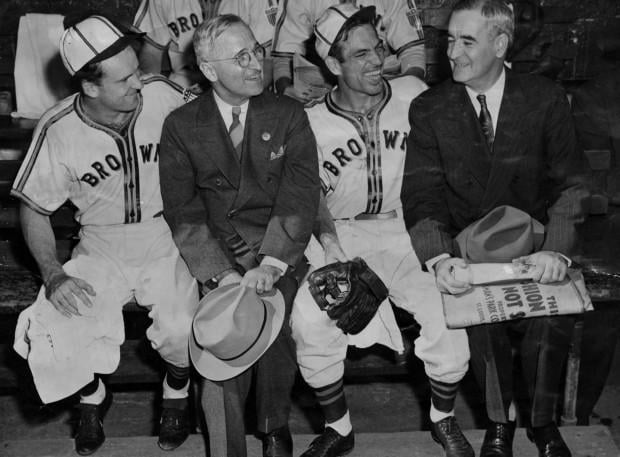
Left to right: George McQuinn, U.S. Senator Harry S Truman of Missouri,
Don Gutteridge, and State Senator Phil Donnelly, before Game 3.
A month later, Truman was elected Vice President of the United States,
and Donnelly was elected Governor. Shortly before the next Opening Day,
President Franklin D. Roosevelt died, and Truman became President.

But the Cardinals had Stan Musial. Not yet known as "Stan the Man," he had been in the majors 3 full seasons, and the Cards had won the Pennant all 3 times. He hit a home run of Sigmund "Sig" Jakucki, to help pitcher Harry "the Cat" Brecheen. The Cards won, 5-1, and they never looked back: They took Game 5, 2-0, with Cooper getting revenge on Galehouse; and Game 6, 3-1, with Emil Verban driving in all 3 runs, Max Lanier as the starting and the winning pitcher, and Ted Wilks retiring all 11 Browns he faced in relief.
Stan the young man

In the International League, the Baltimore Orioles saw their home, Oriole Park, burn down on the 4th of July. They had to move to Municipal Stadium, a football stadium a few blocks away. Somehow, they recovered and won the IL Pennant. At the exact same time that the Cards were dusting off the Browns, in front of a full house of 31,630, a crowd of 52,833, then a record for a minor league game, saw the Orioles fall to the Louisville Colonels, 5-4 in Game 4 of the "Junior World Series." But the Orioles would win that series in 6 games.

This team, and how well it drew, raised Baltimore's profile, and made its return to the majors for the first time since 1902 (unless you count the Federal League of 1914 and '15) possible.

In 1945, the Browns came close to following up, but finished 3rd, 6 games behind the Tigers. The Cardinals didn't win the Pennant, either, as their 2 best players, Musial and Enos Slaughter, were in the service, in the final year of The War. In 1946, everybody was back, and the Cards won another Series. In terms of Pennants, Musial was now 4-for-4. Nobody knew it yet, but he would play another 17 seasons, putting together a record that makes him perhaps the best lefthanded hitter in NL history, but would never win another Pennant.

At least the Cardinals were occasionally in contention in those years. The Browns went back to their losing ways. Even Bill Veeck, who owned the Cleveland Indians and won the 1948 World Series, could not buy the Browns and make them contend, or, despite all kinds of promotions and stunts, get big crowds out to the North Side of St. Louis.

In 1953, Gussie Busch, owner of Anheuser-Busch Breweries and maker of Budweiser beer, bought the Cardinals. With billions in beer bucks behind Busch, Veeck knew that the game was up: St. Louis and its metropolitan area were only big enough for 1 Major League Baseball team, and he didn't have the money to compete.

He sold Sportsman's Park to Busch, who renamed it Busch Stadium. Ironically, Veeck sold the Browns to another brewing tycoon, Jerrold Hoffberger of Baltimore, another city with a beermaking tradition. In 1954, the team took the field as the Baltimore Orioles. It took them until 1966 to win another Pennant, and to become the last of the classic 8 AL franchises to win a World Series.

The 1944 season would remain the only time the Cardinals and the Browns/Orioles franchise both made the postseason until 1996, when each team lost its respective League Championship Series. They both made it again in 2012 and 2014. But, despite winning 17 Pennants between them since 1944, they have never faced each other in another World Series.

The last survivor of the 1944 Cardinals was Musial, living until 2013. The last survivor of the only Browns Pennant winner was Don Gutteridge, who lived until 2008.

*

October 9, 1944 was a Monday. Football was in midweek. Hockey was out of season. And the NBA hadn't been founded yet. So there were no other scores on this historic day.

Three rock and roll legends were born on this day: John Entwistle, the bass guitarist for The Who; Nona Hendryx, who sang with Patti LaBelle's group Labelle; and reggae singer Peter Tosh.

Friday, September 30, 2022

September 30, 1946: The Feller-Paige Tour

September 30, 1946: One of baseball's biggest postseason "barnstorming tours" begins. It is the end of one era, and the start of another.

Before World War II, Bob Feller of the Cleveland Indians was the best pitcher in baseball -- in the all-white major leagues, anyway. Leroy "Satchel" Paige was the best pitcher in the all-black Negro Leagues.

Feller missed most of 4 seasons in the war, and came back strong. At the age of 28, was as good as any pitcher ever: In the 1946 season, he went 26-15, had a 2.18 ERA, pitched a no-hitter against the New York Yankees -- the 2nd of 3 he would go on to pitch -- and struck out 348 batters.

For a while, that was believed to be a major league record, as Rube Waddell was believed to have topped out at 343 in 1904. A later check of the records revealed that Waddell had actually struck out 349, but that wasn't found out until after Sandy Koufax with 382 in 1965, and then Nolan Ryan with 383 in 1973, had surpassed Feller's total. So when Koufax broke the record, everyone thought it was Feller's.

Also happening in that 1946 season was the debut of Jackie Robinson with the Montreal Royals, the top farm team of the Brooklyn Dodgers. Feller had gone on record as saying that, if Robinson were white, he "would not be big-league material." He spent the rest of his life trying to make up for that misjudgment. As it turned out, in 1962, he and Robinson were elected to the Baseball Hall of Fame together.

But he had already had an idea, before his discharge from the U.S. Navy, of having a tour of two opposing teams, one white, one black. In an interview with William Marshall, for his book, Baseball's Pivotal Era, 1945-1951, he said, “I knew what I was going to do, and I knew the people personally that I was going to have get the black clubs together: The Kansas City operator, Mr. Wilkinson, and Satchel Paige, and many others that I wanted to oppose us.”

It was in mid-July of Feller’s stellar comeback campaign that he announced plans for a coast-to-coast exhibition tour featuring an all-star squad made up of players from both the American and National leagues and a team of the nation’s finest Negro League players.

He obtained from Commissioner Albert B. "Happy" Chandler's permission to carry the tour beyond the 10-day barnstorming limit. And he contacted J.L. Wilkinson, owner of the Kansas City Monarchs, correctly thinking him the man to be the go-between with the other Negro League owners, who would let their players go on this tour.

The 27-game tour began on September 30, at Forbes Field in Pittsburgh, with the itinerary including stops in such outposts as Cleveland, Chicago, Cincinnati, Baltimore, Newark, New York, Columbus, Dayton, Louisville, Davenport, Des Moines, St. Paul. Omaha, Wichita, St. Louis, Kansas city, Denver, Los Angeles, San Diego, Vancouver, San Francisco, Seattle, Portland and Tacoma. It ran concurrent with the World Series, which ran from October 6 to 15, and the St. Louis Cardinals beat the Boston Red Sox in 7 games.

No Red Sox, including Ted Williams winning what turned out to be his only Pennant despite retiring 14 years later, and no Cardinals, including Stan Musial, winning what turned out to be the last of his 4 Pennants despite retiring 17 years later, were available -- at least at first.

Musial joined in mid-tour. Williams did not: According to Feller's memoir, Red Sox owner Tom Yawkey offered him $10,000 not to go, and Detroit Tigers owner Walter "Spike" Briggs offered his star, Hank Greenberg, a similar amount. Part of the issue was that Feller had rented planes, and the players would be flying, and the team owners didn't want their players dying in plane crashes. Feller, himself a licensed pilot understood the danger, and heavily insured the tour.

Because the Yankees did not win the Pennant, it made their players available, and left fielder Charlie Keller, shortstop Phil Rizzuto and pitcher Spurgeon "Spud" Chandler joined Bob Feller's All-Stars. So did Feller's Indian teammates, pitcher Mel Harder and Bob Lemon; Boston Braves pitcher Johnny Sain; and Washington Senators 1st baseman Mickey Vernon.

In his memoir, Buck O'Neil wrote. "I was excited to be chosen for the Satchel Paige All-Stars, along with guys like Hilton Smith, Gene Benson and Quincy Trouppe, because I knew I'd be making more money in one month than I had made in the last six. And I was excited to able to play against guys like Mickey Vernon, Phil Rizzuto, Johnny Sain and Stan Musial right after the big-league World Series.

"I also felt that, even though it was black against white, this tour was an event that could have a real effect on big-league integration, because it took place after Jackie had proven himself, and if a lot of us weren't that lucky, we could at least prove ourselves against big-leaguers in these games."

In addition to the preceding, Satchel Paige's All-Star included Negro League stars Max Manning, Barney Brown, Hank Thompson, Art Wilson and Howard Easterling.

The itinerary:

* September 30, Forbes Field, Pittsburgh: Paige 3, Feller 1.
* October 1, Idora Park, Youngstown, Ohio: Feller 11, Paige 2.
* Later on October 1, Cleveland Municipal Stadium: Feller 5, Paige 2.
* October 2, Comiskey Park, Chicago: Feller 6, Paige 5.
* October 3, Crosley Field, Cincinnati: Feller 3, Paige 0.
* October 4, Yankee Stadium, New York: Feller 4, Paige 2.
* October 5, Ruppert Stadium, Newark, New Jersey: Feller 13, Paige 10.
* October 6, Yankee Stadium: Paige 4, Feller 0.
* Later on October 6, Bugle Field, Baltimore: Paige 7, Feller 4.
* October 7, Red Bird Stadium (later renamed Cooper Stadium), Columbus, Ohio: Paige 4, Feller 3.
* October 8, Hudson Field, Dayton, Ohio: Feller 7, Paige 6.
* October 9, a day off.
* October 10, Municipal Stadium, Richmond, Indiana: Feller 7, Paige 5.
* October 12, American Legion Park, Council Bluffs, Iowa: Feller 3, Paige 2.
* Later on October 12, Lawrence Field, Wichita, Kansas: Feller 5, Paige 3.
* October 13, Kansas City Municipal Stadium: Paige 3, Feller 2.
* October 14, K.C. Municipal Stadium: Feller 4, Paige 1.
* October 15, a day off.
* October 16, Wrigley Field, Los Angeles: Feller 4, Paige 3.
* October 17, Lane Field, San Diego: Feller 2, Paige 0.
* October 18 to 22: Time off.
* October 23, Sam Lynn Park, Bakersfield, California: Feller 12, Paige 4.

Overall record: Feller 14, Paige 5. So while the argument that the best black players could play in the white major leagues held up, the argument that the Negro Leagues were the equal of the white majors does not.

Two years later, Indians owner Bill Veeck signed Paige, despite his age being apparently 42. He helped Feller and the Indians win the World Series.

In 1990, the Yankees visited Cleveland for their Old-Timers Day, and their old-timers' game was held between games of a doubleheader. Rizzuto, by this point, was the Yankees aging, quirky broadcaster, and had former Met ace Tom Seaver in the booth with him. He asked Feller to interview, and Rizzuto brought up the tour. As patriotic as Feller was, he was also honest, telling the WPIX-Channel 11 audience, "We did the tour for one reason: To make money. I'm not going to kid you about that. We lost a lot of money during the war."

And when former Commissioner Francis T. "Fay" Vincent wrote a book, he interviewed Feller for it. He wouldn't change his story: "We were interested in one thing, making money. I mean, what else is there? Yes we put on a good show. There was racial rivalry, not amongst the players, but amongst the fans. And we got a few laughs. They're great friends of mine. They love me dearly. I love them dearly. I know all the guys. We made more money in that month of October than we made all year round."

By the time the tour concluded, approximately a quarter of a million fans had witnessed this unprecedented tour.

*

September 30, 1946 was a Monday. Baseball's regular season was almost over, and no games were played on this day. Nor in football: Monday Night Football was still 24 years away. And basketball and hockey were out of season. So there were no scores on this historic day.

Monday, August 1, 2022

August 1, 1972: Nate Colbert's 5-Homer Day

August 1, 1972: The San Diego Padres sweep a doubleheader from the Atlanta Braves at Atlanta Stadium. (It was renamed Atlanta-Fulton County Stadium in 1975.) They win the opener, 9-0. Clay Kirby pitches a 7-hit shutout. They win the nightcap, 11-7. Over the 2 games, the Braves' Hank Aaron went 1-for-7.

But the real story is Padres 1st baseman Nate Colbert. In the 1st game, he went 4-for-5 with 2 home runs and 5 RBIs. In the 2nd game, he went 3-for-4 with 3 home runs and 8 RBIs. Total: 7 of 9 (for the Braves, resistance was futile), 5 home runs and 13 RBIs. Some players would call that a month. Aaron Judge might call it a week. On this day, Colbert could have called it an honest a day's work.

In the 1st game, the Padres also got a home run from Cito Gaston, who would later manage the Toronto Blue Jays to back-to-back World Series wins. In the 2nd game, the Braves got a home run from Darrell Evans.

Here's the kicker: Five home runs in a doubleheader had been done only once before, and Colbert was there to see it: On May 2, 1954, Colbert, then an 8-year-old boy, was at Sportsman's Park in St. Louis as Stan Musial did it. Musial had 11 RBIs that day, so Colbert topped it by 2.

Colbert would not, however, join Musial in the Baseball Hall of Fame. By 1974, a back injury had cost him his hitting stroke, and he played his last major league game in 1976, only 30, finishing with 173 career home runs. He became an ordained minister, working with at-risk youth, and has been elected to the Padres' team Hall of Fame. He is still alive at age 76. (UPDATE: He died on January 5, 2023.)

*

August 1, 1972 was a Tuesday. These other games were played in Major League Baseball that day:

* The New York Yankees beat the Boston Red Sox, 10-4 at Fenway Park in Boston. Bobby Murcer went 3-for-5 with a home run and 4 RBIs, while Johnny Callison went 3-for-5 with 2 RBIs, in support of Mel Stottlemyre. Carl Yastrzemski went 0-for-4.

* A doubleheader was split at Shea Stadium -- and it had enough innings for 3 games. In the opener, The New York Mets beat the Philadelphia Phillies, 3-2. Cleon Jones singled Tommie Agee home with the winning run in the 18th inning. Jones had homered earlier in the game. Ray Sadecki was the winning pitcher.

The Phillies won the nightcap, 4-1. Steve Carlton was the Phils' starter, meaning, "It's Win Day." He outpitched Jerry Koosman. Jones had 4 hits over the 27 innings. Willie Mays struck out as a pinch-hitter in the 1st game, and went 1-for-4 in the 2nd.

* The Montreal Expos beat the Chicago Cubs, 3-2 at Jarry Park in Montreal. Tim Foli hit a sacrifice fly to drive in the winning run in the 10th.

* The Cleveland Indians beat the Baltimore Orioles, 2-0 at Cleveland Municipal Stadium. Gaylord Perry pitched a 2-hit shutout. Brooks Robinson went 0-for-2.

* The Milwaukee Brewers were leading the Detroit Tigers, 9-0 at Tiger Stadium in Detroit, when the game was called due to rain at the 7th inning stretch. Harmon Killebrew went 1-for-4. Rod Carew did not play. Al Kaline did not play.

* The St. Louis Cardinals beat the Pittsburgh Pirates, 7-4 at Busch Memorial Stadium in St. Louis. Lou Brock went 1-for-5 with a stolen bases, and Joe Torre went 1-for-4 with an RBI. Willie Stargell went 1-for-3 with a walk, and Roberto Clemente did not play.

* The Minnesota Twins beat the Texas Rangers, 3-0 at Arlington Stadium in the Dallas suburb of Arlington, Texas. Dick Woodson pitched a 3-hit shutout.

* The Cincinnati Reds beat the Houston Astros, 3-1 at the Astrodome in Houston. Joe Morgan hit a 2-run home run. Pete Rose went 1-for-2 with 2 walks. Johnny Bench went 1-for-4 with an RBI.

* The San Francisco Giants beat the Los Angeles Dodgers, 4-3 at Dodger Stadium in Los Angeles. Frank Robinson, in his only season with the Dodgers, went 1-for-4 in this game.

* And the Oakland Athletics beat the Kansas City Royals, 4-0 at the Oakland Coliseum. Reggie Jackson went 2-for-3 with a home run, a walk and 2 RBIs.

Thursday, July 14, 2022

July 14, 1942: "The Pride of the Yankees" Premieres

July 14, 1942: The Pride of the Yankees premieres at the Astor Theatre, at 1537 Broadway in Manhattan. It was distributed by RKO Radio Pictures, and directed by Sam Wood, previously known for directing the Marx Brothers films A Night at the Opera and A Day at the Races.

It stars Gary Cooper as New York Yankees star Lou Gehrig, who had died a year earlier, and Teresa Wright as his wife Eleanor, who lived on until 1984.

At this point, Cooper was best known for Sergeant York, about Alvin C. York, the Tennessee farmer and pacifist, turned World War I Congressional Medal of Honor winner. "Coop" was considered an All-American hero himself.

But the worst-kept secret in Hollywood was that he slept with all his female leads -- not including Wright. But they did include Clara Bow, Lupe Vélez, Marlene Dietrich, Carole Lombard, Ingrid Bergman, Patricia Neal and Grace Kelly. (Granted, some of these women also got around, especially Bow, Dietrich and Kelly.) In contrast, if the real Gehrig ever slept with any woman other than Eleanor, I would be surprised.

But there was a problem other than Cooper's extramarital activities: He had never played baseball before. And he just couldn't swing a bat lefthanded, as Gehrig did. So they made a reverse Yankee uniform, had him run to 3rd base, and flipped the film.

File footage of the original Yankee Stadium was used, and the film has some of the best footage available of the 8 American League ballparks then in use. But, due to proximity to the Hollywood studios, the actual baseball scenes were filmed at Wrigley Field, home of the Pacific Coast League's Los Angeles Angels, then a Chicago Cubs farm team, and thus built to look like Wrigley Field in Chicago.

Walter Brennan had also been in Sergeant York. Through his role in Western films, the 1960s Western TV series The Real McCoys, and the spoken-word records he made like "Old Rivers," he is remembered as a grizzled old ranch hand. In this film, much younger, and dressed in what were then present-day clothes, he was almost unrecognizable as he played fictional sportswriter Sam Blake.

Four Yankee greats play themselves: Babe Ruth, Bob Meusel, Mark Koenig and Bill Dickey (still active at the time, and the closest thing the Yankees had to a Captain after Gehrig's retirement). The scene where Dickey punches out a teammate who questions the dedication of an impaired Gehrig was a dramatization, but he would have done it: Gehrig was his best friend on the team.

Gehrig's farewell address on July 4, 1939 is depicted, although the key line, about being "the luckiest man on the face of the Earth," is spoken at the end, instead of the beginning as it actually happened. The film ends with Cooper walking down the tunnel to the locker room -- the baseball equivalent of a Western hero walking off into the sunset.

It is regarded as the best baseball-themed movie yet made, and would remain so into the 1980s. But it really isn't a "baseball movie." It's an old-fashioned romance, the story of Lou and Eleanor, and Lou just happens to be a baseball player.

In 1977, Eleanor's memoir was turned into an ABC TV-movie A Love Affair: The Eleanor and Lou Gehrig Story. Blythe Danner (Gwyneth Paltrow's mother) played Eleanor, Edward Herrmann played Lou, and, in a weird twist, Gehrig's domineering German immigrant mother was played by one of Cooper's exes, Patricia Neal. Unlike The Pride of the Yankees, this film showed the final effects of amyotrophic lateral sclerosis (ALS), the disease that claimed Lou's life and has since borne his name.

The Astor Theatre was on Broadway between 45th and 46th Streets, facing Times Square. It was torn down in 1982, and the Marriott Marquis Hotel was built on the site. I stood across from it as I watched the Yankees' 2009 World Series win on the big board in Times Square.

*

July 14, 1942 was a Tuesday. These baseball games were played that day:

* The New York Yankees beat the Detroit Tigers, 3-0 at Yankee Stadium. Hank Borowy pitched a 2-hit shutout. Tommy Henrich, soon to be drafted, hits a home run. Joe DiMaggio went 2-for-3 with a walk, and would also be in World War II before the next Opening Day.

* The New York Giants lost to the Chicago Cubs, 3-0 at Wrigley Field in Chicago. Vern Olssen allowed 11 hits, but kept the shutout, and helped his own cause with a sacrifice fly. Mel Ott went 0-for-4.

* The Brooklyn Dodgers beat the Pittsburgh Pirates, 4-1 at Forbes Field in Pittsburgh. Whitlow Wyatt went the distance for the win, and Pete Reiser got 3 hits.

* The St. Louis Browns beat the Boston Red Sox, 3-2 at Fenway Park in Boston. Ted Williams went 0-for-4, but still went on to win the Triple Crown that season -- and go into The War the next.

* The Philadelphia Phillies beat the Cincinnati Reds, 2-1 at Crosley Field in Cincinnati.

* The St. Louis Cardinals beat the Boston Braves, 7-5 at Sportsman's Park in St. Louis. A rookie named Stan Musial won the game with a home run in the bottom of the 11th inning.

* The Chicago White Sox were supposed to play the Philadelphia Athletics at Shibe Park in Philadelphia, but got rained out. On August 31, an off day for both teams, 2 games that had been rained out were played. The ChiSox swept, 3-1 and 5-0. Edgar Smith allowed 9 hits in the nightcap, but still pitched a shutout.

* And, in a notation for which Baseball-Reference.com (without which I could not possibly write this feature to my satisfaction) provides no explanation, a game scheduled for this day, between the Washington Senators and the Cleveland Indians for Griffith Stadium in Washington, was moved back to the preceding Sunday, July 12, as part of a doubleheader. The Indians swept, 9-7 and 5-0. Jeff Heath won the 1st game with a triple in the top of the 10th inning. Jim Bagby Jr. allowed 8 hits in the 2nd game, but kept the shutout.

Tuesday, July 12, 2022

July 12, 1955: Stan Is The Man

July 11, 1955: Major League Baseball hosts its All-Star Game at Milwaukee County Stadium. With the move of the Boston Braves to Milwaukee 2 seasons earlier, it's the 1st time the game has been held in a new city since Pittsburgh, 11 years earlier.

Robin Roberts of the Philadelphia Phillies was the starting pitcher for the National League. A winner of 286 games in his Hall of Fame career, he had nothing on this night, allowing 4 runs in the 1st inning, including a home run to Mickey Mantle of the New York Yankees.

The American League's starter was Billy Pierce of the Chicago White Sox, and he pitched 3 scoreless innings. The AL scored again in the 6th, to make it 5-0. According to Baseball-Reference.com, when the bottom of the 7th inning began, the NL had less than a 1 percent chance of winning the game.

Whitey Ford of the Yankees was on the mound. Willie Mays of the New York Giants led off with a single. Ford got Ted Kluszewski of the Cincinnati Reds and Randy Jackson of the Chicago Cubs out. But Hank Aaron of the host Braves drew a walk, and his teammate, Johnny Logan, singled Mays home. Stan Lopata of the Phillies reached on an error by shortstop Chico Carrasquel of the White Sox, allowing Aaron to score. The NL was within 5-2.

In the 8th, Ford gave up singles to Mays, Kluszewski and Jackson to close the game to 5-3, and was removed for Frank Sullivan of the Boston Red Sox. That season, Sullivan would lead the AL with 18 wins. But on this day, he could only get Aaron to ground to 3rd, and Al Rosen of the Cleveland Indians threw it away, allowing Kluszewski and Jackson to score. Tie game.

Each team wasted 2 baserunners in the 9th, and the game went to extra innings. It was not the 1st All-Star Game to do so: The 1950 edition, at Comiskey Park in Chicago, went 14 innings. Joe Nuxhall of the Cincinnati Reds began the top of the 10th by walking Al Kaline of the Detroit Tigers, but then struck out the side. Aaron singled in the bottom of the 10th, but was stranded.

In the 11th, the AL got a walk from Bobby Ávila of the Indians and a single from Mantle, but couldn't score. The NL got no baserunners in their half. Gene Conley of the host Braves struck out the side in the top of the 12th: Kaline, Mickey Vernon of the Washington Senators, and Rosen. Conley would become the only man ever to win a World Series and an NBA Championship: 1957, with the Braves; and 1959, with the Boston Celtics.

Leading off the bottom of the 12th was Stan Musial of the St. Louis Cardinals. The leading National League hitter of his generation, he became known as Stan the Man for hitting especially well against the Brooklyn Dodgers, whose fans would say, "That man is back in town."

Sullivan was still pitching for the AL. Musial stroked his delivery into the right-center field bleachers. The NL had come back from 5-0 down to win, 6-5.

It was the 1st time the All-Star Game had ended on a home run. It has only happened once since: In 1964, with Johnny Callison of the National League's Phillies, at Shea Stadium in New York.

Musial finished the 1955 season with a .319 batting average, 33 home runs and 108 RBIs. But the Cardinals only finished 68-86, in 7th place, 30 1/2 games behind the Pennant-winning Dodgers. While the Cards had won the Pennant in each of Musial's 1st 4 seasons -- 1942, '43, '44 and '46, while he spent '45 in the U.S. Navy -- they didn't win another until 1964, the year after Musial retired. They were among the last MLB teams to integrate, and among the last to fully integrate. By 1964, they had, and won 3 of the next 5 NL Pennants.

In 1957, after he won the NL batting title for the 7th time, Sports Illustrated named Musial their Sportsman of the Year.

*

July 12, 1955 was a Tuesday. Since baseball was North America's only Summer sport at the time, there were no other scores on this day.

Monday, July 11, 2022

July 11, 1944: The Few-Stars Game

Bill Nicholson

July 11, 1944: Baseball holds its All-Star Game at Forbes Field in Pittsburgh. With the manpower drain of World War II, the term “All-Star” is a bit of a stretch.

The starting pitcher for the American League was the Yankees’ Hank Borowy, from Bloomfield, New Jersey. He was the only Yankee in the starting lineup: Joe DiMaggio and Joe Gordon were in the Army (DiMaggio in the Army Air Force), Bill Dickey and Phil Rizzuto were in the Navy, Charlie Keller was in the Merchant Marine, and Tommy Henrich was in the Coast Guard. The only other Yankee in the game was relief pitcher Joe Page.

From the starting lineup, only 2nd baseman Bobby Doerr of the Boston Red Sox would make the Hall of Fame. From the reserves: Shortstop Lou Boudreau of the Cleveland Indians, catcher Rick Ferrell of the Washington Senators, and pitcher Hal Newhouser of the Detroit Tigers.

The National League’s starter was Bucky Walters of the Cincinnati Reds. They also had just 1 of their starters make the Hall of Fame: Center fielder Stan Musial of the St. Louis Cardinals. (And that was not his usual position. The next year, Stan the Man would be in the Navy.) The only Hall-of-Famers from their reserves were both, then, with the New York Giants, and too old to be drafted: Right fielder and manager Mel Ott and left fielder Joe Medwick.

So there were only 6 Hall-of-Famers in this game.

In the top of the 2nd inning, Borowy himself singled home Cleveland 3rd baseman Ken Keltner, to put the AL on the board first. But that was all they would get. The NL scored 4 in the bottom of the 5th, RBIs coming on a double by Chicago Cubs outfielder Bill Nicholson, a single by Brooklyn Dodger outfielder Augie Galan, a single by Cardinal catcher Walker Cooper, and a single by Dodger 1st baseman Dixie Walker.

A 2-RBI double in the 7th by Cardinal 3rd baseman Whitey Kurowski, and a single in the 8th by Musial, put the finishing touches on a 7-1 win for the NL.

The next season, there was no All-Star Game at all: The new Commissioner, Albert "Happy" Chandler, canceled it due to wartime travel restrictions. In 1946, with the war over and the restrictions off, Chandler gave the All-Star Game to the ballpark that was going to get it in 1945: Fenway Park in Boston.

Note until 2012 would there be another All-Star Game with fewer players who are, as of the 2022 elections, in the Baseball Hall of Fame. From that point onward, we're looking at some active players who might work their way into Hall-worthiness.

Note: Bill Nicholson, known as "Swish" because he struck out a lot, was not related to the English soccer player and manager of the same name.

*

July 11, 1944 was a Tuesday, as is usually the case when the All-Star Game is played. There were no other major league sports in season at the time, so this was the only score on this historic day.

Sunday, July 10, 2022

July 10, 1962: The Mets' 1st All-Star: A Phillies Legend

This is not a happy man.
This is a proud man, with much to be proud of,
working in a place where his pride is regularly hurt.

July 10, 1962: From 1958 to 1962, Major League Baseball held 2 All-Star Games every season, 1 in a ballpark of each League. This day was the day of the season's 1st, at the new District of Columbia Stadium in Washington.

President John F. Kennedy attended, and threw out the ceremonial first ball. No one could have foreseen that, within just 6 years, both JFK and his brother, then the Attorney General of the United States, would be assassinated, and that, a year after that, D.C. Stadium would be renamed Robert F. Kennedy Memorial Stadium.

Before the first ball ceremony, JFK spoke to Stan Musial of the St. Louis Cardinals, an ardent Democrat. Musial was 41 years old, 2 years younger than JFK was when he was elected. JFK said, "They said I was too young to be President, and you were too old to play baseball. I guess we both proved them wrong."

Selected for the American League team from the defending World Champion New York Yankees were starting center fielder Mickey Mantle, starting right fielder Roger Maris, catcher Elston Howard, 2nd baseman Bobby Richardson, shortstop Tom Tresh and pitcher Ralph Terry.

Mantle would win his 3rd AL Most Valuable Player award, though he said that Richardson deserved it. Tresh, the eventual AL Rookie of the Year, would be moved to left field when Tony Kubek returned from his military service. Terry went on to win 23 games, not including his shutout in Game 7 of the World Series.

But, at a time when the Cy Young Award was given to the best pitcher in both leagues, it was given to Don Drysdale of the Los Angeles Dodgers, who was the National League's starting pitcher in this game. Jim Bunning of the Detroit Tigers started for the AL.

For the 1st time, the All-Star Game had a Most Valuable Player award. It was given to Maury Wills of the Dodgers, on his way to setting a new major league record with 104 stolen bases in a season. In the 6th inning, he entered the game as a pinch-runner for Musial. Wills stole 2nd base, and was singled home by Dick Groat of the Pittsburgh Pirates. In the 8th inning, Wills singled, was singled to 3rd by Jim Davenport of the San Francisco Giants, and scored on a sacrifice fly by the Giants' Felipe Alou. The NL won, 3-1.

For the NL's expansion New York Mets and Houston Colt .45s, the team that would become the Houston Astros in 1965, this was the 1st All-Star Game. Houston's 1st All-Star was pitcher Richard "Turk" Farrell. The Mets' 1st was center fielder Richie Ashburn. Each had previously been named an All-Star while with the Phillies.

The 2nd 1962 All-Star Game was played on July 30, at Wrigley Field in Chicago, and the AL won, 9-4. Since then, it has been 1 All-Star Game a year for Major League Baseball, except in 2020 when it was canceled due to COVID restrictions.

Don Richard Ashburn -- like Ford, he was nicknamed Whitey due to his very light blond hair, and didn't mind, because, like later Phillies star Dick Allen, he didn't like being called "Richie" -- was born in 1927 in Tilden, Nebraska, and grew up there. He had debuted with the Phillies in 1948, leading the NL in stolen bases. In 1950, he was the sparkplug of the Phils' Pennant-winning team known as the Whiz Kids. He won the NL batting title in 1955 and 1958, and was named to 5 All-Star Teams -- 6 games counting this season's dual entry.
He was traded to the Cubs in 1960, and the Mets purchased him in their 1st off-season, 1961-62. At the age of 35, he was still an exceptional center fielder, and batted .306, just below his career average of .308. But it was a season of misery, as the Mets went 40-120. He said that he knew it was time to retire when he was named the most valuable player of, as he and many others believed the '62 Mets to be, "the worst team in history."

He returned to the Phillies as a broadcaster, and became an even more beloved figure. As his contemporary, Phil Rizzuto, was to the Yankees, he was the beloved player who became a broadcaster, and had to wait too long to be elected to the Baseball Hall of Fame. He was finally elected in 1995, a year after Rizzuto was, and died 2 years later.

The Phillies did not reach the postseason without him being involved as either a player or a broadcaster between 1915 and 2007. They went on to retire his Number 1, and dedicate a statue to him at Citizens Bank Park when it opened in 2004.

*

July 10, 1962 was a Tuesday, as the day of the MLB All-Star Game tends to be. This being the All-Star Break, and with no other sports in progress at the time, this was the only score on the day.

This was also the day that Telstar 1 was launched. I have a separate entry for that event.

July 10, 1962: Telstar 1 Is Launched

July 10, 1962: The Telstar 1 communications satellite is launched at Cape Canaveral, Florida. By July 23, it was beaming television signals from each side of the Atlantic Ocean to the other. It relayed its first, and non-public, television pictures, a flag outside Andover Earth Station, to Pleumeur-Bodou, France the following day. 

Almost two weeks later, on July 23, at 3:00 PM Eastern Time, it relayed the 1st publicly available live transatlantic television signal. The broadcast was shown in Europe by Eurovision, and in North America by NBC, CBS, ABC, and the CBC. The 1st public broadcast featured CBS's Walter Cronkite and NBC's Chet Huntley in New York, and the BBC's Richard Dimbleby in Brussels, Belgium. The first pictures were the Statue of Liberty in New York and the Eiffel Tower in Paris.

The first broadcast was to have been remarks by President John F. Kennedy, but the signal was acquired before the president was ready, so engineers filled the lead-in time with a short segment of a televised baseball game at Wrigley Field in Chicago, between the Philadelphia Phillies and the Chicago Cubs. The batter, the Phillies' Tony Taylor, was seen hitting a ball pitched by Cal Koonce to the right fielder, George Altman. (The Phillies won the game, 5-3, thanks to a home run by Don Demeter.)

From there, the video switched first to Washington, D.C.; then to Cape Canaveral, Florida; to the World's Fair in Seattle; then to Quebec City; and, finally, to Stratford, Ontario. The Washington segment included remarks by a now-ready Kennedy, talking about the price of the American dollar, which was causing concern in Europe. When Kennedy denied that the United States would devalue the dollar, it immediately strengthened on world markets. Cronkite later said that "we all glimpsed something of the true power of the instrument we had wrought."

On February 21, 1963, due to increased nuclear testing in the atmosphere, Telstar 1 stopped functioning – around the time the song "Telstar" by The Tornadoes -- the 1st song by a British band to hit Number 1 in America, over a year before The Beatles did it -- dropped off the music charts. Telstar 2 was launched on May 7, 1963, and lasted about as long. Although completely useless for 59 years, both of these satellites are still in orbit around the Earth.

*

July 10, 1962 was a Tuesday. Unlike the day of the Phillies-Cubs broadcast, when there were other games, there was only 1 score on this historic day. From 1958 to 1962, Major League Baseball held 2 All-Star Games every season, 1 in a ballpark of each League. This day was the 1st, at the new District of Columbia Stadium in Washington. I have a separate entry for this event, because it included the 1st All-Star for the New York Mets: Richie Ashburn.

President Kennedy attended, and threw out the ceremonial first ball. No one could have foreseen that, within just 6 years, both JFK and his brother, then the Attorney General of the United States, would be assassinated, and that, a year after that, D.C. Stadium would be renamed Robert F. Kennedy Memorial Stadium.

Before the first ball ceremony, JFK spoke to Stan Musial of the St. Louis Cardinals, an ardent Democrat. Musial was 41 years old, 2 years younger than JFK was when he was elected. JFK said, "They said I was too young to be President, and you were too old to play baseball. I guess we both proved them wrong."

Selected for the American League team from the defending World Champion New York Yankees: Center fielder Mickey Mantle, right fielder Roger Maris (both starting), catcher Elston Howard, 2nd baseman Bobby Richardson, shortstop Tom Tresh (the eventual AL Rookie of the Year, who would be moved to left field when Tony Kubek returned from his military service), and pitcher Ralph Terry. The opposing starting pitchers were Jim Bunning of the Detroit Tigers and Don Drysdale of the Los Angeles Dodgers.

For the 1st time, the All-Star Game had a Most Valuable Player award. It was given to Maury Wills of the Dodgers, on his way to setting a new major league record with 104 stolen bases in a season. In the 6th inning, he entered the game as a pinch-runner for Musial. Wills stole 2nd base, and was singled home by Dick Groat of the Pittsburgh Pirates. In the 8th inning, Wills singled, was singled to 3rd by Jim Davenport of the San Francisco Giants, and scored on a sacrifice fly by the Giants' Felipe Alou. The NL won, 3-1.

Thursday, June 30, 2022

June 30, 1959: Two Balls In Play

Vic Delmore

June 30, 1959: The St. Louis Cardinals and the Chicago Cubs, arch-rivals, play each other at Wrigley Field in Chicago. A strange thing happens, as they occasionally do when the Cubs are involved.

The Cardinals scored a run in the 1st inning, and another in the 2nd. The Cubs pulled one back in the 3rd, so that it was Cardinals 2, Cubs 1, with 1 out in the top of the 4th, when... this happened:

Stan Musial came to the plate. With a count of 3 balls and 1 strike, Cub pitcher Bob Anderson threw a bad pitch, which got past catcher Sammy Taylor, and rolled to the backstop. Musial had checked his swing. Home plate umpire Vic Delmore called ball 4, and awarded 1st base to Musial. That should have been the end of the play.

Anderson and Taylor argued with Delmore, saying that, in checking his swing, Musial had foul-tipped the ball, meaning it should be strike 2, and the at-bat should continue. Seeing this, and knowing that neither Delmore nor any other umpire had stopped play, Musial -- in his 18th season in the major leagues, so he'd seen it all, or thought he had -- broke for 2nd base, as he was entitled to do, since no umpire had declared a dead ball.

Alvin Dark, former New York Giants shortstop, was the Cubs' 3rd baseman on this day. In his 13th season, he'd seen his share of big situations, and realized that the play was still alive. He ran to the backstop, and got the ball, intending to throw Musial out at 2nd.

Delmore was still dealing with Anderson and Taylor, so he didn't see Dark. As the plate umpire, Delmore had the supply of baseballs, and gave a new one to Taylor -- without calling time out or saying that the previous play was dead.

Only then did Anderson notice Musial trying to reach 2nd base. He threw the ball to 2nd baseman Tony Taylor, and the ball went into the outfield for an error. Musial saw this, and decided to break for 3rd base. At the same time, the original ball was thrown by Dark to shortstop Ernie Banks, who tagged Musial out.

At this point, nobody seemed to know what was going on. After conferring with the other umpires, Delmore realized that he hadn't called the play dead, or called time out. Therefore, the ball with which Musial was tagged was live, and Musial was out. According to the rules, that was the correct call.

The rest of the game was comparatively uneventful. Hal Smith singled, meaning that if everything had gone like it was supposed to, the Cards would have had Musial on 2nd and Smith on 1st with 1 out. Instead, Smith was on 1st with 2 outs, and Anderson struck Dick Gray out to end the inning.

Both managers, Bob Scheffing of the Cubs and Solly Hemus of the Cards, told Delmore they were playing the game under protest. The Cards went on to win, 4-1, and dropped their protest. Larry Jackson went the distance to be the winning pitcher for the Cardinals. Musial went 1-for-2 with 2 walks, and was later removed for defensive purposes. Banks went 1-for-3 with a walk. The Cubs' protest was not upheld. Both teams finished under .500, and the game had no effect on the Pennant race. It was just one game, with one weird occurrence.

But Delmore became an object of ridicule, even though it was Anderson and Taylor distracting him with a phony argument that caused the confusion. The National League did not renew his contract for the 1960 season. On June 10, 1960, less than a year after the incident, Delmore died, apparently of heart disease, but perhaps depression over the event had a physical effect as well. He was only 44 years old.

In his memoir, When In Doubt, Fire the Manager, published in 1980, Dark said, "It was a mess and I really felt sorry for Vic Delmore... I don't remember everything about it but I do remember everyone laughed at Vic Delmore. That play ruined him, and he was a great fellow and a good umpire."

*

June 30, 1959 was a Tuesday. Actor Vincent D'Onofrio was born. And these other baseball games were played:

* The New York Yankees beat the Baltimore Orioles, 4-1 at Memorial Stadium in Baltimore. Duke Maas started, but didn't get through the 5th inning, not qualifying to be the winning pitcher. Art Ditmar was credited as such. Yogi Berra went 1-for-3 with a walk and 2 RBIs. Mickey Mantle and Brooks Robinson did not play.

* The Pittsburgh Pirates beat the Philadelphia Phillies, 4-3 at Connie Mack Stadium in Philadelphia. Roberto Clemente did not play.

* The Washington Senators beat Boston Red Sox, 6-1 at Griffith Stadium in Washington. Pedro Ramos went the distance for the win. Faye Throneberry, brother of "Marvelous Marv," hit a home run. Harmon Killebrew went 3-for-4 with 2 RBIs. Ted Williams went 1-for-4.

* The Cleveland Indians beat the Chicago White Sox, 3-1 at Cleveland Municipal Stadium.

* The Cincinnati Redlegs beat the Milwaukee Braves, 8-5 at Crosley Field in Cincinnati. Frank Robinson went 2-for-4 with an RBI, and the Reds got home runs from Gus Bell, Vada Pinson and Jerry Lynch. Hank Aaron went 1-for-4, while Eddie Mathews and Joe Adcock hit home runs.

* And the Detroit Tigers beat the Kansas City Athletics, 4-0 at Briggs Stadium (now Tiger Stadium) in Detroit. Al Kaline did not play for the Tigers. Roger Maris went 0-for-4 for the A's.

* And the San Francisco Giants beat their arch-rivals, the Los Angeles Dodgers, 2-0 at the Los Angeles Memorial Coliseum. Sam Jones took a no-hitter into the 8th inning, and gave up a single to Jim Gilliam. He kept the 1-hitter, outpitching Don Drysdale. Willie Mays hit a home run, while Duke Snider went 0-for-4.

December 31, 1999 & January 1, 2000: The Millennium

December 31, 1999:  The Millennium arrives. The people of planet Earth survived. At a terrible cost. But we hadn't destroyed ourselves. ...