Showing posts with label johan cruyff. Show all posts

Thursday, July 7, 2022

July 7, 1974: The Netherlands' Lost Final

Johan Cruyff and Franz Beckenbauer in the Final.
The fact that the Dutch wore a bright color
and the Germans wore black and white
seemed symbolic of each country's soccer style.

July 7, 1974: Rarely is a sports competition remembered less for the team that won than for the team, or one of the teams, that lost. The 1974 World Cup was one of them.

The tournament was being held in West Germany, and the Dutch team seemed to have the best of all Dutch worlds:

From AFC Ajax, of Amsterdam (currently or formerly), came forwards Johan Cruyff and Piet Kiezer, midfielder Johan Neeskens, right wing Johnny Rep centerback Arie Haan, right back Wim Suurbier, and left back Ruud Krol.

(Note: Since his name was usually written as "Cruyff" for the English-speaking world, that's how I'm going to spell it in this post, even though it was always written as "Cruijff" in his homeland.)

* From Feyenoord, of Rotterdam, who formed the country's greatest rivalry with Ajax, came goalkeeper Eddy Treijtel; defenders Wim Rijsbergen, Wim Jansen, Rinus Israel and Harry Vos; and midfielders Willem van Hanegem and Theo de Jong.

* From PSV Eindhoven came defender Pleun Strik and twin brother midfielders René and Willy van de Kerkhof.

* From Twente Enschede came goalkeeper Piet Schrijvers and defender Kees van Ierssel.

* From FC Amsterdam came starting goalkeeper Jan Jongbloed.

* From Belgian club Anderlecht came forward Rob Rensenbrink.

* And from Anderlecht's arch-rivals, Club Brugge, came midfielder Ruud Giels. While Belgium is mostly divided among ethnic French (Wallonia) and ethnic Dutch (Flanders), both Anderlecht and Brugge are on the Dutch side of the country.

(And to clear something up: The names "Holland" and "the Netherlands" are not interchangeable. While Holland includes the country's 3 largest and most important cities -- Amsterdam, Rotterdam and The Hague -- it has about 1/3rd of the country's population, and about 1/6th of its area. Telling someone from Eindhoven, in North Brabant, that he lives in "Holland" is less dangerous than telling someone from Glasgow that he lives in "England," but it's still an insult.)

The Netherlands defeated Uruguay 2-0, drew 0-0 with Sweden, and demolished Bulgaria 4-1 to advance to the 2nd Group Stage. There, they beat Argentina 4-0, East Germany 2-0, and defending champions Brazil 2-0.

It was beginning to look easy. They had played 6 games, and had an aggregate advantage of 14-1. With their flowing football, flowing hair and bright orange uniforms, they had captivated the entire world -- especially since this was, for many countries, still the early days of color television. But not in America: No matches were broadcast live. CBS broadcast the Final a few days later.

On July 7, 1974, at the Olympiastadion in Munich, the dream seemed to be coming true. The Dutch lined up for the Final against a West Germany side dominated by players from Bundesliga winners Bayern Munich, including defender Franz Beckenbauer, goalie Sepp Meier and forward Gerd Müller. In only the 1st minute of the game, Crujiff advanced into the penalty area, and Bayern's Uli Hoeness brought him down. A penalty was rightly awarded, the 1st ever awarded in a World Cup Final, and Neeskens converted to give the Dutch a lead before 2 minutes had passed.
The Olympiastadion in Munich

But the Dutch may have scored too soon, and rested on their laurels. The Germans fought back, and got a legitimate penalty of their own in the 25th minute. Müller scored in the 43rd to give West Germany the lead. The half soon came, and Cruyff argued with the referee, Englishman Jack Taylor, and was booked for this.

The Dutch came a little unglued, and although they fell no further behind, neither did they get any closer. West Germany won, 2-1. It was not a home soil victory: Indeed, in the 2nd half, they had a goal waved off for offside, and were denied what looked like another legitimate penalty.

Playwright Johan Timmers wrote, "The defeat of 1974 is the biggest trauma that happened to Holland in the 20th Century, apart from the floods of 1953 and World War II." Historian Bastiaan Bommeljé wrote, "It should have been the epiphany of the sixties. Instead it turned out to be its requiem. The team was a product of an age that had put all its money on youth and the promise of youth and the idea that good times will be here when a new generation takes over."

In his book Brilliant Orange: The Neurotic Genius of Dutch Soccer, David Winner wrote, "The most talented group of footballers their country -- almost any country -- ever produced blew it. How? Why? It's a riddle wrapped in a mystery inside an enigma." He cited a 20th Anniversary survey that showed that nearly everyone old enough to watch remembered exactly where they were, and, on that basis, he compared it to the assassination of President John F. Kennedy in 1963.

Despite the defeat in the Final, Cruyff, since 1973 playing his "club football" for FC Barcelona in Spain, was awarded the Ballon d'Or (Golden Ball), as World Player of the Year, for the 3rd time in the last 4 years. There was no doubt that he was now the best player in the world, even if he couldn't quite get his country to the greatest prize of all.

In 1977, Cruyff announced his retirement from international soccer, refusing to play in the 1978 World Cup in Argentina. For 30 years, it was believed that he was protesting the military dictatorship that took over Argentina in 1976, after the country was awarded the tournament. But in 2008, he revealed the truth: There was a threat against his family, and it got into his head, and he didn't think he would be at his best for the tournament.

Again, the Netherlands reached the Final, even without Cruyff. This time, it was a home soil victory, as the Argentines' mere qualification for the Final under the system then in place was dubious, and they scored 2 dubious goals in extra time to win 3-1. There were some Dutch players who were quoted as saying they didn't know if they would leave the stadium alive if they won.

Cruyff has been called the greatest player that Europe has ever produced. However, the lack of a World Cup sticks out on his resume, as it does for players like Puskás, Argentina's Di Stéfano and (so far) Lionel Messi, France's Raymond Kopa, Wales' John Charles, Northern Ireland's George Best, Italy's Paolo Maldini, and Portugal's Eusébio and (so far) Cristiano Ronaldo. (UPDATE: In 2022, Argentina, with Messi, won the World Cup.)

For some of those players (particularly Charles and Best), it's because their countrymen were not up to their level. For Maldini, it was down to luck: He was considered too young to make the national side in 1982, and too old in 2006, despite his 25 years of top-flight football.

But the Netherlands has had so much talent, yet their only major tournament win has been Euro 88. They would lose the World Cup Final again in 2010, to Spain. No other country that's been in at least 3 Finals has failed to win at least 1.

One more note: The Olympiastadion in Munich is 1 of 3 stadiums to have hosted an Olympic Games, a World Cup Final and a UEFA European Cup/Champions League Final. The others are the Olympiastadion in Berlin and the old Wembley Stadium in London. In 2024, the Stade de France outside Paris will make it 4.

UPDATE: An article for ESPN.com, published after the 2026 World Cup, ranking all 23 tournaments, rated this one 4th.

*

July 7, 1974 was a Sunday. These baseball games were played that day:

* The New York Yankees lost to the Texas Rangers, 3-2 at Arlington Stadium in the Dallas suburb of Arlington, Texas. Steve Hargan outpitched Pat Dobson. Chris Chambliss went 3-for-4 with an RBI in defeat.

* The New York Mets beat the San Francisco Giants, 6-0 at Shea Stadium. Ted Martinez went 3-for-4 with 4 RBIs. Tom Seaver had to leave the game after 5 innings, allowing 2 hits. Bob Apodaca went the rest of the way, for a 3-hit shutout.

* The Los Angeles Dodgers swept a doubleheader from the Montreal Expos, 4-1 and 5-3 at Jarry Park in Montreal.

* A doubleheader was split at Fenway Park in Boston. The Kansas City Royals won the 1st game, 11-9. Hal McRae singled home the winning run in the top of the 10th inning. Rick Miller went 5-for-5 with an RBI in defeat. The Boston Red Sox won the 2nd game, 5-3. After going 0-for-4 in the 1st game, Carl Yastrzemski went 3-for-3 with a walk in the 2nd game. George Brett was nursing an injury: He didn't play in the 1st game, and was removed from the 2nd after going 1-for-2.

* The Philadelphia Phillies beat the San Diego Padres, 9-3 at Veterans Stadium in Philadelphia. Mike Schmidt went 2-for-4 with a walk and an RBI. Willie McCovey, then with the Padres, went 2-for-4 with an RBI. Dave Winfield did not play.

* The Cincinnati Reds swept a doubleheader from the St. Louis Cardinals, 2-1 and 11-2 at Riverfront Stadium in Cincinnati. Pete Rose went 1-for-5 with 4 walks in the doubleheader. Johnny Bench went 1-for-9. Joe Morgan went 0-for-4 in the 1st game, and didn't play in the 2nd game. Lou Brock went 0-for-4 in the 1st game, and didn't play in the 2nd game. Joe Torre didn't play in the 1st game, but went 1-for-4 in the 2nd game.

* The Chicago White Sox beat the Detroit Tigers, 3-1 at Tiger Stadium in Detroit. Al Kaline, in his last season, did not play.

* The Chicago Cubs beat the Atlanta Braves, 4-3 at Wrigley Field in Chicago. Hank Aaron went 2-for-4, including his 725th career home run.

* A doubleheader was split at Milwaukee County Stadium. The Milwaukee Brewers won the 1st game, 8-5. The Minnesota Twins won the 2nd game, 5-3. Steve Brye doubled home the winning run in the top of the 11th inning. He and Bobby Darwin each went 4-for-5, and Darwin had a home run and 4 RBIs. Harmon Killebrew only appeared as a pinch-hitter in each game, getting a hit in the 2nd game. Rod Carew went 3-for-9 with a walk.

* The Pittsburgh Pirates beat the Houston Astros, 6-4 at the Astrodome in Houston. Richie Zisk hit 2 home runs, and Willie Stargell went 1-for-2 with 3 walks and an RBI.

* The Cleveland Indians beat the California Angels, 6-2 at Anaheim Stadium (now Angel Stadium of Anaheim). Frank Robinson was then with the Angels, did not play in this game, was traded to the Indians later in the year, and was named their manager, the 1st black manager in the major leagues, at the end of the season.

* The Baltimore Orioles beat the Oakland Athletics, 4-1 at the Oakland Coliseum. Dave McNally outpitched Ken Holtzman. Reggie Jackson drove in the only run for the A's.

Saturday, June 25, 2022

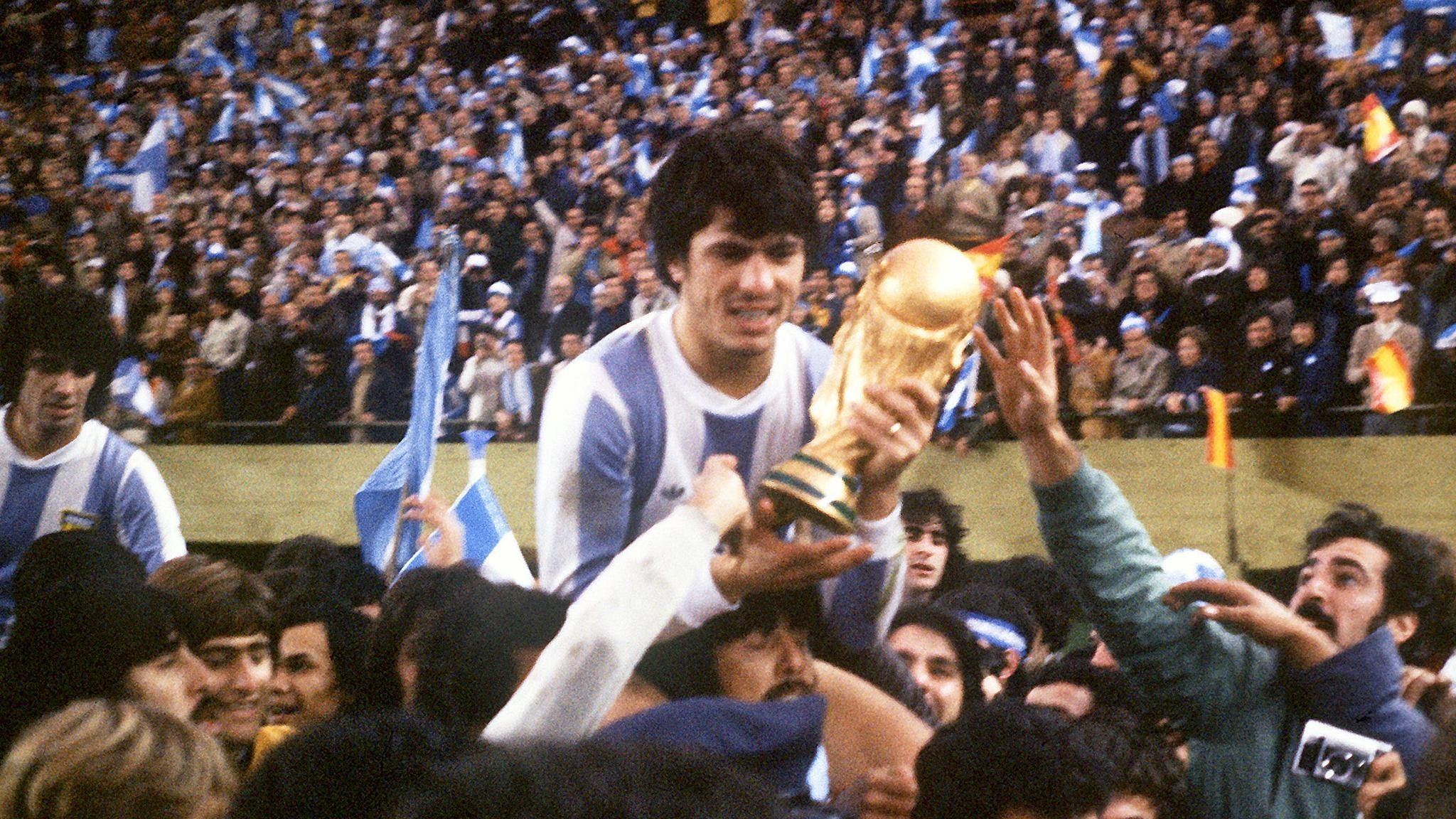
June 25, 1978: The Scariest World Cup Final

Argentina Captain Daniel Passarella, with the Jules Rimet Trophy

June 25, 1978: The World Cup Final is held at Estadio Monumental in Buenos Aires, Argentina. In this most corrupt of sports, it may have been the most corrupted game ever. And the scariest.

Not that Americans knew: Despite the North American Soccer League being probably at its peak, the country's English-language commercial networks did not broadcast the tournament, marking the only World Cup between 1966 and the modern era to have zero coverage on mainstream home TV. The Spanish International Network (SIN), which later became Univision, secured the U.S. broadcast rights and televised up to 25 games in Spanish to major American cities.

In 1973, Argentina was awarded the 1978 World Cup by FIFA, the International Federation of Football Associations. But in 1976, a coup resulted in a Fascist military dictatorship. It would be one of the ugliest governments in the history of the world, with tens of thousands of people labeled as "disappeared."

In 1974, Johan Cruyff led the Netherlands to the World Cup Final, where they lost to West Germany. It wasn't a "home soil victory": The Germans had a goal incorrectly waved off. Still, the Oraanje were considered favorites to stay among the world's elite. After all, Cruyff would only be 31 during the 1978 World Cup.

But in 1977, Cruyff announced his retirement from international soccer, refusing to play in the tournament. For 30 years, it was believed that he was protesting the military dictatorship. But in 2008, he revealed the truth: There was a threat against his family, and it got into his head, and he didn't think he would be at his best for the tournament.

Defending champions West Germany failed to make the Final, by losing 3-2 to Austria, at Chateau Carreras in Córdoba. For Austria, which hasn’t had a good national team since the 1938 Anschluss, it is known as Das Wunder von Córdoba: The Miracle of Cordoba. For Die Mannschaft, it is Die Schmach von Córdoba: The Disgrace of Cordoba.

Again, the Netherlands reached the Final, even without Cruyff. They would play the hosts and the Argentines' mere qualification for the Final under the system then in place was dubious. Following Brazil's 3–1 win over Poland, Argentina needed to win their last game in the Second Group Stage by a margin of 4 goals to proceed to the Final, and did so by defeating Peru by 6–0. 

There were allegations that the military government interfered to ensure Argentina would defeat Peru through intimidation, though these were denied by Peruvian captain Héctor Chumpitaz and several Peruvian players.

Some accusations originated in the Brazilian media (Brazil being Argentina's soccer arch-rivals), and pointed to the fact that the Peruvian goalkeeper, Ramón Quiroga, had been born in Argentina. here was also an alleged deal, reported by the British media as an anonymous rumor, that involved the delivery of a large grain shipment to Peru by Argentina, and the unfreezing of a Peruvian bank account that was held by the Argentine Central Bank.

Another alleged deal, published by a Colombian drug lord in a controversial book, involved the Peruvian team being bribed without any political implications. A third alleged deal, stated by a Peruvian leftist politician, encompassed sending 13 Peruvian dissidents exiled in Argentina back to Peru.

There was also a rumor that the referee was initially supposed to be Abraham Klein of Israel. This was before Muslim countries began refusing to allow Israel to compete in Asian tournaments, and FIFA had to reassign Israel to UEFA for Europe. The referee for the World Cup Final should be from a continent other than that of either team.

But, according to the rumor, Argentina had asked for a different referee: Sergio Gonella, of Italy. FIFA accepted the request. Was this meant to help the Netherlands, the European country? No: Italians are one of the largest ethnic groups in Argentina. Argentines of Italian descent have been common in Italy's league, and were vital in helping Italy win the World Cup in 1934 and 1938. Of Argentina's starting XI, 3 were of Italian descentincluding Captain Daniel Passarella, then with River Plate and thus playing on his home field, but would later play in Italy for Fiorentina and Inter Milan. Those who believed the rumor believed that Gonella was in the Argentines' pocket.

Regardless of what was true, the Final itself was controversial, literally from the start. The Dutch accused the Argentines of using stalling tactics to delay the match, causing tension to build in front of a hostile home crowd. The host team eventually came out 5 minutes late, after the audience was whipped into a frenzy.

The Argentines also questioned the legality of a plaster cast on the wrist of René van de Kerkhof, despite him having worn it in earlier games without objections, causing the Dutch to threaten to walk off the pitch. (He and his twin brother, Willy van der Kerkhof, played together in this game, as they did for Dutch team PSV Eindhoven.) Gonella upheld the Argentine complaints, and forced Van de Kerkhof to apply extra bandage.

Throughout the game, the Argentines made dirty tackles, and threw punches and elbows at the Dutch players. The fans threw confetti and other things onto the pitch, making it look like a ticker-tape parade had been held there. Gonella looked the other way at all of it.

For most of the 1st half, neither team looked like scoring. Argentina tallied in the 38th through Mario Kempes, who then played for Spanish team Valencia. It was on an assist from Leopoldo Luque, who had thrown a vicious elbow at Ernie Brandts.

Under normal circumstances, that goal would never have been allowed to stand, and Luque would have received no less than a yellow card. These were not normal circumstances. There were 5 yellow cards in the game, 2 to Argentina, 3 to the Netherlands.

Rob Rensenbrink, of Belgian team Anderlecht, and probably the best Dutch player at the time other than the absent Cruyff, almost tied it shortly thereafter, but Argentine goalie Ubaldo Filliol made a brilliant kick save. The clock wound down, and it looked like Argentina would win 1-0. Had it ended like that, with the controversy of before, it would have been bad enough, but it would have been a lot simpler. But in the 82nd minute, Dick Nanninga headed in a cross from René van de Kerkhof. In stoppage time, Rensenbrink nearly won it, but the ball hit the post, and regulation ended tied, 1-1.

In the 105th minute, at the end of the 1st half of extra time, Kempes charged toward Dutch goalie Jan Jongbloed, and shot. Jongbloed could only deflect it, not stop it, and his forward momentum caused Kempes to jump. The ball bounced off Kempes twice as he came down, then off Jongbloed's head, and into the net. It was an unorthodox goal, but a legal one. It was 2-1 Argentina.
Mario Kempes

In the 115th minute, Daniel Bertoni -- of Italian descent, then with Avellaneda team Independiente but later to play for 3 Italian teams -- put the game away, after committing an obvious handball, which should have gotten the goal waved off, and himself sent off. Gonella looked away again, and Argentina won, 3-1.

Ruud Krol, the great sweeper from Cruyff's team Ajax Amsterdam and his successor as Dutch Captain, said, in an interview with David Winner for his book Brilliant Orange: The Neurotic Genius of Dutch Soccer, "Of course, we felt the referee was not with us, that's for sure. Everybody knew that on the field. We spoke at halftime about it: 'That fucking referee, is he playing for Argentina, too?' That's a normal reaction from the players."

Johnny Rep, a former Ajax winger, then playing with Bastia, on Corsica, in France's league, went further than that. In an interview with Winner for the same book, he said, "Maybe we wouldn't have got out alive from the stadium... It was not a good atmosphere. It was too hot. All the military, not a good atmosphere. It was too heavy...

It was boiling. When we went to the stadium, there were so many people on the street. And all the people banging on the windows of the coach (meaning the team bus)...

Is it possible that the Argentine army had some Dutch players intimidated into not trying their best? Is it possible that the Argentine government would have had the victorious Dutch players arrested -- or even shot? What could have happened? Would President Jimmy Carter have accepted this as an attack on one NATO nation, therefore on all of them, and rallied the rest of NATO to go to war with Argentina? Would the sport have been forever poisoned? Would there ever have been another World Cup?

We'll never know, because the Dutch players lost, and they did leave the stadium alive.

So the Dutch, who came from a very liberal country and played a very liberal kind of soccer, lost to Argentina, a very conservative country then with a tyrannical right-wing government, which wouldn't fall until 1983, after their disastrous war with Britain over the Falkland Islands.

In 2010, Chateau Carreras in Córdoba, where Austria upset West Germany, was renamed Estadio Mario Kempes, as Kempes is a native of the city.

I'll let Argentina's 1978 manager, César Luis Menotti, a Socialist unlike his country's government at the time, have the last word. He had starred as a striker, winning league titles with Boca Juniors in 1965 and Brazilian team Santos in 1968 (where he was a teammate of Pelé), and had managed a league title winner with Buenos Aires team Huracán in 1973. He would later manage FC Barcelona to Spain's Copa del Rey in 1983. He once said:

There's a right-wing football and a left-wing football. Right-wing football wants to suggest that life is struggle. It demands sacrifices. We have to become of steel and win by any method... obey and function, that's what those with power want from the players. That's how they create retards, useful idiots that go with the system..

UPDATE: An article for ESPN.com, published after the 2026 World Cup, ranking all 23 tournaments, rated this one 21st, 3rd from last, and the worst since 1934. Author Bill Connelly cited Cruyff's withdrawal having hurt star power, and added, "controversy was rampant, and not of the 'fun to discuss in retrospect' variety." 

*

June 25, 1978 was a Sunday. Baseball All-Star Aramis Ramírez was born. And these Major League Baseball games were played:

* The New York Yankees beat the Detroit Tigers, 4-2 at Tiger Stadium in Detroit. Don Gullett was the winning pitcher. Due to injury, he won only 1 more game in the major leagues. Thurman Munson went 3-for-4 with a walk and 2 RBIs. Manager Billy Martin gave Reggie Jackson the day off.

* The New York Mets lost to the Pittsburgh Pirates, 4-0 at Shea Stadium. Bert Blyleven pitched a 5-hit shutout, to beat Nino Espinosa. Steve Henderson got 2 of those hits. Willie Stargell did not play.

* The Boston Red Sox beat the Baltimore Orioles, 4-1 at Fenway Park in Boston. Carl Yastrzemski went 0-for-4. Eddie Murray went 0-for-3 with 2 walks.

* The Philadelphia Phillies beat the Chicago Cubs, 4-2 at Veterans Stadium in Philadelphia. Mike Schmidt went 1-for-4. Greg Luzinski and Garry Maddox hit home runs.

* A doubleheader was split at Cleveland Municipal Stadium. The Toronto Blue Jays won the opener, 2-1. The Cleveland Indians won the nightcap, 3-2.

* The Minnesota Twins swept a doubleheader from the Chicago White Sox, 8-5 and 9-6 at Comiskey Park in Chicago. Over the 2 games, Rod Carew went 3-for-7 with a walk and 3 RBIs, despite not even starting the 2nd game.

* The Seattle Mariners beat the Milwaukee Brewers, 10-8 at Milwaukee County Stadium. Robin Yount went 1-for-6.

* The St. Louis Cardinals beat the Montreal Expos, 7-5 at Busch Memorial Stadium in St. Louis.

* The Oakland Athletics beat the Kansas City Royals, 6-3 at Royals Stadium (now Kauffman Stadium) in Kansas City. George Brett went 1-for-3 with a walk and an RBI.

* The Texas Rangers beat the California Angels, 7-0 at Arlington Stadium in the Dallas suburb of Arlington, Texas. George "Doc" Medich pitched a 7-hit shutout.

* The San Diego Padres swept a doubleheader from the Houston Astros, 6-1 and 7-4 at San Diego Stadium (later renamed Jack Murphy Stadium and Qualcomm Stadium). Over the 2 games, Dave Winfield went 3-for-8 with a walk and 4 RBIs.

* The Cincinnati Reds beat the Los Angeles Dodgers, 5-4 at Dodger Stadium in Los Angeles. Pete Rose, then in his 44-game hitting streak, went 2-for-3 with a walk. Johnny Bench did not play.

* And a doubleheader was split at Candlestick Park in San Francisco. The San Francisco Giants won the 1st game, 9-3. The Atlanta Braves won the 2nd game, 8-4. After relieving Gary Lavelle in the 9th inning, Randy Moffitt, an All-Star in his own right, and the older brother of tennis star Billie Jean King, fell apart in the top of the 11th inning, allowing 5 runs. The Giants could only pull 1 run back in the bottom of the 11th.

Thursday, June 2, 2022

June 2, 1971: The Triumph of Total Football

June 2, 1971: The European Cup Final is held at Wembley Stadium in London. It marks a revolution in soccer tactics.

Johan Cruijff -- pronounced "KROYF," and English-speaking media usually spelled it "Cruyff" -- was born in 1947 in Amsterdam, the Netherlands. In 1964, having grown up a 5-minute walk away from their ground, De Meer, he made his debut for Amsterdamsche Football Club Ajax, pronounced "EYE-ax," and named for the mythical Greek hero. They were the leading soccer team in the largest Dutch city and the nation's capital.

(And to clear something up: The names "Holland" and "the Netherlands" are not interchangeable. While Holland includes the country's 3 largest and most important cities -- Amsterdam, Rotterdam and The Hague -- it has about 1/3rd of the country's population, and about 1/6th of its area. Telling someone from Eindhoven, in North Brabant, that he lives in "Holland" is less dangerous than telling someone from Glasgow that he lives in "England," but it's still an insult.)

In 1965-66, he scored 25 goals, leading Ajax back from an awful finish the season before, their worst ever, to the league title, the 1st of 8 he would win with the club. In 1967, Ajax again won the league, and also won the Koninklijke Nederlandse Voetbalbond Beker -- the Royal Dutch Football Association Cup, usually written as the KNVB Cup. This was the 1st time Ajax had won the Dutch equivalent of "The Double," the 1st of 4 times they would do so with Cruijff.

In 1969, Ajax advanced to the European Cup Final, losing to AC Milan, led by perhaps the greatest Italian player of them all, Gianni Rivera. This may have had an effect on Cruijff and Ajax manager Rinus Michels, who began to devise what became known as "totaalvoetball" -- "Total Football."

The idea is that any outfield player -- anyone ahead of the goalkeeper -- can move to another part of the field, and another player can move to slip into the space vacated by the preceding player. This had been previously been attempted by the great Real Madrid and Hungary teams of the 1950s, both including the great Hungarian star Ferenc Puskás; and the Burnley side in England that won the 1960 Football League title, but they didn't maintain it for long.

In his book Brilliant Orange: The Neurotic Genius of Dutch Football, David Winner described what they made Dutch soccer into as being like Dutch art: "Cruyff became the greatest exponent and teacher of totaalvoetball. His vision of perfect movement and harmony on the field was rooted in the same sublime ordering of space that one sees in the pictures of Vermeer or church painter Pieter Jansz Saenredam. It was the music of the spheres on grass."

In 1970, Ajax's arch-rivals, Rotterdam-based Feyenoord, having won the previous season's Eredivisie title, became the 1st Dutch team to win the European Cup. But Ajax again won The Double, and launched the most stunning run of soccer play Europe has ever seen.

In 1971, Ajax progressed all the way to the Final of the European Cup again (at that time, only a defending national league champion could appear in it, unless they were the previous season's European Cup winners), and were set to play Panathinaikos of Athens, Greece.

The Final of what was known from 1955 to 1992 as the European Cup and since 1992 as the UEFA Champions League has always been set for a neutral site, although it hasn't always worked out that way. For 1971, the site chosen was the original Wembley Stadium in London. This factor cannot be underemphasized: The European Cup Final was the only non-English soccer game broadcast live on British television at the time, and, because it was at England's national stadium, the BBC promoted the heck out of this game.

Ajax had already played Arsenal, the North London side that won the League and FA Cup Double in that 1970-71 season, in the Semifinal of the 1969-70 Inter-Cities Fairs Cup, with Arsenal winning and then beating Belgium's Anderlecht in the Final.

The British interest wasn't just about fans' recent familiarity with Ajax, and how good they already believed Ajax to be. There was also intense interest in their Greek opponents. "Pana" had modeled themselves after a great British side, Glasgow-based Celtic, down to wearing green uniforms and having a shamrock as their logo; and were managed by Puskás, whose masterclass for the aforementioned Hungary side at Wembley in 1953 resulted in the England national team's 1st defeat on home soil to a team from outside the British Isles. (Scotland, Wales and Ireland had all done it by this point.)

In those days, teams generally didn't seek out foreign players or managers. Puskás wasn't Greek, but all of his players were. Sweeper Velibor Vasović, a Serb from Yugoslavia, and substitute defender Horst Blankenburg of Germany, were the only non-Dutch players to get into this game for Ajax. The others: Goalkeeper Heinz Stuy; defenders Wim Suurbier and Barry Hulshoff; midfielders Cruijff, Nico Rijnders, Johan Neeskens, Gerrie Mühren and substitute Arie Haan; and forwards Sjaak Swart, Piet Keizer and Dick van Dijk -- yes, his name was pronounced like "Dick Van Dyke."

van Dijk scored in only the 5th minute, and Pana desperately held on, looking for an equalizer, and not finding it, before Haan put the game away with a goal in the 87th. Ajax won, 2-0, and had become Champions of Europe for the 1st time.

Despite manager Michels being lured away by the money of Spanish club FC Barcelona, Ajax repeated in 1972 under Romanian manager Stefan Kovacs, winning the Netherlands' 1st European Treble: the national league, the national cup, and the European Cup. They lost only 1 game all season long, including knocking Arsenal out in the European Cup Quarterfinal.

The 1972 European Cup Final proved to be Total Football's finest hour. They faced Internazionale of Milan, a team which had won the European Cup in 1964 and 1965, and lost to Celtic in the 1967 Final, with a system called catenaccio (a word meaning "padlock"): Defense above all. "Il Grande Inter" had been so successful with the system, in contrast to the free-flowing format of their groundsharing rivals AC Milan, that they were considered the hallmark of soccer defense.

Italian sportswriter Gianni Brera, a man often thought of as an Inter fan (he denied it), reflected the dominant thought of the Italian game at this point, writing that the perfect game of "calcio" (what the Italians call soccer) would end 0-0.

No such luck for Inter on this night: Despite having the great Sandro Mazzola and world-class defenders Giacinto Facchetti and Tarcisio Burgnich, Cruijff controlled the game from first whistle to last, scoring in the 47th and 78th minute to provide the 2-0 margin of victory.

"The Death of Catenaccio" was reported all over Europe. The Dutch newspaper Algemeen Dagblad wrote, "The Inter system undermined. Defensive football is destroyed." To make the moment all the sweeter, the venue was Stadion Feijenoord in Rotterdam, home ground of hated Feyenoord.

Ajax did it again, as Johnny Rep scored in the 5th minute for the only tally in the 1973 European Cup Final, defeating another Italian side, Turin-based Juventus, 1-0 at the Red Star Stadium in Belgrade, Yugoslavia (Serbia). Three straight European Cups would be done again by Bayern Munich in the next 3 years, but it hasn't been done in the 40 years since.

But all good things must come to an end. In August 1973, due to infighting at Ajax, Cruijff wanted out, and he got it: His former manager Michels brought him to Barcelona, for what was then a world record transfer fee, worth about $2 million at the time. Barça fans, known as cules, were ecstatic, getting the man then generally regarded as the best player in the world, something their arch-rivals, Real Madrid, had previously had with Puskás and Alfredo Di Stéfano. Now, it was La Blaugrana who had this advantage over Los Merengues. 

Cruijff would lead the Netherlands' national team, with their bright orange shirts seeming to stand for their style, into the 1974 World Cup Final in Munich. But hosts West Germany, with their all-white kits suggesting the contrasting, defense-first, very dull style, won, 2-1. The Netherlands, this time without Cruijff, would repeat in 1978: Reaching the Final, but losing to the host nation, Argentina.

Cruijff and Ajax had a stormy relationship over the years, making peace and breaking it again. He served as manager for a time, then left, and went back to Barcelona, building them into one of the greatest teams in the world well into the 21st Century. He died in 2016.

*

June 2, 1971 was a Wednesday. These Major League Baseball games were played that day:

* The New York Yankees beat the Boston Red Sox, 6-1 at Yankee Stadium. Stan Bahnsen outpitched Sonny Siebert. Bobby Murcer hit 2 home runs, 1 off Siebert, 1 off Bill Lee.

* The New York Mets beat the San Francisco Giants, 5-2 at Candlestick Park in San Francisco. Willie Mays went 0-for-2 with 3 walks. The winning pitcher for the Mets was Charlie Williams. A year later, the Mets traded Williams for the 41-year-old Mays, even-up. The losing pitcher was Juan Marichal, who gave up a home run to Art Shamsky.

* The California Angels were leading the Washington Senators, 2-1 at Robert F. Kennedy Memorial Stadium, after 8 innings, when the game was called due to rain, a win for the Angels.

* The Atlanta Braves beat the Houston Astros, 3-1 at Atlanta Stadium (later renamed Atlanta-Fulton County Stadium). Hank Aaron went 2-for-4.

* The Pittsburgh Pirates beat the St. Louis Cardinals, 10-1 at Three Rivers Stadium in Pittsburgh. Roberto Clemente went 1-for-2 before being replaced. Willie Stargell went 2-for-4 with a walk and 3 RBIs. Lou Brock went 1-for-5.

* The Chicago Cubs swept a doubleheader from the Cincinnati Reds, 6-3 and 4-1 at Riverfront Stadium in Cincinnati. In his last season, Ernie Banks went 1-for-4 with a home run and 3 RBIs in the opener, then sat out the nightcap. Over the 2 games, Pete Rose went 3-for-6 with 2 walks and an RBI, and Johnny Bench went 0-for-7.

* The Baltimore Orioles beat the Chicago White Sox, 3-2 at Comiskey Park in Chicago. Terry Forster threw a wild pitch in the top of the 12th inning, allowing Frank Robinson to score. Frank went 1-for-5. Brooks Robinson went 2-for-4 with a walk and 2 RBIs.

* The Cleveland Indians beat the Milwaukee Brewers, 4-2 at Milwaukee County Stadium.

* The Detroit Tigers beat the Minnesota Twins, 5-4 at Metropolitan Stadium in the Minneapolis suburb of Bloomington, Minnesota. Al Kaline went 1-for-4 with a walk. Harmon Killebrew went 0-for-4, but Rod Carew went 2-for-4 with 2 RBIs.

* The San Diego Padres beat the Philadelphia Phillies, 6-0 at San Diego Stadium (later renamed Jack Murphy Stadium and Qualcomm Stadium). Steve Arlin pitched a 5-hit shutout.

* The Los Angeles Dodgers beat the Montreal Expos, 7-1 at Dodger Stadium in Los Angeles.

* And the Kansas City Royals and the Oakland Athletics were not scheduled.

Thursday, February 17, 2022

February 17, 1974: Johan Cruijff, the Hero of Barcelona

February 17, 1974: Futbol Club Barcelona win El Clásico, the biggest sports rivalry in Spain, defeating Real Madrid Club de Fútbol, 5-0 at Estadio Santiago Bernabéu. For the people of Catalonia, for whom FC Barcelona are a cultural touchstone -- as they say, "Més que un club" ("More than a club") -- it is the beginning of the end of the tyranny over their home region.

On this day, the power of Francisco Franco cannot compete with that of Johan Cruijff.

The Dutch soccer star -- whose name is usually written outside his homeland as "Cruyff" -- had starred for his hometown team, AFC Ajax in Amsterdam, the Netherlands, leading them to 3 straight European Cup wins.

But all good things must come to an end. In August 1973, due to infighting at Ajax, Cruijff wanted out, and he got it: His former manager Rinus Michels brought him to Barcelona, for what was then a world record transfer fee, worth about $2 million at the time. Barça fans, known as cules, were ecstatic, getting the man then generally regarded as the best player in the world, something their arch-rivals, Real Madrid, had previously had with Ferenc Puskás and Alfredo Di Stéfano. Now, it was La Blaugrana who had this advantage over Los Merengues.

Crujiff married a woman named Danny Coster. They had daughters Chantal in 1970 and Susila in 1972. They maintained a home in Barcelona from 1973 onward. On February 9, 1974, their son was born. Johan gave his son a Catalan name: Johan Jordi Cruijff. Naming his son after Jordi, Catalonia's patron saint, further endeared him to the Catalan people, especially since Spanish dictator Francisco Franco (who would be dead within 2 years), said to have fixed titles in favor of Real Madrid, had banned all use of Catalan national symbols. (Jordi Cruyff, as his name has usually been written, went on to have a decent career as a player, but people always expected more from the son of Cruijff.)

But what the cules really loved about him came just 8 days later: On February 17, 1974, Barcelona went to Estadio Santiago Bernabéu, Real Madrid's mighty 100,000-seat home stadium, and beat them 5-0. Cruijff scored one goal, and assisted on 2 others. It should have been 6-1, but Barcelona had a goal disallowed, and Real Madrid were denied a penalty. If Crujiff had never played another game for La Blaugrana, they would have loved him forever for this game alone.
Note that the captain's armband is the Catalan flag.

Barcelona won La Liga in 1974. It all seemed to be setting Cruijff up for the greatest prize of all: The World Cup. The tournament was being held in West Germany, and the Dutch team seemed to have the best of all Dutch worlds. Alas, in the Final, they had to face West Germany, with several players from Bayern Munich, who had replaced Ajax as European Cup winners, and they had to play it in Munich. The Germans won, and while the Dutch have never complained about the officiating or the home-field advantage, they also have never gotten over the defeat.

Cruijff remained with Barcelona until 1978, seeing the death of Franco and Spain's return to democracy. He then went to America to play for the Los Angeles Aztecs and the Washington Diplomats of the North American Soccer League, before going back to Europe. He would manage both Ajax and Barcelona. He wanted to copy the Ajax Academy that had produced himself and so many other great players. It was established on land owned by the club, outside a 1702 house known as La Masia ("The Farmhouse"), and La Masia has remained the academy's name ever since. It has kept the talent flowing, well into the age of Lionel Messi.

He died in 2016. Ajax subsequently renamed its Amsterdam Arena for him. But he may be more loved in Barcelona, not just for his performances, especially this one, but for what they represented against the Fascist regime then ruling Spain.

*

February 17, 1974 was a Sunday. Actor Jerry O'Connell was born. And the Zamalek Stadium disaster happened in Egypt. I have a separate entry for that event.

Baseball and football were out of season. There were 8 games in the NBA:

* The New York Knicks lost to the Milwaukee Bucks, 97-86 at the Milwaukee Exposition & Convention Center Arena, a.k.a. The MECCA. Kareem Abdul-Jabbar had 32 points and 23 rebounds.

* The Detroit Pistons beat the Philadelphia 76ers, 118-107 at The Spectrum in Philadelphia.

* The Capital Bullets -- as the Washington Bullets were known in their 1st season only -- beat the Boston Celtics, 99-95 at the Capital Centre in the Washington suburb of Landover, Maryland.

* The Golden State Warriors beat the Chicago Bulls, 108-105 at the Chicago Stadium.

* The Buffalo Braves beat the Houston Rockets, 135-118 at the Hofheinz Pavilion (now the Fertitta Center) in Houston. Bob McAdoo scored 38 points.

* The Phoenix Suns beat the Portland Trail Blazers, 112-100 at the Arizona Veterans Memorial Coliseum in Phoenix.

* The Atlanta Hawks beat the Los Angeles Lakers, 113-110 at The Forum outside Los Angeles in Inglewood, California. Gail Goodrich of the Lakers and Lou Hudson of the Hawks each scored 35 points. Pete Maravich of the Hawks scored 32.

* And the Seattle SuperSonics beat the Cleveland Cavaliers, 106-97 at the Seattle Center Coliseum.

There were 3 games in the American Basketball Association:

* The Virginia Squires beat the Kentucky Colonels, 118-113 at The Scope in Norfolk, Virginia. Jim Eakins scored 41 points.

* The Indiana Pacers beat the Denver Rockets, 93-92 at the Auditorium Arena in Denver.

* And the San Diego Conquistadors beat the Carolina Cougars, 129-123 at the San Diego Sports Arena (now the Pechanga Arena). Travis Grant scored 41.

There were 4 games in the NHL:

* The Montreal Canadiens and the Philadelphia Flyers played to a tie, 2-2 at the Montreal Forum.

* The Buffalo Sabres beat the Detroit Red Wings, 2-1 at the Buffalo Memorial Auditorium.

* The Chicago Black Hawks beat the Toronto Maple Leafs, 4-1 at the Chicago Stadium. Yes, it hosted an NBA game and an NHL game on the same day.

* And the Minnesota North Stars beat the California Golden Seals, 7-1 at the Metropolitan Sports Center in the Minneapolis suburb of Bloomington, Minnesota.

And there were 6 games in the World Hockey Association:

* The Jersey Knights beat the Quebec Nordiques, 10-3 at the Cherry Hill Arena in the Philadelphia suburb of Cherry Hill, New Jersey.

* The Cleveland Crusaders beat the Chicago Cougars, 6-5 at the Cleveland Arena.

* The New England Whalers beat the Winnipeg Jets, 3-2 in overtime at the Winnipeg Arena.

* The Minnesota Fighting Saints beat the Houston Aeros, 6-1 at the Sam Houston Coliseum in Houston.

* The Edmonton Oilers beat the Toronto Toros, 3-2 in overtime at the Edmonton Gardens.

* And the Vancouver Blazers beat the Los Angeles Sharks, 4-0 at the Los Angeles Memorial Sports Arena. 

December 31, 1999 & January 1, 2000: The Millennium

December 31, 1999:  The Millennium arrives. The people of planet Earth survived. At a terrible cost. But we hadn't destroyed ourselves. ...