
As a native of New Jersey, and a fan of the football team at Rutgers University, I loathed Penn State University, their Nittany Lions, and their head coach, Joe Paterno, long before it was cool. But they have provided perhaps the greatest speech any college football player has ever given.
December 13, 1973: Penn State running back John Cappelletti wins the Heisman Trophy, as yet the only Nittany Lion so honored. His acceptance speech transcended sports.
Born in 1952 in the Philadelphia suburb of Upper Darby, Pennsylvania, he was apparently no relation to New England Patriots legend Gino Cappelletti. He graduated from the storied Monsignor Bonner High School. He did not play for Penn State in his freshman season, 1970, because the NCAA did not let freshmen play on the varsity until 1972. He was a defensive back in his sophomore season, 1971, because the starting running back slots were occupied by Franco Harris and Lydell Mitchell, who went to 12 Pro Bowls between them. He did start as a junior in 1972.
In 1973, helping Penn State complete an undefeated regular season, he rushed for 1,522 yards and scored 17 touchdowns in 11 games. Paterno would later call him the best player he ever coached. Ohio State also went through the regular season undefeated, but they had 3 players splitting the votes that only 1 would have gotten: Offensive tackle John Hicks finished 2nd, sophomore running back Archie Griffin finished 5th, and linebacker Randy Gradishar finished 6th.
Giving his acceptance speech at the Downtown Athletic Club in Manhattan, after having been seated next to newly-sworn-in Vice President Gerald Ford, himself an All-American center at the University of Michigan in 1935, Cappelletti said:
I'm very happy to do something like this. I thought about it since the Heisman was announced 1- days ago, and this is to dedicate a trophy that a lot of people earned, I've earned, my parents and the people I've mentioned, and numerous other people that are here tonight and been with me for a long time.
The youngest member of my family, Joseph, is very ill. He has leukemia. If I can dedicate this trophy to him tonight, and give him a couple days of happiness, this is worth everything.
I think a lot of people think that I go through a lot on Saturdays and during the week, as most athletes do, and you get your bumps and bruises, and it is a terrific battle out there on the field. Only for me, it is on Saturdays, and it's only in the Fall. For Joseph, it is all year 'round, and it is a battle that is unending with him. And he puts up with much more than I'll ever put up with. And I think that this trophy is more his than mine, because he has been a great inspiration to me.
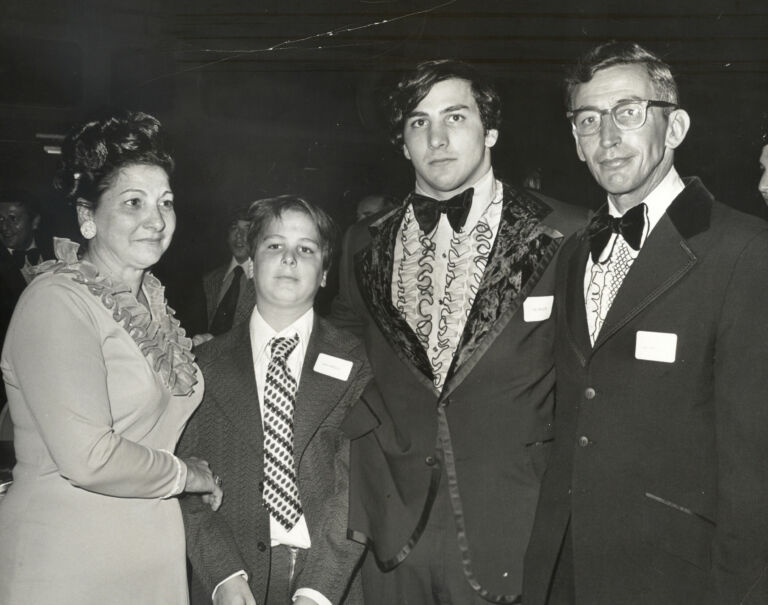
Anna, Joey, John Jr., John Sr.
It was similar to the speech that Gale Sayers gave in New York in 1970, upon receiving the NFL's George S. Halas Most Courageous Player Award, named for the owner of his team, the Chicago Bears. Despite having led the League in rushing after surgery on both knees in 1969, Sayers dedicated the award to an even more courageous teammate, running back Brian Piccolo, who was dying of cancer.
Cappelletti's speech brought those big tough football men to tears. Archbishop Fulton J. Sheen, the famed "TV priest" of the 1950s, had been asked to deliver the ceremony's benediction. He told a national TV audience, "There is no need for a benediction. God has already blessed you with John Cappelletti." Between this, and the Italian ancestry of both player and head coach, the viewing audience could have been excused for thinking that, like Notre Dame, Penn State was a Catholic school, instead of a State school.
(I used to make that same mistake with Temple University, thinking it was either Catholic or Jewish. Villanova, St. Joseph's and La Salle are Catholic schools in or around Philadelphia, but Temple is not.)
Despite their undefeated record, being an independent meant that Penn State meant that they had no Conference Championship to play for, and they didn't play a single ranked team until their Thanksgiving Saturday matchup with arch-rival University of Pittsburgh, and even they were only ranked Number 20. Penn State won that game, but remained at Number 6. In Cappelletti's last college game, Penn State beat Louisiana State University (LSU) in the Orange Bowl, but stayed Number 6 in the last poll. For the 3rd time in the last 6 years, the Nittany Lions had gone undefeated for an entire season, and yet were denied the National Championship. Not until 1982 would they be awarded one.
Joey Cappelletti hung on until 1976, at the age of 13. In 1977, the film Something for Joey was made about the brothers.
John Cappelletti played for the Los Angeles Rams from 1974 to 1979, and the San Diego Chargers from 1980 to 1983. But, like so many Heisman winners, his professional career was a disappointment, in his case due to injuries. The Rams reached Super Bowl XIV in the 1979-80 season, but Cappelletti was unable to play in it.
He was elected to the College Football Hall of Fame, the National Italian American Sports Hall of Fame, the Philadelphia Sports Hall of Fame, and the Orange Bowl Hall of Honor. On September 7, 2013, at their home opener, Penn State honored their 1973 football team, and retired Cappelletti's Number 22. He remains the only Penn State athlete to have his number retired.
Cappelletti moved to Laguna Niguel, California, with his wife Betty and 4 sons. Betty's sister is the daughter of another Heisman Trophy winner, Alan Ameche, who won the Trophy with Wisconsin in 1954, and starred in the NFL for the Baltimore Colts.
UPDATE: In 2023, on the 50th Anniversary of the award and the speech, Cappelletti was interviewed. He said, "The speech gave me an opportunity to express some things I think on all our behalf’s. Just what we were feeling. I don’t think even I expected it to come out like that. It’s something you can’t really rehearse. It was just a feeling at the time, the feeling of all my family, not just myself."
*
December 13, 1973 was a Thursday. Baseball was out of season. Football was in midweek. There were 2 games in the NBA. The Chicago Bulls beat the Milwaukee Bucks, 97-94 at the Milwaukee Exposition & Convention Center Arena, a.k.a. The MECCA. (It's now named the UW-Milwaukee Panther Arena.) And the Portland Trail Blazers beat the Phoenix Suns, 119-108 at the Arizona Veterans Memorial Coliseum.
There were 2 games in the American Basketball Association. The San Antonio Spurs beat the Virginia Squires, 96-94 at the Scope in Norfolk, Virginia. And the San Diego Conquistadors beat the Memphis Tams, 107-104 at the Mid-South Coliseum in Memphis.
There were 4 games in the NHL:
* The New York Islanders lost to the Los Angeles Kings, 3-2 at The Forum outside Los Angeles in Inglewood, California.
* The Boston Bruins beat the Minnesota North Stars, 4-2 at the Boston Garden.
* The Detroit Red Wings beat the St. Louis Blues, 7-3 at the Olympia Stadium in Detroit.
* And the Toronto Maple Leafs beat the Atlanta Flames, 6-1 at The Omni in Atlanta.
And there was 1 game in the World Hockey Association: The Toronto Toros beat the Cleveland Crusaders, 3-1 at the Varsity Arena in Toronto.


