Showing posts with label tin pan alley. Show all posts

Friday, December 2, 2022

December 2, 1929: Irving Berlin Publishes “Puttin’ On the Ritz”

December 2, 1929: Irving Berlin first publishes his song "Puttin' On the Ritz." The title was an expression that Harlemites of the time coined, meaning to dress nice, and takes its name from the Ritz Hotel in London, which may also have produced the adjective "ritzy.: The following year, a film with the title was released, and Harry Richman sang it in front of Hollywood's 1st interracial ensemble.

It's also been sung in films by Clark Gable (complete with white tie and tails) in Idiot's Delight in 1939, Fred Astaire in Blue Skies in 1946, and, for comedic effect, Gene Wilder and Peter Boyle in Young Frankenstein in 1974.

In 1982, Indonesian-Dutch singer Taco Ockerse (using only his first name) released the most recent hit version. It reached Number 4 in the U.S. Irving Berlin was then 95 years old, making him the oldest living songwriter to have a song he wrote enter the Top 10. Unfortunately, Taco's original video for it had blackface performers, and had to be re-shot.

*

December 2, 1929 was a Monday. Sportswriter Dan Jenkins was born.

Baseball was out of season. Football was in midweek. The NBA hadn't been founded yet. And the NHL had a day off. So there were no scores on this historic day.

Monday, November 21, 2022

November 21, 1934: "Anything Goes" Premieres

November 21, 1934: The musical Anything Goes premieres at the Alvin Theatre in New York. Along with Kiss Me, Kate, Cole Porter called it "one of my two perfect musicals."

Cole Albert Porter was born on June 8, 1891 in Peru, Indiana, to a wealthy family. His mother, the daughter of a coal and lumber speculator who was believed to be the richest man in Indiana at the time, indulged his love of music. Together, they wrote his first operetta when he was only 10 years old.

He was valedictorian of his Massachusetts prep school, and his grandfather rewarded him with a trip to Europe and admission to Yale University, which made him a worldly young man. He joined the famed Whiffenpoofs a cappella singing group, and wrote "Bulldog," which is still Yale's fight song to this day.

His frequent trips to Manhattan on the New York, New Haven & Hartford Railroad (now the New Haven Line of Metro-North Commuter Railroad) indulged his love of musicals, but also indulged his love of nightlife, including gay liaisons.

To indulge his grandfather, he moved on to Harvard Law School, but the school's dean knew where his talent lay, and helped him switch to Harvard Music School. His mother was told, and supported it; his grandfather was not told. He staged musicals at Harvard, and by 1915, was staging them on Broadway.

He worked with the Duryea Relief organization during World War I, and hosted debauched parties in Paris. In 1918, he met Linda Lee Thomas, and their marriage gave both what they needed: She got security, and a man who adored her for her personality, if not lusting for her; he got the cover of a marriage to deflect public suspicion of what he really wanted in bed. The marriage lasted until her death in 1954.

His musicals were good enough to help him get by, if not to become famous, until 1928, when Paris became his 1st big hit show. His 1929 show Fifty Million Frenchmen included the song "You Do Something to Me," which truly launched him: Along with Irving Berlin, George & Ira Gershwin, Richard Rodgers & Lorenz Hart, and Johnny Mercer and his various collaborators, Cole Porter became one of the leaders of what became known as "The Great American Songbook." More than that, it kept him afloat during the Great Depression, when many writers, producers and theater owners went under.

In 1932, he staged a musical titled The Gay Divorce -- "gay" in its original sense of "happy," not as in "homosexual," no matter what the tendencies of Broadway in general and Porter in particular. It starred Fred Astaire, and it was his last show before he went to Hollywood, including the 1934 film version, The Gay Divorcee. It included "Night and Day," which remains Porter's best-known song.

In 1934, producer Vinton Freedley came up with a new approach to producing musicals. Instead of commissioning book, music and lyrics, and then casting the show, Freedley sought to create an ideal musical with stars and writers all engaged from the outset.

The stars he wanted were Ethel Merman, William Gaxton and comedian Victor Moore. He planned a story about a shipwreck and a desert island, and for the book he turned to P. G. Wodehouse and Guy Bolton. For the songs, he decided on Porter. By telling each of these that he had already signed the others -- in other words, lying to them -- Freedley gathered his ideal team together.

A drastic last-minute rewrite was necessitated by the Morro Castle fire off the coast of New Jersey in September, which dominated the news and made Bolton and Wodehouse's book seem tasteless. Nevertheless, the show, Anything Goes, was an immediate hit.

Its songs include the title number, "I Get a Kick Out of You," "All Through the Night" and, along with "Night and Day," probably the best-known Porter song, "You're the Top." (Often mis-listed and mis-sung as "You're the Tops.") It name-checks several current big names in the world: Mickey Mouse, Mahatma Gandhi (pronounced "GAN-dee," to rhyme with "Napoleon brandy"), Greta Garbo, Fred Astaire, Eugene O'Neill, Jimmy Durante, Irving Berlin, and "Mrs. Astor," although not specifying which one.

Anything Goes was filmed in 1936, with Merman, Bing Crosby and Ida Lupino. There was a remake in 1956, but with a seriously rewritten story, this time with Crosby and Mitzi Gaynor. Merman and Frank Sinatra starred in a made-for-TV version in 1954, for NBC's The Colgate Comedy Hour. A performance of a 2021 London revival, with Broadway (and TV show Younger) star Sutton Foster and British musical legend Robert Lindsay, was broadcast on PBS' Great Performances in 2022.

Anything Goes was the 1st of 5 Porter shows featuring Merman. He loved her loud, brassy voice, and wrote many numbers that displayed her strengths. Jubilee, written with Moss Hart in 1935, was not a major hit, but included the songs "Begin the Beguine" and "Just One of Those Things." He also wrote for movies, including "I've Got You Under My Skin" for Born to Dance in 1936, and "In the Still of the Night" for Rosalie in 1937. (This is not the doo-wop hit of The Five Satins in 1956, although Dion & the Belmonts had a hit with it in 1960.) He wrote "Don't Fence Me In" for a 1934 film musical that was never made, but it became a hit when Roy Rogers sang it in the 1944 film Hollywood Canteen.

On October 24, 1937, only 46 years old, Porter was riding a horse at Piping Rock Club in Locust Valley, Long Island, New York, when his horse rolled on him and crushed his legs, leaving him substantially crippled and in constant pain for the rest of his life. Though doctors told Porter's wife and mother that his right leg would have to be amputated, and possibly the left one as well, he refused to have the procedure. He remained in the hospital for seven months before being allowed to go home to his apartment at the Waldorf Towers.

He resumed work as soon as he could, finding it took his mind off his perpetual pain. In 1938, he staged Leave It to Me!, with Mary Martin singing "My Heart Belongs to Daddy." His 1939 show DuBarry Was a Lady starred Merman and Bert Lahr, but it was too risqué for the censors, and some lines and songs had to be cut. "Friendship," one of Merman's best-known songs, was kept.

In 1940, Porter wrote Panama Hattie. Most of its songs have been forgotten, but it was his longest-running hit yet. It also led to one of the best jokes on The Muppet Show: In 1977, Merman guested, and, after she sang a medley of her hits, the camera panned to the box where the old hecklers Statler and Waldorf, both named for famous New York hotels, sat. Waldorf said, "I remember Ethel Merman in the opening of Panama Hattie!" Statler, apparently believing himself to be the younger of the two, told him, "You remember Teddy Roosevelt in the opening of the Panama Canal!" (In fact, while Roosevelt got the Canal built, it didn't open until 1914, when Woodrow Wilson was President.)

Composer biographies were common in 1940s films, even for still-living writers like Porter. In 1946, Cary Grant played Porter in Night and Day. Porter himself was at a commercial low point, but in 1948, he staged Kiss Me, Kate, a modernization of William Shakespeare's The Taming of the Shrew, which led to a rebound in his career. The following year, the Tony Awards debuted, and Kiss Me, Kate won the 1st-ever Tony for Best Musical.

After Porter resisted it for 20 years after the horseback accident, ulcers on his right leg finally forced its amputation in 1958. Broadway writer Noël Coward, a close friend, visited him, and saw how he was no longer in pain, and predicted that his musical output would get back to normal levels, and he would be a hit all over again.

Sadly, that turned out to be wishful thinking: He never wrote another song, and lived in seclusion until kidney failure ended his life on October 15, 1964 outside Los Angeles in Santa Monica, California. He was 73. Both the music industry, through rock and roll, and Broadway, with more sophisticated musicals like My Fair Lady and Fiddler On the Roof, had passed him by.

But not completely. The roster of singers who've recorded compilation albums of his songs is staggering: Ella Fitzgerald, Frank Sinatra, Rosemary Clooney, Anita O'Day, Julie London, Dionne Warwick, and, as recently as 2021, in his last album before being overtaken by Alzheimer's disease, Tony Bennett recorded Love for Sale, a series of Porter duets with Lady Gaga, born 22 years after Porter died.

In 1966, Frankie Valli & The Four Seasons had a Top 10 hit with "I've Got You Under My Skin." In a 1974 episode of M*A*S*H, set in 1951, "Trapper" John McIntire (played by Wayne Rogers) sang it during a surgery session. In a 1982 episode of the show, set in 1953, Hawkeye Pierce (played by Alan Alda), having lost a bet to Trapper's replacement, B.J. Hunnicutt (played by Mike Farrell), had to climb on top of a table in the mess tent, drop his pants (but not his underwear), and "sing 'You're the Tops' without your bottoms." Not long before her death in 1984, Merman recorded a new version of "Friendship" for Friendship brand margarine.

In 1989, interviewed for the CBS News show 48 Hours while on tour for his album Flowers In the Dirt, Paul McCartney, 47 years old and 19 years into his post-Beatles solo career, made no bones about his love for rock and roll, but also made the point that he didn't start out that way: He said, "I was out to be another Cole Porter. Still am, babe."

In 1990, noting that Porter was gay and that AIDS had devastated the gay community, including the gay overlap with the Broadway sub-community, the fundraising album Red Hot + Blue was recorded. It included David Byrne of Talking Heads on "Don't Fence Me In," Neneh Cherry on "I've Got You Under My Skin," and Sinéad O'Connor on "You Do Something to Me."

The Alvin Theatre, where Anything Goes premiered, was at 250 West 52nd Street in Midtown Manhattan. In 1983, it was renamed the Neil Simon Theatre. It is still in operation. Oddly, no Broadway Theatre has yet been named for Cole Porter.

*

November 21, 1934 was a Wednesday. This was also the day that American newspapers broke the story of the "Business Plot," a proposed military coup that would be backed by some of America's richest men to depose President Franklin D. Roosevelt and install a fascist government, a plan torpedoed when their intended commander, Marine General Smedley Butler, blew the whistle on it in a Congressional committee hearing. I have a separate entry for that event.

This was also the day that the Yankees purchased the contract of Joe DiMaggio from the San Francisco Seals of the Pacific Coast League. I have a separate entry for that event.

Baseball was out of season. Football was in midweek. The NBA hadn't been founded yet. And while the NHL season began on November 8, there were no games scheduled for this day. So there were no scores.

Monday, November 7, 2022

November 7, 1904: "Little Johnny Jones" Opens On Broadway

November 7, 1904: Little Johnny Jones opens at the Liberty Theatre at 236 West 42nd Street in New York. It is the 1st play staged there. George M. Cohan is the writer, director and star, playing an American jockey who goes to London to race in the famed Epsom Derby, loses, is accused of throwing the race, and must clear his name.
The show contains 2 of Cohan's legendary songs: "Yankee Doodle Dandy" and "Give My Regards to Broadway." The former not only becomes the title of the 1942 film biography of Cohan, starring James Cagney, but also helps to popularize "Yankees" as an alternative name for the New York Highlanders of baseball's American League.
Ironically, because New York Giants manager John McGraw cultivated Broadway performers as friends, Cohan became a Giants fan, despite being from Providence, Rhode Island. Cagney, however, was a Yankee Fan, and even threw out the ceremonial first ball at a 1981 World Series game. It was one of his last public appearances.
Cohan is best remembered for his patriotic songs, like "Grand Old Flag" and what became known as the theme song of the American Expeditionary Force in World War I, "Over There." Of all the stars that Broadway has ever had, he's the only one with a statue on the street, at the northern end of Times Square.
But, contrary to what the song "Yankee Doodle Dandy" says, he was not born on the 4th of July. He was born on July 3, 1878, in Providence. Close enough, he probably thought. He died of cancer on November 5, 1942, at 64, 5 months after the premiere of Yankee Doodle Dandy the film. (Film biographies of classical composers, and of writers of more recent popular songs, were big in the 1930s and '40s.)
The Liberty Theatre still stands, but has been converted into retail space, including a Ripley's Believe It Or Not Museum and a Famous Dave's restaurant. With some appropriateness, a Yankees Clubhouse Store is almost right across the street, at 236 West 42nd.
*
November 7, 1904 was a Monday. Baseball was out of season. Saturday had been standardized as the day for football. And the NBA and the NHL hadn't been founded yet. So there were no scores on this historic day.

Monday, October 24, 2022

October 24, 1908: "Take Me Out to the Ballgame" Is Introduced

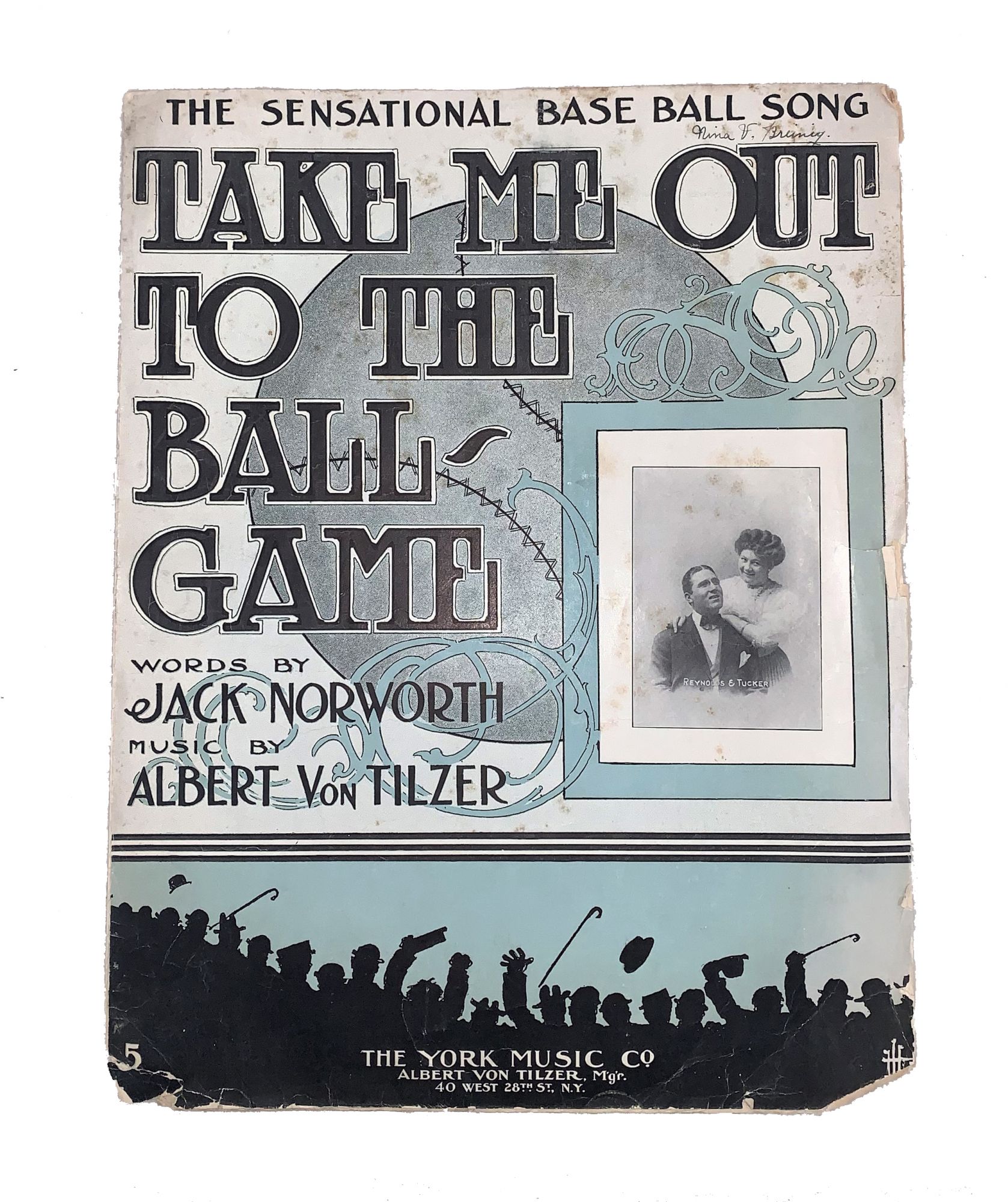
October 24, 1908: Baseball's anthem, "Take Me Out to the Ballgame," is introduced by singer Bill Murray -- no relation to the later actor who got his start on Saturday Night Live. At the time the song was written by composer Albert Von Tilzer and lyricist Jack Norworth (words), neither had ever seen a game. But Norworth had seen an advertising sign on the new (opened 1904) New York Subway:
BASE BALL
TO-DAY
POLO GROUNDS

And he was inspired to write a song about an Irish girl -- apparently his favorite subject, as so many of his songs had an Irish theme, not surprising for New York City at that time:

Katie Casey was baseball mad.
Had the fever and had it bad.

Just to root for her hometown crew
every sou, Katie blew.

On a Saturday, her young beau
called to see if she'd like to go
to see a show
but Miss Kate said no,
I'll tell you what you can do:

Take me out to the ballgame.
Take me out with the crowd.

Buy me some peanuts and Cracker Jack.
I don't care if I never get back.
Let me root, root, root for the home team.
If they don't win, it's a shame.
For it's one, two, three strikes, you're out
at the old ballgame.

Katie Casey saw all the games.
Knew all the players by their first names.
Told the umpire he was wrong,
all along, good and strong.

When the score was just two to two,
Katie Casey, she had the clue.

Just to cheer up the boys she knew,
She made the gang sing this song.


Take me out to the ballgame.
Take me out with the crowd.

Buy me some peanuts and Cracker Jack.
I don't care if I never get back.
Let me root, root, root for the home team.
If they don't win, it's a shame.
For it's one, two, three strikes, you're out
at the old ballgame.

A "sou" is a penny. Sometimes that archaic lyric is changed to "Every cent, Katie spent."
Norworth probably named her after the title character in the most famous baseball poem, "Casey at the Bat," written in 1888 and thus still relatively new. In 1927, Norworth rewrote the song, and the girl subject became Nellie Kelly -- a better rhyme, and still Irish. But most people don't even know there are verses: They only sing the chorus.
Edward Meeker made the first recording, but Murray appears to have been the first to sing it live. Murray had also recorded "Tessie," which became a ballpark chant for Boston Red Sox fans in 1903. Ironically, Murray was a fan of the New York Highlanders, the team that would become the Yankees. In an even greater irony, Von Tilzer didn't see a live major league game until 1928, and Norworth didn't until 1940.

It apparently took until 1934 for the song to be played at a major league game. In 1976, Chicago White Sox owner Bill Veeck noticed that, while organist Nancy Faust was playing it during the 7th Inning Stretch, broadcaster Harry Caray was leaning out of the press box, and inviting fans to sing the song with him. So Veeck piped Harry and the fans into the public-address system at Comiskey Park, and a tradition was born.

Harry took it with him across town to Wrigley Field, and, with the Cubs' partnership with cable-TV "superstation" WGN, made the singing of that song at that stage of the game a national phenomenon. (And probably saved Wrigley for at least 2 more generations.)

Unfortunately, Harry always got the words wrong, and, to this day, the celebrities the Cubs have brought on to sing it in Harry's place since his death in 1998 -- including that other Bill Murray, a noted Cub fan -- have repeated his mistakes: They sing, "Take me out to the crowd," and, "I don't care if I ever get back."

In 1994, I heard it played at Mercer County Waterfront Park (now Arm & Hammer Park), home of the Trenton Thunder of the Class AA Eastern League. The Thunder didn't do too well in that 1st season of professional baseball in New Jersey in the modern era, and it inspired me to sing, "I don't think this team's gonna come back, for it's root, root, root for the home team, if they don't win, it's the same."

*

October 24, 1908 was a Saturday. The only games played on this day were in college football. Some of them:

* The Carlisle Indian School, outside Harrisburg, Pennsylvania, made an early inroads into public consciousness, achieving a 6-6 tie with the University of Pennsylvania at the original Franklin Field. A freshman named Jim Thorpe scored Carlisle's touchdown, but also missed 3 field goals, any one of which could have won the game. Both teams had come into the game unbeaten: Carlisle at 5-0, Penn at 7-0.

* Another matchup of unbeatens took place at Worden Field, on the campus of the U.S. Naval Academy in Annapolis, Maryland. Navy played Harvard University, and this one also ended in a 6-6 tie.

* Yale University beat Washington and Jefferson University, 38-0 at Yale Field in New Haven, Connecticut.

* The University of Pittsburgh beat Bucknell University, 22-0 at Exposition Park in Pittsburgh, home of the Pittsburgh Pirates -- until the following June 30, when Forbes Field opened.

* Michigan beat Ohio State, 10-6 at Ohio Field in Columbus.

* Georgia Tech beat Alabama, 11-6 at Ponce de Leon Park in Atlanta, home of minor-league baseball's Atlanta Crackers.

* In New York City, Fordham and New York University were idle.

* In New Jersey, Rutgers lost to Haverford College, 9-5 in the Philadelphia suburb of Haverford, Pennsylvania. Princeton played the next day, held to a 0-0 tie by Syracuse at University Field in Princeton.

In that other kind of football, Woolwich Arsenal beat Manchester-area team Bury, 4-0 at the Manor Ground in Plumstead, Kent, now part of Southeast London.

Thursday, October 6, 2022

October 6, 1927: The First Talking Movie

October 6, 1927: The Jazz Singer premieres, starring the biggest stage star of the Roaring Twenties, Al Jolson. It is directed by Alan Crosland, with a screenplay by Alfred A. Cohn, based on a 1925 play of the same title by Samson Raphaelson.

Spoiler alerts for a film nearly a century old: The story tells of Jacob Rabinowitz, son of a New York cantor (played by Warner Oland), who wants "Jakie" to follow in his footsteps. He has the talent, but he wants to sing popular music, including the rising form of jazz. So he defies his father, denies his heritage, takes the name "Jack Robin," and becomes a musical star. (Jolson himself had been born Asa Yoelson.) He also meets Mary Dale (May McAvoy), a decidedly non-Jewish woman (known in Yiddish as a shikseh), who becomes his manager and his girlfriend, further enraging his father.

His father tells the congregation, "Now, I have no son." His mother (Eugenie Besserer), watching him sing jazz, is more understanding: "Here he belongs. If God wanted him in His house, He would have kept him there. He's not my boy anymore -- he belongs to the whole world now."

Years later, after Jack's first burst of success, his father falls ill the day before Yom Kippur, the Day of Atonement -- which falls on the same day as the premiere of Jack's big show. He is told that if he doesn't take his father's place at the service, his father will die without his forgiveness; and that if he doesn't sing at the premiere, he'll never get another job.

Presaging the later decisions of baseball stars Hank Greenberg and Sandy Koufax, Jack goes to the synagogue, and sings the Kol Nidre in his father's place. His parents' apartment is close enough to hear, and his father tells his mother, "Mama, we have our son again," and he dies. Apparently, God rewards Jack, because the end of the film shows him a successful singer.

The film is 1 hour and 29 minutes long. At 17 minutes and 25 seconds into it, all of it silent thus far, even in its apparent musical sequences, Jolson speaks words that he tended to say in his stage act: "Wait a minute, wait a minute: You ain't heard nothin' yet, folks!" He then sings the 1st song heard in a sound film, Gus Kahn's "Toot, Toot, Tootsie (Goo' Bye)."

It is often called "the first sound film" or "the first talking picture." It isn't -- Jolson himself had sung in a much shorter film the year before -- but it is the 1st feature-length motion picture with a synchronized recorded music score, and the 1st feature-length motion picture with lip-synchronous speech and singing.

The film's scenes of Jolson, singing Southern songs in blackface, have been parodied and, retroactively, critically assailed. The Southern songs in question are "My Mammy" and "Waiting for the Robert E. Lee" (a steamboat named for the Confederate General). But the film also includes Kaddish, the Jewish prayer for the dead; "Yahrzeit Licht," Irving Berlin's "Blue Skies," and, as mentioned, "Toot, Toot, Tootsie (Goo' Bye)."

Talking pictures was an idea whose time had come. On February 24, 1926, a film version of Giacomo Puccini’s opera La Bohème premiered, starring John Gilbert and Lillian Gish. The fact that a silent film had been made of an opera appears to suggest that the Roaring Twenties didn't understand the concept of irony.

Lights of New York premiered on July 6, 1928. A crime drama, it was the 1st "all-talking" feature-length film. Critics hated it, none more so than Oliver Claxton of The New Yorker: "It would have been better silent, and much better unseen." But it was a box-office smash. By the end of 1929, all movies -- with a few exceptions, such as Charlie Chaplin's City Lights in 1931 and Modern Times in 1936 -- would be "talkies." Chaplin made his 1st talkie in 1940, The Great Dictator, and proved he could be a genius that way, too.

Jolson died in 1950, at the age of 64, already a relic of a bygone age, and no longer an exemplar of Jewish success in America. His death came shortly after he had recorded one last hit song. It was a song from his era, first recorded in 1927. But it would be best known in a 1960 version by Elvis Presley: "Are You Lonesome Tonight?" Yes, Jolson did the spoken-word part in the middle, too, although the words are a little different. As would be said later, Asa Yoelson did have soul.

Eugenie Besserer, born in France and raised in Canada, was Catholic rather than Jewish, and died in 1934. Warner Oland, a Swedish actor who was not Jewish, was also not Chinese, yet he gained fame playing Chinese-American detective Charlie Chan. He died in 1938, while one of his Chan movies was still in progress. It was rewritten to star Hungarian-Jewish actor Peter Lorre as the Japanese secret agent Mr. Moto.

May McAvoy, who had starred in the 1926 silent version of Ben-Hur, continued acting, including having a cameo in the 1959 remake of Ben-Hur, and lived until 1984. Bobby Gordon, who played Jakie as a boy, went on to become a renowned director under the name Robert Gordon, and died in 1990, as the last surviving castmember of The Jazz Singer.

Remakes of The Jazz Singer have been done in 1952 with Danny Thomas (a Maronite Catholic), in 1959 with Jerry Lewis (Jewish, and he brought back one of Jolson's songs, "Rock-a-Bye Your Baby With a Dixie Melody," in 1956 and had a hit with it), and in 1980 with Neil Diamond (Jewish). While quite a few black singers have left "the sanctified church" and Gospel music for jazz, rock and soul, no one has yet thought to remake The Jazz Singer with a black cast.

*

October 6, 1927 was a Thursday. There was only one sporting event of any consequence on the day, but it was of rather large consequence. It was Game 2 of the World Series, at Forbes Field in Pittsburgh. The New York Yankees scored 3 runs in the 2nd inning and 3 more in the 8th, and beat the Pittsburgh Pirates 6-2. Babe Ruth went 0-for-3, but drew a walk and got a run home on a sacrifice fly. Lou Gehrig went 1-for-3 with a walk. George Pipgras was the winning pitcher. The Yankees went on to sweep the Series in 4 straight.

Monday, July 11, 2022

July 11, 1937: George Gershwin Dies

July 11, 1937: George Gershwin dies of a brain tumor in Los Angeles. He was 38 years old, and had been complaining about headaches since February. He had also been experiencing mood swings, concerning those who knew him, but he refused to seek medical treatment.

Born Jacob Bruskin Gershowitz on September 26, 1898 in Brooklyn, the late New York Daily News columnist Sidney Zion once mistakenly put him in a group he called "The Century Seven," 7 people who had been born in 1899, at the end of the 19th Century, who shaped American popular culture in the 20th Century. The others were:

* Edward Kennedy "Duke" Ellington, born April 29 in Washington, D.C., jazz composer and bandleader.
* Frederick Austerlitz, a.k.a. Fred Astaire, born May 10 in Omaha, Nebraska, actor-singer-dancer.
* James Francis Cagney Jr., born July 17 in Manhattan, actor-singer-dancer.
* Ernest Miller Hemingway, born July 21 outside Chicago in Oak Park, Illinois, novelist.
* Hoagland Howard "Hoagy" Carmichael, born November 22 in Bloomington, Indiana, songwriter.
* Humphrey DeForest Bogart, born December 25 in Manhattan.

(Zion could also have named film producer Irving Thalberg; or actresses Gloria Swanson and Gertrude Berg; or writers Vladimir Nabokov, E.B. White and Hart Crane, but didn't. Nor did he name Al Capone. Nor did he name another major mover of intoxicating liquor, Gussie Busch. He could have stretched it, and named film director Alfred Hitchcock and playwright Noël Coward, 2 Englishmen who did their best work in America, but didn't. Astaire was the last survivor of Zion's "Century Seven," living until 1987.)

Jacob Gershowitz changed his first name to "George" and his surname to "Gershwin" when he went into the music business. His siblings followed suit, including his brother Ira, with whom he wrote many of this songs. In spite of the change, he -- as did Israel Baline, a.k.a. Irving Berlin -- became an icon for first-generation American Jews due to his success, beating the establishment at what had been their game.

Like so many New York-based songwriters of the time, he got an office on West 28th Street between 5th and 6th Avenues, a block whose sound of cheap pianos earned it the nickname "Tin Pan Alley." Gershwin had his first hit in 1916, and in 1919 wrote the melody for "Swanee," with lyrics by Irving Caesar. Al Jolson, the biggest Broadway star of the time, heard Gershwin sing it at a party, recorded it, and made himself a star.

From our perspective in the early 21st Century, it seems as though the term "The Great American Songbook" is pretty much half made up of songs written by Irving Berlin, Cole Porter and George Gershwin in the 1920s and '30s. George, mostly but not all with Ira, wrote a lot of musicals that are now almost completely forgotten (and eminently forgettable), except for one or two songs, but those songs survive nearly a century later -- not unlike a lot of rock and roll albums of the 1960s and '70s are forgettable except for one hit.

"Fascinating Rhythm" from Lady, Be Good in 1924 (featuring Astaire and his sister and sometime dance partner Adele Astaire). "That Certain Feeling" from Tip-Toes in 1925. "Someone to Watch Over Me" from Oh, Kay! in 1926. "The Man I Love" from Strike Up the Band in 1927. "Funny Face," "S Wonderful" and "Let's Kiss and Make Up" from Funny Face in 1927 (again featuring the Astaires). "(I've Got a) Crush On You" from Treasure Girl in 1928. "Embraceable You," "I Got Rhythm" and "But Not For Me" from Girl Crazy in 1930 (helping to launch the careers of both Ginger Rogers, later Fred Astaire's best-known dance partner, and Ethel Merman). "Who Could Ask for Anything More?" from Of Thee I Sing in 1931. "Summertime," "I Got Plenty o' Nuttin'" and "It Ain't Necessarily So" from Porgy and Bess in 1935.

Admit it: You've never heard of most of the musicals, which were cheap to produce, and designed pretty much to market the songs, selling the sheet music and the eventual original cast recordings. But you've heard the songs.

Gershwin knew that those cheap musicals were going to pay the bills, but he also knew that he wanted to make a mark on serious music. On February 12, 1924, he debuted his composition Rhapsody in Blue, and it became one of the premier pieces of 20th Century American classical music. So did Porgy and Bess, which he wrote in 1935. It wasn't just a musical, it was an opera -- with an all-black cast. Maybe the stereotypes look bad, 87 years later, but, for the time, this was a revolutionary production. So by going into classical music, Gershwin changed American music twice.

Gershwin never married, and, despite the work of a prominent hoaxster claiming to be his son and thus demanding a share of his song royalties, is not known to have had any children. Given these facts, and the nature of Broadway, both musical and nonmusical, it has been suspected that Gershwin was gay. (Cole Porter and Noël Coward were, but, as far as I know, none of the others I mentioned were.) But this wasn't true: He had a long-term affair with a fellow composer, Kay Swift, even titling Oh, Kay! after her. But his mother, Rose, put the kibosh on him marrying a woman who wasn't Jewish, so they never got hitched. She remained lifelong friends with Ira. (Ira lived until 1983, Kay until 1993.) 

Gershwin died 2 months after the premiere of the film Shall We Dance, starring Fred Astaire and Ginger Rogers, which had 2 songs that get remembered today: "Let's Call the Whole Thing Off" ("You say to-may-to, I say to-mah-to," and so on), and "They Can't Take that Away From Me."

Given only the titles, and his subsequent death, it brings to mind such later songs recorded by big names right before they died: Hank Williams' "I'll Never Get Out of This World Alive," Buddy Holly's "It Doesn't Matter Anymore," Eddie Cochran's "Three Steps to Heaven," and Elvis Presley's version of "My Way." And, of course, the cruel twist on the preceding, John Lennon's "(Just Like) Starting Over."

Given that Berlin and Porter were still writing music after the dawn of rock and roll in the 1950s, and that some of Gershwin's songs were adapted and turned into hits by rock groups, I have no doubt that he could have adapted his own work and still been at it into his 60s, or even his 70s, possibly changing American music for a 3rd time.

So his death at age 38 hit show business, both Broadway and Hollywood, hard. He was one of the men who made the Roaring Twenties roar, and helped people get through the Great Depression was that still ongoing when he died. 

John O'Hara, a friend and a prominent author of short stories, was in denial, saying, "George Gershwin died in July 11, 1937, but I don't have to believe it if I don't want to."

*

That date was a Sunday. It was the off-season for the NFL and the NHL, and the NBA hadn't yet been founded. But a full slate of Major League Baseball games was played.

* The New York Yankees beat the Washington Senators, 4-3 at Yankee Stadium. Lou Gehrig and Bill Dickey hit home runs in support of Lefty Gomez. This was the 1st game of a doubleheader. The 2nd game was called after 9 innings due to darkness, 5-5.

Like Gershwin, Gehrig was a New York native that made it big in his chosen field in his hometown, and died young, not quite 38.

When Ken Burns made his miniseries Baseball in the early 1990s, he chose Gershwin's Rhapsody in Blue as the background music for the segment about the opening of the original Yankee Stadium in 1923, even though the composition debuted the following year, simply because the piece has become so identified with New York in the years between the World Wars, what has become known as "Heroic New York." The Gershwin brothers, Gehrig and Babe Ruth (retired by this point, but hitting the 1st homer in the Stadium in 1923) were all a part of that.

* New York's National League arch-rivals squared off in a doubleheader at Ebbets Field in Brooklyn. The New York Giants swept it, beating the Brooklyn Dodgers 10-4 in the 1st game, and 5-1 in the 2nd game.

* A doubleheader was split at Braves Field in Boston -- nicknamed "The Bee Hive," since this was during the brief period that the Boston Braves were officially the Boston Bees. The lost the opener to the Philadelphia Phillies, 10-4. But they won the 2nd game, 1-0, on a suicide squeeze bunt in the 13th inning by Bees catcher Al Lopez, later to manage both the Indians and the White Sox to Pennants. It broke up a great pitching duel between Boston's Lou Fette and Philadelphia's Syl Johnson, who both went the distance.

* It was also a doubleheader between Boston and Philadelphia in the American League, at Shibe Park in North Philly. The Boston Red Sox swept the Philadelphia Athletics, winning the 1st game 9-4, and the 2nd game 8-2.

* The Pittsburgh Pirates beat the Chicago Cubs, 3-2 at Forbes Field in Pittsburgh.

* The Detroit Tigers beat the Cleveland Indians, 3-2 at Navin Field in Detroit. The following season, the ballpark would be expanded into its more familiar shape, and renamed Briggs Stadium. It was renamed Tiger Stadium in 1961.

* A doubleheader was split at Comiskey Park in Chicago. The St. Louis Browns won the 1st game 4-1, and the Chicago White Sox won the 2nd game 4-3.

* The Browns still fared better than their tenants did. The St. Louis Cardinals not only got swept by the Cincinnati Reds  at Sportsman's Park in St. Louis, they got shut out, 6-0 and 7-0. Roy "Peaches" Davis allowed 9 hits and 4 walks in the opener, but kept the shutout. Al Hollingsworth pitched a 6-hit shutout in the nightcap. 

December 31, 1999 & January 1, 2000: The Millennium

December 31, 1999:  The Millennium arrives. The people of planet Earth survived. At a terrible cost. But we hadn't destroyed ourselves. ...