Showing posts with label radio. Show all posts

Saturday, December 24, 2022

December 24, 1906: The 1st Radio Broadcast

Reginald Aubrey Fessenden

December 24, 1906: The first radio broadcast for entertainment and music to the general public was transmitted from Brant Rock, in Marshfield, Massachusetts, about 30 miles southeast of Boston.

This pioneering broadcast was achieved after years of development work by Reginald Aubrey Fessenden (1866-1932), who built a complete system of wireless transmission and reception using amplitude modulation (AM) of continuous electromagnetic waves. This technology was a revolutionary departure from transmission of dots and dashes widespread at the time.

Fessenden played "O Holy Night" on his violin, read the Gospel of Luke's account of the birth of Christ, and played George Friderich Handel's "Largo" from a phonograph.

*

December 24, 1906 was a Monday. Baseball was out of season. Football was played on Christmas Day at the time, but not on Christmas Eve. Basketball barely existed. Later in the week, the Stanley Cup was won. It was a two-games-total-goals series, at the Montreal Arena. The Montreal Wanderers, defending Champions, known as "The Little Men of Iron," beat the New Glasgow Cubs, a team from Nova Scotia, 10-3 on December 27; and again, 7-2, on December 29.

Friday, December 23, 2022

December 23, 1947: Bell Labs Invents the Transistor

The 1st working transistor. Yes, it has been preserved.

December 23, 1947: Bell Telephone Laboratories, or Bell Labs for short, announces the invention of the transistor at its headquarters at Murray Hill, in the Township of Berkeley Heights, Union County, New Jersey.

According to Wikipedia:

transistor is a semiconductor device used to amplify or switch electrical signals and power. The transistor is one of the basic building blocks of modern electronics. It is composed of semiconductor material, usually with at least three terminals for connection to an electronic circuit. A voltage or current applied to one pair of the transistor's terminals controls the current through another pair of terminals. Because the controlled (output) power can be higher than the controlling (input) power, a transistor can amplify a signal. Some transistors are packaged individually, but many more are found embedded in integrated circuits...

The first working device to be built was a point-contact transistor invented in 1947 by American physicists John Bardeen and Walter Brattain while working under William Shockley at Bell Labs. The three shared the 1956 Nobel Prize in Physics for their achievement...

Transistors revolutionized the field of electronics, and paved the way for smaller and cheaper radios, calculators, and computers, among other things.

Left to right: John Bardeen, William Shockley, Walter Brattain

In 1960, Shockley was 1 of 15 scientists who were shown on the cover and listed as stand-ins for all American scientists as Time magazine's Men of the Year. Their explanation: "Science is at the apogee of its power for good or evil." It did note that "the 15 men include two or three whose greatest work is probably behind them."

The others were: Geneticist George Beadle, spacecraft engineer Charles Draper, virologist John Enders; biologists Joshua Lederberg, Linus Pauling and Robert Woodward; and physicists Donald Glaser, Willard Libby, Edward Purcell, Isidor Rabi, Emilio Segrè, Charles Townes, James Van Allen, and Edward Teller, co-inventor of the hydrogen bomb.

In 1963, Shockley went west, teaching at Stanford University between San Francisco and San Jose, leading to the region being known as Silicon Valley, for the element used in most transistors. Sadly, he also began to use his brilliant mind to pass off twisted theories of eugenics. He argued that black people were genetically inferior to white people, and that no amount of social assistance from government would make any difference.

In 1981, a science writer for the Atlanta Constitution compared Shockley's beliefs with those of the Nazis. Shockley sued for libel. He won the case, and was awarded one dollar in damages. In other words, the damage done was to his ego, for he had already damaged his own reputation with his statements. He died in 1989.

Nevertheless, we owe these 3 men a great deal, for all the technology that transistors have made possible -- including the transistor radios on which we've listened to sporting events and the Top 40 songs.

Bardeen won a 2nd Nobel Prize in 1972, with Leon Cooper and John R. Schrieffer, for a fundamental theory of conventional superconductivity. He lived until 1991. Brattain died in 1987.

The court-ordered breakup of AT&T led to the 2007 loss of Bell Labs to the company. The Labs are now run by a competitor, Japanese company Nokia.

*

December 23, 1947 was a Tuesday. Baseball was out of season. The NFL was leading up to its Championship Game. In the Basketball Association of America, the league that would become the NBA 2 years later, 2 games were played. The New York Knicks lost to the Providence Steamrollers, 66-58 at the Rhode Island Auditorium in Providence. And the Chicago Stags beat the Boston Celtics, 83-75 at the Boston Garden.

Of course, you've heard of the Knicks and the Celtics. In contrast, unless you really know your basketball history, you don't know about the Steamrollers and the Stags -- because they folded in 1949 and 1950, respectively.

One game was played in the NHL, and you'll recognize the names of both teams, even if you're not used to "Black Hawks" being 2 words, as it officially was from 1926 until 1986. The Chicago Black Hawks beat the New York Rangers, 7-1 at the Chicago Stadium. The Hawks got 2 goals each from Metro Prystai and Red Hamill. No, that's not the Moscow subway and a Commie version of Luke Skywalker. 

Sunday, December 11, 2022

December 12, 1901: The 1st Transatlantic Radio Signal

December 12, 1901: Guglielmo Marconi receives the 1st transatlantic radio signal.

He had been working on "wireless telegraphy" since 1894, only 20 years old. By 1895, he was able to transmit signals up to 2 miles. He moved from his native Bologna, Italy to England in 1896, and on March 13, 1897, he sent the first wireless communication over an open sea, the Bristol Channel, from Flat Holm Island in England to Lavernock Point near Cardiff, Wales. It was only 3.7 miles, but he successfully sent the message, "Are you ready." That convinced the British government to fund his efforts, and, by the end of the year, he had stretched the possible reception distance to 10 miles.

Marconi was able to stretch his signals longer and longer. Finally, in 1901, he set up a station in Poldhu in Cornwall, southwestern England, and another in Clifden, County Galway, Ireland, to help stretch the signal. So now, he was covered at the westernmost points in the British Isles. He went to the already aptly-named Signal Hill in St. John's, Newfoundland and Labrador, the easternmost city in North America, and set up a station there, in an abandoned hospital, which has since been destroyed by fire.

On December 14, he released a statement, revealing the details of his experiment, 2 days earlier, successfully sending a signal 1,700 miles:

On arriving in Newfoundland and installing my station on Signal Hill, the entrance to St. John's, I sent up kites every day this week with the vertical aerial wire appended, by which our signals are received. I had previously cabled to Cornwall Station to begin sending the prearranged signal.

Tuesday my kite broke away and nothing resulted. Wednesday, however, I had better luck. My arrangement was for Cornwall to send at five-minute intervals between 3 and 6 o'clock p.m. the Morse letter 'S', which consists of three dots. The hours named were equivalent to from noon to 3 p.m. at St. Johns, and on Wednesday, during the hours, myself and my two assistants received these signals under such conditions as assured us they were genuine.

On Thursday, we tried again during the same hours and were again rewarded with audible signals, though fainter than on Wednesday.

This was a huge step forward in the development of radio transmission. Soon, it became possible to transmit between land and ships in the middle of the ocean. In 1912, radio played a part in the rescue of the Titanic survivors. By 1920, radio broadcasting was possible.

*

December 12, 1901 was a Thursday. Baseball was out of season. Football season had ended 3 weeks before. Basketball barely existed. Hockey was still all-amateur, and I have no record of games played that day. I can say that the Winnipeg Victorias would win the Stanley Cup the following March 17. No Winnipeg-based, or even Manitoba-based, team has won the Cup since.

Monday, November 21, 2022

November 21, 1959: The "Payola" Scandal

November 21, 1959: Alan Freed is fired by New York radio station WABC. More than any other disc jockey, he was a symbol of rock and roll. Now, more than any other disc jockey, he becomes a symbol of "the Payola Scandal."

Aware of their rising status in the new era of rock and roll, disc jockeys established flat rate deals with labels and record distributors. A typical deal for a mid-level DJ was $50 a week, per record, to ensure a minimum amount of spins -- about $506 in 2022 money. More influential jocks commanded percentages of grosses for local concerts, lavish trips, free records by the boxful, plus all the time-honored swag. Some even opened their own record stores. As Cleveland DJ Joe Finan later described the decade, "It was a blur of booze, broads and bribes."

As payola escalated, the weekly "trade publications" Variety and Billboard did lengthy features, calling for reform and government intervention. To its credit, Billboard wrote, "The cancer of payola cannot be pinned on rock 'n' roll." Though they may have been thinking about their own skin: Rock and roll (or "rock 'n' roll") meant big sales, and thus big money, for them, too.

ASCAP (the American Society of Composers, Authors, and Publishers) were also vocal in their opposition to payola, using it as a means to lambaste their competitor, BMI (Broadcast Music, Inc.). At the time, the larger ASCAP represented the old guard of mostly white composers from the Tin Pan Alley days. BMI was associated with the young, racially mixed writers of R&B and rock and roll, as well as indie labels such as Aladdin, King and Chess. By the mid-1950s, BMI single releases outnumbered ASCAP's by almost 2 to 1. The older organization cried foul, accusing BMI of promoting payola.

Fingers pointed and words flew over payola, but it wasn't until the TV quiz show scandals of 1958 that the government got seriously involved. Once the "Do you now, or have you ever... ?" questions began, the jig was up.

With the threat of losing their licenses, some radio stations took the precaution of firing disc jockeys who might put them at risk. In November 1959, in closed and open sessions before the U.S. House of Representatives' Oversight Committee, 335 disc jockeys from around the country admitted to having received over $263,000 in "consulting fees." That figure was only the tip of the payola iceberg: Before the hearings, Phil Lind, a DJ at Chicago station WAIT, had confessed that he had once taken $22,000 to play a single record.

The trial heated up when the two most influential jocks in the country took the stand. Alan Freed and Dick Clark both played important parts in the rise of rock and roll. Freed embodied the incendiary spirit of the music more than Clark, refusing to play white cover versions of black songs, such as Pat Boone's version of Little Richard's "Tutti Frutti." And, though they both denied ever accepting payola, it's almost impossible to imagine two young, popular jocks not succumbing to a little temptation. Guilty or not, it was Freed who ended up taking the fall for DJs everywhere.

Why did the committee single him out? Freed was abrasive. He consorted with black R&B musicians. He jive-talked, smoked like a chimney, drank like a fish, screwed like a rabbit, and looked like an insomniac. He was also Jewish, and this was the 1950s. Clark was Protestant, squeaky-clean, Brylcreemed, handsome and polite. At least, on the surface. (It was the quiz show scandal's comparison of Herbert Stempel and Charles Van Doren all over again.)

Once the grilling started, Freed's friends and allies in broadcasting quickly and cowardly deserted him. He refused -- "on principle," he said -- to sign an affidavit saying that he'd never accepted payola. WABC, who took him on after WINS fired him in 1958, fired him, and he was charged with 26 counts of commercial bribery.

Freed escaped with fines and a suspended jail sentence. But he drank himself into commercial oblivion and health crisis. He died on January 20, 1965, only 43 years old, broke and virtually forgotten. He would not be "rediscovered" until the early 1970s, when the nostalgia wave for the 1950s got underway.

Before the trial, Clark divested himself of all incriminating connections. He had part ownership in seven indie labels, six publishers, three record distributors and two talent agencies. He got a slap on the wrist by the Committee's Chairman, Oren Harris, who called him "a fine young man." (A Democrat from the Southern State of Arkansas, he never would have said that of Freed.)

As Clark told Rolling Stone in 1989, the lesson he learned from the payola trial was: "Protect your ass at all times." Surprisingly candid words from the man who eventually became known as "The World's Oldest Teenager."

Congress amended the Federal Communications Act to outlaw "under-the-table payments and require broadcasters to disclose if airplay for a song has been purchased." Payola became a misdemeanor, with a penalty of up to $10,000 in fines and one year in prison.

The loophole in the legislation was that it didn’t say anything about "undisclosed payments." And so payola joined the cockroach and the Republican Party on the list of things that, despite changing times, always manage to survive and come back.

*

November 21, 1959 was a Saturday. Baseball season was over. The college football season was reaching its climax, with the 8-day rivalry week starting on this day. These were among the games played:

* Number 1 Syracuse beat Boston University, 46-0 at Nickerson Field in Boston. 'Cuse went undefeated, led by sophomore running back Ernie Davis, who, 2 years later, would become the 1st black player to win the Heisman Trophy.

* Number 2 University of Mississippi (Ole Miss) were idle.

* Rivalry: Number 3 Louisiana State University (LSU) beat Tulane, 14-6 at Tiger Stadium in Baton Rouge, Louisiana. Three weeks earlier, on a foggy Halloween Night, they were ranked Number 1, and beat Ole Miss, then Number 3. But LSU lost to Tennessee the next week, costing them the Southeastern Conference (SEC) title. When SEC Champion Georgia accepted the Orange Bowl bid, the Sugar Bowl set up an Ole Miss-LSU rematch, which Ole Miss won.

* Rivalry: Number 4 University of Southern California (USC) were upset by the University of California at Los Angeles (UCLA), 10-3 at their shared home field, the Los Angeles Memorial Coliseum. This loss cost USC the title  of the Athletic Association of Western Universities (AAWU, forerunner of the Pac-12), a bid to the Rose Bowl, and a shot at the National Championship.

* Number 5 Texas were idle. They won the Southwest Conference title, but lost the Cotton Bowl to Syracuse, giving the Orangemen the National Championship.

* Number 6 Georgia were idle. They won the SEC title, which would normally have put them in the Sugar Bowl. Instead, they accepted a bid to the Orange Bowl.

* Rivalry: Number 7 Penn State lost to the University of Pittsburgh, 22-7 at Pitt Stadium in Pittsburgh.

* Rivalry: Number 8 Northwestern, unusually favored in this game, were upset by Illinois, 20-0 at Memorial Stadium in Champaign, Illinois. This was Northwestern's 3rd straight loss, after starting the season 6-0. Unlike the many flops of the Chicago Cubs, this is one Chicago-area flop nobody ever talks about.

* Rivalry: Number 9 Wisconsin beat Minnesota, 11-7 at Memorial Stadium in Minneapolis. Wisconsin won the Big Ten Conference title.

* Number 10 Texas Christian University (TCU) beat Rice University, 35-6 at Amon G. Carter Stadium in Fort Worth, Texas.

* Rivalry: Number 14 Washington beat Washington State, 20-0 at Husky Stadium in Seattle. Washington won the AAWU title, and beat Wisconsin in the Rose Bowl.

* Rivalry: Number 15 Oregon were upset by Oregon State, 15-7 at Hayward Field in Eugene, Oregon.

* Number 16 Iowa were upset by Notre Dame, 20-19 at Iowa Stadium (later Kinnick Stadium) in Iowa City.

* Rivalry: Number 20 Tennessee were upset by Kentucky, 20-0 at McLean Stadium in Lexington, Kentucky.

* Oklahoma beat Iowa State, 35-12 at Memorial Stadium in Norman, Oklahoma. Oklahoma won the Big Seven Conference title (Oklahoma State soon joined, making it a Big Eight), but were on probation, and couldn't accept the Orange Bowl's usual invitation to the league Champion.

* Rivalry: Missouri beat Kansas, 13-9 at Memorial Stadium in Lawrence, Kansas. As the 2nd-place team in the Big Seven (Oklahoma had beaten them), Missouri accepted the Orange Bowl's bid. Georgia beat them.

* Rivalry: Harvard beat Yale, 35-6 at the Yale Bowl in New Haven, Connecticut.

* Rivalry: Maryland beat Virginia, 55-12 at Byrd Stadium (now SECU Stadium) in the Washington suburb of College Park, Maryland.

* Rivalry: Florida beat Florida State, 18-8 at Florida Field in Gainesville.

* Rivalry: Michigan beat Ohio State, 23-14 at Michigan Stadium in Ann Arbor.

* Rivalry: Purdue beat Indiana, 10-7 at the original Memorial Stadium (which was replaced by the current one the next season) in Bloomington, Indiana.

* Rivalry: Utah beat Utah State, 35-21 at Ute Stadium (later Robert Rice Stadium) in Salt Lake City.

* Rivalry: The University of California beat Stanford, 20-17 at Stanford Stadium in Palo Alto, California.

* Air Force were the only service academy in action, losing to New Mexico, 28-27 at Denver University Stadium in Denver. Army and Navy had the week off, preparing to play each other in Philadelphia. Navy won.

* And among New Jersey schools, Rutgers lost to Columbia, 26-16 at Baker Field in Upper Manhattan; while Princeton lost to Dartmouth, 12-7 at Palmer Stadium in Princeton. 

There were 4 games played in the NBA:

* The New York Knicks lost to the Boston Celtics, 128-127 at the old Madison Square Garden.

* The Syracuse Nationals beat the Philadelphia Warriors, 116-107 at the Onondaga County War Memorial (now the Upstate Medical University Arena) in Syracuse, New York.

* The Minneapolis Lakers beat the Cincinnati Royals, 99-93 in overtime at the Cincinnati Gardens.

* And the Detroit Pistons beat the St. Louis Hawks, 109-107 at the Kiel Auditorium in St. Louis.

There were 2 games in the NHL. The Montreal Canadiens beat the Toronto Maple Leafs, 4-1 at Maple Leaf Gardens in Toronto. And the Boston Bruins and the Detroit Red Wings played to a tie, 3-3 at the Boston Garden. The New York Rangers and the Chicago Black Hawks were not scheduled.

And in English soccer, Arsenal, the North London team I would one day support, beat Chelsea, 3-1 at Stamford Bridge in West London.

November 21, 1941: America's Longest-Running Daily Radio Broadcast

Sonny Boy Williamson II

November 21, 1941: The first broadcast of King Biscuit Time airs on KFFA in Helena, Arkansas, sponsored by King Biscuit Flour, and features the African-American blues artists Sonny Boy Williamson and Robert Lockwood, Jr. They play live in the studio. and are the key musicians in the original studio band, the King Biscuit Entertainers.

The original Sonny Boy Williamson was John Lee Curtis Williamson, born in 1914 in rural Tennessee. He is often regarded as the pioneer of the harmonica, or "blues harp," as a solo instrument. He played on hundreds of recordings by many pre–World War II blues artists. Under his own name, he was one of the most recorded blues musicians of the 1930s and 1940s. Unfortunately, he was an innocent bystander in a shootout in the aftermath of a robbery in Chicago in 1948. He was 34 years old.

For some musical personalities, death turned out to be "a great career move." Not for him: Even while he was still alive, another harmonica player came along, calling himself many things. By 1941, he was using the name "Rice Miller." But KFFA decided to capitalize on the established bluesman's name -- in other words, to commit fraud -- and billed Miller as "Sonny Boy Williamson," even though Sonny Boy was very much still alive and active.

It didn't help that this new "Sonny Boy" had clouded origins: He previously used several names, most often Aleck Miller, and also Aleck Ford, which may or may not have been his birth name; his place of birth is usually cited as in Mississippi, although no one is sure of where in the State; and his date of birth has been cited as anywhere from 1897 to 1912, any of which would make him older. 

It was a while before people realized this new "Sonny Boy" wasn't the same guy. And he ended up being more famous, just as pool player Rudolf Wanderone became more famous using the name "Minnesota Fats," taken from the Jackie Gleason character in the film The Hustler, than the film itself became. He died in 1965.

To differentiate them, they are usually assigned Roman numerals: The first one is sometimes listed as "Sonny Boy Williamson I," and the second one as "Sonny Boy Williamson II." Beyond any question, the 2nd one was the one who performed on the early King Biscuit Time.

King Biscuit Time is still broadcast on KFFA every weekday. It is the longest-running daily radio broadcast in American history.

*

November 21, 1941 was a Friday. Actress Juliet Mills was born. So was Dave Porter, who, with Sam Moore, formed the soul-singing duo Sam & Dave.

Baseball was out of season. The NBA hadn't been founded yet. And no games were scheduled in the NHL. There were 2 college football games played. The University of Miami beat South Carolina, 7-6 at Burdine Stadium in Miami, the stadium that would one day be renamed the Orange Bowl. And Texas Tech beat Hardin-Simmons, 7-0 at Tech Field (now Jones AT&T Stadium) in Lubbock, Texas.

Sunday, October 30, 2022

October 30, 1938: Orson Welles' "War of the Worlds"

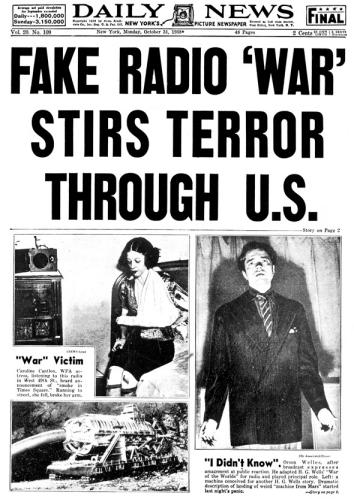
October 30, 1938: The CBS radio show The Mercury Theater of the Air airs an adaptation of H.G. Wells' novel The War of the Worlds. (In New York, it went over the network's flagship station, WCBS, 880 on the AM dial.)

Wells' story first appeared in London-based Pearson's Magazine in 1897. That same year, in America, Cosmopolitan serialized it. (It was a literary magazine until 1965, when Helen Gurley Brown was named editor, and turned it into a women's magazine.) It appeared in hardcover in 1898.

To make a long story short, with a spoiler: Creatures from the planet Mars invade Earth by attacking the greatest city of the age, late-Victorian London, and terrorize humanity, but soon die due to having no immunity to Earth germs.

It's been filmed in 1953 by George Pal, starring Gene Barry and moving the location to Southern California -- in other words, Hollywood itself -- and in 2005 by Steven Spielberg, starring Tom Cruise and set in New York. In each case, the film was set in what was then the present day.

The 1938 radio version was also set in its present. Howard E. Koch adapted the story for the broadcast, and lead actor Orson Welles (not related to H.G. Wells, note the different spelling), just 23 years old, tells of creatures from Mars landing in Grover's Mill, in the Township of West Windsor, Mercer County, New Jersey. The site is about a mile east of where the Princeton Junction train station now stands, about halfway between Midtown Manhattan and Center City Philadelphia, and 17 miles from East Brunswick, where I grew up.

The story is told as if it were a live news broadcast. While it ends with the Martians dying -- after having devastated New York -- it also ends with Welles, as the surviving Professor Pierson, interviewing a man in Newark, who holds fascist ideals, and wanting to use the Martian weaponry to take over what's left of Earth. It's worth noting that it had been one month since Britain and France caved in to Nazi Germany's demand for Czechoslovakia's Sudetenland. I have listened to the broadcast on YouTube. It clocks in at a little under an hour.

Legend has it that people heard that the alien invaders were killing people and advancing toward New York, panicked, grabbed their shotguns and pitchforks, and evacuated. However, Welles said at the end of every commercial break that it was just a show, not actually happening, and repeated this at the end.

Furthermore, it would have been very easy for people to turn to another radio station -- say, their local NBC affiliate -- and hear regularly-scheduled programming, and not any "special report" of a Martian invasion and attack, and know that everything was as it was before. Welles publicly apologized the next day -- Halloween. But it made him a legend.

In 1941, Welles co-wrote, produced, directed, and starred in Citizen Kane, one of the greatest movies ever made. But because Charles Foster Kane was, despite all denials, an obvious sendup of newspaper baron William Randolph Hearst, Hearst told his media empire, now including film newsreels and radio stations, to blast the film.

Welles never fully recovered, despite making some more good films (The Magnificent Ambersons, The Third Man, Touch of Evil), reduced to a punchline due to his fall from grace, his "slumming" with things like commercials for Paul Masson wine, his wasted genius, and his, uh, geniused waist. He died in 1985, having been mostly irrelevant from ages 26 to 70.
While many sports teams, professional and collegiate alike, have given themselves nicknames of various kinds of warriors, none has ever named itself "The Martians" or "The Aliens." Although the Las Vegas 51s, named for the nearby U.S. Air Force base nicknamed "Area 51," use "the Roswell Alien" as their logo.

*

October 30, 1938 was a Sunday. Baseball season was over. The NBA hadn't been founded yet. And the NHL season wouldn't start for another 4 days. But there were 3 NFL games played that day:

* The football version of the Brooklyn Dodgers played the Washington Redskins to a 6-6 tie at Ebbets Field.

* The Green Bay Packers beat the Cleveland Rams, 28-7 at League Park in Cleveland. The Rams moved to Los Angeles in 1946.

* And the Detroit Lions beat the Chicago Bears, 13-7 at Wrigley Field.

Despite it being a Sunday, there was one notable college football game played: Southern Methodist University (SMU) beat the University of Texas, 7-6 at Ownby Stadium in Dallas.

Tuesday, October 18, 2022

October 18, 1954: The Transistor Radio

October 18, 1954: Texas Instruments announces it has begun production of the 1st transistor radio, the Regency TR-1. Baseball fans everywhere rejoice, for now they can listen to ballgames almost anywhere, from the office to the beach.
Well, they'll have to wait until April 1955 to listen to them, and until Summer 1955 to listen to them on the beach. Maybe they can listen on the beach in April 1955, if they live in California and can get Pacific Coast League broadcasts.
Also on this day, Mort Walker and Dik Browne debut the comic strip Hi & Lois. Separately, Walker created Beetle Bailey (Lois Flagston was Beetle's sister), and Browne created Hagar the Horrible.
*
October 18, 1954 was a Monday. Baseball season had ended 16 days earlier, when the New York Giants swept the Cleveland Indians in the World Series. Football was in midweek: There would be no Monday Night Football for another 16 years. The NBA season began 12 days later. And while the NHL season was underway, no games were scheduled. So there were no scores on this historic day.

Friday, October 7, 2022

October 8, 1921: The 1st Football Game on Radio

The 1921 University of Pittsburgh football team

October 8, 1921: For the 1st time, a football game is broadcast on radio. KDKA in Pittsburgh, who had debuted by broadcasting the previous year's Presidential election results, and earlier this year had become the 1st station to broadcast a baseball game, heads for the gridiron.

Harold Arlin, a foreman at KDKA's parent company Westinghouse, was the announcer., for radio's 1st football game, as he had been 2 months earlier for radio's 1st baseball game. He was an engineer working for the station's owner, the Westinghouse Electric and Manufacturing Company. Although he had no background in the nascent radio industry, or in anything else that required the use of his voice, like stage acting, the company assigned him to call these games.

The opponents are the University of Pittsburgh and West Virginia University, a rivalry later nicknamed The Backyard Brawl, at Forbes Field, home of baseball's Pirates. Pitt wins, 21-13. 
Forbes Field

On September 14, 1923, Arlin became the 1st boxing announcer over radio, going to the Polo Grounds in New York, to announce Jack Dempsey's wild comeback to knock Luis Firpo out and retain the Heavyweight Championship of the World.

But after 1921, Arlin never broadcast the Pirates again. He became known as radio's first celebrity interviewer, conducting interviews with William Jennings Bryan, Lillian Gish, Will Rogers and Babe Ruth. He later moved to Mansfield, Ohio, and ran Westinghouse's plant there. He lived until 1896.

*

October 8, 1921 was a Saturday. Some of the other notable college football games of the day:

* The University of Iowa upset Notre Dame, the defending National Champions, 10-7 at Iowa Field in Iowa City. Iowa Stadium was built in 1929, and was renamed Kinnick Stadium in 1972.

* The University of California, on its way to being declared National Champions for 1921, beat the University of Nevada, 51-6 at California Field in Berkeley. California Memorial Stadium was built 2 years later, on the profits of Cal's "Wonder Team."

* Army beat Lebanon Valley College of Annville, Pennsylvania, 33-0 on The Plain at West Point, New York. Michie Stadium opened in 1924.

* Harvard beat Indiana University, 19-0 at Harvard Stadium in Boston. But 3 weeks later, Harvard would be the victims of a stunning upset, 6-0 at Harvard Stadium, by Centre College of Danville, Kentucky.

* In New York City, Columbia beat Wesleyan University, 14-3 at South Field. Baker Field, on which today's Wien Stadium was built, opened in 1923. Fordham beat the Catholic University of America, based in Washington, D.C., 10-0 at Fordham Field in The Bronx. And New York University lost to Brown, 13-0 at Andrews Field in Providence, Rhode Island. 

* In New Jersey, Princeton beat Colgate, 19-0 at Palmer Stadium. And Rutgers lost to Lehigh, 7-0 at Neilson Field in New Brunswick.

October 8 was an off-day in the World Series, which was played entirely at the Polo Grounds in Upper Manhattan, and which the New York Yankees led over the New York Giants, 2 games to 1. But the Giants would win it, 5 games to 3. This remains the last World Series not to be a best-4-out-of-7.

And Arsenal lost to Sunderland, 1-0 at Roker Park in Sunderland, in the North-East of England. 

Thursday, August 11, 2022

August 11, 1984: President Ronald Reagan Jokes About Starting World War III

August 11, 1984: President Ronald Reagan is preparing for his weekly Saturday morning radio address, with a remote hookup from his home-away-from-home, his Rancho del Cielo (Ranch in the Sky) in Goleta, California.

He was scheduled, as usual, to go on the air at 12:00 Noon, Eastern Time. Since he was in California, on Pacific Time, this meant the address would begin at 9:00 AM. Usually, since Reagan started the weekly tradition in 1982, it started a few minutes late, to give the national networks time to give a short introduction.

Sure enough, this address began at 9:06. It wasn't especially memorable. It began, "My fellow Americans: I'm pleased to tell you that today I signed legislation that will allow student religious groups to begin enjoying a right they've too long been denied: The freedom to meet in public high schools during nonschool hours, just as other student groups are allowed to do."

It was typical Reagan garbage: Pandering to the religious right with something that was blatantly unconstitutional. After all, the Republican was running for re-election, with the Democratic nominee being former Vice President Walter Mondale.

What was not typical was what happened a few minutes before the broadcast. A live feed was being transmitted to radio stations around the country. Many rebroadcasters were already recording the feed, to be ready for the official transmission. Many in the media heard Reagan's impromptu remarks as he gave them, but they were not broadcast live.

Reagan, known for his sense of humor, decided to have a little fun. He said, "All right. My fellow Americans, I'm pleased to tell you today that I've signed legislation that will outlaw Russia forever. We begin bombing in five minutes."

Laughter could be heard. It's not clear who in the room was laughing. Maybe it was everyone.

Ironic: The 1st former actor to become President, the most media-savvy President ever, failed to notice that this joke was being recorded.

He also failed to notice that it wasn't funny at all. War is not funny. Nuclear destruction is not funny. And this son of a bitch was joking about starting World War III.

It took 2 days for the recording to reach the outside world. Mondale took the high road, saying, "A President has to be very, very careful with his words." He did not suggest that Reagan was mentally unstable, or in the throes of dementia. But Reagan's 1994 admission of Alzheimer's disease seemed to confirm what many people were already suspecting 10 years earlier.

On August 14, the Soviet government announced that Reagan's remarks were "unprecedentedly hostile." Soviet forces were placed on high alert, and it took some very careful words from the U.S. Department of State to calm the Soviets down.

I was 14 years old. I couldn't vote for another 4 years. I was convinced that there might not be an election in 4 years. I was hoping that America would recognize that a 73-year-old man either evil enough, crazy enough, or impaired enough to make just such a joke was unacceptable, and that they would then vote for Mondale.

When I went to bed on November 6, 1984, every State except Minnesota had been called, all for Reagan. Minnesota was Mondale's home State, and it hadn't yet been called for him. Only the majority-black District of Columbia had. Or, as comedian Jay Leno put it, "When I went to bed, Mondale had only 3 more Electoral Votes than I did, and I wasn't even running!" Mondale eventually won the State by just 4,000 votes. I have had a great deal of respect for Minnesota ever since.

But Reagan had won, and I was very, very scared.

As it turned out, Reagan's 2nd term was terrible, full of scandal and a hollow prosperity, but did not include a World War III.

Rancho del Cielo is 124 miles northwest of Los Angeles, 90 miles northwest of Reagan's Presidential Library in Simi Valley, 30 miles northwest of Santa Barbara, and 6 miles north of the Pacific Ocean at Refugio Beach. The house was built in 1871, and Reagan bought the ranch in 1974, as his 2nd term as Governor of California was winding down. (While Governors of California are now limited to 2 terms, that was not the case then, but he didn't run for a 3rd term, anyway.)

Reagan had signed his disastrous 1981 tax cut there, and had also entertained many world leaders there, including Britain's Queen Elizabeth II and Prime Minister Margaret Thatcher, and Soviet President Mikhail Gorbachev.

Friends would say of Ronald and Nancy Reagan that the ranch was his house, while any home they had near Hollywood was her house. Due to Reagan's advancing Alzheimer's disease, Nancy sold the property in 1998, to the Young America's Foundation, a conservative group, which maintains it and holds conferences there. It is now open by appointment.

After Reagan, both George Bushes, Bill Clinton and Barack Obama continued the weekly radio address. After 9 months in office, Donald Trump stopped doing it. He thought he was too good to speak to us one Noon a week, every week. Joe Biden resumed the tradition.

*

August 11, 1984 was a Saturday. This was also the day of the Mary Decker-Zola Budd confrontation in the 1984 Olympics. I have a separate entry for that event.

These Major League Baseball games were played that day:

* The New York Yankees beat the Cleveland Indians, 10-1 at Cleveland Municipal Stadium. Mike Pagliarulo and Don Mattingly hit home runs in support of Phil Niekro.

* The New York Mets beat the Pittsburgh Pirates, 3-1 at Shea Stadium. George Foster hit a home run, and Rookie of the Year-in-waiting Dwight Gooden struck out 10 batters.

* The Chicago Cubs beat the Montreal Expos, 2-1 at the Olympic Stadium in Montreal. Pete Rose was available for the Expos, but did not play. Five days later, he was traded to the Reds, and named their manager, and his chase for 4,192 career hits was back on.

* The Philadelphia Phillies beat the St. Louis Cardinals, 6-1 at Veterans Stadium in Philadelphia. Steve Carlton was the winning pitcher. Mike Schmidt was 0-for-3, but had an RBI on a sacrifice fly.

* The San Diego Padres beat the Atlanta Braves, 4-1 at Atlanta-Fulton County Stadium. Graig Nettles hit a home run, and Tony Gwynn went 1-for-4.

* The Toronto Blue Jays beat the Baltimore Orioles, 3-2 at Exhibition Stadium in Toronto. Eddie Murray went 2-for-3, and Cal Ripken went 3-for-4 with an RBI.

* The Houston Astros beat the Cincinnati Reds, 8-4 at Riverfront Stadium in Cincinnati. 

* The Milwaukee Brewers beat the Chicago White Sox, 10-5 at Comiskey Park in Chicago. Robin Yount went 1-for-4, and Paul Molitor was injured and did not play.

* The Detroit Tigers beat the Kansas City Royals, 9-5 at Royals Stadium (now Kauffman Stadium) in Kansas City. George Brett went 2-for-4 with a solo home run.

* The Boston Red Sox beat the Texas Rangers, 5-4 at Arlington Stadium in the Dallas suburb of Arlington, Texas. Wade Boggs went 2-for-5 with an RBI.

* The Oakland Athletics beat the California Angels, 3-2 at Anaheim Stadium (now Angel Stadium of Anaheim). An error by Daryl Sconiers on a Mike Davis grounder gave the A's the winning run in the top of the 10th inning. Neither Reggie Jackson nor Rod Carew entered the game for the Angels. Rickey Henderson went 3-for-6 for the A's.

* The Los Angeles Dodgers beat their arch-rivals, the San Francisco Giants, 4-2 at Candlestick Park in San Francisco.

* And the Seattle Mariners beat the Minnesota Twins, 5-4 at the Kingdome in Seattle. Al Cowens singled home the winning run in the bottom of the 10th.

One other item from baseball: Dominican slugger Melky Cabrera was born on this day.

Friday, August 5, 2022

August 5, 1921: Baseball On Radio

Harold Arlin. Yes, that thing in front of him is a microphone,
not a tiki torch or a giant chesspiece.

August 5, 1921: For the 1st time, a game in what would eventually be called Major League Baseball was broadcast on radio.

Radio station KDKA had gone on the air in Pittsburgh, at 1020 on the AM dial (hence the time of this post), on November 2, 1920, broadcasting election returns, and announcing that Warren G. Harding had been elected President.

So they were a natural to be the 1st station to broadcast baseball. On August 5, they brought their equipment across town to Forbes Field, home of the Pittsburgh Pirates, and set up to broadcast the Pirates' game against their cross-Pennsylvania rivals, the Philadelphia Phillies.

Harold Arlin was the announcer, as he had been for the Election Night debut. Not to be confused with a contemporary, songwriter Harold Arlen, Arlin was an engineer working for the station's owner, the Westinghouse Electric and Manufacturing Company. Although he had no background in the nascent radio industry, or in anything else that required the use of his voice, like stage acting, the company assigned him to call the game.
Forbes Field

The Phillies scored a run in the 1st inning, but the Pirates scored 2 in the 2nd. The Phillies came back with 3 in the 3rd, including a home run by Cy Williams. The Pirates closed to within 4-3 in the bottom of the 5th, and then took a 5-4 lead in the 6th.

The Phillies tied it in the top of the 8th. George "Possum" Whitted led off the bottom of the 8th with a single. James "Cotton" Tierney drew a walk. Three straight singles followed, by Ray Rohwer, Tony Brottem and Jimmy Zinn. This forged the final score: Pirates 8, Phillies 5. Zinn, who pitched 6 innings of relief, was the winning pitcher.
Jimmy Zinn

Westinghouse must have been satisfied with Arlin's work: The next day, they assigned him to become the 1st person to broadcast a tennis match over radio, a Davis Cup match in which Australia beat Great Britain.

On October 8 of that year, he became the 1st football broadcaster, again at Forbes Field, watching the University of Pittsburgh beat West Virginia University 21-13, in a rivalry that would later be known as "The Backyard Brawl." On September 14, 1923, he became the 1st boxing announcer over radio, going to the Polo Grounds in New York, to announce Jack Dempsey's wild comeback to knock Luis Firpo out and retain the Heavyweight Championship of the World.

But after 1921, Arlin never broadcast the Pirates again. He became known as radio's first celebrity interviewer, conducting interviews with William Jennings Bryan, Lillian Gish, Will Rogers and Babe Ruth. He later moved to Mansfield, Ohio, and ran Westinghouse's plant there.

Eventually, radio helped baseball regain popularity during the Great Depression. At first, team owners were afraid to "give away" games, for fear it would cause attendance to drop. The opposite happened: People who were now hearing games for the first time wanted to see them, and they were willing to play.

The Pirates didn't start regular broadcasts of their games until 1934, with Jimmy Murray and Walter E. Sickles. Starting in 1938, their main announcer was Albert "Rosey" Rowswell. When a Pirate hit a home run, he would imagine a little old lady with an apartment window facing Forbes Field, and yell, "Open the window, Aunt Minnie, here it comes!" Then he would smash a light bulb, to simulate the ball breaking Aunt Minnie's window, and say, "Too late!"

In 1947, Rowswell was joined by Bob Prince. Rowswell's last year was 1954: By this point, television began to take over -- KDKA aired Pirate games on Channel 2 -- and fans could see that what was behind the outfield fence at Forbes Field was Schenley Park and the Carnegie Library, not apartments, so Rowswell's Aunt Minnie shtick was no longer any good.

Prince was known as "The Gunner," and one of the great "homers" of baseball broadcasting. His "Gunnerisms" included this line, for when the Pirates, or "Bucs" or "Buccos," came from behind to win: "The Buccos had 'em all the way." A ball just foul was "foul by a gnat's eyelash." And, long before John Sterling began using the phrase with the Yankees, Prince said a two-run deficit was easy to overcome: "We need a bloop and a blast!" If it was three runs, he would make it, "A bleeder, a bloop and a blast!"

In 1969, Steve Arlin, grandson of Harold, became an original San Diego Padre. On June 18, 1972 -- the day after the Watergate break-in -- Steve was penciled in to pitch for the Padres against the Pirates at Three Rivers Stadium. It had been 51 years since Harold Arlin had broadcast a game for the Pirates, and Bob Prince invited him to call the game with him. Steve pitched a 2-hit shutout, and the Padres won, 1-0. Harold died in 1986, age 90; Steve followed in 2016, age 70.
Prince (left) and Arlin, June 18, 1972

Prince was fired after the 1975 season. Unlike Arlin and Rowswell, he received the Baseball Hall of Fame's award for broadcasters. From 1976 to 2008, the voice of the Pirates was Lanny Frattare. His partners included former Pirate pitchers Steve Blass, Jim Rooker and Bob Walk. Walk is still part of a Pirate broadcasting team that also includes Greg Brown, John Wehner, Joe Block, Kevin Young, Matt Capps and Michael McKenry.

*

August 5, 1921 was a Friday. This was the off-season for the NFL and the NHL, and there would be no NBA for another quarter of a century. But these other Major League Baseball games were played:

* The New York Yankees beat the Detroit Tigers, 7-3 at the Polo Grounds. Wally Schang hit a home run. Babe Ruth went 1-for-3, and his hit was just a single, but from right field, he threw a runner out at the plate. Carl Mays was the winning pitcher.

* The New York Giants beat the St. Louis Cardinals, 2-1 at Sportsman's Park in ST. Louis.

* The Brooklyn Robins beat the Cincinnati Reds, 6-1 at Redland Field in Cincinnati. The Robins would go back to their former name of Dodgers in 1922. The following year, Redland Field would be renamed Crosley Field.

* The Philadelphia Athletics beat the St. Louis Browns, 4-2 at Shibe Park in Philadelphia.

* The Washington Senators beat the Cleveland Indians, 4-1 at Griffith Stadium in Washington.

* The Boston Red Sox beat the Chicago White Sox, 10-1 at Fenway Park in Boston.

* And the Boston Braves beat the Chicago Cubs, 6-1 at Cubs Park in Chicago. It was renamed Wrigley Field in 1926. 

Sunday, June 19, 2022

June 19, 1926: NBC Is Founded

TTheir 1979-86 logo. It's my favorite because
it's the only one they've ever used
that combines the letter N with a peacock.

June 19, 1926: The Radio Corporation of America (RCA) founds the National Broadcasting Company (NBC), the 1st major broadcast network in America.

RCA was then owned by General Electric (GE), American Telephone and Telegraph (AT&T), Westinghouse, and United Fruit Company (forerunner of Chiquita Brands). In 1932, GE had to sell its shares of RCA, due to antitrust charges.

In 1986, with Ronald Reagan as President, and the federal government no longer caring about antitrust laws -- AT&T had been broken up in 1982, but that was a process begun under the Carter Administration -- GE was able to buy RCA, and therefore NBC, in its entirety. In 2011, Comcast bought NBC from GE, and remains the owner.

The 4 longest-continuously-running television series in American history are all still currently running on NBC: The weekly news program Meet the Press, which debuted in 1947; the morning news and entertainment program Today, or The Today Show, 1952; The Tonight Show, originally just Tonight, 1954; and Saturday Night Live, which, since 1975, has tried to do for Saturday what The Tonight Show does for weeknights.

RCA chairman David Sarnoff made NBC the first coast-to-coast radio network. In 1927, he established a 2nd radio network, which became known as NBC Blue or "The Blue Network." In 1939, he began to move NBC into television. In 1943, antitrust laws forced him to sell Blue, which became ABC. By 1947, NBC had beaten CBS in the race to become the 1st nationwide TV network.
Microphone logo, 1943-57 

In 1948, NBC became the 1st network to televise the two major American political parties' national nominating conventions. Their teaming of Chet Huntley and David Brinkley to do cover the conventions in 1956 led to the two of them co-anchoring the 1st half-hour nightly news broadcast, The Huntley-Brinkley Report, which lasted until 1970.

Huntley-Brinkley was replaced by the much more generically-titled NBC Nightly News, with John Chancellor as anchor. He was succeeded by Tom Brokaw in 1982, Brokaw was followed by Brian Williams in 2005, and Williams was succeeded by Lester Holt in 2015. (UPDATE: In 2025, Holt was succeeded by Tom Llamas.)

In 1957, NBC debuted its Peacock logo, designed to symbolize the transition to color television. It would be shown with the following announcement: "The following program is brought to you in living color on NBC."
Peacock logo, 1957-75

Its official name is Johnny Chimes, after the three-note programming cue that NBC has used since 1929: "G3 E4 C4." In 1959, NBC introduced the animated "Snake" logo that would appear at the end of every broadcast, with the Chimes playing as the animation played out. It also appeared at the base of every sportscaster's microphone.
But the Snake never proved as popular as the Chimes, which remained NBC's main identifier on radio, or the Peacock, which became even more identified with the network. So much so that, when they decided to retire the Peacock in 1975, there was an uproar. The Snake was retired at the same time, but few people cared. The Peacock was used for the last time to start The Tonight Show on New Year's Eve, December 31, 1975. And host Johnny Carson roasted the network over it. He could do that: The network was not going to fire its most popular employee over a few non-profane jokes.
This 50th Anniversary logo never caught on.

The Peacock was brought back in 1979, in a combination of the new "N" logo. In 1986, NBC dropped the N, switching from an 11-feathered Peacock facing the viewer's left, which every version thus far had been, to a 6-feathered Peacock facing right, which they have used ever since.
NBC was a sports pioneer. Their 1st coast-to-coast broadcast of anything was the 1927 Rose Bowl. NBC became the 1st network to broadcast a baseball game, in 1939; a football game, that same year, first at the college level, then in the NFL; the 1st to broadcast the World Series, in 1947; and the 1st to broadcast coast-to-coast in color, with the Rose Bowl again, in 1962.

In the 1966 season, NBC owned the broadcast rights to the American Football League, while CBS held those to the NFL. As part of the leagues' merger that season, both got to cover Super Bowl I. Regrettably, due to the high cost of videotape, which led to so many events, sports and otherwise, being taped over, no complete color videotape copy of Super Bowl I exists.

This is also true for most of NBC's World Series broadcasts up until 1975. Some black & white copies, meant as backups, survive. It's only because of a resourceful New York sports fan that the 1969 "miracles," the Jets' win in Super Bowl III and the Mets' home games (3, 4 & 5) in the World Series, have been saved in their entirety. (The subsequent 1970 NBA Finals, won by the Knicks, were on ABC.)

NBC's headquarters is at 30 Rockefeller Plaza, on 6th Avenue between 49th and 50th Streets in Midtown Manhattan. Nicknamed "30 Rock," it has officially been known as the RCA Building from its opening 1933 to 1988, the GE Building from then until 2015, and the Comcast Building ever since.
NBC also owns the cable networks CNBC and Bravo, the Spanish-language network Telemundo, and the streaming service Hulu; and, with Microsoft, co-owns the cable network MSNBC. (UPDATE: In 2026, NBC restructured its cable holdings, creating the holding company Versant, and MSNBC became MS NOW.)

NBC's affiliates for major league cities include:

* New York: WNBC-4 (formerly W2XBS, WNBT and WRCA)
* Philadelphia: WCAU-10 (formerly KYW-3)
* Baltimore: WBAL-11
* Washington: WRC-4
* Boston: WBTS-15 (formerly WBZ-4)
* Atlanta: WXIA-11
* Tampa: WFLA-8
* Miami: WTVJ-6
* Pittsburgh: WPXI-11
* Cleveland: WKYC-3
* Cincinnati: WLWT-5
* Detroit: WDIV-4
* Chicago: WMAQ-5
* Milwaukee: WTMJ-4
* Minneapolis: KARE-11
* St. Louis: KSDK-5
* Kansas City: KSHB-41
* Dallas: KXAS-5
* Houston: KPRC-2
* Denver: KUSA-9
* Phoenix: KPNX-12
* San Diego: KNSD-39
* Los Angeles: KNBC-4
* San Francisco: KNTV-11
* Seattle: KING-5

*

June 19, 1926 was a Saturday. These baseball games were played that day:

* The New York Yankees beat the Chicago White Sox, 6-5 at Comiskey Park in Chicago. Babe Ruth went 2-for-3 with a walk and 2 RBIs. Lou Gehrig went 2-for-4.

* The New York Giants lost to the Pittsburgh Pirates, 4-2 at the Polo Grounds.

* The Brooklyn Robins (as the Dodgers were known while Wilbert Robinson was their manager from 1914 to 1931) beat the Chicago Cubs, 7-1 at Ebbets Field.

* The St. Louis Cardinals swept a doubleheader from the Boston Braves, 4-0 and 3-2 at Braves Field in Boston. Jesse Haines pitched a 7-hit shutout in the opener. Over the 2 games, Rogers Hornsby, player-manager for the Redbirds, went 3-for-9 with an RBI.

* The Cincinnati Reds swept a doubleheader from the Philadelphia Phillies, 8-2 and 14-8 at Baker Bowl in Philadelphia.

* The Boston Red Sox beat the Cleveland Indians, 8-3 at League Park in Cleveland. Tris Speaker, player-manager for the Tribe, went 0-for-3 with a walk.

* The Detroit Tigers beat the Philadelphia Athletics, 5-3 at Navin Field (later Briggs Stadium and Tiger Stadium) in Detroit. Ken Holloway outpitched Lefty Grove. Ty Cobb, player-manager for the Tigers, went 2-for-3 with 2 RBIs. For the A's, Jimmie Foxx went 0-for-3.

* And the St. Louis Browns beat the Washington Senators, 9-4 at Sportsman's Park in St. Louis.

Saturday, June 18, 2022

June 18, 1984: The Assassination of Alan Berg

June 18, 1984: Radio talk-show host Alan Berg is shot and killed in the driveway of his Denver home. He was 50.

Born in Chicago in 1934, he moved to Denver because it was his wife Judith's hometown. He went to the University of Denver, but returned to Chicago to practice law. He hated it, and went into radio broadcasting. He developed a brain tumor, and while it was removed, he fixed his hair to give himself bangs to hide the scar.

He and his wife split up, but his star rose in Denver radio. In 1981, he began hosting a late-night talk show on KOA, 850 AM. Its 50,000-watt signal allowed his show to be heard in 30 States. And he was confrontational: In addition to mocking the conservatives who would call into to his show, he would invite bigots, even white supremacists, onto his show, and take them on, and demolish them.

At about 9:30 p.m. on June 18, 1984, Berg returned to his Adams Street townhouse after a dinner date with Judith, with whom he was attempting reconciliation. Berg stepped out of his black Volkswagen Beetle, and was shot 12 times. He was officially pronounced dead at the scene at 9:45 p.m.

The murder weapon, a semi-automatic Ingram MAC-10, which had been illegally converted to an automatic weapon, was later traced to the home of one of the neo-Nazi group The Order's members by the FBI. Two members of The Order were convicted, killing him because he was Jewish and he challenged on the air the beliefs of an author who wrote that Jews were from the family line of the devil. Both died in prison: David Lane in 2007, and Bruce Pierce in 2010.

Berg was assassinated at the height of the Reagan era, and liberal radio was going into decline. By 1988, Rush Limbaugh would be nationally syndicated out of WABC in New York.

Berg's life and death have inspired a number of productions, including Eric Bogosian's play Talk Radio. Bogosian would also star in a film version, directed by Oliver Stone.

*

June 18, 1984 was a Monday. It was a travel day for most Major League Baseball teams, and only 4 games were played, 3 of them on the West Coast:

* The New York Yankees beat the Detroit Tigers, 2-1 at Tiger Stadium in Detroit. Aging knuckleballer Phil Niekro outpitched Milt Wilcox. Dave Winfield went 2-for-4. Don Mattingly went 1-for-2 with a walk and 2 RBIs.

* The Texas Rangers beat the California Angels, 6-2 at Anaheim Stadium (now Angel Stadium of Anaheim). Former Angel Frank Tanana outpitched Tommy John. Gary Ward homered for the Rangers. For the Angels, Reggie Jackson and Rod Carew each appeared only as a pinch-hitter, and neither reached base.

* The Oakland Athletics beat the Kansas City Royals, 10-2 at the Oakland Coliseum. Dave Kingman, Rickey Henderson and Davey Lopes hit home runs for the A's. George Brett did not play for the Royals.

* And the Chicago White Sox beat the Seattle Mariners, 8-4 at the Kingdome in Seattle. Harold Baines went 3-for-4 with a home run and 4 RBIs.


December 31, 1999 & January 1, 2000: The Millennium

December 31, 1999:  The Millennium arrives. The people of planet Earth survived. At a terrible cost. But we hadn't destroyed ourselves. ...