Showing posts with label george patton. Show all posts

Tuesday, November 8, 2022

November 8, 1942: Operation Torch: D-Day In North Africa

November 8, 1942: Operation Torch is launched, the Allied invasion of Nazi-held North Africa in World War II. Landing points include several points in Morocco, including Casablanca; and the Algerian cities of Algiers and Oran. At the time, Morocco and Algeria were French colonies, but were heavily influenced by Nazi-controlled "Vichy France."

The invasion is planned by Lieutenant General Dwight D. Eisenhower, who would learn from both the successes and mistakes of Operation Torch a year and a half later, when planning the Allied invasion of Western Europe, codenamed Operation Overlord, a.k.a. "D-Day."

By Thanksgiving Day, November 26, the Allies were in control of Morocco. On that day, the film 
Casablanca premiered, set in early December 1941, right before America entered The War due to the Japanese attack on Pearl Harbor.
Since Axis forces including Vichy French, this also marks the last battle ever fought between English or British troops and French troops.
Among the American soldiers stationed in Casablanca at the time was Sergeant George Goldberg, later to rename himself George Golden, my future grandfather. A Yankee Fan from The Bronx, he was nominally Jewish, but hated organized religion, believing it to be the cause of all human strife. But, as they were determined to wipe the Jews off the face of the Earth, he hated the Nazis more than he hated religion, and enlisted.
Grandpa was a photographer in civilian life, and my mother once showed me some pictures he'd taken in the service. One showed a very tall French general, conferring with 2 of his officers. Grandpa may not have known who the general was, but, clearly, he was a man of some importance. It turned out to be Charles de Gaulle. If a soldier tried to take a picture of an army's commanding officer like that today, he'd be in big trouble.

Grandpa also served with the invading U.S. Army in Italy. In both cases, his ultimate commanding officer --- aside, of course, from his Commander-in-Chief, President Franklin D. Roosevelt -- was Major General, later Lieutenant General, George S. Patton, "Old Blood and Guts."

Also on this day, Ángel Tomás Cordero Jr. is born in Santurce, Puerto Rico, the same hometown as Roberto Clemente. The 1st Puerto Rican elected to the United States Racing Hall of Fame, the son of renowned jockey and horse trainer Angel Cordero Sr. won 7,057 races, including the Kentucky Derby in 1974, 1976 and 1985; the Preakness Stakes in 1980 and 1984; the Belmont Stakes in 1976; 4 Breeders' Cup races, 3 Jockey Club Gold Cups, and an Arlington Million. He is still alive.

He came into controversy at the 1980 Preakness. He was riding Codex, and came upon Genuine Risk, who, 2 weeks earlier, had become the 1st filly in 65 years to win the Kentucky Derby. Jacinto Vásquez, Genuine Risk's Panamanian jockey and, as a fellow Hispanic, something of a rival to Cordero, got a little too close. Cordero nudged Codex over and bumped Genuine Risk, affecting the outcome of the race. Don't judge Cordero too harshly: Vásquez later got involved in some shady things, while this remained the only blot on Cordero's career.

*

November 8, 1942 was a Sunday. Baseball season was over. The NBA wasn't founded yet. But there were 2 games played in the NHL. The Chicago Black Hawks and the Detroit Red Wings played to a 3-3 tie at the Olympia Stadium in Detroit.

And the New York Rangers lost to the Montreal Canadiens, 10-4 at the Montreal Forum. Among the Canadiens players who scored was a rookie with his 1st NHL goal. His name was Maurice Richard. There would be 543 more.

And there were 5 games played in the NFL:

* The New York Giants beat the Philadelphia Eagles, 14-0 at Shibe Park in Philadelphia.

* The NFL version of the Brooklyn Dodgers lost to the Chicago Bears, 35-0 at Ebbets Field.

* The Washington Redskins beat the Chicago Cardinals, 28-0 at Griffith Stadium in Washington.

* The Green Bay Packers beat the Cleveland Rams, 30-12 at Cleveland Municipal Stadium. The Rams would win the NFL Championship in 1945, but, due to low attendance, moved to Los Angeles the next season.

* And the Pittsburgh Steelers beat the Detroit Lions, 35-7 at Briggs Stadium (later renamed Tiger Stadium) in Detroit.

Also on this day, Alessandro Mazzola is born in Turin, Italy, where his father, Valentino Mazzola, was a star with soccer team Torino, but died with most of his teammates in a plane crash in 1949, known as the Superga Disaster.

Sandro and his brother, Ferruccio Mazzola, overcame the loss of their father, and both played top-flight calcio (what the Italians call soccer). Ferruccio (1945-2013) was a midfielder for several teams, helping Rome club Lazio win its 1st Serie A (national league) title in 1974, alongside future New York Cosmos star Giorgio Chinaglia.

Sandro Mazzola was an attacking midfielder who played 17 seasons for Internazionale Milano, leading La Grande Inter to league titles in 1963, 1965, 1966 and 1971, and the European Cup in 1964 and 1965. He and Ferruccio were briefly teammates in 1967, when Inter again reached the European Cup Final, losing to Celtic. Between them, the father and 2 sons won 10 league titles.

Sandro helped Italy win Euro 1968, but they lost the Final of the 1970 World Cup, because the manager, Ferruccio Valcareggi, could never find a way to put the 2 great Milan-based stars of the era, Sandro Mazzola of Inter and Gianni Rivera of AC Milan, together in the same lineup. Sandro also played in the 1966 and 1974 World Cups. Sandro became a commentator for Italian network RAI, including for Italy's wins in the 1982 and 2006 World Cups, and is still active in that role.

Friday, October 14, 2022

October 14, 1944: The Death of Field Marshal Erwin Rommel

October 14, 1944: Field Marshal Erwin Rommel, implicated in the 20th of July Plot that tried and failed to assassinate Chancellor Adolf Hitler of Germany, is given a choice: A long and public trial, which would result in his disgrace and execution; or committing suicide, with the promise that his death would be told to the Reich as one from battle, and his reputation and his family would be left alone.
He chooses to say goodbye to his family at their home in Herrlingen, in Baden-Württemberg, Southern Germany, and takes a cyanide pill. He was 52 years old.
Johannes Erwin Eugen Rommel, born on November 15, 1891 in Heidenheim an der Brenz, also in Baden-Württemberg, was a hero of World War I. Initially, he supported Hitler's rise to power, and was vital in Nazi victories in France and North Africa, where, commanding the tank-based unit known as the Afrika Corps, he became known as "The Desert Fox."
He was hailed for his unwillingness to fight dirty, appears not to have shared the anti-Semitic views of the Nazi high command, and did associate with the leaders of the 20th of July Plot. For thess reasons, he was one of the few Germans whose reputation improved after World War II.
But he made a key tactical mistake: In 1937, then-Lieutenant Colonel Rommel published a book, whose English title was Infantry Attacks. Surely, he must have known that Hitler was preparing for another war, at least on a continental scale, and that he would be a commander in it (he was only 46 at the time of the book's publication), and that his tactics might be read and anticipated.
One man who did just that was another man who was then a Lieutenant Colonel, the U.S. Army's George S. Patton Jr., a West Point graduate who never missed a trick. Whether Patton, eventually a full General (4 stars), actually said, as George C. Scott did in playing him in the 1970 film Patton, "Rommel, you magnificent bastard, I read your book!" only he knew for sure.
*
October 14, 1944 was a Saturday. Also dying in Nazi custody on this day was Tadeusz Gebethner, a Polish former soccer star who had been arrested for protecting Jews. I have a separate entry for that event.
Baseball season was over, ending 5 days earlier with the all-St. Louis World Series, with the Cardinals beating the Browns in 6 games. The NBA hadn't been founded yet. The NHL season didn't start for another 2 weeks.
There were college football games that day, including the following:
* Number 1 Notre Dame beat Dartmouth, 64-0 at Fenway Park in Boston, making it, technically, a "home game" for the Hanover, New Hampshire-based Dartmouth.
* Number 3 Army beat the University of Pittsburgh, 69-7 at Michie Stadium in West Point, New York. Army later beat Notre Dame and, unsurprisingly, would win the National Championship.
* Number 4 Randolph Field beat Southern Methodist (SMU), 41-0 at Alamo Stadium in San Antonio. Randolph Field was a base of the U.S. Army Air Forces, predecessor to the U.S. Air Force that was separated from the Army in 1947. Their team included University of Virginia star "Bullet Bill" Dudley, who had already played a pro season with the Pittsburgh Steelers. He was eligible to play against collegiate opposition for Randolph Field because Randolph Field was not a college team.
They finished 12-0 and ranked Number 3, but didn't face ranked opposition until their last 2 games: A 20-7 win over Number 14 March Field (Air Force, Riverside, California) at the Los Angeles Coliseum on December 10, and a 13-6 win over Number 20 Second Air Force (Colorado Springs, later the site of the Air Force Academy) at the Polo Grounds on December 16. They were good, but almost certainly not good enough to beat Number 1 Army or Number 2 Navy.
* Number 5 Great Lakes Naval Training Station beat Western Michigan, 38-0 at Ross Field in Chicago. Great Lakes, whose baseball team included Bob Feller and Phil Rizzuto, and was good enough to be called "the 17th Major League Team," went 9-2, losing only to Ohio State, ranked Number 4 at the time; and Notre Dame, Number 9.
* Number 6 Navy beat Duke, 7-0 at Thompson Stadium in Annapolis, Maryland. Navy would beat Notre Dame, but, ranked Number 2 at the time, would lose to Army at Municipal Stadium in Baltimore.
* Number 7 Purdue lost to Number 11 Iowa Pre-Flight, 13-6 at Ross-Ade Stadium in West Lafayette, Indiana. Iowa Pre-Flight was the Navy flying school set up at the University of Iowa, even though that school kept its team for the duration of The War. On that day, they lost to Number 14 Illinois, 40-6 at Memorial Stadium in Champaign, Illinois. On the Saturday after Thanksgiving, Iowa Pre-Flight beat Iowa, 30-6 at Iowa Stadium, which would later be renamed Kinnick Stadium, after Nile Kinnick, the 1939 Heisman Trophy winner, who was killed in a Navy training flight in 1943.
* Number 8 Ohio State beat Number 19 Wisconsin, 20-7 at Camp Randall Stadium in Madison, Wisconsin.
* Number 9 Pennsylvania beat William & Mary, 46-0 at Franklin Field in Philadelphia. To someone whose memory of college football only goes back to the 1978 split of NCAA Division I into Division I-A and I-AA (now FBS and FCS, respectively), it seems strange to see an Ivy League team ranked at all, let alone in the Top 10.
* Among teams in the New York Tri-State Area: Columbia lost to Yale, 27-10 at the Yale Bowl in New Haven, Connecticut; New York University lost to Temple, 25-0 at Ohio Field in The Bronx; City College of New York played the day before, and lost to Boston College, 33-0 at Braves Field in Boston; Rutgers did not start its season until October 28, playing only 5 games, 2 against Lafayette, 2 against Lehigh, and 1 against their own ASTP (Army Specialized Training Program) team; Princeton, until November 11, playing only 3 games; and Fordham had suspended its program entirely.

Saturday, September 17, 2022

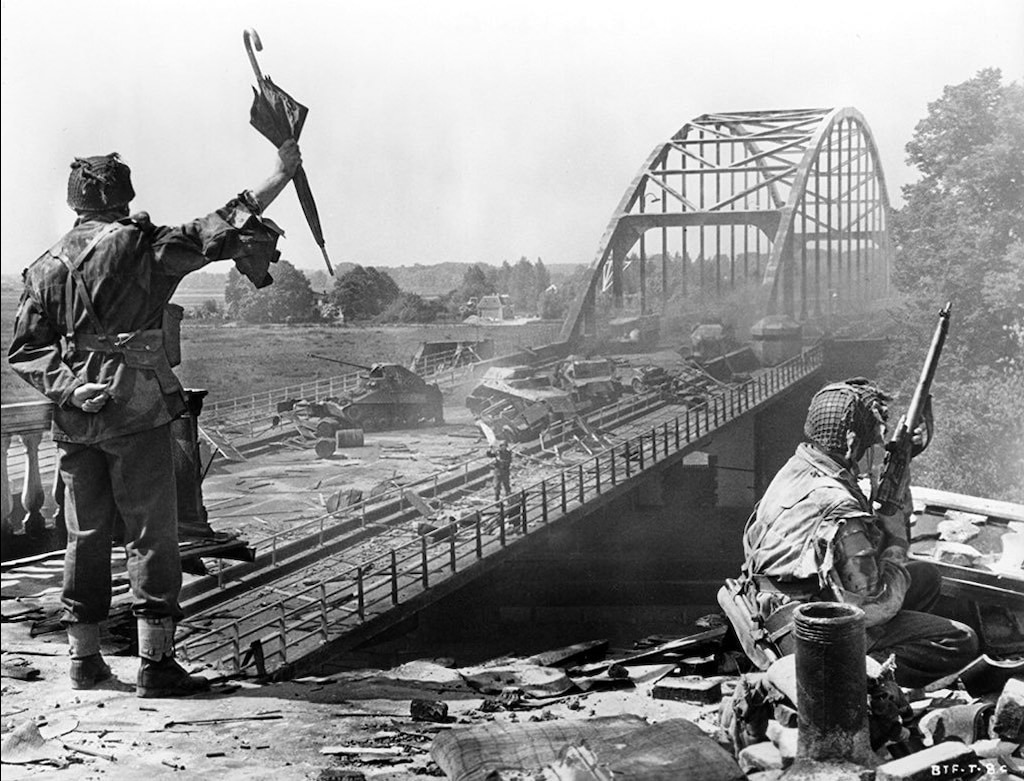
September 17, 1944: Operation Market Garden

September 17, 1944: The Allies launch Operation Market Garden, an attempt to liberate the Netherlands. It turned out to be the Nazis' last win... and the Allies handed it to them through bungling.

Its objective was to create a 64-mile salient into German territory, with a bridgehead over the Nderrijn (Lower Rhine) River, creating an Allied invasion route into northern Germany. This was to be achieved by two sub-operations: Seizing 9 bridges with combined U.S. and British airborne forces (the part of the operation codenamed "Market"), followed by British land forces swiftly following over the bridges ("Garden"). British General Bernard Montgomery was the architect of Operation Market Garden.

The airborne soldiers, numbering more than 41,000, were dropped in sites where they could capture key bridges and hold the terrain until the land forces arrived. This included the U.S. Army's famed 101st Airborne Division, which further included the 1st Demolition Section of the Regimental Headquarters Company of the 506th Parachute Infantry Regiment. They became known as "The Filthy Thirteen," and inspired the 1965 novel and the 1967 film The Dirty Dozen.

The land forces consisted of 10 armored and motorized brigades with a similar number of soldiers. The land forces advanced from the south along a single road surrounded by flood plains on both sides. The plan anticipated that they would cover the 64 miles from their start to the bridge across the Rhine in 48 hours. About 100,000 German soldiers were in the vicinity to oppose the allied offensive.

The operation succeeded in capturing the Dutch cities of Eindhoven and Nijmegen, and a few V-2 rocket launching sites. It failed in its most important objective: Securing the bridge over the Rhine at Arnhem. The Germans slowed and then halted the armored brigades advancing from the south before they reached the Rhine. The First Airborne Division was unable to secure the bridge, and was withdrawn from the north side of the Rhine after suffering 8,000 dead, missing, and captured out of a complement of 12,000 men.

Market Garden has been called "a testament to the failure of intelligence." Despite all the Allies' planning and logistics, they never had agents with actual eyes on the ground, and signal intelligence missed the Panzer division that was there for resupply and retrofit.

For this reason, the argument that Montgomery stopped U.S. General George Patton from coming in and winning the battle, waylaying the fuel and supplies he was using in France following the liberation of Paris, and made the European Theater of the war last months longer than it should have, is wrong: Patton's troops would have run into the same German tanks, and faced the same resistance.

In the aftermath of the battle, the Germans punished the people of the Netherlands by cutting off food shipments to the country, and 20,000 died of starvation. Arnhem was finally captured by the allies in April 1945, near the end of the war.

The story was told in the 1974 book A Bridge Too Far by Cornelius Ryan, made into a film in 1977.

*

September 17, 1944 was a Sunday. The NFL season kicked off, but with just 1 game: The Green Bay Packers beat the Brooklyn Tigers, 14-7 at the Dairy Bowl in the Milwaukee suburb of West Allis, Wisconsin. The Dairy Bowl was a football stadium built in the infield of a speedway, now known as the Milwaukee Mile, at the Wisconsin State Fair Park.

Formerly the football version of the Brooklyn Dodgers from 1930 to 1943, the Tigers folded after the season.

Since it was a Sunday, especially with wartime travel restrictions in effect, most baseball teams played doubleheaders that day:

* The New York Yankees were swept by the Philadelphia Athletics, 5-4 and 2-1 at Yankee Stadium.

* The New York Giants were swept by the Philadelphia Phillies, 7-0 and 5-4 at Shibe Park in Philadelphia. Bill Lee (no relation to the later pitching "Spaceman" of the same name) pitched a 2-hit shutout in the opener.

* The Brooklyn Dodgers split with the Boston Braves at Braves Field in Boston. The Braves won the 1st game, 3-0. Jim Tobin pitched a 4-hit shutout. The Dodgers won the 2nd game, 3-2.

* In a single game, the Washington Senators beat the Boston Red Sox, 7-6 at Griffith Stadium in Washington.

* There was a split at Forbes Field in Pittsburgh. The Pittsburgh Pirates won the 1st game, 7-1. The Cincinnati Reds won the 2nd game, 2-1. Frank McCormick doubled home Woody Williams with the winning run in the top of the 10th inning.

* The Detroit Tigers swept the Cleveland Indians, 7-2 and 3-0 at Cleveland Municipal Stadium. Rufus Gentry pitched a 2-hit shutout in the 2nd game.

* The Chicago Cubs swept their arch-rivals, the St. Louis Cardinals, at Wrigley Field in Chicago. Both games ended 2-1.

* And there was a split at Sportsman's Park in St. Louis. The St. Louis Browns won the 1st game, 5-1. The Chicago White Sox won the 2nd game, 8-2.

Tuesday, April 12, 2022

April 12, 1945: President Franklin D. Roosevelt Dies

April 12, 1945: Two of the U.S. Army's leading Generals meet to discuss how to make the final surge on Nazi Germany. The Supreme Commander of Allied forces, Dwight D. Eisenhower, suggests sending U.S. troops through the industrial heart of the nation, the south.

But George S. Patton suggests that the main U.S. force go right for the capital, Berlin, and continue to the river that was then the border between Germany and Poland: "And on to the Oder!" Patton was already thinking of the future, one where the Soviet Union might control Eastern Europe, including parts of Germany.

Eisenhower thought of Berlin, and asked Patton, "Who would want it?" Patton said, "I think history will answer that question for you, Ike."

But Eisenhower thought that, for all they suffered in World War II, the Soviets deserved to be the ones to take Berlin. Patton could have gone over Eisenhower's head, to the Commander-in-Chief, but he didn't.

It wouldn't have mattered if he had, because this was the day that the Commander-in-Chief, the 32nd President of the United States, Franklin Delano Roosevelt, died.

At 1:00 PM, U.S. Eastern Time, he was at the "Southern White House" he had built at Warm Springs, Georgia, at the health spa where he had once tried in vain to recover from the effects of polio. He was posing for a portrait, being painted by Russian exile Elizabeth Shoumatoff, when he suddenly dropped the papers he was reading, put his left hand to the back of his head, and said, "I have a terrific pain in the back of my head," and lost consciousness.

A doctor was retrieved. After 12 years and 1 month, the longest Presidency ever, of fighting the Great Depression, Nazi Fascism and Japanese imperialism, FDR's blood pressure (according to a document released by his Presidential Library on April 12, 2020, the 75th Anniversary of the event) was 300 over 190. He had suffered a cerebral hemorrhage. Death came to him at 3:35 PM. He was 63 years old.

The portrait was never finished. It now hangs in the house at Warm Springs, next to an earlier portrait that Shoumatoff had painted of him.
Vice President Harry S Truman was presiding over the U.S. Senate, and went to see the Speaker of the House, Sam Rayburn of Texas. As Rayburn began pouring drinks, he remembered that Stephen Early, the White House Press Secretary, had called, and asked to have Truman call him back. Why the Secret Service didn't immediately find Truman and whisk him away to the White House is a question for them, not that their current counterparts would answer it now.

Truman called the White House, and Early told him, "Please come over here as quickly and as quietly as possible." In a letter to his mother, Martha Ellen Young, who lived another 2 years, Truman claimed that he had no idea of what this was about. Truman was what would now be called a "mama's boy," and I it seems unlikely that he would lie to his mother.

But there was a 3rd man in that room, Lewis Deschler, the House parliamentarian and a key aide to Rayburn. In his 1975 biography Sam Rayburn, Alfred Steinberg quoted Deschler, by then the last survivor, as saying that Truman yelled, "Holy General Jackson!" as if he knew exactly what the call meant.

In order to write his 1992 biography Truman, which went on to win the Pulitzer Prize, David McCullough was given access to Steinberg's notes, and realized that Steinberg had cleaned the words up for 1970s public consumption: According to Deschler, what Truman actually said was, "Jesus Christ and General Jackson!" As if he was putting Andrew Jackson and Jesus on the same level.

Regardless of whether Truman or Deschler was telling the truth, Truman did as Early asked, and was taken to a room where First Lady Eleanor Roosevelt was sitting all alone. According to Truman, that's when he guessed what had happened. She said, "Harry, the President is dead." After pausing to collect himself, Truman asked, "Is there anything I can do for you?" Knowing that it was true, she said, "Is there anything we can do for you? For you are the one in trouble now."

She thought she knew how much trouble he was in. So did he. But, at this point, neither one of them knew about the development of the atomic bomb. Trying to keep it as secret as possible, for fear of spies -- Nazi, Japanese, and Soviet -- FDR hadn't told his wife, which was the right thing to do; but he also hadn't told his Vice President, which was wrong.

Truman's wife Bess and their 20-year-old daughter Margaret were called from their condominium apartment at 4701 Connecticut Avenue, and brought to the White House. At 7:09 PM, 3 hours and 34 minutes after FDR's death, Harry S Truman was sworn in as the 33rd President of the United States by the Chief Justice of the Supreme Court of the United States, Harlan F. Stone, who had sworn FDR in for a 4th term only 3 months earlier.
The new President, his wife Bess, their daughter Margaret

You'll notice that there is no period after the S. When Truman was born, there was a disagreement over what his middle name should be. Traditionally, middle names were either the same as that of the boy's father -- (First Name) (Middle Name) (Last Name) (Jr., III, IV, and so on); or that of the mother's family, as with Franklin Delano Roosevelt; or there was no middle name at all.

When Truman was born on May 8, 1884 in Lamar, Missouri, outside Kansas City, he was named for a maternal uncle, Harrison "Harry" Young -- but his legal first name was Harry, not Harrison. One grandfather was Anderson Shipp Truman, and the other was Solomon Young. A compromise was reached, and "S" became his entire middle name, honoring both "Shipp" and "Solomon." It was a split down the middle that the original King Solomon might have appreciated.

Nevertheless, when Chief Justice Stone recited the Oath of Office for Truman to repeat, he made a mistake, saying, "I, Harry Solomon Truman, do solemnly swear... " The new President, correctly, said, "I, Harry S Truman, do solemnly swear... " He did not hold it against Stone, who, most likely, had simply heard the story wrong.

Under the Presidential Succession Act of 1886, from FDR's death on April 12, 1945 until the passage of the next Presidential Succession Act on July 18, 1947, the man next in line for the Presidency was the Secretary of State, Edward Stettinius.
Edward Stettinius

The 1947 Act put the Speaker of the House of Representatives, and then the President Pro Tempore of the Senate, in the line of succession, between the Vice President and the Cabinet. So, from July 18, 1947 until January 3, 1949, the man next in line was Joseph W. Martin of Massachusetts, a Republican. From January 3 to 20, 1949, it was Sam Rayburn.

This Act was not a maneuver by the Republicans, having taken over Congress as a result of the 1946 elections, to launch a soft coup. Truman believed that the President should have been elected by the people. A Vice President, appearing on a ticket with the President, has been. These are the only offices elected by all the people. The closest anyone else comes to it, Truman reasoned, was the Speaker of the House, who was elected by all the Representatives of all the people. And the President Pro Tempore of the Senate, in effect "the Vice Vice President," came the next-closest to such a distinction.

Truman was aware of the possibility that a vacancy in the Vice Presidency could lead to a change of party in power without the action of a recent election. He believed this was still the fairest way to do it. As of April 12, 2022, such a change has never happened, with the closest call coming in the Autumn of 1973, between the resignation of Vice President Spiro Agnew and Congress' confirmation of Gerald Ford to succeed him, when, had President Richard Nixon, a Republican, died -- or, at a turbulent moment in the Watergate scandal, Congress decided there was no choice but to vote to impeach and remove him -- the Speaker would have become President, and that was then a Democrat, Carl Albert of Oklahoma. 

On that night of April 12, 1945, Truman was told by a U.S. Army General that a powerful bomb was being developed, but got no details. It wasn't until the next day that he learned of the Manhattan Project. Unlike in more recent times, when the President keeps the Vice President in the loop about national security matters, in case of just such an emergency as his own death, FDR hadn't told Truman about the development of the atomic bomb.

The news of Roosevelt's death was announced to the world at 5:50 PM, Eastern Time. In the shock and the sadness, with World War II still going -- and FDR knowing far better than the general public how close the Allies were to victory -- the question was asked, "What do we do now?" After all, the distribution of information wasn't like today: Outside of Washington, D.C. and his native Missouri, not that many people knew much about Truman.

Graham Jackson, a black Chief Petty Officer in the U.S. Navy, played many instruments, and had performed for Franklin and Eleanor at Warm Springs a few times, becoming a friend. On April 13, as FDR's coffin was loaded onto a train to take it north to Washington, Jackson tearfully played "Goin' Home," a spiritual based on a tune by Antonin Dvořák, on his accordion. Life magazine photographer Ed Clark took a picture of this, and it not only appeared in the magazine, but won the Pulitzer Prize for Photography. Jackson lived until 1983, Clark until 2000.
On April 14, a state funeral was held in Washington. On April 16, FDR was laid to rest with a large but simple marble gravestone at his home and Presidential Library in Hyde Park, Dutchess County, New York, on the Hudson River, 78 miles north of Midtown Manhattan, and 67 miles south of the State Capitol in Albany. His Scottish terrier, Fala, would join him there in 1952; and Eleanor would in 1962.
FDR's death plunged the nation into mourning, the kind unseen since the assassination of Abraham Lincoln at the close of the American Civil War, 80 years earlier. Adolf Hitler momentarily believed that FDR's death was a sign that Nazi Germany would somehow turn things around and win World War II. But he lived only 18 days after FDR. V-E Day, Victory in Europe, would come 26 days after FDR's death; V-J Day, Victory in Japan and the end of World War II, 124 days after.

In 1999, writing for Time, Walter Isaacson, the magazine's editor, said he chose Albert Einstein as the magazine's Person of the Century, because the century was, as he put it, driven more by science than statecraft. But he acknowledged that, despite the magazine having chosen Winston Churchill as "Man of the Half-Century" in 1949 -- along with Life, it was then run by the archconservative Henry Luce, who once told FDR he was one of those "who hate your gaudy guts" -- the world at the end of the 20th Century much more closely resembled the vision of FDR than any of the other major players of World War II, including the not-as-democratic-as-he-then-appeared Churchill, or other allies such as Charles de Gaulle or Chiang Kai-shek. Certainly, it was much more FDR's world than Hitler's, or Joseph Stalin's, or Hideki Tojo's, or Mao Zedong's.

And let's not forget, it was FDR who read Einstein's letter of 1939 and decided that America had to build an atomic bomb before the Nazis could -- and did. So if there is a Person of the Century for 1900 to 1999, it is Franklin Delano Roosevelt. 

*

FDR died on a Thursday. The Major League Baseball season was scheduled to begin the following Monday, April 16. That was the day set for his funeral, so Opening Day was pushed back a day. (Speaker Rayburn, rather than the new President, Truman, threw out the first ball in Washington.) There were no games scheduled for April 12, anyway. Nor was the NFL scheduled to play: This was during the off-season. And there was, as yet, no NBA: It wouldn't begin play for another year and a half.

Indeed, there was only 1 game in all of major league sports that day, and it wasn't in the United States. (Had it been, it almost certainly would have been postponed.) It was Game 3 of the Stanley Cup Finals, at Maple Leaf Gardens in Toronto. The Toronto Maple Leafs beat the Detroit Red Wings, 1-0, on a goal by Gus Bodnar. The Leafs took a 3-games-to-none lead.

The Wings won the next 3, and set up the reverse of the 1942 Finals, when the Wings won the 1st 3, and the Leafs took the next 4, the 1st time a 3-0 deficit had ever been overcome in any postseason series in any sport. But the Leafs won Game 7 on April 22, to prevent a full reverse.
The 1944-45 Toronto Maple Leafs.
Note the narrower Cup, in use until 1947;
and the British, rather than Canadian, flags.

With the manpower drain from World War II still in effect, professional sports wouldn't really recover until the following Spring and baseball's Opening Day.

Monday, March 7, 2022

March 8, 1916: Pancho Villa's Raid on Columbus, New Mexico

March 8, 1916: Pancho Villa crosses from Mexico into New Mexico, and attacks the town of Columbus, 3 miles north of the border. It remains the last land invasion of the United States of America.

Mexico had been in a state of revolution since 1910. In 1914, 9 U.S. sailors came ashore at the Mexican port city of Veracruz to secure supplies, and were detained by Mexican forces. The Mexican government refused to release them, and, despite the country being in a state of revolution and civil war, all the factions united against the U.S.

President Woodrow Wilson sent troops to Veracruz, under the command of Admiral Henry T. Mayo, and taking the city turned out to be easy. The occupation lasted 6 months, and led to the fall of President Victoriano Huerta. But this led to a renewal of the hatred of Americans by Mexicans, originally stoked by the Mexican-American War of 1846 and 1847.

José Doroteo Arango Arámbula was born on June 5, 1878 in San Juan del Río, in the State of Durango. He began calling himself Francisco Villa, taking his grandfather's surname, although it's not clear where the nickname "Pancho" came from. His friends called him "La Cucaracha" (The Cockroach), but he would he would eventually be called the Lion of the North, the Centaur of the North, and the Mexican Napoleon.

He became a key figure in the movement that forced out President Porfirio Diaz. But when the next President, Francisco Madero, was ousted by General Victoriano Huerta in 1913, Villa led the Constitutionalist Army against him.

But, as so often happens, after the revolution, the victors split, between the forces of Villa and Venustiano Carranza. The U.S. government aided the Carranza government against Villa in the Second Battle of Agua Prieta in November 1915. Villa lost, and most of his army left him.

Angry over this, on March 8, 1916, he took what he had left, crossed the border into Columbus, New Mexico -- New Mexico had only gained Statehood 4 years earlier -- and raided an American military outpost manned by the 13th U.S. Cavalry, because he needed weapons. In so doing, 8 American soldiers and 10 civilians were killed. But 67 of Villa's men were killed, and 7 were captured. He got the weapons he needed, but, in terms of manpower, he was considerably worse off.

But, like George Washington, he knew he wasn't the best of generals, but was a savvy politician. He gave interviews to foreign journalists, including John Reed, whose fame now rests on his reporting on the Bolshevik Revolution. He had film cameras follow him, and allowing the films to be sent to Hollywood and released, with the label "And starring Pancho Villa as himself." In 2003, that became the title of a film about Villa, starring Spanish actor Antonio Banderas.

The raid led to another American invasion of Mexico, which became known as the Punitive Expedition. While failing to capture Villa, it sent him into hiding, leading to his downfall. It was also a convenient warmup for the U.S. Army for fighting in World War I, especially since its commander was General John J. Pershing. "Black Jack" would go on to command U.S. troops in Europe in World War I. General George S. Patton, then a Lieutenant, credited much of his later career to having served on this Expedition.
Cartoon by Clifford Berryman for The Washington Star

In 1920, Carranza was ousted from power, and the new President, Adolfo de la Huerta, offered Villa a deal: Amnesty and a landed estate, if he would retire from politics. He took it. But on July 20, 1923, while visiting Parral, in the State of Chihuahua, he was assassinated in his car, a 1919 Dodge, probably on the orders of the next President, Álvaro Obregón, who still saw him as a threat. Supposedly, Villa's last words were, "Don't let it end like this. Tell them I said something."

After his death he was excluded from the pantheon of revolutionary heroes until the Sonoran generals Obregón and Calles, whom he battled during the Revolution, were gone from the political stage. Villa's exclusion from the official narrative of the Revolution might have contributed to his continued posthumous popular acclaim. He was celebrated during the Revolution and long afterward by corridosfilms about his life, and novels by prominent writers. In 1976, his remains were reburied in the Monument to the Revolution in Mexico City in a huge public ceremony.

*

March 8, 1916 was a Wednesday. Baseball was in Spring Training. Football was in the off-season. Professional basketball didn't really exist.

This was before the National Hockey League, but there was a National Hockey Association, from which only the Montreal Canadiens survive today, although a new Ottawa Senators team took up the name of an NHA/NHL franchise that went out of business in 1934; and a Pacific Coast Hockey Association, from which no teams survive.

The PCHA wrapped up its season on February 25. Two games were played in the NHA on this day. The Toronto Blueshirts beat the Montreal Wanderers, 3-2 at the Montreal Arena. And the Ottawa Senators beat the Quebec Bulldogs, 8-5 at the Ottawa Arena.

December 31, 1999 & January 1, 2000: The Millennium

December 31, 1999:  The Millennium arrives. The people of planet Earth survived. At a terrible cost. But we hadn't destroyed ourselves. ...