Showing posts with label jerry west. Show all posts

Thursday, May 12, 2022

May 12, 1974: The End of the NBA's 1st Great Era

Kareem Abdul-Jabbar, guarded by
Dave Cowens (left) and Don Nelson (right)

May 12, 1974: The Boston Celtics beat the Milwaukee Bucks, 102-87, at the Milwaukee Exposition & Convention Center Arena (The MECCA). This was the Celtics' 12th title, but their first without Bill Russell.

The Bucks were in their 2nd Finals, having won the title in 1971, but it took 50 years for them to get back, before they won the title in 2021. In between, they'd usually been good, but not Finals good.

This was also the last game for Oscar Robertson, closing out his career with the Bucks. In fact, this game was the end of an era for the NBA, as legends Jerry West, Willis Reed, Dave DeBusschere, and Robertson's former Cincinnati Royals teammate Jerry Lucas announced their retirements. So would Wilt Chamberlain, although he hadn't played this season, due to a contract dispute between the NBA and the ABA.

A year and a half later, Kareem Abdul-Jabbar demanded a trade, and got it, going to the Los Angeles Lakers. The Bucks were usually good thereafter, but they would not return to the NBA Finals until 2021.

The 1974 NBA Finals was the end of an era, when men were men, and pretty much only the people in the arena saw the game, because television coverage was so rare. The era of Dr. J, Skywalker, Chocolate Thunder, Magic, Larry, the Human Highlight Film and Air Jordan, an era where substance took a back seat to style, was about to begin. The NBA made a lot more money during that period. But it was not better.

*

May 12, 1974 was a Sunday. The ABA Championship had been won 2 days earlier, by the New York Nets over the Utah Stars.

Game 3 of the Stanley Cup Finals was played that day. The Philadelphia Flyers beat the Boston Bruins, 2-1 at The Spectrum in Philadelphia, and went on to win the series in 7 games. The WHA Playoffs were between the Semifinals and the Finals. The Houston Aeros went on to sweep the Chicago Cougars in 4 straight.

And these games were played in Major League Baseball:

* The New York Yankees were swept in a doubleheader by the Milwaukee Brewers, at Shea Stadium, where the Yankees were groundsharing with the Mets while Yankee Stadium was renvoated. The Brewers won the opener, 7-3. Clyde Wright outpitched Mel Stottlemyre. George "Boomer" Scott went 3-for-4 with 2 RBIs. Lou Piniella hit a home run.

The Brewers won the nightcap, 5-1. Kevin Kobel outpitched Dick Woodson. Dave May homered for the Brewers. Rick Dempsey, later to be traded to the Baltimore Orioles, where he would not be available to succeed Thurman Munson as the Yankees' catcher (Munson was the designated hitter in this game, after catching the opener.)

* The New York Mets lost to the Chicago Cubs, 4-3 at Wrigley Field in Chicago. George Mitterwald singled Matt Alexander home, off Tom Seaver, in the bottom of the 9th. José Cardenal hit a home run for the Cubs, Rusty Staub for the Mets.

* The Philadelphia Phillies beat the Pittsburgh Pirates, 8-7 at Veterans Stadium in Philadelphia. Mike Schmidt went 1-for-3 with a walk. Mike Anderson hit a home run. For the Pirates, Willie Stargell went 0-for-4 with a walk, but Richie Zisk went 4-for-5 with 2 RBIs, and Al Oliver went 3-for-5 with a home run and 3 RBIs.

* A doubleheader was split at Atlanta Stadium. (It was renamed Atlanta-Fulton County Stadium the next season.) The Atlanta Braves won the 1st game, 5-1. Hank Aaron went 2-for-3 with a walk and his 721st career home run, before being taken out of the lineup. He did not play in the 2nd game, which the San Francisco Giants won, 6-2.

* The Cincinnati Reds swept the Houston Astros, 5-0 and 4-2 at Riverfront Stadium in Cincinnati. Fred Norman pitched a 5-hit shutout in the 1st game. Merv Rettenmund hit home runs in both games. Over the 2 games, Pete Rose went 2-for-7 with a walk and an RBI, while Johnny Bench went 2-for-7 with a home run, a walk and an RBI.

* The Boston Red Sox beat the Detroit Tigers, 4-3 at Tiger Stadium in Detroit. Dick McAuliffe, the Tigers' long-time 2nd baseman, doubled Carl Yastrzemski home in the top of the 10th inning, to win the game for the Red Sox. Yastrzemski went 2-for-4 with a walk. Al Kaline went 0-for-3 with a walk.

* The Chicago White Sox beat the Texas Rangers, 5-4 at Arlington Stadium in the Dallas suburb of Arlington, Texas.

* The Los Angeles Dodgers beat the San Diego Padres, 15-9 at San Diego Stadium (later Jack Murphy Stadium and Qualcomm Stadium). The Padre bullpen melted down in the top of the 13th inning, so if new team owner Ray Kroc thought Opening Day was "the most stupid ballplaying I've ever seen," then he hadn't seen anything yet.

* The Kansas City Royals swept a doubleheader from the California Angels, 3-2 and 5-2 at Anaheim Stadium (now Angel Stadium of Anaheim). Hal McRae singled Amos Otis home in the top of the 9th to win the 1st game. The Royals scored all 5 runs of the 2nd game in the 8th inning. George Brett did not play in the 1st game, and went 0-for-2 in the 2nd game before being replaced. He may have been injured.

* The Oakland Athletics beat the Minnesota Twins, 9-2 at the Oakland Coliseum. Reggie Jackson did not play. Harmon Killebrew went 0-for-2 with a walk. Rod Carew went 1-for-3 with a walk.

* The Baltimore Orioles and the Cleveland Indians were rained out at Cleveland Municipal Stadium. The game was made up as part of a doubleheader on July 25. The Indians swept, 8-7 and 5-4. They won the 2nd game when Tommy McCraw singled John Ellis home in the bottom of the 13th inning.

* And the Montreal Expos and the St. Louis Cardinals were rained out at Jarry Park in Montreal. The game was made up as part of a doubleheader on August 6. The Cards swept, 5-4 and 9-4.

Saturday, May 7, 2022

May 7, 1972: The Lakers Finally Win Los Angeles a Title

May 7, 1972: The Los Angeles Lakers beat the New York Knicks, 114-100 at The Forum, outside Los Angeles in Inglewood, California, in Game 5 of the NBA Finals. This gives the Lakers the series, 4 games to 1, and their 1st NBA Championship since 1954, when they were in Minneapolis.

The Lakers had lost their last Finals in Minneapolis, in 1959. They moved to Los Angeles a year later. They lost the Finals in 1962, 1963, 1965, 1966, 1968 and 1969. All 7 of these defeats were to the Boston Celtics. Then the Celtics got old, and the Lakers thought the path to a title was clear. But in 1970, they lost the Finals to the Knicks, and lost the Western Conference Finals to the Milwaukee Bucks in 1971.

So, despite having Elgin Baylor from the 1958-59 season onward, Jerry West from 1960-61 onward, Gail Goodrich from 1965-66 onward, and Wilt Chamberlain from 1968-69 onward, they lost 8 straight appearances in the NBA Finals; and failed to win a title in their 1st 11 seasons in Los Angeles.

Early in the 1971-72 season, Baylor retired. But right after that, the Lakers went on a 33-game winning streak, still the longest in the history of major league sports in North America. They won 69 regular-season games, a new NBA record that would stand for 24 years. They swept the Chicago Bulls in the 1st round of the Playoffs, then dethroned the Bucks in 6 games. The Knicks won Game 1 of the Finals, 114-92. But the Lakers took the next 4 straight: 106-92, 107-96, 116-111 in overtime, and 114-100.

The Lakers were coached by Bill Sharman, who had played on the Celtics' dynasty. The season before, 1970-71, he had coached the Utah Stars to the title in the American Basketball Association. He and Alex Hannum were the only coaches to win the title in both the NBA and the ABA. Hannum had won the NBA with the 1967 Philadelphia 76ers, including Chamberlain; and the ABA with the 1969 Oakland Oaks.

This title also made Los Angeles the 1st city to have basketball's pro and college champions in the same calendar year, as UCLA won the NCAA Tournament. Oddly, given the Lakers' 12 NBA Championships since moving moving to Los Angeles, and the Bruins' 11 National Championships, this remains the only time it's ever happened. (UCLA won in 1965, '68, '69 and '73, but the Lakers lost in the Finals each time; the Lakers won the title in 1980, but UCLA lost the Final.) If you count Ann Arbor as part of the Detroit metropolitan area, then 1989, with the University of Michigan and the Pistons, remains the only other time it's ever been done.

The Knicks won the rubber Finals with the Lakers in 1973. After that, both teams got old. It would take the Lakers until 1980, with Kareem Abdul-Jabbar and Earvin "Magic" Johnson, before they reached, and won, the Finals again.

Despite baseball's Dodgers having moved from Brooklyn, and won the World Series in 1959, 1963 and 1965, the Lakers surpassed them as Los Angeles' most popular sports team. They remain so.

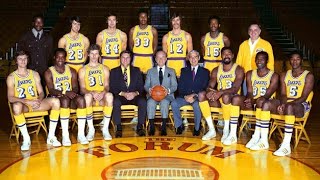
The Lakers would follow that 1980 title, under coach Paul Westhead, with titles in 1982, 1985, 1987 and 1988, under coach Pat Riley. Riley was a reserve on the 1972 Lakers: That's him in the photo above, wearing Number 12, and a cheesy mustache. Oddly, the Lakers have never retired his number, the way they've retired 13 for Chamberlain, 22 for Baylor, 25 for Goodrich and 44 for West, along with some later players.

*

May 7, 1972 was a Saturday. The ABA Finals were between Games 1 and 2. The Indiana Pacers would beat the New York Nets, 4 games to 2.

Game 4 of the Stanley Cup Finals was played. The Boston Bruins beat the New York Rangers, 3-2 at Madison Square Garden. This was the 1st time any building with that name played host to the NBA and Stanley Cup Finals in the same year. It would happen again in 1994. The Bruins won the Cup in 6 games.

These games were played in Major League Baseball:

* The New York Yankees lost to the Oakland Athletics, 7-5 at the Oakland Coliseum. Reggie Jackson went 1-for-4 with an RBI. Unfortunately, he wasn't yet playing for the Yankees. Ron Blomberg of the Yankees and Dave Duncan of the A's hit home runs.

* The New York Mets beat the San Diego Padres, 8-6 at Shea Stadium. Tommie Agee hit a home run in the bottom of the 10th inning, making Tug McGraw a winner in relief of Gary Gentry.

* The Montreal Expos beat the Los Angeles Dodgers, 1-0 at Jarry Park in Montreal. The Dodgers' 1st baseman made an error in the bottom of the 13th inning, allowing Mike Jorgensen to reach base and John Boccabella to score the winning run. The 1st baseman's name was Bill Buckner.

* The Minnesota Twins beat the Boston Red Sox, 8-4 at Fenway Park in Boston. Harmon Killebrew went 1-for-2 with 2 walks and 2 RBIs. Rod Carew went 2-for-4 with a walk and 2 RBIs. Carl Yastrzemski went 1-for-4 with a walk and 2 RBIs.

* The Philadelphia Phillies beat the San Francisco Giants, 8-3 at Veterans Stadium in Philadelphia. Greg Luzinski hit a home run. Willie Mays did not appear in the game. Four days later, the Giants traded him to the Mets.

* The Baltimore Orioles beat the Kansas City Royals, 5-4 at Memorial Stadium in Baltimore. Brooks Robinson went 1-for-3 with a walk.

* The Cleveland Indians beat the Chicago White Sox, 3-0 at Cleveland Municipal Stadium. Milt Wilcox pitched a 3-hit shutout.

* The Pittsburgh Pirates beat the Cincinnati Reds, 9-6 at Riverfront Stadium in Cincinnati. Roberto Clemente went 3-for-5 with 2 RBIs. Willie Stargell hit 2 home runs and had 5 RBIs. Pete Rose went 0-for-5. Johnny Bench went 1-for-4.

* The Detroit Tigers beat the Texas Rangers, 7-4 at Tiger Stadium in Detroit. Al Kaline went 1-for-4 with a walk and an RBI.

* The St. Louis Cardinals beat the Atlanta Braves, 5-4 at Busch Memorial Stadium in St. Louis. Lou Brock went 3-for-4 with 2 stolen bases. Hank Aaron did not play.

* The Milwaukee Brewers beat the California Angels, 5-2 at Anaheim Stadium (now Angel Stadium of Anaheim).

And in English soccer, the FA Cup Final was played at the old Wembley Stadium in West London. Cupholders Arsenal, of North London, were defeated by Yorkshire team Leeds United, 1-0, on a diving header by Allan Clarke. Arsenal had edged Leeds for the Football League title the season before, winning both the League and the Cup, for "The Double." For all their success, 1972 remains the only FA Cup won by Leeds.

Thursday, May 5, 2022

May 5, 1969: Bill Russell's Last Game & Last Title

May 5, 1969: Game 7 of the NBA Finals is played at The Forum, outside Los Angeles in Inglewood, California. Jack Kent Cooke, builder of The Forum, and owner of its teams, the NBA's Los Angeles Lakers and the NHL's Los Angeles Kings, has prepared the building for the Lakers' 1st World Championship since moving to Los Angeles in 1960. (They had previously won titles in Minneapolis in 1949, '50, '52, '53 and '54.) Balloons are suspended from the ceiling, in anticipation of the celebration.

There was good reason for this anticipation. The Lakers had 4 men on their roster who went on to the Basketball Hall of Fame: Guards Jerry West and Gail Goodrich, forward Elgin Baylor, and, acquired the previous off-season, center Wilt Chamberlain. Goodrich was an excellent passer. West was that, and the best shooter the game had ever seen, and a great defensive player. Baylor was the flashiest player in the league, with offensive moves no one had ever seen before.

And Chamberlain was the greatest basketball player who ever lived. The year before, with the Philadelphia 76ers, he had led the league in assists, the only time a center has ever done that. The year before that, he had led the Sixers to the NBA Championship. In each of the 7 seasons before that, he had led the NBA in scoring, including in 1961-62, when he averaged 50.4 points per game. He would be the NBA's all-time leading scorer until 1984. He is still its all-time leading rebounder. Blocked shots were not kept as an official statistic at that time; if they were, he would still be the all-time leader in that, too.

And now, he had been added to the Lakers. Before the 2003-04 Lakers, before the 2007-08 Boston Celtics, before the early 2010s Miami Heat, before the late 2010s Golden State Warriors, and before the 2020 Lakers, this was the NBA's 1st planned superteam, although that term wasn't used at the time.

The Lakers went 55-27, easily winning the regular-season title in the Western Division. In the Playoffs, they beat the San Francisco Warriors in 6 games, and then the Atlanta Hawks in 5.

Standing in their way, as they always seemed to be, were the Boston Celtics. The Celtics had won their 1st NBA Championship in 1957. In 1959 (the Lakers' last Finals appearance in Minneapolis), '62, '63, '65, '66 and '68, they had beaten the Lakers in the Finals. They had also beaten the St. Louis Hawks in the Finals in 1957, '60 and '61, losing to them in '58; and the Warriors in the Finals in '64.

Red Auerbach had coached the Celtics until the 1966 title, then stepped aside, remaining general manager. He handed the head coaching reins to the man who had been his best player since his arrival in 1956: Bill Russell. He was the 2nd-best player the game had ever seen to this point, behind Chamberlain.

But where Chamberlain was the best player, Russell was the best team player, because Auerbach built a great team around him, and Russell made them all better. He led them to another Championship in 1968, and Sports Illustrated named him their Sportsman of the Year. By 1969, that team included fellow future Hall-of-Famers Sam Jones, John Havlicek, Tom "Satch" Sanders, Bailey Howell, and, though it would be as a coach that he would be elected, Don Nelson.

Age, and the pressure of also coaching the Celtics, was catching up with Russell. The Celtics went 48-34, only finishing 4th in the Eastern Division. But it was enough to make the Playoffs, in which the Celtics beat the 76ers in 5 games, and the New York Knicks in 6.

Russell had announced he would retire as a player. Due to the aging of the Celtics -- he was 35, to Baylor's 34, Chamberlain's 32 and West's 30 -- for the 1st time, they went into an NBA Finals as an underdog. And, sure enough, the Lakers took the 1st 2 games in Inglewood, 120-118 and 118-112.

No one was really surprised when the Celtics took the next 2 at the Boston Garden, 111-105 and 89-88. Or when the Lakers won Game 5 at home, 117-104. (Due to the league having expanded to 5 additional teams over the last 3 seasons, this was the 1st NBA game ever played in the month of May.) Or when the Celtics won Game 6 at home, 99-90. There was no way Bill Russell was going to lose his last game at the Boston Garden.

But no home team had ever lost an NBA Finals Game 7. At that point, home teams were 8-0: The Rochester Royals won in 1951; the Lakers did so in 1952 and '54; the Syracuse Nationals in 1955; and the Celtics in 1957, '60, '62 and '66.

And so, for Game 7, with every good reason to believe that it would happen, Cooke ordered the balloons, yellow with "World Champion Lakers" written in purple on them, suspended from the rafters of The Forum. In every seat, and all 17,568 were filled, a flyer was placed, stating, "When, not if, the Lakers win the title, balloons will be released from the rafters, the USC marching band will play 'Happy Days Are Here Again' and broadcaster Chick Hearn will interview Elgin Baylor, Jerry West and Wilt Chamberlain in that order."

Cooke was counting his chickens before they hatched. West, trying to get through a hamstring pull in Game 5, went out for a pre-game shoot-around, and saw the balloons, and, thinking them a jinx, yelled at Cooke. Russell saw them, and walked over to West, and said, "Those fucking balloons are staying up there."

Russell told his players to take advantage of West's injury by running the fast break every chance they got. After 1 quarter, it was Celtics 24, Lakers 12. At halftime, the Lakers had cut it to 59-56. The Celtics extended their lead to 91-76 after 3.

For all his achievements, Chamberlain would later say that he was most proud of the fact that he had never fouled out of a game in his career. But early in the 4th quarter, he was assessed his 5th foul. With only 1 more to give, he had to take it easy on defense. With 5 minutes left, and the Celtics leading 103-94, he injured his knee, and walked to the bench.

Laker coach Butch van Breda Kolff, who had coached a Princeton University team featuring later New York Knicks star Bill Bradley to the NCAA Final Four in 1965, sent backup center Mel Counts in -- and with 2 minutes left, it was Boston 103, Los Angeles 102.

Chamberlain told van Breda Kolff he was ready to go back in. VBK said, "We're doing fine without you."

They were not doing fine without him: They were still behind. And so, in the most important two minutes of his coaching career, down by one point, Butch van Breda Kolff left the greatest player of all time on the bench. It remains the greatest coaching blunder in the history of the NBA.

With 1:33 left, it was still 103-102 Boston, when Havlicek, famous for a key steal at the end of Game 7 of the 1965 Eastern Conference Finals, against a 76ers team with Chamberlain, had the ball knocked away from him by Keith Erickson. This looked like a big break for the Lakers. Instead, it went to Nelson, who beat the 24-second shot clock with a shot from 18 feet out, to make it 105-102 Celtics.

The Lakers would follow this with turnovers that might not have happened if Chamberlain had been put back in. The game ended Celtics 108, Lakers 106. Two points made the difference between the Lakers finally winning their 1st NBA Championship in Los Angeles, and letting the balloons come down, and the most humiliating defeat in NBA history.

For the Celtics, Russell used only 7 players, all game long: Havlicek scored 26, Jones 24, Em Bryant 20, Nelson 16, Howell 9, Larry Siegfried 7, and Russell himself 6 plus 21 rebounds.

The Lakers also used only 7 players: West scored 42, with 13 rebounds and 12 assists, making him the 1st player with a triple-double in an NBA Finals Game 7 (through the 2021 Finals, he has been followed only by James Worthy in 1988 and LeBron James in 2016); Baylor 20, with 15 rebounds; Chamberlain 18, with 27 rebounds, despite missing the last 5 minutes; Counts and Johnny Egan each scored 9, Erickson 6, and Tom Hawkins 2.

For the 1st time, a Most Valuable Player award was presented for the Finals. It was given to West. He remains the only player from a losing team ever to receive it. In 2009, the award was renamed the Bill Russell Award, honoring a man who never had it available to him, but had played 13 seasons in the NBA, made 12 Finals, and won 11 Championships.
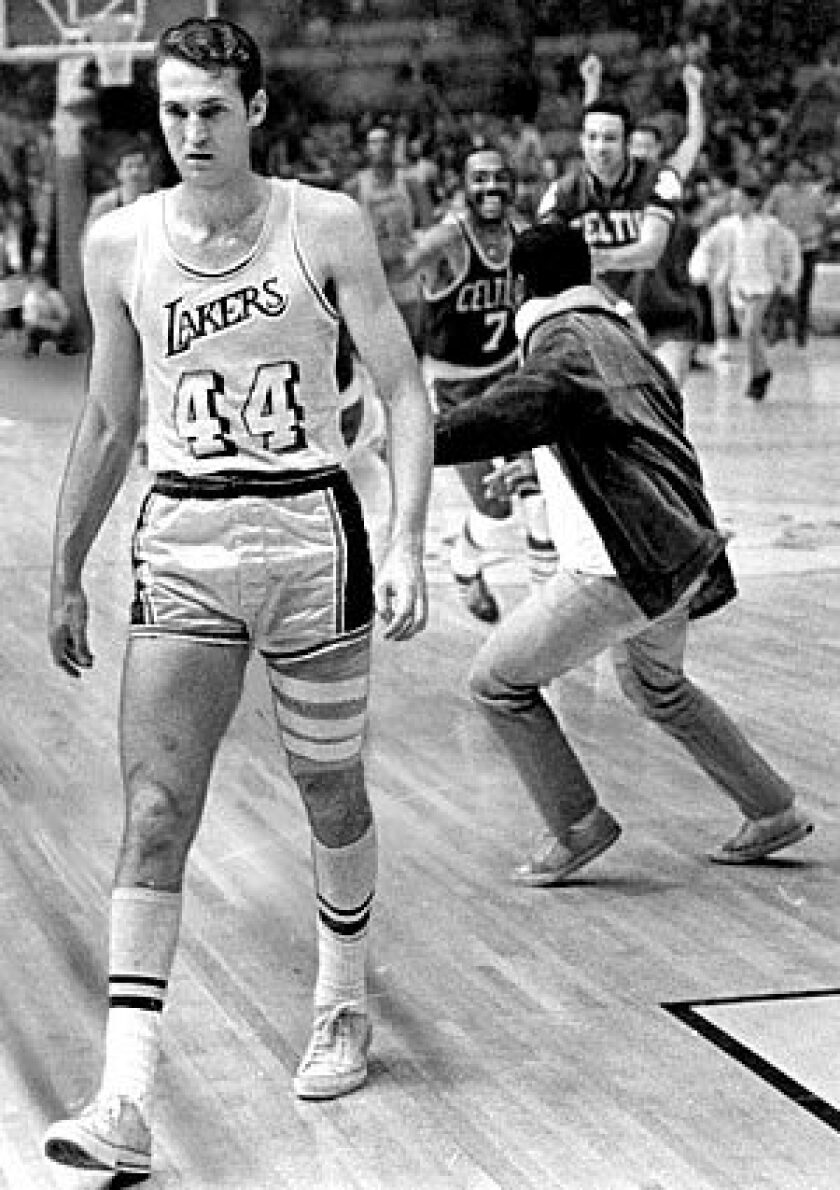
Jerry West

Cooke correctly identified the scapegoat, and fired van Breda Kolff almost immediately. VBK went on to coach in the NBA with Detroit, Phoenix and New Orleans (the Jazz, not the Hornets/Pelicans franchise); in the ABA with Memphis; and in college with the University of New Orleans, Lafayette and Hofstra. He never got close to winning again. Chamberlain (and West) had carried him, so maybe he should have given Chamberlain the benefit of the doubt.

Russell went on to coach 4 seasons with the Seattle SuperSonics, and 1 for the Sacramento Kings. Like many player-coaches, he found it a lot harder to coach when he couldn't call on himself to play. Without himself (and Auerbach to build teams for him), he coached 5 seasons, losing in the 1st round of the Playoffs twice, missing twice, and being fired before he could complete his season in Sacramento.

The Lakers got back to the Finals in 1970, and lost to the Knicks, and they remain the only team ever to lose 3 straight NBA Finals. Early in the 1971-72 season, Baylor retired. In their next game, the Lakers began a 33-game winning streak, still a record for North American major league sports. They set a new record with 69 regular-season wins, breaking the record of 68 by the 1967 76ers, who also had Chamberlain. They beat the Knicks in the Finals, breaking a 13-year, 0-8 Finals drought. That Finals was won in Game 5, at The Forum. There were no balloons. The Lakers faced the Knicks in the Finals again the next year, and lost. Chamberlain retired after that, and West after 1 more year.

The Celtics rebuilt, and won titles in 1974 and 1976. Both teams rebuilt, and the Celtics, with Russell not involved by Auerbach, who was still team president, won titles in 1981, '84 (beating the Lakers in the Finals) and '86; while the Lakers, with Cooke having sold the team and the arena to Jerry Buss, and West as general manager, won them in 1980, '82, '85 (beating the Celtics in the Finals), '87 (beating the Celtics again) and '88.

Both teams rebuilt again, but the Celtics couldn't get it done, while watching the Lakers, under West's building and Phil Jackson's coaching, win again in 2000, '01 and '02. Another rebuilding job led the Celtics to win the Finals over the Lakers in 2008, but the Lakers won in 2009, and beat the Celtics in 2010. The Lakers have since won again, in 2020, while the Celtics are still looking for their 1st title since 2008. 

The 2 franchises share the record: Each team has won 17 NBA Championships. But if you only count what they've won in their respective current cities (and you should), it's Boston 17, Los Angeles 12.

Going into the 2021-22 Playoffs, home teams are now 15-4 in NBA Finals Game 7s. Since the 1969 Lakers, the only losers have been the 1974 Milwaukee Bucks to the Celtics, the 1978 Seattle SuperSonics to the Washington Bullets, and the 2016 Golden State Warriors to the Cleveland Cavaliers.

(UPDATE: The Celtics won again in 2024, making the count Celtics 18, Lakers 17.)

*

May 5, 1969 was a Monday. That same night, Game 4 of the American Basketball Association Finals was played, and the Oakland Oaks beat the Indiana Pacers, 144-117 at the Indiana State Fair Coliseum (now the Corteva Coliseum) in Indianapolis. The Oaks wrapped up the title 2 nights later at the Oakland Coliseum Arena, winning 135-131.

The NHL season had ended the night before, as the Montreal Canadiens completed a 4-game sweep of the St. Louis Blues, 2-1 at the St. Louis Arena, to win their 2nd straight Stanley Cup, their 4th Cup in the last 5 years, and their 8th in the last 14.

Football was out of season. These Major League Baseball games were played:

* The New York Yankees lost to the Oakland Athletics, 3-2 at the Oakland Coliseum. Chuck Dobson outpitched Mel Stottlemyre, future Yankee Danny Cater hit a home run, and Reggie Jackson, not quite 23 years old and in his 2nd full MLB season, went 2-for-3 with a walk.

* The Cincinnati Reds beat the Montreal Expos, 8-5 at Jarry Park in Montreal, in a game shortened to 7 innings due to rain. Lee May and Bobby Tolan hit home runs for the Reds, Pete Rose went 2-for-3 with a walk and scored 3 runs, while Johnny Bench went 0-for-2 with 2 walks.

* The Kansas City Royals beat the Baltimore Orioles, 4-2 at Memorial Stadium in Baltimore. Frank Robinson went 2-for-3, but Brooks Robinson went 0-for-3, and Dick Hall blew a save in the 9th inning.

* The Los Angeles Dodgers beat the Pittsburgh Pirates, 13-3 at Forbes Field in Pittsburgh. Andy Kosco hit 2 home runs for the Dodgers, while Willie Stargell went 1-for-3 for the Pirates, and Roberto Clemente did not play.

* The Minnesota Twins beat the Detroit Tigers, 6-2 at Tiger Stadium in Detroit. For the Twins, Harmon Killebrew hit a home run, and Rod Carew had an RBI single. For the Tigers, Jim Northrup hit a home run, and Al Kaline went 1-for-3.

* The San Francisco Giants beat the Chicago Cubs, 11-1 at Wrigley Field in Chicago. They did this without Willie Mays entering the game. Ernie Banks only appeared as an unsuccessful pinch-hitter.

* The St. Louis Cardinals beat the San Diego Padres, 7-6 at Busch Memorial Stadium in St. Louis.

* The Boston Red Sox beat the California Angels, 7-2 at Anaheim Stadium (now Angel Stadium of Anaheim.)

* And the Seattle Pilots beat the Washington Senators, 2-0 at Sick's Stadium in Seattle. Rich Rollins singled home a run in the 1st inning, and Steve Whitaker did the same in the 4th.

In Ball Four, his memoir of that season, Pilots pitcher Jim Bouton wrote:

The meeting before the game was marvelous. When we went over the hitters, Gary Bell had the same comment on each one: "Smoke him inside" (fastball inside). Frank Howard, (Ken) McMullen, (Ed) Brinkman, (Mike) Epstein -- every hitter. "Smoke him inside," said Bell. It got to be funny as hell after a while, because not only did he get no opposition, but he was taken seriously. According to the gospel of Gary Bell you pitch to the entire Washington team by smoking them inside.

Marshall, an intellectual, and thus one of Bouton's favorite teammates, pitched a 2-hit shutout against that dangerous lineup managed by former Red Sox legend Ted Williams, the man who, literally, wrote the book on hitting: The Science of Hitting, like Ball Four, was published the following year. Bouton wrote, "I guess Mike Marshall smoked them on the inside."

* And the New York Mets and the Atlanta Braves, and the Chicago White Sox and the Cleveland Indians, were not scheduled to play.

And Hideki Irabu, the Japanese pitcher who briefly shone for the Yankees, was born.

Wednesday, February 9, 2022

February 9, 1997: The NBA's 50th Anniversary 50 Greatest Players

February 9, 1997: The NBA hosts its All-Star Game at the Gund Arena (now the Rocket Arena) in Cleveland. The East beat the West, 132-120. Glen Rice, then with the Charlotte Hornets, was named the game's Most Valuable Player.

But the game was secondary to the halftime entertainment. Although the names had already been announced a few weeks earlier, to coincide with the NBA's actual 50th Anniversary -- the 1st game was played on November 1, 1946 -- the 50 Greatest Players, as chosen by a special panel (including, as it turned out, some of the players in question) were introduced.

Of the 50, 49 were still alive at the time. The only one who had died was Pete Maravich, who suffered a heart attack in 1988, only 40 years old. He was represented at the ceremony by his sons, Jaeson and Josh.

Of the 49 living players, 47 were on hand. The two who weren't? One had a good excuse: Jerry West, the legendary guard and executive of the Los Angeles Lakers, was in a hospital, recovering from surgery. (He did recover, and was still alive to be selected to the 75th Anniversary 75 Greatest Players.)

The other player who didn't show up did not have a good excuse. It was Shaquille O'Neal. He'd played 4 seasons, thrilling fans with ferocious dunks, and leading the Orlando Magic to the 1995 NBA Finals. This was his 1st season with the Lakers, and there were people who said his worthiness as a selection as an all-time great was premature. (That turned out to be true.)

But it wasn't humility, a belief that he didn't yet belong, that kept him away. No, it was an injury. He decided that, if he couldn't play in the game, he wouldn't show up. So he didn't. And so, when his name was announced, the crowd in Cleveland -- a city which had absolutely no reason to dislike him, or the Lakers, or even the Magic -- booed him hard.

Hakeem Olajuwon of the Houston Rockets was selected, for both the All-Star Game and the 50 Greatest Players. So was Patrick Ewing of the New York Knicks. Like Shaq, both of these men were injured, and unable to play in the game. But both of them showed up, anyway, wearing suits instead of their uniforms. And each of them was solidly cheered by a crowd in a city for which he had never played.

The members of the 50 Greatest Players who were still active, and selected for the games, wore their East or West uniforms. All the others wore suits. All of them were given special leather jackets, with the NBA 50th Anniversary logo, white sleeves, and torsos in the solid color of the team with which they were the most identified.

Only 4 of the NBA's 1st 50 Championship teams were not represented: The 1947 Philadelphia Warriors, the 1948 Baltimore Bullets, the 1951 Rochester Royals, and the 1979 Seattle SuperSonics, although their head coach, Lenny Wilkens, was named as one of the 50 Greatest Players.

Here they were, in (roughly) chronological order:

* From the Minneapolis Lakers' dynasty of the 1950s: George Mikan.

* From the Syracuse Nationals' 1955 NBA Champions: Dolph Schayes.

* From the Philadelphia Warriors' 1956 NBA Champions: Paul Arizin.

* From the St. Louis Hawks' 1958 NBA Champions: Bob Pettit.

* From the Boston Celtics' dynasty of the 1950s and '60s: Bob Cousy, Bill Sharman, Bill Russell, Sam Jones, John Havlicek.

* From the Philadelphia 76ers' 1967 NBA Champions: Wilt Chamberlain, Hal Greer and Billy Cunningham.

* From the New York Knicks' 1970 NBA Champions: Willis Reed, Walt "Clyde" Frazier and Dave DeBusschere. From their 1973 Champions: Those 3, plus Jerry Lucas and Earl "the Pearl" Monroe. But not, interestingly, Bill Bradley.

* From the Milwaukee Bucks' 1971 NBA Champions: Oscar Robertson and Kareem Abdul-Jabbar.

* From the Los Angeles Lakers' 1972 NBA Champions: Chamberlain and Jerry West.

* From the Celtics' Champions of 1974 and '76: Havlicek and Dave Cowens.

* From the Golden State Warriors' 1975 NBA Champions: Rick Barry.

* From the Portland Trail Blazers' 1977 NBA Champions: Bill Walton.

* From the Washington Bullets' 1978 NBA Champions: Wes Unseld and Elvin Hayes.

* From the Lakers' dynasty of the 1980s: Abdul-Jabbar, Earvin "Magic" Johnson and James Worthy.

* From the Celtics' dynasty of the 1980s: Larry Bird, Kevin McHale and Robert Parish. Nate "Tiny" Archibald was selected, and played on their 1981 title team. Walton was selected, and played on their 1986 title team.

* From the 76ers' 1983 NBA Champions: Julius "Dr. J" Erving and Moses Malone.

* From the Detroit Pistons' back-to-back titlists of 1989 and '90: Isiah Thomas.

* From the Chicago Bulls' dynasty of the 1990s: Michael Jordan and Scottie Pippen.

* From the Houston Rockets' 1994 NBA Champions: Hakeem Olajuwon. From their 1995 Champions: Olajuwon and Clyde Drexler.

* From a sort-of dynasty yet to begin, that of the San Antonio Spurs of 1999-2007: David Robinson. Tim Duncan was still in college at this point.

* From a dynasty yet to begin, that of the Lakers in the early 2000s: Shaquille O'Neal. Kobe Bryant was a rookie, but was selected for the All-Star Game, and led all scorers with 31 points.

* Selected, but never won a title, though they did reach the NBA Finals at least once: Elgin Baylor, 1959 Minneapolis Lakers, Los Angeles Lakers of 1962, '63, '65, '66, '68, '69 and '70; Lenny Wilkens, 1961 St. Louis Hawks; Nate Thurmond, 1964 and '67 San Francisco Warriors; Charles Barkley, 1993 Phoenix Suns; Patrick Ewing, 1994 and '99 Knicks; and Karl Malone and John Stockton, both 1997 and '98 Utah Jazz.

* Selected, but never even made the NBA Finals: Dave Bing, 1970s Pistons; Pete Maravich, 1970s Atlanta Hawks and New Orleans Jazz; and George Gervin, 1970s and '80s Spurs.

Every one of these players has been elected to the Basketball Hall of Fame, including those who were still active at the time. Shaq was the last one still active, in 2011.

And every one of these players was also re-selected in 2021 for the 75 Greatest Players. No one was demoted. One player already retired in 1997 who was not selected for the 50, but was promoted to the 75, was Bob McAdoo, who played on the Lakers' 1982 and '85 Champions. And Dominique Wilkens, still playing in 1997 (with the Spurs) but close to the end of the line, whatever legacy he had already secure (and, as a 1980s Atlanta Hawk, his dunking got him nicknamed "The Human Highlight Reel"), was not selected for the 50, but was selected for the 75.

One final note: In the locker room, waiting for the ceremony to begin, Michael Jordan was holding court, smoking a cigar, and telling anyone who would listen that he was the greatest basketball player of all time.

Wilt Chamberlain heard this. He'd been hearing for a few years that Jordan was the greatest, and not just from Jordan himself. He decided to put an end to this. He walked over, towering over the seated Jordan, and said, "Michael, my man, when you played, they changed the rules to make it easier for you. When I played, they changed the rules to make it harder for me. And it didn't work."

And he walked off. Dead silence in the room. Talk about "dropping the Mike."

It didn't put an end to it: There are still people who consider Jordan the greatest ever. LeBron James was then 12 years old, and now, some people think he was greater than either of them. But neither Jordan nor LeBron can ever touch Wilt.

UPDATE: Added for the 75th Anniversary, in addition to McAdoo and Wilkins, were: Dennis Rodman, who won the titled with the 1989 and '90 Pistons, and the 1996, '97 and '98 Bulls; Tim Duncan, 1999, 2003, '05, '07 and '14 Spurs; Kobe Bryant, 2000, '01, '02, '09 and '10 Lakers; Gary Payton and Dwyane Wade, 2006 Miami Heat; Kevin Garnett and Paul Pierce, 2008 Celtics; Ray Allen, 2008 Celtics and 2012 and '13 Heat; Jason Kidd and Dirk Nowitzki, 2011 Dallas Mavericks; LeBron James, 2012 and '13 Heat, 2016 Cleveland Cavaliers, 2020 Lakers; Kawhi Leonard, 2014 Spurs and 2019 Toronto Raptors; Steph Curry, 2015, '17, '18 and '22 Warriors; Kevin Durant, 2017 and '18 Warriors; Anthony Davis, 2020 Lakers; Giannis Antetokounmpo, 2021 Bucks; Reggie Miller, who reached the Finals on the 2000 Indiana Pacers; Allen Iverson, who reached the Finals on the 2001 76ers; Russell Westbrook and James Harden, who reached the Finals with Durant on the 2012 Oklahoma City Thunder; Chris Paul, who reached the Finals on the 2021 Suns; and never-finalists Carmelo Anthony, Steve Nash and, so far, Damian Lillard.

*

February 9, 1997 was a Sunday. There were no other NBA games played that day. Baseball and football were out of season. But there were 5 NHL games played:

* The New York Rangers lost to the Florida Panthers, 4-3 at the Miami Arena.

* The Buffalo Sabres beat the Ottawa Senators, 2-1 at the Marine Midland Arena (now the KeyBank Center) in Buffalo.

* The Dallas Stars beat the Los Angeles Kings, 2-1 at the Reunion Arena in Dallas. Neal Broten scored the winning goal with 44 seconds left in overtime.

* The Calgary Flames beat the Mighty Ducks of Anaheim, 6-1 at the Saddledome in Calgary.

* And the Edmonton Oilers beat the Washington Capitals, 4-1 at the Edmonton Coliseum (as the Northlands Coliseum was known at the time).

And football star Saquon Barkley was born on this day.

December 31, 1999 & January 1, 2000: The Millennium

December 31, 1999:  The Millennium arrives. The people of planet Earth survived. At a terrible cost. But we hadn't destroyed ourselves. ...