November 3, 1992: Governor Bill Clinton of Arkansas is elected President of the United States, defeating incumbent President George H.W. Bush and computer billionaire H. Ross Perot, who ran an independent campaign.
The popular vote: Clinton, 44.9 million, Bush 39.1 million, Perot 19.7 million. This was the 1st time that over 100 million people voted in a Presidential election. Clinton won 43.0 percent of the vote, Bush 37.4, Perot 18.9. States: Clinton 32, Bush 18, Perot none. Electoral Votes: Clinton 370, Bush 168, Perot none.
At 10:47 PM, Eastern Time, CBS called Ohio for Clinton. That put him over 270 Electoral Votes giving him the win.
It had once been a longshot that things would reach this point. In April 1991, after winning the Persian Gulf War, Bush had an approval rating of 91 percent. And some of the biggest names in the Democratic Party got scared out of running: Senator Bill Bradley of New Jersey, Senator and former Governor Bob Graham of Florida, Representative Pat Schroeder of Colorado; 1988 candidates like the Rev. Jesse Jackson, Representative Dick Gephardt of Missouri, and former Gov. Bruce Babbitt of Arizona; even the 1988 Vice Presidential nominee, Senator Lloyd Bentsen of Texas. Certainly, the defeated 1988 Presidential nominee, former Governor Michael Dukakis of Massachusetts, wasn't going to try again.
Others had good excuses for not running. Senator Ted Kennedy of Massachusetts found his personal life in a mess at that point; Senator Al Gore of Tennessee (a candidate in '88) had to deal with a family emergency at the time his candidacy would have had to start; and Governor Mario Cuomo of New York was facing a budget crisis in his home State, interfering with his ability to file as a candidate, as the deadlines coincided.
That left a comparatively weak field. Senator and former Governor Bob Kerrey of Nebraska, a wounded veteran of the Vietnam War, seemed like a great candidate. But he won only the Primary in neighboring South Dakota, and ran out of money. Doug Wilder of Virginia, the 1st black Governor of a Southern State, didn't get anywhere. Senator Tom Harkin won the Caucuses in his home State of Iowa, but since he had them locked up anyway, nobody else ran there, and so that victory, so meaningful to Jimmy Carter in 1976, may have ended up hurting him.
The Governor of California was a Republican, Pete Wilson, who ended up running in 1996. One of the State's former Governors, Jerry Brown ran, but his image as a flake -- his nickname was "Governor Moonbeam" -- hurt him. By the time campaigning in the New Hampshire Primary got serious, there were only 2 candidates with any traction.
And one of them was Paul Tsongas, a former Congressman from a neighboring State, Massachusetts. Anything he got in New Hampshire could be attributed to proximity. And his location and his Greek ancestry, and his "face made for radio" all evoked Dukakis' failed campaign. At least Dukakis didn't have a speech impediment: Tsongas did.
That left Clinton, who'd been elected Governor of Arkansas in 1978, lost in 1980, regained the office in 1982, and was re-elected in 1984, 1986 (then it became a 4-year term) and 1990. He was young (45), and a good-looking guy whose Southern accent seemed charming. He certainly wasn't a "dumb Southerner": He was a Rhodes scholar at Oxford, with degrees from Georgetown and Yale Law. He seemed like just the guy to break the Republicans' hammerlock on the South, and like just the guy to appeal to young people.
But his youth led to problems. He was the 1st Presidential candidate from the "Baby Boom" generation to be taken this seriously. (Gore tried to be, 4 years earlier, but he didn't get very far, through little fault of his own.) Every President going back to Franklin Roosevelt had some sort of role in World War II. Clinton wasn't even born until after that war. He was the 1st serious candidate where serving in Vietnam, or not, would be a serious issue. And he didn't serve. The way he avoided it was legal, but it was sketchy, and a lot of people who served, or loved someone who served, held that against him.
He was also the 1st Presidential candidate taken this seriously for whom the use of marijuana and other drugs associated with 1960s youth culture were an issue. By his own admission, he handled it badly. But what really threatened to derail him was his lack of marital fidelity. His wife, the former Hillary Rodham, whom he'd met at Yale Law, defended him a joint interview on 60 Minutes, broadcast on CBS after that network broadcast the Super Bowl, so millions were still watching. Her angry defense of him ended up polarizing more people than he did.
But it worked: He finished 2nd to Tsongas in New Hampshire, and the nickname "The Comeback Kid," first used on him when he regained the Governorship 10 years earlier, was revived. The questions about his lovelife, drug use and war avoidance didn't go away, though: It took until June 2, when he won the California Primary, before he clinched the Democratic nomination. (It didn't help that Brown made a big effort to win his home State, but failed.)
But Bush wasn't running away with the race, either. The American economy was in tatters. And a race riot had broken out in Los Angeles on April 29. There was little confidence in him. The conservative wing of the Republican Party had never fully trusted him. When, in June 1990, he saw the recession deepening and the federal budget deficit skyrocketing, he broke his 1988 Republican Convention promise of "Read my lips: No new taxes." Reasonable people realized that he had to do it. But conservatives, as has usually been the case since the Barry Goldwater campaign of 1964, were not interested in being reasonable people.
Pat Buchanan, a journalist who had worked in the Administrations of Richard Nixon (as a speechwriter, with a brief holdover under Gerald Ford) and Ronald Reagan (as White House Director of Communications), had some credibility with the hard right wing, and challenged Bush in the Primaries, gaining 38 percent of the vote in New Hampshire. This pushed Bush to the right for the rest of the campaign: Buchanan "lost the nomination, but won the nominee."
But that pushed moderates, and independents, people who didn't belong to any party, away. So Perot, a Dallas businessman who became a billionaire through early investing in the computer industry, and, years earlier, a household name when he worked to bring prisoners of war back from Vietnam, ran as an independent candidate.
For a while, he was ahead of Clinton in the polls, and not that far behind Bush. People were actually willing to trust a struggling economy, and a quickly-changing "world chessboard," to a completely unqualified, and apparently "nutty" (to use one of Bush's favorite words), businessman, because they no longer trusted the establishments of either major party. Oh yes: Perot also had odd hair.
Sound familiar? Not quite: Unlike Donald Trump, Ross Perot was (as far as we know) faithful to his wife, wasn't obsessed with golf, never acted like he had to be the center of attention, and had never expressed appreciation for foreign dictators. (He did seem to be obsessed with Fidel Castro of Cuba, but in a negative way, which helped feed his paranoia.)
So there it was: Three major candidates for President, and it didn't look like any of them could win -- or should win. Had a more qualified candidate than Buchanan -- say, 1988 Republican candidates Bob Dole or Jack Kemp -- challenged Bush from the right, that candidate might have won the whole thing.
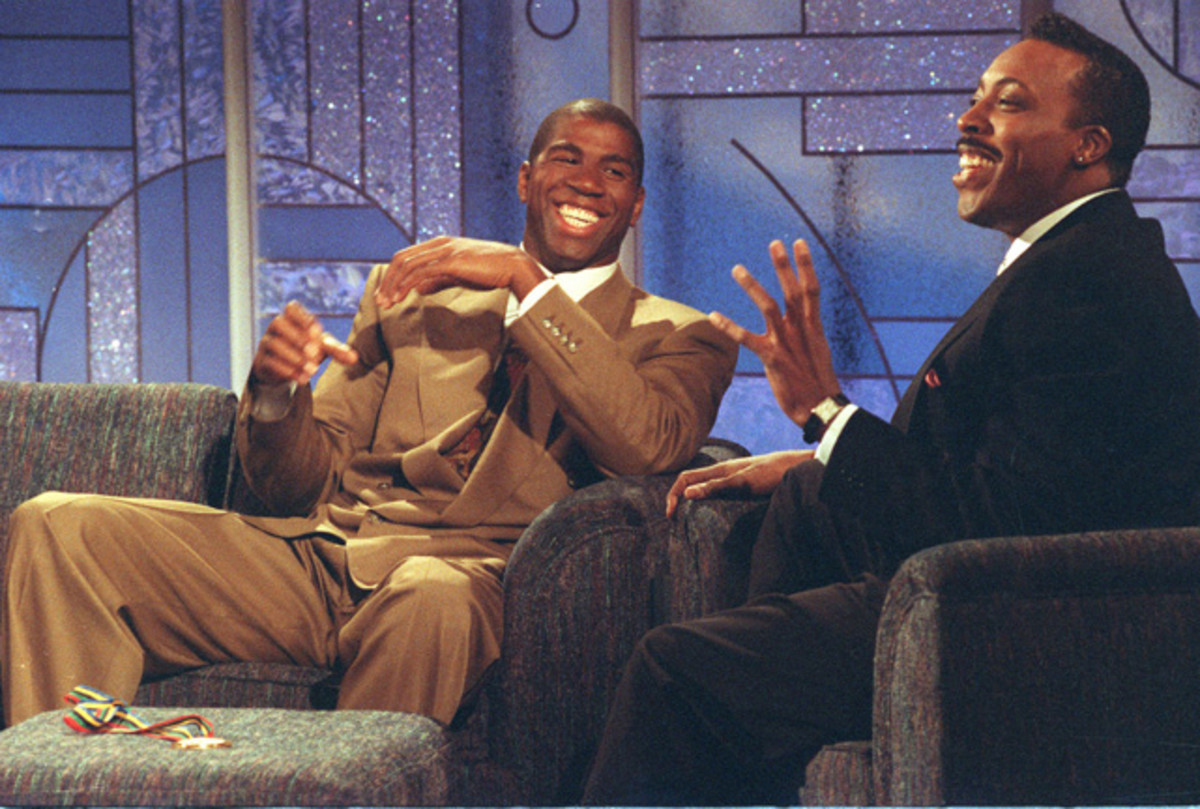
But the night after the California Primary, Clinton stuck around in the Golden State, and appeared as a guest on The Arsenio Hall Show. Hall was the 1st black person to succeed as a late-night talk show host, and had more credibility with young people than did the retiring Johnny Carson, Carson's replacement Jay Leno, or even David Letterman. It is hard to explain to today's kids just how big Arsenio was at that point. After all, he did something neither Carson, nor Leno, nor Letterman ever did: He made a man President. (As much as any man, including the candidate himself, did.)
The show began with Clinton, wearing sunglasses, jamming with The Posse, Arsenio's band, playing "Heartbreak Hotel" by Elvis Presley on the saxophone he'd played since he was a kid. This was considerably hipper than the classical piano playing that Presidents Harry Truman and Nixon had done: This was a President who appreciated rock and roll, which Jimmy Carter and Bush had accepted, but that was about it.
After a careful examination of what Hall called "the smokin' the joint thing," in which Clinton admitted he should've just answered the original question, "Yes," they got serious, talking about job creation and educational opportunities, especially in the inner cities. Hall's Hollywood studio was just a short bus ride from the epicenter of the riot, and Clinton's comments really resonated with his studio audience. Hall brought Hillary on as well, and the appearance helped to humanize her as much as it did him.
At the Democratic Convention at Madison Square Garden in New York, Clinton took Gore, whose family emergency had been resolved, as his Vice Presidential nominee. It was a very inclusive Convention, with Cuomo, Kennedy and Jackson all giving good speeches for Clinton. And then, the morning of the last day of the Convention, Perot dropped out of the race. Suddenly, Clinton had all of the energy, and all of the momentum -- or, as Bush called it in a previous campaign, "The Big Mo."
So the Republican Convention, at the Astrodome in Houston, Bush's adopted hometown, became the nastiest major-party convention ever. (At least, until 2016.) Buchanan gave a speech with the most reluctant of endorsements of Bush, and saying, "There is a religious war going on in our country, for the soul of America." Speaker after speaker ripped the Democrats for favoring civil rights, gay rights, single mothers and public schools -- to the detriment of, respectively, white people, straight people, "traditional families" and religious schools.
It seemed like a Nuremberg rally in 1930s Germany. The Texas-based newspaper columnist Molly Ivins said of Buchanan's speech, and could have said it of others, "It probably sounded better in the original German."
The Republican attacks on Clinton got worse. They even attacked him for a trip he took to the Soviet Union -- in 1969, when he was 23 and a Rhodes scholar at Oxford, 5 years before he ran his 1st campaign for public office. And things got more complicated when Perot got back in the race, resulting in the 1st-ever 3-way Presidential debate.
That happened on October 11, which just happened to be the Clintons' 17th wedding anniversary, at Washington University in St. Louis. In the debate, citing his experience, Bush mentioned the '69 Soviet trip. But, remembering how Bush had done similar things to Dukakis 4 years earlier, Clinton was ready, and he ended Bush's campaign, right there:
When Joe McCarthy went around this country, questioning people's patriotism, he was wrong. He was wrong. And a Senator from Connecticut stood up to him, named Prescott Bush. Your father was right to stand up to Joe McCarthy. You were wrong to attack my patriotism.
If Clinton could stand up to Bush, people realized, he could stand up to nations and terrorist groups that would attack America.
The 2nd Presidential debate, at Robbins Field House, at the University of Richmond in Virginia, deepened Bush's problems. As moderator Carole Simpson of ABC News solicited a question from the audience in the "town hall" format used for this debate, Bush stood up and looked at his watch. By doing this, he made it look like the debate, facing those undecided voters, wasn’t worth his time.
The question that Simpson received, to be fair, was poorly worded. She had to clarify that the questioner, asking, “How has the national debt personally affected each of your lives?” probably meant, “How has the recession affected you?” Perot answered by saying it made him interrupt what he said was a pretty good life to take on the campaign.
Bush fumbled with his answer, saying, "I think the national debt affects everybody. Obviously, it has a lot to do with interest rates," and then asked, "Are you saying that if a person has means, he can't understand hardship?" When Simpson clarified that the question was really about the recession, Bush went off on a tangent about a visit to a black church, seeming to find his bearings, but still not convincing anyone.
In contrast, when it was his turn, Clinton stood up, and said to the questioner, "Tell me again how it's affected you?" She said she knew people who had lost their jobs. He said that, as Governor, when a business in Arkansas went under, chances were he knew the people who ran it. All the Republican mockery of him being "Governor of a small State" -- according to the 1990 Census, Arkansas was home to 2.35 million people -- paid off at that moment. It was another example of a line Clinton had used in other forums: "I feel your pain."
(The 3rd debate, at Michigan State University in East Lansing, was inconclusive: It was Bush's best performance, but the other two were also judged to have done well.)
The Republican campaign continued to get nastier, but it had little effect. The Republicans made slight gains in each house of Congress, but Clinton won solidly in the popular vote, and overwhelmingly in the Electoral Vote, largely because young people, who hadn't really had a candidate to back since the assassination of Robert Kennedy in 1968, finally had someone who seemed to understand their needs.
To this day, many conservatives blame Perot, with his big spending on October half-hour infomercials full of charts, and his overly folksy manner, for throwing the election to Clinton. This is a stupid idea, mainly because exit polls taken on Election Night showed that about half of Perot's voters wouldn't have voted at all, and the other half were pretty much evenly split between Bush and Clinton.
What's more, those very conservatives pushed Bush too far to the right, making him seem as crazy as they were, when he wasn't. Bush himself ran a bad campaign, looking in his speeches like he'd rather be anywhere else on the planet but at that podium; whereas Clinton looked like he was happy to be among the voters at his rallies. And the economy, though slightly better in the 2nd half of 1992 than it was in the 1st half, was still working against an incumbent;
Perot finished 2nd in 2 States: Utah, ahead of Clinton; and, surprisingly, Maine, ahead of Bush, who had a family home there. It is possible that Perot siphoned off enough conservative (or, at least, non-liberal) votes to throw the following States to Clinton: Georgia, Kentucky, Montana, Nevada, New Hampshire, possibly New Jersey, and Ohio. That's a shift of 68 Electoral Votes, which would have turned a 370-168 Clinton win into a 302-236 Clinton win. And it could be just as easily argued that Perot siphoned enough votes to swing Arizona, Florida, North Carolina, South Dakota and Texas to Bush. That's 82 EVs: Clinton could have won 452-86.
Perot ran again in 1996, and in the last days, told his audiences that Clinton would have pending criminal charges against him. This turned out not to be true. Perot didn't do nearly as well, but still did well enough to deny Clinton a majority.
He never ran for office again, and endorsed Bush's son, George W. Bush in 2000. He supported Mitt Romney in 2008 (Romney didn't get the Republican nomination for President) and 2012 (he did, but lost to Barack Obama). He did not endorse anyone in 2016, and died in 2019.
George Herbert Walker Bush told his audience in his concession announcement, "I intend to get fully involved in the grandchild business." He certainly did, and kind of became America's Grandpa. Oddly, his son George W. Bush's Presidency, 2001-09, resembled Nixon's and Reagan's -- right down to the international swagger and the domestic corruption -- much more than his father's. Every mistake he made seemed to be the opposite of a decision his father got right. As Dubya's reputation tumbled, his father's rose. Clinton worked with both George Bushes on disaster relief in the 2000s and 2010s. The elder George Bush died in 2018, and was remembered fondly.
In 1990, Time magazine got creative with its Man of the Year distinction: "Men of the Year: The Two George Bushes." The idea was that Bush, working through Operation Desert Shield, the leadup to the Gulf War, which became Operation Desert Storm, was having success; but, also working through the recession, and having to raise taxes, was struggling, so it was as if 2 different men were President. Clinton ran against the "second George Bush," and won, and Time named him Man of the Year for 1992.
In spite of Clinton's win, the Democrats only broke even in the U.S. Senate, and the Republicans gained 9 seats in the House of Representatives. Following the treatment of Dr. Anita Hill in the Senate confirmation hearings for Supreme Court Justice Clarence Thomas, Democrats called 1992 "The Year of the Woman," and among the new Senators elected were Dianne Feinstein (special election) and Barbara Boxer (regularly-scheduled election) in California, Carol Moseley Braun of Illinois, and Patty Murray of Washington.
Bill Clinton's 2 terms were full of controversy, but, in terms of accomplishments and leaving the country better off when he arrived, he was the most successful President since Lyndon Johnson. He fully supported his wife Hillary's political career, and seemed more hurt than she was when the 2016 election was stolen from her.
The 1992 campaign was a very nasty one, or so it seemed by the standards of the time. This built an odd friendship, to the point where both preferred Bill's wife Hillary for President in 2016 -- though that could also be due to how Donald Trump treated Jeb Bush in that year's campaign.
Clinton's Presidential Library opened on November 18, 2004 in Little Rock, Arkansas. And the city's main airport is named Bill and Hillary Clinton National Airport. The headquarters of the Environmental Protection Agency, in Washington, is named the William Jefferson Clinton Federal Building. Clinton remains the only President born in Arkansas, or to represent it in politics.
Aside from the "Presidential City" in Rapid City, South Dakota, the only known statue of Bill Clinton is in Pristina, the capital of Kosovo, a country he helped liberate.
On Saturday Night Live, he was played by Phil Hartman from 1992 to 1994, Michael McKean in the 1994-95 season, and Darrell Hammond has played him ever since. Dennis Quaid played him in The Special Relationship in 2010 -- not about Bill's relationship with Hillary, or with Monica Lewinsky, but about America's relationship with Britain, with Michael Sheen playing Prime Minister Tony Blair.
*
November 3, 1992 was, like all modern Election Days in U.S. history, a Tuesday. This was also the day that the New York Yankees traded Roberto Kelly to the Cincinnati Reds for Paul O'Neill, a major transaction in the Yankees' 1990s restoration. I have a separate entry for that event.
The baseball season was over. Football was in midweek. And there were no NBA games played that day. But there were 5 NHL games:
* The only team from the New York Tri-State Area in action was the New York Islanders, and they lost to the Pittsburgh Penguins, 2-0 at the Civic Arena in Pittsburgh.
* The Quebec Nordiques and the Hartford Whalers played to a tie, 3-3 at the Hartford Civic Center (now the PeoplesBank Arena).
* The Washington Capitals beat the Chicago Blackhawks, 4-1. This was one of the NHL's early-1990s experiments with neutral-site games. It was played at the Market Square Arena in Indianapolis, formerly home to the World Hockey Association's Indianapolis Racers. This made it a lot closer to a home game for the Hawks than it was for the Caps, but the Caps won.
* The expansion Tampa Bay Lightning beat the St. Louis Blues, 6-4 at the Florida State Fairgrounds Expo Hall in Tampa.
* And the Edmonton Oilers beat the expansion Ottawa Senators, 5-2 at the Northlands Coliseum in Edmonton.