Showing posts with label cliff barker. Show all posts

Wednesday, March 23, 2022

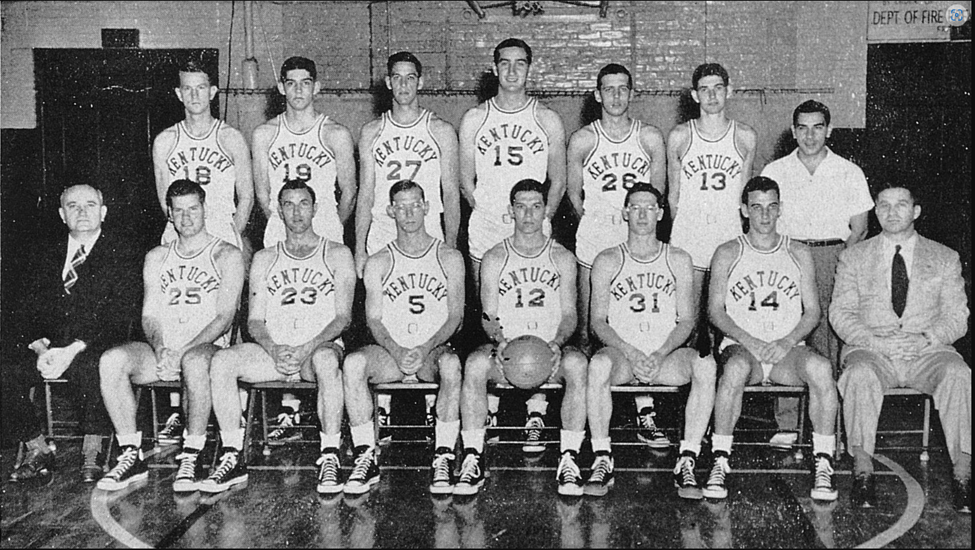
March 23, 1948: Kentucky's "Fabulous Five"

March 23, 1948: The University of Kentucky win the NCAA Basketball Tournament for the 1st time, defeating Baylor University, 58-42 at the old Madison Square Garden in New York.

Baylor had a player named Jackie Robinson -- a white man who would play with some of the Kentucky players on the 1948 U.S. Olympic Team in London, and became a minister. That's the most interesting thing about the Baylor squad.

But the Kentucky team was perhaps the best college basketball team ever assembled to this point. Their head coach, Adolph Rupp, called them "The Fabulous Five": Guards Ralph Beard and Kenny Rollins, forwards Wallace "Wah Wah" Jones and Cliff Barker, and center Alex Groza. They went 34-2, with the only losses being by 1 point to Temple in Philadelphia, a loss they avenged by 20 points in a rematch in Lexington; and 9 away to Notre Dame.

Rupp had been born in 1901 in Kansas, and had played at the University of Kansas under Forrest "Phog" Allen, while Allen's mentor, Dr. James Naismith, the literal inventor of basketball, was still alive and teaching there. After coaching in high school, Kentucky named him head coach in 1930, and he would lead them to 27 Southeastern Conference titles, 13 SEC Tournament wins, and 876 wins, more than any coach before him. He became known as "the Baron of the Bluegrass."

Rollins graduated in 1948, but the other four of the returned for the 1948-49 season. Dale Barnstable took Rollins' place in the starting lineup, and the Wildcats went 32-2, losing by 2 away to Saint Louis University, and by 11 against Loyola of Chicago, knocking UK out of the NIT at The Garden. But they won the NCAA, beating Oklahoma A&M (who became Oklahoma State in 1958) in the Final at Seattle.

After the 1949 NCAA Tournament, Coach Rupp then retired the uniform numbers of Beard, 12; Groza, 15; Barker, 23; Rollins, 26; and Jones, 27. Barnstable's 18 has never been retired.

It was these back-to-back National Championships that established Kentucky as an elite team. Fans of the "Bluegrass Boys" are sometimes mocked as the "Blue Bloods," and are said to be as arrogant as fans of the New York Yankees, the Dallas Cowboys, the Boston Celtics, the basketball team at Duke University, and the football team at the University of Notre Dame. (The Yankees, the Cowboys and Duke also wear blue and white; Notre Dame, blue but with gold.)

In 1948, Rollins was selected by the Fort Wayne Pistons in the NBA Draft, but they traded him to the Chicago Stags. In 1949, a new team in the NBA, the Indianapolis Olympians, tried to reassemble the U.S. Olympic Team. They selected Groza in the 1st round of the NBA Draft, Beard in the 2nd round. Barker was drafted by the Washington Capitols, but the Olympians acquired him in a trade. Barnstable was drafted by the Boston Celtics in 1950, but instead took a teaching and coaching job at a Louisville high school.

With Barker as player-coach, the Olympians won the NBA Western Division in 1950, and beat the Sheboygan Red Skins in the 1st round of the Playoffs, before losing the Division Finals to the Anderson Packers. In 1951, they just made the Playoffs, and lost to the Minneapolis Lakers in the 1st round.

But at the start of the 1951-52 season, Groza, Beard and Barnstable were arrested for taking bribes from gamblers to "shave points" while they were at Kentucky. When the dust settled in 1952, they were banned from the NBA for life. UK got its 1952-53 season canceled, and was banned from competing in the NCAA Tournament and the NIT in 1954.

Barker, Rollins and Jones were not implicated, and were allowed to play the 1951-52 season. But Barker and Jones left Olympians after that season, and never played professionally again. Rollins last played in 1953, with the Celtics. After that season, the Olympians folded, having lost to the Lakers again in the Playoffs in 1952 and '53.

Kentucky, still banned from the postseason at that point, went 25-0 in 1954, and the Helms Foundation declared them -- not NCAA Champion LaSalle or NIT Champion Holy Cross -- the National Champions.

Kentucky would win another title in 1958, with a bunch of players that Rupp said were "just fiddling around." Thus, they became known as the Fiddlin' Five. They made the Final again in 1966, with a team lacking much height, and thus known as "Rupp's Runts," but famously lost to the school now known as Texas-El Paso. This would lead to Rupp finally racially integrating his team.

After his retirement, Joe B. Hall, a reserve on the 1949 and 1951 title teams, led Kentucky to the National Championship in 1978, a few months after Rupp's death. Rick Pitino did so in 1996, Tubby Smith in 1998, and John Calipari in 2012. Baylor made what would later be called the Final Four again in 1950, but did not do so again until 2021, when they won the whole thing. By that point, they had become better known for their successful women's basketball program.

Groza, brother of Pro Football Hall-of-Famer Lou Groza, would later coach in college and in the ABA. Beard tried to play professional baseball, but his gambling connection got him banned from that sport as well. He became a scout for the ABA's Kentucky Colonels, and worked in the pharmaceutical industry. Barnstable wasn't playing in the pros anyway, but had gotten a job as a high school coach in Louisville, and was fired from that job as a result of the scandal. He later became a successful seller of air filters, and won senior golf tournaments. But none of the 3 were were ever involved in the NBA again, as their bans were never lifted.

Groza died in 1995, Barker in 1998, Beard in 2007, Rollins in 2012, Jones in 2014, Barnstable in 2019. None of them has ever been elected to the Basketball Hall of Fame. They were, however, all allowed to keep their Olympic Gold Medals.

*

March 23, 1948 was a Tuesday. Baseball was in Spring Training. Football was out of season. And the NHL was between the end of the regular season and the start of the Stanley Cup Playoffs.

There were 2 games in the NBA. The Chicago Stags beat the Washington Capitols, 74-70 at the Chicago Stadium. And the St. Louis Bombers beat the Philadelphia Warriors, 60-58 at the St. Louis Arena.

Thursday, January 6, 2022

January 6, 1951: The NBA's Longest Game

Ralph Beard. No, he didn't have one.

January 6, 1951: The longest game in National Basketball Association history is played. You might not recognize the name of either team, though. And the building in which it was played is long gone.

The building was the Edgerton Park Arena, in Edgerton Park, in Rochester, New York. It was built in 1892, had an artificial ice surface installed in 1935, and was home to the Rochester Royals from 1945 to 1955. But, at 4,200 seats, it was too small to be a major league sports facility, and the Royals moved to the Community War Memorial Arena.

The Royals had won the Championship of the National Basketball League in 1946, before joining the Basketball Association of America. The BAA and the NBL merged in 1949, to form the NBA, although the NBA now recognizes the BAA's founding in 1946 as its own founding. Their players included former Seton Hall University All-American Bob Davies and a flashy (for the time) point guard from Brooklyn named William "Red" Holzman.

Their opponents were the Indianapolis Olympians. They were so named because they signed up several members of the U.S. team that won the Gold Medal at the 1948 Olympics in London. Three of those were still there, men who had led the University of Kentucky to National Championships in 1948 and 1949: Alex Groza (brother of Cleveland Browns lineman and kicker Lou Groza), Ralph Beard and Cliff Barker.

The Royals came into the game a strong 18-11. The Olympians were shuffling along at 16-15. Apparently, those Kentucky Wildcats weren't used to professional competition. But, at least on this night, they adjusted: At the end of the 1st quarter, the Olympians led, 20-10.

The Royals came back, and it was 38-33 Indianapolis at the half. After 3 quarters, it was 57-53 Indianapolis. A strong 4th quarter resulted in the game being tied at the end of regulation, 65-65.

Unlike the NFL and the NHL, the NBA, then as now, had no provision for ties: Teams have always played until somebody won. But this was the era before the shot clock: In overtime, the idea was to get the ball, and stall until you could make a last-second shot; and, if you lost the ball, foul away.

Each team scored only 2 free throws in overtime, so it went to a 2nd overtime. Nobody scored in it, so the game went on. And on. And on. Each team scored only 2 free throws in the 3rd overtime. Nobody scored in the 4th. Each team scored 4 free throws in the 5th overtime. 

And so, for what remains the only time in professional basketball history -- neither the old ABL, nor the 1967-76 American Basketball Association, nor any women's league including the WNBA has had one go that long -- a 6th overtime was needed.

Finally, with 1 second left in that 6th OT, Beard put up a shot, and it went in. The Olympians had won, 75-73.

The game went 78 minutes, and Holzman, who later coached the Knicks to the 1970 and 1973 NBA Championships, played 76 of them. Harvey Frommer, better known as a travel writer but also the author of a few sports books, wrote Holzman's authorized biography, and quoted him as saying that this was 1 of 2 games in the 1950-51 season that led to the creation of the shot clock. The other was a game in which the Fort Wayne Pistons tried to freeze the ball against George Mikan and the Minneapolis Lakers.

The following season, Groza and Beard were charged with shaving points at Kentucky, and were banned from the NBA for life. Both men went on to work in the ABA, but their NBA bans were never lifted. Nor have they ever been elected to the Basketball Hall of Fame, as they likely would have if not for the scandal. The Olympians survived until the 1953 season, but, without their big stars, they couldn't draw fans, and folded.

The Royals went on to win the NBA Championship in 1951, beating the Knicks in the Finals in 7 games. In 1955, they moved to the Community War Memorial Arena, which still stands, now known as the Blue Cross Arena at the War Memorial, and home to minor-league hockey's Rochester Americans. 

But Rochester, the 3rd-biggest city in the State of New York behind New York City and Buffalo, was, and remains, too small to host a major league team. In 1957, the Royals moved to Cincinnati. They moved to become the Kansas City Kings in 1972, and again in 1985, becoming the Sacramento Kings.

Since 1951, the longest game in the NBA has been a 5-overtime game at the Bradley Center in Milwaukee on November 9, 1989, the day the Berlin Wall came down. The Milwaukee Bucks beat the Seattle SuperSonics, 155-154.

*

January 6, 1951 was a Saturday. Three other games were played in the NBA that day:

* The New York Knicks lost to the Syracuse Nationals, 87-85 at the old Madison Square Garden. This game only needed 1 overtime.

* The Baltimore Bullets beat the Philadelphia Warriors, 64-57 at the Baltimore Coliseum. No overtimes necessary. The Bullets folded in 1954, and the Warriors moved to San Francisco in 1962, taking the name "Golden State" in 1971. The aforementioned Syracuse Nationals took the Warriors' place in 1963, renaming themselves the Philadelphia 76ers.

* And the Fort Wayne Pistons beat the Washington Capitals, 91-76 at the Uline Arena. No overtimes necessary. The Capitols folded at the end of this season. However, their arena, later renamed the Washington Coliseum, still stands. The Pistons moved to Detroit in 1957.

There were 2 games played in the NHL that day: The New York Rangers beat the Toronto Maple Leafs, 4-2 at Maple Leaf Gardens in Toronto; and the Montreal Canadiens beat the Detroit Red Wings, 5-2 at the Montreal Forum.

And Arsenal played Carlisle United at Highbury in North London, in the 3rd round of the FA Cup, and the game ended in a 0-0 draw. That forced a replay at Carlisle, which Arsenal won, 4-1.

Also on this day, Kim Wilson, the leader singer of the rock band The Fabulous Thunderbirds, was born.

December 31, 1999 & January 1, 2000: The Millennium

December 31, 1999:  The Millennium arrives. The people of planet Earth survived. At a terrible cost. But we hadn't destroyed ourselves. ...