Showing posts with label abc. Show all posts

Sunday, December 25, 2022

December 25, 1895: The Legend of Stagger Lee

Lloyd Price

December 25, 1895: The legend of "Stagger Lee" is born. Lee Shelton, a black pimp known as "Stack" or "Stacker" Lee, ran an, um, entertainment venue called the Four Hundred Club in St. Louis. He and William Lyons, also involved in the St. Louis underworld, were drinking in the Bill Curtis Saloon. They began to argue, and Lyons took Shelton's Stetson hat off his head. For this offense, Shelton shot Lyons, killing him.

Shelton was convicted, served 12 years for murder, was imprisoned again for robbery, and died in prison in 1912.

As early as 1897, during Shelton's trial, the 1st song about the murder was performed. It spread throughout American music, black and white alike, and, depending on the singer's accent, the perpetrator (and thus the title) could be "Stack-o-Lee," "Stag-o-Lee," "Stacker Lee," "Stagger Lee," and so on. The legendary New Orleans pianist Mac "Dr. John" Rebennack claimed that there were so many versions, he could sing the song for half an hour and never repeat a verse.

Eventually, "Stagger Lee" became the best-known version. But the song, as most people know it now, gets the details wrong: In most versions, "Stagger Lee" and "Billy" are shooting dice in an alley late at night, and Billy, having already won Stagger Lee's Stetson hat, tries to cheat him. So Stagger Lee goes home, gets his gun, goes to the bar, and, despite Billy pleading for his life -- "I got three little children and a very... sickly wife!" -- shoots him. (I wonder if one of the versions that Dr. John knew went, "I got three little children and a very... ugly wife!")

Fred Waring & His Pennsylvanians became the 1st white act to record it, in 1923. Lloyd Price hit Number 1 with it in 1959, but there was a problem: It was on ABC-Paramount Records, and ABC not only owned the label, but aired American Bandstand. That show couldn't have the Number 1 song in the country played for teenagers, on live national daytime television, with the words, "Stagger Lee shot Billy, oh, he shot that poor boy so bad, 'til the bullet came through Billy and it broke the bartender's glass!" (How did that couplet get past 1950s censors in the first place?)

So they had Price record a cleaned-up version, in which Billy stole Stagger Lee's girlfriend, but he feels bad about it, and gives her back, and the guys make up, and are both alive at the end. The way to tell the difference is at the beginning: In the original version, Price sings, in his New Orleans accent, "The night was Claire," while in the cleaned-up version, he sings it straight, "The night was clear." In both versions, "the Moon was yellow, and the leaves came tumbling down" -- making the opening a haiku (five syllables, then seven, then five), and also suggesting that the song takes place in  Autumn, several weeks before Christmas.

*

December 25, 1895 was a Wednesday. Baseball was out of season, hockey was all-amateur, basketball was a recent invention, and this was before college football was playing bowl games, let alone on Christmas Day.

But in England, soccer, or "football" as they call it, had a tradition: To keep traveling to a minimum, and thus families together, 2 nearby teams would play at one's home ground on Christmas Day, and at the other's on the next day, December 26, Boxing Day. This tradition began to die out in the 1950s, but Boxing Day games are still played.

On December 25, 1895, the London-based team which I would eventually support, then known as Woolwich Arsenal, played, but not against a nearby team: They hosted Burslem Port Vale, at the Manor Ground in Plumstead, Kent, later to be a part of Southeast London, and won, 2-1.

Sunday, December 18, 2022

December 18, 1974: "The Missiles of October" Premieres On ABC

William Devane as JFK

December 18, 1974: The TV-movie The Missiles of October airs on ABC. William Devane plays President John F. Kennedy, and Martin Sheen plays his brother, Attorney General Robert F. Kennedy. The film is based on Thirteen Days: A Memoir of the Cuban Missile Crisis, written by RFK but not published until 1969, after his assassination.

The film also stars Howard Da Silva as Soviet Premier Nikita Khrushchev, and Ralph Bellamy as U.N. Ambassador Adlai Stevenson.

In 1979, Sheen starred in Blind Ambition, based on the memoir of John Dean, counselor to President Richard Nixon and defendant/informant in the Watergate case. In 1983, he starred in the NBC miniseries Kennedy, making him, as far as I know, to this day, the only actor ever to play both Jack and Bobby Kennedy. That same year, in The Dead Zone, he played a Senate candidate who, in a vision of the future by Johnny Smith (Christopher Walken), becomes a President who starts World War III.

In 2003, playing fictional President Jed Bartlet on The West Wing, Sheen was reunited with Devane, who played Secretary of State Lewis Berryhill. In 2007, he provided the voice of George Washington for the documentary Searching for George Washington.

Devane has also played fictional Presidents on Stargate SG-1 and 24, and in The Dark Knight Rises. In 1991, in the NBC film A Woman Named Jackie, he played Jack Bouvier, father of Jacqueline Kennedy.

Bellamy had played Franklin D. Roosevelt in Sunrise at Campobello in 1960, telling of FDR's initial struggle with polio before becoming President. He played FDR as President in the 1984 ABC miniseries The Winds of War and its 1988 sequel War and Remembrance, based on the World War II novels of Herman Wouk.

Da Silva, the original Jud Fry in Oklahoma! in 1943, played Benjamin Franklin in the 1969 Broadway musical 1776 and its 1972 film version. And he played FDR in the 1977 film The Private Files of J. Edgar Hoover.

In 2000, a theatrical release about the Crisis was released, taking the Thirteen Days name from RFK's book, but based on another book about the Crisis, based on information declassified long after The Missiles of October aired.

*

December 18, 1974 was a Wednesday. Pro Bowl linebacker Peter Boulware was born.

Baseball was out of season. Football was in midweek. There were 3 games in the NBA:

* The Boston Celtics beat the Philadelphia 76ers, 131-99 at The Spectrum in Philadelphia.

* The Washington Bullets beat the New Orleans Jazz, 113-90 at the Capital Centre in the Washington suburb of Landover, Maryland.

* And the Seattle SuperSonics beat the Detroit Pistons, 100-97 at Cobo Hall (now Huntington Place) in Detroit. Fred Brown scored 34 for the Sonics.

There were 4 games in the American Basketball Association:

* The Virginia Squires beat the Memphis Sounds, 112-86 at the Mid-South Coliseum in Memphis.

* The Indiana Pacers beat the San Antonio Spurs, 128-122 at the Market Square Arena in Indianapolis. George McGinnis led all scorers on the night with 45.

* The Kentucky Colonels beat the Spirits of St. Louis, 110-94 at the St. Louis Arena. Artis Gilmore scored 36 for the Colonels.

* And the San Diego Conquistadors beat the Utah Stars, 113-99 at the San Diego Sports Arena (now the Pechanga Arena).

There were 6 games in the NHL:

* The New York Rangers beat the Minnesota North Stars, 7-0 at Madison Square Garden. Former Boston Bruins star Derek Sanders scored 3 goals and had an assist for the Rangers.

* The New York Islanders lost to the Buffalo Sabres, 3-2 at the Buffalo Memorial Auditorium.

* The Toronto Maple Leafs beat the Pittsburgh Penguins, 6-4 at Maple Leaf Gardens in Toronto.

* The Chicago Black Hawks beat their arch-rivals, the Detroit Red Wings, 7-5 at the Chicago Stadium.

* The Los Angeles Kings beat the Kansas City Scouts, 6-0 at the Kemper Arena (now the Hy-Vee Arena) in Kansas City.

* And the Montreal Canadiens beat the California Golden Seals, 4-3 at the Oakland Coliseum Arena.

And there were 2 games in the World Hockey Association. The Quebec Nordiques beat the Winnipeg Jets, 5-1 at the Colisée de Québec. And the Phoenix Roadrunners beat the Vancouver Blazers, 5-3 at the Arizona Veterans Memorial Coliseum.

Tuesday, December 6, 2022

December 6, 1964: The Rankin/Bass Empire Premieres

December 6, 1964: Rudolph the Red-Nosed Reindeer premieres on CBS, the 1st animated holiday special produced by Rankin/Bass Productions, Inc., now known as Rankin/Bass Animated Entertainment.

Arthur Gardner Rankin Jr. was born on July 19, 1924 in Manhattan, and both of his parents were actors. Julius Bass, known professionally as Jules Bass, was born on September 16, 1935 in Philadelphia. In 1955, ABC hired Rankin as an art director, and Bass as a copywriter. Together, they made TV commercials, using animation.

In 1960, they founded Videocraft International, which became Rankin/Bass Productions. In 1964, they made their 1st stop-motion animation special, based on the 1947 Christmas-themed song "Rudolph, the Red-Nosed Reindeer."
Arthur Rankin Jr. (left) and Jules Bass

The story, narrated by Burl Ives as Sam the Snowman (who has a mustache and a goatee, like Ives himself did), follows the song, with some embellishments. In this version, Rudolph is the son of Donner, who is listed here as Santa Claus' lead reindeer, and Donner's wife, whose name is never mentioned. (This was before "the Second Wave of Feminism.") Rudolph, voiced by actress Billie Mae Richards, has the bright red nose from birth. Santa (voiced by Stan Francis) agrees with Donner that the nose has to be hidden. It has been noted that it's not just "all of the other reindeer" who were mean to Rudolph: This is not one of the nicer versions of Big Red.

After running away with Hermey (voice of Paul Soles, a voiceover legend, including the 1st person to play Spider-Man, albeit animated), an Elf who doesn't want to make toys for Santa, and would rather be a dentist, they find adventure with a miner, an abominable snowman, and an island of "misfit toys." Upon returning to the North Pole, they gain new respect. On Christmas Eve, the fog is so thick that Santa and the reindeer can't see through it, but Rudolph, with his nose so bright can guide the sleigh that night. It has occurred to me that neither Santa nor any of the other reindeer ever apologized to Rudolph.

The special is a musical, and it closes with Ives, as Sam, singing a song that became a Christmas classic: "A Holly Jolly Christmas."
The success of this special led to other holiday-themed specials, most of them based around Christmas legends, even though Rankin and Bass were both Jewish. In 1968, they produced The Little Drummer Boy, a stop-motion animation that aired on NBC, narrated by a woman voiced by actress Greer Garson. The drummer boy is voiced by Teddy Eccles, and the Vienna Boys' Choir sings the title song.

That special is not widely remembered today. Their next one is: In 1969, for CBS, they produced, with traditional animation, Frosty the Snowman. Jimmy Durante narrated, and was represented by a lookalike resident of the town where Frosty was "born," complete with big nose.

Comedian Jackie Vernon voiced Frosty. Because the original 1950 song doesn't have an antagonist, aside from the weather, the magic hat that brings Frosty to life previously belonged to Professor Hinkle, an evil magician voiced by Billy De Wolfe. Paul Frees returns, playing a much kindlier Santa than seen in Rudolph.

In 1970, Rankin & Bass returned to stop-motion, for Santa Claus is Comin' To Town. Fred Astaire voiced the narrator, a mailman named S.D. Kluger -- "S.D." for "Special Delivery." He gives the first truly detailed origin story for Santa Claus, although others have been put forth. Mickey Rooney voices Santa from infancy to jolly old elf. Robie Lester voices schoolteacher Miss Jessica, who becomes Mrs. Claus.

In 1971, they produced a special for Easter, Here Comes Peter Cottontail. It was not based on the 1950 song of that title, but on a 1957 novel The Easter Bunny That OversleptDanny Kaye played narrator Seymor S. Sassafrass. Casey Kasem, star Los Angeles disc jockey, who voiced Shaggy on Scooby-Doo (and would later voice Robin in the Super Friends cartoons), voiced Peter. And the master of horror, Vincent Price, voiced the villain, evil rabbit January Q. Irontail.

In 1974, Mickey Rooney once again played St. Nick, in the stop-motion The Year Without a Santa Claus, premiering on ABC. Santa doesn't feel up to delivering the presents this year. His doctor says it's because not enough people believe in him anymore. So Mrs. Claus, this time voiced by Shirley Booth, sends a pair of Elves named Jingle Bells and Jangle Bells out on the sleigh, pulled by Vixen, the lone female reindeer of the usual crew of 8 (9, when Rudolph is leading the way).

What everyone tends to remember about this special, more so than the outcome (Santa is convinced to go for it, of course), is the antagonists, Snow Miser and Heat Miser, bickering brothers, both sons of Mother Nature. Each of them, true to their alternating song, is "too much."

Rudolph's Shiny New Year premiered on ABC in 1976. Red Skelton voices Father Time, who narrates. Billie Richards returns as Rudolph. Father Time tells his friend Santa that the Baby New Year must be found before the 12th "bong" at midnight on New Year's Eve, or else there will be no new year. As it's snowing, Santa sends Rudolph out to find him. Father Time considers Rudolph a good choice, because he would understand: The Baby, a.k.a. Happy, ran away from home because of his own unusual physical feature, enormous ears.

Rudolph goes to the Archipelago of Last Years (a variation on the Island of Misfit Toys). Each island represents a past year. On 1,000,000 BC Island, they meet a caveman named O.M. (for "One Million," voiced by Morey Amsterdam). He agrees to help Rudolph. So does Sir 1023, a Scottish knight (Frank Gorshin), who leaves his island of the year 1023, where all the fairy tales you've ever heard are real. Also agreeing to help is Sev (short for "1776," who looks like Benjamin Franklin and is voiced by Paul Frees), who leaves his island where every day is the 4th of July.

Other islands are no use: On 4,000 BC Island, all the people there want to do is build pyramids; on 1492 Island, people are too busy discovering things; everybody on 1893 Island is depressed, since there was a depression that year; and 1965 Island is "too noisy," as people are yelling about rock bands and a war. Nevertheless, Happy is found, rescued from a monster bird, and is brought back just in time.

Like Rudolph, Frosty returned in 1976, with Frosty's Winter Wonderland. By this point, Jimmy Durante was too ill to participate, so Andy Griffith was hired to narrate. With a new snowfall, Frosty returned to the town where he was "born," but the kids' love of Frosty makes Jack Frost, the symbol of Winter (Paul Frees), jealous, and he fights Frosty.

Frosty buys him off, by asking him to be the best man at his wedding to a snowwoman named Crystal (as snowflakes are crystals, and she's voiced by Shelley Winters). She came to life with a snow-corsage. The Parson Brown mentioned in the original song can't marry them, as he can only marry humans. So a snow parson is made, and Brown's Bible brings him to life. (Dennis Day voices both parsons.) Frosty and Crystal have to go north again, but promise to return.

Next, in 1977, again with Astaire as S.D. Kluger, was The Easter Bunny Is Comin' to Town. Keep in mind: Peter Cottontail and the Easter Bunny are separate characters, and this special told of a possible origin for the Easter Bunny, voiced by Skip Hinnant, already known to kids as Fargo North, Decoder on PBS' The Electric Company.

On Thanksgiving Weekend 1979 came the Justice League or Avengers of Christmas specials: Rudolph and Frosty's Christmas in July. Returning are Billie Richards as Rudolph, Jackie Vernon as Frosty, Shelley Winters as Crystal, Mickey Rooney as Santa, and Paul Frees as Jack Frost. Frees also plays the villain, a snow wizard named Winterbolt, who wants to reclaim the North Pole from Santa, and plans to discredit Rudolph and Frosty to achieve this.

Red Buttons returns, but as Milton, an ice cream salesman, not as Father Time. Don Messick, the original voice of Scooby-Doo, plays several roles, including taking over as Rudolph's father, Donner. Darlene Conley voices Mrs. Claus. Thurl Ravenscroft, best known as the voice of Kellogg's cereals' Tony the Tiger, but also the singer of "You're a Mean One, Mr. Grinch" from How the Grinch Stole Christmas! (not a Rankin/Bass special), plays the Genie of the Ice Scepter, and Ethel Merman plays Lilly Loraine, owner of the circus where Milton works. The only things that seem to be missing are the Miser Brothers.

Finally, a few days after that special, came Jack Frost, as the Winter sprite got his own special, although this time, he is voiced by Robert Morse instead of Frees. His story is told by Pardon-Me-Pete, a groundhog voiced by Buddy Hackett, who has a vested interest in a longer Winter: More sleep. He and a human girl, voiced by Debra Clinger, fall in love, but, in the end, he loses her to a human boy. The girl's name is Elisa; maybe if her name had been Elsa, it would have worked out, but Jack has to let it go.

In 1987, Rankin and Bass sold their company to Lorimar Productions. Jimmy Durante, the narrator of Frosty, died in 1980. Paul Frees, voice of many characters in these specials, including the original Jack Frost, died in 1986. Jackie Vernon, the voice of Frosty, died in 1987. So did Fred Astaire, the narrator of Santa Claus is Comin' To Town. So did Danny Kaye, the narrator of Here Comes Peter Cottontail. Burl Ives, the narrator of Rudolph the Red-Nosed Reindeer, died in 1995. Red Skelton, the narrator of Rudolph's Shiny New Year, died in 1997.

Billie Mae Richards, the voice of Rudolph, died in 2010. Andy Griffith, the narrator of Frosty's Winter Wonderland, died in 2012. Arthur Rankin died on January 30, 2014, at age 89. Mickey Rooney, twice the voice of Santa in Rankin/Bass specials, also died in 2014. Robert Morse, star of Jack Frost, died in 2022. Jules Bass died on October 25, 2022, at 87.

Still alive as of December 6, 2022 is Skip Hinnant, the '77 voice of the Easter Bunny, but better known for his performance on the PBS kids' show The Electric Company, as characters including Fargo North, Decoder.

*

December 6, 1964 was a Sunday. These NFL games were played that day:

* The New York Giants lost to the Minnesota Vikings, 30-21 at Yankee Stadium.

* The Detroit Lions beat the Baltimore Colts, 31-14 at Memorial Stadium in Baltimore.

* The Pittsburgh Steelers beat the Washington Redskins, 14-7 at District of Columbia Stadium (later Robert F. Kennedy Memorial Stadium) in Washington.

* The football version of the St. Louis Cardinals beat the Cleveland Browns, 28-19 at Busch Stadium (formerly Sportsman's Park) in St. Louis.

* The Philadelphia Eagles beat the Dallas Cowboys, 24-14 at Franklin Field in Philadelphia.

* The San Francisco 49ers beat their arch-rivals, the Los Angeles Rams, 28-7 at Kezar Stadium in San Francisco.

* And the day before, the Green Bay Packers beat the Chicago Bears, 17-3 at Wrigley Field in Chicago.

In the American Football League:

* The New York Jets lost to the San Diego Chargers, 38-3 at Shea Stadium.

* The Boston Patriots beat the Kansas City Chiefs, 31-24 at Kansas City Municipal Stadium.

* The Oakland Raiders beat the Buffalo Bills, 16-13 at Frank Youell Field in Oakland.

* And the Denver Broncos and the Houston Oilers had the week off.

Baseball was out of season. There were 3 games played in the NBA:

* The New York Knicks lost to the St. Louis Hawks, 115-94 at the Kiel Auditorium in St. Louis.

* The Cincinnati Royals beat the Baltimore Bullets, 124-113 at the Baltimore Civic Center (now the CFG Bank Arena).

* And the Los Angeles Lakers beat the Philadelphia 76ers, 109-104 at the Los Angeles Memorial Sports Arena.

And there were 2 games in the NHL:

* The New York Rangers beat the Chicago Black Hawks, 4-1 at the Chicago Stadium.

* The Detroit Red Wings beat the Montreal Canadiens, 4-1 at the Olympia Stadium in Detroit.

* And the Boston Bruins and the Toronto Maple Leafs were not scheduled.

Wednesday, November 30, 2022

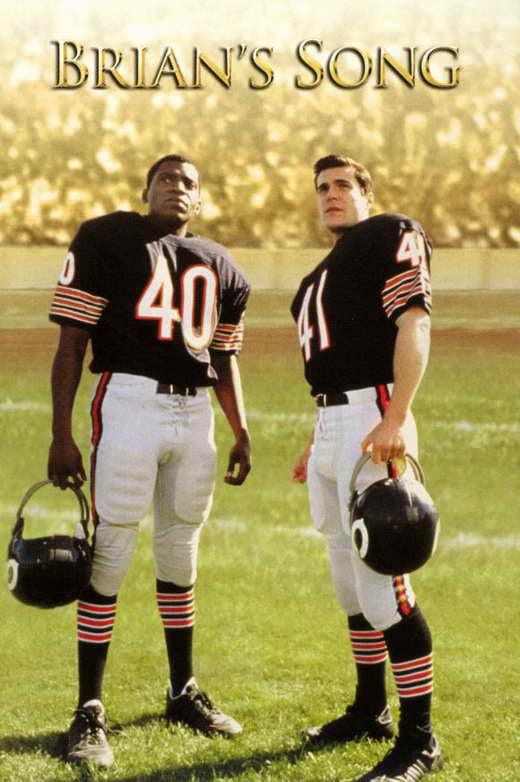
November 30, 1971: "Brian's Song" Premieres

James Caan as Brian Piccolo (left)
and Billy Dee Williams as Gale Sayers

November 30, 1971: The ABC Tuesday Night Movie airs the film Brian's Song. Billy Dee Williams plays African-American Chicago Bears running back Gale Sayers, and James Caan plays his white teammate Brian Piccolo.

While some dramatic license was taken, the story is mostly true: The two men overcome their respective biases and form a bond of friendship, first with Piccolo helping Sayers, the best running back in the game in the late 1960s, return from a devastating knee injury; then with Sayers helping Piccolo deal with the cancer that struck him, and ultimately brought his life to a close on June 16, 1970.

The film made stars of both Williams and Caan, and is often regarded as the first movie that allowed tough guys to cry.

A remake was made, airing on ABC almost exactly 30 years later, on December 2, 2001. The additional 30 years of changing sensibilities allowed some things to be filmed that couldn't be put on TV for the original. Sayers was played by Mekhi Phifer, and Piccolo by Sean Maher.
Phifer and Maher in the remake

By a coincidence, Sayers wore uniform Number 40, and Piccolo Number 41. Thus, they were given lockers next to each other. Both numbers were retired by the team.

*

November 30, 1971 was a Tuesday. Actress Jessalyn Gilsig was born. So was Kristi Noem, elected Governor of North Dakota as a Republican. (UPDATE: Donald Trump appointed her Director of Homeland Security for his 2nd term.)

Baseball was out of season. Football was in midweek. There were 6 games played in the NBA that night:

* The New York Knicks lost to the Seattle SuperSonics, 110-109 at Madison Square Garden.

* The Cincinnati Royals beat the Baltimore Bullets, 118-103 at the Baltimore Civic Center (now the CFG Bank Arena).

* The Houston Rockets beat the Buffalo Braves, 115-101 at the Buffalo Memorial Auditorium.

* The Chicago Bulls beat the Atlanta Hawks, 86-85 at the Chicago Stadium.

* The Golden State Warriors beat the Milwaukee Bucks, 106-103 at the Milwaukee Arena. In 1974, it was renamed the Milwaukee Exposition, Convention Center and Arena, or "The MECCA." Since 2014, it has been named the UW-Panther Arena. Kareem Abdul-Jabbar had 30 points and 24 rebounds, but the Warriors had a more balanced attack. Four players had at least 20 points, led by Joe Ellis, who didn't even start, with 25.

* And the Phoenix Suns beat the Portland Trail Blazers, 121-111 in overtime at the Portland Memorial Coliseum.

There were 4 games played in the American Basketball Association:

* The Virginia Squires beat the Pittsburgh Condors, 134-129 at the Civic Arena in Pittsburgh. Charlie Scott led all scorers on the night with 46 points for the Squires.

* The Indiana Pacers beat the Memphis Pros, 114-88 at the Mid-South Coliseum in Memphis.

* The Denver Rockets beat the Dallas Chaparrals, 106-91 at the Denver Auditorium Arena. The Chaps became the San Antonio Spurs in 1973, and the Rockets, anticipating entering the NBA where there was already a Houston Rockets, became the Denver Nuggets in 1974.

* And the Utah Stars beat the Miami Floridians, 127-114 at the Salt Palace in Salt Lake City.

There were 2 games played in the NHL that night. The St. Louis Blues beat the California Golden Seals, 5-2 at the St. Louis Arena. And the Vancouver Canucks beat the Chicago Black Hawks, 4-2 at the Pacific Coliseum in Vancouver. 

Sunday, November 20, 2022

November 20, 1983: "The Day After" Airs On ABC

November 20, 1983: The Day After airs on ABC. With over 100 million people watching, a 46 rating and a 62 share, it remains the most-watched made-for-television movie in American history.

It aired when the Cold War was at one of its chilliest points:

* One year earlier, on November 10, 1982, Leonid Brezhnev, the General Secretary of the Communist Party of the Soviet Union, died. He was succeeded by Yuri Andropov, who had already been secretly running the country, and by extension its alliance of nations known as the Warsaw Pact, since 1975, when Brezhnev suffered a stroke. But now, he was dying, too, from kidney failure.

* Eight months earlier, on March 8, 1983, Ronald Reagan, President of the United States, declared in a speech before evangelical ministers -- at Walt Disney World, outside Orlando, Florida -- that the Soviet Union was "an evil empire." That got the Soviets' attention.

* Eleven weeks earlier, on September 1, 1983, the Soviet Air Force shot down Korean Air Lines Flight 007 over Sakhalin Island, which was disputed between the Soviet Union and Japan. They claimed they had mistaken it for a spy plane.

* Eight weeks earlier, on September 26, 1983, a Soviet early-warning system near Moscow reported the launch of 5 American missiles. The Soviets were ready to retaliate, but were talked down by Lieutenant Colonel Stanislav Petrov, who convinced them that, if the Americans were going to attack, there would be a lot more than five missiles, so this was probably a false alarm. The false alarm was confirmed by ground radar, and, when the documents concerning this incident were declassified, Petrov became known as "The Man Who Saved the World."

* Two weeks earlier, on November 7, 1983, the armed forces of the nations of the North Atlantic Treaty Organization carried out a series of joint wargames called Able Archer 83. NATO conducted these wargames before, and the Soviets knew about them. This time, they did a few different things, and the Soviets found out about this, and got spooked. They went on high alert. When the wargames ended on November 11 -- the anniversary of the Armistice ending World War I -- and nothing had happened, the Warsaw Pact stood down.

All this time, there was the occasional mass demonstration, in America or in Europe, against nuclear proliferation. This was not helped by the events of early 1979, when the premiere of the film The China Syndrome, about a nuclear power plant melting down, was almost immediately followed by a real-life close call at the Three Mile Island plant outside Harrisburg, Pennsylvania.

So ABC wanted to make a movie about the effects of not a nuclear accident, but a nuclear war. Plenty of films, including TV-movies, had been made about the potential for such a war, including WarGames, premiering on June 3, 1983. But ABC executives wanted to show the effects on average Americans.

For this reason, director Nicholas Meyer insisted that most of the cast be as yet unknown, although some became stars: John Lithgow, Steve Guttenberg, JoBeth Williams, Amy Madigan, John Cullum, Stephen Furst, Wayne Knight.

ABC insisted on at least one star that would be recognizable when they released the film to European theaters the next year. Meyer ran into Jason Robards on a flight, and cast him as the one star. Meyer also cast Bibi Besch, whom he'd cast as Dr. Carol Marcus in his most famous film, a year earlier: Star Trek II: The Wrath of Khan.

The location was as close to literally being Middle America as you can get: Lawrence, home of the University of Kansas, and the nearby city of Kansas City, Missouri.

A summary of the plot. The Warsaw Pact blockades West Berlin. Both sides mass troops on the border between East Germany and West Germany. The East invades, and the West uses tactical nuclear weapons to stop them. Each side attacks the other's targets in the Persian Gulf. Multiple messages are sent over the Emergency Broadcast System. Scared civilians begin hoarding key supermarket items and evacuating major cities.

The missiles are launched. The film doesn't say which side fired theirs first, the U.S. or the U.S.S.R. Detonations cause heat and shock waves that vaporize everything nearby, and also electromagnetic pulses that disable vehicles and destroy the electrical grid. The promos that ABC did for the film conclude at this point, with mushroom clouds swelling, and a male voice, that of Lithgow, over a communications system asking, "Lawrence, Kansas, is there anybody there? Anybody at all?"

With food and water in short supply, martial law is declared. It doesn't seem to matter, as those who are not too sick to do anything due to radiation poisoning get shot as they look for food. As President John F. Kennedy had warned 20 years earlier, "The living would envy the dead."

To this film, the natural response of America's conservative media was that ABC and Meyer were traitors. But Reagan, himself a former actor, had been allowed to screen the film at the White House before its airing. In his diary, he wrote that it was "very effective and left me greatly depressed." At the end of the calendar year, Time magazine designated its Man of the Year in a split distinction to Reagan and Andropov.
Andropov died on February 9, 1984, and his successor, Konstantin Chernenko, on March 10, 1985. His successor was the much younger, much healthier Mikhail Gorbachev, and he and Reagan began meeting to reduce the possibility of a nuclear World War III.

In 1987, The Day After was shown on Soviet television for the first time. A few weeks later, Reagan and Gorbachev signed the INF Treaty, the 1st-ever agreement to reduce the number of nuclear weapons in both countries. The Warsaw Pact collapsed in 1989, and the Soviet Union itself in 1991.

The terrorist attacks of September 11, 2001 made it clear that it was now far more likely for a nuclear attack to be a "tactical" one, a "briefcase bomb" left by a terrorist. While Vladimir Putin, the current President of the Russian Federation, is evil, ambitious, and driven by religion (in his case, Russian Orthodox Catholic), he is not suicidal. He doesn't want a war with America, because he knows that, even if America loses, he cannot "win."

*

November 20, 1983 was a Sunday. There was no Sunday night broadcast for the NFL to challenge the film in the ratings. Except for the next night's Monday Night Football, also on ABC -- the New York Jets beating the New Orleans Saints, 31-28 at the Superdome in New Orleans -- all the NFL games were played on Sunday afternoon:

* The New York Giants beat the Philadelphia Eagles, 23-0 at Veterans Stadium in Philadelphia.

* The Cleveland Browns beat the New England Patriots, 30-0 at Sullivan Stadium (formerly Schafer Stadium, later Foxboro Stadium) in the Boston suburb of Foxborough, Massachusetts.

* The Atlanta Falcons beat the San Francisco 49ers, 28-24 at Atlanta-Fulton County Stadium.

* The Chicago Bears beat the Tampa Bay Buccaneers, 27-0 at Tampa Stadium.

* The Miami Dolphins beat the Baltimore Colts, 37-0 at the Orange Bowl.

* The Los Angeles Raiders beat the Buffalo Bills, 27-24 at Rich Stadium (later Ralph Wilson Stadium) in the Buffalo suburb of Orchard Park, New York. The Bills came back from 21 points down to tie it, but lost, anyway.

* The Minnesota Vikings beat the Pittsburgh Steelers, 17-14 at Three Rivers Stadium in Pittsburgh.

* The Cincinnati Bengals beat the Houston Oilers, 38-10 at Riverfront Stadium in Cincinnati.

* The Detroit Lions beat the Green Bay Packers, 23-20 in overtime at Milwaukee County Stadium.

* The football version of the St. Louis Cardinals beat the San Diego Chargers, 44-14 at Busch Memorial Stadium in St. Louis.

* The Dallas Cowboys beat the Kansas City Chiefs, 41-21 at Texas Stadium in the Dallas suburb of Irving, Texas.

* The Denver Broncos beat the Seattle Seahawks, 38-27 at Mile High Stadium in Denver.

* The Washington Redskins beat the Los Angeles Rams, 42-20 at Anaheim Stadium in the Los Angeles suburb of Anaheim, California. (It's now named Angel Stadium.)

There was 1 game scheduled in the NBA that day. The San Diego Clippers beat the Cleveland Cavaliers, 99-97 at the San Diego Sports Arena. (It's now named the Pechanga Arena.)

And there were 4 games scheduled for the NHL:

* The New York Rangers beat the Quebec Nordiques, 6-5 at Madison Square Garden. The Rangers blew leads of 1-0 and 5-2, but Kent-Anders Eriksson scored the winner for them, just 8 seconds into overtime.

* The Philadelphia Flyers beat the Pittsburgh Penguins, 5-4 at The Spectrum in Philadelphia. Bobby Clarke scored the winner, 2:43 into overtime.

* The Minnesota North Stars beat the Chicago Black Hawks, 4-3 at the Chicago Stadium.

* And the Vancouver Canucks beat the Los Angeles Kings, 8-3 at the Pacific Coliseum in Vancouver.

Also on this day, Nayvadius DeMun Wilburn was born. He had a future ahead of him. As a rapper calling himself Future.

November 20, 1978: The Earl Campbell Game

November 20, 1978: ABC Monday Night Football airs a game between the Houston Oilers and the Miami Dolphins, at the Astrodome in Houston.

The Oilers had drafted Earl Campbell, who had won the Heisman Trophy the year before, at the University of Texas, nearly leading them to the National Championship. He became perhaps the greatest fullback the NFL had seen since Jim Brown, knocking over much bigger men trying to tackle him. In this game, he ran for 199 yards and 4 touchdowns, and the Oilers beat the Dolphins, 35-30 in front of 50,000 rapturous fans, many of them waving pom-poms of the Oilers' powder blue.

This was the "Luv Ya Blue" era, where Oail Andrew "Bum" Phillips, a native of Orange, in the southeastern corner of Texas, was the head coach and the general manager. He built a team led by quarterback Dan Pastorini. Joining Campbell in the backfield was former USC star Anthony Davis. They had 3 good receivers in Billy "White Shoes" Johnson, Ken Burrough (known as "Double-O," because he was the last NFL player to wear Number 00), and Mike Renfro. The defense had end Elvin Bethea, tackle Curley Culp, and linebacker Robert Brazile.

But Campbell was the key. Phillips said, "I don't know if he's in a class by himself, but I do know that when that class gets together, it sure don't take long to call the roll." When asked about Earl's inability to finish a one-mile run in training camp, he said, "When it's first and a mile, I won't give it to him."

And, at the height of the Dallas Cowboys' self-proclaimed "America's Team" era, South Texas fans couldn't get enough of them. Phillips said, "The Cowboys may be America's Team, but the Oilers are Texas' team." (Ironically, at least for this game, the song they sang had been stolen from the Dolphins: "We're the Houston Oilers, Houston Oilers, Houston Oilers, Number 1... ")

But the Oilers were victims of geography and NFL alignment. They had been placed in the AFC Central Division, the same as the Pittsburgh Steelers, who were at the height of their powers. Phillips coined a saying that has since been adapted to fit other teams: "The road to the Super Bowl runs through Pittsburgh. Sooner or later, you've got to go to Pittsburgh."

In 1978, the Oilers went 10-6, and got to the AFC Championship Game, but lost to the Steelers at Three Rivers Stadium in Pittsburgh. In 1979, they went 11-5, and got to the AFC Championship Game, but lost at Three Rivers again. In 1980, Phillips traded Pastorini to the Oakland Raiders for Ken Stabler, who was more his kind of quarterback. The Oilers went 11-5 again, and had a home Playoff game with the Raiders. What happened? Pastorini had gotten hurt, and replaced by Jim Plunkett, who led the Raiders all the way to the Super Bowl. The Steelers finally got old, and the Oilers couldn't take advantage. Campbell was named NFL Offensive Player of the Year all 3 times, but they didn't get to the Super Bowl.

Oilers owner Bud Adams fired Phillips, and the team went into decline. They were a Playoff team again from 1987 to 1993, then fell apart again. After the 1996 season, Adams moved them, making them the Tennessee Titans. They finally reached the Super Bowl in the 1999 season. The Houston Texans began play in 2002, and while they've made the Playoffs a few times, they've never gotten to the AFC Championship Game.

The Oilers had won the AFL Championship in its 1st 2 seasons, 1960 and 1961; and Houston has hosted the Super Bowl 3 times. But that 1978 Monday Night Football game remains the signature moment in the history of Houston professional football; and Campbell, more than the Oilers' 1960s quarterback George Blanda and the Texans' 2010s defensive end J.J. Watt, remains their signature player.

Campbell and Phillips would be reunited when Phillips was named head coach of the New Orleans Saints, but they couldn't win together there, either. Campbell, Bethea, Culp, Brazile and Stabler went on to be elected to the Pro Football Hall of Fame.

*

November 20, 1978 was, as stated, a Monday. Baseball was in the off-season. There were no games in the NBA or the World Hockey Association, and only 1 in the NHL: The Los Angeles Kings beat the Chicago Black Hawks, 4-3 at The Forum outside Los Angeles in Inglewood, California. Apparently, by this point, the leagues had learned not to try to compete with Monday Night Football for TV viewers.

Friday, November 18, 2022

November 18, 1985: Lawrence Taylor Breaks Joe Theismann's Leg

November 18, 1985: One of the nastiest-looking injuries in NFL history occurs, before a national audience on ABC's Monday Night Football.

The New York Giants were a team on the rise, coached by Bill Parcells, quarterbacked by Phil Simms, and with a great defense led by linebacker Lawrence Taylor. Even before it was known that L.T. was a heavy cocaine user, he was seen as a bit unhinged: One NFL Films clip showed him exhorting his teammates by saying, "Hey, baby, let's go out there like a bunch of crazed dogs!"

The Washington Redskins were in the middle of the greatest run in team history. Under coach Joe Gibbs, they had won Super Bowl XVII, reached but lost Super Bowl XVIII, and were the defending NFC Eastern Division Champions. They were quarterbacked by Joe Theismann, from South River, New Jersey, a Notre Dame graduate with a big mouth, but also a strong arm that tended to back his words up. But not always.

He was protected by an offensive line known as "The Hogs": Center Jeff Bostic, guards Russ Grimm and Raleigh McKenzie, and tackles Joe Jacoby and Mark May. They had Hall of Fame running back John Riggins to hand off to, and had an elite receiving corps known as "The Fun Bunch," including Art Monk and Gary Clark Their defense was really good, too, from linemen Charles Mann and Dexter Manley to cornerback Darrell Green, generally regarded as the fastest player in the NFL.

The Giants were 7-4. The Redskins were 5-5. On October 20, the Giants beat the Redskins, 17-3 at Giants Stadium at the Meadowlands. Now, they were playing at Robert F. Kennedy Memorial Stadium in Washington, where the Redskins had one of the best home-field advantages in the League.

I was 15, and a junior at East Brunswick High School in Central Jersey, and the Giants were one of the local teams. On top of that, I really enjoyed watching the Redskins: They were, indeed, a fun bunch. So I was watching this game.

Each team scored in the 1st quarter. Theismann threw a 10-yard touchdown pass to Don Warren, but the Giants equalized on a 56-yard touchdown run. The score was still 7-7 in the 2nd quarter, when Gibbs called for a flea-flicker: Theismann handed off to Riggins, who then spun and lateraled back to Theismann.

But Theismann couldn't find an open receiver, and the blitz was on. Taylor grabbed Theismann and tackled him. Taylor's knee fell on Theismann's lower right leg, breaking both the tibia (the central bone in the lower leg) and the fibula (the thinner bone on the side of the leg). Taylor's fellow linebackers, Harry Carson and Gary Reasons, came into assist on the sack.

To me, at first, the tackle didn't look like anything out of the ordinary. But after about 5 seconds, Taylor began waving his arm at the sideline, to call over the Redskins' trainer. He put his hands up to his head, as if to say, "Oh my God, what have I done?" If Lawrence Taylor is spooked, you know something very bad has happened.

Jim Burt, the Giants' nose tackle, made the same gesture, even though he wasn't involved in the tackle. Carson was, and took off his helmet so that his call for help could be better heard. Grimm, the only member of the "Hogs" who has, thus far, been elected to the Pro Football Hall of Fame, also began waving for someone to come over.

ABC then showed a reverse angle of the play, and the break of Theismann's leg could be clearly seen. Frank Gifford, the 1st man to be elected to the Pro Football Hall of Fame as both a player and an announcer, kept describing the images being shown to the TV audience. Gifford's broadcast partner twice said, "Augh!" at the sight. That partner was O.J. Simpson.

Theismann was 36 years old, so it's not clear how much longer he would have played anyway. Regardless, he never played again, and having his career end at that point may have kept him from being elected to the Hall of Fame. Taylor apologized. Theismann told him that he shouldn't feel bad, that he was just doing his job.
Theismann and Taylor, reunited to promote NBC's
Thanksgiving Night broadcast of Redskins vs. Giants, 2017

Jay Schroeder was sent in to be the new Redskin quarterback. The score was still 7-7 at halftime. And yet, Schroeder rallied his shocked teammates to victory. He got them to the Giants' 1-yard line in the 3rd quarter, and Riggins scored, the 103rd touchdown of his Hall of Fame career. There would be only 1 more, as he retired after the season.

Joe Morris scored 2 more touchdowns for the Giants, putting them up 21-14. But a field goal by Mark Moseley and a pass from Schroeder to Clint Didier, both in the 4th quarter, gave the Redskins a 23-21 win.

In other words, the team that lost their quarterback to one of the nastiest injuries in NFL history ended up winning the game.

Both teams made the Playoffs. Neither team reached the Super Bowl. The following season, the Giants won Super Bowl XXI. The season after that, the Redskins won Super Bowl XXII -- but not with Schroeder as their quarterback. He lost his job to Doug Williams, who became the 1st black quarterback to win a Super Bowl.

*

November 18, 1985 was, obviously, a Monday. So there were no other NFL games played. The baseball season was over. And there were no NBA games scheduled for that day.

Only 1 game was scheduled for the NHL. Maybe both they and the NBA were afraid of getting clobbered both at the box office and in the TV ratings.

At any rate, the 1 NHL game was not just an "Original Six" game, but a bitter rivalry: The Montreal Canadiens beat the Boston Bruins, 6-2 at the Montreal Forum. Kjell Dahlin scored 2 goals for the Canadiens.

And Allyson Felix, a Gold Medal sprinter for America in the 2008, 2012, 2016 and 2020 Olympics, was born on this day.

Sunday, November 13, 2022

November 13, 1969: Vice President Spiro Agnew's "Media Speech"

November 13, 1969: Vice President Spiro Agnew delivers a speech at the Hotel Fort Des Moines in Des Moines, Iowa, as part of the Midwest Regional Republican Conference, an annual meeting of campaign strategists.

The speech was written by William Safire, later a Pulitzer Prize-winning longtime conservative columnist for The New York Times. Ten days earlier, President Richard Nixon had delivered a speech written by Safire, outlining his policy of "Vietnamziation," a process of slowly but surely turning the responsibility of defending South Vietnam over to the country itself, and pulling U.S. troops out.

Nixon appealed to what he called "the great silent majority of Americans" for support, and he did gain support for the plan in opinion polls.

But not everyone agreed, and Nixon thought that he was being undermined by the national networks' news broadcasts: The CBS Evening News with Walter Cronkite, The Huntley-Brinkley Report with Chet Huntley and David Brinkley on NBC (not yet NBC Nightly News), and The ABC Evening News (not yet World News Tonight) with Howard K. Smith and Frank Reynolds. Nixon thought the newsmen, their correspondents, and their interviewees weren't giving him a fair shake.

Nixon had been through this before: When he ran for Governor of California in 1962, he lost badly, and blamed the media, telling them the next morning, "Just think of how much fun you'll be missing. You don't have Nixon to kick around anymore, because, gentlemen, this is my last press conference." He lied, running for President in 1968, and winning.

He took Governor Spiro T. Agnew of Maryland as his running mate. Agnew had been Baltimore County Executive, and won the Governorship as a liberal Republican against a segregationist Democrat. At first, Agnew was seen as tough but fair. But his response to the riot in Baltimore after Martin Luther King's assassination on April 4, 1968 got Nixon's attention, and he was nominated for Vice President. His image as a moderate would soon be shattered by remarks of what we would now call "casual racism," and he very nearly cost Nixon the election.

As Vice President, he tended to give speeches that showed he had an acute affinity for alliteration. Safire, who later wrote a column titled "Language Maven," enjoyed writing for him, giving him the phrases "the nattering nabobs of negativism," "the professional pessimists," "the troubadours of trouble," and "the 4-H Club: The Hopeless, Hysterical Hypochondriacs of History."

Safire was Jewish, and it was more likely one of Nixon's other speechwriters, the Catholic Patrick J. Buchanan, who gave Agnew the line "the vicars of vacillation." And, while this phrase didn't reflect anyone's religion, or offer any alliteration, I suspect it was also Buchanan who had Agnew call the media "an effect corps of impudent snobs."

Agnew did not use that line in this speech, which all 3 networks broadcast live, an unprecedented forum for a sitting Vice President who, at the time, was not also a candidate for President. Among his remarks:

No nation depends more on the intelligent judgment of its citizens. And no medium has a more profound influence over public opinion. Nowhere in our system are there fewer checks on such vast power. So nowhere should there be more conscientious responsibility exercised than by the news media. The question is, "Are we demanding enough of our television news presentations?" "And are the men of this medium demanding enough of themselves?"

Monday night, a week ago, President Nixon delivered the most important address of his Administration, one of the most important of our decade. His subject was Vietnam. My hope, as his at that time, was to rally the American people to see the conflict through to a lasting and just peace in the Pacific. For 32 minutes, he reasoned with a nation that has suffered almost a third of a million casualties in the longest war in its history.

When the President completed his address -- an address, incidentally, that he spent weeks in the preparation of -- his words and policies were subjected to instant analysis and querulous criticism. The audience of 70 million Americans gathered to hear the President of the United States was inherited by a small band of network commentators and self-appointed analysts, the majority of whom expressed in one way or another their hostility to what he had to say.

It was obvious that their minds were made up in advance. Those who recall the fumbling and groping that followed President Johnson's dramatic disclosure of his intention not to seek another term have seen these men in a genuine state of non-preparedness. This was not it.

One commentator twice contradicted the President's statement about the exchange of correspondence with Ho Chi Minh. Another challenged the President's abilities as a politician. A third asserted that the President was following a Pentagon line. Others, by the expressions on their faces, the tone of their questions, and the sarcasm of their responses, made clear their sharp disapproval.

To guarantee in advance that the President's plea for national unity would be challenged, one network (meaning ABC) trotted out Averell Harriman for the occasion. Throughout the President's address, he waited in the wings. When the President concluded, Mr. Harriman recited perfectly. He attacked the Thieu government as unrepresentative. He criticized the President's speech for various deficiencies. He twice issued a call to the Senate Foreign Relations Committee to debate Vietnam once again. He stated his belief that the Vietcong or North Vietnamese did not really want a military takeover of South Vietnam. And he told a little anecdote about a "very, very responsible" fellow he had met in the North Vietnamese delegation.

All in all, Mr. Harriman offered a broad range of gratuitous advice challenging and contradicting the policies outlined by the President of the United States. Where the President had issued a call for unity, Mr. Harriman was encouraging the country not to listen to him.

A word about Mr. Harriman. For 10 months, he was America's chief negotiator at the Paris peace talks, a period in which the United States swapped some of the greatest military concessions in the history of warfare for an enemy agreement on the shape of the bargaining table. Like Coleridge's Ancient Mariner, Mr. Harriman seems to be under some heavy compulsion to justify his failures to anyone who will listen. And the networks have shown themselves willing to give him all the air time he desires.

Now, every American has a right to disagree with the President of the United States, and to express publicly that disagreement. But the President of the United States has a right to communicate directly with the people who elected him, and the people of this country have the right to make up their own minds, and form their own opinions, about a Presidential address without having the President's words and thoughts characterized through the prejudices of hostile critics before they can even be digested.

Agnew was underestimating the intelligence of TV viewers. He believed they were incapable of making up their minds about what Nixon said before any opposing views could be aired. He also underestimated their ability to decide for themselves about what Harriman, also a former Governor of New York, and others opposing Nixon had said.

Agnew continued:

When Winston Churchill rallied public opinion to stay the course against Hitler's Germany, he didn't have to contend with a gaggle of commentators raising doubts about whether he was reading public opinion right, or whether Britain had the stamina to see the war through. When President Kennedy rallied a nation in the Cuban missile crisis, his address to the people was not chewed over by a roundtable of critics who disparaged the course of action he'd asked America to follow.

And when those speeches were given, they were on the subject of existential threats to the countries involved. North Vietnam was not Nazi Germany. Nor was it the Soviet Union. And there had already been plenty of doubt about what America was doing in Vietnam. Americans were very much used to questioning their leaders on that subject. If they hadn't been, Nixon -- and, by extension, Agnew -- could never have been elected.

So for Agnew to suggest that Nixon's words should go unchallenged was an authoritarian gesture. And the American people didn't like that. He wrapped up:

In tomorrow's edition of The Des Moines Registeryou'll be able to read a news story detailing what I said tonight. Editorial comment will be reserved for the editorial page, where it belongs. Should not the same wall of separation exist between news and comment on the nation's networks?

Now, my friends, we'd never trust such power, as I've described, over public opinion in the hands of an elected Government. It's time we questioned it in the hands of a small and unelected elite. The great networks have dominated America's airwaves for decades. The people are entitled to a full accounting of their stewardship.

At the conclusion of the speech, all 3 network's anchors interviewed their own network's president, to give their own response. Frank Stanton of CBS gave the best one, calling the speech "an unprecedented attempt by the Vice President of the United States to intimidate a news medium which depends for its existence upon government licenses."

The networks were not intimidated. As the years went on, all 3 would be rather harsh toward Nixon -- and Agnew. They couldn't convince people not to re-elect the Republican ticket in 1972. But when Agnew fell under investigation for tax fraud and bribery, the networks covered it as a serious news story worthy of investigation, keeping whatever glee they may have had to themselves.

Agnew resigned his office on October 10, 1973, cutting a plea deal to avoid prison time. That same month, the Watergate scandal that had engulfed Nixon got worse, and ABC's Smith became the 1st network anchor to issue an on-air editorial calling for Nixon's resignation.

Early the next year, Dan Rather, then CBS' White House correspondent, stood up to ask Nixon a question during a press conference. Upon introducing himself, he got a round of applause from his colleagues. Nixon, smiling, asked him, "Are you running for something?" Rather, not smiling, answered, "No, Mr. President. Are you?"

The Republicans hated Rather for the rest of his career, and hated CBS above all networks, until the 1990s, when NBC spun off the network MSNBC, which frequently challenged the conservative movement's own favorite network, Fox News Channel.

Speaking of which: Spiro Agnew died on September 17, 1996, at the age of 83. Exactly 20 days later, Fox News Channel went on the air. Something tells me he would have been just fine with the way they have conducted themselves since then.

*

November 13, 1969 was a Thursday. Scottish actor Gerard Butler was born on this day.

Baseball season was over. Football was in midweek. There were 3 games played in the NBA:

* The New York Knicks beat the Chicago Bulls, 114-99 at the new Madison Square Garden.

* The Philadelphia 76ers beat the Phoenix Suns, 124-110 at the Arizona Veterans Memorial Coliseum in Phoenix.

* And the Seattle SuperSonics beat the Detroit Pistons, 117-113 at the Seattle Center Coliseum.

There were 2 games played in the American Basketball Association. The Indiana Pacers beat the Miami Floridians, 115-109 at the Dinner Key Auditorium in Miami. And the Kentucky Colonels beat the Denver Rockets, 109-104 at Freedom Hall in Louisville.

And there were 2 games in the NHL. The Boston Bruins beat the Detroit Red Wings, 3-1 at the Boston Garden. And the St. Louis Blues beat the Pittsburgh Penguins, 4-0 at the St. Louis Arena.

Friday, November 11, 2022

November 11, 1980: "Too Close for Comfort" Premieres

Left to right: Deborah Van Valkenburgh, Nancy Dussault
Jim J. Bullock, Ted Knight, Lydia Cornell and Audrey Meadows.

November 11, 1980: Too Close for Comfort premieres on ABC. It was based on Keep It In the Family, a British sitcom created by Johnny Speight, who also created That Was the Week That Was and Till Death Us Do Part, on which All In the Family was based.

Ted Knight played Henry Rush, a cartoonist in San Francisco. In real life, Knight dropped out of high school to serve in World War II, and never went to college, so, as Henry -- a much smarter and, though a bit gruff, nicer guy than Ted Baxter of The Mary Tyler Moore Show -- he wore college sweatshirts, 4 years before Bill Cosby started doing it on The Cosby Show. This proved popular enough that fans began donating sweatshirts, some of which he wore on the show.

Nancy Dussault played his wife Muriel, a photographer. Deborah Van Valkenburgh, previously known for her role in The Warriors, played their daughter Jackie. Lydia Cornell played their daughter Sara. In the pilot episode, the daughters moved out of the upstairs apartment in their house to the downstairs apartment. At the start of the 3rd season, despite their parents both being in their late 40s, they were joined by a baby brother, Andrew.

Jim J. Bullock (then billed as "JM J.") played Monroe Ficus, a friend of the daughters, intended as a one-time role, but became popular enough to be the show's "Cousin Oliver" or "Urkel." Ray Middleton played Henry's father. Audrey Meadows played Muriel's mother, coming full circle from her role on The Honeymooners: Now she was playing the battleaxe mother-in-law.
The show ran for 6 seasons, until Knight died of cancer in 1986. As of November 11, 2022, the rest of the main cast have all retired from acting, although Cornell has mostly produced and directed since 2005.

*

November 11, 1980 was a Tuesday. Baseball was out of season. Football was in midweek. There were 9 games in the NBA:

* The New York Knicks beat the Detroit Pistons, 149-118 at Madison Square Garden. In spite of the Knicks' high point total, the game's leading scorer was Michael Campanella "Campy" Russell, with 28 points.

* The Washington Bullets beat the Denver Nuggets, 107-92 at the Capital Centre in the Washington suburb of Landover, Maryland.

* The Los Angeles Lakers beat the Atlanta Hawks, 126-97 at The Omni in Atlanta.

* The Houston Rockets beat the expansion Dallas Mavericks, 105-94 at the Reunion Arena in Dallas.

* The Indiana Pacers beat the San Antonio Spurs, 119-113 at the HemisFair Arena in San Antonio. Billy Knight led all scorers on the night with 52 points. Despite being a basketball player for an Indiana team, he was black, and thus not related to Indiana University coach Bobby Knight, who was about to start a season that would see him win the 2nd of his 3 National Championships at IU.

* The Milwaukee Bucks beat the Cleveland Cavaliers, 100-96 at The Coliseum in the Cleveland suburb of Richfield, Ohio.

* The Philadelphia 76ers beat the Chicago Bulls, 121-80 at the Chicago Stadium.

* The Phoenix Suns beat the San Diego Clippers, 109-107 at the San Diego Sports Arena (now the Pechanga Arena).

* And the Kansas City Kings beat the Portland Trail Blazers, 102-101 at the Portland Memorial Coliseum.

And there were 6 games in the NHL:

* The New York Rangers lost to the Calgary Flames, 7-3 at the Stampede Corral in Calgary. Guy Chouinard had a hat trick.

* The New York Islanders and the Minnesota North Stars played to a tie, 6-6 at the Nassau Coliseum. Mike Bossy scored 4 goals, and it still wasn't enough to give the Isles the win.

* The Chicago Black Hawks and the Quebec Nordiques played to a tie, 6-6 at the Colisée de Québec. The Nords blew a 5-0 lead.

* In an "Original Six" matchup, the Boston Bruins and the Detroit Red Wings played to a tie, 4-4 at the Joe Louis Arena in Detroit.

* The Montreal Canadiens beat the Colorado Rockies, 8-2 at the McNichols Arena in Denver. Les Habitantes got goals from 8 different players: Larry Robinson, Mark Napier, Pierre Mondou, Serge Savard, Gaston Gingras, Brian Engblom, Keith Acton and Bob Gainey.

* And the St. Louis Blues beat the Vancouver Canucks, 8-2 at the Pacific Coliseum in Vancouver.

December 31, 1999 & January 1, 2000: The Millennium

December 31, 1999:  The Millennium arrives. The people of planet Earth survived. At a terrible cost. But we hadn't destroyed ourselves. ...