Showing posts with label havana. Show all posts

Sunday, December 25, 2022

December 25, 1907: College Football In Cuba

December 25, 1907: For the 1st time, a game of American football is played in a foreign country -- Cuba.

The game was known as the Bacaradi Bowl, and was held at La Tropical Stadium in the capital of Havana. The University of Havana, founded in 1728, had invited Louisiana State University, who came into the game at 6-3. Perhaps UH showed LSU a little too much hospitality -- or, perhaps UH drank too much Bacardi. LSU won the game, 56-0.

La Tropical was torn down in 1929, and replaced with a new football/soccer stadium, Pedro Marrero Stadium, which is still in use.

*

December 25, 1907 was a Wednesday. Cabell Calloway III, later known as the jazz singer Cab Calloway, was born.

There was 1 other sporting event that day, and it was also a college football game. Washington State University beat Saint Louis University, 11-0 at Natatorium Park in Spokane, Washington. This was a minor-league baseball park built next-door to a public pool, or a "natatorium."

For those of you from the St. Louis area, this is "Wazzu," from Pullman, in the eastern part of the State of Washington, near Spokane and the Idaho State Line, in "the Palouse"; and it should not be confused with Washington University of St. Louis.

Why the Cougars and the Billikens were playing each other at all, let alone on Christmas, and in a cold-weather place instead of a warmer clime, is information that I don't have. Nevertheless, this was a reasonable substitute for the on-hiatus Rose Bowl, as Wazzu finished the season 7-1, while SLU finished 7-3.

There may have been hockey games that week, but I have no record of them. A few days later, the Montreal Wanderers defended the Stanley Cup at the Montreal Arena, in a two-games-total-goals series with the Ottawa Victorias, winning 9-3 on January 9, 1908, and 13-1 on January 13.  

Thursday, September 8, 2022

September 8, 1934: The Morro Castle Fire

September 8, 1934: The cruiseliner SS Morro Castle burns and sinks, killing 135 people, off the coast of Asbury Park, Monmouth County, New Jersey.

Launched in 1930, the ship was run by Agwi Navigation Lines, and regularly sailed between New York City and Havana. Before 1959 and the revolution of Fidel Castro, Cuba, especially its capital city of Havana, was considered a resort for America's rich. And in the days before air travel was considered safe, cruise ships were the way to go to islands that couldn't be reached by train or automobile. The ship was named for a castle built in Havana by their former colonial overlords, the Spanish Empire.

On September 5, the Morro Castle set out from Havana to New York. On September 7, a storm began brewing, and when the rain started, many crewmembers retired early to their berths. Among them was the Captain, Robert Rennison Willmott. He had his dinner delivered to his quarters, rather than dining with his officers.

Shortly thereafter, he complained of stomach pain. Shortly after that, he died. Chief Officer William Warms was forced to assume command. As Midnight and September 8 came, the winds increased past 30 miles per hour.

At around 2:50 AM, the ship was 8 nautical miles -- the limit of a country's jurisdiction being 3 miles, until a 1982 United Nations agreement made it 12 miles -- off the coast of New Jersey's Long Beach Island. That's when a fire was detected in a storage locker on B Deck. Within 20 minutes, the fire had burned through the ship's main cables. This ended all electrical power, including the radio. The hydraulic lines were also severed by the fire, costing everyone the ability to steer the ship.

Of the ship's 12 lifeboats, only 6 could be launched. The sea was still rough, but the passengers pretty much had the choice to jump or burn. Some people tossed deck chairs and life rings overboard, to act as makeshift flotation devices. Several boats came to the rescue, but the rough sea made that difficult. Out of 549 people on board, 135 died.

There is a theory that the ship had been used to smuggle things between New York and Havana and back, and that the fire was purposely set to disguise this, and that the Captain was killed to silence him. Of course, Prohibition had ended 9 months earlier, so if they were transporting liquor, that wouldn't have been very profitable. And, of course, this was long before the embargo on Cuban products such as cigars. So this theory might not be accurate.

Less than 3 years later, less than 30 miles to the southwest, at Lakehurst Naval Air Station in Ocean County, the zeppelin LZ 129 Hindenburg caught fire and crashed, killing 36 people.

*

September 8, 1934 was a Saturday. The NFL and NHL seasons hadn't started yet, most college football teams hadn't started their seasons, yet, and the NBA hadn't been founded yet.

In baseball, the entire American League played that day, but the entire National League did not:

* The New York Yankees beat the Chicago White Sox, 7-1 at Comiskey Park in Chicago. Lou Gehrig, George Selkirk and Tony Lazzeri hit home runs in support of Johnny Broaca.

* The Cleveland Indians swept a doubleheader from the Boston Red Sox at League Park in Cleveland. The Tribe won the opener 5-1, and the nightcap 3-2.

* A doubleheader was split at Navin Field in Detroit. The Philadelphia Athletics won the 1st game, 4-3. The Detroit Tigers won the 2nd game, 2-1. The ballpark was expanded into its familiar configuration in 1938, and renamed Briggs Stadium. It was renamed Tiger Stadium in 1961.

* The Washington Senators beat the St. Louis Browns, 5-1 at Sportsman's Park in St. Louis.

So what was up with the National League? The storm that hit the Northeast postponed some games. The Brooklyn Dodgers were supposed to host the St. Louis Cardinals at Ebbets Field. The game was moved to September 21, as part of a doubleheader.

The Cards won the opener, 13-0. Jay "Dizzy" Dean pitched a 3-hit shutout. The nightcap was a 3-0 Cardinal win, and Dizzy's brother, Paul "Daffy" Dean pitched a no-hitter. (Diz liked his nickname. Daff hated his.) Although Dizzy made the Hall of Fame, and had plenty of accomplishments to brag about, and did brag about them, a no-hitter was one that eluded him. He said afterward, "Gee, Paul, if I'd a-known you was gonna throw a no-hitter, I'd a-thrown one, too."

On September 7, the New York Giants wrapped up a series against the Chicago Cubs at the Polo Grounds. On September 9, they started a home series against the Pittsburgh Pirates. And the Giants played only 153 games that season, instead of the standard 154.

Since it would have been very odd not to play on a Saturday, when most people weren't working and thus a high attendance could be expected, and there is no notation in the remainder of the Giants', Cubs' or Pirates' schedules, it is reasonable to conclude that there was a game set for September 8, but it got rained out, and it wasn't necessary to reschedule it.

Likewise, the Philadelphia Phillies played only 149 games that season, but none between a September 5 win over the Cincinnati Reds and a September 9 loss to the Cardinals. It seems likely that the storm that helped end the cruising life of the Morro Castle also canceled the game they had scheduled for September 8. The Boston Braves are also not listed as playing that day, so the storm may have rained them out, too.

Also, Arsenal drew with Leeds United, 1-1 at Elland Road in Leeds, Yorkshire. 

Friday, July 8, 2022

July 8, 1960: The End of Professional Baseball In Cuba

Once he gained power, Castro began posing
batting and throwing righthanded, instead of his natural left.

July 8, 1960: Dictator Fidel Castro abolishes professional baseball in Cuba. Since then, it has been all-amateur there.

This forced the Havana Sugar Kings, a farm team of (with unintentional irony) the Cincinnati Reds, who had won the Class AAA International League Pennant in 1959, to move. They were the Jersey City Jerseys in 1961, the Jacksonville Suns from 1962 to 1968, and have been in Norfolk since 1969, as the Tidewater Tides until 1992, and then the Norfolk Tides since.

It may have upset Castro to know that what had been the biggest sports team in his homeland was now playing in the capital of the U.S. Navy, the very institution that ended the peak of his influence in October 1962.

The Cuban League usually had 4 teams. Habana, also known as Leones (Lions), which won 30 Pennants; their arch-rivals, Almendares, representing the Havana district of the same name, a.k.a. Alacranes (Scorpions), 24; Cienfuegos, of the city of the same name, a.k.a. Elefantes (Elephants), 6; and Marianao, outside Havana, a.k.a. Tigres (Tigers), 4.

The legend is not true: A lefthanded (or "left wing") pitcher, Castro was never even on a college team, let alone seriously considered by any American major league team. The idea that the Yankees (or, depending on who’s telling the story, the Washington Senators) had ever scouted him is ridiculous.

*

July 8, 1960 was a Friday. These games were played in the major leagues:

* The New York Yankees lost to the Boston Red Sox, 8-0 at Fenway Park. Bill Monbouquette pitched a 7-hit shutout, outpitching Art Ditmar. Ted Williams, in his final season as a player, went 1-for-3 with a walk. For the Yankees, Mickey Mantle and Yogi Berra each went 1-for-4, and Roger Maris went 0-for-3 with a walk.

* A doubleheader was split at Connie Mack Stadium in Philadelphia. The Philadelphia Phillies won the opener, 6-5. Turk Farrell singled RubĂ©n Amaro Sr. home with the winning run in the bottom of the 10th inning. The Pittsburgh Pirates won the nightcap, 8-3. Roberto Clemente only appeared in the opener as a pinch-hitter, and drew a walk; and went 0-for-3 with 2 walk in the nightcap.

* The Washington Senators beat the Baltimore Orioles, 9-5 at Memorial Stadium in Baltimore. Brooks Robinson went 3-for-3 with a walk and 2 RBIs.

* The Chicago White Sox beat the Cleveland Indians, 4-1 at Comiskey Park in Chicago.

* The Milwaukee Braves beat the Cincinnati Reds, 6-3 at Milwaukee County Stadium. Hank Aaron went 2-for-4 with a home run and 2 RBIs. Frank Robinson went 0-for-4.

* The Kansas City Athletics beat the Detroit Tigers, 5-4 at Kansas City Municipal Stadium. Bill Tuttle singled Russ Snyder home with the winning run in the bottom of the 13th inning. Al Kaline went 3-for-6 with a home run and 2 RBIs.

* The Los Angeles Dodgers beat the Chicago Cubs, 5-3 at the Los Angeles Memorial Coliseum. Duke Snider went 1-for-4 with an RBI. Ernie Banks went 2-for-3 with a walk.

* And the St. Louis Cardinals beat the San Francisco Giants, 7-1 at Candlestick Park in San Francisco. Stan Musial went 2-for-4 with a home run, a walk and 2 RBIs. Willie Mays went 0-for-3 with a walk.

Monday, April 4, 2022

April 5, 1915: The Fall of Jack Johnson

April 5, 1915: America's white racists get what they had been looking for for the last 6 years: The fall of Jack Johnson.

A native of Galveston, Texas, Johnson had become the 1st black Heavyweight Champion of the World on December 26, 1908, at Sydney Stadium in Sydney, Australia, when he knocked out Canadian fighter Tommy Burns. This "conquest of the white man," and his flamboyant lifestyle, made Johnson the most hated man in America. Even many black people hated him, for making them look bad. He didn't care: He was still going to be Jack Johnson.

So America's white establishment looked for a "Great White Hope" who could beat Johnson. Four times in 1909, a fighter was put up against Johnson:

* Philadelphia Jack O'Brien, the Light Heavyweight Champion, fought him in his hometown of Miami. I mean, Philadelphia. (Just wanted to see if you were paying attention.) It was a draw, but O'Brien didn't want a rematch.

* Tony Ross fought him in Pittsburgh, and Johnson beat him.

* Al Kaufman fought him in San Francisco, and Johnson beat him.

* Stanley Ketchel, the Middleweight Champion, a vicious fighter known as the Michigan Assassin, made a deal with Johnson, the same deal that O'Brien had made with him: They would fight to a draw, and thus split the proceeds from the film rights. It was a good plan. Except Ketchel got greedy, for the title and the money, and knocked Johnson down. All that did was make Johnson mad, and he not only knocked Ketchel out, he knocked out a bunch of his teeth. The film of the fight is clear enough to see Johnson brushing Ketchel's teeth out of his glove.

Now, the search for a Great White Hope became truly intense. Novelist Jack London, tapping into the racism of the time, had a nationally syndicated newspaper column, and used it to address Jim Jeffries, who had been Heavyweight Champion from 1899 to 1904, and retired undefeated to an alfalfa farm outside Los Angeles. London wrote, "Jeff, it's up to you."

Boxing promoter George "Tex" Rickard promised him $75,000 -- about $2.2 million in 2022 money -- regardless of the result. It took Rickard a while to find a location willing to host the fight, and Reno, Nevada set it up for the 4th of July, 1910. A ring was built in an open field, and a temporary stadium was built around it.

Johnson was willing to fight Jeffries. Having waited so long for his shot at the title, he knew he had no right to duck anybody. And he was sure he would win -- if the fight was on the level. So he told Rickard that the referee had to be someone that both fighters could trust. After making some inquiries about who was ready, willing and able, Rickard decided to officiate himself. Both fighters accepted him.

The fight was a mismatch. It was scheduled for a maximum of 45 rounds, which sounds brutal for the modern era, where the norm became 15, and eventually 12 by the 1980s. Jeffries hung on for 12 rounds, but in the 13th, Johnson knocked Jeffries down. Jeffries got up. He shouldn't have, because Johnson knocked him out in the 15th. Later that day, Jeffries admitted that, on his best day, he never could have beaten Johnson -- and this was far from his best day.

Without the Internet, television, or even radio, it was the telegraph that spread word of the fight around the nation. Black people launched great celebrations. White people, humiliated and angry, accepting Jeffries' defeat as their own loss, launched attacks on black people, and there were riots in New York, Philadelphia, Johnson's adopted hometown of Chicago, and many other cities. At least 20 deaths are attributable to these riots.

In 1912, Johnson was arrested for violating the Mann Act, which forbade "transporting women across State lines for immoral purposes." The woman in question was Lucille Cameron. Contrary to what is often reported, Cameron was not already Johnson's wife, which would have made the charge impossible to prove in court -- not that an all-white jury would have cared. But she refused to cooperate, and soon married Johnson.

In 1913, Johnson was arrested on the Mann Act again. This time, in a Chicago courtroom presided over by Judge Kenesaw Mountain Landis, later to become the 1st Commissioner of Baseball and the perpetuator of the sport's "color line," Johnson was convicted by an all-white jury, and sentenced to a year and a day in prison.

He skipped bail, and escaped first to Canada, then to France. Having only defended his title once since the Jeffries fight, he could now only do so abroad. On December 19, 1913, in Paris, in the 1st-ever Heavyweight Championship fight between 2 black men, he may have recognized the significance, and held back a little, as he fought Battling Jim Johnson (no relation) to a rather lackluster draw. In 1914, he defeated Frank Moran in Paris. In early 1915, he knocked Jack Murray out in Buenos Aires, Argentina.

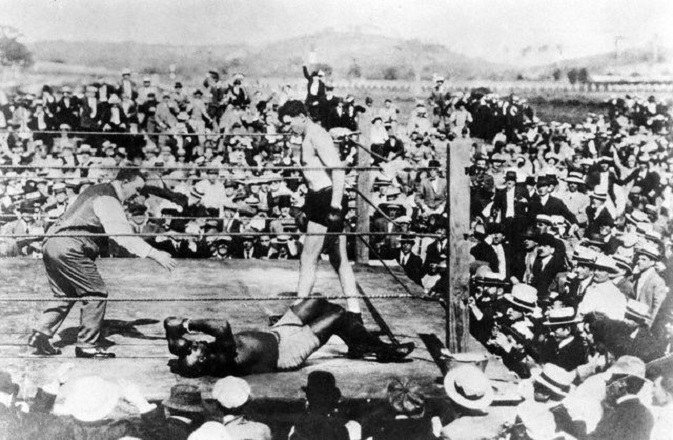
Finally, it all caught up with him. Jess Willard, a 6-foot-6 Kansan, became the latest "Great White Hope." On April 5, 1915, at Oriental Park, a horse racing track in Havana, Cuba, in a fight scheduled for 45 rounds, and held in heat even worse than in Reno 4 years earlier, perhaps he finally got tired of being Jack Johnson, and threw the fight. Or maybe, at 37, the oldest Heavyweight Champion ever (and he would remain so until Jersey Joe Walcott in 1951), he just wasn't in shape anymore. Willard knocked him out in the 26th round.

Jack and Lucille Johnson continued to live abroad. Finally, on July 20, 1920, Jack crossed the border from Mexico to America, and surrendered to federal agents. He was taken to the federal penitentiary at Leavenworth, Kansas (with some irony, in Willard's home State), and began serving his sentence. He was released early, on July 9, 1921.

Lucille was the 3rd of what turned out to be 4 wives for Jack Johnson. Only the 1st was black. On June 10, 1946, he was driving on U.S. Route 1 near Franklinton, North Carolina, when he crashed into a telegraph pole, and died. He was 68 years old.

His last wife, Irene Pineau, said of him, "I loved him because of his courage. He faced the world unafraid. There wasn't anybody or anything he feared."

Jeffries went back to his farm, never fought again, and lived until 1953. Burns lasted until 1955. Willard successfully defended his title once, defeating Frank Moran at Madison Square Garden -- the 2nd one, overlooking Madison Square, and torn down in 1926 to make way for the New York Life Building. With World War I on, there was little desire to see a title fight in 1917 or 1918. He was destroyed by Jack Dempsey in his 2nd defense. He died in 1968.

That same year, Howard Sackler's play The Great White Hope made its Broadway premiere. James Earl Jones became a star playing Jack Jefferson, a barely-disguised version of Johnson, right down to the shaved head. Jane Alexander played the character's white wife, both enjoying her husband's fame and struggling with its downside.

They reprised their roles in the 1970 film version, which seems to suggest that Johnson lost the title simply because his fight with the U.S. government had taken his fighting spirit away from him -- if not coming right out and saying he threw the Willard fight.

Oriental Park was demolished in 1967.

*

April 5, 1915 was a Monday. Baseball was in Spring Training. Football was out of season. There barely was any professional basketball. And the Stanley Cup had already been decided on March 26, with the Pacific Coast Hockey Association Champion Vancouver Millionaires beating the National Hockey Association Champion Ottawa Senators. So there were no scores on this historic day.

Monday, March 28, 2022

March 28, 1999: The Baltimore Orioles Go to Cuba

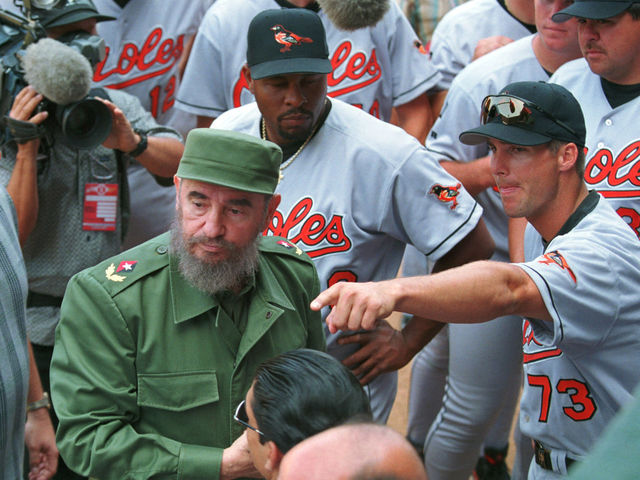
March 28, 1999: The Baltimore Orioles beat the Cuba national baseball team, 3-2 in 11 innings, in an exhibition game at Estadio Latinoamericano in Havana, Cuba. It was the 1st game played in Cuba by American major league players since 1959.

Baseball players from Cuba had long been a part of American baseball: White ones, starting in 1911; and black ones, starting in 1949. In 1961, 2 years after his successful revolution, dictator Fidel Castro banned professional sports in the country, leading to the loss of the one minor-league team on the island that was a part of America's "farm system," the Havana Sugar Kings, who had to move back to the American mainland.

Like the Soviet Union, Cuba had a national team that was amateur in name only. Castro, once a lefthanded pitcher (yes, a left wing), promoted this team, and gave it benefits that most citizens didn't have. They would win international tournaments, but their players wouldn't be allowed to play professional baseball in America, or any other country, even those in the Caribbean region with renowned leagues: Puerto Rico, the Dominican Republic, Mexico.

In the 1990s, Cuban players, mostly pitchers, began to defect, doing whatever it took to leave the island and get to America, or a nearby country, and then get to play in America. Castro figured that, if he threw his players a bone, they might be less likely to defect. So he arranged to have the national team play exhibition games against a Major League Baseball team.

On March 28, 1999, in Havana, Charles Johnson hit a home run to help the Orioles beat Cuba, 3-2. On May 3, at Oriole Park at Camden Yards in Baltimore, Andy Morales hit a home run to lead Cuba to a 12-6 win. Castro and Baseball Commissioner Bud Selig attended both games, and each was a sellout: Estadio Latinoamericano, 55,000; Camden Yards, 48,000.

After these 2 games, what changed? Not much: Cuba is still a Communist dictatorship, even after the death of Castro; its players are still defecting to America; and the old Cubans in South Florida are still too chicken to live up to their principles and try to topple that government, or even to fund people who will.

*

March 28, 1999 was a Monday. Baseball's regular season was about to begin. Football was out of season. There were 4 games played in the NBA:

* The Atlanta Hawks beat the Indiana Pacers, 83-82 at the Market Square Arena in Indianapolis.

* The Seattle SuperSonics beat the Dallas Mavericks, 109-101 at the Reunion Arena in Dallas.

* The Denver Nuggets beat the Los Angeles Clippers, 100-88 at the McNichols Arena in Denver.

* And the Los Angeles Lakers beat the Vancouver Grizzlies, 116-98 at The Forum outside Los Angeles in Inglewood, California.

And there were 9 games played in the NHL:

* The New Jersey Devils and the Florida Panthers played to a 2-2 tie at the National Car Rental Center (now the Amerant Bank Arena) in the Miami suburb of Sunrise, Florida.

* The Tampa Bay Lightning and the Carolina Hurricanes played to a 3-3 tie at the Greensboro Coliseum in Greensboro, North Carolina.

* The Dallas Stars beat the Nashville Predators, 3-0 at the Nashville Arena (now the Bridgestone Arena).

* The Buffalo Sabres beat the Pittsburgh Penguins, 4-3 at the Marine Midland Arena (now the KeyBank Center) in Buffalo. Dixon Ward scored the winning goal with 2:33 left in overtime.

* The Detroit Red Wings beat the Philadelphia Flyers, 3-2 at the Joe Louis Arena in Detroit. Wendel Clark scored the winning goal with 2:34 left in overtime.

* The Chicago Blackhawks beat the St. Louis Blues, 3-1 at the United Center in Chicago.

* The Colorado Avalanche beat the Los Angeles Kings, 7-2 at the McNichols Arena in Denver.

* The Edmonton Oilers beat the San Jose Sharks, 5-2 at the Northlands Coliseum (then named the Skyreach Centre).

* And the Mighty Ducks of Anaheim beat the Calgary Flames, 5-1 at the Arrowhead Pond of Anaheim (now the Honda Center).

December 31, 1999 & January 1, 2000: The Millennium

December 31, 1999:  The Millennium arrives. The people of planet Earth survived. At a terrible cost. But we hadn't destroyed ourselves. ...