Showing posts with label jawaharlal nehru. Show all posts

Monday, November 21, 2022

November 21, 1962: The Sino-Indian War Ends

November 21, 1962: The Sino-Indian War ends, preventing a conflict between the 2 most populous nations on Earth from expanding into a wider war, possibly even World War III.

During the 1959 Tibetan uprising in southwestern China, India had granted political asylum to Tenzin Gyatso, who, as the 14th Dalai Lama, was the spiritual head of Tibetan Buddhism, and the head of state of Tibet. Previous Chinese leaders had given Tibet varying measures of autonomy. But, since Mao Zedong founded it in 1949, the People's Republic of China has recognized Tibet as part of their country, and the Dalai Lama fled.

Since the '59 uprising, there were violent border skirmishes between China and India. Throughout 1962, there had been diplomatic attempts to reach a settlement, but they failed. On October 20, China invaded India at Ladakh.

Most of the fighting was in the mountains, with neither country using its navy (understandable) or its air force (considerably less understandable, as one or the other using it might have made a difference).

President John F. Kennedy, already dealing with the Cuban Missile Crisis (which the world at large did not know about until October 22), was never going to aid China, because he viewed it as an ally of the Soviet Union. But, surprising the world, the Soviets supported India, selling them MiG fighter jets. Now knowing, for the first time -- perhaps a failure of the CIA and MI6 -- that there was a Sino-Soviet split, the U.S. and Britain announced their neutrality in the conflict.

As JFK and Soviet Premier Nikita Khrushchev settled their conflict peacefully, the one between China and India turned into a stalemate. On November 20, China declared a ceasefire, and withdrew behind their border. Prime Minister Jawaharlal Nehru of India took this as a victory, and left things at that, refusing to punish China with an invasion of their territory.

China claimed to have lost 722 men, and killed 5,000 Indian troops. India claimed to have lost 1,383 men, and killed around the same number of Chinese troops. Despite various tensions, the 2 countries have never fought each other again.

As of November 21, 2022, the 14th Dalai Lama is 87 years old, and still promoting peace and his faith around the world. In 1989, he was awarded the Nobel Peace Prize.

*

November 21, 1962 was a Wednesday. Gospel singer Steven Curtis Chapman was born.

Baseball season was over. Football was in midweek. There were 4 games played in the NBA:

* The New York Knicks beat the Chicago Zephyrs, 137-108 at the Chicago Coliseum. Terry Dischinger scored 37 in defeat for the Zephyrs, who became the Baltimore Bullets the next season, and are now the Washington Wizards.

* The Boston Celtics beat the St. Louis Hawks, 115-106 at the Boston Garden.

* The Syracuse Nationals beat the Detroit Pistons, 122-120 at Cobo Hall (now Huntington Place) in Detroit. The Nats became the Philadelphia 76ers the next season.

* And the Cincinnati Royals beat the San Francisco Warriors, 143-139 at the Cow Palace in the San Francisco suburb of Daly City, California. For the Royals, Oscar Robertson scored 40, and Jack Twyman scored 31. For the Warriors, Wilt Chamberlain scored 61 and had 22 rebounds, while Guy Rodgers scored 26.

Monday, October 31, 2022

October 31, 1984: The Assassination of Indira Gandhi

October 31, 1984: Prime Minister Indira Gandhi of India is assassinated, in the garden of the official Prime Minister's residence at 1 Safdarjung Road, in the national capital of New Delhi. She was 66 years old.

Indira Priyadarshini Nehru was born on November 19, 1917 in Allahabad, in what was then known as British India. Her father, Jawaharlal Nehru, and his friend, Mohandas K. Gandhi, a.k.a. the Mahatma, were the leaders of India's independence movement, achieved in 1947. Jawaharlal Nehru became the 1st Prime Minister. Gandhi was assassinated just 5 months later.

Nehru's daughter, Indira, married a Member of Parliament, Feroze Gandhi. He was not related to the Mahatma: He had changed the spelling of his surname, Ghandy, in tribute. Indira Gandhi served her father unofficially as a personal assistant during his tenure as Prime Minister. Towards the end of the 1950s, Gandhi served as the President of the Congress.

After her father's death in 1964, she was appointed a member of the upper house of the Indian Congress, the Rajya Sabha, and served in the Cabinet of Prime Minister Lai Bahadur Shastri, as Minister of Information and Broadcasting. When Shastri died in 1966, the Congress Party elected her as Leader on January 24, making her the Prime Minister. Since she was a woman, other party leaders hoped to use her as a puppet, with the Hindi media calling her "Goongi Goodiya": "Dumb Doll."

They were all in for a surprise. Having become an elected leader before nearly any other woman in history, she understood how crucial her role could be. Having served at her father's side and in his successor's Cabinet, she was no political rookie. And, at 48, she was just entering her political prime.

Following some initial setbacks, both in governing and in an election, she was expelled from the Congress Party by its President, Siddavanahalli Nijalingappa. She then formed a new party, and pulled enough members away to gain a new majority, making her again the leader of the Congress Party, and expelled Nijalingappa.

Like the recent American President Lyndon Johnson, she launched a war on poverty, which gained her support throughout the country, and she gained seats in the 1971 election. This was immediately followed with the Indo-Pakistani War, which India won, leading to the separation of East Pakistan as the new nation of Bangladesh.

She maintained good relations with Britain and the other nations of the British Commonwealth, including Canada, Australia, and some of the former British colonies in Africa. And she was opposed to Red China, with whom India had fought a brief war in 1962.

But she was not all on the West's side in the Cold War. She was also seen as friendly to the Soviet Union, and was opposed to America's role in the Vietnam War. And, despite majority-Hindu India's rivalry with all-Muslim Pakistan, she cultivated good relationships with the Muslim nations of the Middle East, and was critical of Israel. 

She had gotten along with President John F. Kennedy when they met in 1962 (before she was Prime Minister), and LBJ in 1966. When she met with President Richard Nixon in November 1971, he was publicly cordial to her. But once she left, he let loose in a conversation with his National Security Advisor, Henry Kissinger, recorded on his infamous Oval Office tapes. Nixon said, "This is just the point when she is a bitch." Kissinger, speaking about Pakistan, responded, "Well, the Indians are bastards, anyway. They are starting a war there."

Like most other democracies, India was hit hard by the 1973 oil embargo. On top of the combined inflation and recession striking the world's largest democracy, including the world's largest middle class, she was accused of electoral malpractice. This led to some civil unrest, as both her supporters and her opponents were intense.

She declared an emergency in 1975, assuming greater emergency powers, in which her son, Sanjay Gandhi, began to exercise some power. This led to the contradictory claims of her opponents that she was too powerful, and that she was actually weak and that it was her son who was using the power. Having an opposition to herself was one thing, but having an opposition to her son as well was too far for some people. She called an election for March 24, 1977, hoping to vindicate herself, but the Congress Party lost, and among the seats lost were those of both mother and son.

Indira won a by-election in 1978, getting back into Parliament. And the new government couldn't hold things together, leading to a new election on January 7, 1980, which the Congress Party won. She was back in charge, but tragedy soon struck: On June 23, Sanjay was killed in a plane crash. (It was not suspicious: Witnesses all agreed he was attempting an unnecessary aerobatic maneuver.) He was only 33 years old.

This led Indira to do the same thing that Joseph P. Kennedy Sr. did when his eldest son was killed in World War II: Elevate the next son, in spite of his reluctance to enter the family business, to be the hope of the family's political future. But the move from Sanjay to Rajiv Gandhi, who at 36 was actually older, was less a move from Joe Kennedy Jr. to John F. Kennedy, and more a move from the hotheaded Sonny Corleone to the cooler, but ultimately more ruthless, Michael.

She did not meet with either Gerald Ford or Jimmy Carter while they were President, the latter being a problem because she was out of office for most of his Presidency. Having regained the Premiership, she met with President Ronald Reagan twice, and they got along well, giving America hope for improved relations with the only more populous nation on Earth that was a democracy.

In the Summer of 1982, a Sikh separatist movement gained momentum, led by Jarnail Singh Bhindranwale. He based his forces in the Golden Temple, the holiest site in the Sikh faith, in Amritsar, less than 20 miles east of the Pakistan border.

On June 6, 1984, after nearly 2 years of negotiations refused to get Bhindranwale to stand down, the Prime Minister launched Operation Blue Star. Heavy artillery caused heavy damage to the Temple, and the death toll, including Bhindranwale, is disputed, but has been described as "many hundreds to many thousands." Opponents said she was using the attack to shore up support for the Congress Party in elections set for the end of the year.

But it was her own bodyguards she had to watch out for. Since Sikhs have a reputation as warriors, they are assigned as protective detail for the Prime Minister. On October 31, 1984, she was walking through the garden (backyard) of her official residence, about to give an interview with British actor Peter Ustinov for a documentary. She never made it, because 2 bodyguards, Satwant Singh and Beant Singh, not related to each other ("Singh" is as common as "Smith" among Sikhs), drew their service weapons, and fired 33 shots at her. Doctors worked on her for 5 hours, but she never had a chance.

They were taken to another room, where Beant Singh was immediately shot. He was 25. Satwant Singh was tried, was convicted, and was executed at the Tihar Jail in New Delhi on January 6, 1989. He was 26.

After the assassination, the Congress Party immediately elected Rajiv Gandhi as Prime Minister. At 40, he was, and remains, the youngest in the country's history. He was defeated for re-election in 1989. On May 21, 1991, running to regain the office, he was campaigning in Chennai when he, too, was assassinated.

In 2022, Rahul Gandhi, son of Rajiv, is out of office, but has been President of the Congress Party. His sister, Priyanka Gandhi, is the Party's General Secretary. Varun Gandhi, son of Sanjay, is a member of the other major party, the Bharatiya Janata Party, led by the current Prime Minister, the right-wing and Hindu nationalist Narendra Modi. If Modi should ever give up power willingly, it could lead to a civil war within the family -- and, perhaps, in the country.

*

October 31, 1984 was a Wednesday. Baseball season was over. Football was in midweek. There were 3 NBA games that night:

* The New Jersey Nets lost to the Boston Celtics, 116-105 at the Boston Garden.

* The Dallas Mavericks beat the Indiana Pacers, 101-100 at the Market Square Arena in Indianapolis.

* And the Milwaukee Bucks beat the Washington Bullets, 105-79 at the Milwaukee Exposition, Convention Center and Arena, or "The MECCA." Since 2014, it has been named the UW-Panther Arena.

And there were 6 games in the NHL:

* The New Jersey Devils lost to the Pittsburgh Penguins, 7-6 at the Brendan Byrne Arena in the Meadowlands. Uli Heimer scored a hat trick for the Devils. But Wayne Babych and Warren Young each scored 2 goals for the Penguins, and rookie Mario Lemieux added 1.

* The Quebec Nordiques beat the Hartford Whalers, 5-3 at the Hartford Civic Center (now the PeoplesBank Arena).

* The Washington Capitals beat the Calgary Flames, 4-3 at the Capital Centre in the Washington suburb of Landover, Maryland. Mike Gartner scored the winning goal, with 3:02 left in overtime.

* The Philadelphia Flyers and the Buffalo Sabres played to a tie, 3-3 at the Buffalo Memorial Auditorium.

* The St. Louis Blues beat the Toronto Maple Leafs, 6-5 at the St. Louis Arena. Brian Sutter scored the winning goal with 3:52 left in overtime.

* And the Los Angeles Kings beat the Vancouver Canucks, 10-3 at the Pacific Coliseum in Vancouver. Dave Taylor had a hat trick.

Monday, October 24, 2022

October 24, 1946: The Bihar Riots

October 24, 1946: The Bihar Riots take place in Bihar, West Bengal, India. They are in response to the Calcutta Killings the previous August 16, and the Noakhali Riots on October 10, both actions by Muslims against Hindus.

There was wide variation in estimates of the number of casualties. A statement given to the British Parliament put the death toll at 5,000. The Indian National Congress put it at 2,000. Mohammed Ali Jinnah of the Muslim League stated that 30,000 people had been killed. Another estimate stated that 35,000 had fled the fighting.

The riots were severe enough that Jawaharlal Nehru, then the head of the interim government, set up to assist the transition to independence, threatened to bombard rioters from the air. On November 5, Nehru issued a statement, saying, "We must put an end to this madness. We can argue later," and adding "What has happened and what is happening in certain parts of Bihar province is terrible, and I can hardly believe that human beings can behave in such a manner."

That same day, Mohandas Gandhi, who was in Calcutta (now named Kolkata) visiting riot-stricken areas, stated that he would fast unto death if the violence in Bihar did not stop within 24 hours. His statement was broadcast nationally. The violence finally stopped on November 11 -- just as it did in World War I.

Independence took place on August 15, 1947, but Muslims get their separate nation of Pakistan, with Jinnah becoming its 1st Prime Minister. But there was new violence, and, to this day, with religion being the key, the two nations still hate each other's guts.

*

October 24, 1946 was a Thursday. Baseball season was over. Football was in midweek. The 1st season of the league that would become the NBA was 8 days away. And while the NHL season was underway, there were no games scheduled. So there were no scores on this historic day.

Monday, August 15, 2022

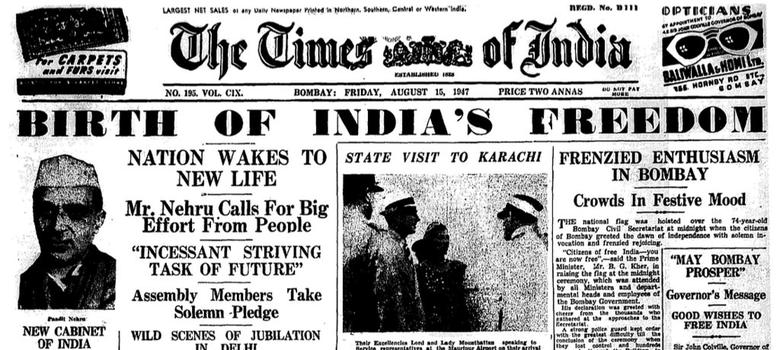
August 15, 1947: India and Pakistan Independent

August 15, 1947: The partition of India takes effect, and the nations of India and Pakistan are created out of the former British "Raj."

The independence took effect at midnight, Delhi time. Pakistan is 1 hour behind, so they celebrate their independence on August 14, India theirs on August 15.

Jawaharlal Nehru, India's 1st Prime Minister, tried to echo President Franklin D. Roosevelt's words about how America "had a rendezvous with destiny": Over the network All India Radio, he said that the new country with an ancient civilization "had a tryst with destiny."
Despite a great deal of trouble, he kept winning elections until his death on May 27, 1964. And when he died, for once, the world’s great powers were in agreement. Lyndon Johnson said, "Perhaps more than any other world leader he has given expression to man's yearning for peace. This is the issue of our age. In his fearless pursuit of a world free from war he has served all humanity."

And Nikita Khrushchev said, "Jawaharal Nehru is known as an outstanding statesman of modern times who devoted his entire life to the struggle for strengthening friendship and cooperation among peoples and for the progress of humanity."

His daughter eventually became Prime Minister, lost the office, regained it, and was assassinated while still in it. Indira Gandhi took her husband’s family name, but he was not related to her father’s friend Mohandas Gandhi. A member of the Nehru-Gandhi family was Prime Minister for 37 of the country’s 1st 44 years of independence.

As with India's 1st head of government, Pakistan's had been a lawyer before becoming an activist. Muhammad Ali Jinnah served as the leader of the All-Indian Muslim League from 1913 until 1947, and was a natural choice to lead his new country. But he had long suffered from tuberculosis, and died on September 11, 1948, at 71, only a year into independence.
Pakistan calls Jinnah "The Father of the Nation." But historian Akbar S. Ahmed calls him "the most maligned person in recent Indian history ... In India, many see him as the demon who divided the land." Thus, they hold him responsible for the conflict that followed, which was, for all intents and purposes, a civil war. British actor Christopher Lee starred in the film Jinnah in 1998, and called it the finest performance of his career.

The title "Empress of India" was created by the British Parliament for Queen Victoria in 1877. She held it until her death in 1901. The title "Emperor of India" was subsequently held by her son, King Edward VII, until his death in 1910; by his son, King George V, until his death in 1936; by his son, King Edward VIII, until his abdication later that year; and by his brother, King George VI, who renounced the title on June 22, 1948, 10 months after independence. Officially, he remained head of state as King of India until the country became a republic on January 26, 1950. He remained King of Pakistan until his death in 1952. His daughter, Queen Elizabeth II, was Queen of Pakistan until that country became a republic on March 23, 1956.

India remains a member of the successor organization to the British Empire, the Commonwealth of Nations, informally known as the British Commonwealth. Pakistan left it in 1972, but rejoined in 1989.

One thing that both countries kept from Britain is the love of the sport of cricket, which is baseball's cousin. The similarities are easy to see, but the differences can be very confusing.

To this day, no native of South Asia has ever played in Major League Baseball. Some Indian-born players -- all trained as cricket bowlers, the equivalent of pitchers -- have played in the North American minor leagues, but haven't reached the majors.

One former major leaguer was born in Afghanistan: Jeff Bronkey, born in the capital of Kabul in 1965 to an Afghan father and an American mother, who raised him in Oregon. He pitched, mostly in relief, for the Texas Rangers in 1993, and the Milwaukee Brewers in 1994 and '95, going 2-2 with 2 saves and a 4.04 ERA.

*

The NFL, the NBA and NHL were all in their off-seasons, and did not play on August 15, 1947, a Friday. These Major League Baseball games were played: 

* The New York Yankees beat the Boston Red Sox, 10-6 at the old Yankee Stadium. George "Snuffy" Stirnweiss hit a home run for the Bronx Bombers. Joe DiMaggio went 2-for-3 for the Yanks, Ted Williams 4-for-5 for the BoSox. Joe Page was the winning pitcher, in relief of Karl Drews.

* The New York Giants lost to the Boston Braves, 8-7 at Braves Field in Boston.

* The Brooklyn Dodgers beat the Philadelphia Phillies, 8-1 at Shibe Park in Philadelphia.

* The Philadelphia Athletics beat the Washington Senators, 3-0 at Griffith Stadium in Washington.

* The St. Louis Cardinals beat the Pittsburgh Pirates, 7-4 at Forbes Field in Pittsburgh.

* The Chicago Cubs beat the Cincinnati Reds, 6-5 at Crosley Field in Cincinnati.

* The Detroit Tigers beat the Chicago White Sox, 9-2 at Comiskey Park in Chicago.

* And the Cleveland Indians beat the St. Louis Browns, 2-0 at Sportsman's Park in St. Louis.

None of these games went to extra innings. 

Sunday, January 30, 2022

January 30, 1948: The Assassination of Mohandas Gandhi

January 30, 1948: Mohandas K. Gandhi, whose use of nonviolent resistance to British rule helped to establish the independence of India just 5 months earlier, is assassinated in the national capital of New Dehli. He was 78 years old.

Gandhi was with his grandnieces in the garden of Birla House, the home of a friend, Ghanshyam Birla, a prominent Indian businessman. At 5:17 PM, Gandhi left with his grandnieces, on the way to address a prayer meeting, when Nathuram Godse, a 37-year-old writer, fired three bullets into his chest from a pistol at close range.

Nathuram Godse

According to some accounts, Gandhi died instantly. In other accounts, such as one prepared by an eyewitness journalist, Gandhi was carried into the Birla House, into a bedroom. There he died, about 30 minutes later as one of Gandhi's family members read verses from Hindu scriptures.
Prime Minister Jawaharlal Nehru addressed his countrymen over All-India Radio:
Friends and comrades, the light has gone out of our lives, and there is darkness everywhere, and I do not quite know what to tell you, or how to say it. Our beloved leader, Bapu as we called him, the father of the nation, is no more.
Perhaps I am wrong to say that. Nevertheless, we will not see him again, as we have seen him for these many years. We will not run to him for advice or seek solace from him, and that is a terrible blow, not only for me, but for millions and millions in this country.
Godse, a Hindu nationalist with links to the right-wing extremist group Hindu Mahasabha, made no attempt to escape. Several other conspirators were soon arrested as well. They were tried in court at Delhi's Red Fort. At his trial, Godse did not deny the charges, nor express any remorse.
According to Claude Markovits, a French historian noted for his studies of colonial India, Godse stated that he killed Gandhi because of his complacence towards Muslims, holding Gandhi responsible for the frenzy of violence and sufferings during the subcontinent's partition into Pakistan and India. Godse accused Gandhi of subjectivism, and of acting as if only he had a monopoly of the truth. Godse was found guilty and, despite pleas from 2 of Gandhi's sons for commutation of his sentence to life, was executed by hanging at the Ambala Central Jail in Punjab on November 15, 1949.
Gandhi's death was mourned nationwide. Over 1 million people joined the 5-mile-long funeral procession that took over 5 hours to reach Raj Ghat from Birla house, where he was assassinated, and another 1 million watched the procession pass by. Gandhi's body was transported on a weapons carrier, whose chassis was dismantled overnight to allow a high-floor to be installed so that people could catch a glimpse of his body. The engine of the vehicle was not used; instead, 4 drag-ropes held by 50 people each pulled the vehicle.
All Indian-owned establishments in London remained closed in mourning as thousands of people from all faiths and denominations and Indians from all over Britain converged at India House in London.
Gandhi's assassination dramatically changed the political landscape. According to Markovits, while Gandhi was alive, Pakistan's declaration that it was a "Muslim state" had led Indian groups to demand that India be declared a "Hindu state." Nehru used Gandhi's martyrdom as a political weapon to silence all advocates of Hindu nationalism as well as his political challengers. He linked Gandhi's assassination to politics of hatred and ill-will.
Nehru used the assassination to consolidate the authority of the new Indian state. Gandhi's death helped marshal support for the new government and legitimize the Congress Party's control, leveraged by the massive outpouring of Hindu expressions of grief for a man who had inspired them for decades.
In 1971, the Indian government bought Birla House, renamed it Gandhi Smriti, and made it a museum dedicated to his memory.
Temple to Gandhi's memory, at Gandhi Smirti,
showing his footsteps to the spot of his assassination.
Despite his nickname "The Mahatma" (meaning "Great Soul") also being given to the great baseball executive Branch Rickey (and I have no idea what he, a devout Methodist, thought of that), as far as I know, he had nothing to do with sports.
But in 1983, an article titled "Gandhi at the Bat" was printed in The New Yorker, taking place in 1933, 50 years earlier, a completely fictional story that featured him meeting Babe Ruth and "playing for the Yankees."
Gandhi and Nehru, friends, were the founding fathers of the modern Indian nation, which, despite its oppression by the British, came to love the British sports of cricket and field hockey, and now finally seems to be absorbing soccer as well.

Gandhi's wife, Kasturba, had died in 1944. They had 4 sons, and no daughters. Harilal, a lawyer like his father, died less than 5 months after him, from tuberculosis, just 59 years old. Manilal, a journalist, died of a stroke in 1956, at 63. Ramdas was the most involved of Gandhi's sons in the nation's freedom struggle, and, upon his request, Ramdas lit the funeral pyre. He lived until 1969, at 72. Devdas, also a journalist, died in 1957, at 57. The Mahatma's family continues, with Harilal having fathered 5 children, Manilal 3, Ramdas 3 and Devdas 4.

In 1982, Richard Attenborough's film Gandhi was nominated for 11 Academy Awards, winning 8, including Best Picture, Best Director, and Best Actor for Ben Kingsley, the son of a Yorkshire mother and a Gujarati father. Both Attenborough and Kingsley were knighted.

Nehru's daughter, Indira, married a Member of Parliament, Feroze Gandhi. He was not related to the Mahatma: He had changed the spelling of his surname, Ghandy, in tribute. Indira Gandhi would become Prime Minister of India, as would her son Rajiv Gandhi. Both were, like Mohandas Gandhi, assassinated.

The comedy team of Key & Peele starred in a 2013 episode of the YouTube series Epic Rap Battles of History, with Keegan-Michael Key playing Gandhi, and Jordan Peele playing Gandhi's most famous follower, Martin Luther King Jr. One would think they wouldn't have been rivals, but, as Gandhi, Key started with, "You want to battle wits? So who's the better pacifist? I fought the caste system, but you still cannot touch this!" And, as King, Peele said, "I admire the way you broke the British power, but I have a dream that, one day, you'll take a shower!"

*

January 30, 1948 was a Friday. Aviation pioneer Orville Wright died on the same day, albeit of natural causes, at age 76, in his hometown of Dayton, Ohio. His brother, Wilbur Wright, had died in 1912, only 45, from typhoid fever.

Baseball and football were out of season. And there were no NHL games scheduled for that day. But there were 2 games played in the Basketball Association of America, the league that would become the NBA a year and a half later:

* The Providence Steamrollers beat the Boston Celtics, 79-69 at the Boston Garden. The Steamrollers played 1 more season and folded. The Celtics survive to this day.

* And in another regional rivalry that didn't last, the Baltimore Bullets beat the Washington Capitols, 95-71 at the Fifth Regiment Armory in Baltimore. This version of the Bullets went out of business in 1954, and is not connected to the franchise now known as the Washington Wizards, who were the Baltimore Bullets from 1963 to 1973. These Bullets normally played at the Baltimore Coliseum, but used the Armory on this occasion. Built in 1901 and still standing, it hosted the 1912 Democratic National Convention that nominated Woodrow Wilson for President.

The Capitols went out of business in 1951, and while the American Basketball Association would have a Washington Capitols in the 1970-71 season, the District of Columbia didn't get another NBA team until 1973, when the Bullets moved down Interstate 95.

December 31, 1999 & January 1, 2000: The Millennium

December 31, 1999:  The Millennium arrives. The people of planet Earth survived. At a terrible cost. But we hadn't destroyed ourselves. ...