Showing posts with label spider-man. Show all posts

Tuesday, October 25, 2022

October 25, 1971: "The Electric Company" Premieres

Back row, left to right: Rita Moreno, Jim Boyd, Judy Graubart,
Morgan Freeman, Hattie Winston, Luis Ávalos,
Danny Seagren as Spider-Man, Skip Hinnant.
Front row, The Short Circus, left to right:
Réjane Magloire, June Angela, Janina Mathews,
Rodney Lewis, Todd Graff.

October 25, 1971: The Electric Company premieres on PBS. A companion piece to Sesame Street, it is geared toward kids a little older who were, by then, learning to read. As the closing tagline says, it is produced by the same production company: "The Electric Company gets its power from The Children's Television Workshop."

It is also backed by many of the same foundations that funded Sesame Street, including The Ford Foundation and The Carnegie Corporation of New York. And by the U.S. Department of Health, Education and Welfare (HEW), founded in 1953, and split in 1980 to form the Department of Education (DOE), and the Department of Health and Human Services (HHS).

Included in the original cast of this show are 2 performers who are already legends: Rita Moreno, 39; and Bill Cosby, 34. Not yet a star was Morgan Freeman, 34. Also in the original cast: Judy Grabuart, 28 and a veteran of the Second City comedy troupe; Lee Chamberlin, 33; and Joseph "Skip" Hinnant, 31.

All had done stage work in New York. Of note: Hinnant had appeared in the Broadway musical You're a Good Man, Charlie Brown, based on Charles Schulz's comic strip Peanuts: He had played Schroeder, the piano-playing catcher; while his brother, Bill Hinnant, played Snoopy, Charlie Brown's beagle who played shortstop and pretended to be a World War I flying ace.

Not onscreen, but providing voices, was Jim Boyd, about to turn 38. He, Wayland Flowers (the ventriloquist for Madame) and Cleavon Little (later Sheriff Bart in Blazing Saddles) had done puppetry and voices for The Surprise Show, a local New York kids' show.

Like the cast of Rowan & Martin's Laugh-In, still on the air at this point, the performers would often imitate the already-defunct mode of vaudeville. They used routines that emphasized a particular letter, group of letters, or sound to help kids with reading. Other sketches would be used for this as well. For example, on a few occasions, they would demonstrate that the letters "ie" could be pronounced like the letter E, or the letter I, as in "a piece of pie." Which, as you've probably guessed, involved someone getting hit in the face by a pie.

Freeman played a comic version of Count Dracula, who, like Sesame Street's Cookie Monster, would bite anything. (Although only once did I ever see Cookie Monster bite a person, and a Muppet at that.) He also played Mel Mounds, a disc jockey who would play songs by The Short Circus (more about whom later).

Most of all, he played Easy Reader, whose name was a play on Easy Rider. At first, Easy was an out-and-out hippie, looking like he had raided the wardrobe of the recently deceased Jimi Hendrix. As the show went on, he developed a look that was more urban cool cat: Shorter hair, sunglasses (sometimes even indoors), leather shoes, and a jacket-pants combo that was originally blue denim, and later brown suede. The jacket had a flower on the back and a light bulb on the sleeve.
Freeman also played Marcello, the perpetually-abused cue card man employed by Otto, a parody of an old-time movie director (named after Otto Preminger) played by Moreno. She also played Pandora, a naughty little girl.
She also played Millie the Helper (named after Millie Helper, a character from The Dick Van Dyke Show), whom Cosby kept trying and failing to train at various jobs. It seemed the only thing she was competent at was yelling, "Hey, you guys!"

It became the show's first catchphrase, and was even incorporated into the show's opening segment. When my sister was the age at which it was appropriate to start watching the show, she thought its name was Hey You Guyyyyyyyys! To this day, people who have never seen West Side Story or any other of Rita's roles see her and say, "Hey, you guys!"

In Season 2, 1972-73, Boyd became an onscreen performer for the first time, although not always recognizable. In Season 1, in a play on both "crank calling" and on the British film producer J. Arthur Rank, he played the angry voice of J. Arthur Crank.

In Season 2, the character of Crank was seen for the first time. His face, hair and mustache resembled those of Rank, but he dressed and acted like a slob, but not really a bad guy. Essentially, Crank was a parody of All In the Family's Archie Bunker, minus the bigotry, which was important on a show with black actors Cosby, Freeman and Chamberlin, and Hispanic actress Moreno.
Boyd also put on a gorilla suit to play Paul the Gorilla, alongside Graubart's Jennifer of the Jungle, a parody of both Tarzan and George of the Jungle, in which "Tarzan" and "Jane" were basically the same person, and Paul was her "Cheeta." 
Another letter combination with 2 different sounds.

Boyd also played a bumbling superhero named Blue Beetle, not connected to any of the 3 heroes who have used that name in comic books. He also continued to voice Maurice the talking plant and a talking chicken named Loreli Loverly. In addition to Jennifer, Graubart played a parody of PBS chef Julia Child, named Julia Grownup.

Also joining the cast at this time was Luis Ávalos, a Cuban-born actor then just 26, but already distinctively bald, but sometimes (not always) with a mustache. The mustache enabled his best-known character: A parody of the name of Dr. Dolittle and the characters played in 1930s film comedies by Groucho Marx, Dr. Doolots had a gigantic orange Afro. He also teamed with Morgan Freeman, as Igor to Freeman's Mad Scientist.
Boyd as Paul, Ávalos as Dr. Doolots, Graubart as Jennifer

Boyd and Ávalos could be added because Cosby left the show after Season 1, to devote more attention to his CBS Saturday morning cartoon Fat Albert and the Cosby Kids. Chamberlin, best known for playing Vi (presumably, short for Violet) of Vi's Diner -- as the song went, "and the homemade pies, and that is why we go to Vi's" -- left after Season 2 as well. Nevertheless, segments with each of them would appear on the show for the rest of its run.
Chamberlin as Vi, singing to a visiting Grover from Sesame Street

Hinnant played Fargo North, Decoder. He wore a trenchcoat and a fedora like a 1940s private detective, but the fedora was pink. And he was a bit of a bumbler, in the mold of Maxwell Smart, the spy played by Don Adams on Get Smart. Like Easy, Fargo had his own theme music. Once, Fargo visited Dr. Doolots, and the sketch ended with Fargo's theme playing, and, in his best Groucho impression, Ávalos said, "What's your music doing in my office?"
Hinnant as Fargo, with a visiting Big Bird from Sesame Street

In Season 3, Chamberlin was replaced by another black New York stage actress, Hattie Winston, 28. She became Valerie the Librarian, who had playful banter with Easy Reader, suggesting (but never outright saying) that they might have been a couple.
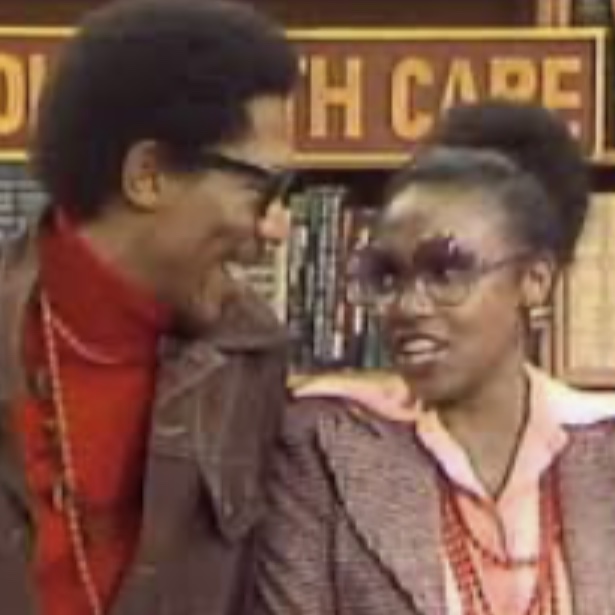
Freeman and Winston as Easy and Valerie

Season 4 introduced Spidey Super Stories, with Danny Seagren, 31, a professional dancer who had previously appeared on Sesame Street, as the first ever live-action version of the Marvel Comics superhero Spider-Man. This Spidey didn't exactly "talk": Instead, his words were put on the screen in "word balloons," followed by a pause for the kids watching at home to try to read, before whoever he was talking to repeated it. Instead of Spidey's usual rogues' gallery -- no Green Goblin, Dr. Octopus, Electro and so on -- the various castmembers played one-shot villains, never seen before or since.

One edition showed Spidey attending Fargo's birthday party, along with Easy, Jennifer and Paul, interrupted by Ávalos as The Blowhard, a villain with destructive super-breath that Fargo -- apparently considerably more competent when we're not watching -- had once put in prison, and was seeking revenge. Just as he was about to blow them all away, Paul hit him in the face with Fargo's birthday cake, giving Spidey the chance to sling his web and trap him.

While Spidey's civilian persona, Peter Parker, was established as living in Queens, The Electric Company and Spider Super Stories was the initial establishment of him as a fan of the New York Mets, who (then as now) played in Queens. Marvel ran with it, and made Peter's Met fandom comic canon. 

Boyd played The Wall, disrupting a Met game that Spidey attended in costume: "Well, if it isn't the Wall-Crawler himself! Well, this is one Wall you'll never crawl!" Hinnant played an ill-fated outfielder, and Freeman a typically vision-impaired umpire.
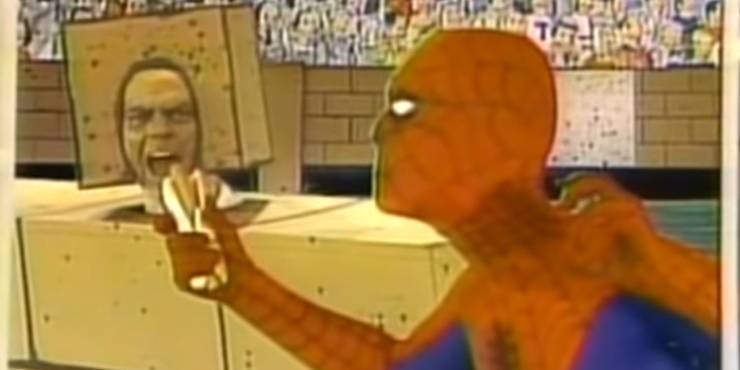
I said the stories were titled "Super." I didn't say they were good.

There were animated segments as well. One had a character who never got an official name, so they just called him "Blond-Haired Cartoon Man." Mel Brooks did his voice. Satirical singer Tom Lehrer wrote and sang a series of songs featuring the "ly" and "sn" sounds, and "Silent E." Warner Brothers contributed some animated shorts featuring the Road Runner and Wile E. Coyote.

And before Spidey or the Blue Beetle were ever on the show, there was The Adventures of Letterman. Letterman was dressed like an old-time football player, with a "varsity letter" on his chest, which always happened to be just the letter needed to restore a word that had been changed by The Spellbinder, a villain who would use his magic wand to change a word and turn an item into something dangerous, or at least upsetting. Letterman was voiced by Gene Wilder, The Spellbinder by Zero Mostel, and the narrator was Joan Rivers, all of whom had worked with Brooks.
"Faster than a rolling O, stronger than Silent E,
able to leap Capital T in a single bound!
It's a word! It's a plan! It's Letterman!"

And there was the band, 5 teenagers named The Short Circus, a play on "short circuit." The original band of 1971 was June Angela, 12, as Julie, on tambourine; Irene Cara, 12, as Iris, on keyboards; Melanie Henderson, 14, as Kathy, on guitar; Douglas Grant, 12, as Zach, on guitar; and Steve Gustafson, 12, as Buddy, on drums.
Angela couldn't play an instrument, but, as the best singer they auditioned, they had to keep her, so she selected a tambourine, possibly a nod to Eddie Brigati of The Rascals and/or Mark Volman of The Turtles. She named her character after Julie Andrews. Gustafson, being a drummer, named his after Buddy Rich.

Since Cosby and Moreno were already stars, and Freeman didn't become a big star for many more years, until Driving Miss Daisy was released in 1989, Cara got the biggest boost to her career of any castmember, appearing in both the film Fame and the subsequent NBC show based on it, and having Number 1 hits from the themes from Fame and the film Flashdance.

Part of the problem with having teenage actors is that they grow up too fast, and sometimes it became hard for the little kids to relate to them. Cara left the show after the 1st season, and was replaced on keyboards by Denise Nickerson, 15 and already known for playing Violet Beauregarde in Willy Wonka and the Chocolate Factory, as Allison. In 1973, the keyboard position was eliminated, and Nickerson was replaced by Bayn Johnson, 15, as guitarist Kelly; and Grant was replaced by Gregg Burge, 14, as bass guitarist Dwayne.

In 1975, the entire band was replaced, except for Angela: Being short meant that she could still appear on the show at age 18. Henderson was replaced on guitar by Réjane Magloire, 11, as Samantha; 
Johnson on guitar by Janina Mathews, 12, as Gail; Burge on bass by Rodney Lewis, 12, as Charlie; and Gustafson on drums by Todd Graff, 16, as Jesse. 
Angela was the show's only Asian-American regular, while Cara was Hispanic, and Henderson, Grant, Burge, Magliore and Lewis were black.

On occasion, Short Circus members would interact with the adult castmembers, such as when they went to see Vi at the diner or Valerie at the library. Sometimes, a Spidey Super Story would be narrated by Angela, or feature another bandmember as the younger version of the villain, telling the brief origin story: "And so, he (or she) turned to a life of crime!"

The show made new episodes until 1977, and remained on the air in reruns until 1985. In 2009, PBS began airing a new show with the title, but, aside from the title and the use of Moreno's catchphrase, "Hey you guyyyyyyyys!" it bore no resemblance to the original. It lasted only 2 years.

Ironically, from the original show, the first castmember to die was one of The Short Circus, Burge, in 1998. Boyd died in 2013, Ávalos and Chamberlin in 2014, Grant in 2018, and Nickerson in 2019. The rest of the cast lived to see the show's 50th Anniversary -- although there will always be a cloud over Cosby, no matter how long he lives. Cara died in 2022.

UPDATE: Seagren died in 2025.

*

October 25, 1971 was a Monday. Baseball Hall of Fame pitcher Pedro Martinez was born. So were actor Craig Robinson, and classical violinist Midori Goto.

The baseball season had ended 8 days earlier, with the Pittsburgh Pirates beating the Baltimore Orioles in Game 7 of the World Series. Future Hall-of-Famer Pedro Martinez was born on this day.

Most of the NFL teams had played the day before, but on this night, ABC Monday Night Football aired the Minnesota Vikings beating the defending NFL Champion Baltimore Colts, 10-3 at Metropolitan Stadium in the Minneapolis suburb of Bloomington, Minnesota.

There was 1 NBA game played that night: The Boston Celtics beat the Atlanta Hawks, 136-116 at the Boston Garden. For the Celtics, Dave Cowens scored 27 points, and John Havlicek added 25. For the Hawks, Herm Gilliam scored 25 and Lou Hudson 23, but Pete Maravich was injured and didn't play. And there were no games scheduled that night for the ABA or the NHL.

Sunday, June 5, 2022

June 5, 1962: Spider-Man Debuts

June 5, 1962: Amazing Fantasy #15 is published. It was already set to be the last issue for the magazine, so there was nothing left for its publisher, Marvel Comics, to lose. So they chose to debut a new character: Spider-Man.

Created by Marvel boss and main writer Stan Lee, and artist Steve Ditko, "Spidey" was designed to be a hero that teenagers could relate to without being a child version of an adult hero like Superboy, or a sidekick to an adult hero like Batman's Robin.

Peter Parker was a nerdy, scrawny New York teenager with genius intellect and a love for science. While attending a science fair and seeing an experiment in radioactivity, a spider becomes irradiated, and bites him. The radioactivity gives Peter the proportionate strength and agility of a spider, and a "spider-sense" that acts as a warning system. He designs a substance that acts as a "spider's web," and wrist gadgets that allow him to shoot them and trap criminals.

His parents dead, Peter was raised by his Aunt May and his Uncle Ben. One day, early in his career, Spider-Man is interviewed for a local talk show. As he's leaving a man runs past, and a security guard tells Spidey he should have stopped the man, saying he'd robbed the box office. Spidey said it wasn't his problem.

When Peter gets home, he find out Uncle Ben has been murdered, and the police have the killer surrounded in a building. He goes after him in his Spidey costume, and discovers it's the robber: f Peter had stopped him, Uncle Ben would still be alive. At the end of the issue, Lee wrote, "With great power, there must also come great responsibility!" This was later retconned as advice from Uncle Ben.

Spidey was a hit immediately. It didn't save Amazing Fantasy, but it did lead to his own comic line. The Amazing Spider-Man #1 showed him auditioning to join Marvel's original superhero team, the Fantastic Four. Despite having had many adventures with them, the Avengers, and the X-Men over the decades, Spidey works best alone.

While still in high school, Peter gets a job as a photographer for a New York newspaper, the Daily Bugle. Their publisher, J. Jonah Jameson, is... complicated. On the one hand, he's a crusader to make the City better, having made his name exposing organized crime. On the other hand, he's a nasty boss, bullies his employees, including Peter, and when the city sees Spidey as a hero, "JJJ" prints editorials claiming Spidey is actually a menace who must be stopped, as giving "real heroes" a bad name -- real heroes like his son, John Jameson, an astronaut (who later becomes the unwilling villain Man-Wolf).

Peter's best friend is Harry Osborn, whose father Norman is a brilliant scientist. When an experiment goes wrong, it drives Norman insane, but it also gives him super-strength, and he becomes Spidey's greatest enemy, the Green Goblin. They fight, and the Goblin discovers Peter's dual identity. In their next fight, Peter knocks Norman out, and when Norman recovers, he has no memory of his Goblin identity.

Peter's first girlfriend is a blonde named Gwen Stacy, daughter of a hero cop. Eventually, he starts dating a redheaded aspiring actress named Mary Jane Watson, In 1971, while Peter was dating Mary Jane, daughter of Aunt May's best friend, Stan Lee agreed to work with the federal government to print an anti-drug message in The Amazing Spider-Man #s 96, 97 and 98. The Goblin returns, but, again, loses his memory after Spidey beats him.

By 1973, Spidey was back with Gwen, but in The Amazing Spider-Man #121, the Goblin came back, and killed her. The title of the issue was not revealed until the last page: "The Night Gwen Stacy Died!" Still, despite his vow to kill the Goblin over this, Peter remembered his great responsibility, and didn't do it. Eventually, the Goblin died without his "help." He got back with Mary Jane, but never forgot Gwen.

In 1967, Paul Frees became the voice of Spider-Man in a cartoon series. In 1974, Danny Seagren began playing Spidey on the PBS kids series The Electric Company. From 1977 to 1979, concurrent with their series The Incredible Hulk and 2 movies featuring Captain America, CBS aired The Amazing Spider-Man, with Nicholas Hammond. Despite being good as both Peter and Spidey, he was too old to play a teenage science prodigy, and so played Peter as an adult photographer, and it didn't really work.

In 2002, Tobey Maguire was cast in the 1st of 3 Spider-Man movies, making the character more popular than ever. In 2012 and 2014, Andrew Garfield starred in 2 The Amazing Spider-Man movies. In 2016, with legal issues having been resolved, allowing the character to appear in "The Marvel Cinematic Universe," Tom Holland played Spidey in Captain America: Civil War, leading to his appearances in 3 standalone movies and the Avengers films Infinity War and Endgame.

While DC Comics had explored the idea of a "multiverse" since 1961, Spider-Man was the 1st Marvel hero to have the idea explored. Marvel began its What If series in 1977, starting with "What If Spider-Man Had Joined the Fantastic Four?" It also explored:

* What if someone else besides Spider-Man had been bitten by the radioactive spider?

* What if a spider had been bitten by a radioactive human? (Ew.)

* What if Spider-Man had stopped the burglar who killed his uncle? (As it turned out, not as advantageous as you might have guessed. Marvel later flipped the story, and had Aunt May be the one killed, while a widowed Uncle Ben became "Alfred" to Peter's "Batman.")

* What if Spider-Man had rescued Gwen Stacy?

* What if Spider-Man's clone lived? ("The Clone Saga" was a storyline that most Spidey fans hated.)

* What if the alien costume had possessed Spider-Man? (In other words, what if Spidey had totally given in to the Venom symbiote.)

* What if Kraven The Hunter had killed Spider-Man?

* What if Spider-Man had not married Mary Jane Watson? With a B-story: What if Spider-Man had a son? (Peter had married Mary Jane by this point, but their daughter May died at birth.) Corollary: What if Spider-Man married the Black Cat?

* What if Spider-Man had not lost his cosmic powers? (I don't remember this one at all, so I can't explain it.)

* What if Spider-Man had kept his six arms? (In The Amazing Spider-Man #100, he grew four new arms. This didn't last. But in a later issue, he grew them back, and kept going, until he became more spider than man, and had to be stopped, though not killed, by a merciful Kraven.)

* What if Spider-Man killed the Lizard?

* What if the Punisher had killed Spider-Man?

* What if Spider-Man's parents destroyed his family? 

* What if Spider-Man became a murderer?

* What if Peter Parker had to destroy Spider-Man?

* What if J. Jonah Jameson adopted Spider-Man? (In other words, if, after Uncle Ben's death, Jameson, not yet knowing of Peter's dual identity, adopted him.)

* What if Scarlet Spider had killed Spider-Man?

This led to, among other things, Marvel's "MC2" universe, in which the newborn May Parker survived, and inherited her father's abilities, eventually becoming Spider-Girl. Another universe had the radioactive spider biting Gwen Stacy, and she became Spider-Girl -- or, to fans of the character, "Spider-Gwen" -- when Peter was murdered.

And another had the radioactive spider surviving years after Peter had become Spider-Man, long enough to bite another kid, a black Puerto Rican teenager named Miles Morales, who, after Peter was killed in action, became the new Spider-Man. This led to the Spider-Verse cartoon series, in which Miles meets many versions of Spider-Man, including the one from the main "Marvel Universe," and Spider-Gwen.

It also led to the 2021 live-action MCU film Spider-Man: No Way Home, in which the multiverse begins a dangerous overlap, leading to Holland's Peter having to fight the Green Goblin, Doctor Octopus and the Sandman from the Tobey Maguire Spidey's Earth; and Electro and the Lizard from the Andrew Garfield's Spidey's Earth. These were villains that he had never faced before, and may not even have existed on his Earth. This leads to the Goblin killing Holland's Aunt May (played by Marisa Tomei, way too young to play a character always depicted in the comics as elderly), and his friends bringing the Maguire and Garfield versions of Peter to their Earth, to stop the villains.

Although Bill Bixby's David Banner and Lou Ferrigno's Hulk would interact with versions of Daredevil and Thor in TV-movies in the 1980s, they never interacted with Nicholas Hammond's Spidey. And, despite still being alive at the time, neither Seagren nor Hammond were included in No Way Home. Nor were they included in the Spider-Verse cartoons. And Paul Frees died in 1986, so he was not included in any of those.

On a 1996 episode of Friends, the fact comes up that, unlike most superheroes with the "man" suffix, Spidey's name is hyphenated. Phoebe Buffay (Lisa Kudrow) asks why his name isn't pronounced "SPIGH-der-mun." Chandler Bing (Matthew Perry) explains that it's not his last name, "Spiderman": "He's a Spider... Man. There's Goldman, but there's no Gold-Man."

Phoebe says there should be a Gold-Man. Chandler asks what his powers would be. Phoebe says, "He turns things to gold." Clearly, she'd never heard of the Greek myth of King Midas, whose lust for gold led to the gods giving him that power, which betrays him when he touched his food, and eventually his daughter.

More than Captain America, the Hulk, or anyone else, Spider-Man remains Marvel's most popular hero, rivaling DC's Superman and Batman as the most popular superhero of all.

UPDATE: Danny Seagren died in 2025.

*

June 5, 1962 was a Tuesday. These baseball games were played:

* The Baltimore Orioles beat the Washington Senators, 6-5 at Memorial Stadium in Baltimore. Brooks Robinson went 1-for-4. Hitting a home run for the Orioles was Whitey Herzog, whose 1st managing job would be in 1973, with the Senators franchise, after they moved to become the Texas Rangers.

* The Los Angeles Dodgers swept a doubleheader from the Pittsburgh Pirates, 3-2 and 8-3 at Forbes Field in Pittsburgh. Don Drysdale won the nightcap, with Sandy Koufax pitching the 9th inning for a save. Over the 2 games, Roberto Clemente went 1-for-8.

* The San Francisco Giants beat the Chicago Cubs, 11-4 at Wrigley Field in Chicago. Willie Mays went 1-for-4 with a walk and an RBI. Ernie Banks went 0-for-4.

* The Kansas City Athletics beat the Minnesota Twins, 4-3 at Metropolitan Stadium in the Minneapolis suburb of Bloomington, Minnesota. Harmon Killebrew went 0-for-3 with a walk.

* The St. Louis Cardinals beat the Cincinnati Reds, 10-9 at Busch Stadium (formerly Sportsman's Park) in St. Louis. At age 41, Stan Musial was, again, Stan the Man, hitting a home run in the bottom of the 11th inning. Frank Robinson and Reds starting pitcher Bob Purkey both hit home runs, to no avail.

* The Houston Colt .45s beat the Milwaukee Braves, 7-1 at Colt Stadium in Houston. Hank Aaron went 0-for-4. The Colts were renamed the Houston Astros in 1965.

* The Los Angeles Angels beat the Chicago White Sox, 9-5 at Dodger Stadium in Los Angeles. The Angels groundshared there until 1966, when their Anaheim stadium opened.

* The Boston Red Sox and the Detroit Tigers were rained out at Fenway Park in Boston. The game was made up as part of a doubleheader the next day. The Red Sox won the 1st game, 2-1. Frank Malzone won it with a home run in the bottom of the 9th. Carl Yastrzemski went 0-for-4.

The Tigers won the 2nd game, 3-2. In the top of the 11th inning, Norm Cash scored on a suicide squeeze bunt by Dick Brown. Cash had homered earlier in the game. Jim Bunning went the distance for the win. Yaz went 1-for-5 with an RBI. Al Kaline did not play in either game.

* The New York Mets and the Philadelphia Phillies were rained out at Connie Mack Stadium in Philadelphia. The game was made up as part of a doubleheader on August 28. The Mets won the 1st game, 2-0. Al Jackson pitched a 3-hit shutout. The Phils won the 2nd game, 10-1.

* And the New York Yankees and the Cleveland Indians were rained out at Yankee Stadium. This game was made up as part of a doubleheader on August 29. The Indians swept, 3-2 and 9-5. Roger Maris hit home runs in both games. Mickey Mantle went 2-for-4 with an RBI in the 1st game, but sat out the 2nd. Yogi Berra did not start either game, but pinch-hit in each, hitting a single in the 1st game.

Monday, May 2, 2022

May 2, 2008: The Marvel Cinematic Universe Begins

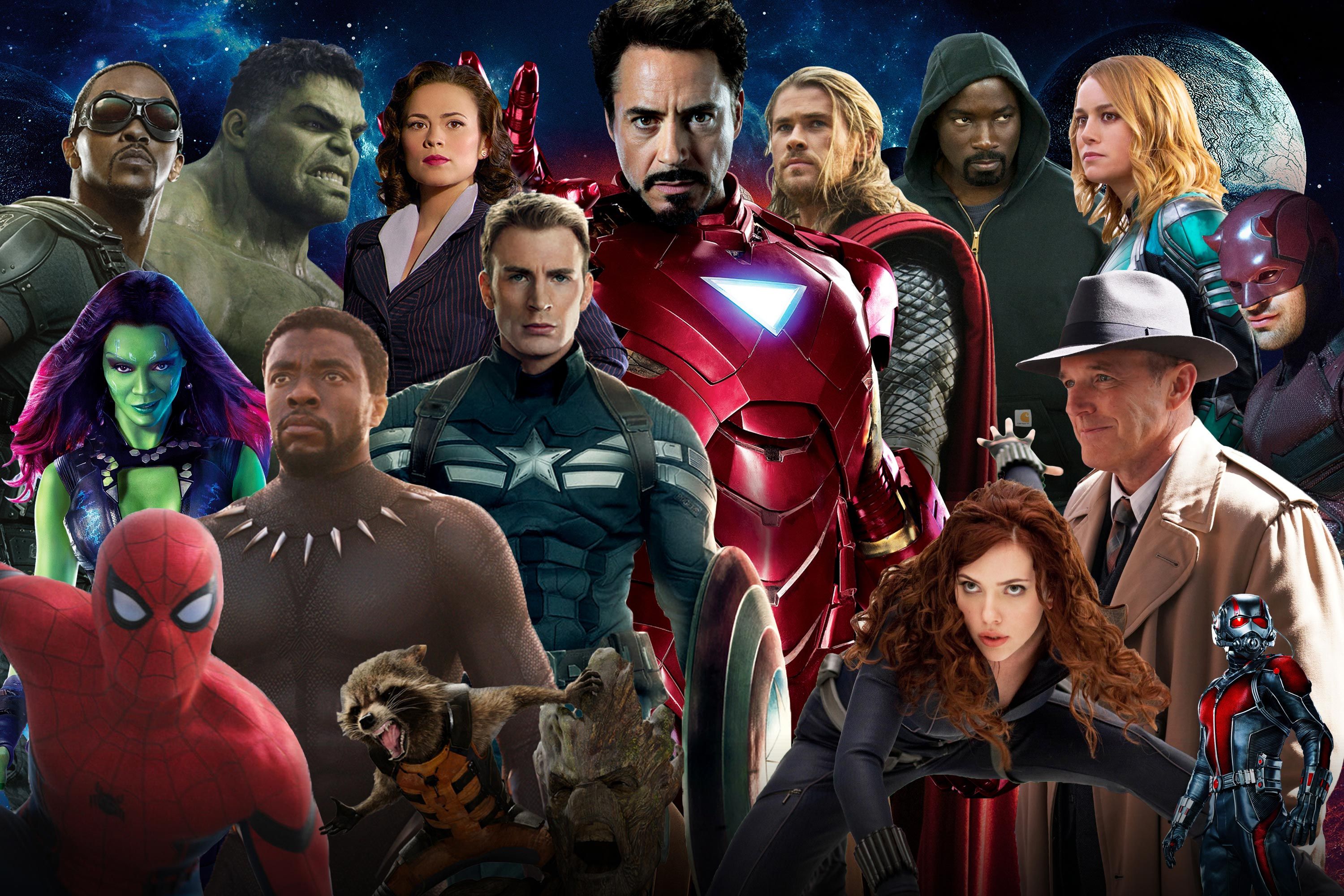
May 2, 2008: The Marvel Cinematic Universe begins, with the release of the film Iron Man, starring Robert Downey Jr. as Tony Stark, a billionaire scientist who uses his genius to become a superhero and fight injustice.

The character of Iron Man had debuted in Tales of Suspense #39 in March 1963, and had led the Avengers since the group's debut in The Avengers #1 in September of that year. But he had never been in the top tier of Marvel Comics characters in terms of popularity, unlike Spider-Man, the Hulk, Captain America, Thor, Daredevil, the Fantastic Four and the X-Men.

Example: Spider-Man had been seen in live-action on TV in 2 separate series, one in 1974-77, another in 1977-79, and 3 movies starting in 2002; the Hulk on TV in 1977-82, 3 TV-movies based on the series in 1988-90, and in a film in 2003; Captain America had been in a movie all the way back in 1944, and then in TV-movies in 1979 (2 of them) and 1990; Thor and Daredevil had each been in one of the Hulk TV-movies, and Daredevil headlined a 2003 movie; and there had been 3 movies each for the F4 and the X-Men.

Until the release of Spider-Man: No Way Home in 2021 brought the Tobey Maguire (2002-07) and Andrew Garfield (2012-14, in other words not yet seen in 2008) versions of Spidey together with the Tom Holland version (2016-onward), none of those productions was considered part of the MCU.

But Iron Man not only launched Stark to the forefront of Marveldom, but also symbolized Downey's comeback from a fine acting career that had seemed ruined by drug use.

Other films followed:

* 2008: The Incredible Hulk.
* 2010: Iron Man 2.
* 2011: Thor and Captain America: The First Avenger.
* 2012: Marvel's The Avengers.
* 2013: Iron Man 3 and Thor: The Dark World.
* 2014: Captain America: The Winter Soldier and Guardians of the Galaxy.
* 2015: Avengers: Age of Ultron and Ant-Man.
* 2016: Captain America: Civil War and Doctor Strange.
* 2017: Guardians of the Galaxy Vol. 2, Spider-Man: Homecoming and Thor: Ragnarok.
* 2018: Black Panther, Avengers: Infinity War and Ant-Man and the Wasp.
* 2019: Captain Marvel, Avengers: Endgame and Spider-Man: Far From Home.
* 2021: Black Widow, Shang-Chi and the Legend of the Ten Rings, Eternals, and Spider-Man: No Way Home.
* Scheduled for release in 2022: Doctor Strange in the Multiverse of Madness, Thor: Love and Thunder, and Black Panther: Wakanda Forever.
* Planned for 2023: Ant-Man and the Wasp: Quantumania, Guardians of the Galaxy Vol. 3, The Marvels.

In addition, there have been TV series: Agents of S.H.I.E.L.D., 2013-20; Agent Carter, 2015-16; Daredevil, 2015-18; Jessica Jones, 2015-19; Luke Cage, 2016-18; The Defenders, 2017; Inhumans, 2017; Iron Fist, 2017-18; The Punisher, 2017-19; Runaways, 2017-19; Cloak & Dagger, 2018-19; Helstrom, 2020; WandaVision, The Falcon and the Winter Soldier, Loki and Hawkeye, all 2021; the animated (and thus far cheaper to make) What If..., 2021-22; and Moon Knight, starting in 2022 and possibly continuing beyond.

The MCU, produced by The Walt Disney Company, forced Warner Brothers' hand: It owned the rights to movies for the characters in DC Comics, but the DC Extended Universe has had its problems -- the unsuitability of some of its writers and directors being more important than the quality of the stories and the acting.

In hindsight, it is interesting that the greatest crisis in each brand's live-action history was set in 2019: For Marvel, "The Snap" by Thanos in the film Avengers: Infinity War, on May 31 in their continuity, though the film was released on April 27, 2018; and for DC, the titular event in their miniseries Crisis On Infinite Earths, on December 10, the day it aired on The CW Network. And, in both cases, the man who was then President in real life, Donald Trump, couldn't save anyone.

*

May 2, 2008 was a Friday. These games were played in Major League Baseball:

* The New York Yankees beat the Seattle Mariners, 5-1 at Yankee Stadium. Chien-Ming Wang was the winning pitcher. Derek Jeter went 0-for-4, but Melky Cabrera had a 2-RBI double.

* The New York Mets beat the Arizona Diamondbacks, 7-2 at Chase Field in Phoenix.

* The Boston Red Sox beat the Tampa Bay Rays, 7-3 at Fenway Park in Boston.

* The Philadelphia Phillies beat the San Francisco Giants, 6-5 at Citizens Bank Park in Philadelphia. The Phils got home runs from Chase Utley, Pedro Feliz, and a walkoff in the 10th inning from Pat Burrell.

* The Pittsburgh Pirates beat the Washington Nationals, 11-4 at Nationals Park in Washington.

* The Atlanta Braves beat the Cincinnati Reds, 2-0 at Turner Field (now Center Parc Stadium) in Atlanta. Tim Hudson pitched a 3-hit shutout, 10 strikeouts, no walks. Brian McCann hit a home run.

* The Florida Marlins beat the San Diego Padres, 6-4 at Dolphin Stadium (now Hard Rock Stadium in Miami Gardens, Florida.

* The Houston Astros beat the Milwaukee Brewers, 7-4 at Minute Maid Park (now Daikin Park) in Houston.

* The Toronto Blue Jays beat the Chicago White Sox, 2-0 at the Rogers Centre in Toronto. It took 5 Jays pitchers to complete a 5-hit shutout. In contrast, Mark Buehrle went the distance for the South Siders, but lost.

* The St. Louis Cardinals beat their arch-rivals, the Chicago Cubs, 5-3 at Busch Stadium in St. Louis. Skip Schumaker won it with a home run in the bottom of the 11th.

* The Minnesota Twins beat the Detroit Tigers, 11-1 at the Metrodome in Minneapolis.

* The Los Angeles Dodgers beat the Colorado Rockies, 11-6 at Coors Field in Denver.

* The Baltimore Orioles beat the Los Angeles Angels of Anaheim, 4-3 at Angel Stadium of Anaheim.

* The Texas Rangers beat the Oakland Athletics, 4-3 at the Oakland Coliseum (then named the McAfee Coliseum).

* And the Cleveland Indians and the Kansas City Royals got rained out at Kauffman Stadium in Kansas City. It was made up as part of a doubleheader on September 13. The Royals won both games, 8-3 and 8-4.

Football was out of season. The NBA Playoffs were in the 1st Round:

* The Atlanta Hawks beat the Boston Celtics, 103-100 at the Philips Arena (now the State Farm Arena) in Atlanta. That was a Game 6, and the Hawks won Game 7 2 nights later.

* The Cleveland Cavaliers beat the Washington Wizards, 105-88 at the Verizon Center (now the Capital One Arena) in Washington, to win Game 6 and the series. LeBron James had 27 points, 13 rebounds and 13 assists.

* And the Utah Jazz beat the Houston Rockets, 113-91 at the Delta Center (then named the EnergySolutions Arena) in Salt Lake City, to win Game 6 and the series. Tracy McGrady scored 40 points.

One Stanley Cup Playoff game was played that night, but it was a doozy. The San Jose Sharks beat the Dallas Stars, 3-2 at the HP Pavilion (now the SAP Center) in San Jose. Joe Pavelski scored 1:05 into overtime. That was in Game 6 of an NHL Western Conference Semifinal. But, 2 nights later, Game 7 went to 4 overtimes, and Brenden Morrow won it for Dallas.

Sunday, May 1, 2022

May 1, 1971: Spider-Man vs. Drugs

May 1, 1971: Marvel Comics takes on their most insidious bad guy yet: Drugs.

Previously, the Comics Code Authority forbade the depiction of illegal drugs, even as a warning as to their dangers. But President Richard Nixon wanted to wage war on drugs -- a great idea that turned out to be spectacularly poorly carried out.

Elliot Richardson, then the U.S. Secretary of Health, Education and Welfare, wrote to Marvel boss Stan Lee, and asked him to publish an anti-drug message in one of the company's leading titles.

Lee, already 48 years old, but always willing to stay on the cutting edge, agreed. And so, with The Amazing Spider-Man #96, with a list date of May 1971, he began a 3-part story arc involving drug use.
Smilin' Stan Lee. Excelsior, true believers!

At this point in his life, Peter Parker, secretly the New York-based superhero Spider-Man, is in college, with a side job as a photographer for a newspaper, The Daily Bugle. He shares an apartment with Harry Osborn, and they've been friends for a long time, in spite of the fact that Harry's father, industrialist Norman Osborn, is Spidey's arch-enemy, the Green Goblin, and the Goblin knows Peter's dual identity.

As the 2002 film Spider-Man would eventually show, having the Goblin die would devastate Harry. On top of that, Smilin' Stan was one of the few people in American public life in the 1960s who addressed the issue of mental illness, writing that Spidey knew that Norman's split personality between Harry's dad the genius scientist businessman and the arch-criminal wasn't his fault. So he had to subdue the Goblin without really hurting him with his strength, proportionally that of a spider.

The last time before this that they had fought, Spidey had defeated the Goblin, and Norman developed retrograde amnesia: He didn't remember anything he experienced after becoming the Goblin, including Peter's secret identity.

But Norman's troubles, and his treatment of Harry, led Harry to seek solace in prescription drugs. Peter sees him taking them, and says, "When did you become a pill-popper?" When the pill makes Harry fall asleep, Peter suddenly realizes that Harry had been doing this for a while: Pills to help him sleep, and pills to help him stay awake.

So Lee wrote a monologue for Spidey, as he swung through the City, talking about how drugs could hurt people. And then he sees an example: A black kid on the edge of a roof, stoned out of his gourd. Spidey fails to save him.

That night is the premiere of an Off-Off-Broadway show, starring Peter's girlfriend, Mary Jane Watson, who says, "If it were any more off Broadway, it would be in Hoboken!" Also friends of Mary Jane, Norman and Harry attend together.

So does a black man about Peter's and Harry's age, who knew the younger guy who fell. This man knows that Norman is rich, and has influence to go with his money, and demands that he use it to help ghetto kids. They argue, and this triggers Norman's split. At the end of the issue, Peter and Norman are both in costume, and they know who each other is.

At the end of the 2nd issue, #97, Harry overdoses. At the start of the 3rd, #98, Peter is standing over Harry in his hospital bed, when the Goblin hovers on his glider at the window, ready to kill the uncostumed Peter. Peter shows the Goblin his son, and, in a moment of clarity that he is also Norman, he backs off. They fight later in the issue, Peter wins, takes an unconscious Norman home, and burns the Goblin costume, hoping that will put an end to the Goblin personality. Harry recovers. All is well. With them, anyway.

Until Peter's original girlfriend, Gwen Stacy, returns, during one of Peter's periodic breakups with Mary Jane. And Norman's Goblin personality kicks back in, and he makes a new costume and new weapons. In Spider-Man #121, June 1973, there is no title on the title page. Instead, the last panel shows the title, with Spidey holding Gwen, killed by the Goblin: "The Night Gwen Stacy Died!" In #122, the Goblin dies, in a scene recreated for the 2002 Spider-Man film.

The Comics Code Authority heard about the anti-drug story, and refused to issue its seal of approval, which had been a must for any comic book wanting to stay in business, ever since the publication of the anti-comics screed The Seduction of the Innocent by Frederic Wertham in 1954.

Lee decided that publishing these 3 issues, especially the 1st one, was more important that staying in business. He rolled the dice that people would buy The Amazing Spider-Man #96 without the seal of approval. His roll came up 7: It sold so well that the Authority revised its Code.

DC Comics, Marvel's rival, accepted that they also needed to publish an anti-drug message. So they published Green Lantern #85, with a list date of August 1971, and a headline, "The shocking truth about drugs!" #85 had the title of "Snowbirds Don't Fly," and #86, the conclusion of the story, was titled, "They Say It'll Kill Me... But They Won't Say When."
Green Lantern, in civilian life a test pilot named Hal Jordan, often teamed up with Oliver Queen, a businessman without powers but with great archery skill, who fought crime as Green Arrow. Queen had adopted a teenage boy named Roy Harper, and, giving him a red outfit similar to his own green one, made Roy "Robin" to his "Batman."

Why would a superhero with an archery theme, rather than a speedster, be called "Speedy"? With the 1940s "Golden Age" versions of the characters, Roy once got into costume and out of their hideout while Ollie was still getting his costume on.

But Roy had a secret beyond his crimefighting identity: He had become addicted to heroin. Fans of the 2012-20 CW Network TV series Arrow, which shows Oliver as a more Batman-like, haunted, brooding figure, might be surprised to know that the comics' Green Arrow was, like the 1st Robin (Dick Grayson) and Spider-Man, a quipster, dropping bons mots while taking bad guys down. This time, as Hal suggested, Ollie did not have the answer, aside from taking down the gang that had gotten Roy hooked, and getting Roy to "go cold turkey."

DC had done it well, even taking it a step further by showing a superhero getting addicted to an illegal drug, not just a prescription. But Marvel had done it first, and better. As Smilin' Stan himself would have said, "'Nuff said!"

Nixon would eventually appoint Elliot Richardson to be U.S. Attorney General, but he resigned that post in 1973, rather than fire the Special Counsel investigating the Nixon Administration over "the Watergate matter," leading to a series of moves that became known as "The Saturday Night Massacre."

In 1980, the Department of Health, Education and Welfare (HEW) was split into 2 separate departments: The Department of Education (DOE) and the Department of Health and Human Services (HHS).

*

May 1, 1971 was a Saturday. This was also the day that Amtrak began service, and the film Billy Jack premiered. I have separate entries for those events.

Football was out of season. The NBA Championship had been decided the day before, when the Milwaukee Bucks completed a 4-game Finals sweep of the Baltimore Bullets. The Stanley Cup Playoffs were underway, with the Montreal Canadiens waiting to see who they would play in the Finals. It turned out to be the Chicago Black Hawks, who beat the New York Rangers in a Game 7 the following day.

These Major League Baseball games were played that day:

* The New York Yankees lost to the Milwaukee Brewers, 1-0 at Yankee Stadium. It was a typical Yankee game for the period between the retirement of Mickey Mantle at the start of the 1969 season, and the closing of the original Stadium for its renovation at the end of 1973: They got a great pitching performance, in this case from Stan Bahnsen, they couldn't back him up.

They got only 5 hits off Brewer starter Lew Krausse: A triple by Roy White in the 3rd inning, but there were 2 outs, and he was stranded; back-to-back singles by Bobby Murcer and Danny Cater to lead off the 4th, but they couldn't bring them around; a single by Jake Gibbs to lead off the 6th, followed by White drawing a walk, but they couldn't be brought around, either; and a double by Gene Michael in the 7th. In the 8th, Bahnsen lost the game on a solo home run by Tommy Harper. (I wonder if Harper told Bahnsen, "'Preciate it. Thanks.")

And, in spite of it being a beautiful Spring weekend, only 7,384 fans showed up.

* The New York Mets did no better than their Bronx neighbors, losing to the Houston Astros, 3-1 at the Astrodome in Houston.

* The Minnesota Twins beat the Boston Red Sox, 7-3 at Fenway Park in Boston.

* The Chicago White Sox beat the Washington Senators, 5-3 at Robert F. Kennedy Stadium in Washington.

* The Atlanta Braves beat the Los Angeles Dodgers, 7-5 at Atlanta Stadium. (It was renamed Atlanta-Fulton County Stadium in 1974.) Hank Aaron hit 2 home runs.

* The Pittsburgh Pirates beat the San Diego Padres, 5-4 at Three Rivers Stadium in Pittsburgh. Cliché Alert: Walks can kill you, especially the leadoff variety. Bob Robertson led off the bottom of the 11th with a walk, was bunted over to 2nd base by Manny Sanguillen, and driven in by a single by Gene Alley. Willie Stargell went 3-for-5. Roberto Clemente only appeared as a pinch-hitter, and did not get a hit. The Pirates only got 6,068 fans to come out, but went on to win the World Series.

* The Cincinnati Reds beat the San Francisco Giants, 3-2 at Riverfront Stadium in Cincinnati. For the Reds, Pete Rose went 1-for-3, and Johnny Bench went 1-for-4. For the Giants, Willie McCovey went 0-for-3, while Willie Mays only appeared as a pinch-hitter, and did not get a hit.

* The Chicago Cubs beat the Philadelphia Phillies, 7-4 at Wrigley Field in Chicago.

* The St. Louis Cardinals and the Montreal Expos were tied, 2-2 at Busch Memorial Stadium in St. Louis, when the game was called due to rain. It was never replayed. For the Expos, Steve Renko outpitched Bob Gibson, allowing 3 hits to Gibson's 7.

* The Kansas City Royals beat the Baltimore Orioles, 5-2 at Kansas City Municipal Stadium.

* The California Angels beat the Detroit Tigers, 9-1 at Anaheim Stadium in the Los Angeles suburb of Anaheim, California. (The ballpark is now named Angel Stadium of Anaheim.)

* And the Cleveland Indians beat the Oakland Athletics, 2-1 at the Oakland Coliseum. Ted Ford hit a home run off Diego Segui to make the difference for the Tribe. Reggie Jackson went 1-for-4 for the A's.

Also, Arsenal beat Stoke City, 1-0 at Highbury in North London. Their next 2 games would win them trophies: A 1-0 win over arch-rivals Tottenham Hotspur at White Hart Lane in North London, to clinch the Football League title; and a 2-1 extra-time win over Liverpool at the old Wembley Stadium in West London, in the FA Cup Final.

December 31, 1999 & January 1, 2000: The Millennium

December 31, 1999:  The Millennium arrives. The people of planet Earth survived. At a terrible cost. But we hadn't destroyed ourselves. ...