Showing posts with label 1897. Show all posts

Monday, October 31, 2022

November 1, 1897: The Library of Congress Opens

The Thomas Jefferson Building

November 1, 1897: The current Library of Congress building opens in Washington, D.C., across First Street from the U.S. Capitol Building. There is a dispute as to whether it or the British Library is the largest in the world, based on total number of volumes contained therein. Both have over 170 million volumes.

Once the national capital moved to Washington in 1800, the Library of Congress was housed in the Capitol. Much of its original collection was burned by the British troops in the War of 1812, along with the rest of the Capitol, and the White House, on August 24, 1814. That remains the worst attack on the Capitol. During the Trump Insurrection of January 6, 2021, the Library of Congress was safe: Most of those people wouldn't intentionally go anywhere near a library.

After the fire, Congress purchased former President Thomas Jefferson's entire personal collection of 6,487 books, to restore its own collection -- and also to help him pay off his debts. Over the next few years, its collection slowly grew. But on Christmas Eve, December 24, 1851, another fire broke out in the Capitol chambers. This destroyed a large amount of the collection, including many of Jefferson's books.

After the American Civil War, the importance of the Library of Congress for legislative research increased, and there was a campaign to purchase replacement copies for volumes for its lost books. The library received the right of transference of all copyrighted works, and deposit of two copies of books, maps, illustrations, and diagrams printed in the United States. The Library also built its collections through acquisitions and donations.

Between 1888 and 1894, Congress constructed and moved the collection to a large adjacent library building, across the street from the Capitol. On April 13, 1976, on the anniversary of Jefferson's birth, and in connection with the nation's Bicentennial, the main Library was renamed the Thomas Jefferson Building, 

Two more adjacent library buildings, the John Adams Building, opening in 1939, and the James Madison Memorial Building, opening in 1980, hold expanded parts of the collection and provide space for additional library services.
The Jefferson Building's Main Reading Room

The library's primary mission is to research inquiries made by members of Congress, which is carried out through the Congressional Research Service. It also houses and oversees the United States Copyright Office. The library is open to the public for research, although only high-ranking government officials and library employees may borrow -- i.e., temporarily take custody of -- books and materials.


*

November 1, 1897 was a Monday. There were no games on this historic day: Baseball season was over, football was in midweek, and basketball and hockey were both still all-amateur.

Tuesday, September 20, 2022

September 21, 1897: "Yes, Virginia, There Is a Santa Claus"

Francis P. Church

September 21, 1897: The New York Sun newspaper prints an editorial, confirming to a local girl that Santa Claus exists.

In 1897, Philip O'Hanlon, a coroner's assistant, was asked by his 8-year-old daughter, Laura Virginia O'Hanlon, who went by her middle name, whether Santa Claus really existed. O'Hanlon suggested she write to The Sun. In her letter, Virginia wrote:

DEAR EDITOR: I am 8 years old.
Some of my little friends say there is n190o Santa Claus.
Papa says, "If you see it in THE SUN it’s so."
Please tell me the truth; is there a Santa Claus?

VIRGINIA O’HANLON.
115 WEST NINETY-FIFTH STREET.

Virginia O'Hanlon, age 8, 1897

The Sun's editor-in-chief, Edward Page Mitchell, received the letter, and gave it to Francis Pharcellus Church. Since 1878, Church had written many editorials for the paper, having previously written for several other publications. Mitchell reported that Church, who was initially reluctant to write a response, produced it "in a short time" during an afternoon.

As with the best-known description of Santa Claus to that point, Clement C. Moore's 1823 story A Visit from St. Nicholas, and with a prominent baseball poem of 1888, Ernest L. Thayer's Casey at the Bat, this editorial was published anonymously, and it would be years before its author was identified. In fact, Mitchell convinced Church to write it by saying that he would never reveal its author for as long as they both lived. Indeed, it wasn't until Church died in 1906 that Mitchell publicly identified him as the author.

On September 21, 1897, the editorial appeared in The Sun, preceded by Virginia's letter:

VIRGINIA, your little friends are wrong. They have been affected by the skepticism of a skeptical age. They do not believe except they see. They think that nothing can be which is not comprehensible by their little minds. All minds, Virginia, whether they be men’s or children’s, are little. In this great universe of ours man is a mere insect, an ant, in his intellect, as compared with the boundless world about him, as measured by the intelligence capable of grasping the whole of truth and knowledge.

Yes, VIRGINIA, there is a Santa Claus. He exists as certainly as love and generosity and devotion exist, and you know that they abound and give to your life its highest beauty and joy. Alas! how dreary would be the world if there were no Santa Claus. It would be as dreary as if there were no VIRGINIAS. There would be no childlike faith then, no poetry, no romance to make tolerable this existence. We should have no enjoyment, except in sense and sight. The eternal light with which childhood fills the world would be extinguished.

Not believe in Santa Claus! You might as well not believe in fairies! You might get your papa to hire men to watch in all the chimneys on Christmas Eve to catch Santa Claus, but even if they did not see Santa Claus coming down, what would that prove? Nobody sees Santa Claus, but that is no sign that there is no Santa Claus. The most real things in the world are those that neither children nor men can see. Did you ever see fairies dancing on the lawn? Of course not, but that’s no proof that they are not there. Nobody can conceive or imagine all the wonders there are unseen and unseeable in the world.

You may tear apart the baby’s rattle and see what makes the noise inside, but there is a veil covering the unseen world which not the strongest man, nor even the united strength of all the strongest men that ever lived, could tear apart. Only faith, fancy, poetry, love, romance, can push aside that curtain and view and picture the supernal beauty and glory beyond. Is it all real? Ah, VIRGINIA, in all this world there is nothing else real and abiding.

No Santa Claus! Thank God! he lives, and he lives forever. A thousand years from now, Virginia, nay, ten times ten thousand years from now, he will continue to make glad the heart of childhood.
Fred Astaire, in the 1979 film The Man in the Santa Claus Suit

The editorial proved so successful, and sold so many copies of The Sun that its publisher, Charles Dana, who described it as "real literature," ordered it reprinted in his paper every year. In 1950, the paper was absorbed by The World-Telegram. After The World Telegram & Sun folded in 1966, the New York Daily News began reprinting it every Christmas Eve, and still does.

The story of Virginia's letter and The Sun's response has been adapted into an NBC radio show in 1932, as a segment of the film The Santa Claus Story in 1945, an ABC special in 1974, a TV-movie starring Charles Bronson as Church in 1991, and a CBS animated special in 2009.

And what of Virginia? She grew up, and got degrees from 3 different New York City schools: A Bachelor of Arts from Hunter College in 1910, a Master of Education from Columbia University in 1912, and a Doctorate of Education from Fordham University in 1930.

Shortly after getting her master's, she married Edward Douglas, but he left her right before the birth of their daughter Laura. Still, for the rest of her life, she signed her name "Laura Virginia O'Hanlon Douglas." She taught in New York's public schools starting in 1912, became a junior principal in 1935, and retired in 1959. She always answered letters from people who wrote to her about how her 1897 letter and Church's response had affected them.
Laura Virginia O'Hanlon Douglas, 1970

She died on May 13, 1971, at age 81. Santa Claus? In the hearts of children, he still lives.

In a 2012 episode of the YouTube series Epic Rap Battles of History, "Nice" Peter Shukoff played Santa Claus, with "Epic" Lloyd Ahlquist played 3 different elves, against rapper Snoop Dogg as Moses.

*

September 21, 1897 was a Tuesday. These National League games were played that day:

* The New York Giants lost to the Baltimore Orioles, 10-3 at the 1890-1911 version of the Polo Grounds.

* A doubleheader was split at the South End Grounds in Boston. The Brooklyn Bridgegrooms (forerunners of the Dodgers) won the opener, 22-5. The Boston Beaneaters (forerunners of the Braves) won the nightcap, 9-1.

* The Washington Senators beat the Philadelphia Phillies, 5-4 at National League Park (later to be renamed Baker Bowl) in Philadelphia.

* The Cincinnati Reds beat the Pittsburgh Pirates, 11-3 at Exposition Park in Pittsburgh.

* The Cleveland Spiders beat the Chicago Colts (forerunners of the Cubs), 8-7 at the West Side Grounds in Chicago.

* And the Louisville Colonels and the St. Louis Browns (forerunners of the Cardinals) were not scheduled to play.

Wednesday, August 31, 2022

September 1, 1897: Boston Opens America's 1st Subway

September 1, 1897: The Tremont Street Subway opens in Boston. It is the 1st subway system in America.

This original line consisted of a main line under Tremont Street that terminated at Park Street in downtown Boston, and two forks to the south. One of these was the Pheasant Street Incline, heading to Pheasant Street in the South End, and remained in operation until 1961.

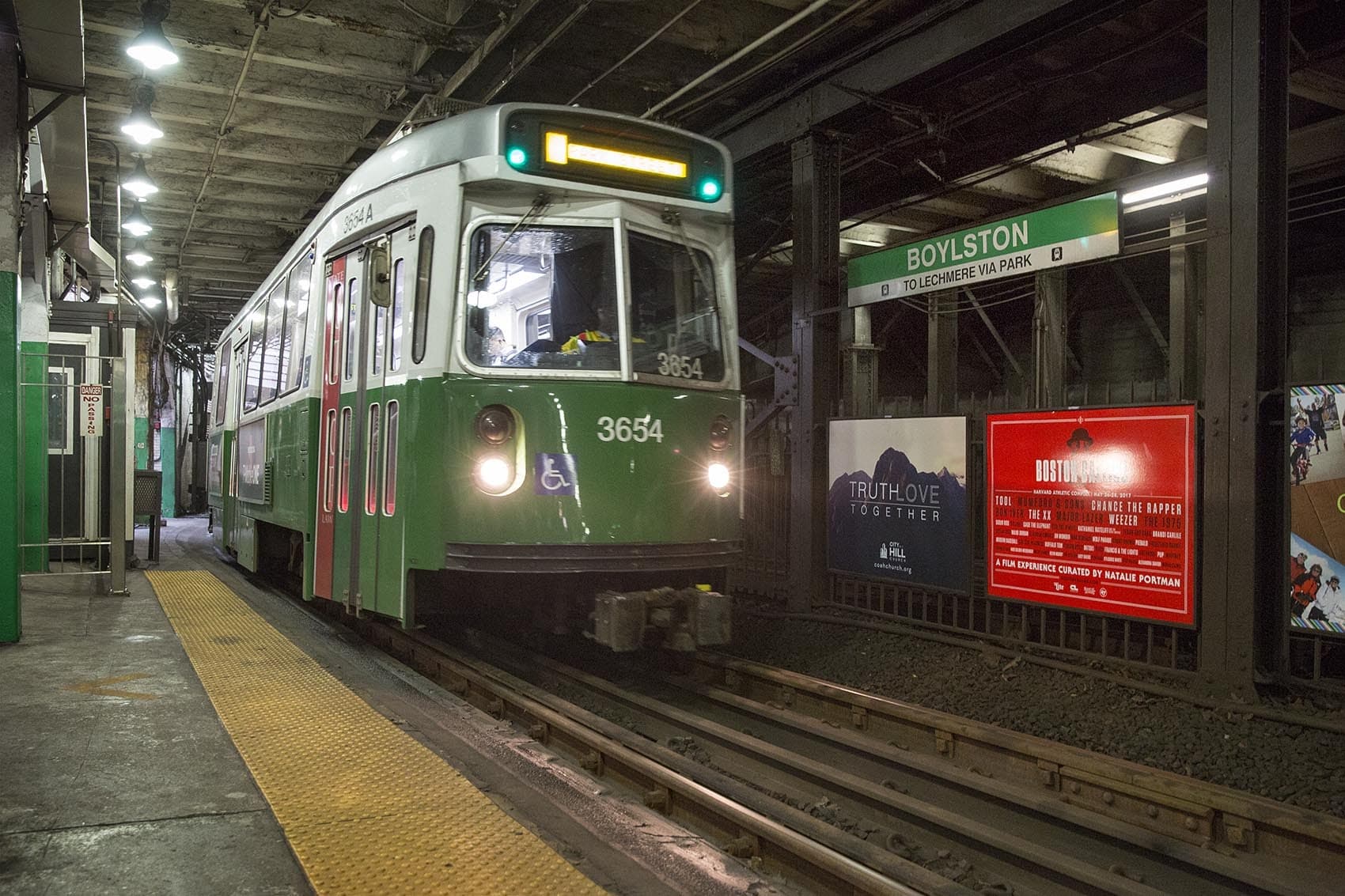
The other remains in operation today, veering westward along Boylston Street, and eventually extended to lines labeled B, C, D and E, serving as the Green Line when the system was rebranded from the Metropolitan Transit Authority (MTA) to the Massachusetts Bay Transportation Authority (MBTA, or just "T") in 1964.

In the opposite direction, the line headed for Scollay Square, North Station, Science Park, and over the Charles River into Cambridge, at Lechmere. This line is currently being extended to Medford and Tufts University, and the MBTA is hoping to open it next May.

There are 2 well-known songs about the Boston subway system, though each mentions a station whose name has since been changed. In 1948, a song was written protesting the exit fare then considered necessary to raise the overall fare from 10 to 15 cents, titled "M.T.A.," sometimes mistitled "Charlie on the M.T.A." In the 4th of the 5 verses:

Charlie's wife goes down
to the Scollay Square station
every day at a quarter past two
and through the open window
she hands Charlie a sandwich
as the train comes rumbling through!

My mother always wondered why Mrs. Charlie didn't just include the extra nickel in the brown bag with the sandwich. It was a protest: Charlie thought no one should have to pay the extra nickel, and his wife was down with it.

In 1944, Tom Lehrer, then a student at Harvard University, not yet the great musical satirist of the 1950s and '60s, wrote a song about commuting from the Harvard campus to downtown, to the tune of "M-O-T-H-E-R, A Word That Means the World to Me":

H is for my alma mater, Harvard.C is Central, next stop on the line.K is for the cozy Kendall station.C is Charles that overlooks the brine.P is Park Str- Pahk Street, busy Boston center.W is Washington, you see.
Put them all together, they spell: "HCKC-PW!"Which is just about what Boston means to me!

"HCKC-PW" was supposed to sound like spitting. This line became the MBTA Red Line. Scollay Square was renamed Government Center in 1963. In 1987, Washington station was renamed Downtown Crossing.

Chicago's elevated line, or "L," actually predates the Boston subway by 5 years, but the city didn't get its 1st underground subway line until the State Street line opened on October 17, 1943.

For each city in Major League Baseball with a subway system, here are the opening dates:

1. June 6, 1892, Chicago.
2. September 1, 1897, Boston.
3. October 27, 1904, New York.
4. March 4, 1907, Philadelphia.
5. December 17, 1913, Cleveland.
6. March 30, 1954, Toronto.
--. October 14, 1966, Montreal.
7. September 11, 1972, San Francisco.
8. March 27, 1976, Washington.
9. June 30, 1979, Atlanta.
10. July 26, 1981, San Diego.
11. November 21, 1983, Baltimore.
12. April 15, 1984, Pittsburgh.
13. May 20, 1984, Miami.
14. July 31, 1987, Detroit.
15. July 14, 1990, Los Angeles.
16. July 31, 1993, St. Louis.
17. June 14, 1996, Dallas.
18. January 1, 2004, Houston.
19. June 26, 2004, Minneapolis.
20. December 27, 2008, Phoenix.
21. July 18, 2009, Seattle.
22. April 22, 2016, Denver.
23. May 6, 2016, Kansas City.
24. September 9, 2016, Cincinnati.
25. November 2, 2018, Milwaukee.
26. Never, Tampa Bay. Neither Tampa nor St. Petersburg has any.

San Francisco had cable cars going back to 1878, and streetcars in 1948, before the opening of BART in 1972. In the cases of San Diego, St. Louis, Dallas, Houston, Minneapolis, Phoenix, Seattle, Kansas City, Cincinnati and Milwaukee, the service in question is street-level light rail. And Miami's, Detroit's and Seattle's are above-ground monorails. Those cities have never had subway systems. Cincinnati started to build one, but abandoned the project in 1928.

*

September 1, 1897 was a Wednesday. Basketball was a new invention. Professional hockey did not exist. Professional football barely did. But all 12 teams in baseball's National League were in action:

* The Boston Beaneaters beat the Chicago Colts, 7-4 at the South End Grounds in Boston. The Beaneaters, the forerunners of the Braves, were in a torrid struggle for the Pennant with the Baltimore Orioles. In fact, from 1891 to 1898, one or the other won the Pennant every year. The former Chicago White Stockings were then known as the Colts because they had so many young players. They became the Cubs in 1903.

* The Baltimore Orioles beat the St. Louis Browns, 11-5 at Oriole Park in Baltimore. These Orioles went out of business after the 1899 season. These Browns became the Cardinals soon thereafter. A series of teams in Baltimore took on the Orioles name, and in 1902, an American League team took on the St. Louis Browns name. In 1954, this team moved, becoming the Baltimore Orioles.

* The New York Giants beat the Cincinnati Reds, 8-7 at the Polo Grounds.

* The Brooklyn Bridegrooms beat the Cleveland Spiders, 5-1 at Eastern Park in Brooklyn. They were called the Bridegrooms because, a few years earlier, several of their players got married in the off-season. By 1911, they were the Dodgers. The Spiders folded after the 1899 season.

* The Philadelphia Phillies beat the Louisville Colonels, 7-6 at Huntingdon Avenue Grounds (later renamed Baker Bowl) in Philadelphia. The Colonels folded after the 1899 season.

* And the Washington Senators beat the Pittsburgh Pirates, 5-1 at Boundary Park in Washington. These Senators folded after the 1899 season.

Sunday, July 17, 2022

July 18, 1897: Cap Anson Starts the 3,000 Hit Club

July 18, 1897: The Chicago Colts beat the Baltimore Orioles, 6-3 at the West Side Grounds in Chicago. Adrian Constantine Anson, a.k.a. "Cap" or "Pop," the 45-year-old 1st baseman and manager of the Chicago team, collects his 3,000th career hit, becoming the 1st player ever to do so.

Or… does he? It depends. If you count walks as hits, as the National League did in 1887, and only in that season, then, yes, this was the day he "founded" what we now call the 3,000 Hit Club. This is how Major League Baseball, the Baseball Hall of Fame, and the Elias Sports Bureau have chosen to officially count Anson's statistics.

If you count statistics from the National Association from 1871 to 1875, then he'd already done it 4 years earlier. Either way, he was the 1st player to get 3,000 hits in the major leagues. But if you accept that those 60 walks from 1887 weren't hits, and you also don't count the NA, then he ended his career at the end of this season, finishing 5 hits short of 3,000.

If, like the authoritative sources above, you accept this date as correct, then the milestone hit was a single off George Blackburn of the Baltimore Orioles, the National League version that were contracted out of existence after the 1899 season. Blackburn was signed by the Orioles that month, and was released before the month was out, never to appear in the major leagues again.

In contrast, Anson played 27 years, and is still generally regarded as the greatest player of the 19th Century: He batted .334 for his career, and his NA-counted total of 3,435 hits included 582 doubles, 142 triples, and 97 home runs, a good if not great total by the standards of the time. He led the NL in batting average 4 times, and in RBIs 8 times. He had 8 seasons of at least 100 RBIs, oddly leading the League in only 4 of those seasons. His OPS+ was 142, meaning he was 42 percent better at producing runs than the average player of his time, so he wasn't just feasting on a bad era of pitching.

He won Pennants as a player with the Philadelphia Athletics in 1871, the 1st season of the NA; and in 1876, the 1st year of the NL, with the team then known as the Chicago White Stockings. As player and manager, he led them to the NL Pennant in 1880, 1881, 1882, 1885 and 1886; finishing 2nd in 1883, 1888, 1890 and 1891. He died in 1922, before there was a Baseball Hall of Fame. He was elected to the Hall in 1939. Had there been an All-Century Team in the 19th Century, he would have been elected to it.

Anson was a great player, but a horrible person. It's not just that he was partly responsible for baseball's "color barrier" that began in 1887, it's also that he is now known to have bet on his own team to win, which would, under modern rules, have gotten him banned from baseball for life, just as happened to Pete Rose.

In 1898, without Anson either playing or managing, the Chicago team, because "they missed their Pop," was nicknamed the Orphans. This was dumb, and in 1903, they took the name by which they have been known ever since: The Chicago Cubs.

As of July 18, 2022, there are 33 members of the 3,000 Hit Club. Anson was joined by Honus Wagner and Nap Lajoie in 1914, Ty Cobb in 1921, Tris Speaker and Eddie Collins in 1925, Paul Waner in 1942, Stan Musial in 1958, Hank Aaron and Willie Mays in 1970, Roberto Clemente in 1972, Al Kaline in 1974, Pete Rose in 1978, Lou Brock and Carl Yastrzemski in 1979, Rod Carew in 1985, Robin Yount and George Brett in 1992, Dave Winfield in 1993, Eddie Murray in 1995, Paul Molitor in 1996, Tony Gwynn and Wade Boggs on back-to-back days in 1999, Cal Ripken Jr. in 2000, Rickey Henderson in 2001, Rafael Palmeiro in 2005, Craig Biggio in 2007, Derek Jeter in 2011, Alex Rodriguez in 2015, Ichiro Suzuki in 2016, Adrián Beltré in 2017, Albert Pujols in 2018, and Miguel Cabrera in 2022.

*

July 18, 1897 was a Sunday. In addition to Orioles at Colts, these 3 games were played in the NL:

* The Cleveland Spiders beat the Brooklyn Bridegrooms, 8-1 at League Park in Cleveland.

* The Cincinnati Reds beat the Washington Senators, 4-3 at League Park in Cincinnati.

* The Louisville Colonels beat the St. Louis Browns, 10-7 at Eclipse Park in Louisville. Making his major league debut in this game, as the Colonels' shortstop, was John "Honus" Wagner.

* And the New York Giants, the Boston Beaneaters, the Philadelphia Phillies and the Pittsburgh Pirates were not scheduled, partly because holding professional sporting events on Sundays was still illegal in Massachusetts, New York and Pennsylvania.

In addition to the Orioles, the Senators, the Spiders and the Colonels were all dropped from the NL after the 1899 season. In 1900, the Browns became the St. Louis Cardinals. In 1911, the Bridegrooms, who had also been the Superbas in the interim, became the Brooklyn Dodgers. In 1912, the Beaneaters, who had also been the Rustlers and the Doves in the interim, became the Boston Braves.

Sunday, July 3, 2022

July 4, 1897: The Tragedy of Louis Sockalexis

July 4, 1897: Louis Sockalexis suffers an injury that turns him from the newest and most exciting star in baseball into a has-been.

Louis Francis Sockalexis was born on October 24, 1871 in Old Town, Maine. A member of the Penobscot tribe, it was said that he could throw a baseball across the 300-foot-wide Penobscot River. The outfielder starred with the Cleveland Spiders of the National League as a rookie in 1897, batting .338 with 16 stolen bases.

But his drinking problem, all too common among Native Americans, had already gotten him expelled from the University of Notre Dame, and caused problems for him with the Spiders. And on July 4, when the brothel he was visiting was raided by the police, he jumped out of a 2nd-story window and wrecked his ankle. He was never the same player. He was only 25 years old.

The circumstances surrounding the 1899 Cleveland Spiders are too convoluted to briefly summarize, but they were the worst team in Major League Baseball history, and they were Louis Sockalexis' last major league team. They released him on May 7. If they'd kept him, despite all his trouble -- he was hitting .273 in spite of his carousing and his injury -- maybe they wouldn't have finished 20-134. Maybe they would have finished 30-124.

He kept playing on minor league teams until 1907, suffered from tuberculosis, and died of a heart attack in Burlington, Maine on Christmas Eve, December 24, 1913, only 42 years old.

It was long presumed that the Spiders' American League replacements, originally called the Blues, then the Broncos, and then the Naps in honor of 2nd baseman and manager Napoleon Lajoie, were renamed the Indians in 1915 in honor of either "Sock," the 1st Native American to play in the major leagues; or the tribes that once lined the shore of Lake Erie.

According to Cleveland Plain Dealer columnist Terry Pluto, who knows more than anyone about the Cleveland franchise of the American League, neither story is true: Baseball is a monkey-see-monkey-do game, like most sports; and, the year before, the World Series had been won by the Boston Braves.

However, there is an honor for Sockalexis at the Guardians' Progressive Field: He is one of the former Cleveland baseball players honored in Heritage Park beyond the center field fence, along with one other Cleveland Spider, Jesse Burkett. Its text, however, sticks to the story that he "inspired the nickname used to this very day."

It is no longer used: Finally bowing to pressure to drop the Native American team name, as the NFL's Washington Redskins had recently done, becoming the Washington Commanders, the baseball team changed its name to the Cleveland Guardians for the 2022 season.

*

July 4, 1897 was a Sunday. Bad news for teams that needed the revenue from holiday doubleheaders, because some of them were places where the law prevented them from playing on Sundays. Out of 12 teams then in the National League, only 6 played on the day, and the Spiders were not one of them:

* The Cincinnati Reds beat the Baltimore Orioles, 5-4 at National League Park in Cincinnati. Crosley Field would be built on the site in 1912.

* The Louisville Colonels beat the St. Louis Browns, 6-3 at Eclipse Park in Louisville, Kentucky.

* And the Chicago Colts beat the Washington Senators, 16-7 at the West Side Grounds in Chicago.

The Spiders, the Orioles, the Colonels and the Senators would be contracted out of the NL after the 1899 season. The Browns became the Cardinals in 1900. The Colts became the Cubs in 1903.

Friday, May 13, 2022

May 14, 1897: John Philip Sousa Premieres "The Stars and Stripes Forever"

May 14, 1897: "The Stars and Stripes Forever" is first performed, at Willow Grove Park in the Philadelphia suburb of Abington, Pennsylvania, conducted by its composer, John Philip Sousa.

Already known as "The March King," Sousa, perhaps the most famous American of Portuguese descent, claimed that he composed it on Christmas Day, December 25, 1896, aboard an ocean liner, on his way home from a European vacation with his wife. He composed it in his head, and wrote it down on paper after docking in New York.

Historically, in show business, and particularly in the theater and the circus, the piece is called "the Disaster March." In the early 20th Century, when it was common for theaters and circuses to have house bands, this march was a traditional code signaling a life-threatening emergency. It subtly notified personnel of emergency situations and ideally allowed them to organize the audience's exit without causing the chaos and panic that an overt declaration might.

Except for impending disaster, circus bands never played the tune under any circumstances. One memorable example of its use was during the Hartford Circus Fire of July 6, 1944, in which at least 168 people were killed.

Sousa conducted the U.S. Army Band in playing "The Star-Spangled Banner" before the 1st game at the original Yankee Stadium, in 1923. He lived until 1932, at the age of 77. In 1987, Congress passed a resolution declaring "The Stars and Stripes Forever" the National March of the United States.

*

May 14, 1897 was a Friday. This was a big day in music for another reason: Jazz pioneer Sidney Bechet, a clarinetist, was born.

Football was out of season. Basketball was a new invention, and hockey only existed on an amateur level. But these games were played in baseball's National League:

* The New York Giants lost to the Cincinnati Reds, 6-5 at League Park in Cincinnati. Crosley Field would be built on the same site in 1991.

* The Pittsburgh Pirates beat the Washington Senators, 7-1 at Exposition Park in Pittsburgh. Nearly a century later, PNC Park would be built on the same site.

* The Philadelphia Phillies beat the Louisville Colonels, 7-1 at Eclipse Park in Louisville.

* The Baltimore Orioles beat the St. Louis Browns, 11-7 at Sportsman's Park in St. Louis. The most familiar ballpark of that name was built on the same site in 1909.

* The Cleveland Spiders were supposed to play the Boston Beaneaters at League Park in Cleveland, but were rained out. The game was made up as part of a doubleheader the next day. The Spiders won the opener, 5-1. The Beaneaters won the nightcap, 7-6.

* And the Brooklyn Superbas and the Chicago Colts were not scheduled to play.

After the 1899 season, the Senators, the Colonels, the Orioles and the Spiders were disbanded. This helped to make the American League possible, including a new Washington Senators and a new St. Louis Browns. The current Browns had already, by then, become the Cardinals. The Beaneaters eventually became the Braves; the Superbas, the Dodgers; and the Colts, the Cubs.

Wednesday, April 27, 2022

April 27, 1897: General Grant National Memorial Opens

April 27, 1897: General Grant National Memorial opens in New York City, on what would have been the 75th Birthday of its subject.

Hiram Ulysses Grant was born on April 27, 1822 in Point Pleasant, Ohio, where Big Indian Creek flows into the Ohio River, across from Kentucky, about 25 miles southeast of Cincinnati. His family always referred to him by his middle name.

When he was admitted to the U.S. Military Academy at West Point, New York in 1839, a clerical error led to him being listed as "U.S. Grant." Since "U.S." stood for not just "United States" but also "Uncle Sam," his classmates called him "Sam," which he apparently didn't mind. It beat being called "Useless," which is what some rotten kids called him in Ohio.

Eventually, his name became "Ulysses Simpson Grant," and he married Julia Dent, the sister of a classmate. A cousin of Julia's, James Longstreet, would turn out to be a Confederate General. Grant fought in the Mexican-American War, and became renowned within the U.S. Army for his horsemanship. But civilian life was a struggle, and when the American Civil War came in 1861, he was working in his father's tanning shop in Galena, Illinois.

On February 16, 1862, he won the Battle of Fort Donelson in Tennessee, the Union's 1st major victory of the war. He demanded, and got an "unconditional surrender." And so, "U.S." came to also stand for "Unconditional Surrender." His victory at Vicksburg, Mississippi on July 4, 1863, combined with the Union victory at Gettysburg, Pennsylvania the day before, insured that the Confederacy could no longer win the war militarily.

On April 9, 1865, having taken the Confederate capital of Richmond, Virginia, he got General Robert E. Lee to surrender his troops at Appomattox Court House. His humane treatment of Lee and his troops meant that, unlike his good friend, General William Tecumseh Sherman, scourge of Georgia and the Carolinas, he was always admired, never hated, by Southerners. The combination of this respect, and the location of his great victory at Vicksburg, is why his Presidential Library was established at Mississippi State University in Starkville in 2012.

He was elected President in 1868, and re-elected in 1872. He crushed the original Ku Klux Klan in the South, and fought for early civil rights gains for the freed slaves. But corruption in his Administration (though he was never accused of anything worse than trusting the wrong men) and the depression that began in 1873 hurt his historical reputation. By the time he left office on March 4, 1877, the nation was ready to move on.
Some bad moves in the stock market forced him to write his memoirs for money. Advancing cancer forced him to work quickly, through immense pain. He finished The Personal Memoirs of U.S. Grant -- limiting it to the period from his birth until the end of the Civil War, and not discussing his Presidency at all -- just 5 days before his death on July 23, 1885, at a cottage near Mount McGregor, in the Adirondack Mountains of New York, about 200 miles north of Midtown Manhattan, and 45 miles north of the State Capitol in Albany.

Ulysses and Julia had 4 children. Frederick served as U.S. Minister to Austria-Hungary under President Benjamin Harrison. Ulysses Jr., known as Buck, became a lawyer, and served as his father's private secretary during his last year as President, and later as a U.S. Attorney in New York. Their 3rd child was a daughter named Ellen, known as Ellie. And youngest child Jesse became a lawyer, and helped to develop the border city of Tijuana, Mexico as a gambling resort.

Grant was eulogized in the press, likened to George Washington and his former Commander-in-Chief, Abraham Lincoln. He was laid to rest in Riverside Park, first in a temporary tomb, and then, in 1897, in the General Grant National Memorial, the largest mausoleum in North America. Julia died in 1902, and subsequently joined him there.
The Memorial is in the middle of a divided Riverside Drive, at 123rd Street, in the Morningside Heights section of Upper Manhattan, near Riverside Church and Columbia University. Decades later, baseball legend Babe Ruth had an apartment overlooking the Memorial. Each man was arguably the most famous man in America in his respective time. But Ruth learned nothing from the Memorial, since he died from the same thing Grant did: Throat cancer from too many cigars.

Why New York? True, he had lived there since leaving the Presidency. But he wasn't identified with it. He wanted to be buried at West Point, or at the Old Soldier's Home in Washington, D.C. But he also wanted Julia to be buried next to him, and that eliminated all military cemeteries: In a policy that would later be changed, they did not allow women to be buried on their grounds. The family still owned a home in Galena, but they rejected the site as not easily accessible. Julia was talked into a New York location.

Since 1913, Grant has appeared on the U.S. $50 bill. Since 1924, a Ulysses S. Grant Memorial, an equestrian statue of him, has stood on the Capitol Building grounds in Washington. From 1963 to 1992, a submarine named the USS Ulysses S. Grant was in service
Grant Memorial, Washington

Although born in Ohio, Grant became the 1st President who lived in Missouri. But he represented Illinois in politics.

There are high schools named for Grant in Oklahoma City, Los Angeles, Sacramento, and Portland, Oregon. The 1995 film Mr. Holland's Opus begins in 1964, and the high school where Mr. Holland teaches, in Portland, is shown having its sign changed from being named for Grant to being named for John F. Kennedy.

The last surviving member of Grant's Cabinet was James Donald Cameron, who served as Secretary of War. Cameron later served as a U.S. Senator from Pennsylvania, and lived until 1918.

General Grant National Memorial became popularly, but incorrectly, nicknamed "Grant's Tomb." On You Bet Your Life, a game show televised by NBC from 1950 to 1961, if the host, comedy legend Groucho Marx, liked a contestant, he would offer a consolation prize if they could correctly answer a very easy question. Frequently, that would be, "Who was buried in Grant's Tomb?" If the contestant answered, "Grant," he awarded the prize.

In fact, no one is buried in General Grant National Memorial. The main floor is up steps, rising it one level above the ground, but the sarcophagi containing each of the Grants' remains stand on a marble floor, at ground level. Therefore, while they are interred there, they are not buried.

*

April 27, 1897 was a Tuesday. The only sport being played in North America on this day was baseball, and these National League games were played:

* The New York Giants beat the Washington Senators, 8-3 at the Polo Grounds.

* The Baltimore Orioles beat the Brooklyn Bridegrooms, 12-8 at Union Park in Baltimore. The Brooklyn team were called the Bridegrooms because, a few years earlier, several of their players got married in the off-season.  

* The Philadelphia Phillies beat the Boston Beaneaters, 10-8 at National League Park (later Baker Bowl) in Philadelphia.

* The Cincinnati Reds beat the Cleveland Spiders, 7-3 at League Park in Cincinnati.

* The Louisville Colonels, 8-6 at Eclipse Park in Louisville, Kentucky.

* And the St. Louis Browns beat their arch-rivals, the Chicago Colts, 10-4 at Sportsman's Park in St. Louis.

The Senators, the Orioles, the Spiders and the Colonels were contracted out of the NL after the 1899 season, which gave the American League a chance. In 1900, the St. Louis team became the Cardinals. In 1903, the Chicago team became the Cubs. In 1911, the Brooklyn team became the Dodgers. In 1912, the Boston team became the Braves.

Monday, April 18, 2022

April 19, 1897: The 1st Boston Marathon

April 19, 1897: The 1st Boston Marathon is held. The winner is John McDermott, a 23-year-old New Yorker. 

This was in the wake of the most popular event of the 1st modern Olympic Games, held the year before in Athens, Greece. It celebrated the Battle of Marathon, in 490 BC, when a united army from several Greek city-states defeated a larger force from the Persian Empire, ending that empire's best chance at conquering Greece.

Legend has it that a courier named Pheidippides ran from Marathon all the way back to Athens, and told the governing archons, "Joy, we win!" Or, depending on your translation, "Rejoice, we conquer!" And then he dropped dead. The exact date of the battle has been lost to history, but it's thought to have been in August or September, and Greece is in the Mediterranean. Whether or not Pheidippides was just a courier, or a soldier wearing armor for the entire run, depends on who's telling the story.

The distance from Marathon to Athens is about 25 miles, and a statue of Pheidippides now stands on the highway between the cities, at about the halfway mark. At the 1908 Olympics in London, the race started at Windsor Castle, home of King Edward VII, and ended at the King's box at the Shepherd's Bush Stadium in West London. That distance was 26 miles, 385 yards, and that has been the official distance for marathon races ever since.

These days, several American cities have marathons, including New York, Philadelphia, Chicago and Los Angeles. But Boston was the 1st city to run one regularly. They hold it annually on the 3rd Monday in April, which is celebrated as Patriots Day in New England, to celebrate the Battle of Lexington and Concord on April 19, 1775.

(Don't ask me to do a "Scores On This Historic Day" post for that day. The British Army, having instituted martial law, had all the day's sporting events canceled.)

The course starts at the Town Common in the suburb of Hopkinton, and goes through the towns of Ashland, Framingham, Natick, Wellesley, Newton and Brookline, before finishing in front of the Boston Public Library at Copley Square.

The 4 "Newton Hills" begin at around 16 miles. The last of them is "Heartbreak Hill," between the 20-mile and 21-mile marks, near Boston College. At this point in a marathon, the additional elevation of 88 feet is enough to tire marathoners, and is the source of the expression "hitting the wall."

On Marathon Day, the Red Sox play a home game at Fenway Park, starting at 11:05 AM, with the idea that fans would clear the area before the runners come down Boylston Street.

Women began to be allowed to officially run in 1972. The 2013 Marathon was attacked by a pair of terrorist brothers. And COVID restrictions canceled the 2020 edition and postponed the 2021 edition to October. In non-COVID years, the Marathon attracts about 30,000 participants and 500,000 spectators.

*

April 19, 1897 was, as is tradition, a Monday. And the Boston team of the time, the Boston Beaneaters of the National League, that team that would become the Braves in 1912, played at home. They hosted the Philadelphia Phillies at the South End Grounds, the 3rd ballpark with that name. The Phillies won, 6-5. It was the opening game of a season that would see the Beaneaters win the Pennant anyway. No other games were played.

December 31, 1999 & January 1, 2000: The Millennium

December 31, 1999:  The Millennium arrives. The people of planet Earth survived. At a terrible cost. But we hadn't destroyed ourselves. ...