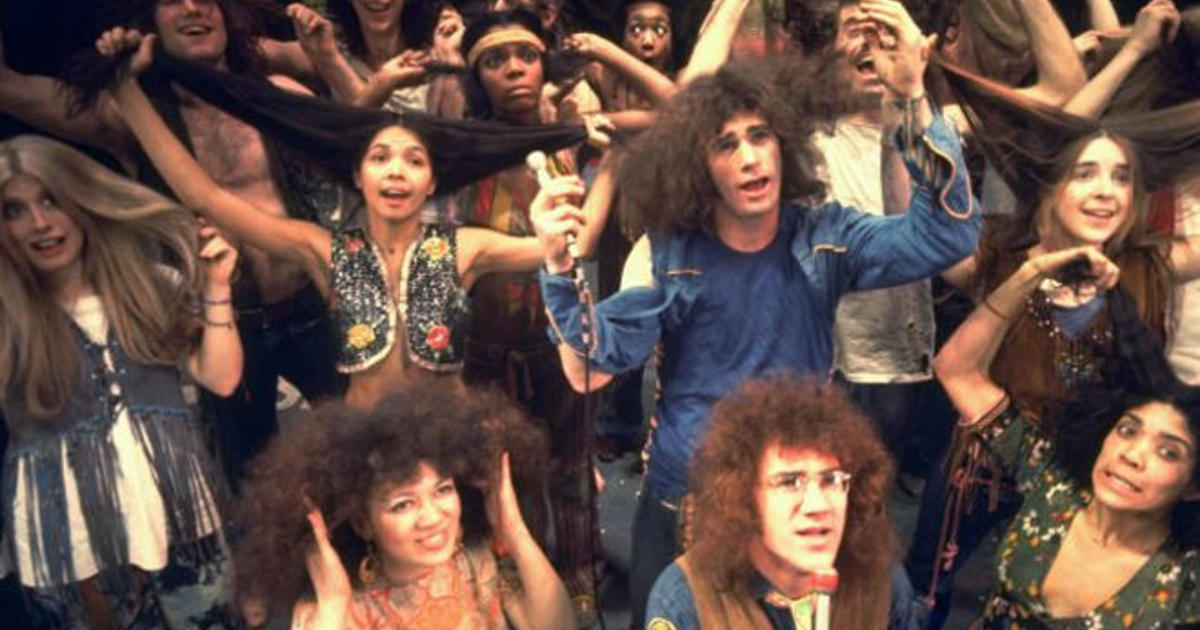
A scene from the original production
October 17, 1967: Hair: The American Tribal Love-Rock Musical premieres. It was not the 1st Broadway musical to incorporate rock and roll music -- Bye Bye Birdie had preceded it by 7 years -- but it was the 1st to be written by members of the 1st generation of rock and roll fans, and treated the musical style, and its fans, and the culture of youth and the difficulties it was having at the time, not as a curious phenomenon at best and a silly joke at worst, but as something to be taken seriously, even embraced.
In 1964, actors James Rado, a 32-year-old Polish Los Angeleno born James Radomski, and Gerome Ragni, a 29-year-old Italian Pittsburgher, met while appearing in an Off-Broadway play titled Hang Down Your Head and Die. It was a flop, but it launched their collaboration.
They began writing what became Hair almost immediately, with Rado writing his own pensive, romantic character into that of Claude Hooper Bukowski, and Ragni his extroversion into that of George Berger. Rado said the show's inspiration was "a combination of some characters we met in the streets, people we knew and our own imaginations. We knew this group of kids in the East Village who were dropping out and dodging the draft, and there were also lots of articles in the press about how kids were being kicked out of school for growing their hair long."
This matched a story that baseball pitcher Jim Bouton told in his book Ball Four. In 1967, despite struggling with injury at the time, he was invited to his former high school's sports awards banquet. He took questions. A kid stood up, and asked Jim what he thought about boys having long hair. Jim said the problem wasn't that an entire generation of teenage boys decided to let their hair get longer, it was that schools were ready to expel otherwise well-behaved kids over it. The kids gave him a standing ovation. The parents, he said, resolved never to invite Jim Bouton again.
Rado continued: "There was so much excitement in the streets and the parks and the Hippie areas, and we thought if we could transmit this excitement to the stage it would be wonderful... We hung out with them and went to their Be-In, let our hair grow."
Many cast members, including Shelley Plimpton, were recruited right off the street. Rado said, "It was very important historically, and if we hadn't written it, there'd not be any examples. You could read about it and see film clips, but you'd never experience it. We thought, 'This is happening in the streets,', and we wanted to bring it to the stage."
In 1966, while the two were developing Hair, Ragni performed in The Open Theater's production of Megan Terry's play Viet Rock, a story about young men being deployed to the Vietnam War. In addition to the war theme, Viet Rock employed the improvisational exercises being used in the experimental theatre scene and later used in the development of Hair, which probably couldn't have been fully adapted without it.
Rado and Ragni brought their drafts of the show to producer Eric Blau, who, through common friend Nat Shapiro, connected the two with Canadian composer Galt MacDermot. (He thus surpassed the entirely fictional and evil John Galt of Ayn Rand's novel Atlas Shrugged as the most important Galt in the history of popular culture.) MacDermot had won a Grammy Award in 1961, for his composition "African Waltz," recorded by jazz saxophonist Julian "Cannonball" Adderley.
MacDermot seemed not to be the ideal target audience: "I had short hair, a wife, and, at that point, four children, and I lived on Staten Island... I never even heard of a Hippie when I met Rado and Ragni." He may not have known of the lifestyle, but, surely, he had heard the word: In 1963, the Philadelphia-based vocal group The Orlons had a hit song titled "South Street," which asked the question, "Where do all the hippies meet?" By "hippies," they meant jazz musicians. And, indeed, the South Street neighborhood turned out to be Philly's version of New York's Greenwich Village, just as Cambridge became that for Boston, Old Town for Chicago, Haight-Ashbury for San Francisco, and West Hollywood for Los Angeles.
But he shared their enthusiasm to do a rock and roll show. "We work independently," MacDermot told an interviewer in May 1968. "I prefer it that way. They hand me the material. I set it to music." MacDermot wrote the 1st score in 3 weeks. He first wrote "Aquarius" as an unconventional art piece, as befitting the apparent adoption of astrology by many Hippies, but later rewrote it into an uplifting anthem.
No Broadway producer would touch the play: They were all too set in their ways to try such an experiment. Enter Joseph Papp, boss of the New York Shakespeare Festival. He was used to adapting the works of William Shakespeare in unconventional ways, but had never produced a work by still-living authors. He thought Hair would be the perfect show to open the Public Theater, which he was converting the former Astor Library into, at 425 Lafayette Street in the East Village.
Papp hired Gerald Freedman as director, but decided that, now that Rado was 35, he was too old to play Claude. He did accept Ragni, now 32, as Berger.
The Public, and Hair, opened on October 17, 1967, with an intentionally-limited engagement of 6 weeks. The timing was right, at both ends: San Francisco's "Summer of Love," the Monterey Pop Festival, and the premiere of The Smothers Brothers Comedy Hour had already happened, and the establishment's backlash against the Hippies hadn't. So the general public were aware of the Hippies, but hadn't yet gotten tired of them. Ragni played Berger, Walker Daniels played Claude, Jill O'Hara played Sheila Franklin, Steve Dean played Neil "Woof" Donovan, Arnold Wilkerson played Lafayette "Hud" Johnson, Sally Eaton played Jeanie Ryan, and Shelley Plimpton played Crissy.
Act I of the play actually predicted Seinfeld: It's "a show about nothing"; "nothing happens"; "just talking." And singing. The characters discuss fashion, including hair. They discuss the 1960s trinity of sex, drugs, and rock and roll. They discuss politics, including President Lyndon B. Johnson, his potential 1968 rivals Richard Nixon and George Wallace (but not Robert F. Kennedy or Eugene McCarthy), and the Vietnam War, which appears to have no end in sight. They discuss how Berger was expelled from school, and how Claude was disowned by his parents, and has been drafted.
The scene at the end of Act I where everybody takes their clothes off and walks off the stage naked was not in the original production.
Act II is where things get heavy, man. Claude is inducted into the U.S. Army. Woof says he is "hung up" on Rolling Stones lead singer Mick Jagger; while musical theater had long been a haven for gay men, this wasn't something that was openly admitted on the live stage. Three white women, dressed like Catholic schoolgirls, sing about how they like "black boys"; followed by three black women, dressed like The Supremes (glittering gold sleeveless gowns, long white gloves, bouffant hairdos), singing about how they like "white boys."
Berger gives Claude a hallucinogenic drug, and he has a "bad trip," with each small group he sees -- Buddhist monks, Catholic nuns, astronauts, Chinese people in "Mao suits," Native Americans and Green Berets -- being killed by the next group with their usual weapons: Hands (the nuns strangle the monks), ray guns, knives, tomahawks, and machine guns. The sequence ends when, with no one left to kill except each other, the Green Berets do just that.
The script has varied depending on the production, but, in the original version, Claude goes off to fight, and is killed, and the show ends with "the tribe" dancing around his dead body, singing "The Flesh Failures/Let the Sun Shine In."
Chicago businessman Michael Butler saw the show, and abandoned his plan to run for the U.S. Senate on an antiwar platform to finance the show on Broadway. It moved to The Cheetah, a discothèque at 53rd and Broadway, running 45 performances in December 1967 and January 1968. Again, no nude scene. Again, the controversy over the show was relatively minor, inspiring more curiosity than rage.
Finally, on April 29, 1968, between the assassinations of Dr. Martin Luther King and Robert F. Kennedy, and after the premiere of Rowan & Martin's Laugh-In, Hair premiered at the Biltmore Theatre, at 261 West 47th Street. (As with the Public Theatre, it is still in operation, although it is now named the Samuel J. Friedman Theatre.)
Ragni again played Berger, Sally Eaton again played Jeanie, and Shelley Plimpton again played Crissy. This time, though, Rado got to play Claude, Lynn Kellogg played Sheila, Steve Curry played Woof, and Lamont Washington played Hud. This 1st Broadway production also included Ronnie Dyson, beginning the show by singing "Aquarius," later hit songwriter Paul Jabara, and actresses Melba Moore and Diane Keaton.
Some of the songs became hits, all in 1969, the biggest being The Fifth Dimension's medley of "Aquarius/Let the Sun Shine In," a Number 1 hit. The Cowsills hit Number 2 with "Hair," including the riff on "The Star-Spangled Banner": "Oh, say, can you see... my eyes? If you can, then, my hair's too short!" The singer Oliver hit Number 2 with "Good Morning Starshine," and Three Dog Night had a Top 10 hit with "Easy to Be Hard." (In 1970, Dyson had a Top 10 hit with "(If You Let Me Make Love To You Then) Why Can't I Touch You?" which came from a different musical, Salvation.)
The original production ran until July 1, 1972. Among the performers who would appear in it were Ben Vereen, Heather MacRae (daughter of Broadway legends Gordon and Sheila MacRae), Keith Carradine, La La Brooks of the vocal group The Crystals, "Eve of Destruction" singer Barry McGuire, Lovin' Spoonful drummer Joe Butler, Blues Magoos lead singer Peppy Castro, singer Beverly Bremers, future disco diva Vickie Sue Robinson, future Love Boat actor Ted Lange... and, having previously appeared in the Los Angeles production of the show, Marvin Aday, a.k.a. Meat Loaf.
In 1979, a film version was made, directed by Miloš Forman, with choreography by Twyla Tharp. John Savage played Claude, Treat Williams played Berger, Beverly D'Angelo played Sheila, Annie Golden played Jeannie, Dorsey Wright played Hud, and Don Dacus played Woof.
Ronnie Dyson and Melba Moore were also in it, as were film legend Nicholas Ray; Broadway star Nell Carter, soon to star on the sitcom Gimme a Break!; Charlotte Rae, then on Diff'rent Strokes and soon to star on its spinoff, The Facts of Life; Michael Jeter, later part of the case of Evening Shade; and Ellen Foley, who had sung the girlfriend part on Meat Loaf's hit "Paradise By the Dashboard Light," and would later be part of the cast of Night Court.
But there was no Crissy in this version. Some of the songs from the play were omitted. And the ending is incredibly different: In order to allow a soon-to-be deployed Claude to see Sheila one more time, Berger makes what he considers to be the ultimate sacrifice: He cuts his own hair, puts on Claude's Army uniform, goes to the base, and reports for duty under Claude's name. But before he can make the reverse switcheroo, the orders are given, and Berger is put on the plane, and he ends up dying in Claude's place -- which is what is usually meant by the words "make the ultimate sacrifice."
One of the last scenes shows Claude and the "tribe" standing over a tombstone in a military cemetery. The stone is revealed to have Berger's name on it. Somehow, it was figured out that it was Berger, not Claude, who had died.
Making Berger 22 years old.
The film doesn't explain what happened to Claude: Clearly, he didn't run away to Canada, but he also appears not to have been prosecuted for draft evasion. Is he under indictment, free while awaiting trial? There has never been a sequel, either to the play's continuity or the film's, so we can only speculate.
But times had changed. By 1979, America had seen the war end, with an unsatisfying conclusion. It had seen President Johnson refuse a run for a 2nd full term, in order to concentrate on getting a peace agreement, and fail at that. It had seen Nixon elected on a promise to end the war, run for re-election not having done so, win 49 out of 50 States anyway, be inaugurated for a 2nd term, and only end the war 3 days after that, and, finally resign the office over a scandal that could be traced directly to his paranoia over the war.
America had seen the rise and the fall of the Hippies, and had tired of the psychedelic musical and fashion styles of the 1960s, and had turned to disco. It had seen the War On Poverty, and had come to believe Ronald Reagan's lie that poverty had definitively "won." It had seen inflation, twice now, take over as a more hit-us-at-home issue than the Vietnam War. It had seen the rise of self-expression of women, blacks, Hispanics and gays, and had tired of it all.
If Hair had been released as a film in 1968, '69, '70, maybe even in '71 or early '72, it might have been a hit. But the age of liberalism, of civil rights, of cultural progress, of the Hippies, was over. Even many of the Hippies gave up, cut their hair, put on suits, and got "real jobs," becoming "Young Urban Professionals," or "Yuppies." The age of Reagan, and the Decade of Greed, were about to begin, and nobody wanted to be reminded of the Sixties and its Hippies.
By the early 1990s, of course, America began to see that the Hippies were right. Many former Hippies, and other activists, were now running for office. Antiwar activist Bill Clinton was elected President. Civil rights leader John Lewis and former Black Panther Bobby Rush were elected to Congress. Tom Hayden of the Chicago Seven was elected to both houses of the California State legislature. And Bernie Sanders was elected to both houses of Congress as an independent, and ran in the Democratic Party's Primaries for President in 2016 and 2020, finishing 2nd in popular votes and Delegates both times.
In 1993, on Opening Day, the San Francisco Giants invited The Grateful Dead to sing "The Star-Spangled Banner." This merging of Establishment and Hippiedom got one of the biggest cheers in the history of Candlestick Park, as big as Willie Mays, Joe Montana or The Beatles ever got there. (The Beatles gave what turned out to be their last paying concert there on August 29, 1966, and the reaction was mostly screaming rather than cheering.)
Yes, times had changed again, had somewhat changed back, and mainstream America had accepted what rock singer David Crosby said of his fellow Hippies, something he knew from painful personal experience: "We were right about a lot of things. We were right that peace is better than war. We were right that love is better than hate. We were not right, as it turned out, about drugs."
History repeated itself in 2015, as the Public Theater became the 1st major New York theater to host a show with hip-hop music, a show which, instead of being current like Hair, turned American history on its head, and soon became a massive on-Broadway hit: Lin-Manuel Miranda's Hamilton.
Lamont Washington was trapped in a fire in his apartment on August 10, 1968, and died 15 days later. Ronnie Dyson died in 1990, Gerome Ragni and Joe Papp in 1991, Steve Curry in 2014, Galt McDermot in 2018, Gerald Freedman and Lynn Kellogg in 2020, and James Rado and Paul Jabara in 2022. As of October 17, 2022, Walker Daniels, Jill O'Hara, Steve Dean, Arnold Wilkerson, Sally Eaton, Shelley Plimpton (mother of actress Martha Plimpton), Melba Moore and Diane Keaton are still alive.
UPDATE: In 2023, Treat Williams, star of the film version, was hit by a car while riding his motorcycle near his home in Vermont, and died. Diane Keaton died in 2025.
*
October 17, 1967 was a Tuesday. On the same day, Don Holleder, a former Army quarterback, was killed in action in Vietnam. I have a separate entry for that event.
Baseball season had ended 5 days earlier, when the St. Louis Cardinals beat the Boston Red Sox in Game 7 of the World Series. Football was in midweek. The NHL season was underway, but no games were scheduled for this day. But there were 4 games played in the NBA:
* The New York Knicks beat the San Francisco Warriors, 124-122 at the old Madison Square Garden. The Knicks, and the NHL's Rangers, moved into the new Garden the following February.
* The Detroit Pistons beat the Cincinnati Royals, 131-108 at Cobo Hall (now Huntington Place) in Detroit. Dave Bing scored 35 points for the Pistons.
* The Los Angeles Lakers beat the Chicago Bulls, 107-105 at the Chicago Stadium, despite 36 points from the Bulls' Bob Boozer.
* And the St. Louis Hawks beat the expansion San Diego Rockets, 123-105 at the San Diego Sports Arena (now the Pechanga Arena). This was the last season in St. Louis for the Hawks: They moved to Atlanta the next season. The Rockets moved to Houston in 1971.
And there was 1 game in the American Basketball Association: The Houston Mavericks beat the Denver Rockets, 102-85 at the Denver Auditorium Arena. You read that right: Houston beat the Rockets, and the Houston team was called the Mavericks.
The Houston Mavericks failed. Anticipating being one of the ABA teams invited into the NBA (which they were, in 1976, along with the New York Nets, the Indiana Pacers, and the San Antonio Spurs), and knowing they couldn't have the same name as the Houston franchise of the NBA, the Denver Rockets switched to the name of the city's original NBA team, the Denver Nuggets. And the NBA would later have a team named the Dallas Mavericks, which became the arch-rivals of the Houston Rockets.


