Showing posts with label philadelphia 76ers. Show all posts

Sunday, November 13, 2022

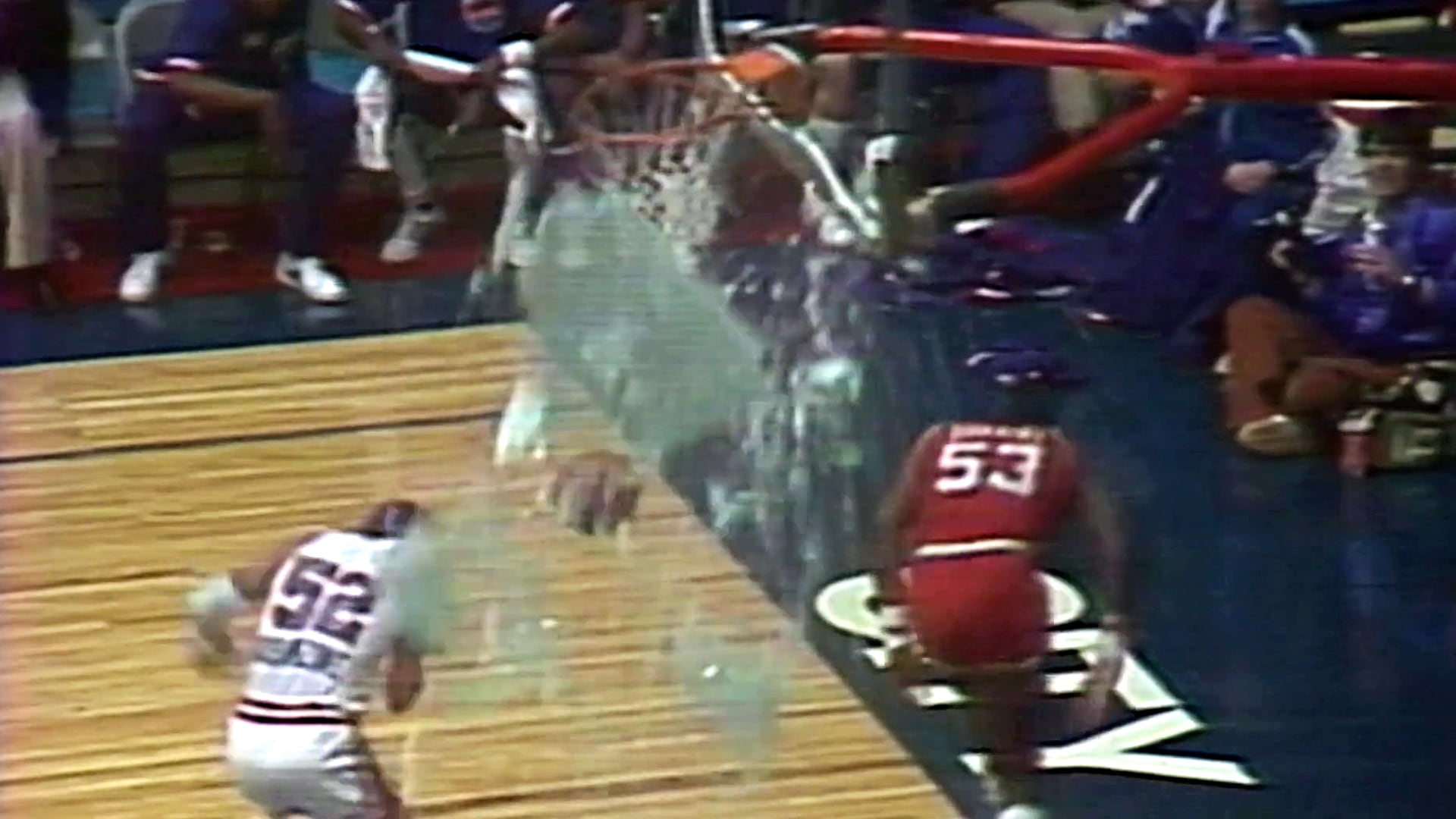
November 13, 1979: Darryl Dawkins Breaks a Backboard

November 13, 1979: The Kansas City Kings beat the Philadelphia 76ers, 110-103 at the Kansas City Municipal Auditorium. (Their usual home, the Kemper Arena, now known as the Hy-Vee Arena, was under repairs, due to the roof collapsing in June.) Phil Ford of the Kings led all players with 34 points.

But the Sixers produce a highlight: Darryl Dawkins, the man claiming to be from the planet Lovetron, scores a dunk so hard it breaks the glass backboard.

No one is injured by the falling glass. Fortunately, the Kings player guarding him ducked, so the glass only fell on his back. His name was Bill Robinzine, and Dawkins, nicknamed Chocolate Thunder by singer Stevie Wonder, named the dunk, "The Chocolate-Thunder-Flying, Robinzine-Crying, Teeth-Shaking, Glass-Breaking, Rump-Roasting, Bun-Toasting, Wham-Bam, Glass-Breaker-I-Am-Jam." He also invented the dunking term, "In-Your-Face Disgrace." And, while Dawkins didn't come up with this one himself, thereafter, any player looking bad during an opposing player's highlight, something worthy of being put on a poster, was said to have gotten "posterized."

Dawkins was not the 1st man to break a backboard in the NBA. During pregame warmups for one of the first games ever played by the Boston Celtics in 1946, Chuck Connors -- who also played baseball and became much more famous as an actor -- accidentally broke a wooden backboard with a warmup shot, forcing a delay in the tipoff, as a backboard was brought in from another arena in town.

Gus Johnson of the Baltimore Bullets, one of the NBA's earliest dunk artists, supposedly broke 3 in the late 1960s and early 1970s, which would make him the 1st to do it with a dunk in a game, but no film footage is known to survive.

A native of Orlando, Florida, Dawkins was the 1st player to go directly from high school to the NBA, the ABA having beaten them to it with Moses Malone. He broke a 2nd backboard just a few weeks later, on December 5, 1979, this time pulling the rim down, too.

He helped the 76ers reach the NBA Finals in 1977, 1980 and 1982, but he was traded to the New Jersey Nets, and they brought Malone in, and he led the Sixers to a title in 1983 without Dawkins.
Dawkins, like baseball great Satchel Paige naming his vast array of pitches, started naming his dunks, including the Rim Wrecker, the Spine-Chiller Supreme, and, creating an expression that became a description for big dunks in general, the In-Your-Face Disgrace.

He also gained nicknames for himself. Added to "Chocolate Thunder" were "Sir Slam" and "Doctor Dunkenstein." That last one, however, would become better remembered for Utah Jazz star Darrell Griffith.

Like the aforementioned Paige, his baseball contemporary Dizzy Dean, and Dawkins' own contemporary, football quarterback Terry Bradshaw, Dawkins figured out that if you've got a certain image, use it to your advantage before others can use it to theirs. Possibly inspired by the man known as Doctor Funkenstein, rock bandleader George Clinton and his "P-Funk Empire," with his "Mothership Connection" stage set, Dawkins began telling people he was from the planet Lovetron, where he had a girlfriend named Juicy Lucy, and practiced "interplanetary funkmanship."

(As far as I know, he never explained what "interplanetary funkmanship" meant. I would have liked to have found out. Clinton and James Brown were probably mad that they didn't think of it first.)

He played 14 seasons in the NBA, mostly for the Sixers and the New Jersey Nets, and won a title in his last season, as a backup with the 1989 Detroit Pistons. He played a season with the Harlem Globetrotters, played a few seasons in Europe, and retired in 2000, going into coaching.

By that point, dunking became not the province of enormous centers -- despite the backboard-wrecking actions of Shaquille O'Neal -- but quick guards like Michael Jordan and Vince Carter, and forwards like Dominique "the Human Highlight Reel" Wilkins.

But the legend of Darryl Dawkins never faded away, not even after he died of a heart attack in 2015, only 58 years old. Bill Robinzine wasn't even that lucky: In 1982, only 29 years old, still an active player, he took his own life.

*

November 13, 1979 was a Tuesday. There were 7 other games in the NBA that night:

* The New York Knicks lost to the Washington Bullets, 111-107 at Madison Square Garden.

* The New Jersey Nets beat the Atlanta Hawks, 101-82 at the Rutgers Athletic Center (now the Jersey Mike's Arena) in Piscataway. Calvin Natt scored 33 points for the Nets.

* The Houston Rockets beat the Chicago Bulls, 128-127 at the Chicago Stadium. The aforementioned Moses Malone scored 45 for the Rockets.

* The San Antonio Spurs beat the Golden State Warriors, 131-127 in overtime at the HemisFair Arena in San Antonio. George Gervin led all scorers on the night with 47.

* The Denver Nuggets beat the Cleveland Cavaliers, 116-110 at the McNichols Arena in Denver.

* The Los Angeles Lakers beat the San Diego Clippers, 137-91 at the San Diego Sports Arena (now the Pechanga Arena).

* And the Milwaukee Bucks beat the Portland Trail Blazers, 101-92 at the Portland Memorial Coliseum. Marques Johnson scored 34.

Baseball was out of season. Football was in midweek. There were 5 games in the NHL:

* The New York Islanders beat their arch-rivals, the New York Rangers, 10-5 at the Nassau Coliseum. Denis Potvin, Bryan Trottier and Billy Harris each had 2 goals. The Rangers had reached the Stanley Cup Finals the season before, beating the Isles in the Semifinals, but, this season, the Isles went on to win the whole thing, start a dynasty, and take over New York Tri-State Area hockey -- for a few years, anyway.

* The Edmonton Oilers beat the Washington Capitals, 5-3 at the Capital Centre in the Washington suburb of Landover, Maryland.

* The Vancouver Canucks beat the Atlanta Flames, 5-3 at The Omni in Atlanta.

* The Montreal Canadiens beat the St. Louis Blues, 5-2 at the St. Louis Arena, then known as the Checkerdome.

* And the Los Angeles Kings beat the Colorado Rockies, 4-1 at The Forum outside Los Angeles in Inglewood, California.

Wednesday, November 9, 2022

November 9, 1965: The Night the Lights Went Out

November 9, 1965: It was "The Night the Lights Went Out." At 5:27 PM, just as the Tuesday night rush hour was getting rough, a blackout hit the Northeastern United States, hitting New York City especially hard. Over 30 million people were without power.

Given the time of year, it was already dark out. Traffic lights went out. People got stuck in elevators. People got stuck in the City's Subway system.

The Consolidated Edison Company, a.k.a. Con Ed, managed to spare Staten Island and parts of Brooklyn from the blackout when they disconnected their Arthur Kill Generation Station, on Staten Island, from the grid. Some parts of New Jersey, powered by Public Service Electric & Gas, a.k.a. PSE&G, were not affected, allowing the City's newspapers to use the printing presses of the Newark Evening News to print their next day's editions, such as they were: Even The New York Times only printed 10 pages.

The New York Police Department later said that the City had the fewest reported crimes of any night since records began to be kept, breaking the record of February 9, 1964, the night The Beatles made their 1st appearance on The Ed Sullivan Show. This would end up in sharp contrast to the next major blackout, in 1977, when rioting developed, and it was the most arrests the NYPD ever made in 1 night.

Power was restored before the morning rush hour. Ever since, while there were also blackouts in New York in 1961, 1963, 1967, 1977 (as mentioned), and in 2003, people old enough to remember it mean November 9, 1965 when they asked, "Where were you when the lights went out?" (UPDATE: There was a brief blackout in 2023 as well.)

And there is no truth to the (pardon my choice of words) urban legend: There were no more babies born in New York in early August 1966, 9 months later, than there were in early August 1965 or in early August 1967.

*

As I said, November 9, 1965 was a Tuesday. The baseball season was over, as the Los Angeles Dodgers had won the World Series 26 days earlier, beating the Minnesota Twins in the World Series. Both the NFL and the AFL were in midweek.

It was early in the NBA and NHL seasons. However, because of the blackout, for only the 2nd time in their history, the New York Knicks had to postpone a game. The 1st was on November 22, 1963, the night of the day that President John F. Kennedy was assassinated.

The New York Rangers were not affected by the blackout, as they were not scheduled. None of the NHL's 6 teams were. But there were 3 games played in the NBA that night -- 2 of them, surprisingly, in the Northeast:

* The Boston Celtics beat the Baltimore Bullets, 130-116, at the Rhode Island Auditorium in Providence.

* The Philadelphia 76ers beat the Los Angeles Lakers, 118-110 at the Philadelphia Civic Center's Convention Hall. Wilt Chamberlain scored 39 points, and Hal Greer scored 32. In a losing effort, Jerry West scored 32.

* And the San Francisco Warriors beat the Detroit Pistons, 107-102 at the Cow Palace in the San Francisco suburb of Daly City, California. Nate Thurmond scored 18 points, and grabbed 42 rebounds.

Monday, October 31, 2022

October 31, 2009: The Spectrum Closes

October 31, 2009: The "grunge rock" band Pearl Jam sell out The Spectrum, in the South Philadelphia Sports Complex. It is the last event at the 42-year-old arena.

The Spectrum, a new sports arena, opened in South Philadelphia on September 30, 1967, with the Quaker City Jazz Festival. It was home to the NBA's Philadelphia 76ers and the NHL's Philadelphia Flyers until 1996; hosted the NBA All-Star Game in 1970 and 1976; the NHL All-Star Game in 1976 and 1992; the NCAA Final Four in 1976 and 1981; the Stanley Cup Finals in 1974, 1975, 1976, 1980, 1985 and 1987; the NBA Finals in 1977, 1980, 1982 and 1983; and concerts by Elvis Presley in 1971, 1974, 1976 and 1977.

Unlike most arenas, The Spectrum was not replaced due to it being technologically outdated, or in poor condition, or being in a bad neighborhood (it was an island in a sea of parking, therefore it was in no neighborhood). It was because Spectator, the company owned by the Snider family to operate the arena and the Flyers, was booking more events than it could handle.

So in 1992, JFK Stadium was torn down, and what was originally named Spectrum II was built on the site. The idea was that the new arena would host the headline events -- the 76ers, the Flyers, and the major concerts -- while the original Spectrum would host smaller events.

The 76ers' last game at The Spectrum was on April 19, 1996. They lost to the Orlando Magic, 112-92. The Flyers' last game there was in the Stanley Cup Playoffs, on May 12. They were eliminated from the Eastern Conference Semifinals by the Florida Panthers, 2-1. Mike Hough scored the winning, and last, goal at 8:05 of the 2nd overtime.

The Spectrum continued to hold public events until a series of Pearl Jam concerts from October 27 to 31, 2009. The building was torn down the following year. Xfinity Live! Philadelphia, a dining and entertainment complex, opened on the site in 2012.

*

October 31, 2009 was a Saturday. It was also Halloween. At the same time as the concert, Game 3 of the World Series was also held at the South Philadelphia Sports Complex. The New York Yankees beat the Philadelphia Phillies, 8-5 at Citizens Bank Park. Andy Pettitte outpitched Cole Hamels. Home runs were hit by Yankees Alex Rodriguez, Nick Swisher and Hideki Matsui; while Jayson Werth hit 2 for the Phillies, and Carlos Ruiz added one.

It figured that A-Rod's 1st World Series home run would be controversial. But it was only a slight controversy: At first, his drive appeared to be a double off the wall. Even he thought so, and he stopped at 2nd base. But, for the 1st time, instant replay was used in a World Series game, and it showed that the ball deflected off a TV camera above the wall. According to the ground rules, that made it a home run.

The Yankees took a 2-games-to-1 lead in the Series, retaking home-field advantage after the Phillies won Game 1. The Yankees went on to win the Series in 6 games.

These notable college football games were played:

* Rivalry: Number 1 Florida beat Georgia, 41-17 at Jacksonville Municipal Stadium (now EverBank Stadium).

* Number 3 Texas beat Number 13 Oklahoma State, 41-14 at Boone Pickens Stadium in Stillwater, Oklahoma.

* Number 4 University of Southern California (USC) were upset by Number 10 Oregon, 47-20 at Autzen Stadium in Eugene, Oregon.

* Number 5 University of Cincinnati beat Syracuse, 28-7 at the Carrier Dome (now the JMA Wireless Dome) in Syracuse, New York.

* Number 6 Boise State beat San Jose State, 45-7 at Bronco Stadium in Boise, Idaho. As an undefeated team and Champions of the Western Athletic Conference, the Broncos got invited to the Fiesta Bowl.

* Number 7 Iowa beat Indiana, 42-24 at Kinnick Stadium in Iowa City, Iowa.

* Number 8 Texas Christian University (TCU) beat the University of Nevada at Las Vegas (UNLV), 41-0 at Amon G. Carter Stadium in Fort Worth, Texas. As an undefeated team and Champions of the Mountain West Conference, the Horned Frogs got invited to the Fiesta Bowl. They came in at Number 6, while Boise State were Number 8. Since neither the WAC nor the MWC, which grew out of the WAC, is a "Power Five" conference, this was a consolation prize: Whoever won was still going to be undefeated, but wouldn't get to be called National Champions. It was, essentially, college football's version of the NIT. Boise State won, 17-10. Despite remaining undefeated, they only rose to Number 4 in the polls.

* Rivalry: Number 9 Louisiana State University (LSU) beat Tulane, 42-0 at Tiger Stadium in Baton Rouge, Louisiana.

* Number 21 South Carolina were upset by Tennessee, 31-13 at Neyland Stadium in Knoxville, Tennessee.

* Number 24 Mississippi lost to  Auburn, 33-20 at Jordan-Hare Stadium in Auburn, Alabama.

* Number 25 Notre Dame beat Washington State, 40-14 at the Alamodome in San Antonio. I don't know why the game was played there, but it was part of "the Shamrock Series," where Notre Dame plays "home away from home games."

* Illinois beat Michigan, 38-13 at Memorial Stadium in Champaign, Illinois.

* Among the service academies, Army had the week off; Navy lost to Temple, 27-24 at Navy-Marine Corps Memorial Stadium in Annapolis, Maryland; and Air Force beat Colorado State, 34-16 at Hughes Stadium in Fort Collins, Colorado.

* And Rutgers beat Connecticut (a.k.a. UConn), 28-24 at Rentschler Field in East Hartford, Connecticut.

There were 7 games played in the NBA. Appropriately, 1 was a win by the 76ers, beating the New York Knicks, 141-127 at Madison Square Garden in New York. Othella Harrington scored 42 points for the Knicks, while Andre Iguodala led the Sixers with 32. The other games:

* The New Jersey Nets lost to the Washington Wizards, 123-104 at the Verizon Center (now the Capital One Arena) in Washington.

* The Cleveland Cavaliers beat the Charlotte Hornets, 90-79 at the Quicken Loans Arena (now the Rocket Arena) in Cleveland.

* The Milwaukee Bucks beat the Detroit Pistons, 96-85 at the Bradley Center in Milwaukee.

* The Houston Rockets beat the Portland Trail Blazers, 111-107 at the Toyota Center in Houston. Brandon Roy scored 42 for the Blazers, while Trevor Ariza led the Rockets with 43.

* The San Antonio Spurs beat the Sacramento Kings, 113-94 at the AT&T Center (now the Frost Bank Arena) in San Antonio.

* And the Dallas Mavericks beat the Los Angeles Clippers, 93-84 at the Staples Center (now the Crypto.com Arena) in Los Angeles.

There were 11 games played in the NHL:

* The New York Islanders beat the Buffalo Sabres, 5-0 at the Nassau Coliseum.

* The New Jersey Devils beat the Tampa Bay Lightning, 2-1 at the St. Pete Times Forum (now the Benchmark International Arena) in Tampa.

* In the opener of Hockey Night In Canada's Saturday night doubleheader, there was an Original Six matchup: The Montreal Canadiens beat the Toronto Maple Leafs, 5-4 in a shootout at the Bell Centre.

* The Boston Bruins beat the Edmonton Oilers, 2-0 at the TD Garden Boston.

* The Philadelphia Flyers beat the Carolina Hurricanes, 6-1 at the Wachovia Center (now the Xfinity Mobile Arena) in Philadelphia.

* The Atlanta Thrashers beat the Ottawa Senators, 3-1 at Scotiabank Place in Ottawa.

* The Minnesota Wild beat the Pittsburgh Penguins, 2-1 at the Mellon Arena (as the Civic Arena was then known) in Pittsburgh.

* The Nashville Predators beat the Dallas Stars, 4-2 at the Sommet Center (now the Bridgestone Arena) in Nashville.

* The Florida Panthers beat the St. Louis Blues, 4-0 at the Scottrade Center (now the Enterprise Center) in St. Louis.

* The Phoenix Coyotes beat the Anaheim Ducks, 3-2 in a shootout at the Jobing.com Arena (now the Desert Diamond Arena) in the Phoenix suburb of Glendale, Arizona.

* The Detroit Red Wings beat the Calgary Flames, 3-1 at the Saddledome in Calgary.

* And the New York Rangers, the Chicago Blackhawks, the Los Angeles Kings, the Vancouver Canucks, the Washington Capitals, the Colorado Avalanche, the San Jose Sharks and the Columbus Blue Jackets were not scheduled.

And in English soccer, a North London Derby was held at the Emirates Stadium. Arsenal beat Tottenham Hotspur, 3-1.

Thursday, October 20, 2022

October 20, 1976: The Sale of Doctor J

October 20, 1976: The Long Island-based New York Nets are in trouble. They had won the last Championship of the American Basketball Association, and 2 of the last 3. Along with the Denver Nuggets, the Indiana Pacers, and the San Antonio Spurs, they were invited to join the NBA for the 1976-77 season.
But, having to pay the NBA $3 million as an entry fee, and having to pay the New York Knicks a $4.8 million "territorial indemnification fee," the Nets owed $7.8 million -- about $40.1 million in today's money.
The Nets offered their biggest star, Julius Erving, whose "operation" on the basketball court earned him the nickname "Doctor J," to the Knicks in exchange for their waiving the territorial indemnification fee. This would have dropped the Nets' fees to $3 million.
The Knicks refused: They wanted the money more than the superstar. This was a tremendous mistake, as they had already fallen far from their 1970 and 1973 NBA Championships with the retirements of Willis Reed, Dave DeBusschere and Jerry Lucas, while Walt Frazier and Bill Bradley were clearly in decline, although Earl Monroe was still good. The Knicks went on to crash and burn.
But so did the Nets: On this day, with the regular season starting the next day, they sold Erving to the Philadelphia 76ers for $3 million, leaving them with only the territorial indemnification fee of $4.8 million. Despite having picked up future Hall-of-Famer Nate "Tiny" Archibald in the trade, the Nets instantly went from the ABA Championship to the worst record in the NBA. It would take until 1981-82 to recover, by which point the Knicks had also begun to do so.
The Sixers reached the NBA Finals in 1977, 1980 and 1982, and finally won the Championship in 1983. Then, they got old, and began a decline that has never truly been reversed. They've made the NBA Finals only once since, in 2001.
For the 1977-78 season, the Nets left Long Island, became the New Jersey Nets, and played at the brand-new Rutgers Athletic Center, on Rutgers University's Livingston Campus in Piscataway. (The 9,000-seat chunk of concrete is now named the Jersey Mike's Arena.)
In 1981, they moved to the Meadowlands Sports Complex in East Rutherford, just 7 miles from Midtown Manhattan, when the building alternately known as the Meadowlands Arena, the Brendan Byrne Arena, the Continental Airlines Arena and the Izod Center opened. They played at the Prudential Center in Newark for the 2010-11 and 2011-12 seasons, and then moved back to New York, to the Barclays Center, becoming the Brooklyn Nets.
The Nets didn't win an NBA Playoff series until 1984 -- beating the 76ers, then the defending NBA Champions. They didn't win another until acquiring Jason Kidd in 2001, reaching the next 2 NBA Finals and winning 4 Division titles.
Their move to Brooklyn was ambitious, and they've made several acquisitions designed to win a title and take the New York market away from the Knicks. But they never have. They are a joke franchise, and, with the exception of the Kidd years, 2001 to 2008, they have been ever since they came into the NBA.
Is there a curse on the Nets? Doctor J, who became a studio analyst for NBA broadcasts, seems like too nice of a guy to have done that, especially since the trade was good for his career. Maybe the fault lies the owners. The Curse of Roy Boe? The Curse of the Secaucus Seven?
*
October 20, 1976 was a Wednesday. Game 4 of the World Series was supposed to be played at Yankee Stadium, but it was postponed by rain. Not that it did the New York Yankees much good, as the Cincinnati Reds completed the sweep on the 21st, anyway.
Football was in midweek. As I said, the NBA's 1976-77 regular season started the next day. There were no games played in the World Hockey Association, but there were 5 in the NHL:
* The New York Rangers lost to the Los Angeles Kings, 4-2 at Madison Square Garden.
* The Toronto Maple Leafs and the Buffalo Sabres played to a tie, 4-4 at Maple Leaf Gardens in Toronto.
* The Buffalo Sabres beat the Vancouver Canucks, 4-0 at the Buffalo Memorial Auditorium.
* The Minnesota North Stars beat the Atlanta Flames, 4-3 at the Metropolitan Sports Center in the Minneapolis suburb of Bloomington, Minnesota.
* And the Boston Bruins beat the Colorado Rockies, 2-1 at the McNichols Arena in Denver.

Wednesday, October 19, 2022

October 19, 1963: The Philadelphia 76ers Debut

October 19, 1963: After 14 seasons as the Syracuse Nationals, the NBA's Philadelphia 76ers make their home debut, taking the place of the Philadelphia Warriors, who moved to San Francisco the year before. It doesn't go so well: Despite 31 points from Lee Shaffer and 24 from Chet "the Jet" Walker, they lose to the Detroit Pistons, 124-121 at the Convention Hall of the Philadelphia Civic Center.

After bringing Wilt Chamberlain back from the Warriors in 1965, the 76ers built one of the greatest teams every in 1967, winning the NBA Championship. By 1973, they had collapsed, and finished with the worst record in NBA history, 9-73.

They rebuilt, and reached the NBA Finals in 1977, 1980 and 1982, before winning another title in 1983. But 2 disastrous trades in 1986 doomed them, and they've only reached the NBA Finals once since, in 2001. The last few years, they have asked their fans to "trust the process." Well, they're waiting.

They played at the Convention Hall of the Philadelphia Civic Center through the 1967 title, then moved to The Spectrum in South Philadelphia. In 1996, they moved next-door to the arena currently named the Wells Fargo Center.
The Philadelphia Civic Center's Convention Hall

From their beginnings, the have retired the Number 4 of forward Dolph Schayes, who had starred for them in Syracuse. From their 1967 title team, coached by Alex Hannum with Dr. Jack Ramsay as their general manager, they have retired the 13 of center Wilt Chamberlain, the 15 of guard Hal Greer, and the 32 of forward Billy Cunningham.

From the 1983 title team, coached by Cunningham, with Pat Williams as general manager, they have retired the 2 of center Moses Malone, the 6 of Julius "Dr. J" Erving, the 10 of guard Maurice Cheeks, and the 24 of forward Bobby Jones. From the late 1980s and early 1990s, they have retired the 34 of forward Charles Barkley. From the 2001 Finalists, they have retired the 3 of guard Allen Iverson.

And, in place of a retired number, they have hung a banner with a picture of a microphone, in memory of Dave Zinkoff, the public address announcer for the Warriors from their founding 1946 until their move in 1962, and for the 76ers from their 1963 arrival until his death in 1985.

*

October 19, 1963 was a Saturday. This was also the day that the song "You'll Never Walk Alone" was first played at Anfield, home stadium of Liverpool Football Club, who beat Birmingham-area team West Bromwich Albion, 1-0. I have a separate entry for that event. Also, Arsenal lost to Aston Villa, 2-1 at Villa Park in Birmingham.

There were 3 other games in the NBA that day:

* The New York Knicks lost to the Cincinnati Royals, 121-97 at the Cincinnati Gardens.

* The aforementioned San Francisco Warriors beat the Baltimore Bullets, 103-102 at the Baltimore Civic Center (now named the CFG Bank Arena) Wilt Chamberlain scored only 23 points. Walt Bellamy scored 36 in defeat.

* And the St. Louis Hawks beat the Los Angeles Lakers, 117-108 at the Kiel Auditorium in St. Louis. Jerry West scored 30 for the Lakers, Bob Pettit 32 for the Hawks.

There were 2 games played in the NHL. The Montreal Canadiens beat the Boston Bruins, 2-0 at the Montreal Forum. And the Toronto Maple Leafs beat the Detroit Red Wings, 2-1 at Maple Leaf Gardens in Toronto. The New York Rangers and the Chicago Black Hawks were not scheduled.

And these major college football games were played:

* Number 1 Texas beat Arkansas, 17-13 at Razorback Stadium in Fayetteville, Arkansas. Texas went on to win the Southwest Conference, and won the National Championship by beating Navy in the Cotton Bowl.

* Number 2 Wisconsin beat Iowa, 10-7 at Iowa Stadium (later renamed Kinnick Stadium) in Iowa City. But Wisconsin would lose to Ohio State the next week, knocking them out of the Big 10 and national title pictures.

* Number 3 Pittsburgh beat their arch-rivals, West Virginia, 13-10 at the old Mountaineer Field in Morgantown, West Virginia, in the "Backyard Brawl." Pitt lost their next game, away to Navy, and blew their shot at the National Championship. And, then an independent, it had no conference championship to win. They finished the season 9-1 and ranked Number 4, but didn't even go to a bowl game.

* Number 4 Ohio State were upset by USC, and it was a regular-season game, not the Rose Bowl. It wasn't even close: 32-3 at the Los Angeles Memorial Coliseum. This ruined Ohio State's chances of winning the Big 10 and National Championships. As I said, they took their frustrations out on Wisconsin the next week.

* Number 5 Mississippi beat Tulane, 21-0 at Tulane Stadium in New Orleans. "Ole Miss" went on to win the Southeastern Conference, but lost to Alabama in the Sugar Bowl.

* Number 6 Oklahoma beat Kansas, 21-6 at Oklahoma Memorial Stadium in Norman. A later loss to Nebraska cost them the Big 8 title.

* Number 7 Illinois beat Minnesota, 16-6 at Memorial Stadium in Champaign, Illinois. Illinois won the Big 10, and beat Washington in the Rose Bowl.

* Number 8 Georgia Tech were upset by Auburn, 29-21 at Grant Field in Atlanta.

* Number 9 Alabama beat Tennessee, 35-0 at Legion Field in Birmingham. 

* Number 10 Navy beat Virginia Military Institute, 21-12 at Navy-Marine Corps Memorial Stadium in Annapolis, Maryland. Navy would rise to Number 2, but lost the Cotton Bowl and the National Championship to Texas.

* North Carolina, currently unranked, beat North Carolina State, 31-10 at Kenan Stadium in Chapel Hill, North Carolina. UNC won the Atlantic Coast Conference title, and beat the Air Force Academy in the Gator Bowl.

* Nebraska, currently unranked, beat Kansas State, 28-6 at Memorial Stadium in Manhattan, Kansas. Nebraska would go on to win the Big 8, and beat Auburn in the Orange Bowl.

* Washington, currently unranked, beat Stanford, 19-11 at Husky Stadium in Seattle. Washington went on to win the title in the AAWU (forerunner of the Pac-12), but lost the Rose Bowl to Illinois.

* Army beat Wake Forest, 47-0 at Michie Stadium in West Point, New York.

* Notre Dame beat UCLA, 27-12 at Notre Dame Stadium in South Bend, Indiana.

* Dartmouth beat Holy Cross, 13-8 at Memorial Field in Hanover, New Hampshire. Dartmouth went on to win the Ivy League title.

* And in New Jersey, Rutgers beat Lehigh, 30-6 at Rutgers Stadium in Piscataway. And Princeton beat Colgate, 42-0 at Palmer Stadium in Princeton.

Friday, September 30, 2022

September 30, 1967: The Spectrum Opens

September 30, 1967: The Spectrum, a new sports arena, opens in South Philadelphia, just to the north of John F. Kennedy Stadium. The new baseball and football facility, Veterans Stadium, had recently begun construction, just to the north. The first event at the arena was the Quaker City Jazz Festival.

Lou Scheinfeld, former President of the Spectrum, explained that the name "Spectrum" was selected to evoke the broad range of events to be held there:

* SP: "SPorts" and "South Philadelphia"
* E: "Entertainment"
* C: "Circuses"
* T: "Theatricals"
* R: "Recreation"
* UM: "Um, what a nice building!"

That last one was a bit of a stretch. Scheinfeld also said that a seat in the city's first superbox initially cost $1,000 a year: "For every Flyers game, Sixers game, circus, you name it, you got 250 events for $1,000."

The first sporting event at the arena was a fight card on October 17, headlined by hometown hero Joe Frazier defeating Tony Doyle. The next day, the defending NBA Champion 76ers, previously playing at the Convention Hall of the Philadelphia Civic Center, made their Spectrum debut, beating the Los Angeles Lakers, 103-87. Elgin Baylor of the Lakers led all scorers with 24 points. Wilt Chamberlain scored only 11, but had 30 rebounds. The day after that, the Flyers made their home debut, beating their fellow Pennsylvania expansion team, the Pittsburgh Penguins, 1-0. Bill Sutherland scored the 1st goal.

On March 1, 1968, wind blew part of the covering off The Spectrum's roof during a performance of the Ice Capades, forcing the building to close for a month while Mayor James Tate fought with Philadelphia County District Attorney Arlen Specter (later a U.S. Senator) over responsibility for the construction of the roof, and the damage was repaired.

The 76ers moved their home games to Convention Hall and to the Palestra, but neither of those arenas had ice rinks at the time, and there were no other NHL-quality sites in the Philadelphia area. Thus the Flyers hurriedly moved their next home game, against the Oakland Seals, to Madison Square Garden in New York, followed by a meeting with the Boston Gardens at Maple Leaf Gardens in Toronto, before establishing a base at Le Colisée de Québec in Quebec City, home of their top farm team, the Quebec Aces. The roof was repaired in time for them to play their home Playoff games there.

In 1976, the nation's Bicentennial led to several events being held in Philadelphia, where the Declaration of Independence was written, debated and signed. Veterans Stadium hosted MLB's All-Star Game, while The Spectrum hosted the NBA and NHL All-Star Games, and the NCAA Final Four, won by Indiana University.

In fiction, each of the fights between Rocky Balboa and Apollo Creed were held at The Spectrum in 1976: The 1st, in the original Rocky, on New Year's Day, January 1; the 2nd, in Rocky II, on Thanksgiving Day, November 25.

The Spectrum also hosted the All-Star Game for the NBA in 1970, and for the NHL in 1992. A 2nd Final Four was held there in 1981, again won by Indiana. The Spectrum hosted the NBA Finals in 1977, 1980, 1982 and 1983, with the Sixers winning only the last of these; and the Stanley Cup Finals in 1974, 1975, 1976, 1980, 1985 and 1987, with the Flyers winning the 1st 2 of these.

The arena became home to statues of 76ers star Julius "Dr. J" Erving, a prominent goal scored by the Flyers' Gary Dornhoefer, the fictional Rocky Balboa (later moved to its site in the movies, the Philadelphia Museum of Art), and Kate Smith, the Flyers' "good luck charm" during their 1974 Stanley Cup run.

Elvis Presley sang there 4 times: November 8, 1971; June 23, 1974; June 28, 1976; and May 28, 1977. The Beatles did not perform there together, but all of them except John Lennon would give solo concerts there. The Grateful Dead played there more than any other act, 53 times. Other notable Spectrum concerts included Jimi Hendrix and Led Zeppelin in 1969, The Doors in 1970, The Who in 1973, Bob Marley in 1975 and 1978, Queen in 1980, Bruce Springsteen paying tribute to John Lennon the day after his murder in 1980, Guns N'Roses opening for Aerosmith in 1988, N.W.A. and Metallica in 1989 (not on the same bill), and Philadelphia-area natives Pink and Taylor Swift in 2009 (not on the same bill).

Unlike most arenas, The Spectrum was not replaced due to it being technologically outdated, or in poor condition, or being in a bad neighborhood (it was an island in a sea of parking, therefore it was in no neighborhood). It was because Spectator, the company owned by the Snider family to operate the arena and the Flyers, was booking more events than it could handle.

So in 1992, JFK Stadium was torn down, and what was originally named Spectrum II was built on the site. The idea was that the new arena would host the headline events -- the 76ers, the Flyers, and the major concerts -- while the original Spectrum would host smaller events.

The 76ers' last game at The Spectrum was on April 19, 1996. They lost to the Orlando Magic, 112-92. The Flyers' last game there was in the Stanley Cup Playoffs, on May 12. They were eliminated from the Eastern Conference Semifinals by the Florida Panthers, 2-1. Mike Hough scored the winning, and last, goal at 8:05 of the 2nd overtime.

The Spectrum continued to hold public events until a series of Pearl Jam concerts from October 27 to 31, 2009. The building was torn down the following year. Xfinity Live! Philadelphia, a dining and entertainment complex, opened on the site in 2012.

In 2005, the NBA's Charlotte Bobcats opened a new arena, named the Charlotte Bobcats Arena. Neither the team nor the arena kept their original names. In 2008, the arena became the Time Warner Cable Arena. In 2014, the Bobcats were permitted to take the name of the city's previous NBA team, the Charlotte Hornets. In 2016, following Time Warner's breakup, its cable-TV operations were bought out by Charter Communications, and the arena became the Spectrum Center. Charter Communications and their Spectrum division have no connection to Spectacor or the Snider family, which sold Spectacor in 2011.

*

September 30, 1967 was a Saturday. Actress Andrea Roth was born. And, in college football, Nate Northington of the University of Kentucky became the Southeastern Conference's 1st black football player. I have a separate entry for this event. Kentucky lost to the University of Mississippi, 26-13 at McLean Stadium in Lexington, Kentucky.

Among the other college football games played that day were these:

* Number 1 Notre Dame were upset by Number 10 Purdue, 28-21 at Ross-Ade Stadium in West Lafayette, Indiana.

* Number 2 Southern California (USC) beat Michigan State, 21-17 at Spartan Stadium in East Lansing, Michigan.

* The night before, Number 3 University of Houston beat Wake Forest, 50-6 at the Astrodome in Houston.

* Number 4 UCLA beat Washington State, 51-23 at the Los Angeles Memorial Coliseum.

* Number 5 Georgia beat Clemson, 24-17 at Memorial Stadium in Clemson, South Carolina.

* Number 7 Nebraska beat Minnesota, 7-0 at Memorial Stadium in Lincoln, Nebraska.

* Number 8 Texas lost to Texas Tech, 19-13 at Memorial Stadium in Austin, Texas.

* Number 9 Alabama beat Southern Mississippi, 25-3 at Ladd Stadium in Mobile, Alabama.

* Among the service academies, Army beat Boston College, 21-10 at Alumni Stadium, just outside Boston in Chestnut Hill, Massachusetts; Navy lost to Rice, 21-7 at Rice Stadium in Houston; and Air Force lost to the University of Washington, 30-7 at Falcon Stadium in Colorado Springs, Colorado.

* In New Jersey, Princeton beat Rutgers, 22-21 at Palmer Stadium in Princeton.

And in New Jersey high school football, East Brunswick, the school that would one day be my Alma Mater, beat Woodbridge, 14-0 at home, at the stadium that would one day be named Jay Doyle Field.

And these games were played in Major League Baseball:

* The Boston Red Sox beat the Minnesota Twins, 6-4 at Fenway Park in Boston. This was the next-to-last day of the regular season, and the Red Sox and Twins were battling the Detroit Tigers and the Chicago White Sox for the American League Pennant. Carl Yastrzemski of the Red Sox and Harmon Killebrew of the Twins each hit his 44th home run of the season. Neither of them homered the next day, so they finished in a tie for the AL home run lead.

With Yaz also leading the AL in batting average and runs batted in, that means that, despite only being tied for the home run lead, he was awarded the Triple Crown. There would not be another Triple Crown winner for 45 years.

At the time, the Red Sox' games were broadcast on WHDH-Channel 5. With the Sox involved in a Pennant race for the 1st time in a generation, the station went against protocol, which was to save money on videotape by taping over old games, and saved several games from that season. These clips were edited down into a highlight reel, except for the last 2 games, this one and the next day's. As a result, this Boston victory over Minnesota is, as far as is publicly known, the oldest surviving full color video broadcast of an MLB game.

* A doubleheader was split at Tiger Stadium in Detroit. The Detroit Tigers won the opener, 5-0. Mickey Lolich pitched a 3-hit shutout. The California Angels won the nightcap, 8-6. Over the 2 games, Al Kaline went 1-for-8 with a walk.

With this doubleheader, the AL standings now featured the Red Sox and the Twins tied for 1st place, with the Tigers only half a game back. The Red Sox and Twins played each other again the next day, with the winner assured of no worse than a Playoff for the Pennant the next day. The Tigers had another doubleheader, and if they swept it, they would have a Playoff with the Red Sox-Twins winner. As it turned out, the Red Sox beat the Twins, and the Tigers only split their doubleheader, so the Sox won the Pennant.

* The Washington Senators beat the Chicago White Sox, 4-0 at Comiskey Park in Chicago. The White Sox had been eliminated from the race when the Senators beat them the night before, so this game was meaningless -- except, perhaps, to Senators pitcher Frank Bertaina, who pitched a 5-hit shutout.

* The New York Yankees beat the Kansas City Athletics, 5-4 at Yankee Stadium. Mickey Mantle drove in the Yankees' 1st run with a groundout, and then left the game due to injury. Rookie Reggie Jackson did not play for the A's in this game. The next day, the Yankees won, 4-3. This was the last game for the A's representing Kansas City. The next season, they moved to Oakland.

* The New York Mets beat the Los Angeles Dodgers, 5-0 at Dodger Stadium in Los Angeles. Les Rohr pitched 8 shutout innings, and Ron Taylor completed a 7-hit shutout, to outpitch Don Drysdale. Ken Boswell hit a home run.

* The St. Louis Cardinals beat the Atlanta Braves, 3-1 at Atlanta Stadium (later Atlanta-Fulton County Stadium). In contrast to the AL, the Cardinals had the National League Pennant wrapped up several days earlier. Lou Brock went 3-for-4. Roger Maris went 1-for-4 with an RBI. Joe Torre went 1-for-3 with an RBI. Hank Aaron only appeared as a pinch-hitter, and struck out.

* The Houston Astros beat the Pittsburgh Pirates, 4-3 at Forbes Field in Pittsburgh. Roberto Clemente went 1-for-3 with a walk. Willie Stargell went 1-for-4 with an RBI.

* The Baltimore Orioles beat the Cleveland Indians, 5-2 at Cleveland Municipal Stadium. Frank Robinson went 0-for-4, and Brooks Robinson did not play.

* The Chicago Cubs beat the Cincinnati Reds, 9-4 at Crosley Field in Cincinnati. Ernie Banks went 4-for-5 with an RBI. Pete Rose went 1-for-5 with 2 RBIs. Rookie Johnny Bench did not play for the Reds in this game.

* And the San Francisco Giants swept a doubleheader with the Philadelphia Phillies, 3-2 and 1-0 at Candlestick Park in San Francisco. Willie McCovey hit a home run in the 1st game. Willie Mays went 0-for-4, and then did not play in the 2nd game. Three Giant pitchers -- Bill Henry (3 innings), Nestor Chavez (4, winning pitcher) and Lindy McDaniel (2, save) combined on a 4-hit shutout. 

Saturday, September 17, 2022

September 17, 1961: The Civic Arena Opens In Pittsburgh

September 17, 1961: The Civic Arena opens in Pittsburgh. The city had been without a major sports arena since the Duquesne Gardens was demolished in 1956.

Edgar J. Kaufmann, who ran Kaufmann's department stores, and commissioned Frank Lloyd Wright to build his house, Fallingwater, in 1938, came up with the idea for an auditorium with a retractable round roof -- for the Pittsburgh Civic Light Opera, hence the building's name. The CLO had previously been using the University of Pittsburgh's Pitt Stadium. But he died in 1955, and never saw construction begin.

That construction began in 1955, with the demolition, for the arena and its parking lots, of buildings that were home to 8,000 black people and 400 businesses, ruining what had been the lower Hill District, the cultural center of black life in Pittsburgh. This would be paralleled a few years later by the demolition of housing for Mexican-Americans on what became the site of Dodger Stadium in Los Angeles. In a touch of irony, this new arena for the Steel City was delayed in 1959 by a steelworkers' strike.

The 1st event was the Ice Capades. The 1st roof opening was on July 4, 1962, for a comedy show headlined by Carol Burnett, who said, "Ladies and gentlemen, I present the sky!"

Upon its opening, it seated 10,732 people. An addition in 1967 boosted it to 12,508, another in 1975 to 16,402, and it peaked in 1993 at 17,537.

The building immediately became home to the CLO, which used it until 1973, when it moved to Heinz Hall, then to the Benedum Center in 1988, and to The CLO Cabaret at Theater Square in 2004. The American Hockey League's Pittsburgh Hornets, dormant since the Duquesne Gardens was torn down in 1956, were restarted, and played at the Civic Arena until the NHL's Pittsburgh Penguins debuted in 1967. The American Basketball League's Pittsburgh Rens (short for "Renaissance") also began play shortly after the Arena opened, but folded with the ABL a year later.

Duquesne University played games there from 1964 to 1988. The University of Pittsburgh used it for some home games from 1984 to 2002. The NBA's Philadelphia 76ers used it for one or two "home games" per season until The Spectrum opened in 1967. The American Basketball Association's 1st title, for the 1967-68 season, was won there by the Pittsburgh Pipers, but they moved after just 1 season, moved back after another, changed their name to the Pittsburgh Condors in 1970, and folded in 1972. The Arena was also home to minor-league teams, like the Pittsburgh Spirit of the Major Indoor Soccer League and the Pittsburgh Gladiators of the Arena Football League.

Former President Dwight D. Eisenhower was the featured speaker at a Republican Party rally at the Arena on October 12, 1962. In the closing days of the 1964 election, both major-party candidates for President spoke there, first President Lyndon B. Johnson, the Democrat, on October 27, then the Republican nominee, Senator Barry Goldwater of Arizona, on October 29. Former Vice President Richard Nixon, running for President, had a rally there on October 28, 1968.

Cassius Clay, not yet Muhammad Ali and not yet the Heavyweight Champion of the World, beat Charlie Powell there on January 24, 1963. Larry Holmes defended the Heavyweight Championship there against Renaldo Snipes on November 6, 1981.

The 1st rock concert there was hosted by Craig "Porky" Chedwick, the WHOD disc jockey known as "The Daddio of the Raddio" and "The Pied Piper of Platter." Local group The Skyliners headlined a show that included Jackie Wilson, The Drifters, The Coasters, Jerry Butler, The Flamingos, The Angels, and The Blue-Belles, whose lead singer was Patti LaBelle.

Other concerts there included The Beatles on September 14, 1964; The Temptations on March 6, 1969; The Doors on May 2, 1970, recorded for a live album; The Rolling Stones on July 22, 1972, March 11, 1999, and January 10, 2003; Pink Floyd on June 19, 1973; Elvis Presley on June 25 and 26, 1973, and December 31, 1976; the 1st American concert by Rush on August 14, 1974; The Bee Gees on September 4 and 5, 1979; Michael Jackson with his brothers on August 13, 1981, and solo on September 26, 27 and 28, 1988; Destiny's Child on July 20, 2005; and Taylor Swift on October 1, 2009.

The Arena is best remembered as the home of the Penguins, who struggled at first. Even a switch of team colors in 1979-80, from blue and gold to the black and gold of the World Series-winning Pirates and the Super Bowl-winning Steelers, didn't help. In 1984, they drafted Mario Lemieux, who made them contenders, and led them to the Stanley Cup in 1991 and 1992.

The Arena was a filming location for the 1979 basketball film The Fish That Saved Pittsburgh; the 1995 film Sudden Death, about a terrorist attack during Game 7 of the Stanley Cup Finals; and the 2001 film Rock Star, in which Mark Wahlberg played a singer with a concert there in 1987.

The cost of operating the retractable roof proved too much, and it remained closed from 1995 onward. As the team's largest creditor, Lemieux was awarded ownership of the bankrupt Penguins in 1999. He sold the naming rights to Pittsburgh-based Mellon Bank, and the building was known as the Mellon Arena almost to the end. The Arena's mailing address was changed to 66 Mario Lemieux Place, after his uniform number.

In 2005, Sidney Crosby debuted with the Penguins. They reached the Stanley Cup Finals again in 2008, and won them in 2009. In 2010, they moved to a new arena, across Centre Avenue, originally named the CONSOL Energy Center, now named the PPG Paints Arena. The Civic Arena, its old name restored, was demolished the next year.

The Penguins had played their 1st game there on October 11, 1967, and their last on May 12, 2010, a Playoff game. In both of these milestone games, they were defeated by the Montreal Canadiens. The last event was on June 26, 2010, a concert by James Taylor and Carole King. King had written, among so many others, "You've Got a Friend," and Taylor had hit Number 1 with it in 1971. For millions of people in Western Pennsylvania, the Civic Arena in Pittsburgh was a friend.

UPDATE: The Penguins have a team Hall of Fame. From the 1960s and '70s, they have inducted head coach Jack Riley, goaltender Les Binkley, centers Syl Apps Jr. and Dave Burrows, and right wings Jean Pronovost and Rick Kehoe.

From their 1991 and 1992 Stanley Cup winners, they have inducted team owner Edward J. DeBartolo Sr., general manager Craig Patrick, head coach Bob Johnson, center Mario Lemieux, defensemen Paul Coffey and Ulf Samuelsson, and right wings Mark Recchi and Joe Mullen. So far, Lemieux as owner is the only inductee from their 2009, 2016 and 2017 Stanley Cup winners.

And they have inducted such long-term team personnel as clubhouse attendants A.T. Caggiano and Frank Sciulli, organist Vince Lascheid, broadcaster Mike Lange, executive Elaine Heufelder, and team physician Charles "Chip" Burke.

Lemieux, Lange and Sidney Crosby have been elected to the Pittsburgh Sports Hall of Fame. Connie Hawkins of the 1968 Pipers is the only Pittsburgh professional basketball player elected to it.

*

September 17, 1961 was a Sunday. The NFL season began, and these games were played:

* The New York Giants lost to the football version of the St. Louis Cardinals, 21-10 at Yankee Stadium.

* The Minnesota Vikings played their 1st game, and beat the Chicago Bears, 37-13 at Metropolitan Stadium in the Minneapolis suburb of Bloomington, Minnesota. This was also the professional debut of quarterback Fran Tarkenton, who completed 17 out of 23 passes, for 250 yards, 4 touchdowns, and no interceptions. This would be the highlight of the season for the Vikes: They went 3-11.

* The Philadelphia Eagles beat the Cleveland Browns, 27-20 at Franklin Field in Philadelphia.

* The Baltimore Colts beat the Los Angeles Rams, 27-24 at Memorial Stadium in Baltimore.

* The Detroit Lions beat the Green Bay Packers, 17-13 at the new Green Bay City Stadium, which was renamed Lambeau Field in 1965.

* The Dallas Cowboys beat the Pittsburgh Steelers, 27-24 at the Cotton Bowl in Dallas.

* And the San Francisco 49ers beat the Washington Redskins, 35-3 at Kezar Stadium in San Francisco.

There were 2 games played in the American Football League. The Buffalo Bills beat the New York Titans, 41-31 at War Memorial Stadium in Buffalo. And the San Diego Chargers beat the Oakland Raiders, 44-0 at Balboa Stadium in San Diego.

And these baseball games were played:

* The New York Yankees beat the Detroit Tigers, 6-4 at Tiger Stadium in Detroit. Roger Maris hit his 58th home run of the season in the top of the 12th inning. Luis Arroyo became the winning pitcher, in relief of Bill Stafford. Bill "Moose" Skowron and Clete Boyer also hit home runs. Mickey Mantle went 0-for-4 with 2 walks. Yogi Berra went 0-for-5 with a walk. Al Kaline went 2-for-5 with a walk.

* The Boston Red Sox beat the Baltimore Orioles, 1-0 at Fenway Park in Boston. Bill Monbouquette pitched a 3-hit shutout, outpitching Chuck Estrada. The only run scored in the bottom of the 4th, when Jim Pagliaroni doubled Pete Runnels home. Rookie Carl Yastrzmeski went 1-for-2 before being pinch-hit for. Brooks Robinson went 0-for-4.

* The Kansas City Athletics beat the Washington Senators, 3-2 at Griffith Stadium in Washington.

* The St. Louis Cardinals beat the Pittsburgh Pirates, 3-0 at Forbes Field in Pittsburgh. Larry Jackson pitched a 5-hit shutout. Stan Musial hit his 453rd career home run. Roberto Clemente went 0-for-3.

* The Minnesota Twins swept a doubleheader from the Cleveland Indians, 5-0 and 5-3 at Cleveland Municipal Stadium. Camilo Pascual allowed 8 hits in the opener, but kept a shutout. Over the 2 games, Harmon Killebrew went 0-for-5 with 3 walks.

* The Philadelphia Phillies beat the Cincinnati Reds, 4-0 at Crosley Field in Cincinnati. Art Mahaffey pitched 8 innings of 3-hit shutout ball, and Frank Sullivan pitched a perfect 9th. Frank Robinson went 0-for-3 with a walk.

* The Chicago White Sox swept a doubleheader from the Los Angeles Angels, 8-1 and 4-3 at Comiskey Park in Chicago. Over the 2 games, Luis Aparicio went 2-for-6 with 4 walks and 3 stolen bases.

* The Los Angeles Dodgers beat the Milwaukee Braves, 4-3 at the Los Angeles Memorial Coliseum. In the top of the 11th inning, Joe Torre singled Eddie Mathews home with a go-ahead run. But in the bottom of the 11th, Duke Snider singled Tommy Davis and Bob Aspromonte home with the winning runs. 

Snider had pinch-hit for Don Drysdale, and went 2-for-3 with 3 RBIs. The winning pitcher, having pitched 2 innings of relief, was Sandy Koufax. Mathews went 1-for-4. Hank Aaron went 2-for-5 with an RBI.

* And the San Francisco Giants beat the Chicago Cubs, 8-2 at Candlestick Park in San Francisco. Felipe Alou went 4-for-4 with a home run and 4 RBIs. Willie Mays went 2-for-4 with a walk. Willie McCovey did not play.

Wednesday, June 15, 2022

June 15, 1986: The Draft Day Debacle of the Philadelphia 76ers

Moses Malone

June 15, 1986: For fans of the Philadelphia 76ers, this is a day which lives in infamy.

The Sixers had made the Playoffs in each of the last 10 seasons. In 7 of them, they had reached the NBA Eastern Conference Finals. In 4 of them, they had reached the NBA Finals. And in 1983, they had won the NBA Championship.

In 1986, they lost in the First Round. By this point, they were an aging team. Julius Erving was 36 years old, and was soon to announce that the next season would be his last. Bob McAdoo and Bobby Jones were both 34, and the season that had ended just a week before would prove to be the last in the NBA for each of them.

Still, there was reason to hope that their run of success could continue. Moses Malone was 31. Maurice Cheeks was 29. Andrew Toney was 28. There was young talent on the roster, including 23-year-old Charles Barkley. And they had obtained the Number 1 pick in the NBA Draft in a trade with the Los Angeles Clippers.

Except that, 2 days before the Draft, 76ers owner Harold Katz traded that top pick, to the Cleveland Cavaliers, for Roy Hinson. The Cavs ended up using the pick on Brad Daugherty. To make matters worse, on the same day, Katz traded Malone and Terry Catledge to the Washington Bullets for Jeff Ruland and Clifford Robinson.

There was nothing wrong with wanting healthy versions of Roy Hinson, Jeff Ruland and Clifford Robinson. But Ruland only played 5 games for the Sixers before getting hurt, and retired, although he made a comeback 5 years later. And Hinson and Robinson did little in Philadelphia.

In contrast, Malone was still an All-Star as late as 1989, and still playing as late as 1995; while Daugherty made 5 All-Star Teams, and, arguably, should be in the Basketball Hall of Fame along with Malone.

The 76ers have never been the same, making only 1 NBA Finals, in 2001 with Allen Iverson. Otherwise, with Barkley, Iverson, Joel Embiid and James Harden, and under 3 different ownership regimes, the Philadelphia 76ers have been one of the most underachieving teams in North American sports.

From the NBA Finals of 1984 to that of 2021, the count of NBA Championships is as follows: Los Angeles Lakers 9, Chicago Bulls 6, San Antonio Spurs 5, Detroit Pistons 3, Boston Celtics 3, Miami Heat 3, Golden State Warriors 3, Houston Rockets 2, Dallas Mavericks 1, Cleveland Cavaliers 1, Toronto Raptors 1, Milwaukee Bucks 1. The other 18 teams, including the Philadelphia 76ers, none. And of those 18 teams, 6 didn't even exist in 1983.

From 1983, when the Philadelphia 76ers won the NBA Championship, until 2008, when the Phillies won their next World Series, no Philadelphia professional sports team won a World Championship. Could this be the Curse of Harold Katz? No, it's usually called the Curse of Billy Penn: The suggestion was that the construction of One Liberty Place in 1987, making it taller than the statue of William Penn atop City Hall, caused Penn's spirit to put a curse on the city's teams.

*

June 15, 1986 was a Sunday. The NBA Season had ended a week earlier, when the Boston Celtics beat the Houston Rockets for the title. The NHL season had ended on May 24, when the Montreal Canadiens beat the Calgary Flames for the Stanley Cup. And football was out of season. These Major League Baseball games were played:

* The New York Yankees lost to the Baltimore Orioles, 4-3 at Memorial Stadium in Baltimore. Rickey Henderson and Dan Pasqua hit home runs, but Don Mattingly went 0-for-4. Eddie Murray and Cal Ripken each went 1-for-3, with Murray's hit being a 2-run homer, and Ripken also adding an RBI.

* The New York Mets swept a doubleheader from the Pittsburgh Pirates, 4-1 and 8-5 at Shea Stadium.

* The Milwaukee Brewers beat the Boston Red Sox, 7-3 at Fenway Park in Boston. Robin Yount and Ben Oglivie hit home runs for the Brew Crew.

* The Montreal Expos beat the Philadelphia Phillies, 2-0 at Veterans Stadium in Philadelphia. Andy McGaffigan pitched shutout ball for 6 2/3rd innings, and 2 relievers finished a 4-hit shutout. Mike Schmidt went 1-for-2 with a walk.

* The Cincinnati Reds beat the Atlanta Braves, 9-7 at Atlanta-Fulton County Stadium. Reds player-manager Pete Rose did not put himself into the game.

* The Toronto Blue Jays beat the Detroit Tigers, 9-6 at Exhibition Stadium in Toronto.

* The Minnesota Twins beat the Cleveland Indians, 7-3 at Cleveland Municipal Stadium.

* The Chicago Cubs beat their arch-rivals, the St. Louis Cardinals, 4-3 at Wrigley Field in Chicago. Steve Lake singled home the winning run in the bottom of the 11th inning.

* The San Francisco Giants beat the Houston Astros, 7-2 at the Astrodome in Houston.

* The Los Angeles Dodgers beat the San Diego Padres, 6-0 at Jack Murphy Stadium in San Diego. Rick Honeycutt pitched shutout ball for 6 innings, and 2 relievers finished a 7-hit shutout. Tony Gwynn got 1 of those hits.

* The Kansas City Royals beat the California Angels, 6-5 at Anaheim Stadium (now Angel Stadium of Anaheim). George Brett went 1-for-4 with a walk. Reggie Jackson drew a bases-loaded walk as a pinch-hitter.

* The Oakland Athletics beat the Texas Rangers, 9-2 at the Oakland Coliseum.

* And the Seattle Mariners beat the Chicago White Sox, 10-5 at the Kingdome in Seattle.

Sunday, June 5, 2022

June 5, 1977: The Triumph of the Portland Trail Blazers

June 5, 1977: The Portland Trail Blazers and the Philadelphia 76ers take the court for Game 6 of the NBA Finals. One team can win their 1st title, a very improbable one. The other can force a Game 7, and build on an established legacy of greatness for their city.

The 76ers had been the Syracuse Nationals, arriving in 1963, a year after the Philadelphia Warriors moved to San Francisco. They won the NBA Championship in 1967, and remained a Playoff team through 1971. Then they crashed and burned, and their 1972-73 team had the worst record in NBA history, 9-73.

They rebuilt, and were back in the Playoffs in 1976. Then they acquired the best player in the newly-folded American Basketball Association, Julius Erving. They also acquired possibly the 2nd-best ABA player, George McGinnis. Erving, a.k.a. "Dr. J," with his smooth moves, spectacular dunks and strong defense, led them to 50 wins, the Atlantic Division title, and Playoff series wins over the defending NBA Champion Boston Celtics (always the arch-rival of any NBA team from Philadelphia) and the Houston Rockets, returning to the NBA Finals after 10 years.

The Blazers were an expansion team in 1970, the 1st major league sports team in the City of Portland, or even in the State of Oregon. This was a great growth period for the Pacific Northwest: The NBA had already added the Seattle SuperSonics in 1967, Major League Baseball tried the Seattle Pilots in 1969 before moving them to become the Milwaukee Brewers the next year, and the NHL established the Vancouver Canucks for the 1970-71 season.

The Blazers' star player was a Princeton graduate named Geoff Petrie. Their 1st season wasn't that bad, 29-53. For comparison's sake, look at the other 2 teams brought into the league that season: The Cleveland Cavaliers not only lost to the Blazers' in both teams' debut, but lost their 1st 15 regular-season games, en route to a 15-67 finish; while the Buffalo Braves finished 22-60.

Under an ownership group led by Larry Weinberg, general manager Harry Glickman slowly built a better team. In 1971, he drafted guard Larry Steele from Kentucky. In 1972, he drafted center Lloyd Neal from Tennessee State. And in 1974, with the 1st pick in the NBA Draft, he chose a 6-foot-11 center from San Diego: Bill Walton.

Walton had played at UCLA under legendary coach John Wooden, who kept a tight leash on his players. When Wooden showed up for the first preseason practice with long hair and a beard, against rules, and told Wooden he wasn't going to a barber, Wooden told Walton he respected him for standing up for his principles. And then he said, "I'm sorry to see you go." In other words, Walton had the right to have long hair and a beard, or the right to play for Wooden, but not both.

Walton got the haircut and the shave, and led UCLA to the National Championship in 1972 and 1973, but they lost in the Semifinal of the NCAA Tournament in 1974. The Blazers drafted him, and he made up for lost time, growing his hair long even by rock star standards, growing the beard, and wearing a headband. Between his hair, beard, the red Blazers road uniform and his naturally pale skin, he looked like the reddest human being on the planet.

He may also have been the most injured athlete on the planet. In high school, he broken bones in his feet, his ankle, and his leg, and had knee surgery, essentially missing his sophomore year. In the 1973 NCAA Tournament Final, in which he had gone 21-for-22 on shots, he injured his knee and his ankle on the same play, forcing him to leave the game with 3 minutes to play. In 1974, he hurt his back, and he said it contributed to the end of UCLA's record 88-game winning streak and its loss to North Carolina State in the NCAA Tournament Semifinal.

And his first two seasons included twice breaking his wrist, dislocated two fingers, sprained an ankle, broke one toe and dislocated two others, and injured his leg in a jeep accident. He played in only 35 games in 1974-75, and 51 in 1975-76. If only he could stay healthy for most of a season, and then the Playoffs...

Glickman kept building the Blazers. In 1975, he drafted guard Lionel Hollins from Arizona State, and tough forward Bob Gross from Long Beach State. He also signed forward Robin Jones. After the 1975-76 season, despite his popularity, Glickman traded Petrie to the Atlanta Hawks for the 2nd pick in the ABA Disperal Draft, which he used to select forward Maurice Lucas. He also traded for guards Johnny Davis and Herm Gilliam and forward David "Corky" Calhoun. He drafted forward Wally Walker from Virginia. That's the University of Virginia, not the Virginia Squires. Guard Dave Twardzik, who got around the court so much, his nickname was "Pinball," played for the Squires, and Glickman signed him as a free agent.

Now, with Lucas and Gross, the Blazers had sledgehammers to go with stylists Hollins, Davis and Twardzik. And, of course, they had Walton, who was both. It was a deep team, allowing it to be a well-rested team, and there were no major weaknesses -- presuming, that is, Walton could stay healthy.

Lucas was the key. Walton would recall Lucas walking up to him in the locker room before games, and saying, "Who do you want me to kill tonight?" More often than not, the player Walton named would get shut down by Lucas.

More importantly, for that season, Glickman hired Jack Ramsay as head coach. He had been the head coach at St. Joseph's University in Philadelphia, then the general manager of the '67 76ers, then the Sixers' coach, and then the Braves' coach. Having received a doctorate of education from the University of Pennsylvania -- in Philadelphia, even the Ivy League school is tough -- and was known as "Dr. Jack." He was seen as the right man to take the Blazers to the next level.

Walton played 65 of a possible 82 games in 1976-77. The Blazers thrilled their fans, who plowed into the Portland Veterans Memorial Coliseum, 12,880 fans every night, and the team never played to an unsold seat until moving into their larger arena, now known as the Moda Center, in 1995. Riding "Blazermania," the team finished 49-33, to be seeded 3rd in the Western Conference Playoffs.

They beat the Chicago Bulls, 2 games to 1; then beat the Denver Nuggets, the strongest team to emerge from the ABA-NBA merger, 4 games to 2; and then swept the Los Angeles Lakers in 4 straight, a series punctuated by Kareem Abdul-Jabbar suffering a rare "in-your-face disgrace" dunk from Walton. After 6 seasons of not having reached the Playoffs at all, the Blazers had reached the NBA Finals in Year 7, and would face the 76ers.

The 1st 2 games were played at The Spectrum in Philadelphia. Erving scored 33 in Game 1, and the Sixers won, 107-101. They also won Game 2, 107-89. This was the 31st season of NBA play, and only once so far had a team dropped the 1st 2 games of the Finals and gone on to win: The 1969 Celtics.

The action shifted across the continent to Portland. The Blazers took over the series, winning Game 3, 129-107; and Game 4, 130-98. They carried that momentum back to Philadelphia in Game 5, winning, 110-104.

Game 6 was played before a raucous crowd at the Coliseum. At first, it looked easy, as the Blazers led by 15 at the half. But Erving went on a tear, scoring 40 points, and the 76ers took the lead in the dying minutes. It went back and forth, but Walton ended up making the difference, with 20 points, 23 rebounds, 7 assists, and especially with 8 blocked shots. With 5 seconds left, the Blazers led, 109-107.

Lloyd Free, who would later take his nickname, "All-World," and use it as the basis to legally change his name to World B. Free, inbounded the ball. He got the ball to McGinnis, who put up a jumper. He missed, and every other player, including Lloyd, rushed to get the rebound. Walton got to it, and slapped it away, allowing the clock to run out.

The Portland Trail Blazers were World Champions, and the crowd rushed the court. Walton threw his jersey into the crowd. Lucas said, "If I had caught the shirt, I would have eaten it. Bill's my hero." Erving called Walton "an inspiration." The NBA called him the Most Valuable Player of the Finals.

It was only the 7th season of play for the Blazers, and it remains the only World Championship ever won by an Oregon team. The Blazers have since won the Western Conference title in 1990 and 1992, and reached the Conference Finals as recently as 2000. The Portland Timbers won the MLS Cup in 2015. The Portland Thorns won the National Women's Soccer League title in 2013 and 2017. (UPDATE: They won again in 2022.)

The Walter Brown Trophy, named for the late owner of the Boston Celtics, was given to the NBA Champions for the last time. That trophy, like the Stanley Cup, was meant to be held by the winning team only for one year. The new World Championship Trophy was also given to the Blazers, meant to be kept forever. In 1984, when NBA Commissioner Larry O'Brien, who awarded it, retired from his office, giving way to David Stern, the trophy was renamed the Larry O'Brien Championship Trophy.

In the locker room, Ramsay -- who had previously coached Wilt Chamberlain, mind you -- said, "I've never coached a better player, I've never coached a better competitor, and I've never coached a better person than Bill Walton."
Ramsay (blue shirt), Walton (towel), and Larry O'Brien (gray suit)

The Blazers kept going in the 1977-78 season, winning 50 of their 1st 60 games. Walton was named the NBA's Most Valuable Player. He, Lucas and Hollins were named to the All-Defensive First Team, while Gross was named to the All-Defensive Second Team. From March 29, 1977 to February 28, 1978, counting the 1977 Playoffs, the Portland Trail Blazers went 70-15, a winning percentage of .823. It was as good a performance as any NBA team has ever had.

But 13 minutes into their February 28 game, a 113-92 win over the Sixers at the Coliseum, Walton suffered a broken bone in his foot. He did not play again until the 1st Round of the Playoffs, and only in the 1st 2 games of the Round, as his foot injury caused a broken bone in his ankle. The Blazers ended up losing to their geographic rivals, the Seattle SuperSonics, in 6 games.

Like the Chicago Bears, and the New York Mets, who would both win titles in calendar year 1986, the 1977 and '78 Portland Trail Blazers were a team that looked like it would dominate for years to come, turned into "a dynasty of one." The breakup was on: During the off-season, Walton demanded to be traded, citing unethical and incompetent treatment of his and other players' injuries by the Blazers' front office. He did not get his wish, and sat out the entire 1978-79 season, seeing his contract out.

Gilliam had already retired after the 1977 title. Jones was immediately traded to the Houston Rockets, Walker to the Sonics. After the 1977-78 season, Davis and Calhoun were traded to the Indiana Pacers. Neal retired in 1979. In 1980, Twardzik (due to injury, only 29 years old), Steele and Calhoun retired, and Lucas was traded to the New Jersey Nets, and Hollins was traded to the 76ers. Gross was traded in until 1982. It would be 1983 before the Blazers won another Playoff round, and 1990 before they returned to the NBA Finals. As of the 2021-22 season, the 1977 title remains their only one.

Jones retired in 1982, Gross in 1983, Hollins in 1985, Davis in 1986, and Lucas in 1988, having returned to the Blazers for 1 last season. Davis went into coaching, and served as head coach of the 76ers, the Orlando Magic, and the Memphis Grizzlies. Hollins also went into coaching, and was an assistant to Paul Westphal on the 1993 Western Conference Champion Phoenix Suns. In 2009, he succeeded Davis has head coach of the Grizzlies, and later was head coach of the Brooklyn Nets, and won another ring as an assistant on the 2020 Lakers.

Twardzik was hired by the Blazers' front office, was an assistant coach for the Pacers, and served as general manager of the Golden State Warriors. As director of player personnel for the Orlando Magic, he helped build a team that won the 2009 Eastern Conference Championship. He went back to his Alma Mater, Old Dominion University in Norfolk, Virginia, and became their basketball team's broadcaster.

And Walton, the marquee player? signed with the Braves, who had moved to his hometown, and become the San Diego Clippers. Due to injuries, he played 14 games for them in 1979-80, missed 1980-81 completely, and missed 1981-82 completely. Between the ages of 26 and 30, what should have been his peak years, he played a total of 14 games.

He played 33 games in 1982-83, with Blazer teammate Gross joining him; and 55 games in 1983-84. That would be the Clips' last season in San Diego: They moved to Los Angeles, and Walton played a career-high 67 games in 1984-85.

He was traded to the Boston Celtics for Cedric Maxwell and a draft pick. With Kevin McHale wearing Number 32, Walton added 3+2 and began wearing Number 5. Being used by head coach K.C. Jones as a backup to Hall-of-Famer Robert Parish, giving him an average of 19.3 minutes per game, an early version of what would later become known as "load management," Walton was able to be available for all 80 regular-season games.

The Celtics won the title, and, given that Walton played only 10 games in 1986-87, missed 1987-88 completely, and then retired, that 1985-86 season probably made the difference between Walton being considered the great lost opportunity in basketball history, and being elected to the Basketball Hall of Fame. He went on to be named to the NBA's 50th Anniversary 50 Greatest Players, and its 75th Anniversary 75 Greatest Players.

Bill Walton was under contract to one NBA team or another for 14 seasons, from 1974 to 1988. Out of a possible 1,148 regular-season games, he played in 468 -- about 5.7 seasons' worth, or 40.7 percent of the possible games. To put that in perspective, with the players in their respective sports most often identified with injuries: In baseball, Mickey Mantle played in 84.6 percent; in football, Joe Namath played in 76.9 percent; and, in hockey, Bobby Orr played in 70.3. In other words, Walton made the Mick, Broadway Joe and Orr look healthy. He would say, "Minor surgery is what they do to somebody else."

On a 1996 ESPN special about the greatest teams in NBA history, Bob Ryan of The Boston Globe said that Walton was "the most influential player ever to lace up a pair of sneakers." That was ridiculous, and partly colored by the fact that Walton stayed healthy long enough to be a key reserve on Ryan's favorite team of all time, the 1985-86 Celtics.

But, with considerably more credibility, Ryan also said that the 1977 Trail Blazers were "the greatest what-if story in the history of basketball." He said that if they'd stayed healthy, and stayed together, they could have won 3 out of 4 titles, and even 4 out of 6.

It could have been even better than that: Given the fact that the Seattle SuperSonics, winners of the Western Conference in 1978 and the NBA title of 1979, had no players chosen for the NBA's 50th and 75th Anniversary Teams, and that the Houston Rockets only went 40-42 when they won the West in 1981, there was a good chance that, at the very least, they would have won the West 4 out of 5 seasons before the Los Angeles Lakers of Kareem Abdul-Jabbar and Magic Johnson all but locked the Conference down.

Walton, who lived his first 28 years with a stutter so bad that he hated giving interviews, went into broadcasting. CBS hired him for its college basketball coverage. In 1991, and again in 2001, he won an Emmy Award for it. He would announce for several networks, often showing up wearing not a suit, but a tie-dyed T-shirt, in connection with his fandom for rock band The Grateful Dead. (They nicknamed him "Grateful Red.")
Julius Erving and Bill Walton, 2021

He named his son Luke after Maurice Lucas. Luke played for the Lakers, winning NBA Championships in 2009 and 2010. He won another in 2015, as an assistant coach for the Warriors, and later was head coach of the Lakers and the Sacramento Kings.

Herm Gilliam died in 2005, Maurice Lucas in 2010, Dr. Jack Ramsay in 2014, Robin Jones in 2018, Larry Weinberg in 2019, Harry Glickman in 2020 (not from COVID). As of June 5, 2022, the rest of the '77 Blazers are still alive.

UPDATE: Bill Schonely died in 2023. Bill Walton died in 2024.

As of the 2025-26 season, the Portland Trail Blazers do not have a team Hall of Fame. They have, however, retired a large number of uniform numbers, 10, for 11 individuals:

* From their founding era, 1970-76: 45, for guard Geoff Petrie.

* From their 1977 NBA Champions: 13, for guard Dave Twardzik; 14, for guard Lionel Hollins; 15, for guard Larry Steele; 20, for forward Maurice Lucas; 30, for forward Bob Gross; 32, for center Bill Walton; 36, for forward Lloyd Neal; and 77, representing the year of the title, for head coach Jack Ramsay.

* From their 1990 and 1992 NBA Western Conference Championships: 22, for guard Clyde Drexler; and 30 again, for guard Terry Porter.

* In addition, they have raised a banner with a microphone on it, for 1970-1998 broadcaster Bill Schonely; and for founding owner Larry Weinberg. It has the Number 1 on it, but 1 remains in circulation, available to be worn by a Blazers player.

Although his Number 11 has not been retired, Lithuanian center Arvydas Sabonis, who became world famous for playing on the Soviet Union's national team in the 1980s, played for the Blazers from 1995 to 2003, and is a member of the Basketball Hall of Fame, along with Walton, Drexler, Ramsay, and Rick Adelman, who coached them to their 1990 and '92 Finals appearances.

Petrie, Twardzik, Lucas, Walton, Drexler, Porter, 1980s guard Jim Paxson, 1980s and '90s forward Jerome Kersey, and 2000s guard Damon Stoudamire have been elected to the Oregon Sports Hall of Fame.

*

June 5, 1977 was a Sunday. Football was out of season. The Stanley Cup had been decided on May 14, when the Montreal Canadiens swept the Boston Bruins in the Finals. And these Major League Baseball games were played:

* The New York Yankees beat the Chicago White Sox, 8-6 at Comiskey Park in Chicago. Yankee starter Gil Patterson didn't get out of the 2nd inning. This was only the 8th major league appearance of his career, and he made just 2 more.

But the Yankees got home runs from Reggie Jackson, Graig Nettles, Thurman Munson, Carlos May, Bucky Dent and George Zeber, a highly-touted prospect who never panned out. This made a winning pitcher out of Dick Tidrow.

* The New York Mets swept a doubleheader from the Philadelphia Phillies, 6-5 and 3-2 at Shea Stadium. In the opener, Bob Apodaca gave up a tying home run to Tim McCarver in the 9th inning. But he ended up as the winning pitcher, anyway, because, in the bottom of the 10th, with John Stearns at bat, Tom Underwood threw a wild pitch that scored John Milner.

In the nightcap, Craig Swan outpitched Jim Kaat. Dave Kingman drove in all of the Mets' runs with a home run in the 4th inning. Over the 2 games, Mike Schmidt went 0-for-8 with a walk.

* The Montreal Expos beat the St. Louis Cardinals, 7-5 at the Olympic Stadium in Montreal.

* The San Francisco Giants beat the Atlanta Braves, 10-9 at Atlanta-Fulton County Stadium. Willie McCovey did not play.

* The Pittsburgh Pirates beat the Chicago Cubs, 5-4 at Three Rivers Stadium in Pittsburgh. Willie Stargell went 2-for-4 with 2 RBIs.

* The Cincinnati Reds beat the Houston Astros, 10-4 at Riverfront Stadium in Cincinnati. Gary Nolan outpitched J.R. Richard. Johnny Bench hit 2 home runs and had 5 RBIs, and Joe Morgan hit 1 and had 3 RBIs. Pete Rose went 3-for-4.

* The Boston Red Sox beat the Minnesota Twins, 5-1 at Metropolitan Stadium in the Minneapolis suburb of Bloomington, Minnesota. Carl Yastrzemski hit a home run. Rod Carew went 1-for-3 with an RBI.

* The Kansas City Royals beat the Baltimore Orioles, 4-3 at Royals Stadium (now Kauffman Stadium) in Kansas City. George Brett went 2-for-4 with an RBI. Brooks Robinson, in his final season, went 0-for-2 with a walk before being removed for a pinch-hitter. Eddie Murray, in his Rookie of the Year season, went 1-for-4.

* The Texas Rangers beat the Milwaukee Brewers, 7-6 at Arlington Stadium in the Dallas suburb of Arlington, Texas. Gaylord Perry outpitched Jim Slaton. Tom Grieve hit a home run. Sal Bando, Cecil Cooper, Charlie Moore hit them for the Brewers. Robin Yount went 1-for-4.

* The Toronto Blue Jays beat the Oakland Athletics, 7-3 at the Oakland Coliseum.

* The California Angels beat the Detroit Tigers, 5-1 at Anaheim Stadium (now Angel Stadium of Anaheim).

* The Los Angeles Dodgers beat the San Diego Padres, 4-2 at Dodger Stadium in Los Angeles. Dave Winfield went 0-for-2 with 3 walks.

* And the Seattle Mariners beat the Cleveland Indians, 6-1 at the Kingdome in Seattle.
December 31, 1999 & January 1, 2000: The Millennium

December 31, 1999:  The Millennium arrives. The people of planet Earth survived. At a terrible cost. But we hadn't destroyed ourselves. ...