Showing posts with label kansas city athletics. Show all posts

Sunday, December 11, 2022

December 11, 1959: The Yankees Trade for Roger Maris

December 11, 1959: The New York Yankees trade right fielder Hank Bauer, pitcher Don Larsen, outfielder Norm Siebern, and 1st baseman Marv Throneberry to the Kansas City Athletics. In exchange, the Yankees get right fielder Roger Maris, infielder Joe DeMaestri and 1st baseman Kent Hadley.

This was one of several trades the Yankees made with the A's from their 1955 arrival in Kansas City until 1960, when team owner Arnold Johnson died and the team was bought by Charles O. Finley, who stopped the original Yankee "shuttle." Anytime the A's got a player the Yankees thought was good, the Yankees would send the A's a veteran player they didn't need anymore, and get the prospect. Some players would go back and forth between the teams, including pitcher Ralph Terry and outfielder Bob Cerv.

It got to the point where people, remembering that the Kansas City Blues had been the Yankees' top farm team before the A's left Philadelphia, said that Kansas City was still a Yankee farm team.

Bauer helped the Yankees win 9 Pennants in 11 years, played 2 more years for the A's, and retired. Siebern became an All-Star for the A's, and then again for the Baltimore Orioles, where Bauer was his manager. (Bauer managed the Orioles to their 1st Pennant and World Series win in 1966, but, by then, Siebern was gone.) Larsen, the man who pitched a perfect game in the 1956 World Series, got to the San Francisco Giants, and helped them win the 1962 National League Pennant, even pitching against the Yankees in the World Series.

Throneberry was the Yankees' top prospect. But he didn't do much in Kansas City, and then not much in Baltimore. Early in the 1962 season, the Orioles traded him to the New York Mets. While the short right field fence at the Polo Grounds allowed him to hit 17 home runs, showing what used to be known as "oafish clout," his fielding at 1st base was legendarily bad, on the same level (if not as a slugger) with that of Dick "Dr. Strangeglove" Stuart.

Hadley played the 1960 season with the Yankees, got sent down to the minors, and then played a few seasons in Japan. DeMaestri was a decent reserve infielder on the early 1960s Pennant winners. But those 5 Pennants, including the 1961 and '62 World Series, wouldn't have been won without Maris.

He became the American League's Most Valuable Player in 1960. He won the MVP again the next year, setting a new single-season home run record, the famous "61 in '61," despite seemingly everybody hoping that he wouldn't break Ruth's record of 60 in 1927, and that teammate Mickey Mantle would. In addition, Maris might have been the best-fielding right fielder in Yankee history. Perhaps no player in Yankee history was treated worse, by fans, by team management, and by the sportswriters. And few deserved it less. He didn't have Hall of Fame career statistics, but he was a Hall of Fame person.

Would Brian Cashman, general manager of the Yankees since 1998, make this trade? Never in a million years. Maris was a lefty, and Throneberry was the crown jewel of the Yankee farm system, having already made a bit of a contribution to their 1958 World Championship season. Who knew his name would become a byword for baseball ineptitude?

*

December 11, 1959 was a Friday. Baseball was out of season. Football was in midweek. No games were scheduled in the NHL.

There were 2 games in the NBA. The New York Knicks beat the Syracuse Nationals, 152-121 at the old Madison Square Garden. Richie Guerin scored 57 points for the Knicks. This would be a team record until Christmas Day 1984, when Bernard King scored 60. That record lasted for 29 years and 1 month, before Carmelo Anthony scored 62 in a 2014 game. (UPDATE: Julius Randle scored 57 in a 2023 game.)

And the Boston Celtics beat the St. Louis Hawks, 122-99 at the Boston Garden.

Tuesday, November 8, 2022

November 8, 1954: The Death of the Philadelphia Athletics

Connie Mack and Bobby Shantz, who turned out to be
the last living former player for the Philadelphia Athletics

November 8, 1954: The American League owners approve the shift of the Philadelphia Athletics franchise to Kansas City. Roy and Earle Mack, sons of the now-senile 88-year-old Connie Mack, sell the A's to Arnold Johnson, a Chicago-based trucking magnate.

Johnson's bid is $3‚375‚000 for the team and stadium‚ Shibe Park, recently renamed Connie Mack Stadium. He says he will sell the stadium to the Phillies for $1‚675‚000, although Phils owner Bob Carpenter, a very wealthy man as a member of both the Carpenter and the duPont families, says, "I need Shibe Park like I need a hole in the head."

One of the offers for the team is from a wealthy Texas group that proposes to move the A's to Los Angeles. This would have meant that the expansion team of 1961 that we currently know as the Los Angeles Angels would have been established elsewhere. However, given that the A's were in the American League, Walter O'Malley still might have moved the National League's Brooklyn Dodgers there.

But the A's did not go to L.A. Kansas City, long a hotbed of minor league and Negro League baseball, gets major league status for the 1st time since the Kansas City Packers of the Federal League in 1915 – or, if you don’t count that, since the Kansas City Cowboys of the old American Association in 1889.

The A's had won AL Pennants in 1902, 1905, 1910, 1911, 1913, 1914, 1929, 1930 and 1931. They had won the World Series in 1910, 1911, 1913, 1929 and 1930. Connie Mack had built 2 dynasties, then broke them up because he needed money.

Unlike in Boston, where the Red Sox stayed and the Braves left, and St. Louis, where the Cardinals stayed and the Browns left, in Philadelphia, the more historically successful team was the one that moved. But while the A's had 9 Pennants to the Phillies' 2, and 5 titles to the Phils' none, the Phils had money, and the A's didn't. And, since both teams couldn't survive in the city, the one without the money went.

Would Philadelphia have been better off if it had been the A's that stayed and the Phils that moved? Imagine, instead, that the Carpenters had bought the A's from the Macks in 1943, instead of buying the Phils from William D. Cox at that time. Here is what the teams won from 1931 to 1970:

Phillies: 1950 Pennant, plus that agonizing near-miss of 1964
A's: Nothing

Doesn't sound good for either team, but at least the Phils won something, right? Hold on, here's 1971 to 2006:

A's: 1971 AL West, 1972 World Series, 1973 World Series, 1974 World Series, 1975 AL West, 1981 AL West, 1988 Pennant, 1989 World Series, 1990 Pennant, 1992 AL West, 2000 AL West, 2001 AL Wild Card, 2002 AL West, 2003 AL West, 2006 AL West

Phils: 1976 NL East, 1977 NL East, 1978 NL East, 1980 World Series, 1981 NL East (1st half), 1983 Pennant, 1993 Pennant

Better for both, but now, it favors the A's. Now, check it out from 2007 onward:

Phils: 2007 NL East, 2008 World Series, 2009 Pennant, 2010 NL East, 2011 NL East, 2022 Pennant

A's: 2012 AL West, 2013 AL West, 2014 AL Wild Card, 2018 AL Wild Card, 2019 AL Wild Card, 2020 AL Wild Card

So, now, the A's have the edge. Here it is, overall, 1901 to 2014:

A's: 30 postseason appearances, 15 Pennants, 9 World Championships
Phillies: 15 postseason appearances, 8 Pennants, 2 World Championships

Definitely, the A's were the ones that should have stayed. At least then, they'd have been in a better stadium than either the Oakland Coliseum or Veterans Stadium by 2004.

Vic Power played until 1965, making him the last active Philadelphia Athletic.

UPDATE: On September 26, 2025, Bobby Shantz celebrated his 100th birthday. By that point, he was the last living Philadelphia Athletic, and the last living man who had played for Connie Mack.

*

November 8, 1954 was a Monday. Baseball season was over. Football was in midweek: There would be no Monday Night Football for another 16 years. And the NBA and NHL seasons were underway, but no games were scheduled in either. So there were no scores on this historic day.

Sunday, September 25, 2022

September 25, 1965: Satchel Paige, MLB's Oldest Player

September 25, 1965: The Boston Red Sox beat the Kansas City Athletics, 5-2 at Kansas City Municipal Stadium. Lee Thomas and Tony Conigliaro hit home runs for the Red Sox, while Carl Yastrzemski went 2-for-4.

Satchel Paige started the game for the A's. He went 3 innings, allowed no runs, 1 hit, no walks, striking out 1. It was the K.C. bullpen -- Diego Seguí, Don Mossi and John Wyatt -- who lost the game.

So why take Satch out so early? Well, he was 59 years old. He was the oldest player ever to appear in a Major League Baseball game.

His birth name, Leroy Robert Paige, was known. Less known was how he got his nickname: Either his feet were as big as suitcases, or "satchels," and "Satchelfoot" became "Satchel," or "Satch" for short; or his constant traveling, as the loose structure of the Negro Leagues meant that he was always in demand, led to him always carrying a satchel.

Not known for sure, for a long time, was his birthdate. His contemporary, Dizzy Dean, would tell differing stories about his date of birth, place of birth, and real name, most of them lies. But as to his date of birth, Paige simply kept them guessing. He would say things like, "How old would you be if you didn't know how old you was?" And, "A goat ate the Bible that had my birth certificate. That goat lived to be 29 years old."

When Paige was finally brought to the major leagues in 1948, by Bill Veeck, owner of the Cleveland Indians, Veeck decided to find out for himself. He had heard Paige say he was born in Mobile, Alabama, a city which would later produce 2 other Hall-of-Famers, Hank Aaron and Willie McCovey. So Veeck went to Mobile, accepted the possibility that there might not be a birth record for a black child born in the early part of the 20th Century, and found one anyway: With the permission and accompaniment of members of the Paige family, he went to the Mobile County Board of Health, and found that Satch was born on July 7, 1906. That made him 42, the oldest rookie in major league history.

That didn't stop the speculation. One of his former Negro League teammates, Ted Radcliffe, known as "Double Duty" because he could catch and pitch, said he grew up with Paige in Mobile, and Paige was exactly 2 years older. Since Radcliffe's birthdate was established as July 7, 1902, that meant Paige was born on July 7, 1900, making him 48 when he reached the major leagues. (Radcliffe lived to be 103, stuck by his story to the end, and should be in the Hall of Fame.)

A few years after his debut, someone interviewed Paige's mother, and she said he was born in 1904, and she should know, right? Paige said, "She was in her nineties when she told the reporter that, and sometimes she tended to forget things." 

So people still wondered. Veeck said he'd seen the birth certificate, but he said a lot of things over the years, some of which were proven to be untrue.

Similarly, Archie Moore, Light Heavyweight Champion of the World from 1952 to 1962, was the subject of questions about his age. He said he was born on December 16, 1916, but his mother said it was 1913. Sonny Liston, Heavyweight Champion from 1962 to 1964, also faced questions about his age: He was officially 32 when Muhammad Ali dethroned him, but, as part of his poetic trash-talking, Ali, then still using his birth name, said, "You're 40 years old, if a day, and you don't belong in the ring with Cassius Clay!" Hispanic players, due to poor record-keeping, have also faced questions about their ages, including the Cuban pitchers Luis Tiant and Orlando "El Duque" Hernández.

Paige got around in the Negro Leagues and the Caribbean leagues. He debuted with the Chattanooga Black Lookouts in 1926, presumably as a teenager for a few weeks. Among his tenures: He played 4 seasons with the Birmingham Black Barons, 4 with the Pittsburgh Crawfords, and 8 with the Kansas City Monarchs. Negro League records are incomplete, but he is known for sure to have at least 118 wins against 80 losses. How many games he won in all those "barnstorming" appearances, God only knows.

As a "rookie" in 1948, Paige helped the Indians win the World Series. He pitched for them in 1949 as well. He returned to the Negro Leagues in 1950, because Veeck sold the Indians, and the new owner didn't want him. Veeck bought the St. Louis Browns in 1951, and brought Paige in. In 1953, with the Browns, at age 47, Paige became the oldest player to appear in the All-Star Game. But Veeck sold the Browns after that season, and they became the Baltimore Orioles. Paige did not go with them, and went back to barnstorming.

In 1955, Veeck bought the Miami Marlins of the Class AAA International League, whose name would later be taken by a major league team. He signed Paige, who stayed through the 1958 season, at 52. He kept barnstorming -- apparently, he needed the money -- until 1961, when he signed with the Portland Beavers of the Class AAA Pacific Coast League.

In 1965, desperate for attendance, Kansas City Athletics owner Charlie Finley, remembering that Paige had played longer in Kansas City than anywhere else, signed him to play one last major league game. Finley invited several Negro League veterans to be introduced before the game. If Finley wanted a big crowd, it didn't work: Only 9,289 fans came out.

Ironically, this last appearance may have delayed Satch's entrance into the Baseball Hall of Fame. At the Hall's 1966 induction ceremony, Ted Williams told the crowd that Paige, catcher Josh Gibson, and other Negro League stars should be eligible for the Hall. The Hall's rules state that a player must be retired for 5 full seasons. Paige was the 1st Negro Leaguer elected, in 1971 -- 5 full seasons after his last appearance. (Gibson had died in 1947, of a brain tumor while still an active player, 3 months before Jackie Robinson made his debut. He was elected in 1972.)

In 1968, Paige reached out to all 20 teams then in MLB, to try and join one of them on the active roster, in order to reach the 158 days he still needed to qualify for the five-year minimum for the Players' Association pension. On August 12, Atlanta Braves owner Bill Bartholomay signed him as an adviser and an assistant trainer, and Paige qualified. With his struggle in mind, the following season, MLB and the Players' Association reduced the requirement from 5 to 4 years, and "grandfathered in" all players who had played up to 1959.

Paige died on June 8, 1982, a month before his presumed 76th birthday, of a heart attack at his home in Kansas City. He was married 3 times, and had 7 children, all with his 3rd wife. In 1999, The Sporting News ranked him 19th on their list of the 100 Greatest Baseball Players. In 2022, ESPN ranked him 41st on their updated 100. In each case, he was the highest-ranking  among Negro League players. Statues of him stand in Cooperstown, New York, a block from the Hall of Fame; and in the Negro Leagues Baseball Museum in Kansas City.

Satch broke the record of Charley O'Leary, who was just short of turning 59 on September 30, 1934. He appeared as a pinch-hitter, singled and scored, making him the oldest player to get a hit and the oldest player to score a run. He was not then placed in the field. He had last played in the majors in 1913, his 21-year gap between appearances still an MLB record. But he had been a player-manager in the minors for a while, and had coached for the St. Louis Browns that season, activated for the season finale.

For a while, it was thought that Minnie Miñoso, brought out of retirement at 53 for the 1976 Chicago White Sox, as a publicity stunt by, you guessed it, team owner Bill Veeck, was the oldest player to get a hit. But later research found that O'Leary was older than previously thought. Miñoso made 1 more appearance, at 56 in 1980, making him a 5-decade player, but did not get a hit.

Jack Quinn, a pitcher, was the oldest player to appear regularly, last doing so at 50 with the 1933 Cincinnati Reds. He finished with a career record of 247-218. Julio Franco was the oldest position player to appear regularly, last doing so with the 2007 Atlanta Braves, at 49. In 2006, at 48, with the New York Mets, Franco became the oldest player to hit a home run.

In 2012, at 48, Jamie Moyer became the oldest pitcher to win a game, with the Colorado Rockies. Since the National League still didn't have the designated hitter, Moyer had to bat for himself, and also became the oldest player with an RBI.

The oldest players to appear at each position:

Pitcher: 59, Satchel Paige, 1965 Kansas City Athletics
Catcher: 54, Jim "Orator" O'Rourke, 1904 New York Giants
Third Base: 49, Jimmy Austin, 1929 St. Louis Browns
First Base: 48, Hughie Jennings, 1918 Detroit Tigers
Second Base: 48, Johnny Evers, 1929 Boston Braves
Right Field: 46, Sam Thompson, 1906 Detroit Tigers
Shortstop: 44, Omar Vizquel, 2012 Toronto Blue Jays
Left Field: 44, Ichiro Suzuki, 2018 Seattle Mariners
Center Field: 43, Ichiro Suzuki, 2017 Miami Marlins

*

September 25, 1965 was a Saturday. This was also the day that Barry McGuire's recording of "Eve of Destruction" became the Number 1 song in America. I have a separate entry for that event.

These other Major League Baseball games were played that day:

* The New York Yankees were swept by the Chicago White Sox in a doubleheader, 3-1 2-0 at Comiskey Park in Chicago. In the opener, not only did future Yankee Tommy John outpitch Bill Stafford, he hit a home run, the 1st of 5 he hit in a long career. Roy White, who made his major league debut 18 days earlier, went 1-for-3. Bobby Murcer, who made his major league debut 17 days earlier, went 3-for-4 with an RBI.

In the nightcap, Gary Peters (6 2/3rds innings) and Hoyt Wilhelm combined on a 6-hit shutout. White and Murcer didn't play. Roger Maris was injured, and didn't play in either game. Over the 2 games, Mickey Mantle went 1-for-7 with a walk.

* The New York Mets split a doubleheader with the Philadelphia Phillies at Connie Mack Stadium in Philadelphia. The Phils won the opener, and Mets won the nightcap, and both games ended 4-1. Dick Stuart and Clay Dalrymple hit home runs in the 1st game. Greg Goossen and Jim Hickman homered in the 2nd game.

* The Baltimore Orioles swept a doubleheader from the California Angels, 2-1 and 2-0 at Memorial Stadium in Baltimore. Brooks Robinson went 2-for-6 with 2 walks and an RBI over the 2 games. In the 2nd game, Milt Pappas pitched a 3-hit shutout. He pitched 1 more game for the Orioles, and was then traded to the Cincinnati Reds for Frank Robinson, in the greatest trade in Oriole history.

* The Minnesota Twins swept a doubleheader from the Washington Senators, 5-0 and 5-3 at District of Columbia Stadium (later Robert F. Kennedy Stadium) in Washington. In the opener, Jim "Mudcat" Grant allowed only 1 hit, a 3rd-inning double by Don Blasingame. Zoilo Versalles went 4-for-5 with a home run, on his way to winning the American League's Most Valuable Player award. Harmon Killebrew went 1-for-7 with 2 walks over the doubleheader.

The next day, the Twins clinched their 1st Pennant in Minnesota, the franchise's 1st since 1933 -- as the previous (though not first) franchise to be known as the Washington Senators.

* The Detroit Tigers beat the Cleveland Indians, 4-1 at Tiger Stadium in Detroit. Al Kaline did not play.

* The Chicago Cubs beat the Pittsburgh Pirates, 6-3 at Wrigley Field in Chicago. Ernie Banks went 0-for-2 with a walk, but had an RBI on a sacrifice fly. Roberto Clemente went 1-for-4. Bill Mazeroski hit a home run. Willie Stargell got a hit as a pinch-hitter.

* The Cincinnati Reds beat the Houston Astros, 1-0 at the Astrodome in Houston. Jim Maloney pitched a 2-hit shutout.

* The Los Angeles Dodgers beat the St. Louis Cardinals, 2-0 at Dodger Stadium in Los Angeles. Sandy Koufax pitched a 5-hit shutout.

* And the San Francisco Giants beat the Milwaukee Braves, 7-5 at Candlestick Park in San Francisco. Willie Mays hit his 50th home run of the season. He would finish with 52, and the National League's MVP, although the Dodgers would edge the Giants for the Pennant. Eddie Mathews hit what turned out to be his last home run for the Braves before they moved to Atlanta the next season. Hank Aaron did not hit a home run, going 1-for-5.

Among the college football games played that day were these:

* Number 1 Notre Dame were upset by Number 6 Purdue, 25-21 at Ross-Ade Stadium in West Lafayette, Indiana.

* Number 2 Nebraska beat Air Force, 27-17 at Falcon Stadium in Colorado Springs, Colorado.

* Number 3 Texas beat Texas Tech, 33-7 at Memorial Stadium in Austin, Texas.

* Number 4 Michigan beat the University of California, 10-7 at Michigan Stadium in Ann Arbor.

* Number 5 Arkansas beat the University of Tulsa, 20-12 at Razorback Stadium in Fayetteville, Arkansas.

* Number 7 Louisiana State (LSU) beat Rice, 42-14 at Tiger Stadium in Baton Rouge, Louisiana.

* Number 9 Syracuse were upset by the University of Miami, 24-0 at Archbold Stadium in Syracuse, New York.

* Number 10 Kentucky beat Mississippi, 16-7 at McLean Stadium in Lexington, Kentucky.

* With the other service academies, Army beat Virginia Military Institute (VMI), 21-7 at Michie Stadium in West Point, New York; and Navy played Stanford to a tie, 7-7 at the old Stanford Stadium in the San Francisco suburb of Palo Alto, Cailfornia.

* And in New Jersey, Princeton beat Rutgers, 32-6 at Palmer Stadium in Princeton, Mercer County.

In New Jersey high school football, East Brunswick of Middlesex County, the school that would one day be my Alma Mater, lost away to Steinert, 13-12 at Steinert High School Football Field (the only name the facility has ever had) in Hamilton, Mercer County (the school is often called "Hamilton East").

And in English soccer, Arsenal beat Manchester United, 4-2 at the Arsenal Stadium, a.k.a. Highbury, in North London.

Also, Basketball Hall-of-Famer Scottie Pippen was born.

Friday, September 16, 2022

September 16, 1964: The 1st Female Broadcaster for an MLB Team

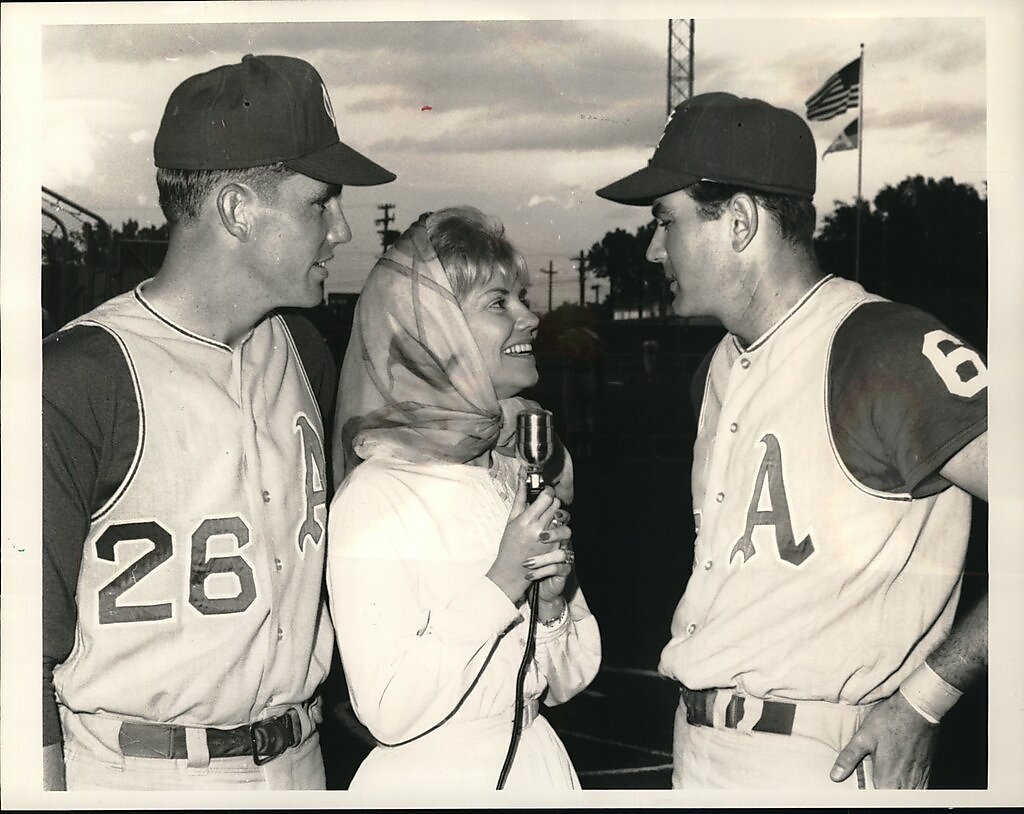
Betty Caywood interviews John O'Donoghue
(left) and Jim Gentile.

September 16, 1964: Betty Caywood is hired to provide color commentary on radio broadcasts of Kansas City Athletics games for the rest of the season. This makes her the 1st female broadcaster for a Major League Baseball team.

Born in Chicago in 1931, she grew up in Kansas City, and returned to the Chicago area to earn a degree in speech therapy from Northwestern University. She then worked as a weather reporter for a Chicago television station, where she was watched by A's owner Charlie Finley on his farm in northwestern Indiana.

She had also modeled, and taught speech and drama at a high school in Salina, Kansas, about 175 miles west of Kansas City. Divorced with 2 young children, she said modeling and broadcasting paid more than teaching.

Finley wasn't exactly progressive, but he'd do anything for good publicity (except spend more money). He hired her to do color commentary, alongside Monte Moore and George Bryson. "The idea is that putting a woman on the staff will appeal to the dolls," he told a newspaper reporter.

In her 1st game, the A's lost to the Boston Red Sox, 10-1 at Fenway Park in Boston. Tony Conigliaro, the Sox' 19-year-old local phenom, hit 2 home runs. The Sox also got home runs from Bob Tillman and Dick Stuart, the 1st baseman so bad a fielder, he was nicknamed Doctor Strangeglove. Carl Yastrzemski went 1-for-4.

By her own admission, she didn’t know much about baseball then. Her next game was 2 days later, with the A's playing the New York Yankees at Yankee Stadium. When the legendary Red Barber called her over during the game, he asked who was batting. She had no idea. He asked who he was by his number, which was 7. She did not know it was Mickey Mantle. Barber asked her what the batter was doing. “I said striking,” she later said. Red told her it was "swinging."

Because her job was so unusual for a woman, she even appeared as a mystery guest on the CBS show What’s My Line? that week.

She called the A's last 16 games of the season, in which they went 3-13, although none of it was her fault: They went 57-105 for the season. She was not rehired for 1965, and wouldn't have taken the job if she was. Not many women have entered baseball commentary since. She joked, "I was so bad, there were no more."

She soon met Jordan Bushman, a principle with Bushman Construction Company. They married, raised 2 more children, and were married for over 50 years. At one point, she said, she got an offer to host The Today Show. But that would have meant moving to New York City, where she did not like the look of schools and living conditions for her children. "Barbara Walters owes me her job," she said.

On August 16, 2008, Betty Caywood Bushman broadcast one more game, invited to join the team on radio station WHB, broadcasting the Kansas City T-Bones, of Kansas City, Kansas, in the independent Northern League. She lived until 2020.

On August 3, 1993, Gayle Gardner became the first woman to do televised play-by-play of an MLB game. The Cincinnati Reds beat the Colorado Rockies, 5-4 in 10 innings at Riverfront Stadium in Cincinnati. In 1997, Suzyn Waldman was hired as the 1st non-interim female broadcaster for an MLB team, joining the Yankees' radio team, providing color commentary alongside play-by-play announcer John Sterling. Through the 2022 season, she is still there.

UPDATE: In 2024, Jenny Cavnar was hired by the Oakland Athletics, as MLB's 1st female play-by-play announcer.

*

September 16, 1964 was a Wednesday. Actress Molly Shannon, best known as a castmember of Saturday Night Live, was born.

These other baseball games were played that day:

* The New York Yankees beat the Los Angeles Angels, 9-4 at Yankee Stadium. Jim Bouton, future author of Ball Four, was the winning pitcher. This was when he could still smoke them inside. Roger Maris hit a home run. Mickey Mantle went 0-for-3 with a walk.

* The New York Mets beat the San Francisco Giants, 4-0 at Candlestick Park in San Francisco. Tracy Stallard, best known for giving up Maris' 61st home run of the 1961 season, may have had his best game: He went the distance for the win, pitched a 5-hit shutout, walked only 2, and struck out 10, outpitching Gaylord Perry.

George Altman went 3-for-4 with a home run and 3 RBIs. Willie Mays did not play. Willie McCovey went 0-for-3. Duke Snider, in one of his last games as an active player, and looking very odd in a Giants uniform, did not reach base as a pinch-hitter.

* The Minnesota Twins beat the Baltimore Orioles. 2-1 at Memorial Stadium in Baltimore. Camilo Pascual outpitched Wally Bunker. Harmon Killebrew hit a home run. Brooks Robinson went 4-for-4, and drove in the Orioles' only run.

* The Cleveland Indians swept a doubleheader from the Washington Senators, 3-1 and 3-2 at Cleveland Municipal Stadium.

* The Chicago White Sox outpitched the Detroit Tigers, 4-1 at Tiger Stadium in Detroit. Al Kaline went 0-for-4.

* The Cincinnati Reds beat the Chicago Cubs, 5-3 at Wrigley Field in Chicago. Frank Robinson went 2-for-4 with an RBI. Pete Rose went 1-for-5. Ernie Banks went 1-for-3 with an RBI. Ron Santo hit a home run.

* The Milwaukee Braves beat the St. Louis Cardinals, 3-2 at Milwaukee County Stadium. Hank Aaron did not play. Joe Torre went 0-for-4. But Denis Menke, a prototypical good-field/no-hit 2nd baseman for the era, drove in all the Braves' runs with a home run. Lou Brock went 1-for-4 with an RBI.

* The Houston Colt .45os beat the Philadelphia Phillies, 6-5 at Colt Stadium in Houston. The day before, the Phillies were 88-57, and led the National League by 6 games with 17 games to play. From this game onward, they went 4-13, and blew the Pennant. The next year, the Colts moved into the Astrodome, and renamed themselves the Houston Astros.

* And the Pittsburgh Pirates beat the Los Angeles Dodgers, 7-5 at Dodger Stadium in Los Angeles. Vern Law was the winning pitcher, and helped his own cause with a home run. Roberto Clemente went 1-for-3 with a walk.

Thursday, September 8, 2022

September 8, 1965: The 1st Man to Play All 9 Positions In an MLB Game

Bert Campaneris, after the A's moved to Oakland

September 8, 1965: Against the California Angels at Kansas City Municipal Stadium, Dagoberto "Bert" Campaneris of the Kansas City Athletics becomes the first player to play all 9 positions in the same game, as part of a special promotion featuring the popular 23-year-old Cuban, whose main position is shortstop.

He began the game at shortstop and played, in order for the next 8 innings: 2nd base, 3rd base, left field, center field, right field, 1st base, pitcher (giving up a run on a hit and 2 walks) and catcher. With the game tied at 3-3 after 9 innings, manager Haywood Sullivan (later better known as the general manager of the Boston Red Sox) sent Rene Lachemann in to replace Campaneris, who was injured in a collision at the plate with Ed Kirkpatrick to end the top of the 9th.

The Angels scored 2 runs in the 13th inning, and defeated the A's 5-3. Attendance: 21,576, meaning there were about 13,000 empty seats, so the promotion didn't exactly work.

There appears to be no surviving footage of this game, but Campaneris survived the last 3 seasons in Kansas City, and the 1967-68 move to Oakland, to help the A's become a dynasty in the 1970s. He only batted .259 lifetime, but had 2,249 hits stole 649 bases, led the American League in stolen bases 6 times, made 6 All-Star Games, and reached the postseason 6 times: 5 straight AL Western Division titles with the A's, including 3 straight World Series in 1972, '73 and '74; and the 1979 AL West title with the California Angels. As of September 8, 2022, he is still alive.

Through the 2022 season, there have been 5 players to play all 9 positions in a major league game. The others are:

* César Tovar, for the Minnesota Twins, on September 22, 1968 -- oddly enough, against Campaneris and the A's. He pitched a scoreless inning.

* Scott Sheldon, for the Texas Rangers, on September 6, 2000. The Chicago White Sox jumped out to a 10-1 lead after 2 innings. Sheldon pitched to 1 batter, Jeff Liefer, in the 8th inning, and struck him out.

* Shane Halter, of the Detroit Tigers, on October 1, 2000, just 26 days later, on the final day of the regular season, against the Twins. Halter pitched to 1 batter, Matt LeCroy, in the 8th inning, and walked him. The game ended as a 13-12 walkoff win for the Tigers.

* Andrew Romine, of the Tigers, on September 30, 2017, against the Twins. It was the next-to-last day of the regular season. He, too, pitched to just 1 batter, also in the 8th inning, getting Miguel Sanó to ground out. The Tigers won, 3-2.

No player has also managed to be a designated hitter in the same game, to make it 10, because that would require him leaving the DH position, thus his team giving it up, and forcing the pitcher to bat unless a pinch-hitter could be found. No player can switch from a field position to the DH.

*

September 8, 1965 was a Wednesday. These other baseball games were played that day:

* The New York Yankees beat the Washington Senators, 6-5 at Yankee Stadium. Jim Bouton started, but the elbow he injured earlier in the year, which ended up ruining his career, left him in too much pain to pitch effectively. (He had not yet started using a knuckleball.) The Senators tied the game in the top of the 9th, but in the bottom of the 9th, Elston Howard singled home a rookie named Roy White with the winning run.

Mickey Mantle did not play. The Yankees got home runs by Archie Moore (no relation to the boxing champion of the same name) and Ray Barker. Rookie Bobby Murcer went 0-for-4. The Yankees had won the last 5 Pennants, and 29 of the last 44. But age and injuries caught up with them this season. By the time they won another Pennant in 1976, White would be the only one left from this team.

* The New York Mets lost to the Cincinnati Reds, 11-2 at Crosley Field in Cincinnati. The Reds knocked Carlton Willey out of the box in the 1st inning with 4 runs. Frank Robinson and Deron Johnson hit home runs for the Reds. Jim O'Toole went the distance for the win.

* The Boston Red Sox beat the Cleveland Indians, 5-3 at Cleveland Municipal Stadium. Tony Horton hit a home run, with Tony Conigliaro on base, in the top of the 10th inning. Conigliaro had homered earlier. Both Tonys would see their career come to sad ends, in Horton's case with the Indians. Carl Yastrzemski went 0-for-3 with 2 walks.

* A doubleheader was split at Tiger Stadium in Detroit. The Baltimore Orioles won the opener, 2-0. Steve Barber pitched a 5-hit shutout, outpitching Hank Aguirre. Apparently, Barber's arm was neither sore nor a little stiff. (A reference to a line in Ball Four, the book by the aforementioned Jim Bouton.)

The Detroit Tigers won the nightcap, 5-0. Dave Wickersham pitched a 3-hit shutout, outpitching Darold Knowles. Over the 2 games, Brooks Robinson went 0-for-6 with a walk, and Al Kaline went 2-for-6 with a walk.

* The Minnesota Twins beat the Chicago White Sox, 3-2 at Comiskey Park in Chicago. Harmon Killebrew did not play. The Twins were about to win their 1st Pennant under that name, the franchise's 1st since they were "the old Washington Senators" in 1933.

* The Philadelphia Phillies beat the Milwaukee Braves, 6-5 at Milwaukee County Stadium. Dick Stuart, the slugger who was so bad a fielder that even putting him at 1st base wasn't safe, to the point where he was nicknamed "Dr. Strangeglove" and "Stonefingers," hit a home run for the Phillies. Hank Aaron and Joe Torre hit them for the Braves.

* The Pittsburgh Pirates beat the St. Louis Cardinals, 2-1 at the 1st Busch Stadium (formerly the last Sportsman's Park) in St. Louis. Roberto Clemente went 0-for-4.

* The San Francisco Giants beat the Houston Astros, 12-3 at Candlestick Park in San Francisco. Willie Mays hit 2 home runs, Willie McCovey 1.

* And the Chicago Cubs and the Los Angeles Dodgers were not scheduled. They started a series in Los Angeles the next night, and Sandy Koufax pitched a perfect game for the Dodgers.

Wednesday, July 13, 2022

July 13, 1963: Early Wynn's Struggle to Win 300

July 13, 1963: For a pitcher in baseball, winning 300 games in a career has long been considered a milestone, which is tantamount to election to the Baseball Hall of Fame. And no pitcher worked harder, or struggled more, to get there than Early Wynn.

Born in Alabama in 1920, a football injury led him to concentrate on baseball. In 1939, he made his major league debut, with the Washington Senators, pitching a complete game in his debut, but losing. He spent most of the 1940 and '41 seasons in the minor leagues, but the manpower drain of World War II forced the Senators to put him in their starting rotation. He remained with them through the 1948 season, except for missing the end of the 1944 season and all of 1945 in the U.S. Army's Tank Corps.

In 1949, he was traded to the Cleveland Indians. He got there too late for their 1948 World Series win, but kept them in contention, and helped them win the American League Pennant in 1954. In 1958, he was traded to the Chicago White Sox. In 1959, despite being 39 years old, he went 22-10, as the ace of a team that won the Pennant. He received the Cy Young Award, then a both-Leagues award.

He made the All-Star Game in 7 seasons. He won 17 or more games in a season 10 times, including 20 or more 3 times. He led the AL in wins in 1954 and 1959, in ERA in 1950, in strikeouts in 1957 and 1958. He struck out 2,334 batters in his career. But he also walked 1,755 batters, a record until Nolan Ryan surpassed it in 1981. His career ERA was 3.54.

As late as 1961, in limited action, he was 8-2, raising his career won-lost record to 292-227. That season, on August 11, Warren Spahn of the Milwaukee Braves won his 300th game, only the 13th pitcher to do it, and the 1st since Lefty Grove in 1941. Spahn and Grove were now the only ones to have done it while playing their entire careers in the post-1920 Lively Ball Era.

Wynn wanted to become the next to do it. But age caught up with him. On July 24, 1962, he won his 297th. It took 3 more starts to win his 298th, on August 10. This was followed by 4 losses, until his won his 299th on September 8. He closed the season by losing his last 3, finishing at 7-15, with a career record of 299-242. He needed only 1 more. But the White Sox released him. He would be 43 before heading down to his next Spring Training.

He did go to the White Sox' camp, but failed to make the team. Several teams offered him one-game contracts, but he wanted a real contract. He got one from the Indians on June 21. His 1st game was that night -- against the White Sox. He gave a statement performance, going the distance, allowing 2 runs on 8 hits and 1 walk. But he didn't get any support, and lost, 2-0.

He started against the White Sox again on June 28, pitching 6 innings, and got no decision, though the Indians won. He started against the Boston Red Sox on the 4th of July. Again, he pitched 6 innings and got no decision, though the Indians won. He was used in the last 2 innings of a game against the Yankees on July 7, and didn't allow any runs, but the Indians couldn't come back and give him Number 300 that way. He wasn't pitching badly, but he wasn't getting that 300th win.

Indians manager George "Birdie" Tebbetts decided to start him in the 2nd game of a doubleheader against the Kansas City Athletics, at Kansas City Municipal Stadium, on July 13, with a full 5 days' rest. But Wynn struggled to sleep, due to gout-related pain. The A's won the opener, 6-5.

Wynn got the A's out 1-2-3 in the bottom of the 1st inning. In the 2nd, the Indians gave him a run, but he walked the bases loaded with 1 out, before getting out of the jam. In the 3rd, he allowed a leadoff single -- to the opposing pitcher, Moe Drabowsky, no less. But he got the next 3 men out. In the bottom of the 4th, he allowed a leadoff home run to George Alusik, tying the game. He got the next 3 men out.

Playing 3rd base for the A's that night, Ed Charles remembered, "His fastball, if it reached 80, that was stretching it. He was laboring, throwing nothing but bloopers and junk."

Wynn himself led off the top of the 5th, and got a hit. After Tito Francona flew out, Dick Howser singled. After Willie Kirkland popped up, Max Alvis walked to load the bases. Joe Adcock singled Wynn and Howser home. It was 3-1 Indians. John Romano walked, re-loading the bases. Al Luplow singled, scoring Adcock and Alvis. That made it 5-1 Indians.

But to start the bottom of the 5th, Wynn allowed 3 straight singles, to Ken Harrelson, Gino Cimoli and José Tartabull, loading the bases with nobody out. Future manager Tony La Russa pinch-ran for Cimoli. Wynn got Wayne Causey to pop up. But Jerry Lumpe hit a double, scoring Tartabull and La Russa. But Wynn's luck turned again: Lumpe was thrown out trying to stretch his hit into a triple, and Alusik popped up. The Indians had closed to within 5-4.

But Wynn had now pitched 5 innings, the minimum necessary to get a win. Tebbetts took no chances, and took him out. "Jerry Walker relieved me ,and saved the game for me," Wynn later said. "He was my roommate, and pitched like a man possessed." Over the last 4 innings, he allowed 3 hits and 2 walks, but no runs. The Indians added a run in the 7th, and another in the 9th. They won, 7-4, and Wynn had his 300th win. The 7-appearance gap remains the longest ever between a pitcher's 299th and 300th wins.

Wynn made 15 more appearances, though only 1 more start, recording a loss and a save. He retired with a record of 300-244. He was elected to the Hall of Fame in 1972. He died in 1999. That year, The Sporting News named its 100 Greatest Baseball Players, and Early Wynn was listed at Number 100.

The Senators moved to become the Minnesota Twins in 1961, but the Washington Nationals, formerly the Montreal Expos, named Wynn to their Ring of Honor, honoring players for all D.C.-based teams, including the Negro Leagues' Homestead Grays. The Indians became the Cleveland Guardians in 2022, and, while still named the Indians, named Wynn to their team Hall of Fame. (The White Sox don't have one.) He usually wore Number 11 in Washington, and Number 24 in Cleveland and Chicago, but no team has ever retired his number.

As of July 13, 2022, there are 24 pitchers who have won 300 or more games. The most recent addition was Randy Johnson in 2009. Given the way pitchers have been used in the 21st Century, it seems unlikely that there will be another in the next few years. Roger Clemens, who won 354 -- more than anyone in the Lively Ball Era except Spahn and Greg Maddux -- is not in the Hall of Fame, due to never-proven accusations of steroid use. Every other pitcher with at least 300 wins is in the Hall of Fame.

*

July 13, 1963 was a Saturday. These other baseball games were played that day:

* The New York Yankees lost to the Los Angeles Angels, 3-1 at Dodger Stadium in Los Angeles, where the Angels were groundsharing until their Anaheim stadium could be built. Dean Chance outpitched Jim Bouton. Mickey Mantle was injured, and did not play.

* The New York Mets lost to the Los Angeles Dodgers, 11-2 at the Polo Grounds. Duke Snider went 1-for-4... as a home player in the Polo Grounds, with a Giants-style "NY" on his cap, against the Dodgers.

* The Philadelphia Phillies beat the San Francisco Giants, 4-3 at Connie Mack Stadium in Philadelphia (which had been Shibe Park until 1953). Willie Mays hit a home run.

* The Washington Senators beat the Baltimore Orioles, 4-3 at District of Columbia Stadium in Washington. (It was renamed Robert F. Kennedy Memorial Stadium in 1969.) Brooks Robinson went 1-for-4.

* The Pittsburgh Pirates beat the Houston Colts .45s, 3-0 at Forbes Field in Pittsburgh. Vernon Law pitched a 6-hit shutout. Donn Clendenon hit 2 home runs. Roberto Clemente went 2-for-4 with the Pirates' other RBI. The Colt .45s became the Astros in 1965.

* The Minnesota Twins beat the Boston Red Sox, 6-4 at Metropolitan Stadium in the Minneapolis suburb of Bloomington, Minnesota. Harmon Killebrew, Rich Rollins and Earl Battey hit home runs. Carl Yastrzemski went 2-for-4.

* The Milwaukee Braves beat the St. Louis Cardinals, 7-5 at Busch Stadium in St. Louis (which had been Sportsman's Park until 1953). Hank Aaron went 3-for-5 with a home run and 3 RBIs. Stan Musial, in his final season, appeared only as a pinch-hitter, and did not reach base.

* And the Chicago White Sox, the Detroit Tigers, the Chicago Cubs and the Cincinnati Reds were not scheduled.

Tuesday, June 7, 2022

June 7, 1966: The Mets Draft Steve Chilcott -- Instead of Reggie Jackson

June 7, 1966: Major League Baseball holds its 2nd annual Amateur Draft. The top pick goes to the team that had the worst record the season before: The New York Mets.

They chose Steve Chilcott, a 17-year-old catcher from Antelope Valley High School in the Los Angeles suburb of Lancaster, California.

What happened to Steve Chilcott? A baserunning blunder wrecked his throwing shoulder. He never reached the major leagues, and he played his last professional game in 1972, only 24 years old. He moved to Santa Barbara, and became a firefighter and a contractor. In a 2005 interview, he said, "I've had a good life, although, at first, it was hard for me to find things to do, because I had such a desire to be a professional athlete. I had to find my place in the world."

With the 2nd pick, the Kansas City Athletics chose Reggie Jackson, an outfielder from Arizona State University.
There were other good picks in that draft. The Houston Astros chose pitcher Wayne Twitchell. The Boston Red Sox chose pitcher Ken Brett. The Washington Senators chose outfielder Tom Grieve. The Cleveland Indians chose pitcher John Curtis. The Cincinnati Reds chose pitcher Gary Nolan. The Pittsburgh Pirates chose shortstop (later 3rd baseman) Richie Hebner. The Chicago White Sox chose outfielder Carlos May.

That was just in the 1st Round. In the 2nd Round, the White Sox chose catcher Johnny Oates. In the 3rd Round, the St. Louis Cardinals chose pitcher Clay Kirby, and the Minnesota Twins chose 3rd baseman Steve Garvey. (He didn't sign with them. Two years later, the Los Angeles Dodgers drafted him as a 1st baseman, and he signed with them.)

In the 5th Round, the Astros chose catcher Cliff Johnson, and the Pirates chose shortstop (later 2nd baseman) Dave Cash. In the 6th Round, the Pirates chose 2nd baseman Gene Clines. In the 8th Round, the Dodgers chose pitcher Charlie Hough. In the 9th Round, the California Angels chose pitcher Ken Forsch, and the Dodgers chose outfielder (later shortstop) Bill Russell.

With perhaps the most interesting pick in the draft, in the 10th Round, the New York Yankees chose a lefthanded pitcher from the University of Alabama: Ken Stabler. Instead of baseball, he chose football, and became a Hall of Fame quarterback with the Oakland Raiders. (John Elway, who later actually did play one season in the Yankee system, followed the same path.)

In the 15th Round, the Dodgers chose catcher (later 2nd baseman) Ted Sizemore. In the 19th Round, the Dodgers chose 3rd baseman Ron Cey. In the 20th Round, the Angels chose pitcher Dave LaRoche. In the 31st Round, the Chicago Cubs chose pitcher Bill Stoneman, and the Angels chose pitcher Bill Bonham. And in the 32nd Round, the Mets chose 2nd baseman Kurt Bevacqua.

So while Reggie turned out to be the best player in that Draft, he was far from the only good player who the Mets overlooked. But why did they overlook him? Arizona State head coach Bobby Winkles, who later managed the A's after Reggie left them, told him that the Mets were concerned that he was a black man with a white girlfriend. This was in 1966, a year before the U.S. Supreme Court ruled that all laws against interracial marriage were unconstitutional.

In fact, Reggie's girlfriend, Jennie Campos, was a Mexican-American, who faced prejudice as well. Reggie and Jennie married, but it didn't last, as Reggie's wandering eye was as active as his batting eye. But he has managed to keep his private life mostly private. There have been no public stories about him mistreating women.

We can say that, as usual, the dumb Mets were so dumb in not taking Reggie. But the catcher they ended up with was Jerry Grote. How do we know a healthy Chilcott would have done better than Grote? We don't. So this is more about who they didn't take than about who they did.

With Reggie, the A's moved to Oakland in 1968, won 5 straight American League Western Division titles from 1971 to 1975, and won 3 straight World Series from 1972 to 1974. He signed with the Yankees for the 1977 season, and led them to back-to-back World Series wins, also winning an AL Eastern Division title in 1980 and an AL Pennant in 1981. After his relationship with team owner George Steinbrenner went from great to terrible, he signed with the Angels, and helped them to AL West titles in 1982 and 1986.

He retired with 563 career home runs, reached the postseason 11 times in 21 seasons, won 6 Pennants and 5 World Series, including the Series Most Valuable Player award twice, and was a 1st-year-of-eligibility electee to the Baseball Hall of Fame.

Having Reggie wouldn't have helped the Mets much. Maybe it would have been better for Cub fans in 1969, since they probably wouldn't have had a big lead to blow, so it's less painful for them. And it would have reversed the result of the 1973 World Series, when Reggie homered in Game 7, and the A's beat the Mets.

But just as the A's players took their earliest possible chances to bolt from team owner Charlie Finley, his cheapness, and his micromanaging, the opposite happened with the similarly cheap president of the Mets, M. Donald Grant: He got rid of his good players before they demanded "too much." Can you imagine George Steinbrenner seeing Reggie Jackson playing the 1976 season for a National League team, and then going after a Mets legend, and making him a bigger star with the Yankees? So, having Reggie on their team might have ended up actually being more painful for Met fans.

*

June 7, 1966 was a Tuesday. This was also the day civil rights activist James Meredith was shot. I have a separate entry for that event.

These Major League Baseball games were played:

* The New York Yankees beat the Cleveland Indians, 7-2 at Cleveland Municipal Stadium. Fritz Peterson went the distance for the win. Bobby Richardson and Joe Pepitone hit home runs. Mickey Mantle went 2-for-4 with a walk and 2 RBIs. Roger Maris went 2-for-5 with an RBI.

* The New York Mets lost to the Atlanta Braves, 11-6 at Shea Stadium. Hank Aaron went 2-for-4 with a walk and 2 RBIs. He did not hit a home run for the Braves, but Joe Torre did. Dick Stuart, the power-hitting but horrible-fielding 1st baseman known as "Dr. Strangeglove," homered for the Mets.

* The Philadelphia Phillies beat the Cincinnati Reds, 5-1 at Connie Mack Stadium in Philadelphia. Jim Bunning went the distance, allowing 1 run on 3 hits, no walks and 14 strikeouts. He beat Milt Pappas, whom the Reds had traded Frank Robinson to get. The only Reds run came on a home run by Leo Cárdenas. Pete Rose went 0-for-3.

* The Baltimore Orioles beat the Washington Senators, 6-5 at Memorial Stadium in Baltimore. The Senators scored 2 runs in the top of the 12th inning, but in the bottom half, the O's scored 3, winning on an RBI single by Frank Robinson, who went 4-for-6. Brooks Robinson went 0-for-4 with a walk.

* The Pittsburgh Pirates beat the St. Louis Cardinals, 9-1 at Forbes Field in Pittsburgh. Don Cardwell outpitches Bob Gibson. Roberto Clemente went 3-for-5 with a home run and 3 RBIs. Willie Stargell went 2-for-5. Lou Brock went 1-for-4.

* The Detroit Tigers beat the Boston Red Sox, 2-1 at Tiger Stadium in Detroit. Mickey Lolich outpitched Bob Sadowski. The only Sox run came on a home run by Tony Conigliario. Carl Yastrzemski went 0-for-3 with a walk. Al Kaline went 0-for-3.

* The Los Angeles Dodgers beat the Chicago Cubs, 8-6 at Wrigley Field in Chicago. Fergie Jenkins relieves Bob Hendley in the 5th inning, but gives up back-to-back home runs to Jim Lefebvre and Al Ferrara leading off the top of the 10th. It was Ferrara's 2nd homer of the game. Phil Regan is the winning pitcher, in relief of rookie Don Sutton. Ernie Banks went 2-for-4 with a walk and an RBI.

* The Minnesota Twins beat the Kansas City Athletics, 6-1 at Metropolitan Stadium in the Minneapolis suburb of Bloomington, Minnesota. Harmon Killebrew went 2-for-4.

* The Houston Astros beat the San Francisco Giants, 10-9 at the Astrodome in Houston. Willie Mays doubled, then left the game with an injury. His pinch-runner was Jesús Alou, who went to right field and went 3-for-4 with an RBI, as Ollie Brown moved from right to center.

* And the California Angels beat the Chicago White Sox, 3-2 at Anaheim Stadium (now Angel Stadium of Anaheim).

Sunday, May 22, 2022

May 22, 1963: Mickey Mantle Hits the Yankee Stadium Façade

This picture is from the game in question,
but from Mantle's previous at-bat.

May 22, 1963: The New York Yankees beat the Kansas City Athletics, 8-7 at Yankee Stadium. The Bronx Bombers scored 7 runs in the bottom of the 2nd inning, oddly without a home run. Bill Stafford took a shutout into the top of the 8th, then fell apart: Between them, Stafford, Marshall Bridges and Ralph Terry allowed 6 runs. Terry gave up a home run to future Met Ed Charles in the 9th.

Mickey Mantle led off the bottom of the 11th against Bill Fischer. Batting lefthanded, He hit a rocket high into the night in right field. No player had ever hit a fair ball completely out of Yankee Stadium. Yogi Berra jumped out of his seat, and, thinking this one was going out, yelled, "My God, that's it!"

It wasn't "it." But it was close. The ball smashed into the frieze atop the roof, maybe 6 inches from the top, and rebounded all the way back to the infield. The spot it hit was 374 feet from home plate, and 108 feet off field level. Somebody suggested at the time that, had there been no obstruction, it would have gone 620 feet.
Mantle later called it the hardest ball he ever hit, and it was the closest anybody ever came to hitting a fair ball out of Yankee Stadium. More importantly, it won the game, making a winning pitcher out of Steve Hamilton.

Mantle had hit the frieze, usually incorrectly called "the façade," twice before, in 1956, both times to right field. He and Frank Howard had both done that in left field, batting righthanded.

A legend states that Josh Gibson, batting righthanded, hit a fair ball all the way out of Yankee Stadium during a Negro League game, around 1934 or so, but this has never been proven. Buck O'Neil once said he'd heard the story from Buck Leonard, adding, "And Buck don't lie." But Leonard himself once said, "I didn't see the one he is supposed to have hit out of Yankee Stadium."

Gibson was called "the Black Babe Ruth." Negro League fans called Ruth "the White Josh Gibson." It is possible that Ruth hit one all the way out of Yankee Stadium before the triple decks were extended around the right field pole in the 1936-37 off-season, 2 years after he left the team. After all, it's easier to clear one level of bleachers than three levels of grandstands. If he did, it's never been reported.

On a weeknight in The Bronx, only 10,312 paying customers saw Mantle come closer than anybody did to hitting one all the way out.

*

May 22, 1963 was a Wednesday. This was also the day that AC Milan, the Champions of Italian soccer, defeated the Portuguese Champions, Benfica, to win the European Cup, popularizing the tactic known as "Catenaccio." I have a separate entry for this event.

These other baseball games were played:

* The New York Mets lost to the Los Angeles Dodgers, 7-3 at Dodger Stadium in Los Angeles. Duke Snider hit a home run for the Mets against his former team. But Tommy Davis and Frank Howard hit home runs in support of Don Drysdale.

* The Minnesota Twins beat the Boston Red Sox, 3-1 at Fenway Park in Boston. Harmon Killebrew went 1-for-5. Carl Yastrzemski went 1-for-4.

* The Baltimore Orioles beat the Detroit Tigers, 2-1 at Memorial Stadium in Baltimore. Steve Barber, proving that his arm was neither sore nor a little stiff (Ball Four reference), outpitched Jim Bunning. The Orioles' Brooks Robinson and the Tigers' Al Kaline, in his hometown, each went 1-for-3.

* The Chicago White Sox beat the Washington Senators, 9-3 at District of Columbia Stadium in Washington. (D.C. Stadium would be renamed Robert F. Kennedy Memorial Stadium in 1969.)

* The Los Angeles Angels beat the Cleveland Indians, 7-6 at Cleveland Municipal Stadium. The Angels led 6-0 going into the bottom of the 4th inning, and blew it. But in the top of the 11th inning, Gary Bell loaded the bases, and forced in the winning run by hitting Lee Thomas with a pitch. (Bell would later to be Barber's teammate on the 1969 Seattle Pilots, and a featured figure in Ball Four, since he roomed with the book's author, Jim Bouton.)

* The Chicago Cubs beat their arch-rivals, the St. Louis Cardinals, 7-6 at Wrigley Field in Chicago. Stan Musial, in his final season, went 3-for-4 with a home run and 2 RBI. Ernie Banks only appeared as a pinch-hitter, and did not reach base. Lou Brock went 2-for-5 with a walk -- for the Cubs, as that epic trade had not yet been made. Ken Aspromonte singled Brock home with the winning run in the bottom of the 11th inning.

* The Pittsburgh Pirates beat the Houston Colt .45s, 4-3 at Colt Stadium in Houston. The Colts took a 3-0 lead into the top of the 9th, and blew it, capped by a pinch-hit 2-RBI single by Roberto Clemente. The Colts became the Houston Astros in 1965.

* The San Francisco Giants beat the Philadelphia Phillies, 10-2 at Candlestick Park in San Francisco. Willie Mays went 2-for-4 with a walk and an RBI.

* And the Milwaukee Braves and the Cincinnati Reds were postponed at Milwaukee County Stadium -- according to Baseball-Reference.com, due to cold weather. In late May. Anyway, it was rescheduled for July 29. The Braves won, 8-2. Warren Spahn went the distance for the win. Hank Aaron went 3-for-5 with a home run and 4 RBIs -- just another day at the office. Home runs were also hit by the Braves' Lee Maye (not to be confused with future Reds and Orioles star Lee May), and by the Reds' Frank Robinson and Vada Pinson.

Tuesday, April 12, 2022

April 12, 1955: Kansas City Goes Major League

April 12, 1955: The Kansas City Athletics beat the Detroit Tigers, 6-2 at Kansas City Municipal Stadium. It was the 1st home game for the A's after moving from Philadelphia. Their new hometown was back in the major leagues after 40 years.

Former President Harry S Truman, from nearby Independence, Missouri, threw out the ceremonial first ball. For the Tigers, Al Kaline went 2-for-4, and Red Wilson hit the ballpark's 1st major league home run. For the A's, Bill Wilson hit a home run, and Alex Kellner was the winning pitcher.

Previously, Kansas City had these major league teams in baseball: The Kansas City Cowboys of the Union Association, a league which only played the 1884 season; the Kansas City Cowboys of the National League, a team which only played the 1886 season, with none of these teams have any official connection with the other; the Kansas City Cowboys of the American Association, a team which only played the 1888 and 1889 seasons; and the Kansas City Packers of the Federal League, a league which only played the 1914 and 1915 seasons. And, in football, the Kansas City Blues entered the NFL in 1924, became the Kansas City Cowboys in 1925, and folded after the 1926 season.

The Kansas City Blues won 10 American Association Pennants: 1888, 1890, 1898, 1901, 1918, 1923, 1929, 1938, 1952 and 1953. The Kansas City Monarchs won 11 Negro League Pennants: 1923, 12 1924, 1925, 1929, 1937, 1939, 1940, 1941, 1942, 1946 and 1953.

Both teams played at Muehlebach Field, built in 1923 by, and named for, George E. Muehlebach, who owned the Blues and a number of other Kansas City businesses, including Muehlebach Beer and the Muehlebach Hotel. The previous Kansas City ballpark, Association Park, was owned by a railroad, which decided to build a new line through it, creating the need for a new ballpark.

In 1937, the New York Yankees bought the Blues, made them their top farm team, and renamed the ballpark Ruppert Stadium, in honor of team owner Jacob Ruppert. Ruppert died in 1939, and the ballpark was renamed Blues Stadium in 1943.

Knowing that the Philadelphia Athletics had been purchased by Arnold Johnson, and were being moved to Kansas City for the 1955 season, the city added an upper deck to Blues Stadium, and renamed it Kansas City Municipal Stadium. It now seated 35,020 people. When the American Football's League's Dallas Texans became the Kansas City Chiefs in 1963, the addition of football bleachers raised seating capacity to 51,000.

When Johnson died in 1960, the A's were bought by Charles O. Finley. He wanted a bigger ballpark, and when the city wouldn't build him one, he flirted with moving the A's to Dallas and Louisville, before finally moving to Oakland, California for the 1968 season. Kansas City then got an expansion team, and the Royals played there from 1969 to 1972.

Unusual for that era, instead of building one stadium for both baseball and football, Kansas City built a stadium for each. Arrowhead Stadium opened in 1972, Royals Stadium opened in 1973, and the complex was named the Harry S Truman Sports Complex. Missouri's favorite son had died the day after Christmas, 1972.

When the Royals' original owner, pharmaceutical magnate Ewing Kauffman, died in 1993, the stadium was renamed Kauffman Stadium for him. Despite a major renovation in 2009, the Royals are looking to build a new stadium, downtown. (UPDATE: In 2024, the Royals released plans for a new stadium, tentatively set to open in 2028.) The Chiefs renovated Arrowhead Stadium at the same time, and have no plans to replace it.

The Chiefs won the AFL Championship in 1966 and 1969, losing Super Bowl I but winning Super Bowl IV. The Royals won the World Series in 1985 and 2015, having lost it in 1980 and 2014. The Chiefs have since won Super Bowl LIV, while losing Super Bowl LV. (UPDATE: They have since won Super Bowls LVII and LVIII.)

In soccer, the Kansas City Spurs won the 1969 North American Soccer League title, playing home games at Municipal Stadium. But they only lasted 1 more season. The Kansas City Wizards won the 2000 MLS Cup. In 2010, they rebranded as Sporting Kansas City, and moved from Arrowhead to a new stadium in nearby Kansas City, Kansas. They won the MLS Cup again in 2013.

A women's team, FC Kansas City, only lasted from 2013 to 2017, but won the National Women's Soccer League title in 2014 and 2015. In 2021, they were replaced by the Kansas City Current.

The area has been less successful in the indoor sports. In 1972, the NBA's Cincinnati Royals moved in, but, since the baseball team was already called the Royals, they became the Kansas City Kings. In 1974, they moved from the Municipal Auditorium to the new Kemper Arena. That same year, the NHL placed an expansion team there, the Kansas City Scouts.

The Scouts were lousy, and moved after 2 seasons. The Kings won a Division title in 1979 and reached the Western Conference Finals in 1981, but never drew well, and moved to Sacramento in 1985. In 2018, the Kemper Arena was downsized and rebranded as the Hy-Vee Arena. In 2007, the Sprint Center opened downtown, but it has failed to attract and NBA, WNBA or NHL team.

No matter: Kansas City still has MLB and the NFL, the 2 sports that mark a city and its metropolitan area as "major league." And while the A's left, the Royals and the Chiefs aren't going anywhere.

*

April 12, 1955 was a Tuesday. This was also the day on which Dr. Jonas Salk announced that the vaccine he had been testing against polio was effective and safe. I have a separate entry for that event

These other baseball games were played:

* The Boston Red Sox beat the Baltimore Orioles, 7-1 at Memorial Stadium in Baltimore. Ted Williams did not play that day.

* The Cleveland Indians beat the Chicago White Sox, 5-1 at Cleveland Municipal Stadium.

* The Chicago Cubs beat the St. Louis Cardinals, 14-4 at Wrigley Field in Chicago. For the Cubs, Randy Jackson hit a home run, and Ernie Banks went 2-for-4 with an RBI. For the Cards, Ken Boyer hit a home run, and Stan Musial went 2-for-4 with an RBI.

* The Milwaukee Braves beat the Cincinnati Redlegs, 4-2 at Milwaukee County Stadium. It was the 2nd of 5 seasons when, in the wake of anti-Communist hysteria, the Cincinnati team was known as the Redlegs, not the Reds. Warren Spahn was the winning pitcher, future World Series-winning manager Chuck Tanner hit a home run on the 1st pitch he ever sees in the major leagues, and Hank Aaron went 1-for-4, the hit an RBI triple.

The next day, April 13:

* The New York Yankees and the Washington Senators opened the season at Yankee Stadium. The Yankees won, 19-1.

* The New York Giants and the Philadelphia Phillies opened the season at Connie Mack Stadium in Philadelphia. The Phillies won, 4-2.

* The Brooklyn Dodgers and the Pittsburgh Pirates opened the season at Ebbets Field. The Dodgers won, 6-1. Nobody knew it yet, but the "Next Year" that their fans had long waited for had finally come.

Football was out of season. The NBA season had ended 2 days earlier, when the Syracuse Nationals beat the Fort Wayne Pistons in Game 7 of the NBA Finals. Game 6 of the Stanley Cup Finals was played at the Montreal Forum that night, and the Montreal Canadiens beat the Detroit Red Wings, 6-3. But the Wings would win the Cup in Game 7 in Detroit, 2 nights later.

December 31, 1999 & January 1, 2000: The Millennium

December 31, 1999:  The Millennium arrives. The people of planet Earth survived. At a terrible cost. But we hadn't destroyed ourselves. ...