Showing posts with label roy campanella. Show all posts

Tuesday, July 12, 2022

July 12, 1949: Baseball's 1st Black All-Stars

Left to right: Roy Campanella, Larry Doby,
Don Newcombe and Jackie Robinson.

July 12, 1949: Ebbets Field, home of the Brooklyn Dodgers, hosts the All-Star Game for the only time. This is the 1st All-Star game with black players. Jackie Robinson, Roy Campanella and Don Newcombe of the Dodgers become the National League's 1st black All-Stars. Larry Doby of the Cleveland Indians becomes the American League's 1st black All-Star. Newcombe and Doby had been teammates on the Negro League's Newark Eagles in 1944.

The starting pitchers are Warren Spahn of the Boston Braves for the National League, and Mel Parnell of the Boston Red Sox for the American League. The AL tagged Spahn for 4 runs in the top of the 1st, but the NL got 2 back in the bottom of the 1st, on a double by Robinson and a home run by Stan Musial of the St. Louis Cardinals. Newcombe, a good hitter for a pitcher, scored Willard Marshall of the New York Giants with a sacrifice fly, and it was 4-3 AL after 2.

The NL took a 5-4 lead in the bottom of the 3rd. Eddie Joost of the Philadelphia Athletics singled home 2 runs in the top of the 4th, and it was 6-5 AL. Joe's brother, Dom DiMaggio of the Red Sox, led off the top of the 6th with a double. George Kell of the Detroit Tigers drew a walk. Bob Dillinger of the St. Louis Browns pinch-ran for Kell. Ted Williams of the Red Sox flew to center. But Joe DiMaggio doubled his brother and Dillinger home, and it was 8-5. Kell would end up beating Williams for the batting title by .0002, and denying him the Triple Crown by the smallest margin ever.

Ralph Kiner of the Pittsburgh Pirates hit a home run in the bottom of the 6th, driving in Robinson ahead of him. But the AL tacked on 3 runs in the top of the 7th, and won, 11-7. Newcombe was the losing pitcher. The winning pitcher was Virgil Trucks of the Tigers, and Raschi got the save.

Robinson played the entire game, going 1-for-4 with a walk, and also reached base due to a fielder's choice. Campanella replaced Andy Seminick of the Philadelphia Phillies behind the plate for the 4th inning, and went 0-for-2. Doby pinch-ran for Joe DiMaggio in the 6th, and moved into right field, while Dom DiMaggio moved from right to center. Doby batted only once, grounding out.

So while there were black players in the All-Star Game for the 1st time, only 1, Newcombe, made much of a difference. He would still win the NL's Rookie of the Year award, while Robinson would win the NL's Most Valuable Player award, and lead the Dodgers to the Pennant, before losing the World Series to the Yankees. Doby had helped the Indians win the previous year's World Series.

*

July 12, 1949 was a Tuesday, as most All-Star Game days have been. There were no other scores on this historic day, as no other major league sport was in season. 

Saturday, May 7, 2022

May 7, 1959: Roy Campanella Night

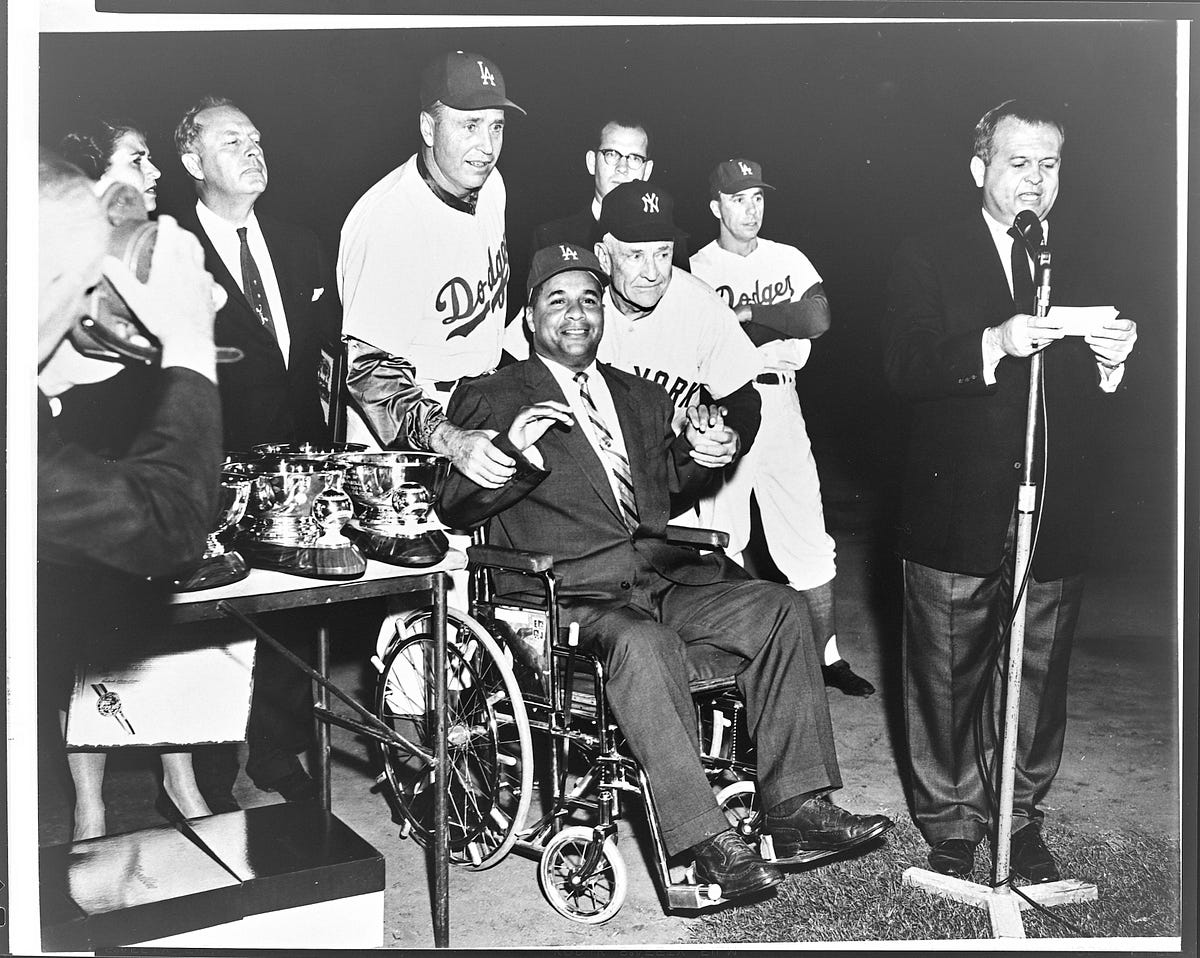
May 7, 1959: The Los Angeles Dodgers do something not often done in baseball, but common in soccer: They hold a testimonial game to raise money for a good cause in a player's name. Roy Campanella Night was held at the Los Angeles Memorial Coliseum. The New York Yankees, in the middle of a Western roadtrip, agreed to be the opponents for this exhibition game.

A native of Philadelphia, Roy Campanella had starred in the Negro Leagues before joining the Brooklyn Dodgers in 1948. From then until 1957, he had played in 8 All-Star Games, batted over .300 3 times, hit 259 home runs, topped 100 RBIs 3 times including a League-leading 142 in 1953, won 3 National League Most Valuable Player awards, and helped the Dodgers win 5 Pennants, facing the Yankees in the World Series each time, winning in 1955.

After the 1957 season, the Dodgers announced their move to Los Angeles. "Campy" was just 36 years old, and already in something of a decline, but the close left-field fence at the Coliseum, necessary until Dodger Stadium could open in 1962, was thought to be a way of helping his power numbers.

He lived in Glen Cove, on New York's Long Island, and owned a liquor store in Harlem. On January 28, 1958, he drove home from the store in his 1957 Chevrolet sedan. He was less than a mile from home when, while driving only about 30 miles per hour, he hit a patch of ice on an S-curve, hit a telephone pole, and overturned.

He broke 2 vertebrae, and was paralyzed from the shoulders down. Eventually, he regained enough mobility to feed himself, but he required the use of a wheelchair for the rest of his life.

Dodger owner Walter O'Malley, usually known for being incredibly greedy and cheap, named Campy a scouting supervisor and a special coach at their "Dodgertown" Spring Training camp at Vero Beach, Florida, paying his travel expenses. It kept him involved in baseball. And he announced the scheduling of Roy Campanella Night for May 7, 1959.

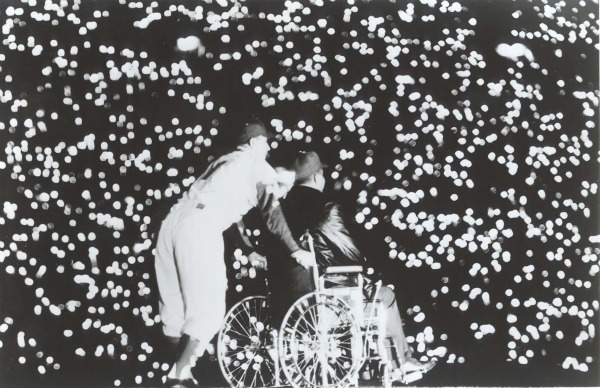
On a Thursday night, 93,103 fans -- most of whom were West Coast residents, and thus had never seen him play, and didn't really have an emotional connection to him -- came out, the largest crowd in baseball history (until 2008). The lights were turned out, and all 93,103 fans held lit candles aloft. The Yankees won the game, 6-2, and the proceeds were used to pay down Campy's medical bills.
Campy, pushed by former teammate Pee Wee Reese,
surrounded by 93,000 candles

In 1969, Campy was elected to the Baseball Hall of Fame, becoming the 2nd black player so honored, after Jackie Robinson. In 1972, in a pregame ceremony at Dodger Stadium, the Dodgers retired Campy's Number 39, Jackie's Number 42, and Sandy Koufax' Number 32. He remained in the Dodger organization until he died on June 26, 1993. He was 71 years old.

One more thing: Like O'Malley, Chicago Bears owner George Halas was known for his cheapness. O'Malley held a testimonial game to help pay for Campanella's medical bills. In 1969 and '70, when running back Brian Piccolo was dying of cancer, Halas paid his medical bills, and his funeral costs, in full.

When another catcher, the Yankees' Thurman Munson, went down in a plane crash in 1979, his injuries were such that, had he been rescued, he would have been paralyzed. I have no doubt that team owner George Steinbrenner would have paid Thurman's medical bills himself, and, with Roy Campanella Night in mind, would have invited the Dodgers to play an exhibition game at Yankee Stadium to raise money to start a new charity for spinal cord patients.

Walter O'Malley could have afforded that. He did not try. He did the minimum that was necessary for public relations, enough to show the people of Southern California that he wasn't the uncaring, greedy monster that New Yorkers thought he was, and that was it.

*

May 7, 1959 was, as I said, a Thursday. This was also the day that Philip Roth published his 1st book, the short story collection Goodbye, Columbus. I have a separate entry for this event.

Football, basketball and hockey were out of season. There were 4 regular-season Major League Baseball games played that day:

* The Pittsburgh Pirates beat the Philadelphia Phillies, 5-4 at Forbes Field in Pittsburgh. Roberto Clemente went 0-for-4. Ted Kluszewski won it for the Pirates with a home run in the bottom of the 10th inning, but would soon be traded to the Chicago White Sox, and helped them win their 1st American League Pennant in 40 years.

* The Baltimore Orioles beat the Washington Senators, 10-1 at Griffith Stadium in Washington. Harmon Killebrew went 1-for-4 for the Senators, who became the Minnesota Twins 2 years later, and were then replaced by a new Senators team that became the Texas Rangers in 1972. Brooks Robinson did not play for the Orioles.

* The Detroit Tigers beat the Boston Red Sox, 3-1 at Briggs Stadium in Detroit. (It was renamed Tiger Stadium in 1961.) Al Kaline went 0-for-3. Ted Williams did not play.

* And the St. Louis Cardinals beat the Chicago Cubs, 4-3 at Busch Stadium (which had been Sportsman's Park until 1953) in St. Louis. Ernie Banks went 2-for-4, Stan Musial 1-for-4, each with a solo homer.

Monday, March 28, 2022

March 28, 1970: Baseball Honors Dr. King

Left to right: Willie Mays, Tony PĂ©rez, Rico Carty

March 28, 1970: Major League Baseball interrupts its Spring Training with a benefit game at Dodger Stadium in Los Angeles. It is named the East-West Major League Baseball Classic, and is arranged by the players to honor the memory and support the causes of Dr. Martin Luther King Jr., who had been assassinated 2 years earlier.

All proceeds from the game went to the Southern Christian Leadership Conference, of which King had been President; and to the construction of the Dr. Martin Luther King Jr. Center in Atlanta.

The players' union, the Major League Baseball Players Association, had asked the SCLC for an idea of how to honor Dr. King. SCLC Sports Project Director Joseph Peters suggested a benefit game, and he contacted the Commissioner of Baseball, William "Spike" Eckert, who approved it. The game was originally set for Dodger Stadium on March 29, 1969, the last Saturday before the opening of the regular season, but the logistics of putting it together that fast proved to be too much, so the game was postponed a year.

The West team was managed by Roy Campanella, one of the earliest players to break baseball's color barrier. He had starred for the Brooklyn Dodgers for 10 years, before a car accident left him paralyzed, ending his career in 1958, while the Dodgers were in the process of moving to Los Angeles.
Roy Campanella (left) and Roberto Clemente

The East team was managed by Joe DiMaggio, the legendary center fielder for the New York Yankees, although he was then the hitting instructor for a West Coast team, the Oakland Athletics. (DiMaggio had grown up in San Francisco, but had been born in Martinez, California, on the Oakland side of San Francisco Bay.)

DiMaggio considered his managing gig for the MLK game a one-and-done affair, saying, "No, I never want to manage. Too much traveling. I can't take it." Campanella, however, always wanted to manage, and still did. It would be another five years before a baseball team hired a Black manager, when the Cleveland Indians appointed Frank Robinson.

For his coaching staff for the Los Angeles game, DiMaggio chose his former Yankee teammate Billy Martin, who had just been fired as manager by the Minnesota Twins; another former teammate, Hank Bauer, a recent casualty from the A’s; John McNamara, Bauer’s replacement as A's manager; and legendary Negro Leagues pitcher Satchel Paige.

For his coaching staff, Campanella chose Dodger pitchers Don Newcombe, Sandy Koufax, and Don Drysdale; St. Louis Cardinals legend Stan Musial; and Elston Howard, the 1st black player for the Yankees, who had been the 1st black coach in the American League. (The 1st in the National League, and the 1st in MLB, had been John "Buck" O'Neil, with the Chicago Cubs. He appears not to have been involved with this game.)

Most of the top players in baseball at the time volunteered to play. Willie Mays flew back and forth from Japan, where the San Francisco Giants were playing a series of exhibition games. He said, "This is too important to pass up... At last, baseball players can show their feelings about the late Dr. King and his work through the medium of this game."

Tom Seaver of the defending World Champion New York Mets left his team's training camp in St. Petersburg, Florida, flying in for the game, and then flying back. He said, "If Dr. King could give his life for a cause he believed in, the least I can do is give one day for it... I respected him for treating violence with nonviolence. For making people ashamed, not angry."

Jackie Robinson, modern baseball's 1st black player and another Dodger, watched from the stands, as did Hollywood stars such as Sammy Davis Jr. and Danny Kaye. Kaye had been a Dodger fan in Brooklyn before either he or they moved to Los Angeles. In 1977, when the Seattle Mariners debuted as an expansion team, he was part of their original ownership group.

A recording of King's "I Have a Dream" speech played over the Dodger Stadium loudspeakers. Remarks were made by Rev. H.H. Brookins, president of SCLC West, SCLC president Rev. Ralph Abernathy, and by the new Commissioner, Bowie Kuhn.

Pitcher Jim "Mudcat" Grant, then a pitcher for the Oakland Athletics, did not play in the game, but he did sing the National Anthem to great acclaim. Dr. King’s widow, Coretta Scott King, threw the ceremonial first pitch to the West team's catcher, Johnny Bench.

Tickets sold for as little as $2 for a bleacher seat and up to $10 for a box seat -- about $75 in 2022 money. Attendance was announced as 31,694, meaning Walter O'Malley's monument to his own greed was about 56 percent full. The game was blacked out in Los Angeles. In a last-minute deal, KTLA-Channel 5 in Los Angeles acquired the rights to show the game the next day, a Sunday, at 12:30 PM. SCLC reported the proceeds from the game as $30,000 -- about $226,000 in 2022 money.

The starting lineups: For the East

LF Ron Fairly, Montreal Expos
CF Reggie Smith, Boston Red Sox
RF Frank Robinson, Baltimore Orioles
1B Willie Stargell, Pittsburgh Pirates
3B Ron Santo, Chicago Cubs
SS Ernie Banks, Chicago Cubs
2B Mike Andrews, Boston Red Sox
C Tim McCarver, Boston Red Sox
P Tom Seaver, New York Mets

DiMaggio chose Fairly and Smith for his starting outfield over future Hall-of-Famers Roberto Clemente of the Pittsburgh Pirates, Al Kaline of the Detroit Tigers, and Lou Brock of the St. Louis Cardinals. The Cardinals' Bob Gibson became his 1st reliever, after Seaver had pitched 3 innings.

For the West:

SS Maury Wills, Los Angeles Dodgers
LF Pete Rose, Cincinnati Reds
RF Hank Aaron, Atlanta Braves
CF Reggie Jackson, Oakland Athletics
C Johnny Bench, Cincinnati Reds
1B Orlando Cepeda, Atlanta Braves
2B Joe Morgan, Houston Astros
3B Sal Bando, Oakland Athletics
P Earl Wilson, Detroit Tigers

Mays came to bat once, as a pinch-hitter. He had flown 12,000 miles from Tokyo, round-trip, to do this.

With the pageantry, the game itself couldn't help but be an anti-climax. Justifying his selection by the Yankee Clipper, Fairly hit a home run, and was named the game's Most Valuable Player. Santo also hit a home run. Kaline (white), Brock (black) and Clemente (Hispanic) did all get into the game, and, in the 8th inning, Kaline singled, Brock doubled him home, and Clemente doubled Brock home. The East won, 5-1.

When the game was over, Banks, already famous for the slogan, "It's a beautiful day for a ballgame, let's play two!" beamed and said, "I'm ready to play another game, aren't you?" Said Santo, his Cub teammate, "This is the first game they've had like this, and I'm really honored to have played in it." Campanella said, "I thank these fellas for giving their time. I don't feel bad about losing."

Rose filed a column for the Cincinnati Enquirer, writing, "I played a baseball game Saturday that meant an awful lot to me. It was more than just another game and even though it was an exhibition game it had meaning. In this game I felt I did some good for my country. I believe I've got to help any way I can and this is my way of doing it."

*

March 28, 1970 was a Saturday. Actor Vince Vaughn was born. This was also the day of the NCAA Wrestling Championships, where Dan Gable lost as an amateur wrestler for the only time in his career. I have a separate entry for that event.

Baseball was otherwise in Spring Training. Football was out of season. One game was played in the NBA. Appropriately, it was in Dr. King's hometown: The Atlanta Hawks beat the Chicago Bulls, 124-104 at the Alexander Memorial Coliseum (now the McCamish Pavilion), on the Georgia Tech campus in Atlanta. Three games were played in the American Basketball Association:

* The New York Nets lost to the New Orleans Buccaneers, 100-92 at the New Orleans Municipal Auditorium. After this season, the Bucs would become the Memphis Pros, then the Memphis Tams, then the Memphis Sounds, and fold in 1975. The Nets would enter the NBA in 1976, moving to New Jersey in 1977 and Brooklyn in 2012. 

* The Kentucky Colonels beat the Carolina Cougars, 101-98 at the Greensboro Coliseum in Greensboro, North Carolina. The Cougars became the Spirits of St. Louis in 1974. The Spirits and the Colonels both survived to the end of the ABA in 1976, but neither team was admitted to the NBA.

* And the Dallas Chaparrals beat the Denver Rockets, 150-126 at the Moody Coliseum in Dallas. Both of these teams still exist, though not under those names: The Chaparrals became the San Antonio Spurs in 1973; and the Rockets, anticipating entering the NBA, which already had the Houston Rockets, took on the name of the 1st NBA team from their city, the Denver Nuggets. Both teams entered the NBA in 1976, along with the Nets and the Indiana Pacers.

There were 5 games in the NHL:

* The New York Rangers and the Montreal Canadiens played to a tie, 1-1 at the Montreal Forum.

* The Boston Bruins and the Detroit Red Wings played to a tie, 5-5 at the Boston Garden.

* The Pittsburgh Penguins beat the Philadelphia Flyers, 2-1 at The Spectrum in Philadelphia.

* The Chicago Black Hawks and the Toronto Maple Leafs played to a tie, 1-1 at Maple Leaf Gardens in Toronto.

* The Los Angeles Kings beat the Minnesota North Stars, 4-2 at The Forum outside Los Angeles in Inglewood, California.

* And the St. Louis Blues and the California Golden Seals were not scheduled.

And in English soccer, Arsenal played Birmingham-area team Wolverhampton Wanderers to a draw, 2-2 at the Arsenal Stadium, a.k.a. Highbury, in North London.

Friday, January 28, 2022

January 28, 1958: The Crash of Roy Campanella

Campy at Ebbets Field, the day demolition began,
February 23, 1960

January 28, 1958: Roy Campanella is paralyzed when his 1957 Chevrolet sedan slips on ice and crashes, less than a mile from his home in Glen Cove, Long Island, New York. At age 36, his baseball career should have had at least another couple of years left.

The Brooklyn Dodgers were in the process of moving from Ebbets Field to the Los Angeles Memorial Coliseum, waiting for Dodger Stadium to be built. The close left-field fence at the Coliseum would have been perfect for Campy's swing.

Because of racism at the beginning of his career, and his accident at the end, he only had 10 seasons in the major leagues, 1948 to 1957, hitting 260 home runs. He should have had at least 400; without the crash, at least 300 would have been likely.

He regained some movement in his arms and hands, but he lived the last 35 years of his life in a wheelchair. After his former teammate Jackie Robinson, he became, in 1969, the 2nd black player elected to the Baseball Hall of Fame.

Campanella wrote his autobiography, It's Good to Be Alive, which was published in 1959. Michael Landon directed Paul Winfield in a CBS movie based on it, starring Paul Winfield.

Family legend has it that my grandparents took my mother to Ebbets Field sometime before his crash, and my mother, just a small child, and only having seen the team on black & white TV to that point, said, "Where's Campy?" In 1986, I got to see Campy and his Dodger teammates Duke Snider, Pee Wee Reese and Sandy Koufax at the Baseball Hall of Fame's induction ceremony in Cooperstown, New York. (Robinson and manager Walter Alston were already dead. So was Gil Hodges, who would not be elected until 2021.)

*

January 28, 1958 was a Tuesday. Baseball and football were out of season. And no games were scheduled in the NHL.

There were 2 games in the NBA, and there were played as a doubleheader at the old Madison Square Garden. In the opener, the St. Louis Hawks beat the Philadelphia Warriors, 123-109. In the nightcap, the New York Knicks lost to the Syracuse Nationals, 110-102.

December 31, 1999 & January 1, 2000: The Millennium

December 31, 1999:  The Millennium arrives. The people of planet Earth survived. At a terrible cost. But we hadn't destroyed ourselves. ...