Showing posts with label police brutality. Show all posts

Thursday, November 3, 2022

November 2, 1971: Frank Rizzo Is Elected Mayor of Philadelphia

November 2, 1971: Frank Rizzo is elected Mayor of Philadelphia. This is cheered by many, and feared by many others.
Francis Lazzaro Rizzo was born on October 23, 1920 in Philadelphia. After serving in World War II, he became a policeman, and in 1967 rose to become Commissioner. At that time, Philadelphia had one of the highest percentages of black policemen of any major city, 21 percent, with 27 percent of new hires being black. But by the time Frank Rizzo left the office to run for Mayor in 1971, the percentage was down to 18 percent, and the hiring rate to 8 percent. His other actions, including raiding a Black Panther Party office in 1970, also led to the perception that he was racist.
When he ran in 1971, he had a 3-word platform: "Firm but fair." Getting the support of the city's labor unions, as well as people afraid of crime, he won the Democratic Primary, defeating Congressman Bill Green, among others; and then the general election, defeating Thacher Longstreth, a Republican who was on the City Council. Rizzo won 52.8 percent of the popular vote, Longstreth 46.4. His margin of victory in the popular vote was 48,000 votes.
Taking office on January 3, 1972, he acted as though he had won in a landslide. Former District Attorney (1952-56) and Mayor Richardson Dilworth (1956-62) accused him of using the police for political espionage. Later in the year, Rizzo crossed party lines, and endorsed President Richard Nixon for re-election. He thought it would get the city more federal funding, and he was right.
Certainly, Rizzo governed like he was Nixon's kind of guy. As the comedian Dick Smothers would have said, That was not a compliment. It alienated the city's Democrats and the city's media. Rizzo famously got into a feud with City party chairman Peter Camiel, and both men took a lie-detector test. Camiel passed his test, Rizzo flunked his, and thus ended Rizzo's 1974 campaign for Governor of Pennsylvania.
It didn't stop him from riding the city's white neighborhoods to get re-elected Mayor in 1975. It didn't help that the opposition to him was divided, between the Republican nominee, Councilman (and later Congressman) Tom Foglietta, and a 3rd-party campaign by Charles Bowser, executive director of the Philadelphia Anti-Poverty Action Committee (and later a Deputy Mayor). It was no contest: Rizzo won 57 percent of the vote, Bowser 24, Foglietta 18.
Rizzo had his landslide, and his mandate. He had told one of his cops, John Timoney, later to serve as Commissioner, "Just wait after November. You'll have a front row seat, because I'm going to make Attila the Hun look like a faggot."
He got the Center City Commuter Connection built, uniting the former Pennsylvania and Reading Railroads under the commuter umbrella of the SouthEastern Pennsylvania Transportation Authority (SEPTA). As part of this, he got Market East Station (now named Jefferson Station) and The Gallery at Market East shopping mall built, although neither was completed until after he left office.
But there was, indeed, more police brutality on his watch. It didn't help that he hired his brother Joseph as Fire Commissioner. A move to recall him failed on constitutional grounds before it could be put on the ballot.
Like Rudy Giuliani and Mike Bloomberg in New York a generation later, he tried to get the law changed to allow himself to run for a 3rd term in 1979. Like Giuliani in 2001 but unlike Bloomberg in 2009, Rizzo failed, as Bowser led a legal effort to stop it. Bill Green, one of his defeated 1971 opponents, was elected, winning 52 percent of the vote in a 3-way race.
Rizzo ran again in 1983, still officially a Democrat. His main opponent was Wilson Goode, the Commissioner of the Public Utility Commission, running to be the city's 1st black Mayor. Rizzo made the mistake of telling people, "Vote white," and enough people of all races were angered enough that Goode got 52 percent of the vote, to Rizzo's 43. Goode won the general election. Rizzo ran again in 1987, finally having officially switched to the Republican Party, and it was close: Goode got 51.1 percent, Rizzo 48.9, with a 14,000-vote margin of victory.
In 1991, with Goode term-limited, Rizzo, at age 70, made his 5th run for Mayor (or his 6th, depending on how you look at it). He just barely won the Republican nomination over State Supreme Court Justice Ronald Castille, a margin of 1,400 votes. He was preparing to face Ed Rendell, former District Attorney (1978-86) and an unsuccessful Mayoral candidate in 1987.
Like former segregationists George Wallace and Strom Thurmond before him, Rizzo knew that his views made him a relic of a time when racism was much more common. He knew he had to adjust to a new political reality. On July 12,  he walked through the largely black 52nd Street neighborhood in West Philadelphia with community leaders. It seemed to help his chances. But, 4 days later, on July 16, he suffered a fatal heart attack at his campaign headquarters, and died.
Instead of nominating the runner-up, Castille, the Republicans nominated Joseph M. Egan Jr., a longtime economic development figure in the city, to take Rizzo's place on the ballot. Rendell won easily, was re-elected in 1995, was elected Governor in 2002 and 2006, and also served as Chairman of the Democratic National Committee.
On January 1, 1999, a statue of Rizzo was unveiled, in front of the Municipal Services Building, across the street from the north front of City Hall. The new statue of Civil War-era baseball player and black activist Octavius Catto is on the south side of City Hall. I wish it was on the north side, so he could have stared Rizzo down. On June 3, 2020, accepting the will of the Black Lives Matter protests, Rizzo's statue was removed.
Frank Rizzo Jr. was elected as a Republican to the City Council, serving from 1996 to 2012.
*
November 2, 1971 was a Tuesday. In spite of the time of year, there was 1 baseball result worth reporting: The Baltimore Orioles' Pat Dobson pitched a no-hitter against the Tokyo-based Yomiuri Giants‚ winning 2-0 at Korakuen Stadium in Tokyo. It was the 1st no-hitter in the history of exhibition games between Japanese and American teams. The Orioles compiled a record of 12-2-4 on their tour of Japan.
Football was in midweek. There were 2 games in the NBA. The Chicago Bulls beat the Phoenix Suns, 108-101 at the Chicago Stadium. And the Golden State Warriors beat the Baltimore Bullets, 106-91 at the Oakland Coliseum Arena. Cazzie Russell scored 43 points for the Warriors.
There were 4 games in the American Basketball Association:
* The Kentucky Colonels beat the Memphis Pros, 123-109 at the Mid-South Coliseum in Memphis.
* The Indiana Pacers beat the Carolina Cougars, 137-116 at the Indiana State Fair Coliseum (now the Corteva Coliseum) in Indianapolis. Jim McDaniels led all scorers on the night with 45 points.
* The Denver Rockets beat the Pittsburgh Condors, 133-114 at the Auditorium Arena in Denver. Ralph Simpson (not to be confused with Ralph Sampson) scored 42 points for the team that would later become the Denver Nuggets.
* And the Virginia Squires beat the Utah Stars, 122-119 at the Salt Palace in Salt Lake City, Utah.
And there were 5 games in the NHL:
* The New York Rangers beat the Vancouver Canucks, 3-1 at the Pacific Coliseum in Vancouver.
* The Montreal Canadiens beat the Chicago Black Hawks, 2-1 at the Montreal Forum.
* The Boston Bruins beat the Detroit Red Wings, 2-1 at the Olympia Stadium in Detroit.
* The Minnesota North Stars beat the St. Louis Blues, 5-1 at the Metropolitan Sports Center in the Minneapolis suburb of Bloomington, Minnesota.
* And the Toronto Maple Leafs beat the Los Angeles Kings, 3-2 at The Forum outside Los Angeles in Inglewood, California.

Friday, September 16, 2022

September 16, 1992: The Giuliani Police Riot

September 16, 1992: Thousands of off-duty police officers crowd in front of New York’s City Hall to protest against Mayor David Dinkins.

The cops were there to oppose a bill that would have removed the police from the city's Civilian Complaint Review Board, an oversight body that handled allegations of police misconduct, and, crucially, would have made it independent of the Police Department itself. Faced with the prospect of potentially greater civilian accountability, New York City police officers took their anger to the streets.

"The cops held up several of the most crude drawings of Dinkins, black, performing perverted sex acts," Jimmy Breslin, the great New York newspaper columnist then working for Newsdaywho was present at the riot, wrote. "'Now you got a n****r right inside City Hall,' one officer reportedly said," Breslin continued. "'How do you like that? A n****r mayor.'" Other officers chanted slogans like "Dinkins gotta go!" and "The mayor's on crack!"

"The mayor doesn’t know why the morale of the New York City Police Department is so low," he said, jabbing his finger in the air. "He blames it on me, he blames it on you. The reason the morale of the Police Department of the City of New York is so low is one reason and one reason alone: David Dinkins!"

Giuliani had risen to fame in the mid-1980s, as a U.S. Attorney for Manhattan, prosecuting criminals both low-class, like the Mafia, and high-class, like Wall Street insider traders. He ran for Mayor in 1989, and it was close: Dinkins, then the Borough President of Manhattan, won 50.4 percent of the vote, while Giuliani won 47.8. Dinkins' margin of victory was 47,080, and he became the City's 1st black Mayor.

Crime, rising in New York ever since World War II, peaked in 1990, then started to go down. But events such as the Crown Heights riot of 1991, and the New York media's twisting of events to favor their conservative owners, made Dinkins look like he didn't care about white people. In 1993, Giuliani won a rematch, getting 49.2 percent of the vote, Dinkins 46.4. Giuliani won by 53,367 votes, becoming the City's 1st Republican Mayor elected since John Lindsay in 1965, and its 1st Italian Mayor since Fiorello La Guardia was last elected in 1941.

What made the difference? Giuliani gained 28,000 votes in Brooklyn, 26,000 in Staten Island, 21,000 in Manhattan, 17,000 in Queens, and 8,000 in The Bronx. So it was a Republican get-out-the-vote effort in Staten Island, the whitest, most conservative Borough; but it was also fear of white liberals in Manhattan and Brooklyn. In particular, Jewish votes in both of those Boroughs shifted. Giuliani particularly pandered to Orthodox Jews in Brooklyn, led by State Senator Dov Hikind, officially a Democrat, but a very conservative man.

Giuliani never acknowledged or condemned the racism of the 1992 police riot. And his Administration, from January 1, 1994 to December 31, 2001, would have some notorious examples of police brutality. After leaving office, without having to face the voters again, he drifted even further to the right, eventually providing legal counsel for Donald Trump, causing him, as of September 16, 2022, to need legal counsel of his own.

UPDATE: As Jamelle Bouie put it in a column for the August 18, 2023 edition of The New York Times, "The line from 'America's mayor' to indicted co-conspirator is a straight one. The answer to What happened to Rudy Giuliani? is Nothing happened. He is the same man he’s always been."

*

September 16, 1992 was a Wednesday. These Major League Baseball games were played that day:

* The New York Yankees lost to the Chicago White Sox, 9-6 at Yankee Stadium. Don Mattingly went 3-for-5, but Sterling Hitchcock was knocked out of the box in the 3rd inning. and Curt Young barely finished the 5th.

* The New York Mets lost to the St. Louis Cardinals, 10-4 at Shea Stadium.

* The Montreal Expos beat the Pittsburgh Pirates, 6-3 at Three Rivers Stadium in Pittsburgh. Barry Bonds went 2-for-5.

* The Boston Red Sox beat the Milwaukee Brewers, 2-1 at Fenway Park in Boston. Bob Zupcic grounded into a fielder's choice to get the winning run home in the bottom of the 15th inning. Wade Boggs did not play. Paul Molitor went 3-for-7 with an RBI, but Robin Yount went 0-for-5 with 2 walks.

* The Baltimore Orioles beat the Kansas City Royals, 3-0 at Camden Yards in Baltimore. Mike Mussina pitched a 4-hit shutout. Cal Ripken went 3-for-4.

* The Cleveland Indians beat the Toronto Blue Jays, 6-3 at the SkyDome (now the Rogers Centre) in Toronto.

* The Atlanta Braves beat the Cincinnati Reds, 3-2 at Riverfront Stadium in Cincinnati.

* The Detroit Tigers beat the Texas Rangers, 4-1 at Tiger Stadium in Detroit.

* The Chicago Cubs beat the Philadelphia Phillies, 14-9 at Wrigley Field in Chicaog.

* The Houston Astros beat the San Francisco Giants, 3-1 at the Astrodome in Houston.

* The San Diego Padres beat their arch-rivals, the Los Angeles Dodgers, 3-1 at Jack Murphy Stadium in San Diego.

* The Oakland Athletics beat the Minnesota Twins, 4-2 at the Oakland Coliseum. Rickey Henderson went 1-for-3 with a walk and a stolen base.

* And the California Angels beat the Seattle Mariners, 2-1 at the Kingdome in Seattle. Luis Sojo singled home the winning run in the top of the 13th inning. Ken Griffey Jr. went 0-for-4 with a walk, and was hit with a pitch.

Thursday, September 1, 2022

September 1, 2016: Colin Kaepernick Takes a Knee

September 1, 2016: The San Francisco 49ers beat the San Diego Chargers, 31-21 at Qualcomm Stadium in San Diego, in their last preseason game. Like any preseason game, the result doesn't matter. This time, it mattered less than ever.

Instead of standing while the National Anthem, "The Star-Spangled Banner," was played before the game, 49er quarterback Colin Kaepernick got down on one knee for the duration of the song.

He did this in protest of the many recent cases of police brutality. This earned him a bit of praise, and also a lot of nasty blowback from racists, who said he was "disgracing the Anthem" and "disgracing the American flag."

These people were not idiots: They were liars. It didn't have a damned thing to do with the flag. It has to do with white cops murdering unarmed black suspects who have been convicted of nothing, and knowing they will get away with it, because the men in power let them get away with it.

But they managed to redefine his protest, so that people didn't get the message that police brutality was a problem.

As a result, nothing changed. That was my only problem with the gesture: It didn't work. But he kept on doing it long after it became obvious that racist cops were still going to beat, and sometimes even murder, unarmed black people.

The people who attacked Kaepernick for his protest were not only disrespecting the 1st Amendment, one of the biggest things for which the flag stands. If they didn't respect his right, then the flag they claimed to love so much means nothing. By attacking Kaepernick for his protest, they were endorsing the cold-blooded murder of unarmed black people by white cops.

See? That's an extreme way to put it, but such a thing works both ways. If Kap is "un-American," then those people were racist. Or, they could have simply admitted that Kap has a point, and try to take that point away from him, by taking steps to solve the problem. That way, everybody would have won. Except the actual racists.

The 49ers went on to have a horrible season, 2-14. Statistically, Kaepernick wasn't much below what he had previously done, including taking the 49ers to Super Bowl XLVII in the 2012 season. In 2016, he completed 59.2 percent of his passes, for 2,241 yards, 16 touchdowns and only 4 interceptions. He also rushed for 468 yards. The position of quarterback was not the 49ers' problem.

Their defense was the problem: Following a 28-0 win over the Los Angeles Rams in their regular-season opener, they allowed the 6-10 Carolina Panthers to score 46, the 7-9 Buffalo Bills to score 45, the 7-9 New Orleans Saints and the Atlanta Falcons to each score 41, the Seattle Seahawks to score 37, the Tampa Bay Buccaneers to score 34, the Arizona Cardinals to score 33, the Miami Dolphins to score 31, and the New England Patriots to score 30.

Their only other win came near the end of the season, also over the 4-12 Rams, on Christmas Eve. Of their 14 losses, only 5 were within 7 points, so even if they'd won all of those, they still would have been 7-9 and missed the Playoffs. Head coach Chip Kelly and general manager Trent Baalke were both fired.

On New Year's Day, January 1, 2017, with Donald Trump, who called Kapernick "that son of a bitch" in a public speech, having ridden a wave of bigotry -- and Russian meddling -- to become President-elect, the 49ers lost their season finale to the Seahawks, 25-23. Kaepernick completed 17 out of 22 passes, for 215 yards, throwing a touchdown pass, and no interceptions. He was 29 years old, hardly old for a quarterback.

He has never thrown another professional pass, in any league on Earth. You see, in the NFL, you can do anything you want, as long as you don't embarrass your team or the League. Once you do that, they are done with you. And Kaepernick had embarrassed the National Football League. Other leagues, such as the Canadian Football League, didn't want him to do the same to theirs, so they didn't sign him, either.

He wasn't banned, he was -- pardon the choice of word, which originally had nothing to do with race -- blackballed. As Mike Lupica insinuated in his column in the New York Daily News, every single team organization in the NFL, some of whom desperately needed improvement at the position of quarterback, was sending a message: "We would rather go 0-16 for what would have been the rest of Colin Kapernick's career than have him play for our team."

A corollary to that message could have been, "We would rather have bigots pay for tickets, parking, food, souvenirs, etc. than take the money of Kaepernick's supporters." But even that didn't really enter into it. Every bigot is an asshole, but not every asshole is a bigot. For the team owners, this wasn't about money. If there is one thing that a rich person values more than money, it is control. And the NFL team owners could not control Colin Kaepernick.

UPDATE: On February 2, 2020, with Jimmy Garappolo as quarterback, the 49ers played in Super Bowl LIV, losing to the Kansas City Chiefs, 31-20. On January 20, 2023, the 49ers were in the NFC Championship Game, playing the Philadelphia Eagles at Lincoln Financial Field in Philadelphia. In the 2022 season opener, Trey Lance was their starting quarterback, but he got hurt on September 18. From then until December 4, it was Jimmy Garoppolo, but he was injured. From then onward, it was Brock Purdy, but he was injured early in that Championship Game. They had signed a previous quarterback, Josh Johnson, as an emergency backup after the December 4 game, and he stepped in for the NFC Championship, but left the game with a concussion in the 3rd quarter. Purdy was pressed back in for emergency duty, and threw 4 passes, completing them all, but for a total of 23 yards. The Niners lost, 31-7.

Colin Kaepernick was 35 years old. He should still have been their starter. If he had been, they might have won a 6th Super Bowl, and even a 7th.

*

September 1, 2016 was a Thursday. As I said, the NFL was still in preseason, so their scores on this historic day mean nothing. But there were 4 games played in Major League Baseball:

* The New York Mets lost to the Miami Marlins, 6-4 at Citi Field. The winning pitcher was José Miguel Ureña. The losing pitcher was Jacob deGrom, who gave up 3 runs on 6 hits and 4 walks in only 5 innings. Jay Bruce and Asdrúbal Cabrera hit home runs for the Metropolitans, but Christian Yelich went 3-for-4 with a home run and 4 RBIs for the Fish.

* The Atlanta Braves beat the San Diego Padres, 9-6 at Turner Field (now Center Parc Stadium) in Atlanta.

* The Chicago Cubs beat the San Francisco Giants, 5-4 at Wrigley Field in Chicago.

* And the Minnesota Twins beat the Chicago White Sox, 8-5 at Target Field in Minneapolis.

Sunday, August 28, 2022

August 28, 1964: The North Philadelphia Riot

August 28, 1964: A race riot breaks out in North Philadelphia, lasting 3 days, and revealing to the nation a latent racism that had infected "The City of Brotherly Love," and the birthplace of the nation and its Constitution.

At the time, the population of Philadelphia was a shade over 2 million, making it the 4th-largest city in the country behind New York, Chicago and Los Angeles. The city was about 65 percent white, 33 percent black, and almost no Hispanics or Asians lived there. About 2/3rds of the city's black population lived in North Philadelphia, with most of the rest in West Philadelphia.

But being "the Birthplace of Liberty" didn't help much. When Jackie Robinson integrated Major League Baseball in 1947, it was the city's baseball team, the Philadelphia Phillies, that offered the loudest and most noxious resistance. In 1950, the Phillies, with a young team known as the "Whiz Kids," became the last all-white team to win the National League Pennant. They didn't integrate until 1957, the last NL team to do so.

By 1964, the Philadelphia Police Department had made a conscious effort to hire black cops, and sending integrated patrol car units in black neighborhoods: One white uniformed officer, one black uniformed officer. And a civilian review board had been established to handle cases of police brutality. And with the Civil Rights Act of 1964 having just been passed, hopes were high.

But New York's Harlem had broken out in a race riot a few days before, following a case of police brutality. And it would be one of those that would spark the riot in North Philadelphia -- and another in Watts in Los Angeles the next year, and another on the East Side of Cleveland and another on the West Side of Chicago the year after that, and others in Newark and Detroit and other cities the year after that.

Still, this had been a good Summer for Philadelphia. There hadn't been much rain, the Jersey and Delaware beaches were clean in those days, and the Phillies were in first place. But things had already begun to go wrong on many fronts, and this riot was a convenient historical landmark.

On August 28, 1964, Odessa Bradford was driving her husband Rush Bradford, both of them black, and they started arguing. She pulled over at the corner of 22nd Street and Columbia Avenue. A police car pulled up to Ms. Bradford's car. Inside were black officer Robert Wells and white officer John Hoff. Ms. Bradford, still angry, began taking her anger out on the officers. They tried to remove her from her car. A man came to her aid by attacking the officers, and he and Ms. Bradford were both arrested.

As would later happen with Watts in 1965 and Newark in 1967, a rumor spread that a black person taken into custody by the police had been killed by them. In this case, the rumor was that it was a pregnant black woman, beaten to death. As with those two later cases, the rumor wasn't true, but by the time anyone found out, it was too late. Ms. Bradford was neither pregnant nor beaten, but she did say, "If that policeman had only treated me like a human being, none of this (rioting) would have happened."

Indeed, once she was released, Cecil B. Moore, President of the city's chapter of the NAACP, drove her around the neighborhood on a truck with a loudspeaker, allowing her to say, "I'm alive! I'm alive!" But it did no good.

I have looked for a reference as to whether Ms. Bradford is still alive, but I haven't found it. I have found 50th Anniversary articles on the riot from 2014, and none had an interview with her, so I suspect she was already dead by that point. Moore was elected to the City Council in 1976, and died in office in 1979. In 1987, Columbia Avenue was renamed Cecil B. Moore Avenue in his memory.
Cecil B. Moore

Moore's efforts were in vain. As with Harlem, many of the businesses in the mostly-black neighborhood were mostly-white-owned. (This led black business owners in later riots to paint "SOUL BROTHER" on their windows, in the hopes of their stores being spared.)

Depending on whose story you believe, nobody died in the rioting, or one person did. (If there was one, it was not Odessa Bradford.) There were 341 injuries, 774 arrests, and 225 stores damaged.

The epicenter, 22nd and Columbia, was about a mile south of Connie Mack Stadium, home of the Phillies since 1938, and home of the now-departed Philadelphia Athletics from 1909 to 1954. It had been named Shibe Park until 1953. The epicenter was also 7 blocks east of the site of the 1st home of the A's, Columbia Park, where they played from 1901 to 1908.

The Phillies were in Pittsburgh at the time of the riot, so it didn't result in any games being postponed. But it scared white fans, who may already have been wary of getting mugged coming down Lehigh Avenue out of the subway, or of their cars getting vandalized if they drove in.

The Phils had 15 home games left, not counting 2 rainout makeups, and the average attendance was 21,265. They really didn't have a home-field advantage the rest of the way, and this may have contributed to the 10-game losing streak that took them from being 6 1/2 games in 1st place with 12 games to go, to finishing 1 game out.

Philadelphia has had racial tension since. In 1971, Police Commissioner Frank Rizzo was elected Mayor on an openly racist platform. In 1975, despite having been caught in corruption, he ran for re-election on white backlash, and won again. He knew he couldn't run for a 3rd term, partly due to his 1977 overreaction to the black nationalist group MOVE. But the city's 1st black Mayor, Wilson Goode, had an even worse overreaction to them in 1985.

Today, the population of Philadelphia is about 1.6 million, ranking 6th behind New York, L.A., Chicago, Houston and Phoenix. It's about 40 percent black (mostly living west of Broad Street in North, West, and Southwest Philly), 37 percent white, 15 percent Hispanic, and 8 percent Asian. It is more diverse than ever before. But that underlying tension remains.

*

August 28, 1964 was a Friday. Golfer Lee Janzen was born. This was also the day that Bob Dylan met The Beatles. I have a separate entry for that event.

It was the off-season for the NFL, the AFL, the NBA and the NHL, but games were played in Major League Baseball:

* As mentioned, the Philadelphia Phillies were playing the Pittsburgh Pirates, at Forbes Field in Pittsburgh. The Pirates won, 4-2. The Phillies took a 2-0 lead in the top of the 8th, but blew it in the bottom of the 9th, thanks to Smoky Burgess' home run.

* The New York Yankees lost to the Boston Red Sox, 5-3 at Yankee Stadium. Felix Mantilla, the former Milwaukee Brave and original Met, and Dick Stuart, the powerful slugger but awful-fielding 1st baseman known as "Dr. Strangeglove," both hit home runs off Al Downing. Joe Pepitone hit one for the Yankees, but Mickey Mantle went 0-for-4.

* The New York Mets beat the Chicago Cubs, 12-10 at Wrigley Field in Chicago.

* A doubleheader was split at Memorial Stadium in Baltimore. The Chicago White Sox won the 1st game, 2-1. The Baltimore Orioles won the 2nd game, 8-3.

* The San Francisco Giants beat the Milwaukee Braves, 3-2 at Milwaukee County Stadium. Willie Mays went 1-for-2 with a 2-run home run, and Hank Aaron went 1-for-2 with 2 walks. Joe Torre hit a home run for the Braves.

* The Washington Senators beat the Minnesota Twins, 3-1 at Metropolitan Stadium in the Minneapolis suburb of Bloomington, Minnesota.

* The St. Louis Cardinals beat the Los Angeles Dodgers, 5-3 at the original Busch Stadium (formerly Sportsman's Park).

* The Cleveland Indians beat the Kansas City Athletics, 4-1 at Kansas City Municipal Stadium.

* The Detroit Tigers swept a doubleheader from the Los Angeles Angels at Dodger Stadium in Los Angeles, where the Angels played from 1962 to 1965 while waiting for their stadium in Anaheim to be built. The Tigers won the opener, 12-1; and the nightcap, 8-7.

* The Cincinnati Reds were supposed to host the Houston Colt .45s at Crosley Field in Cincinnati, but the game was rained out. They played a doubleheader the next day, and the Reds swept it. They won the 1st game, 2-1, on a walkoff single by Steve Boros in the 11th inning. They won the 2nd game, 8-7. The Colt .45s changed their name to the Astros the next season.

Wednesday, July 13, 2022

July 13, 1967: The Newark Riots

July 13, 1967: Riots break out in Newark, New Jersey, over the issue of racial injustice. There were 26 deaths, over 700 injuries, and over 1,400 arrests.

My parents both grew up in Newark, in the 1950s. My mother taught me that, up until the riots, Newark was fantastic, with a thriving downtown shopping and entertainment district. Those things were, indeed, thriving.

But my father's 1964 yearbook from the Newark College of Engineering -- which merged with the New Jersey School of Architecture in 1973, forming the New Jersey Institute of Technology (NJIT) -- used these specific words to describe the city, 3 years before the riots: "Newark needs our help."

And Tom Hayden, in between writing The Port Huron Statement, the founding document of the Students for a Democratic Society in 1962, and his participation in the 1968 events that got him indicted as one of the Chicago Eight, worked in Newark with the Economic Research and Action Project (ERAP). His writing on the subject showed just how devastating urban poverty could be for black people -- and got him unwanted attention from the old version of the FBI run by J. Edgar Hoover, without which he probably wouldn't have been noticed in Chicago.

There had, of course, been racial disturbances in the years leading up to this. Birmingham, Alabama in 1963, except that wasn't the civil rights demonstrators doing the rioting, it was the police with their response. In 1964, New York's Harlem, and North Philadelphia. In 1965, the Watts section of Los Angeles. In 1966, the East Side of Cleveland and the West Side of Chicago.

At 9:40 PM on July 12, 1967, Newark Police officers John DeSimone and Vito Pontrelli pursued and pulled over a taxicab. It was driven by a black man, John William Smith. The officers discovered that he was driving with a revoked license. (Driver's license, not taxi license.) But he was desperate for money, and kept driving his cab.

Had he been white, he probably would have been let off with a warning. Instead, he was arrested, beaten on the scene, and taken to the 4th Precinct house at 247 16th Avenue, across from West Side Park. A rumor went around that he had been beaten to death inside. There was no social media then, and a lot of Newark's slums didn't even have telephones, so this was mostly word of mouth. A crowd gathered outside the precinct house, and began throwing things through the windows.
The 4th Precinct house, 2022

The Congress of Racial Equality (CORE) was contacted. They demanded to see Smith, and upon seeing his injuries, demanded that he be taken to Beth Israel Hospital. This was done. Things began to calm down. If that had been the end of it, we wouldn't be talking about the Newark Riots for the last 55 years.

On July 13, civil rights groups met with Mayor Hugh Addonizio. First elected to Congress in 1948, he first ran for Mayor of Newark in 1962, saying he wanted the job "because you can make a million dollars there."

The demands he received were as follows: Suspend the arresting officers, conduct an investigation, and promote the highest-ranking black person on the NPD, Lieutenant Eddie Williams, to Captain.

A reasonable man would have done all 3. Addonizio said he needed 48 hours to consider the demands. When word of that got out, a protest was set, and the organizers lost control. Again, the windows of the 4th Precinct were smashed, and a police car was set on fire. (No one was in it.) Then the rioters went down Springfield Avenue, the main drag of the Central Ward, and started smashing and looting things there.

All police were placed on emergency duty. At 1:00 AM on July 14, all officers were ordered to "fire if necessary." At 2:20, Addonizio called Governor Richard J. Hughes, calling for the New Jersey State Police to come as reinforcements. Ten minutes later, he called again, asking for the New Jersey National Guard. Hughes sent both. It took 3 days and change for it to be enough, until July 17. 

My father was in the U.S. Army, at this heightening point of the Vietnam War, stationed along the Korean Demilitarized Zone, knowing that, at any moment, thousands of Communist soldiers could come pouring over the border, but they never did.

Meanwhile, my mother, who married him only 2 months earlier, had to get from home in the Forest Hill section in the North Ward to her job Downtown, and on the bus, she heard shooting. She was in more of a war zone than he was, and she had no way of knowing who was firing the shots she heard: The rioters, the people protecting their businesses, street vigilantes, the NPD, the State Police, or the National Guard.

The riots ended. Mom survived. Dad was discharged in August 1968, and in February 1969, they got out of their hometown, and found a garden apartment in adjoining Bloomfield, close enough to the people and the things they loved, but safe. I was born at the end of the year -- not in Newark, or in semi-suburban Bloomfield, but in very suburban Livingston, because that was where my mother's doctor worked.

The investigation into Addonizio's actions during the riots uncovered the fact that he certainly tried his best to make a million bucks as Mayor. He was indicted in 1969, and, in 1970, before going on trial, he lost his bid for re-election to Ken Gibson, who became Newark's 1st black Mayor. He had been the city's chief engineer. Before that, like my father, he had been a civil engineer who served in the Army and worked for the New Jersey Highway Department.

Addonizio was convicted and imprisoned. Gibson served 4 terms, and did some good for the city, but ended up with the same fate: Under indictment in 1986, he lost his bid for re-election to Sharpe James, and went to prison.

James, too, eventually fell under criminal suspicion, chose not to run for re-election in 2006, went to prison, and the man who nearly beat him in 2002, before the charges against him were fully known, won the election. His name was Cory Booker, and he's now a U.S. Senator -- the 1st man to leave the office of Mayor of Newark while not under a cloud in over half a century.

The property damage from the riot amounted to about $10 million -- around $87 million in 2022 money. And, as I said, 26 people died. But what it did to the culture of Newark was incalculable. It left the Central Ward a scar on the city. It wasn't until the 1990s that things like supermarkets and movie theaters began to come back to the neighborhood. The city, always the largest in the State of New Jersey, had a population of 460,000 in 1960. By 1990, it was down to 260,000.

The riots entered popular culture. In 1997, Philip Roth, a native of the Weequahic section of Newark, on the South Side, published American Pastoral, and mentioned the riots' effects. It was made into a movie in 2016.

In 1999, the North Jersey-based TV series The Sopranos aired an episode titled "Down Neck," which is a nickname for the Ironbound section of town, the East Side. It featured a flashback to 1967 and the riots. The 2021 film The Many Saints of Newark is a prequel to the show -- Christopher's family name, Moltisanti, is Italian for "many saints" -- and includes a scene set during the riots. And the 2019 film Joker, set in 1981, shot a scene in downtown Newark. Given how little Newark's architecture had changed, filming these period-piece scenes was easy: Just replace some signs, and get period-specific clothes and cars in there.

In spite of his corruption, Mayor Gibson was able to restore some of the city's pride in the 1970s, revamped the Police Department, and -- through methods above board, and some methods under the table -- was able to get people to invest in the city's Downtown again. Mayor James was able to do the same thing, but, like an old-time city political boss, only seemed to invest in those neighborhoods that had voted for him, like his native South Side.

The demographics of Newark began to change. Just as the G.I. Bill's housing provisions enabled "white flight" after World War II, making it a majority-black city, the Clinton Administration's crime bill and economic measures meant that crime and poverty eased enough in the 1990s that black families who could move to neighboring towns did so.

This led to poor Hispanics coming from other countries and moving in. Mayor Booker recognized that the city had become plurality-Hispanic, and that the things that Gibson and James had done that worked needed to be adapted to the new situation.

Newark wasn't the only city stricken by race riots in July 1967. The one in Detroit, 2 weeks later, was even worse. And those weren't the only cities stricken that Summer. In June, there were riots in Boston's Roxbury, Tampa's Central Park, Cincinnati's Avondale, Atlanta's Dixie Hills, and Buffalo's East Side. In July, in between Newark and Detroit, North Minneapolis broke out. At the same time as Detroit, possibly "inspired" by it, 60 miles to the south, Toledo, Ohio. After these, the West Side of Milwaukee.

It may have been a "Summer of Love" in San Francisco, but, in so many other places, it was "The Long Hot Summer" and "The Year of Living Dangerously." And it was all because of the lingering effects of what America's white aristocracy had done to black people. In 1968, the Kerner Commission released a report saying that these factors had resulted in an America that was "two societies, one white, one black, separate and unequal."

For most of my life, from various sources, I had heard that Newark was "coming back" -- or even that it had "come back." In 1999, I visited Detroit. One look at Detroit, which has become the byword for failed cities in America, and how much it hadn't come back, showed me just how much Newark had.
In 2022, under Mayor Ras Baraka, a more effective Police Department, and a population of about 285,000, Newark is better off now than it was before July 1967. That's the good news. The bad news is, it already wasn't as well off as it should have been.

*

July 13, 1967 was a Thursday. It was the off-season for the NFL, the NBA and the NHL. In Major League Baseball, the Atlanta Braves and the Philadelphia Phillies were not scheduled to play, but everybody else was:

* The New York Yankees lost to the Cleveland Indians, 4-3 at the old Yankee Stadium. Mickey Mantle went 1-for-6, singling and scoring in the 7th inning. Mel Stottlemyre went 8 innings for the Pinstripes, and Luis Tiant did so for the Tribe. But the game went 15 innings, until Thad Tillotson allowed a double to Max Alvis, a sacrifice bunt by Tony Horton, and an RBI groundout by Joe Azcue.

* The New York Mets split a doubleheader at Crosley Field in Cincinnati. The Metropolitans beat the Cincinnati Reds 7-3 in the opener, and lost 6-3 in the nightcap.

* A doubleheader was split at Fenway Park in Boston. The Boston Red Sox won the 1st game 4-2, and the Baltimore Orioles won the 2nd game 10-0.

* The Washington Senators swept a doubleheader from the Detroit Tigers, at District of Columbia Stadium in Washington. The Senators won the 1st game 8-3, and the 2nd game 6-1. D.C. Stadium was renamed Robert F. Kennedy Memorial Stadium in 1969.

* The Chicago White Sox beat the California Angels, 1-0 at Comiskey Park in Chicago. Gary Peters (7 innings) and Hoyt Wilhelm (2) combined on a 6-hit shutout.

* The Minnesota Twins beat the Kansas City Athletics, 3-2 at Metropolitan Stadium in the Minneapolis suburb of Bloomington, Minnesota.

* The Pittsburgh Pirates beat the St. Louis Cardinals, 8-5 at Busch Memorial Stadium in St. Louis.

* The Chicago Cubs beat the Los Angeles Dodgers, 2-1 at Dodger Stadium in Los Angeles.

* And the San Francisco Giants beat the Houston Astros, 5-4 at Candlestick Park in San Francisco. An error in the 10th inning gave the Giants the winning run.

Monday, June 20, 2022

June 20, 1943: Detroit's Wartime Race Riot

June 20, 1943: A race riot breaks out in Detroit, then the nation's 4th-largest city behind New York, Chicago and Philadelphia. It isn't remembered as much as the one it had in 1967, because it wasn't shown on television. But it killed more people, 34 as opposed to the 25 who died in the 1967 riot.

It broke out on a Sunday, amid rising tensions due to black workers -- and white workers, too -- having come from the segregated South to take jobs in the automobile assembly plants of the "Motor City," jobs forfeited by white workers who had been drafted into the armed forces because of World War II.

By this point, Detroit had 1.6 million people, and about 1/10th of them were black -- a far lower percentage than it would become, but one of the largest percentages in the North at that point. Add in the fact that a lot of those 1.6 million were white Southerners, used to feeling superior to black people, and it was inevitable that something would happen.

On a hot Sunday, June 20, 1943, something happened. As would happen so often in the race riots of the 1960s, a false rumor was spread that a white person had killed a black person. Unlike most of those 1960s rumors, the white killer was not said to be a policeman.

In response to this false rumor, black teenagers attacked white ones on the beach at Belle Isle Park. Soon, the fighting moved into the city proper, with most of it taking place in Paradise Valley, a mostly-black neighborhood that was razed in the early 1960s in the name of "slum clearance." Today, it's a mostly industrial area along Gratiot Avenue, with Interstate 375 separating it from Detroit's modern sports facilities -- Comerica Park, Ford Field and the Little Caesars Arena.

It took 6,000 federal troops to stop the violence, after 3 days. Of the 34 people killed, 25 were black, and most of those by the police, and the department was nearly all-white at the time. This riot was preceded by one in Beaumont, Texas the week before, the Zoot Suit Riot in Los Angeles the week before that, and Mobile, Alabama the week before that; and would be followed by a race riot in New York's Harlem in early August.

A federal investigation showed that unemployed young white men made their way across the city to join in fighting the young black men. The NAACP studied the riots, and determined that a shortage of affordable housing, discrimination in employment, and police brutality had pushed young black men too far.

What did Detroit do about these conditions? Nothing. That's why the conditions were still in place in 1967, and it happened all over again.

*

June 20, 1943 was a Sunday. These baseball games were played that day:

* The Detroit Tigers were swept in a doubleheader with the St. Louis Browns, 6-3 and 5-4 at Briggs Stadium in Detroit, less than 2 miles from the site of the riot. (Briggs Stadium was renamed Tiger Stadium in 1961.)

* The New York Yankees split a doubleheader with the Washington Senators at Yankee Stadium. The Senators won the opener, 5-3. The Yankees won the nightcap, 7-6. Charlie Keller hit home runs in both games.

* The Brooklyn Dodgers beat their arch-rivals, the New York Giants, 8-7 at Ebbets Field. Augie Galan singled home the winning run in the bottom of the 10th inning. Dixie Walker reached base all 6 times he came to the plate: 2 doubles, 2 singles, 2 walks. Mel Ott went 2-for-3 with a walk, an RBI, and was hit with a pitch.

* The Boston Red Sox swept a doubleheader with the Philadelphia Athletics, 7-3 and 6-5 at Shibe Park in Philadelphia.

* A doubleheader was split at Comiskey Park in Chicago. The Chicago White Sox won the 1st game, 10-6. The Cleveland Indians won the 2nd game, 7-2.

* The Philadelphia Phillies swept a doubleheader from the Boston Braves, 13-7 and 7-0 at Braves Field. Former Tigers ace Elwyn "Schoolboy" Rowe pitched a 3-hit shutout for the Phillies in the 2nd game.

* The Pittsburgh Pirates swept a doubleheader from the Cincinnati Reds, 5-4 and 4-2 at Forbes Field in Pittsburgh.

* And a doubleheader was split between arch-rivals at Sportsman's Park in St. Louis. The St. Louis Cardinals won the 1st game, 10-9. The Chicago Cubs were leading the 2nd game, 2-1 after 5 innings, when the game was called due to darkness.

Monday, May 30, 2022

May 30, 1937: The Memorial Day Massacre

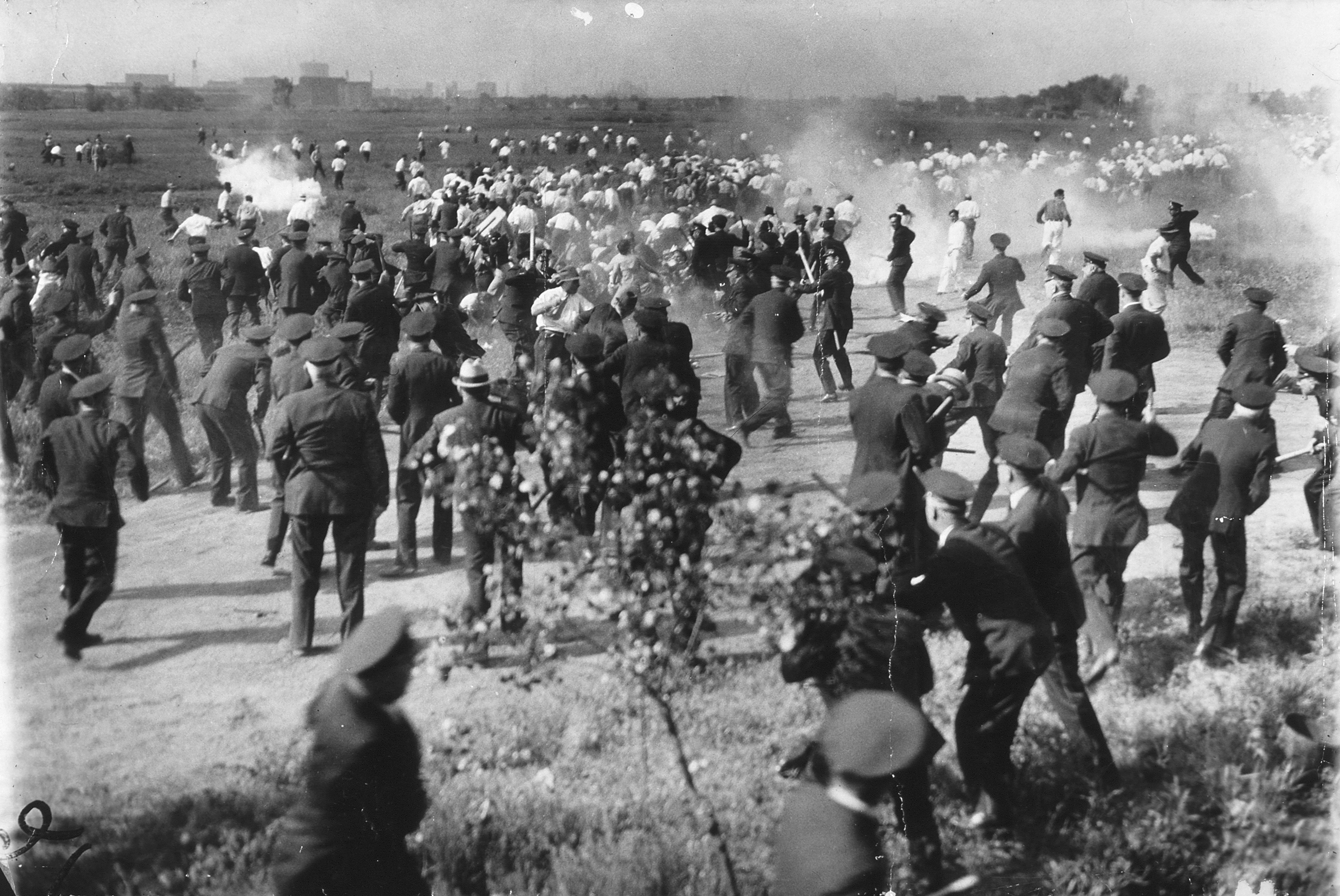
May 30, 1937: Chicago Police Department officers kill 10 unarmed demonstrators. It becomes known as the Memorial Day Massacre.

United States Steel, nicknamed "Big Steel," had signed a contract with the Steel Workers Organizing Committee (SWOC), a unit of the Congress of Industrial Organizations (CIO). But smaller companies, known as "Little Steel," including Republic Steel, refused to go along. So the SWOC called a strike.

From 1868 to 1970, America observed Memorial Day on May 30, no matter what day of the week on which it fell. Since 1971, it's been celebrated on the closest Monday to that date, anywhere between May 25 and May 31.

On May 30, 1937, a Sunday and a Memorial Day, unionists, their families and sympathizers gathered at Sam's Place, a former tavern and dance hall at 113th Street and Green Bay Avenue, on the South Side of Chicago, that served as the headquarters of the SWOC. There was an outdoor picnic lunch, speakers, and songs. The crowd was estimated to be between 1,500 to 2,500, including picketers and their families, strike sympathizers, and curious passersby.

The crowd began to march across the prairie towards the Republic Steel mill to picket, but a line of roughly 300 Chicago policemen blocked their path. The foremost protestors argued their right to continue. The police fired on the crowd. As the crowd fled, police shot and killed 10 people, 4 dying that day, and 6 others subsequently from their injuries. The youngest victim, Western Union telegraph company worker Leo Francisco, was only 17 years old. An additional 9 people were permanently disabled, and another 28 had serious head injuries from police clubbing.

Social reformer Dorothy Day, who was present, wrote: "On Memorial Day, May 30, 1937, police opened fire on a parade of striking steel workers and their families at the gate of the Republic Steel Company, in South Chicago. Fifty people were shot, of whom 10 later died; 100 others were beaten with clubs."

The American media corporations, conservative as usual, suppressed newsreel footage of the event, for fear of creating, in the words of an official at Paramount News agency, "mass hysteria." Initial news coverage of the event instead framed the crowd as a violent threat to social order, arguing that police merely acted in self-defense. Still photographs were published in major newspapers such as the then-archconservative Chicago Tribunealong with captions such as: "At the Height of the Battle--Here are policemen using their nightsticks and tear gas to subdue the attackers." Paramount did release edited clips from the newsreel footage of the massacre that portray the crowd as threatening and riotous.

Years later, one of the protesters, Mollie West, recalled a policeman yelling to her that day, "Get off the field or I'll put a bullet in your back." No policemen were ever prosecuted. A Coroner's Jury declared the killings to be "justifiable homicide." The press often called it a labor or red riot. Even President Franklin Roosevelt, normally friendly to labor, washed his hands of the event, responding to a union plea with a line from Shakespeare's Romeo & Juliet: "The majority of people are saying just one thing: 'A plague on both your houses.'"

The United Steelworkers (USW) were founded in 1942. Republic Steel was bought out, and essentially went out of business, in 1984. The USW are still in operation.

Game 1 of the 1985 NBA Finals, a 148-114 Boston Celtics victory over the Los Angeles Lakers at the Boston Garden on May 27, was immediately called "The Memorial Day Massacre." But the term faded a bit when the Lakers won 4 of the next 5 games to win the Championship, including Games 2 and 6 at the Garden.

*

May 30, 1937 was, as I said, a Sunday. These baseball games were played:

* The New York Yankees beat the Philadelphia Athletics, 13-1 at Yankee Stadium. Lefty Gomez went the distance for the win. Red Rolfe and Lou Gehrig his home runs. Joe DiMaggio went 1-for-5 with 2 RBIs.

* The New York Giants lost to the Philadelphia Phillies, 6-3 at Baker Bowl in Philadelphia. Mel Ott hit a home run.

* The Brooklyn Dodgers lost to the Boston Bees (as the Braves were known from 1936 to 1940), 11-4 at Ebbets Field.

* The Washington Senators beat the Boston Red Sox, 11-4 at Fenway Park in Boston. Pete Appleton not only went the distance pitching, he went 4-for-5 with 6 RBIs. Jimmie Foxx hit a home run in defeat.

* The Chicago White Sox beat the Cleveland Indians, 9-6 at Cleveland Municipal Stadium. Zeke Bonura went 3-for-4 with 5 RBIs.

* The Detroit Tigers beat the St. Louis Browns, 18-3 at Navin Field in Detroit. (It was renamed Briggs Stadium the next year, and Tiger Stadium in 1961.) Gerald "Gee" Walker went 4-for-6 with 2 home runs and 7 RBIs. Hank Greenberg went 5-for-5 with 2 home runs and 5 RBIs.

* The Chicago Cubs beat the Cincinnati Reds, 7-1 at Wrigley Field in Chicago.

* And the Pittsburgh Pirates beat the St. Louis Cardinals, 7-4 at Sportsman's Park in St. Louis.

Tuesday, May 3, 2022

May 3, 1963: Firehoses and Police Dogs In Birmingham

May 3, 1963: A "Children's Crusade" of over 5,000 school students marches from the Sixteenth Street Baptist Church into downtown Birmingham, Alabama. Organized by Rev. James Bevel, they intended to see the Mayor, Albert Boutwell, to talk to him about segregation in the city.

Boutwell had been elected the previous November, as a relative moderate on the issue of race. His election was considered a rebuke to the man he defeated, the city's Commissioner of Public Safety, Theophilus Eugene "Bull" Connor.

They never got that far. Connor still had his job, and ordered the police to let trained attack dogs, German shepherds, loose on the demonstrators. And he ordered the fire department to turn on their fire hoses -- on high pressure, so they could legitimately be called "water cannons" -- and blast them at the demonstrators, inflicting great pain. Connor's men ended up arresting 7,000 people. Given that Birmingham was then home to about 340,000 people, this was like arresting 180,000 New Yorkers.
This was too much for Mayor Boutwell. On May 21, he fired Connor. The dogs and the hoses were also too much for President John F. Kennedy. On June 11, he announced that a civil rights bill would be presented to Congress.

On August 28, a March On Washington for Jobs and Freedom was held in Washington, with 300,000 people attending. Among the speakers was Dr. Martin Luther King, who spoke of a dream of integration and racial harmony.

On September 15, a bomb was set off at the Sixteenth Street Baptist Church. Four girls were killed. One of them was only 11 years old, the other three were 14.

On November 22, 1963, Kennedy was assassinated. As far as is known, it had nothing to do with his stance on civil rights. Vice President Lyndon Johnson became President.

On June 3, 1964, Connor was elected President of the Alabama Public Service Commission.

On June 19 -- Juneteenth, with some appropriateness -- the U.S. Senate passed the civil rights bill. On July 2, the U.S. House of Representatives passed it. That same day, Johnson signed it into law, and gave one of the pens he used to Dr. King.

On December 7, 1966, Connor suffered a stroke, and remained in a wheelchair until his death on March 10, 1973.

*

May 3, 1963 was a Friday. Football, basketball and hockey were out of season. These Major League Baseball games were played:

* The New York Yankees beat the Minnesota Twins, 4-3 at Metropolitan Stadium in the Minneapolis suburb of Bloomington, Minnesota. Harry Bright and Clete Boyer hit home runs, and Boyer's homer in the top of the 10th inning made a winning pitcher out of Jim Bouton. Mickey Mantle was injured and did not play, and Roger Maris went 0-for-4. Harmon Killebrew didn't play, either.

* The New York Mets lost to the San Francisco Giants, 5-3 at the Polo Grounds. Willie Mays went 1-for-4 with an RBI.

* The Philadelphia Phillies beat the Houston Colt .45s, 4-3 at Connie Mack Stadium in Philadelphia.

* The Pittsburgh Pirates beat the Los Angeles Dodgers, 13-2 at Forbes Field in Pittsburgh. Bob Bailey hit 2 home runs, Roberto Clemente went 2-for-5, and Willie Stargell went 1-for-4.

* The Cincinnati Reds beat the St. Louis Cardinals, 6-0 at Crosley Field in Cincinnati. Joe Nuxhall pitched a 5-hit shutout. Frank Robinson went 1-for-5, and rookie Pete Rose hit a home run. Stan Musial did not play.

* The Baltimore Orioles beat the Detroit Tigers, 8-5 at Tiger Stadium in Detroit. Brooks Robinson went 1-for-4 with 3 RBIs. Al Kaline went 1-for-4 with 1 RBI.

* The Washington Senators beat the Chicago White Sox, 5-2 at Comiskey Park in Chicago.

* The Chicago Cubs beat the Milwaukee Braves, 10-7 at Milwaukee County Stadium. Ron Santo, Billy Williams and Ernie Banks all hit home runs, while Len Gabrielson and Hank Aaron hit home runs in vain support of Warren Spahn.

* The Kansas City Athletics beat the Boston Red Sox, 3-1 at Kansas City Municipal Stadium. Carl Yastrzemski went 1-for-4.

* The Cleveland Indians beat the Los Angeles Angels, 2-1 at Dodger Stadium in Los Angeles. (When the Angels played home games there from 1962 to 1965, it was listed on the tickets and game programs as "Chavez Ravine.")

Monday, March 21, 2022

March 21, 1937: The Ponce Massacre

March 21, 1937: Police in Ponce, Puerto Rico kill 19 members of the Puerto Rican Nationalist Party. Two policemen also end up killed.

The Ponce Massacre was nearly 5 times as bad as the Kent State Massacre of 1970, but it wasn't shown on TV news. That's because, at the time, TV news did not exist. But, between that, and the distance of time, and the fact that it wasn't white people who died, it got buried in history.

It was nearly 4 times as bad as the Boston Massacre of 1770, but didn't become an important part of a successful revolution. That's another reason why most of you won't know about it.

No one who participated in the killings was punished, although President Franklin D. Roosevelt did remove Governor Blanton Winship from his post -- 2 years later.

*

March 21, 1937 was a Sunday. Tom Flores was born that day. He was the 1st starting quarterback for the Oakland Raiders in 1960, and coached them to win Super Bowls XI and XV (the latter after they had moved to Los Angeles).

Baseball was in Spring Training. Football was out of season. The NBA hadn't been founded yet. It was the last day of the NHL's regular season, and these 3 games were played:

* The New York Rangers beat the Montreal Canadiens, 3-1 at the old Madison square Garden.

* The Boston Bruins beat the Chicago Black Hawks, 6-1 at the Boston Garden.

* The Montreal Maroons beat the Detroit Red wings, 5-1 at the Olympia Stadium in Detroit.

* And the Toronto Maple Leafs were not scheduled.

December 31, 1999 & January 1, 2000: The Millennium

December 31, 1999:  The Millennium arrives. The people of planet Earth survived. At a terrible cost. But we hadn't destroyed ourselves. ...