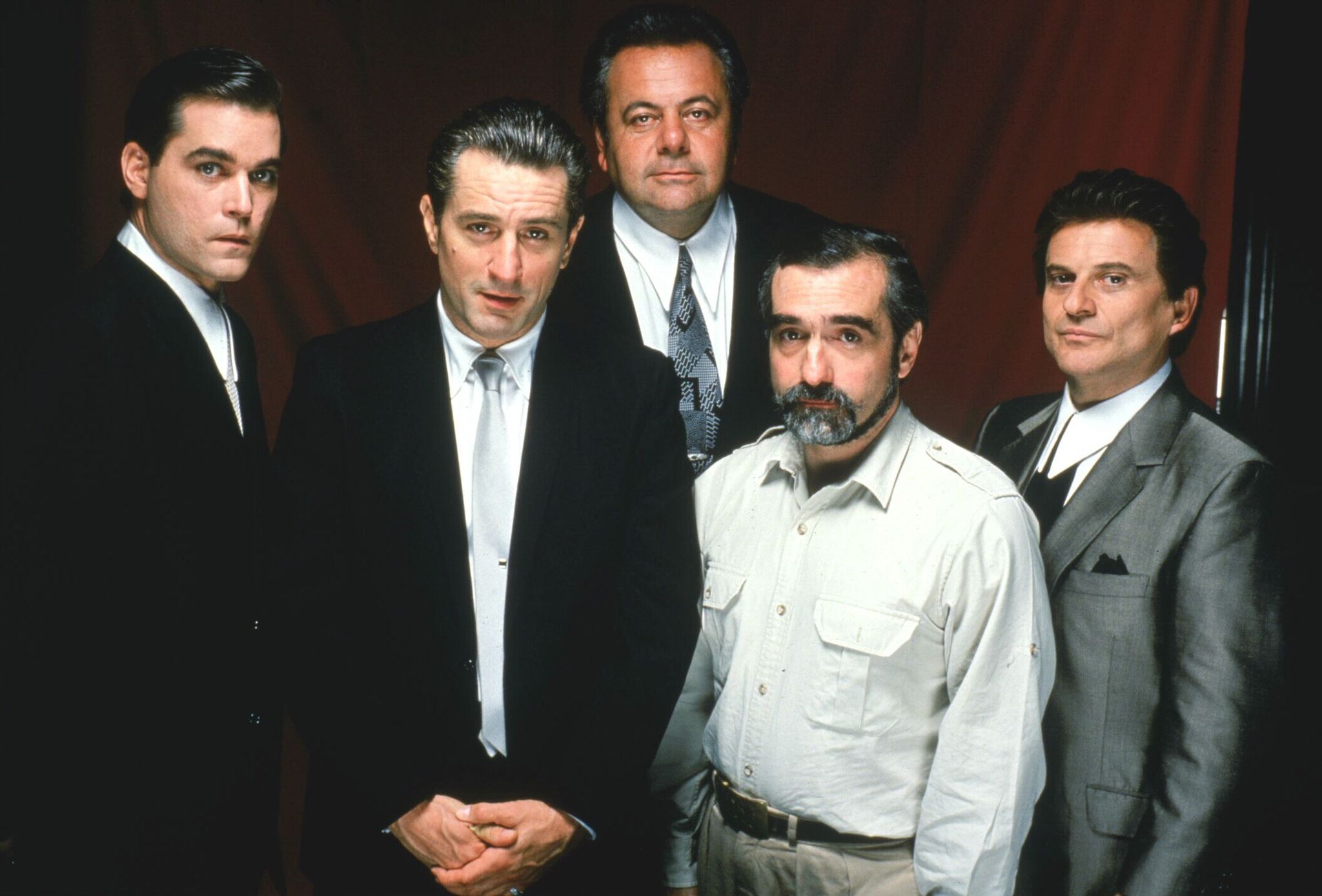
Left to right: Ray Liotta, Robert De Niro,
Paul Sorvino, Martin Scorcese and Joe Pesci
September 19, 1990: Goodfellas premieres, directed by Martin Scorcese, based on the book Wiseguy by Nicholas Pileggi. Along with Francis Ford Coppola's The Godfather, it is considered perhaps the greatest film ever made about organized crime.
Pileggi had collaborated with Henry Hill, an associate of the Lucchese crime family. He was played by Ray Liotta in the movie. Organized crime in New York is led by the so-called Five Families: Lucchese, Gambino, Genovese, Colombo and Bonanno.
(In case anyone affiliated with any of them is reading this, I did not list them in that order for any particular reason. I only listed the Lucchese family first because that's who Hill worked for. No slight was intended to any of the other families.)
Henry, who narrates the film, worked under Lucchese associate Jimmy "the Gent" Burke, whose name was changed to Jimmy Conway for the movie. He was played by Robert De Niro. As in real life, the half-Italian, but also half-Irish, Hill and the all-Irish Conway could never be a "soldier," or "made man," in the "family" -- only an "associate." But, as the top hijacker of trucks and their cargo in New York in the 1960s and '70s, Burke/Conway sure made them a lot of money, so they treated him well.
The first time Henry got arrested, as a teenager, he kept his mouth shut, earning the respect of Conway, Burke, Lucchese capo Paul Vario, and everybody else who called Vario his boss. For the movie, Vario's name was changed to Paul Cicero, and he was played by Paul Sorvino.
Lorraine Bracco plays Karen Friedman, Henry's girlfriend and eventual wife, who is seduced by Henry's free-spending lifestyle. This is emphasized by a great single-shot sequence of Henry and Karen going through the kitchen to the main room of New York's legendary Copacabana Club, to the tune of "Then He Kissed Me" by The Crystals.
In real life, the Copa has since been moved to new addresses, but is still in business. The original building, at 10 East 60th Street, is still there, and Scorcese had the interior made up to look like it did in 1963 when that song came out. I wish somebody had done a similar filming sequence at the old Yankee Stadium, from Subway tunnel to gate to seat, before it was torn down.
The film tells how, on April 7, 1967, a team led by Conway robbed the Air France terminal at John F. Kennedy International Airport in Queens, netting $420,000 worth of cash and cargo (about $3.7 million in 2022 money). This team included Hill and Tommy DeSimone, renamed Tommy DeVito for the movie. He was played by Joe Pesci, and the role, for which Pesci won the Academy Award for Best Supporting Actor, forever defined him as a Mobbed-up, foul-mouthed Italian lunatic who could be set off by anything, including references to his short stature, and even by a compliment: "I'm funny? Funny, how?"
This was demonstrated by recreating the events of June 11, 1970. Two weeks earlier, William Bentvena, a.k.a. Billy Batts -- his "Mob name" was not changed for the film, and his real name wasn't mentioned -- had just gotten out of prison on a drug trafficking charge. Conway (Burke) owned a Queens nightclub named Robert's Lounge, and threw a party for Batts. DeSimone was there, and Batts, a made man in the Gambino family, asked DeSimone if he still shined shoes, a reference to his being short.
On June 11, Batts was at The Suite, a Queens nightclub owned by Hill. DeSimone assaulted Batts, beating him until he was apparently dead. DeSimone, Hill and Conway put him in the trunk of Hill's car, drove him to a secluded spot in Upstate New York, made sure he was dead, and buried him there.
By 1973, Hill had a cocaine connection in Pittsburgh, and a cocaine addiction, and mistresses. He was arrested and sent to prison, but kept his connection going there. When he got out, Vario warned him to stay away from coke, either using, trafficking or dealing. But he was too weak to stay away.
Burke's gang planned to rob the Lufthansa Cargo Building at JFK Airport. Hill was part of the planning, but did not participate in the actual robbery. On the morning of December 11, 1978, while listening to the radio in the shower, he learns that they pulled it off overnight. The $5,875,000 heist, the largest ever on American soil to that point, would be worth about $26.4 million in 2022 money.
Having succeeded in the Lufthansa heist, Burke was paranoid about it. He was afraid that, if his guys spent too much of the loot too soon, it would attract the attention of the Federal Bureau of Investigation. (As the crime was on the grounds of an airport, it was in the FBI's jurisdiction, not the New York Police Department's.)
But it was 2 weeks before Christmas, and, in anticipation of getting their share of the loot, some of the guys in Burke's crew began spending like crazy, especially on their wives and/or mistresses. One of them bought a brand-new top-of-the-line pink Cadillac, which, parked in front of a known Lucchese Family hideout in Queens, might as well have been spray-painted with the words "UNMARKED MOB CAR." And some of them were getting antsy, and demanded their share before Burke was ready to give the shares out.
So all through 1979, members of Burke's crew started dying. The guy who bought the car, and his wife, were found shot to death inside the car. Scorcese showed these murders to the tune of the Jim Gordon piano and Eric Clapton & Duane Allman guitar outro from "Layla" by Derek and the Dominoes.
One murder that was not connected to this was that of Tommy DeVito. In real life, DeSimone was reported missing by his wife on January 14, 1979, a mere 34 days after the Lufthansa heist. The real Hill gave conflicting answers as to what happened to him, including that he was killed by Vario's son Peter, and that he was killed by the eventual boss of the Gambino Family, John Gotti. who had been a close friend of Batts'.
The film shows DeVito being convinced that he's going to be "made," which requires a ceremony attended by other made men. He's driven to a house, and when he walks into a room, he sees it's empty. For once, his bravado falls, because he knows it's a trap. He has just enough time to say, "Oh, no," before he's shot in the head.
This leads to a phone call to Conway, who, in his anger and his grief, destroys the phone booth. It also leads to the movie's most-remembered quote, from Hill: "It was revenge for Billy Batts, and a lot of other things. And there was nothing that we could do about it. Batts was a made man, and Tommy wasn't. And we had to sit still and take it. It was among the Italians. It was real greaseball shit. They even shot Tommy in the face, so his mother couldn't give him an open coffin at the funeral." (Tommy's mother had been played by Catherine Scorcese, the director's mother. She appeared in 16 films, all but 5 of them directed by her son.)
Hill got busted for cocaine trafficking in 1980, and it may have saved his life, because Burke had told him to go down to Florida to perform a contract killing. That made Hill suspicious, because Burke had never asked him to do a "hit" before. He was sure that if he went down to Florida, he would never come back up alive. So he made preparations to go into hiding, but the Feds got him first. This time, with a wife and 2 kids to think about, he spilled his guts.
Ironically, in real life, most of the guys he ratted on were charged with things other than the Lufthansa heist. Jimmy Burke, the mastermind, was charged for his role in the 1978-79 Boston College basketball point-shaving scandal. While serving time for that, he was convicted of a murder, and that had nothing to do with the Lufthansa heist or its aftermath, either. He was doomed to die in prison, and did, in 1996, although the movie, released in 1990, said that "Conway" was still in prison. Paul Vario also died in prison, in 1988.
The Hill family went into the FBI's Witness Protection Program, going from the life of a millionaire gangster to, as Hill put it, "living like a schnook." He mentioned one particular indignity: Going to a restaurant, ordering spaghetti marinara, and getting "egg noodles with ketchup." The song "My Way" is heard over the closing credits -- not the original version by Frank Sinatra, as you might expect, or the cover by Elvis Presley, but the cover by Sid Vicious of the Sex Pistols.
Goodfellas was nominated for 6 Oscars, but Pesci was its only winner. While The Godfather is praised for its fantasy treatment of organized crime in America, Goodfellas is said to show The Mob as it actually is: Murderous, psychopathic, greedy, valuing money over everything, including family and other loyalties. "The life" is no life at all. As the old radio show The Shadow put it, Crime does not pay.
After the movie came out, the real Hill couldn't stay out of trouble, and was busted for drugs again, and served time, and was kicked out of the Witness Protection Program. Karen divorced him, and she and their kids were allowed to stay in the Program.
Henry Hill was a schnook. Still, the Mob never did kill him. He did that to himself: He may have gotten off drugs, but he continued to drink like there was no tomorrow, and died in 2012, a day after his 69th birthday.
The money and the jewels from the Lufthansa heist have never been found.
In 1995, Scorcese released Casino. The similarities to Goodfellas were many. It was a period piece set in the 1970s and early '80s. De Niro and Pesci were in it. There was narration, alternating between De Niro and Pesci. There was a twisted romance, between characters played by De Niro and Sharon Stone. The reality of how rotten the Mob is was shown to be obvious. Pesci's character is a foul-mouthed asshole who can't control his temper, and ends up getting betrayed and killed (even though he's one of the narrators). There's a murder montage set to a classic rock song, in this case The Animals' version of "House of the Rising Sun."
And it ends with the main character telling what's happened to him since. At least De Niro's Ace Rothstein, based on the real-life Lefty Rosenthal, was no longer a marked man and was relatively well-off, if bored. It beat the way Hill ended up.
Casino was hailed as an excellent film, but it was so close in form to Goodfellas that the comparison did it no favors. And as we have seen, favors are important in Mob life. But, contrary to what The Godfather showed, honor is not. Scorcese has been honored, although it took until 2006, with The Departed, a Mob film set in Boston, for him to finally get an Academy Award for Best Director.
*
September 19, 1990 was a Wednesday. These Major League Baseball games were played that day:
* The New York Yankees lost to the Toronto Blue Jays, 7-6 at the SkyDome (now the Rogers Centre) in Toronto. The losing pitcher was Tim Leary, and the winning pitcher was future Yankee Jimmy Key. Junior Félix hit a home run for the Jays. Hensley Meulens and Jim Leyritz hit them for the Yankees.
* The Baltimore Orioles beat the Boston Red Sox, 8-4 at Memorial Stadium in Baltimore. Cal Ripken went 3-for-4. Wade Boggs, uncharacteristically, went 0-for-4, although he had an RBI on a sacrifice fly.
* The Atlanta Braves beat the San Francisco Giants, 5-1 at Atlanta-Fulton County Stadium.
* The Cleveland Indians beat the Milwaukee Brewers, 6-3 at Cleveland Municipal Stadium. Robin Yount went 0-for-3, but had an RBI on a fielder's choice. Paul Molitor went 1-for-4.
* The Pittsburgh Pirates beat the Chicago Cubs, 8-7 at Wrigley Field in Chicago. A skinny 26-year-old named Barry Bonds hit 2 home runs.
* The Minnesota Twins beat the Kansas City Royals, 1-0 at the Metrodome in Minneapolis. Shane Mack singled home the winning run in the bottom of the 11th inning. Mark Guthrie pitched 9 innings of shutout ball, and Gary Wayne finished an 8-hit, 11-inning shutout. George Brett went 2-for-5.
* The Philadelphia Phillies beat the St. Louis Cardinals, 8-4 at Busch Memorial Stadium in St. Louis.
* The Houston Astros beat the Cincinnati Reds, 5-2 at the Astrodome in Houston.
* The Detroit Tigers beat the California Angels, 12-5 at Anaheim Stadium (now Angel Stadium of Anaheim).
* The San Diego Padres beat their arch-rivals, the Los Angeles Dodgers, 9-4 at Dodger Stadium in Los Angeles. Yes, the Dodgers and the Angels were both at home on the same day. Tony Gwynn did not play for the Padres, but among those who did, Benito Santiago and former Yankee 3rd baseman Mike Pagliarulo hit home runs, Jack Clark went 1-for-3 with 2 walks, Roberto Alomar went 1-for-5, Joe Carter went 2-for-4 with a walk and 2 RBIs. Eddie Murray homered for the Dodgers.
* The Oakland Athletics beat the Chicago White Sox, 7-3 at the Oakland Coliseum. Rickey Henderson went 1-for-3 with 2 walks. Mark McGwire hit a home run.
* And the Texas Rangers beat the Seattle Mariners, 6-5 at the Kingdome in Seattle. 19-year-old Ken Griffey Jr. hit a home run off 43-year-old Nolan Ryan.
* And the New York Mets and the Montreal Expos were rained out at Shea Stadium. The game was made up as part of a doubleheader the next day. The Expos swept, 6-4 and 2-0. In the opener, the Mets blew a 4-2 lead when Frank Viola ran out of gas in the top of the 8th, and the Expos scored 4 runs. Earlier in the game, Tim Raines and Tim Wallach had hit home runs.
In the nightcap, Chris Nabholz pitched the game of his life, allowing just 1 hit, a single in the 6th by 2nd baseman Tommy Herr (a former St. Louis Cardinal that I had completely forgotten had ever played for the Mets).