Showing posts with label stanford university. Show all posts

Friday, December 30, 2022

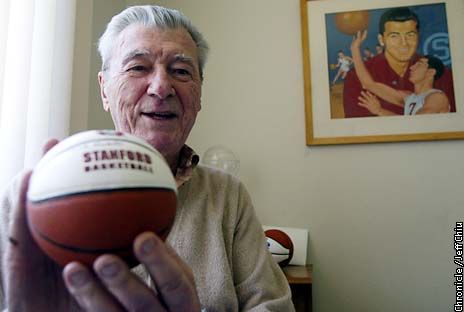
December 30, 1936: Hank Luisetti Revolutionizes Basketball

December 30, 1936: Hank Luisetti changes the game of basketball forever.

A forward, he took his Stanford University team, defending Champions of the Pacific Coast Conference, into the old Madison Square Garden in New York, to play the Number 1- ranked team in the country, Brooklyn-based Long Island University.

New Yorkers, who, even then, thought they knew everything about basketball, and that their teams had practically invented it (this while Dr. James Naismith was still alive), had heard that Luisetti had taken shots with just one hand. This was blasphemy: You had to use both hands, to steady your shot and make it more accurate. One-handed shots were took risky, unless you wanted to use a hook shot.

But Luisetti not only used one hand, he used jump shots. Combining the two? This was madness. Well, on this night, it was a glorious madness. He scored 15 points, but that was a big total in those days. Stanford beat LIU, 45-31, not merely ending the Blackbirds' 43-game winning streak, the longest in college basketball history to that point, but blowing them out.

"I'd get the ball, take a dribble or two and jump and shoot on the way up," Luisetti explained. "I didn't jump and shoot at the height of my jump, the way they do now. I'd let the ball go right near my face. I'd push and shoot, off my fingertips."

"Hank could take over a game like Michael Jordan if he had to," said former Stanford teammate Don Williams. "He was an absolute artist on the basketball court." Certainly, Ned Irish, head of basketball operations at Madison Square Garden and eventually the founding owner of the New York Knicks, thought so: Thinking that Luisetti was the only player who could singlehandedly sell out an arena the size of The Garden, he invited Stanford back for a Holiday Festival in 1937, and they won again. Two nights later, on January 1, 1938, in Cleveland, they played Pittsburgh school Duquesne, and won 92-27. In that game, Luisetti became the 1st player in NCAA history to score 50 points in a game.

Luisetti led the Stanford Indians -- they became the Cardinal in 1972 -- to 3 straight Conference Championships. This was before there was an NCAA Tournament, but they were voted National Champions in 1937.

He arrived on the scene too late to make the 1936 Olympics. He kept his amateur status by playing for Amateur Athletic Union (AAU) teams, including the Olympic Club of his hometown of San Francisco, but the 1940 and 1944 Olympics were canceled due to World War II. He served as a Navy officer, but developed spinal meningitis, ending his basketball career, ruining Irish's hopes of making him the Knicks' 1st star.

In 1950, when he was only 34 years old and should still have been playing, the Associated Press voted him 2nd behind the still-active George Mikan on their list of the top basketball players of the 1st half of the 20th Century. He was a charter inductee into the Basketball Hall of Fame. He ran a travel services company, and died in 2002, at the age of 86.

*

December 30, 1936 was a Wednesday. Baseball and football seasons were over. The NBA hadn't been founded yet. And no NHL games were scheduled. So there were no other scores on this historic day.

Sunday, December 25, 2022

December 25, 1894: The 1st Intersectional College Football Game

Walter Camp

December 25, 1894: In a manner of speaking, the 1st holiday-season college bowl game is played on this day. Certainly, it was the 1st college football game, ever, between teams from 2 different parts of the country. And it was the 2 men most responsible for the development of American football who set it up and opposed each other in it.

Walter Camp had been one of the 1st great college football players, at Yale University in the late 1870s. In 1888, he became Yale's head coach, and one of his players on that great team was Amos Alonzo Stagg. Between them, they invented pretty much every feature that turned American football from a game resembling soccer and rugby to the game that became so popular in the 20th Century.
Amos Alonzo Stagg

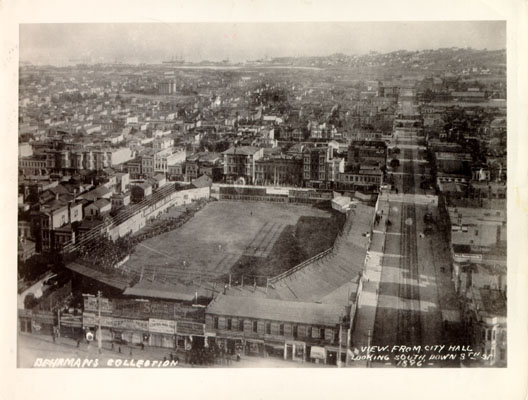
Both men went West to start college football programs, Stagg at the University of Chicago, Camp at the newly-founded Stanford University in the San Francisco Bay Area. They played at the Haight Street Grounds in San Francisco. Chicago beat Stanford 24-4.
The Haight Street Grounds stood from 1887 to 1895. It was actually not at Haight Street, but at the southeastern corner of Stanyan and Waller Streets, in the Haight-Ashbury district that would become the seat of the Hippie movement in the 1960s, at the southeastern corner of Golden Gate Park, about a block from where Kezar Stadium would later be built.

*

December 25, 1894 was a Tuesday. Baseball was out of season, hockey was all-amateur, basketball was a recent invention, and this was before college football was playing bowl games, let alone on Christmas Day.

But in England, soccer, or "football" as they call it, had a tradition: To keep traveling to a minimum, and thus families together, 2 nearby teams would play at one's home ground on Christmas Day, and at the other's on the next day, December 26, Boxing Day. This tradition began to die out in the 1950s, but Boxing Day games are still played.

On December 25, 1894, the London-based team which I would eventually support, then known as Woolwich Arsenal, played, but not against a nearby team: They hosted Burslem Port Vale, at the Manor Ground in Plumstead, Kent, later to be a part of Southeast London, and won, 7-0. Patrick O'Brien scored 3 goals -- not yet known as a "hat trick" in either ice hockey or association football.

Saturday, October 22, 2022

October 22, 1969: ARPANET: The Original Internet

October 22, 1969: The Advanced Research Projects Agency Network (ARPANET) goes online, through the U.S. Department of Defense. It is an early packet-switching network, designed for resource sharing between remote computers, and the first network to implement the TCP/IP protocol suite. The first connections were made between major universities, and the very first was in California, between UCLA and Stanford.

It was designed by Leonard Kleinrock, Paul Baran, Donald Davies, Lawrence Roberts (who worked on the packet-switching methodology), Robert Kahn and Vint Cerf (who developed the protocols).

Although ARPANET was taken offline in 1989, due to successor networks having gone online, it is, essentially, the beginning of the Internet.

In 2000, Vice President Al Gore was running for President, and the Republican Party mocked him for claiming to have invented the Internet. What he actually said, in an interview with Wolf Blitzer on CNN on March 9, 1999, was, "During my service in the United States Congress, I took the initiative in creating the Internet." Which is not the same thing as claiming to have invented it.

On October 2, 2000, Kahn and Cerf released a statement saying the following:

Al Gore was the first political leader to recognize the importance of the Internet and to promote and support its development.

No one person or even small group of persons exclusively "invented" the Internet. It is the result of many years of ongoing collaboration among people in government and the university community. But as the two people who designed the basic architecture and the core protocols that make the Internet work, we would like to acknowledge VP Gore's contributions as a Congressman, Senator and as Vice President. No other elected official, to our knowledge, has made a greater contribution over a longer period of time.

In other words, two of the guys who were part of the invention of the Internet said that Gore was vital as far as its development was concerned. But the American media, in the tank for Gore's opponent, Governor George W. Bush of Texas, never told the truth about it, sticking with the myth that Gore "lied when he said he invented the Internet," when he never said he'd invented it.

Davies died in 2000, Baran in 2011, Roberts in 2018. As of October 22, 2022, Kleinrock, Kahn and Cerf are still alive.

*

October 22, 1969 was a Wednesday. Adam Spiegel, a.k.a. the film director Spike Jonze, and Belgian singer Helmut Lotti were born.

Baseball season ended 6 days earlier, when the New York Mets beat the Baltimore Orioles in Game 5 to win the World Series. Football was in midweek. There were 4 games in the NBA:

* The Philadelphia 76ers beat the Phoenix Suns, 122-119 at The Spectrum in Philadelphia.

* The San Francisco Warriors beat the Atlanta Hawks, 94-93 at the Alexander Memorial Coliseum (now the McCamish Pavilion) in Atlanta.

* The Los Angeles Lakers beat the Cincinnati Royals, 116-109 at the Cincinnati Gardens. Just another day at the office for Wilt Chamberlain: 43 points and 20 rebounds.

* And the Milwaukee Bucks beat the San Diego Rockets, 115-102 at the San Diego Sports Arena (now the Pechanga Arena). Lew Alcindor, the man who would become Kareem Abdul-Jabbar, in only his 3rd professional game, scored 36 points and grabbed 19 rebounds.

There were 3 games in the American Basketball Association:

* The Carolina Cougars beat the Washington Capitols, 122-91 at the original Charlotte Coliseum (now the Bojangles Coliseum). These Capitols moved the next season, becoming the Virginia Squires, and have no connection to either the Washington Capitols who played in the NBA from 1946 to 1951, or to the Washington Capitals who began play in the NHL in 1974. Of course, all 3 teams were nicknamed the Caps for short.

* The Miami Floridians beat the Los Angeles Stars, 119-98 at the Dinner Key Auditorium in Miami. This was about 8 months after Jim Morrison of The Doors was arrested for some alleged naughtiness at a concert there.

* And the Indiana Pacers beat the Denver Nuggets, 117-107 at the Indians State Fairgrounds Coliseum (now the Corteva Coliseum) in Indianapolis.

There were 5 games in the NHL:

* The New York Rangers and the Chicago Black Hawks played to a tie, 1-1 at the new Madison Square Garden.

* The Montreal Canadiens and the St. Louis Blues played to a tie, 3-3 at the Montreal Forum.

* The Philadelphia Flyers beat the Toronto Maple Leafs, 4-3 at Maple Leaf Gardens in Toronto.

* The Boston Bruins beat the Minnesota North Stars, 3-2 at the Metropolitan Sports Center in the Minneapolis suburb of Bloomington, Minnesota.

* The Los Angeles Kings beat the Pittsburgh Penguins, 2-0 at The Forum outside Los Angeles in Inglewood, California.

* And the Detroit Red Wings and the Oakland Seals were not scheduled.

Tuesday, June 14, 2022

June 15, 1878: Eadweard Muybridge Invents Motion Pictures

June 15, 1878: Eadweard Muybridge invents motion pictures. Yes, it goes that far back.

He was born born Edward James Muggeridge on April 9, 1830 in Kingston upon Thomas, Surrey, England. He was interested in Old English, and took the archaic version of his given named, "Eadweard," and made his surname a similarly archaic one, so his name would, presumably, be pronounced "ED-word MIGH-bridge."

He moved to America in 1850, and became a bookseller. In 1860, he returned to Kingston, and took up photography. He returned to America in 1867, and made and sold some stunning photographs of the West, including his adopted hometown of San Francisco. In 1875, he discovered his wife was having an affair, shot and killed the other man, and was acquitted on the grounds of "justifiable homicide."
In June 1878, Muybridge created sequential series of photographs, now with a battery of 12 cameras along the race track at Stanford's Palo Alto Stock Farm, now the campus of Stanford University (which is still called "The Farm"). The shutters were automatically triggered when the wheel of a cart or the breast or legs of a horse tripped wires connected to an electromagnetic circuit.

For a session on June 15, 1878, the press and a selection of turf men were invited to witness the process. An accident with a snapping strap was captured on the negatives and shown to the attendees, convincing even the most skeptical witnesses. The news of this success was reported worldwide.

Newspapers were not yet able to reproduce detailed photographs, so the images were widely printed as woodcut engravings. Scientific American was among the publications at the time that carried reports and engravings of Muybridge's groundbreaking images. Six different series were soon published as cabinet cards, entitled The Horse in Motion.

Many people were amazed at the previously unseen positions of the horse's legs in action, particularly the fact that a running horse had all four hooves in the air at regular intervals. This did not take place when the horse's legs were extended to the front and back, as imagined by illustrators of the time, but when its legs were collected beneath its body as it switched from "pulling" with the front legs to "pushing" with the back legs.

In his later years, Muybridge gave many public lectures and demonstrations of his photography and early motion picture sequences, travelling frequently in England and Europe to publicize his work. He retired to his native England permanently in 1894, and died on May 8, 1904.

*

June 15, 1878 was a Saturday. Three games were played in baseball's National League:

* The Boston Red Stockings beat the Indianapolis Blues, 7-4 at the original version of the South End Grounds in Boston.

* The Cincinnati Reds beat the Providence Grays, 11-3 at the Messer Street Grounds in Providence, Rhode Island.

* And the Chicago White Stockings beat the Milwaukee Grays, 12-2 at the Union Grounds in Chicago.

Monday, February 28, 2022

February 28, 1905: The Murder of Jane Stanford

February 28, 1905: Jane Stanford is murdered -- on the 2nd try.

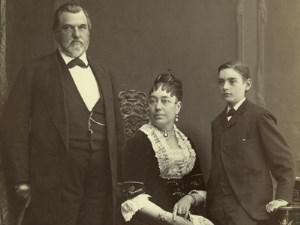
Jane Elizabeth Lathrop was born on August 25, 1828 in Albany, New York. Like any other good little rich girl of her time, she was expected to have no ambitions, marry a rich man, have as many rich children as possible, and do nothing on her own.

Well, she certainly married a rich man: Leland Stanford, a lawyer from nearby Watervliet. He became one of the wealthiest lawyers in Wisconsin. But in 1852, a fire in his office cost him his law library, a vital thing for a lawyer to have. He took Jane west, opened a dry goods store with his brothers, took advantage of the Gold Rush, and built a fortune. In 1861, he was among the founders of the Central Pacific Railroad, and was elected Governor of California, serving a single 2-year term.

As for the other thing, it didn't work out. For whatever reason, she didn't have a child until she was 39, and he would be the only one. On March 13, 1884, Leland Stanford Jr. died of typhoid fever, and there was nothing his parents and all their money could do.
What would now be called an urban legend spread, eventually being repeated on the radio show of broadcaster Paul Harvey. Supposedly, Leland and Jane Stanford went to Harvard University, offered to fund a big scholarship in their son's name, and were flat-out rejected, because old-money Harvard didn't want their nouveau riche money. So they took matters into their own hands, and founded their own university out of spite, choosing the color red like Harvard.

It wasn't true. They didn't go to Cambridge, Massachusetts to meet with Charles W. Eliot, President of Harvard. He didn't turn them down. The plan, all along, was to found a university near San Francisco, then still far ahead of Los Angeles as the leading city not just in California, but in the American West. The location was Palo Alto, on "The Peninsula," 37 miles southeast of San Francisco, and 24 miles northwest of San Jose.

"The Leland Stanford Junior University" was founded in 1885, and opened on October 1, 1891, and it is officially named that to this day. Reading and hearing "Junior University" makes it sound like a "junior college," but it is, essentially, the Harvard of the West Coast, though its main color is a cardinal shade of red, rather than Harvard's crimson. And its rival isn't another old, fabulously wealthy Ivy League school, as Harvard has with Yale, but the main campus of the greatest State university system in the country, the University of California in Berkeley, across San Francisco Bay.

Leland Stanford was elected to the U.S. Senate in 1884, and was still serving California in that capacity when he died on June 21, 1893, from heart failure brought on by years of locomotor ataxia. Jane, then 74, subsequently effectively took control of the university. It was at her direction that Stanford University gained an early focus on the arts. She also advocated for the admission of women, and the University had been co-educational since its founding.

On January 14, 1905, at age 76, at her mansion in the Nob Hill section of San Francisco, Mrs. Stanford drank mineral water, and found it tasting bitter. She quickly forced herself to vomit the water, with prompting from and assistance by her maid, and when both the maid and her secretary agreed that the bottled water tasted strange, she sent it to a pharmacy to be analyzed. The findings, returned a few weeks later, showed that the water had been poisoned with a lethal dose of strychnine.
Mrs. Stanford moved out of her mansion, and vowed never to return. Elizabeth Richmond, the maid, fell under suspicion and was fired. Richmond had worked in Britain and had reportedly regaled Stanford's domestic staff with tales of English aristocrats being poisoned by their servants.
A private detective agency was hired, but despite coming up with enough subplots to stock a soap opera, it could not come up with evidence pointing to a culprit, or a motive for an attempted murder. Depressed by the conviction that an unknown party had tried to kill her, and suffering from a cold, Mrs. Stanford soon decided to sail to Hawaii, with plans to continue on to Japan.
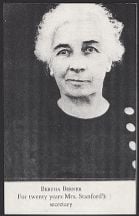
At the Moana Hotel on the island of Oahu, on the evening of February 28, Mrs. Stanford asked for bicarbonate of soda to settle her stomach while in her room. Her personal secretary, Bertha Berner -- a trusted employee of 20 years' standing, and the only other person present who had also been at the scene of the previous incident -- prepared the solution, which Stanford drank.
Is this the face of a killer?
At 11:15 PM, she cried out for her servants and hotel staff to call for a physician, declared that she had lost control of her body, and believed that she had been poisoned again. This time, attempts to induce vomiting were unsuccessful, and her last words were, "This is a horrible death to die."
The news was telegraphed back to her adopted hometown, and, mere hours later, the March 1, 1905 edition of the San Francisco Evening Bulletin blared the headline: "MRS. STANFORD DIES, POISONED."
After 3 days of testimony, the coroner's jury concluded in less than two minutes that she had died of strychnine "introduced into a bottle of bicarbonate of soda with felonious intent by some person or persons to this jury unknown."
The testimony revealed that the bottle in question had been purchased in California -- after Elizabeth Richmond had been let go, which seemed to rule her out as a suspect this time -- had been accessible to anyone in Stanford's residence during the period when her party was packing, and had not been used until the night of her death.
Stanford University President David Starr Jordan, who wanted to avoid a controversy that could damage the University's reputation, sailed to Hawaii himself, and hired a local doctor to dispute poisoning as the cause of death. He then reported to the press that Stanford had in fact died of heart failure.
The coverup succeeded so well that the likelihood that she was murdered was largely overlooked by historians and commentators until the 1980s. At any rate, no one was ever charged with Mrs. Stanford's murder. Whoever did it got away with it.
Was it Bertha Berner? Mrs. Stanford left her $15,000 in her will -- about $500,000 in 2022 money. She continued to live comfortable life in her house in nearby Menlo Park, California. Her social life revolved around the University, which, in 1935, published her book Mrs. Leland Stanford: An Intimate Account. Tellingly, she did not point a finger at any other suspect. She lived until 1945.
UPDATE: In 2022, Stanford University historian Richard White concluded that Stanford was likely poisoned by Bertha Berner, who was the only person present at both poisonings. White concludes that the first poisoning may have been intended to be non fatal and that Jordan and the San Francisco Police likely suspected Berner, but covered up the murder to suit their own interests.
It's a little interesting (to me, anyway) that the historian's name was White: A "Stanford White." Because, the following year, the architect Stanford White was murdered, and his case quickly replaced that of Jane Stanford as "The Murder of the Century."
*

February 28, 1905 was a Tuesday. Baseball and football were out of season. Basketball and hockey were still nearly all-amateur. So there were no scores on this historic day. 

Wednesday, February 23, 2022

February 23, 2014: Jason Collins Becomes the 1st Out U.S. Athlete

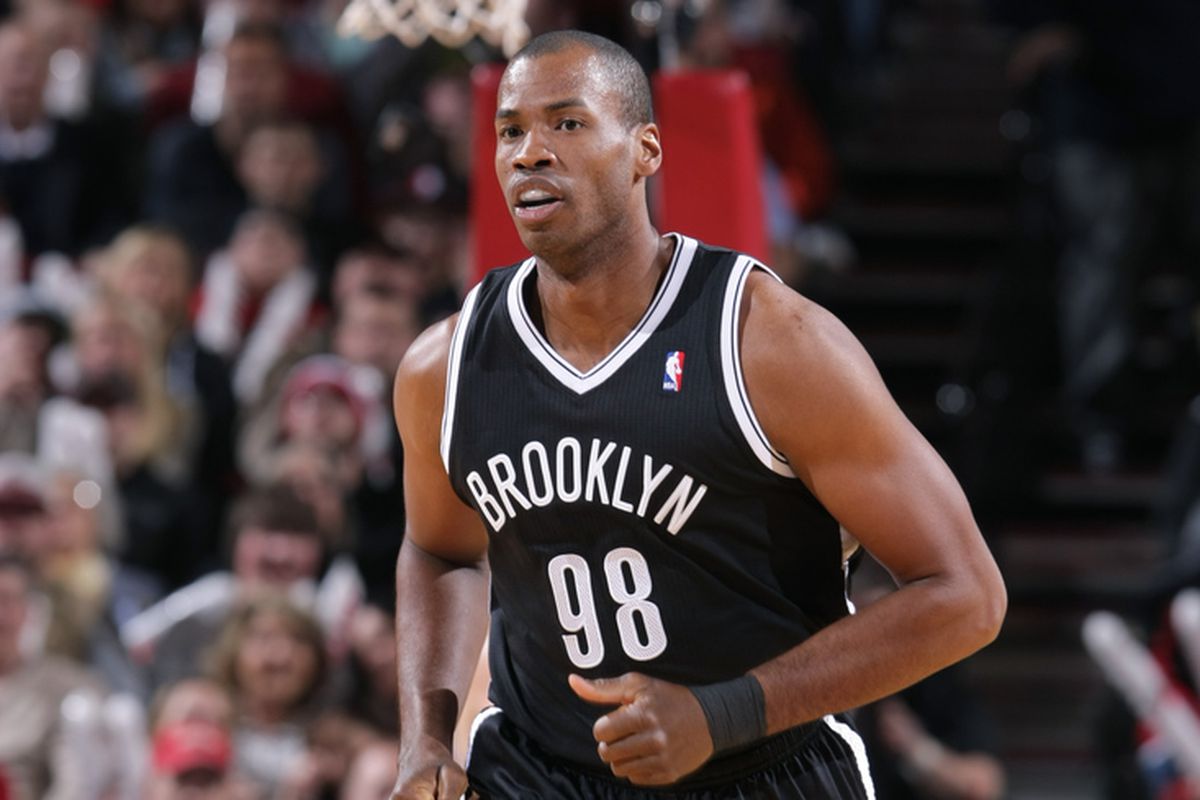
February 23, 2014: The Brooklyn Nets beat the Los Angeles Lakers, 108-102 at the Staples Center (now the Crypto.com Arena) in Los Angeles. Jason Collins played 10 minutes and 37 seconds for the Nets, and he didn't score any points. He did, however, have an offensive rebound, a defensive rebound, and a steal.

This appearance made Collins, who, in the off-season, publicly revealed that he is gay -- also known as "coming out of the closet," or "outing yourself," and was not, at the time, signed to any team -- the first openly gay athlete in major league sports in North America.

Presuming, of course, that you do not include MLS, Major League Soccer, as "major league." Robbie Rogers had already played for the Los Angeles Galaxy since coming out. So far, the reaction to him has been positive. But in the traditional "Big Four" North American sports, Collins was the first. And it appeared that, on that night, the L.A. fans -- presumably, many of whom had cheered Rogers -- treated Collins no worse than they treated any other opposing player.

A few other athletes have come out after retirement. Collins, knowing that he could still have a shot at signing with a new team, but also that teams might shy away from signing him if they knew, chose to be honest, and let them know. The Nets decided that it didn't matter, that it wasn't an indication of bad character, and that he might still be able to help them win, and they signed him.

Born on December 2, 1978 in Los Angeles, Jason Paul Collins was an All-American center at Stanford University. He had previously played with the New Jersey Nets from 2001 to 2008, before their 2012 move to Brooklyn. He played the 2nd half of the 2007-08 season with the Memphis Grizzlies, 2008-09 with the Minnesota Timberwolves, 2009-12 with the Atlanta Hawks, most of 2012-13 with the Boston Celtics, and the end of that season with the Washington Wizards. He ended up playing 22 games for the Nets, starting only 1, and never played again.

In that 1st game for the Nets, he wore Number 46. For his remaining games with the Nets, he wore 98, as he had with the Celtics and the Wizards. He wore it in memory of Matthew Shepard, a University of Wyoming student who was murdered for being gay in 1998. Having proven his point, he announced his retirement on November 19, 2014.

Glenn Burke, who played baseball in the 1970s, didn't "come out" while he was playing, because, in his own mind, he was never "in." Baseball fans at large didn't know he was gay, but his teammates knew, and most of them didn't care. Unfortunately, he played for 2 bigoted managers, Tommy Lasorda and Billy Martin. Lasorda ordered him traded away from the Los Angeles Dodgers; and Billy Martin, with the Oakland Athletics, had him sent down to the minors, burying him and prematurely ending his career.

One day, people who are gay will not have to face the choice of announcing it, or keeping themselves in the closet because they're afraid of repercussions. One day, we will hear that someone is gay, and we'll say, "So what? It doesn't make a difference. It's his (or her) business, not ours."

Until then, anyone facing the choice that Jason Collins and Robbie Rogers have made -- not being gay, but revealing it -- will need more Collinses and Rogerses, to move people's hearts and minds forward. Such people will advance our society in the same way that Jackie Robinson did on race, to the point where the only thing that matters is, "Can he play?"

If a player is a good player and a good teammate, then I don't care if he's a purple Buddhist from Mars in a ménage-a-trois with a college kid and a teddy bear: His personal life doesn't matter, and he can play on my team. If a player is exactly like I was as a young man, except with talent, but not enough to make it at the major league level, then I'd cut him.

I'd rather have a gay player on my team than an anti-gay player.

UPDATE: Jason Collins died of cancer on May 12, 2026. He was only 47 years old.

*

February 23, 2014 was a Sunday. Baseball and football were out of season. And the NHL was in its Winter Olympic break. But there were 7 other games in the NBA that day:

* The Miami Heat beat the Chicago Bulls, 93-79 at the American Airlines Arena (now the Kaseya Center) in Miami.

* The Toronto Raptors beat the Orlando Magic, 105-90 at the Air Canada Centre (now the Scotiabank Arena) in Toronto.

* The Washington Wizards beat the Cleveland Cavaliers, 96-83 at the Quicken Loans Arena (now the Rocket Arena) in Cleveland.

* The Los Angeles Clippers beat the Oklahoma City Thunder, 125-117 at the Chesapeake Energy Arena (now the Paycom Center) in Oklahoma City. Despite the loss, Kevin Durant scored 42 points for the Thunder.

* The Sacramento Kings beat the Denver Nuggets, 109-95 at the Pepsi Center (now the Ball Arena) in Denver.

* The Houston Rockets beat the Phoenix Suns, 115-112 at the US Airways Center (now the Mortgage Matchup Center) in Phoenix.

* And the Portland Trail Blazers beat the Minnesota Timberwolves, 108-97 at the Moda Center in Portland.

Saturday, January 1, 2022

January 1, 1934: Columbia Win the Rose Bowl

January 1, 1934: The football team of Columbia University wins the Rose Bowl.

Stop laughing. It happened.

When the Ivy League was founded as an official college football league in 1954, its teams agreed not to participate in postseason play. That choice still stands. But before that, the teams were permitted to do so. This included the Rose Bowl. Brown played in it in 1916, and lost to Washington State. The University of Pennsylvania lost to Oregon in 1917. Harvard beat Oregon in 1920.

But then, it didn't happen again until the 1933 season. Coached by Lou Little, Columbia were 7-1, having beaten Lehigh, Virginia, Penn State, Navy, Lafayette and Syracuse at home at Baker Field in Upper Manhattan; and Cornell away. Their only loss had been 20-0, away to undefeated Princeton, coached by Fritz Crisler, who did not accept a bowl bid. (Crisler gave Princeton a "winged" design on their helmets, and took it with him to Michigan, who are now the first team fans think of when they think of the design.) The Rose Bowl not yet being automatic between the Champions of the league known today as the Pac-12 and the Champions of the Big 10, they were invited to play in it, and they accepted.

Stanford's teams were called the Indians until 1972, then the Cardinals until 1981, and finally just the Cardinal, after the shade of red they wore, rather than the bird known for the color. In 1933, they were 8-1-1: They beat San Jose State, UCLA, Santa Clara, the University of San Francisco, the Olympic Club of San Francisco, Montana and arch-rivals the University of California at home at Stanford Stadium in the San Francisco suburb of Palo Alto; and USC at the Los Angeles Coliseum. They lost away to the University of Washington, and tied Northwestern away. Among their players was David Packard, co-founder of Hewlett-Packard.

It had rained for 3 days before the New Year, and the field at the Rose Bowl stadium in the Los Angeles suburb of Pasadena, California was described by a Columbia historian as a lake. Attendance was 35,000, the lowest at the game since 1920.

Stanford were heavily favored, having allowed just 5 touchdowns all season. And it rained again, so the field was even worse. The 1st quarter ended scoreless. Early in the 2nd quarter, Columbia quarterback Cliff Montgomery called a trick play: He handed off to Al Barabas, and faked a handoff to Ed Brominski, and he and Barabas ran in opposite directions. The Indians were fooled, going after Brominski, while Barabas ran 83 yards for a touchdown.

That was the game, right there: The muddy field prevented Stanford from getting anything going, and the 7-0 lead held. Columbia had pulled off one of the greatest upsets in college football history, and became the last Ivy League team, and the last college football team from New York City, to win a bowl game.

Whether this remains the greatest win in Columbia history is debatable: On October 25, 1947, they dealt Army their 1st loss in 4 years, in a game known as the Miracle of Morningside Heights.

*

January 1, 1934 was a Monday. It would take until the next year for the Orange Bowl and the Sugar Bowl to be first played, and 2 more years for the Cotton Bowl. The NFL season had ended on December 17, with the Chicago Bears beating the New York Giants in the Championship Game. Baseball was in the off-season. And the NBA wouldn't be founded until 1946.

But there was 1 NHL game played that day: The Toronto Maple Leafs beat the Chicago Black Hawks, 2-1 at the Chicago Stadium.

This was also the date that the Franklin Institute opened its current building in Philadelphia. I have a separate entry for that event.

And it was the date on which Alan Berg, the Denver radio show host who was the subject of Eric Bogosian's play and movie Talk Radio, murdered in 1984 for his political views, was born in Chicago.

Friday, December 31, 2021

January 1, 1902: The 1st College Football Bowl Game

January 1, 1902: The Tournament of Roses Association, operator of the Tournament of Roses Parade in Pasadena, California, outside Los Angeles, every New Year's Day since 1890, hosts a college football game. Although not immediately, it becomes an annual tradition.

By the dawn of the 20th Century, football had become a big business at a few American colleges, especially in the East. The schools that would eventually form the Ivy League led the way: Harvard, Yale, Princeton, the University of Pennsylvania, Columbia, Cornell, Dartmouth and Brown. A few other Northeastern schools were already playing, including Rutgers and Penn State.

In the South, schools such as the Universities of Virginia, North Carolina, Georgia and Alabama, and Auburn University, had already begun play. And in the Midwest, some of the schools that would eventually form the Big Ten Conference had done so, including the University of Michigan, Ohio State University, and the University of Chicago -- a school that would be a national power into the 1930s, but end its program in 1940, over the accusation that it was taking up too much of the school's attention.

On the West Coast, every one of the schools that are now part of what is currently named Pacific-12 Conference had begun playing, except for the University of California at Los Angeles: UCLA wasn't founded until 1919.

At the time, the best football program on the West Coast was one of the newest schools: Stanford. In full, the Leland Stanford Junior University had only been founded in 1885, and had only admitted its first students in 1891. Among these was a future President of the United States, Herbert Hoover, who served as student manager of its sports teams, including its 1st football team.

In his memoirs, Hoover told a story that is confirmed by the staff at the home of President Benjamin Harrison in Indianapolis: The school's founder, Senator Leland Stanford Sr. of California, had invited Harrison, by this point out of office, to give lectures on government at the school. Hoover attended. Harrison also attended one of the University's baseball games, but had apparently not paid. Hoover was asked to ask Harrison for the 25 cents' admission. The former President paid the future President.

In 1900, Stanford's football team went 7-2-1 under head coach Fielding Yost, a native of West Virginia. He had played at West Virginia University and Lehigh University, and had been head coach at Ohio Wesleyan in the 1897 season, Nebraska in 1898, and Kansas in 1899. In 1901, Michigan hired him, making it 5 schools in 5 years. At the time, this was not considered unusual.
Fielding Yost

What was unusual is that, at the school that liked to call itself "The Harvard of the West" -- and, on occasion, has called Harvard "The Michigan of the East" -- Yost stayed for 26 years, and built what arguably remains the finest college football program in what is now generally called the Midwest. During his tenure, the school's fight song would be written: "Hail to the Victors," with its line, "Hail, hail to Michigan, the Champions of the West."

In that 1st season, 1901, Yost built what became known as "The Point-a-Minute Team." With halfback Willie Heston and fullback Neil Snow, they didn't quite average 60 points per game. They did top 60 points in a game twice. But they did put out an offensive explosion unlike any football had ever seen.

They beat Albion College of Albion, Michigan, 50-0. They beat the Case School of Applied Science, of Cleveland, 57-0. That school became Case Western Reserve University. They beat Indiana University 33-0. They beat Northwestern University 29-0.

Then they played the University of Buffalo, and beat them 128-0. That is not a typographical error: One hundred twenty-eight to nothing. Over two points a minute. It was more points than they had scored in the entire previous season.

They played the Carlisle Indian School, and, with Jim Thorpe still being a few years away from being able to help them, the Wolverines beat them, 22-0, before 8,000 fans at the Detroit Tigers' Bennett Park.

They beat Ohio State, 21-0. Next up was the University of Chicago, coached by Amos Alonzo Stagg, who had beaten Michigan in their last 3 meetings. "I knew long before I came to Michigan of the great rivalry existing between this University and the University of Chicago," Yost wrote in his memoir. "It was my desire to win this game above all others." Final score: Michigan Wolverines 22, Chicago Maroons 0.

They walloped Beloit College of Wisconsin, 89-0. And, on Thanksgiving Day, they beat the University of Iowa, 50-0, before 10,000 fans at the Chicago Cubs' West Side Park. A reporter covering the game for The New York Times wrote, "Michigan scored almost at will," as they "outclassed" an Iowa team he called "sturdy, plucky."

Carlisle went out of business during World War I. Chicago, as I said, stopped playing football in 1940. Albion, Case and Beloit all now compete in NCAA Division III. But Ohio State, Iowa, Indiana and Northwestern are all now fellow Big Ten teams.

In their 10 games, the Wolverines scored 501 points, and allowed none. So, that's 50 points a game -- or, a point every 1 minute and 12 seconds.

They thought the season was over. They were wrong: The Tournament of Roses Association invited them to play Stanford in a game in Pasadena. The Association's president, James Wagner, wanted to increase attendance at the Parade, and also to bring tourists to the area in general. Bringing them in from the San Francisco Bay Area and from Michigan would certainly do it. He guaranteed each school $3,500 to cover their expenses.

Admission was 50 cents -- about $16.20 in today's money. A crowd of 8,000 paid it. An additional $1.00 was charged to admit a horse and buggy to Tournament Park, at California Street and Wilson Avenue. Temporary stands were built. There were 5 officials, all but one a Stanford graduate. Would that help Stanford? As it turned out, no.

Kickoff for "The Tournament East-West Football Game" was at 2:30 PM Pacific Time -- 5:30 Eastern, including in Ann Arbor, Michigan. Under the rules of the time, the game was divided into 2 30-minute halves (it was further divided into 4 15-minute quarters in 1910), a touchdown was 5 points (it was changed to 6 in 1912), so was a field goal (it was changed to 3 in 1909), and a conversion after a touchdown one point. The field was 110 yards long, a team had to make 5 yards in 3 downs to gain a 1st down (it became 10 yards in 4 downs in 1912), and forward passes were not allowed.

It wouldn't have helped Stanford if they were allowed. Michigan took a 17-0 lead by halftime, and ran away with it from there. Snow scored 4 touchdowns. With 8 minutes left on the clock, and Michigan leading 49-0 -- it would have been 52-0 under the current scoring system -- Stanford Captain Ralph Fisher walked up to Michigan Captain Hugh White, and said they'd had enough. Game over. Michigan could now, beyond any doubt, say they were "the Champions of the West."

From September 28, 1901 to November 25, 1905, Yost's Michigan Wolverines went 55-0-1, outscoring their opponents 2,821 to 40 -- an average of 50-1. The only blemish in that stretch was a 6-6 tie with Minnesota in 1903, which started the Little Brown Jug tradition. On Thanksgiving Day, November 30, 1905, they finally lost a game coached by Yost for the 1st time, 2-0 at Marshall Field in Chicago (named for department store founder Marshall Field).

But after the 1902 Tournament East-West Football Game, the Tournament Association decided not to risk another blowout. They tried several accompanying events, from chariot races to ostrich races. Finally, in 1915, they gave in, and went back to football: They invited Washington State University and Brown University of Providence, Rhode Island to play the Tournament of Roses Football Game. On January 1, 1916, at Tournament Park, Washington State won, 14-0.

In 1922, a new Rose Bowl stadium opened. On January 1, 1923, it hosted the Rose Bowl game for the 1st time, and USC beat Penn State, 14-3. Stanford next appeared in 1925, led by Ernie Nevers, but lost 27-10 to Notre Dame, coached by Knute Rockne and led by "The Four Horsemen." Michigan didn't accept another bowl bid until the 1948 Rose Bowl, and walloped USC -- again, by a score of 49-0.

Cities in what we would now call the Sun Belt used parades and college football games to generate tourism, following Pasadena's tradition. In 1933, Miami started the Orange Bowl. In 1935, New Orleans started the Sugar Bowl. In 1937, Dallas started the Cotton Bowl. And so on.

But, as ABC Sports' Keith Jackson named it, the Rose Bowl was, and remains, "The Granddaddy of Them All." It has been played in Pasadena every year since 1916, with 2 exceptions: 1942, moved to Durham, North Carolina (because Duke University was one of the participants) due to concerns over the Pacific Coast being attacked following the attack on Pearl Harbor; and 2021, moved to the Dallas suburb of Arlington, Texas due to COVID restrictions.

USC have played in it the most times, 34, going 25-9. The next-most-frequent team, and the leading Big 10 team, is Michigan: 20, 8-12.

*

January 1, 1902 was a Wednesday. Due to the facts that this was the original bowl game, that baseball was out of season, and that basketball was not yet played on a professional level, there were no other scores on this historic day. On January 23, the Winnipeg Victorias won the Stanley Cup, defeating the Toronto Wellingtons in two games of what was meant to be a best-two-out-of-three series.

December 31, 1999 & January 1, 2000: The Millennium

December 31, 1999:  The Millennium arrives. The people of planet Earth survived. At a terrible cost. But we hadn't destroyed ourselves. ...