Showing posts with label ohio. Show all posts

Thursday, December 15, 2022

December 15, 1978: Cleveland Goes Into Default

December 15, 1978: The City of Cleveland goes into default, the largest American city ever to do so. Between this, the Cuyahoga River catching on fire in 1969, the industry falloff, and the nasty Winter weather, Cleveland became America's city of jokes.

Dennis Kucinich, a Democrat, had been elected the city's "Boy Mayor" at age 31 in 1977, but was in over his head. He relied heavily on confrontation politics, a style that, according to a book about his tenure, "alienated business and civic leaders, the news media, and, ultimately, even those neighborhood groups that had been his chief supporters."

The key was the sale of the city's electric company, Municipal Light, to the Cleveland Electric Illuminating Company (CEI). Kucinich opposed it, because it would have resulted in a monopoly on public power in the city. But without the money from the sale, the city would have defaulted. His stubbornness made that happen, and Cleveland remains the only American city to default since the Great Depression.

Kucinich had infuriated everybody, including the local Mafia. A contract was put out in him, and he was set to be assassinated at a public ceremony. It didn't happen because he missed the ceremony, due to being hospitalized for an ulcer. He was defeated for re-election in 1979, by Republican George Voinovich, and the contract was called off.

Kucinich's decision was later vindicated by both city officials and the U.S. Senate, whose investigations found that CEI and the banks had acted improperly. He later served in Congress, and ran a hard-left campaign for President in 2004. Voinovich later served as Governor and U.S. Senator.

In 1983 "Muny Light" became Cleveland Public Power. In 1997, CEI merged with Ohio Edison to become FirstEnergy.

The city's population peaked at 914,808 in 1950, making it, then, the 6th-largest in America, behind New York, Chicago, Los Angeles, Philadelphia and Detroit. It dropped to 876,000 in 1960, no big deal. But "white flight," especially after the East Side race riot of 1966, caused a drop to 751,000 in 1970.

And with the loss of industry and the financial crisis, it got worse, falling to 574,000 in 1980, 505,000 in 1990, 478,000 in 2000, 397,000 in 2010, and 372,000 in 2020. In 1970, the city was 59 percent white, 38 percent black, 2 percent Hispanic; by 2010, it was 52 black, 33 white, 10 Hispanic. The metropolitan area, however, is still home to 3.6 million people.

All the city's problems led to the rise of Cleveland jokes:

* Why do ducks fly over Cleveland upside-down? Because there's nothing worth crapping on.

* What's the only thing that grows in Cleveland? The crime rate.

* How much snow and sleet fell in Cleveland? So much that hookers are exchanging sex for Ice Melt.

* What does the average student from Cleveland get on his SAT? Drool.

* Why don't girls play hide and seek in Cleveland? Because no one would look for them.

* A radio host in rival city Cincinnati asked, "What's the difference between Cleveland and the Titanic?" His answer: "Well, at least Cleveland has a better orchestra." (The city is renowned for it, while, on the Titanic, to comfort the passengers who couldn't get off, the orchestra kept playing, their last song being "Nearer, My God, To Thee.")

* The sports teams haven't been spared. The NBA's Cavaliers have been known as the Cavalosers and the Cadavers.

* Where should Clevelanders go to avoid a tornado? The Browns' stadium. No chance of a touchdown there!

* On a flight to the city, to play the Indians, New York Yankees 3rd baseman Graig Nettles, who had played for them, got on the plane's speaker, and told his teammates, "We are now arriving in Cleveland. Please set your watches back 42 minutes."

* An earlier player, Richie Scheinblum, said, "Maybe we should change our name to the Cleveland Utility Company. All we have are utility players."

* When Len Barker of the Indians pitched a perfect game against the Toronto Blue Jays at Municipal Stadium on May 15, 1981, a sportswriter (whose name I've forgotten) said, "How cold it be perfect? It was in Cleveland."

* It was no surprise that the 1989 and 1994 Major League movies were set in Cleveland, to represent a city that never won.

* In 1989, Cincinnati Bengals fans threw snowballs onto the field to protest a bad call. Their coach, Sam Wyche, was given a house microphone to try to calm the crowd. He said, "Will the next person that sees anybody throw anything onto this field, point 'em out, and get 'em out of here. You don't live in Cleveland, you live in Cincinnati!" The crowd cheered, and no more snowballs were thrown.

* In 1995, The Drew Carey Show premiered on ABC. Cleveland native Carey, a successful comedian, played a struggling middle-manager in a struggling city he still loved. When the Indians won the American League Pennant that year, he said, "Finally, it's everybody else's team that sucks!" And then, as if to remind Northern Ohio not to get cocky, the Indians lost the World Series, and the original version of the Browns moved.

* Want to hear a joke about construction in Cleveland? Sorry, it's not finished yet.

*

December 15, 1978 was a Friday. This was also the day that Superman: The Movie, starring Christopher Reeve, premiered. I have a separate entry for that event.

Baseball was out of season. The NFL was in midweek, and there were no college football bowl games. There were 9 games played in the NBA that night. None of them were played in Metropolis:

* The New York Knicks beat the Chicago Bulls, 118-94 at the Chicago Stadium. Toby Knight scored 43 points for the Knicks. No, I don't remember him, either.

* The New Jersey Nets lost to the Atlanta Hawks, 121-104 at the Rutgers Athletic Center in Piscataway, New Jersey. (It was renamed the Louis Brown Athletic Center in 1986, after a generous University donor.)

* The Philadelphia 76ers beat the Houston Rockets, 91-84 at The Spectrum in Philadelphia.

* The Kansas City Kings beat the Boston Celtics, 105-101 at the Boston Garden.

* The Washington Bullets beat the Detroit Pistons, 116-114 at the Silverdome in the Detroit suburb of Pontiac, Michigan.

* The San Antonio Spurs beat the Indiana Pacers, 125-113 at the Market Square Arena in Indianapolis.

* The Cleveland Cavaliers beat the Milwaukee Bucks, 110-106 at the Milwaukee Exposition, Convention Center and Arena, or "The MECCA." Since 2014, it has been named the UW-Panther Arena.

* The Portland Trail Blazers beat the Denver Nuggets, 116-113 at the McNichols Arena in Denver. David Thompson scored 36 for the Nuggets, but for the Blazers, Maurice Lucas scored 32 with 23 rebounds.

* And the Los Angeles Lakers beat the Seattle SuperSonics, 100-98 at The Forum, outside Los Angeles in Inglewood, California.

Only 1 game was played in the NHL: The Minnesota North Stars beat the Washington Capitals, 6-1 at the Capital Centre in the Washington suburb of Landover, Maryland. And in this season, which turned out to be the last for the World Hockey Association, a Soviet All-Stars team was a member. And on this night, they played in the only WHA game scheduled, losing 5-3 to the Edmonton Oilers at the Northlands Coliseum in Edmonton.

Saturday, December 10, 2022

December 10, 1989: Sam Wyche Stands Up for Cincinnati

December 10, 1989: The Seattle Seahawks defeat the Cincinnati Bengals 24-17 at Riverfront Stadium. Bengals fans, in protest of what they perceived to be a bad call by the officials, began to throw snowballs onto the field at the referees and the Seahawks, who were at their own 4-yard line and an easy target from the bleachers. The Seahawks refused to continue until they stopped, and play was halted by the officials.

In order to stop the onslaught, Bengals coach Sam Wyche was given a house microphone to try to calm the crowd. The result was an epic rant, which also ramped up the nasty intrastate rivalry with the Cleveland Browns, famous (or infamous) for their rowdy bleacher fans, a.k.a. the Dawg Pound:

Will the next person that sees anybody throw anything onto this field, point 'em out, and get 'em out of here. You don't live in Cleveland, you live in Cincinnati!

The much-cheered comment had its roots in the traditional rivalry between Cleveland, in Northern Ohio, and Cincinnati, in Southern Ohio. The cities are in the same State, but they are not the same. As much as Cleveland is an NFL rival of Pittsburgh, those cities are much more alike than Cleveland and Pittsburgh.

Cleveland is a city that is based on steel, oil, shipping and labor unions, with a population that is more ethnically diverse and more Catholic. Cincinnati is more homogenous, with a strong German influence, with fans of baseball's Reds formerly described as "the gingery Germans of Zinzinatti." It's a more conservative city, home of the Taft political family, and not one given to innovation. In the late 19th Century, Mark Twain was quoted as saying, "When the end of the world comes, I want to be in Cincinnati because it's always 20 years behind the times."

The cities also seemingly defy regional status. Cleveland is unquestionably Midwestern. Cincinnatians call their hometown "the Queen City of the Midwest," but it's right across the Ohio River from Kentucky, and so there is a Southern influence.

(Buffalo, New York is "the Queen City of the Lakes." Charlotte, North Carolina, named for the wife of Britain's King George III, is "the Queen City of the Southeast." Springfield, Missouri is "the Queen City of the Ozarks." Seattle is "the Queen City of the Northwest.")

There is some sports overlap: Fans of the Reds, especially when the subject of their 1970s "Big Red Machine" comes up, tend to share an arrogance with fans of the University of Kentucky basketball program -- as Rupp Arena in Lexington is only 81 miles from Great American Ball Park in Cincinnati, as opposed to the 249 miles to the Cleveland Guardians' Progressive Field. If rural Pennsylvania is "Pennsyltucky," then Cincinnati can be "Cincitucky."

The comparison can be seen in the most famous TV shows ever set in each city. WKRP in Cincinnati, which had already wrapped up its run by this point, was about employees of a radio station trying to give it rock and roll's music and attitude despite the innate conservatism of the city, the station's owning family, and even some of its on-air talent. In contrast, The Drew Carey Show, which hadn't yet begun, was about working-class people trying to have a good time against all odds, and the people standing in their way weren't necessarily conservative. Some of them were equally rockish, but were jerks about it.

But Wyche's comment also had roots in his franchise's beginning. Paul Brown, long after his death, is Mr. Ohio Football. He coached State Championship teams at Massillon High School. He coached Ohio State to the 1942 National Championship. He was the 1st head coach and general manager of the Cleveland Browns, winning the All-America Football Conference title in 1946, 1947, 1948 and 1949. He then took them into the NFL, and won the NFL Championship in 1950, 1954 and 1955, losing the Championship Game in 1951, 1952, 1953 and 1957.

But he was fired by new owner Art Modell in 1963. In 1967, Brown got an expansion franchise in the American Football League. He named them the Cincinnati Bengals, a name used by a previous Cincinnati pro team. It just so happened to have the same initials as "Cleveland Browns." Brown gave them the same colors, too: Black and orange.

In their 1st 3 seasons, 1968 to 1970, the last of them being their 1st in the NFL after the merger, Sam Wyche was Brown's quarterback. Wyche was the last head coach Brown hired, in 1984. He got them to the 1988 AFC Championship, though they lost Super Bowl XXIII. Brown died in 1991, and that would be Wyche's last season as head coach, as Paul's son Mike Brown fired him. Wyche died in 2020.

*

December 10, 1989 was a Sunday. These other NFL games were played on that day:

* The New York Giants beat the Denver Broncos, 14-7 at Mile High Stadium in Denver.

* The New York Jets lost to the Pittsburgh Steelers, 13-0 at Three Rivers Stadium in Pittsburgh.

* The Philadelphia Eagles beat the Dallas Cowboys, 20-10 at Veterans Stadium in Philadelphia.

* The Washington Redskins beat the San Diego Chargers, 26-21 at Robert F. Kennedy Stadium in Washington.

* The Miami Dolphins beat the New England Patriots, 31-10 at Joe Robbie Stadium (now Hard Rock Stadium) in Miami Gardens, Florida.

* The New Orleans Saints beat the Buffalo Bills, 22-19 at Rich Stadium (later Ralph Wilson Stadium) in the Buffalo suburb of Orchard Park, New York.

* The Indianapolis Colts beat the Cleveland Browns, 23-17 at the Hoosier Dome in Indianapolis.

* The Detroit Lions beat the Chicago Bears, 27-17 at Soldier Field in Chicago.

* The Minnesota Vikings beat the Atlanta Falcons, 43-17 at the Metrodome in Minneapolis.

* The Kansas City Chiefs beat the Green Bay Packers, 21-3 at Lambeau Field in Green Bay.

* The Houston Oilers beat the Tampa Bay Buccaneers, 20-17 at the Astrodome in Houston.

* The Los Angeles Raiders beat the Phoenix Cardinals, 16-14 at the Los Angeles Memorial Coliseum.

* And the next night, on ABC Monday Night Football, the San Francisco 49ers beat their arch-rivals, the Los Angeles Rams, 30-27 at Anaheim Stadium (now Angel Stadium of Anaheim).

There were 2 games played in the NBA. The expansion Orlando Magic defeated the defending Western Conference Champion Los Angeles Lakers, 108-103 at the Orlando Arena. And the Milwaukee Bucks beat the Portland Trail Blazers, 107-104 at the Bradley Center in Milwaukee. Clyde "the Glide" Drexler scored 36 points in defeat for the Blazers.

And there were 5 games played in the NHL:

* The New York Rangers lost to the Philadelphia Flyers, 4-2 at Madison Square Garden.

* The Los Angeles Kings beat the Quebec Nordiques, 8-4 at the Colisée de Québec.

* The Buffalo Sabres beat the Washington Capitals, 4-3 at the Buffalo Memorial Auditorium.

* The Chicago Blackhawks beat the Vancouver Canucks, 7-1 at the Chicago Stadium.

* And the Winnipeg Jets beat the Calgary Flames, 4-1 at the Winnipeg Arena.

Monday, November 21, 2022

November 21, 1995: The Dayton Agreement

November 21, 1995: The Dayton Agreement is reached at Wright-Patterson Air Force Base, outside Dayton, Ohio, ending the Bosnian Civil War. It was signed there on December 14.

It took the leadership of the President of the United States to stop it. A President who, just hours earlier, was fighting to get his own government reopened.

Taking down Slobodan Milošević and Newt Gingrich in the same week is a very impressive feat, and Bill Clinton simply doesn't get the credit he deserves.

Among the Republican politicians opposing the agreement were Senator Jesse Helms of North Carolina, a bigot who hated anyone who wasn't white and, by his definition, "Christian"; and Representative Robert Dornan of California, a Korean War bomber pilot who so loved war that he was known as "B-1 Bob," but suddenly became a pacifist when it was a liberal Democrat enforcing a peace.

What does it say about Helms and Dornan that they were less reasonable than Slobodan Milošević? A man who killed more people in 5 years than Saddam Hussein killed in 25 years, more than Fidel Castro killed in 50 years?

Just in this war, about 31,000 soldiers died, and an equal number of civilians, many of them in concentration camps, because of their religion -- in this case, Eastern Orthodox Catholic Serbs killing Bosnians for being Muslims. It had been half a century since the Holocaust, and "Never again" had happened again, on the same continent.

Finally, after 3 years of being begged to do something, and remembering how he did nothing to end the Rwandan Genocide in Africa the year before, President Clinton met with his fellow NATO leaders, and united them, and convinced President Boris Yeltsin of Russia to stay out of it. On August 30, Operation Deliberate Force began, with NATO planes bombing "Bosnian Serb" artillery positions. On November 1, Milosevic realized he could beat the Bosnians, but he couldn't beat NATO, and let peace talks begin.

As of November 21, 2022, the peace still holds. The Nobel Committee has given the Nobel Peace Prize to Presidents Theodore Roosevelt, Jimmy Carter and Barack Obama -- but not, as yet, Bill Clinton.

*

November 21, 1995 was a Tuesday. Baseball was out of season. Football was in midweek. There were 4 games played in the NBA:

* The expansion Toronto Raptors beat the Seattle SuperSonics, 102-97 at the SkyDome (now the Rogers Centre) in Toronto.

* The Chicago Bulls beat the Dallas Mavericks, 108-102 in overtime at the Reunion Arena in Dallas. Michael Jordan led all scorers on the night with 36 points.

* The Denver Nuggets beat the Atlanta Hawks, 107-99 at the McNichols Arena in Denver.

* And the Portland Trail Blazers beat the Los Angeles Lakers, 109-108 at The Forum outside Los Angeles in Inglewood, California.

And there were 7 games in the NHL:

* The New York Rangers beat the Pittsburgh Penguins, 9-4 at Madison Square Garden.

* The New Jersey Devils lost to the Florida Panthers, 4-3 at the Miami Arena.

* The Boston Bruins beat the Winnipeg Jets, 5-4 at the brand-new FleetCenter (now the TD Garden) in Boston.

* The Philadelphia Flyers beat the Los Angeles Kings, 5-2 at The Spectum in Philadelphia.

* The Washington Capitals beat the San Jose Sharks at the USAir Arena (formerly the Capital Centre) in the Washington suburb of Landover, Maryland.

* The Toronto Maple Leafs beat the St. Louis Blues, 5-2 at Maple Leaf Gardens in Toronto.

* And the Mighty Ducks of Anaheim beat the Calgary Flames, 3-2 at the Saddledome in Calgary.

Wednesday, November 16, 2022

November 16, 1966: Sam Sheppard Is Finally Exonerated

November 16, 1966: Dr. Sam Sheppard is finally acquitted of murdering his wife Marilyn in their home in the Cleveland suburbs in 1954. His defense attorney was F. Lee Bailey.

Sam was a 30-year-old osteopathic surgeon, living in Bay Village, Ohio with his wife, Marilyn, 31. They had a 7-year-old son, also named Samuel, and Marilyn was pregnant. On July 4, 1954, early in the morning, Marilyn was bludgeoned to death in an apparent robbery. The evidence pointed to Sam, and, after what seemed like a witch-hunt campaign by the local newspapers, he was arrested on July 30.
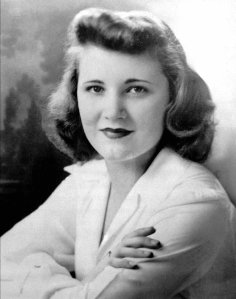
Marilyn Sheppard

He was convicted on December 21, and sentenced to life in prison. Just 17 days later, on January 7, 1955, Sheppard's mother shot and killed herself. Just 11 days after that, his father died of cancer, and perhaps of a broken heart. His father-in-law would also be a suicide, in 1963, while the appeals process was underway.

On June 6, 1966, Bailey's efforts to get a new trial paid off, and his conviction was thrown out, based on apparent bias by the original trial's judge. The new trial began on October 24, and on November 16, after deliberating for 12 hours, the jury found him not guilty. He had served 10 years in prison for a murder he did not commit.

Sheppard didn't exactly help himself in the whole process, including having had an affair before the murder, which was cited as his motive in the original trial, and remarrying while in prison. He lived barely 3 more years before drinking himself to death in 1970.

The actual killer, whom Sheppard described as "a bushy-haired man"? Most likely, it was Richard Eberling, who was imprisoned for another woman's death. He died in prison in 1998.

Despite the denial of the series' creator, Roy Huggins, the Sheppard case is believed to have inspired the 1963-67 ABC TV show The Fugitive.

*

November 16, 1966 was a Wednesday. Baseball was out of season. Football was in midweek. There were 3 games in the NBA:

* The New York Knicks lost to the Philadelphia 76ers, 117-108 at the Philadelphia Civic Center. Hal Greer scored 35 points. Wilt Chamberlain had 28 points and 30 rebounds.

* The Los Angeles Lakers beat the Cincinnati Royals, 124-112 at the Cincinnati Gardens. Jerry West and Rudy LaRusso each scored 36 points for the Lakers. Oscar Robertson and Happy Hairston co-led the Royals with 24 points.

* And the St. Louis Hawks beat the Detroit Pistons, 104-101 at Cobo Hall (now Huntington Place) in Detroit.

And there was 1 game in the NHL: The New York Rangers and the Chicago Black Hawks played to a 2-2 tie at the old Madison Square Garden.

Saturday, October 29, 2022

October 29, 1960: The Cal Poly Plane Crash & Ali's Pro Debut

October 29, 1960: A C-46 plane crashes during takeoff near Toledo, Ohio, killing 22 people, including 16 players for the football team at California Polytechnic State University of San Luis Obispo. The school popularly known as "Cal Poly" should not be confused with the California Institute of Technology, a.k.a. "Caltech," in Pasadena.

They had just lost 50-6 to a Bowling Green team that featured future actor Bernie Casey. An investigation revealed that the plane was overloaded, weighing over 2,000 pounds more than it should have. Fog was also a factor: It was so bad that the City of Toledo suspended taxi service for the night.

Amazingly, 26 people on board survived, including quarterback Ted Tollner, who went on to coach USC from 1983 to 1986. "I was the cutoff for who lived and died," Tollner said in a 2006 interview. "Everyone in front of me died. Everyone behind me survived." Of the 26 survivors, 13 attended a 50th Anniversary memorial service in 2010.
Cal Poly, then an NCAA Division II school, was 1-5, and it canceled the rest of its season. The Mustangs would bounce back in 1961, going 5-3. As recently as 1957 and '58, they had gone 17-2, with a team that included an offensive tackle who would make his mark in pro football, not as a player, but as a coach, broadcaster and video game impresario: John Madden.
The school won the Division II National Championship in 1980, and is now in the Football Championship Subdivision (FCS), formerly known as Division I-AA, having most recently made the Playoffs in 2016.
*
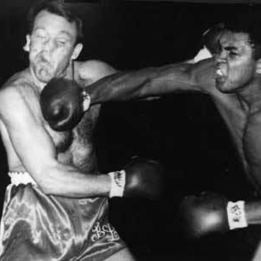
October 29, 1960 was a Saturday. The next-biggest sporting event occurring that day would not be thought of as such for a few more years. Cassius Clay, coming off his Olympic Gold Medal in Rome, has his 1st professional fight, in his hometown of Louisville, Kentucky. He fights Tunney Hunsaker, the fight goes the maximum 6 rounds, and Clay wins a unanimous decision. He later admitted that he wasn't prepared to face a professional fighter, and that Hunsaker gave him one of the hardest body blows he would ever receive.
Not an especially interesting beginning for the man who will become Muhammad Ali, one of the most interesting people who has ever lived. Hunsaker, a U.S. Air Force veteran, returned to his native West Virginia, and was named a police chief at age 27, serving for 38 years. He and Ali stayed in touch and became friends. Hunsaker disagreed with Ali's decision to refuse being drafted, but he respected Ali's dedication to principle. Hunsaker died in 2005.
Among the other college football games played that day:
* Number 1 Iowa beat Number 19 Kansas, 21-7 at Iowa Stadium (renamed Kinnick Stadium in 1972).
* Number 2 Mississippi (Ole Miss) and Louisiana State (LSU) played to a tie, 6-6 at Hemingway Stadium (renamed Vaught-Hemingway Stadium in 1982) in Oxford, Mississippi.
* Number 3 Syracuse were upset by the University of Pittsburgh, 10-0 at Archbold Stadium in Syracuse, New York.
* Number 4 Navy beat Notre Dame, 14-7 at Philadelphia Municipal Stadium (renamed John F. Kennedy Stadium in 1964). Also among the service academies, Army beat Miami University of Ohio, 30-7 at Michie Stadium in West Point, New York; and Air Force lost to George Washington University, 20-6 at Falcon Stadium in Colorado Springs, Colorado. 
* Number 5 Missouri beat Nebraska, 28-0 at Memorial Stadium in Lincoln, Nebraska.
* Number 6 Minnesota beat Kansas State, 48-7 at Memorial Stadium in Minneapolis.
* Number 7 Baylor were upset by Texas Christian University (TCU), 14-6 at Amon G. Carter Stadium in Fort Worth, Texas.
* Number 8 Ohio State beat Number 10 Michigan State, 21-10 at Spartan Stadium in East Lansing, Michigan.
* Number 9 Washington beat Oregon, 7-6 at Husky Stadium in Seattle.
* In a crosstown rivalry that no longer plays football, but is still a nasty one in basketball, Xavier beat the University of Cincinnati, 5-0 at Nippert Stadium in Cincinnati.
* And in New Jersey, Princeton beat Brown, 54-21 at Palmer Stadium in Princeton; and Rutgers lost to Villanova, 14-12 at Rutgers Stadium in Piscataway.
There were 4 NBA games played that day:
* The New York Knicks lost to the Detroit Pistons, 115-110 at the Olympia Stadium in Detroit.
* The Philadelphia Warriors beat the Boston Celtics, 1341-103 at the Boston Garden.
* The Syracuse Nationals beat the Los Angeles Lakers, 125-118 at the Onondaga County War Memorial (now the Upstate Medical University Arena) in Syracuse, New York.
* And the St. Louis Hawks beat the Cincinnati Royals, 113-97 at the Kiel Auditorium in St. Louis.
Two games were played in the NHL. The Montreal Canadiens beat the Boston Bruins, 3-2 at the Montreal Forum. And the Toronto Maple Leafs beat the Chicago Black Hawks, 8-4 at Maple Leaf Gardens in Toronto. The New York Rangers and the Detroit Red Wings were not scheduled.
And Michael Carter was born that day, becoming a defensive tackle who won 3 Super Bowls with the San Francisco 49ers.

Thursday, October 27, 2022

October 27, 1906: The 1st Professional Forward Pass

October 25, 1906: For the 1st time, a legal forward pass is thrown in a professional football game. George Watson "Peggy" Parratt, a 23-year-old quarterback who had graduated from the Cleveland school now known as Case Western Reserve University, throws it to Bullet Riley (a good name for a receiver), for the Massillon Tigers in an Ohio League game against the Benwood-Moundsville team. Massillon won, 60-0, at the Hospital Grounds Stadium in Massillon.
Ironically, it would be by intercepting 2 passes in the championship game, against the Canton Bulldogs, that Parratt would be best remembered in his own time. He would help Massillon win the Ohio League title in 1906, 1911, 1913 and 1914. He later served on the NFL Rules Committee, and lived until 1959.
October 27, 1906 was a Saturday. Baseball season ended 13 days earlier, when the Chicago White Sox beat the Chicago Cubs in the World Series. Professional basketball didn't exist, and if professional hockey did, it was by paying players "under the table."
Records of pro football teams from this era are sketchy. Thankfully, the Massillon Tigers were better than most at it. But there is a list of college football games from the day available, including the following:
* Harvard beat Army, 5-0 on The Plain in West Point, New York.
* Navy and Bucknell played to a 0-0 tie at Worden Field in Annapolis, Maryland.
* Yale beat Amherst, 12-0 at Yale Field in New Haven, Connecticut. Yale went 9-0-1.
* Vanderbilt beat Texas, 45-0 at the original Dudley Field in Nashville. Vandy was the best team in the South that year, going 8-0-1.
* Wisconsin won the title in the Western Conference, the league that became the Big Ten, and went 5-0 on the season, but did not play this week.
* In New York City, New York University lost to Stevens Institute of Hoboken, New Jersey, 6-0 at Ohio Field in The Bronx.
* And among New Jersey teams, Rutgers lost to the University of Delaware, 4-0 in Newark, Delaware; and Princeton beat Cornell, 14-5 at University Field in Princeton. Princeton went 9-0-1.

Saturday, October 22, 2022

October 22, 1934: Pretty Boy Floyd Is Killed

"Pretty Boy"?

October 22, 1934: Pretty Boy Floyd is killed by FBI agents led by Melvin Purvis in East Liverpool, Ohio. The Midwest-based bank robber was 30 years old. Like his contemporary Lester Gillis, a.k.a. Baby Face Nelson, he hated his nickname.

Charles Arthur Floyd was born on February 3, 1904 in Adairsville, Georgia, and grew up in Akins, Oklahoma. He first got arrested at age 18, for stealing $3.50 from a post office. In 1925, he was busted for a payroll robbery in St. Louis, and served 3 1/2 years in prison.

He got involved with organized crime in Kansas City, and pulled off numerous robberies. In 1930, he was sentenced to 12 to 15 years for bank robbery in Ohio, but escaped. In 1931, members of his gang killed Patrolman R.H. Castner in Bowling Green, Ohio. Later that year, Floyd himself killed federal Agent Curtis Burke in Kansas City.

In 1933, Floyd was implicated in a shootout at Union Station that left 2 Kansas City detectives, an Oklahoma police chief, a federal agent dead, becoming known as the Kansas City Massacre. However, the available evidence suggests that Floyd wasn't even there.

Following the death of John Dillinger on July 22, 1934, FBI Director J. Edgar Hoover replaced him as "Public Enemy Number 1" with Floyd. By mid-October, Floyd was on the run in Ohio. On October 22, he made his way to East Liverpool, not far from Wheeling, West Virginia, and found refuge at a pool hall owned by a friend. Attempting to leave the pool hall, he was confronted by officers, tried to run, and was shot and killed.

It was a busy time for the nascent FBI, having gunned down some major bad guys in an 8-month span of 1934 and 1935: May 23, Bonnie Parker and Clyde Barrow in Arcadia, Louisiana; July 22, Dillinger in Chicago; October 22, Floyd November 27, Nelson outside Chicago in Wilmette, Illinois; and January 16, Ma Barker in Lake Weir, Florida.

*

October 22, 1934 was a Monday. Canadian football star Gerry James was born on this day.

Although Monday Night Football was still 36 years away, there was only 1 score on this historic day, and it was in the NFL: The new Detroit Lions beat the football version of the Brooklyn Dodgers, 28-0 at the University of Detroit Stadium.

Thursday, October 20, 2022

October 20, 1944: The East Cleveland Gas Explosion

October 20, 1944: Keeping the promise he made 2 1/2 years earlier, General Douglas MacArthur returns to the Philippines, landing at Leyte Gulf. It will take until April 13, 1945 to get all Japanese troops out of the country. I have a separate entry for that event.

Also on this day, in Europe, the Yugoslav capital of Belgrade is liberated from the Fascists by Yugoslav Partisans. The following year, a professional soccer team will be named for them: Football Klub Partizan Belgrade.

But it's not all a good day: A gas leak causes an explosion that destroys a square mile of the East Side of Cleveland, killing 131 people.

The East Ohio Gas Company built a full-scale commercial liquid natural gas (LNG) plant in Cleveland in 1940, just after a successful pilot plant was built by its sister company, Hope Natural Gas Company of West Virginia. The stored liquid was regasified, and put into the mains when cold snaps hit and extra capacity was needed. Formerly, some customers' gas service was curtailed during a cold snap.

At 2:30 PM, the cylindrical above-ground storage tank Number 4 began to emit a vapor that poured from a seam on the side of the tank, near Lake Erie on East 61st Street, and winds from the lake pushed the vapor into a mixed-use section of Cleveland, where it dropped into the sewer lines via the catch basins located in the street gutters.

As the gas mixture flowed and mixed with air and sewer gas, the mixture ignited. In the ensuing explosion, manhole covers launched skyward as jets of fire erupted from depths of the sewer lines. One cover was found several miles east, in the Cleveland neighborhood of Glenville.

At first it was thought that the disaster was contained, and spectators returned home thinking that the matter was being taken care of by the fire department. But at 3:00, another above-ground tank exploded, leveling the tank farm. The explosions and fires continued to occur, trapping many who had returned to what they thought was the safety of their own homes. Housewives who were at home suddenly found their homes engulfed in flame as the explosion traveled through the sewers and up through drains.

The toll could have been significantly higher had the event occurred after local schools had let out and working parents returned to their homes for the evening. In all, 225 persons were injured; over 700 people were left homeless, and 79 homes, two factories, numerous cars, and miles of underground infrastructure were destroyed.

Following the disaster, utility companies and communities began to rethink their natural gas storage systems, and below-ground storage of natural gas grew in popularity.

*

October 20, 1944 was a Friday. Baseball season had ended 11 days earlier, with the St. Louis Cardinals defeating their landlords at Sportsman's Park, the St. Louis Browns. The NBA hadn't been founded yet. The NHL season wouldn't begin for another 8 days. And the NFL was in midweek. But there were 4 games in college football that night:

* In a rare college football version of the New York City vs. New England sports rivalry, Boston College beat New York University, 42-13 at Fenway Park. Until Alumni Stadium was built in 1957, BC played wherever they could get a playing date, and also played at Braves Field and Harvard Stadium, in addition to their on-campus Alumni Field, which Alumni Stadium would replace. NYU played its home games at Ohio Field in The Bronx, with games too big for that 12,000-seat facility moved across the Borough to Yankee Stadium.

* The University of Kentucky beat Virginia Military Institute, 26-9 at McLean Stadium in Lexington, Kentucky. Although VMI was (and is) a military school, this was not an example of a regular college football team struggling to find games due to the manpower drain of World War II, and settling for playing the college-age players on military bases. But there were many such games, in both World Wars, and these last 2 were among them:

* The team at the U.S. Army's Fort Pierce, in the town of the same name, north of Miami, beat the University of Miami, 38-0 at Burdine Stadium in Miami. In 1959, Burdine Stadium would be renamed for its biggest annual event: The Orange Bowl.

* And the University of Georgia beat Daniel Field, 57-6 at Sanford Stadium in Athens, Georgia. Daniel Field was a U.S. Army Air Forces base in Augusta, Georgia. 

Wednesday, October 12, 2022

October 12, 2018: Columbus Saves the Crew

October 12, 2018: The Columbus Crew are "saved." This was not a given.

One of the founding franchises of Major League Soccer in 1996, the team in Ohio's capital city were the 1st to move into a soccer-specific stadium, in 1999, which became known as Historic Crew Stadium. The Crew won the U.S. Open Cup in 2002, won the Supporters' Shield as regular-season champions in 2004, won the Shield and the MLS Cup in 2008, won the Shield again in 2009, and reached the MLS Cup Final again in 2015.

In 2013, hedge fund manager Anthony Precourt bought the team from Clark Hunt, owner of the NFL's Kansas City Chiefs. (and son of Lamar Hunt, the founding owner of both teams). Like so many other sports team owners, decided he didn't like the team's current playing venue. (So why buy the team, stupid?) On October 17, 2017, he announced intentions to relocate the franchise to Austin, Texas if a downtown stadium could not be secured in Columbus.

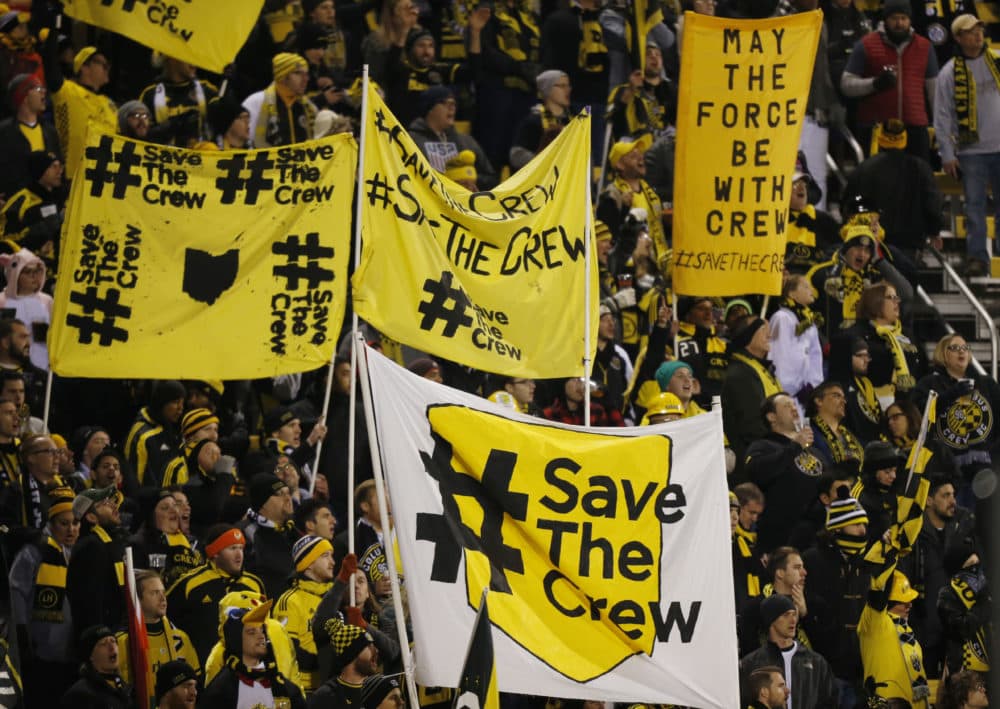
Following this news, fans and supporters of the club began a campaign and movement known as #SaveTheCrew. Later in the month, it was revealed that Precourt had a clause in his purchase of the club that would allow him to relocate the franchise, but only to Austin.

This made no sense. First of all, by playing in a Summer league, the Crew had no competition. The city's baseball team, the Columbus Clippers, was only Class AAA. There was competition early in the season, from the NHL's Columbus Blue Jackets, but the Crew are arguably more popular, and the closest NBA teams were in Cleveland and Indianapolis. And at the end of the season, there was no NFL team to hog the schedule, although Ohio State football sure does.

Second of all, Precourt moving the team to Austin made no sense. It was a metropolitan area that had never previously had any major league sports team, not even in a secondary "rebel league" like the AFL, the ABA, the WHA, the WFL or the USFL. He'd still have to get a stadium built, no matter where he wanted to play, unless he wanted to play before 90,000 empty seats at the University of Texas' Memorial Stadium, or fill a high school stadium.

And the location made no sense for Precourt himself: He grew up in Denver, went to high school in Connecticut, went to college at Pepperdine outside Los Angeles, worked at Merrill Lynch in New York, and started his firm in San Francisco. He had no connection to Austin, or even to Texas.

Responding to fans' demands, on March 5, 2018, Ohio Attorney General Mike DeWine and Columbus City Attorney Zach Klein filed a lawsuit against Precourt, citing a previously untested 1996 State law that prevents sports teams that benefited from public facilities or financial assistance from relocating to another city without a six-month notice and attempting to sell the team to a local ownership group. This was known as the Modell Law, and was passed after Art Modell moved the original version of the Cleveland Browns to Baltimore.

The new Browns franchise was established in 1999, and was now owned by Jimmy Haslam, who owned the Pilot Flying J chain of truck stops, and the Browns, and also a share of the NBA's Milwaukee Bucks. His brother, Bill Haslam, was then the Governor of Tennessee, owns minor-league baseball's Knoxville-based Tennessee Smokies, and, as of 2022, is in the process of buying the NHL's Nashville Predators. So the family is involved in all 5 sports at the professional, if not major-league, level.

On October 12, 2018, Jimmy Haslam revealed that he was in the process of buying the Crew from Precourt. MLS Commissioner Don Garber said that if this deal went through, Precourt would get an expansion team in Austin. The State's lawsuit against Precourt was dropped, and the Modell Law remains untested. The fans and the State government, working together, had #SavedTheCrew. It is one of the few examples of fan power saving their team.

Haslam officially became owner of the Crew on January 1, 2019. With the fans getting a second chance, the Crew won the MLS Cup in 2020. In 2021, the Crew moved into Lower.com Field. Their former home, now named Historic Crew Stadium, remains in operation as the team's training facility and a concert venue. (UPDATE: The Crew won the MLS Cup again in 2023.)

Precourt began operating Austin FC almost immediately after the sale to Haslam went through, hiring coaches and other staff starting in July 2019, and signing players starting in July 2020. They began play on April 17, 2021, losing 2-0 away to Los Angeles F.C. Served Precourt right. They played their 1st 8 games on the road, until the stadium that Precourt wanted so badly, Q2 Stadium, opened on June 19. Austin and the San Jose Earthquakes played to a dull 0-0 draw. Also served Precourt right.

*

October 12, 2018 was a Friday. Game 1 of the National League Championship Series was played at Miller Park (now American Family Field) in Milwaukee. The Milwaukee Brewers beat the Los Angeles Dodgers, 6-5. But the Dodgers won the series in 7 games, and then lost the World Series to the Boston Red Sox.

The NBA season hadn't started yet. The NHL season had, but no games were scheduled for the day.

And in New Jersey high school football, my Alma Mater, East Brunswick, lost to Edison, 31-14 at Matthew J. Drwal Stadium in Edison.

Friday, October 7, 2022

October 7, 2000: The Columbus Blue Jackets: A Team for All Ohio

Ron Tugnutt

October 7, 2000: The Columbus Blue Jackets bring the NHL back to Ohio after 22 years, and give the State capital its 1st-ever major league team, unless you count Major League Soccer's Columbus Crew, or the Columbus Bullies who won the only titles of the 1940-41 American Football League.

Their 1st game is at home against the Chicago Blackhawks, who win, 5-3 at Nationwide Arena, still the Jackets' home. The Jackets' 1st goal is scored by Bruce Gardiner.

The Cleveland Barons were one of the greatest minor-league hockey teams, playing out of the Cleveland Arena. So were the Cincinnati Mohawks, playing out of the Cincinnati Gardens. But at the major league level, neither city could make it. The California Golden Seals, seeing the new Coliseum in suburban Richfield, moved in 1976, taking the Barons name. But they had no money, and after 2 seasons, they were merged with the Minnesota North Stars.

Likewise, the World Hockey Association had the Cleveland Crusaders and the Cincinnati Stingers. The Crusaders lasted 4 seasons, moving from the Arena to the Coliseum in 1974, and made the Playoffs every season. But when the Seals became the Barons, Crusaders owner Jay White moved them to St. Paul, to become the 2nd version of the Minnesota Fighting Saints. That team folded in midseason. The announcement was made at the airport, as they were about to board a plane -- ironically, for Cincinnati.

There, the Stingers began play in 1975 in the brand-new Riverfront Coliseum (now the Heritage Bank Center), and made the Playoffs in 1977 and 1979. They were 1 of the last 6 teams standing as the WHA folded in 1979, but they were not 1 of the 4 teams taken into the NHL: Those were the Quebec Nordiques, the Hartford Whalers, the Winnipeg Jets and the Edmonton Oilers. The Stingers and the Birmingham Bulls folded.

"White flight" meant that, while the metropolitan areas of Cleveland and Cincinnati maintained their populations, the cities themselves had shrunk. Neither one had a big enough population base for an NHL team, expansion or moved. And the Cleveland Arena had been torn down, and neither The Coliseum nor the Gardens nor the Riverfront Coliseum was seen as a viable option. The Gund Arena (now the Rocket Arena) opened in 1994, and a minor-league team became successful there, as in Cincinnati. But neither city was going to get a team.

So while both Cleveland and Cincinnati had minor-league teams, neither was considered big enough of a metropolitan area to support a team by itself. But if it was put in Columbus, an even smaller metro area, it could represent the entire State.

And attendance has never been an issue for the Blue Jackets. Nationwide Arena is in downtown Columbus, 70 miles east of Dayton, 107 miles northeast of Fountain Square in Cincinnati, 142 miles southwest of Public Square in Cleveland, and 142 miles southeast of Toledo. So it's not hard for fans from all over the Buckeye State.

However, the Jackets have not had much success on the ice. It took them until 2009 to make the Playoffs, until 2014 to win a single Playoff game, and 2019 to win a Playoff round. And they have yet to extend Ohio rivalries with other places. They haven't built on Cleveland Browns vs. Pittsburgh Steelers, or Cincinnati Reds vs. Pittsburgh Pirates to make Blue Jackets vs. Penguins a big rivalry. Nor have they built on Cleveland Cavaliers vs. Detroit Pistons, or Ohio State vs. Michigan, to make Blue Jackets vs. Red Wings a big rivalry. It doesn't help that the Jackets aren't in the same Division as the Wings, although they are with the Pens.

UPDATE: The Blue Jackets have retired one uniform number, 61, for their all-time leading scorer, left wing Rick Nash. They have also raised banners honoring team founding owner John H. McConnell, and left wing Johnny Gaudreau, who was killed along with his brother Matthew when they were hit by a drunk driver in South Jersey in 2024. An All-Star when he was with the Calgary Flames, his Number 13 has been removed from circulation, but not officially retired.

*

It is also the night of the 1st game for another expansion team, the Minnesota Wild. They open on the road, at the America West Arena (now the Footprint Center) in Phoenix, and lose to the Phoenix Coyotes, 4-1.

Elsewhere in the NHL:

* The New York Rangers beat the Atlanta Thrashers, 2-1 at the Philips Arena (now the State Farm Arena) in Atlanta.

* The Boston Bruins beat the Philadelphia Flyers, 5-1 at the First Union Center (now the Xfinity Mobile Arena) in Philadelphia.

* The Washington Capitals and the Carolina Hurricanes play to a tie, 3-3 at the Raleigh Entertainment & Sports Arena (now the Lenovo Center).

* The Ottawa Senators beat the Dallas Stars, 3-1 at the Corel Centre (now the Canadian Tire Centre) in the Ottawa suburb of Kanata, Ontario.

* In an "Original Six" matchup, the Toronto Maple Leafs beat their arch-rivals, the Montreal Canadiens, 2-0 at the Air Canada Centre (now the Scotiabank Arena) in Toronto.

* The Pittsburgh Penguins beat the Nashville Predators, 3-1 at the Gaylord Entertainment Center (now the Bridgestone Arena) in Nashville.

* The Buffalo Sabres beat the Los Angeles Kings, 5-3 at the HSBC Arena (now the KeyBank Center) in Buffalo.

* And the Colorado Rockies and the Edmonton Oilers play to a tie, 1-1 at the Skyreach Centre, as the Northlands Coliseum was then known, in Edmonton.

*

October 7, 2000 was a Saturday. This was also the day the TV show Queen of Swords premiered. I have a separate entry for that event.

It was also the day of Game 3 of the National League Division Series. Benny Agbayani's 13th inning home run ends the longest LDS game ever played to that point, 5 hours and 22 minutes. The dramatic round-tripper by the Mets outfielder, who (like a previous Met, Sid Fernandez) wears Number 50 because he's from Hawaii, the 50th State, gives the Mets a 3-2 victory, and a 2-games-to-1 series advantage over the San Francisco Giants.

In the other NLDS, the St. Louis Cardinals do the Mets a huge favor, completing a 3-game sweep over the team in the Mets' heads, the Atlanta Braves. The Cards win, 7-1 at Turner Field (now Center Parc Stadium) in Atlanta.

In the American League Division Series, the Oakland Athletics beat the New York Yankees, 11-1 at the Oakland Coliseum (then named the Network Associates Coliseum) in Game 4. This ties the series up. But the Yankees win the series the next day. The other ALDS was wrapped up the day before, with the Seattle Mariners sweeping the Chicago White Sox.

And there was college football on the day, including the following games:

* Number 1 Florida State were upset by Number 7 Miami, 27-24 at the Orange Bowl in Miami. The Hurricanes won the Big East Conference title. Florida State still won the Atlantic Coast Conference title.

* Number 2 Nebraska beat Iowa State, 49-27 at Jack Trice Stadium in Ames, Iowa.

* Number 3 Virginia Tech beat Temple, 35-13 at Lane Stadium in Blacksburg, Virginia.

* Number 4 Kansas State beat their arch-rivals, Kansas, 52-13 at Memorial Stadium in Lawrence, Kansas.

* Number 5 Clemson beat North Carolina State, 34-27 at Clemson Memorial Stadium in Clemson, South Carolina.

* Number 6 Michigan lost to Purdue, 32-31 at Ross-Ade Stadium in West Lafayette, Indiana. Purdue won the Big 10 Conference title.

* Number 8 Ohio State beat Number 24 Wisconsin, 23-7 at Camp Randall Stadium in Madison, Wisconsin.

* Number 10 Oklahoma beat Number 11 Texas, 63-14 in the Red River Rivalry at the Cotton Bowl in Dallas. The Sooners went on to win beat Kansas State for the Big 12 Conference title, and Florida State in the Orange Bowl, and won the National Championship.

* Number 12 Florida beat Louisiana State, 41-9 at Ben Hill Griffin Stadium in Gainesville, Florida. The Gators went on to beat Auburn for the Southeastern Conference title, but lost the Sugar Bowl to Miami.

* Number 13 Washington beat Number 23 Oregon State, 33-30 at Husky Stadium in Seattle. Washington won the Pacific-10 Conference title, and beat Purdue in the Rose Bowl.

* Number 15 Auburn were upset by Number 20 Mississippi State, 17-10 at Scott Field in Starkville, Mississippi.

* Number 18 Southern California were upset by Arizona, 31-15 at the Los Angeles Memorial Coliseum.

* Number 19 Georgia beat Number 21 Tennessee, 21-10 at Sanford Stadium in Athens, Georgia. Tennessee still ended up going to the Cotton Bowl, but lost it to Kansas State.

* Number 25 Notre Dame beat Stanford, 20-14 at Notre Dame Stadium in South Bend, Indiana. Notre Dame went to the Fiesta Bowl, but lost to Oregon State.

* Nevada-Las Vegas (UNLV) beat arch-rival Nevada, 38-7 at Sam Boyd Stadium in the Las Vegas suburb of Whitney, Nevada.

* In a battle between service academies, Air Force beat Navy, 27-13 at Falcon Stadium in Colorado Springs, Colorado.

* Army lost to New Mexico State, 42-23 at Aggie Memorial Stadium in Las Cruces, New Mexico.

And the last event was held in the 77-year history of the original Wembley Stadium in London. The England national soccer team lost to Germany, 1-0. I have a separate entry for that event. 

October 7, 1922: Ohio Stadium Opens

October 7, 1922: Ohio Stadium opens in Columbus. Ohio State University had outgrown the 14,000-seat Ohio Field, but people laughed when they built a 66,210-seat stadium. They got over 71,000 fans for the opening game, a 5-0 win over Ohio Wesleyan.

NOTE: New York University, oddly, also played football at a facility named Ohio Field, from 1901 until they dropped their program after the 1952 season.

Seating capacity was raised to 78,000 in 1948, 81,000 in 1962, 83,000 in 1974, 85,000 in 1982, 91,000 in 1991, and it broke the 100,000-seat barrier in 2001. Officially, since 2019, the seating capacity of what ABC Sports college football master Keith Jackson labeled "The Big Horseshoe on the Olentangy" has been 102,780, but they've topped out at 110,045, in their 2016 win over arch-rival Michigan. The field was switched to AstroTurf in 1971, back to natural grass in 1990, and to FieldTurf in 2007.

Since moving in, the Buckeyes have won 34 Big Ten Conference Championships, and claim 8 National Championships: 1942, under head coach Paul Brown; 1954, 1957, 1961, 1968 and 1970, under Woody Hayes; 2002, under Jim Tressel; and 2014, under Urban Meyer. Ohio Stadium has been home to 6 Heisman Trophy winners, including Archie Griffin in 1974 and 1975, the only 2-time winner. The others have been Les Horvath in 1944, Vic Janowicz in 1950, Howard Cassady in 1955, Eddie George in 1995, and Troy Smith in 2006. Smith was a quarterback, the rest were running backs.

Ohio Stadium was also home to the Ohio Glory of the World League of American Football (WLAF) in 1992, and to the Columbus Crew of Major League Soccer from their 1996 founding until 1998. The Columbus Bullies, winners of the only titles in the 1940 and 1941 edition of the American Football League, played at Red Bird Stadium, later Cooper Stadium, the city's minor-league ballpark from 1931 to 2008.

*

October 7, 1922 was a Saturday. These other notable college football games were played:

* Army beat Kansas, 13-0 on The Plain in West Point, New York.

* Navy beat Western Reserve, 71-0 at Worden Field in Annapolis, Maryland.

* Columbia beat Amherst, 43-6 at South Field in Upper Manhattan.

* Rutgers beat Fordham, 20-15 at Neilson Field in New Brunswick, New Jersey.

* Princeton beat Virginia, 5-0 at Palmer Stadium in Princeton, New Jersey.

* Syracuse beat New York University (NYU), 34-0 at Archbold Stadium in Syracuse, New York.

* Harvard beat Holy Cross, 20-0 at Harvard Stadium in Boston.

* Yale beat North Carolina, 18-0 at the Yale Bowl in New Haven, Connecticut.

* Alabama beat Oglethorpe, 41-0 at Denny Field in Tuscaloosa, Alabama.

* Notre Dame beat Saint Louis University, 26-0 at Cartier Field in South Bend, Indiana.

* Michigan beat Case -- an Ohio school, if not Ohio State -- 48-0 at Ferry Field in Ann Arbor, Michigan. In 1970, Case and Western Reserve merged, forming Case Western Reserve University.

* The University of Chicago beat the University of Georgia, 20-0 at Stagg Field in Chicago.

There was also a World Series game played. With the questionable calling of Game 2 due to "darkness" in mind, Commissioner Kenesaw Mountain Landis insists that Game 4 be played, despite a heavy rain. Again, one big inning, a 4-run 4th off Yankee pitcher Carl Mays, is enough for Hugh McQuillan of the Giants to squeeze out a 4-3 win. Aaron Ward's 2nd homer of the Series is all the long-ball clout the Yankees will display.

Mays' brief collapse today‚ coupled with his 2 losses in the 1921 Series‚ and with the 1919 Series still fresh in fans' memories, leads to rumors that he took money to throw the games. The accusations will persist for decades. As with the claim that his pitch that killed Ray Chapman of Cleveland in 1920 was on purpose, Mays goes to his grave in 1971 insisting that it wasn't true.

Also on this day, Grady Edgebert Hatton Jr. is born in Beaumont, Texas. A 3rd baseman, he played from 1946 to 1960, mostly for the Cincinnati Reds, and was an All-Star in 1952. He later managed the Houston Astros from 1966 to 1968, remained with them as a scout and a coach, and died in 2013.

Also on this day, for the 1st time, a member of the British royal family speaks during a radio broadcast. It is Edward Albert Christian George Andrew Patrick David, Prince of Wales, the heir to the throne. In early 1936, upon the death of his father, King George V, he became King Edward VIII. In late 1936, he used another radio broadcast to to explain his decision to abdicate the throne, and became the Duke of Windsor. 

December 31, 1999 & January 1, 2000: The Millennium

December 31, 1999:  The Millennium arrives. The people of planet Earth survived. At a terrible cost. But we hadn't destroyed ourselves. ...