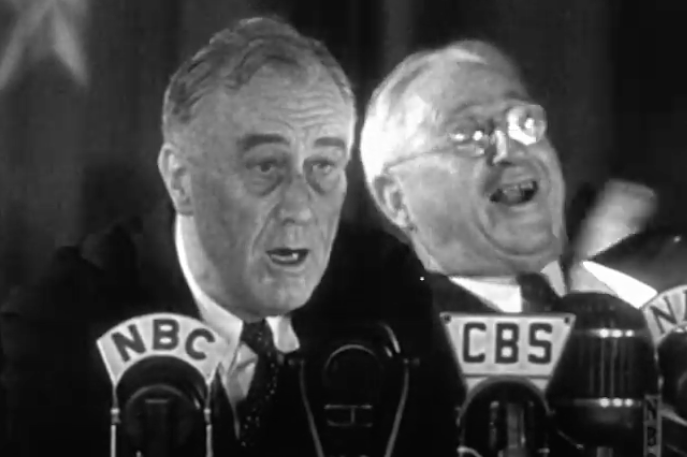
September 23, 1944: The President of the United States, running for re-election, makes his dog an issue in the campaign. Why not? They started it.
On April 7, 1940, a litter of Scottish terrier puppies was born at Wilderstein, in Rhinebeck, Dutchess County, New York. This mansion was the home of, among others, Margaret Suckley. Known as Daisy, she lived 10 miles up the Hudson River from Springwood, the Hyde Park home of her 6th cousin, the President of the United States, Franklin Delano Roosevelt. Whose wife, Eleanor Roosevelt, was a 5th cousin, and a niece of a previous President, Theodore Roosevelt. (FDR's own parents, James Roosevelt and Sara Delano, were 6th cousins. The Hudson Valley of the time saw quite a bit of inbreeding, often closer than that.)
Among the puppies was one that Daisy named Big Boy, although Scottish terriers, a.k.a. "Scotties," are not very big. She trained the dog to sit, roll over, and jump. She was closer to FDR than their blood relationship would suggest, although their physical distance wasn't much. (It was rumored that they were, how shall I put this, a little too close, but this has never been proven.) As a Christmas present, she gave the dog to FDR.
FDR, like many members of old, established New York State families, had (and many of those who didn't, claimed) patrilineal Dutch descent. But he also had Scottish descent, with a grandfather named John Aspinwall, and the Scottie reminded him of an ancestor, known as Murray the Outlaw of Falahill. This became the dog's formal name with the American Kennel Club. FDR called him "Fala" for short, and took him back with him to the White House, to which he had just been elected to an unprecedented 3rd term.
Within a few weeks, Fala was taken to a veterinary hospital. As it turned out, he had figured out how to reach the kitchen, and was being overfed. FDR gave orders to everyone, from kitchen staff to West Wing employees: No one but the President was to feed Fala.
In his 2nd campaign for President, in 1936, the Republicans relentlessly attacked FDR. They also attacked Eleanor, for various reasons. They even printed campaign buttons reading, "And that goes for Eleanor, too!" These attacks got harsher in 1940.
As America entered World War II, FDR's sons entered military service. Franklin D. Roosevelt Jr. served in the U.S. Navy, where he rose to the rank of Lieutenant Commander, served in combat, commanded the destroyer USS Ulvert M. Moore, and earned the Silver Star (for exposing himself under fire to carry a critically wounded sailor to safety), the Bronze Star, the Legion of Merit, the Purple Heart, and the nickname "Big Moose." FDR Jr. was a legitimate war hero.
Elliott Roosevelt, named for Eleanor's father and TR's brother, was also genuinely heroic in The War. (As my grandmother, who lived through it, explained, "It was always Capital T, Capital W.") He was classified 4-F, unfit for service, due to poor eyesight. He asked his father, as Commander-in-Chief, to overrule this so he could serve. He was given a Captain's commission in the U.S. Army Air Forces, and flew 89 combat missions, earning the Legion of Merit and the Distinguished Flying Cross. He later became, like actor and hero pilot Jimmy Stewart, a Brigadier General in the U.S. Air Force Reserve.
James Roosevelt, named for FDR's father, was already a military aide to his father before the attack on Pearl Harbor got America into The War, a Lieutenant Colonel in the U.S. Marine Corps. He served in combat in the Makin Raid (at what's now named Butaritari, in the Pacific Island nation of Kiribati) of August 17, 1942, received the Navy Cross (then as now, the Marines were part of the Department of the Navy), was promoted to full Colonel, and became a postwar Brigadier General in the Marine Corps Reserve.
Youngest son John Aspinwall Roosevelt was talked out of seeking conscientious objector status. He received an Ensign's commission in the Navy, and, according to brother James, "John was the only one of us who had no opportunity to lead a fighting unit, yet he, too, served under fire." He received the Bronze Star, and reached the rank of Lieutenant Commander. (Franklin and Eleanor also had a daughter, Anna, and a son, the 1st Franklin Jr., who died as an infant.)
Any or all of the 4 Roosevelt sons could have taken the easy way out. They could have gotten out of serving, by taking necessary (or "necessary") government jobs. They could have been given military posts that would have kept them stateside, or even in either the European or the Pacific Theater of Operations, but away from combat. Indeed, James already had a stateside, non-combat post. But they all served in combat, all were legitimately decorated, Franklin Jr. was wounded, and all but John were awarded commands.
Still, as FDR ran for a 4th term, the Republicans, who had nominated Governor Thomas E. Dewey of New York for President and Governor John Bricker of Ohio for Vice President (with the slogan, "Win the war quicker with Dewey and Bricker"), noted that all 4 sons started out as officers, not enlisted men working their way up. Which, as college graduates (except for Elliott: He refused to attend college, but the other 3 graduated from Harvard like their father), they were qualified to do, if not entitled.
Noting that all but John had received commands, and that any Naval officer who commands any unit is addressed by his crew as "Captain," regardless of his actual rank, the GOP made campaign buttons reading, "I wanna be a Cap'n too!" Never mind that Elliott and James weren't even in the Navy.
It got worse. There was a "whispering campaign" that FDR was dying. As it turned out, he was: The stress of The War, and his incessant smoking, had given him heart disease and very high blood pressure. But the details were kept out of reach of the media.
The GOP even spread a rumor that, while on an inspection tour of a base in the Aleutian Islands of Alaska, FDR had left Fala behind, and had, at significant cost to U.S. taxpayers, ordered a destroyer to get Fala and bring him back to the mainland. The story spoke to both corruption and a sense of entitlement on the Roosevelts' part.
The story was a total lie, as Republican rumors about the Democrats tend to be. FDR was angry. But Orson Welles, a great actor and director but not really known for comedy, suggested to the President that he use comedy on the Republicans.
In those days, before Primaries became deciding factors, and before "exploratory committees" became vital, Presidential campaigns didn't start nearly 2 years before the election. Sometimes, candidates didn't launch their official campaigns until after their nominating conventions. FDR not only could do this in 1944, but, given The War, he pretty much had to.
And so, his 1st campaign speech took place on September 23, in Washington, at a dinner of the International Teamsters Union, to emphasize his long connection with the labor unions. It lasted half an hour, and was broadcast by all American radio networks. He made the audience laugh, both in the room and in the living rooms:
Well, here we are, together again, after four years. And what years they have been!
You know, I am actually four years older, which is a fact that seems to annoy some people. In fact, in the mathematical field, there are millions of Americans who are more than eleven years older than when we started in to clear up the mess that was dumped in our laps in 1933.
We all know that certain people who make it a practice to depreciate the accomplishments of labor – who even attack labor as unpatriotic – they keep this up usually for three years and six months in a row. But then, for some strange reason, they change their tune, every four years, just before Election Day. When votes are at stake, they suddenly discover that they really love labor, and that they are anxious to protect labor from its old friends...
The whole purpose of Republican oratory these days seems to be to switch labels. The object is to persuade the American people that the Democratic Party was responsible for the 1929 crash and the Depression, and that the Republican Party was responsible for all social progress under the New Deal.
Now, imitation may be the sincerest form of flattery, but I am afraid that, in this case, it is the most obvious common or garden variety of fraud!...
Can the Old Guard pass itself off as the New Deal? I think not. We have all seen many marvelous stunts in the circus, but no performing elephant could turn a handspring without falling flat on his back.
He moved on to foreign policy, and the conduct of The War:
There are some politicians who kept their heads buried deep in the sand while the storms of Europe and Asia were headed our way, who said that the Lend-Lease bill "would bring an end to free government in the United States," and who said, "only hysteria entertains the idea that Germany, Italy, or Japan contemplates war on us."
These very men are now asking the American people to entrust to them the conduct of our foreign policy and our military policy. What the Republican leaders are now saying in effect is this: "Oh, just forget what we used to say. We have changed our minds now. We have been reading the public opinion polls about these things, and now we know what the American people want."
And if that wasn't enough, he addressed the rumor about his dog:
These Republican leaders have not been content with attacks on me, or my wife, or on my sons. No, not content with that, they now include my little dog, Fala!
Well, of course, I don't resent attacks, and my family don't resent attacks, but Fala does resent them!
FDR, and Daniel J. Tobin,
President of the International Teamsters Union
FDR waited for the laughter to subside, to provide the full effect for the radio audience, and continued:
You know, Fala is Scotch, and, being a Scottie, as soon as he learned that the Republican fiction writers -- in Congress, and out -- had concocted a story that I'd left him behind on an Aleutian Island, and had sent a destroyer back to find him, at a cost to the taxpayers of two, or three, or eight, or twenty million dollars... his Scotch soul was furious. He has not been the same dog since.
The next line wasn't funny in the slightest, but it still drew laughter from the room:
I am accustomed to hearing malicious falsehoods about myself. But I think I have a right to resent, to object, to libelous statements about my dog!
After that, Dewey's only chance was if FDR had died before the election. He did not. But he did die on April 12, 1945, less than 3 months into his 4th and final term.
After his death, Eleanor took Fala home with her to Val-Kill, her home in Hyde Park. (She and Franklin each had separate "retreats" away from the main Hudsonside mansion, Springwood. His was called Top Cottage.) Once, in her nationally-syndicated newspaper column, My Day, she wrote, "Fala accepted me after my husband's death, but I was just someone to put up with until the master should return."
In 1952, Fala's health began to fail. He was euthanized on April 5, 2 days before his 12th birthday, and was laid to rest on the grounds of Springwood, next to a previous Roosevelt dog, Chief, not far from where Franklin was buried, and where Eleanor would follow in 1962. Statues of Fala were placed at the entrance to the visitor's center at the FDR Library on the Springwood grounds, and at the FDR Memorial in Washington.
Fala remains the most famous Presidential pet, though not for a lack of trying. On September 23, 1952, 8 years to the day after the Fala Speech, when his integrity was challenged, Richard Nixon, then the Republican nominee for Vice President, mentioned a gift he'd received from a supporter: A cocker spaniel that his daughter, Tricia, had named Checkers. The intention was to remind people of Fala, thinking it would annoy Democrats and thrill Republicans. Checkers lived until 1964, not making it into the White House when Nixon was eventually elected President in 1968.
Both George Bushes had dogs, and when the father's dog (actually, his wife Barbara's dog) Millie had puppies, the father said, "Those puppy pictures saved my first hundred days!" One of those puppies was adopted by the son, who named it Ranger after the baseball team he owned. By the time George W. became President, he had his own Scottish terrier, named Barney.
*
September 23, 1944 was a Saturday. These baseball games were played that day:
* The New York Yankees beat the Cleveland Indians, 7-2 at League Park in Cleveland. Nick Etten hit a home run in support of Bill Bevens. Most of the Yankees' stars were serving, including Joe DiMaggio and Red Ruffing in the Army Air Force, Bill Dickey and Phil Rizzuto in the Navy, Tommy Henrich in the Coast Guard, and Charlie Keller in the Merchant Marine. Yogi Berra was also in the Navy, but hadn't yet made his major league debut. He had already participated in the D-Day invasion, and would become the only man who had done so to also play in the major leagues. Indians ace Bob Feller was in the Navy.
* The New York Giants lost to the Pittsburgh Pirates, 6-4 at the Polo Grounds. Mel Ott, both player and manager by this point, was too old to be drafted. However, he did not put himself into this game.
* The Brooklyn Dodgers beat the Chicago Cubs, 12-3 at Ebbets Field. Manager Leo Durocher had retired as a player, and was too old to be drafted. But Pee Wee Reese, his successor as shortstop and already the team's Captain, was in the Navy, as was Cookie Lavagetto. Pete Reiser was in the Army. So was Jackie Robinson, but the Dodgers didn't know about him yet, unless they knew he'd played college football at UCLA.
* The Boston Braves beat the Cincinnati Reds, 4-0 at Braves Field in Boston. Al Javery pitched a 6-hit shutout. Warren Spahn had made his debut for the Braves in 1942, but didn't win a single game, then went into Army, where he was wounded at the Battle of the Bulge. Then he came back, and won 363 games in the major leagues.
* The St. Louis Cardinals beat the Philadelphia Phillies, 6-2 at Shibe Park in Philadelphia. Stan Musial went 2-for-4. The Cards were hit less by the manpower drain of The War than any other team. Hence, they won the National League Pennant every year from 1942 to 1946, except 1945, the year that Musial was in the Navy. However, they did lose Enos Slaughter to the Army Air Corps, where he served in action in the Pacific.
* The Detroit Tigers beat the Boston Red Sox, 8-2 at Briggs Stadium (later Tiger Stadium) in Detroit. Tigers superstar Hank Greenberg was in the Army, while the Red Sox' Ted Williams was in the Marines.
* The Chicago White Sox beat the Washington Senators, 5-4 at Comiskey Park in Chicago.
* And the St. Louis Browns, about to win their one and only Pennant under that name, beat the Philadelphia Athletics, 3-1 at Sportsman's Park in St. Louis.
All NFL games that weekend were played the next day. And it was too early for the basketball and hockey seasons. But there were college football games played that day. Among them:
* Army, understandably on its way to the National Championship, did not open its season until the following week. Nor did Navy, also understandably one of the best teams in the country. They would be ranked Number 2 when they faced Number 1 Army at Municipal Stadium in Baltimore, a game won by Army. Notre Dame also did not open its season until the following week, and would also be Number 2 when they lost to Number 1 Army.
* Ohio State did not open its season until the next week. It won the Big Ten Conference title and finished undefeated. It did not play in a bowl game, and was ranked Number 2 behind Army.
* Oklahoma did not open its season until the next week. It won the Big Six Conference title (a forerunner of the Big 12), but did not play in a bowl game.
* Georgia Tech did not open its season until the next week. It won the Southeastern Conference title.
* Two other SEC teams went to bowl games that season. Tennessee did not open its season until the next week. Like Georgia Tech, they went undefeated in SEC play, and did not play Tech, but a tie with Alabama cost them the title.
* Alabama also did not open its season until the next week. Despite going 3-1-2 in SEC play, they were 5-2-2 overall, and were invited to the Sugar Bowl.
* Duke beat the University of Richmond, 61-7 at Duke Stadium (now Wallace Wade Stadium) in Durham, North Carolina. then they lost 4 straight games, although 1 was to Army and the other was to Navy. They won the Southern Conference title, a precursor to the Atlantic Coast Conference, and beat Alabama in the Sugar Bowl. (It could have been called the Wallace Wade Bowl, since Wade had coached both schools.)
* The University of Tulsa beat North Texas Agricultural, now known as the University of Texas at Arlington, 47-6 at Skelly Field in Tulsa. They went on to beat Georgia Tech in the Orange Bowl.
* Oklahoma A&M (now Oklahoma State) beat West Texas State (now West Texas A&M), 41-6 at Lewis Field (now Boone Pickens Stadium) in Stillwater, Oklahoma.
* Texas Christian beat Kansas, 7-0 on neutral ground at Ruppert Stadium, later renamed Kansas City Municipal Stadium. TCU won the Southwest Conference title, but lost to Oklahoma A&M in the Cotton Bowl.
* The University of Southern California and the University of California at Los Angeles played to a 13-13 tie at the Los Angeles Memorial Coliseum. USC rebounded from this, and, due to wartime travel restrictions, played only on the West Coast, including a rematch with UCLA, winning 40-13, to win the Pacific Coast Conference, a forerunner of the Pac-12. USC went on to beat Tennessee in the Rose Bowl.
* There wasn't much local action in the New York Tri-State Area. In New York City, Fordham suspended its program for the duration of The War. Columbia opened its season the following week, New York University (NYU) the week after that. In New Jersey, Rutgers only played 5 games, and didn't play their 1st until October 28. Princeton only played 3 games, and didn't start until November 11.