Back row, left to right: Rita Moreno, Jim Boyd, Judy Graubart,
Morgan Freeman, Hattie Winston, Luis Ávalos,
Danny Seagren as Spider-Man, Skip Hinnant.
Front row, The Short Circus, left to right:
Réjane Magloire, June Angela, Janina Mathews,
Rodney Lewis, Todd Graff.
October 25, 1971: The Electric Company premieres on PBS. A companion piece to Sesame Street, it is geared toward kids a little older who were, by then, learning to read. As the closing tagline says, it is produced by the same production company: "The Electric Company gets its power from The Children's Television Workshop."
It is also backed by many of the same foundations that funded Sesame Street, including The Ford Foundation and The Carnegie Corporation of New York. And by the U.S. Department of Health, Education and Welfare (HEW), founded in 1953, and split in 1980 to form the Department of Education (DOE), and the Department of Health and Human Services (HHS).
Included in the original cast of this show are 2 performers who are already legends: Rita Moreno, 39; and Bill Cosby, 34. Not yet a star was Morgan Freeman, 34. Also in the original cast: Judy Grabuart, 28 and a veteran of the Second City comedy troupe; Lee Chamberlin, 33; and Joseph "Skip" Hinnant, 31.
All had done stage work in New York. Of note: Hinnant had appeared in the Broadway musical You're a Good Man, Charlie Brown, based on Charles Schulz's comic strip Peanuts: He had played Schroeder, the piano-playing catcher; while his brother, Bill Hinnant, played Snoopy, Charlie Brown's beagle who played shortstop and pretended to be a World War I flying ace.
Not onscreen, but providing voices, was Jim Boyd, about to turn 38. He, Wayland Flowers (the ventriloquist for Madame) and Cleavon Little (later Sheriff Bart in Blazing Saddles) had done puppetry and voices for The Surprise Show, a local New York kids' show.
Like the cast of Rowan & Martin's Laugh-In, still on the air at this point, the performers would often imitate the already-defunct mode of vaudeville. They used routines that emphasized a particular letter, group of letters, or sound to help kids with reading. Other sketches would be used for this as well. For example, on a few occasions, they would demonstrate that the letters "ie" could be pronounced like the letter E, or the letter I, as in "a piece of pie." Which, as you've probably guessed, involved someone getting hit in the face by a pie.
Freeman played a comic version of Count Dracula, who, like Sesame Street's Cookie Monster, would bite anything. (Although only once did I ever see Cookie Monster bite a person, and a Muppet at that.) He also played Mel Mounds, a disc jockey who would play songs by The Short Circus (more about whom later).
Most of all, he played Easy Reader, whose name was a play on Easy Rider. At first, Easy was an out-and-out hippie, looking like he had raided the wardrobe of the recently deceased Jimi Hendrix. As the show went on, he developed a look that was more urban cool cat: Shorter hair, sunglasses (sometimes even indoors), leather shoes, and a jacket-pants combo that was originally blue denim, and later brown suede. The jacket had a flower on the back and a light bulb on the sleeve.

Freeman also played Marcello, the perpetually-abused cue card man employed by Otto, a parody of an old-time movie director (named after Otto Preminger) played by Moreno. She also played Pandora, a naughty little girl.

She also played Millie the Helper (named after Millie Helper, a character from The Dick Van Dyke Show), whom Cosby kept trying and failing to train at various jobs. It seemed the only thing she was competent at was yelling, "Hey, you guys!"
It became the show's first catchphrase, and was even incorporated into the show's opening segment. When my sister was the age at which it was appropriate to start watching the show, she thought its name was Hey You Guyyyyyyyys! To this day, people who have never seen West Side Story or any other of Rita's roles see her and say, "Hey, you guys!"
In Season 2, 1972-73, Boyd became an onscreen performer for the first time, although not always recognizable. In Season 1, in a play on both "crank calling" and on the British film producer J. Arthur Rank, he played the angry voice of J. Arthur Crank.
In Season 2, the character of Crank was seen for the first time. His face, hair and mustache resembled those of Rank, but he dressed and acted like a slob, but not really a bad guy. Essentially, Crank was a parody of All In the Family's Archie Bunker, minus the bigotry, which was important on a show with black actors Cosby, Freeman and Chamberlin, and Hispanic actress Moreno.

Boyd also put on a gorilla suit to play Paul the Gorilla, alongside Graubart's Jennifer of the Jungle, a parody of both Tarzan and George of the Jungle, in which "Tarzan" and "Jane" were basically the same person, and Paul was her "Cheeta."

Another letter combination with 2 different sounds.
Boyd also played a bumbling superhero named Blue Beetle, not connected to any of the 3 heroes who have used that name in comic books. He also continued to voice Maurice the talking plant and a talking chicken named Loreli Loverly. In addition to Jennifer, Graubart played a parody of PBS chef Julia Child, named Julia Grownup.
Also joining the cast at this time was Luis Ávalos, a Cuban-born actor then just 26, but already distinctively bald, but sometimes (not always) with a mustache. The mustache enabled his best-known character: A parody of the name of Dr. Dolittle and the characters played in 1930s film comedies by Groucho Marx, Dr. Doolots had a gigantic orange Afro. He also teamed with Morgan Freeman, as Igor to Freeman's Mad Scientist.

Boyd as Paul, Ávalos as Dr. Doolots, Graubart as Jennifer
Boyd and Ávalos could be added because Cosby left the show after Season 1, to devote more attention to his CBS Saturday morning cartoon Fat Albert and the Cosby Kids. Chamberlin, best known for playing Vi (presumably, short for Violet) of Vi's Diner -- as the song went, "and the homemade pies, and that is why we go to Vi's" -- left after Season 2 as well. Nevertheless, segments with each of them would appear on the show for the rest of its run.

Chamberlin as Vi, singing to a visiting Grover from Sesame Street
Hinnant played Fargo North, Decoder. He wore a trenchcoat and a fedora like a 1940s private detective, but the fedora was pink. And he was a bit of a bumbler, in the mold of Maxwell Smart, the spy played by Don Adams on Get Smart. Like Easy, Fargo had his own theme music. Once, Fargo visited Dr. Doolots, and the sketch ended with Fargo's theme playing, and, in his best Groucho impression, Ávalos said, "What's your music doing in my office?"

In Season 3, Chamberlin was replaced by another black New York stage actress, Hattie Winston, 28. She became Valerie the Librarian, who had playful banter with Easy Reader, suggesting (but never outright saying) that they might have been a couple.
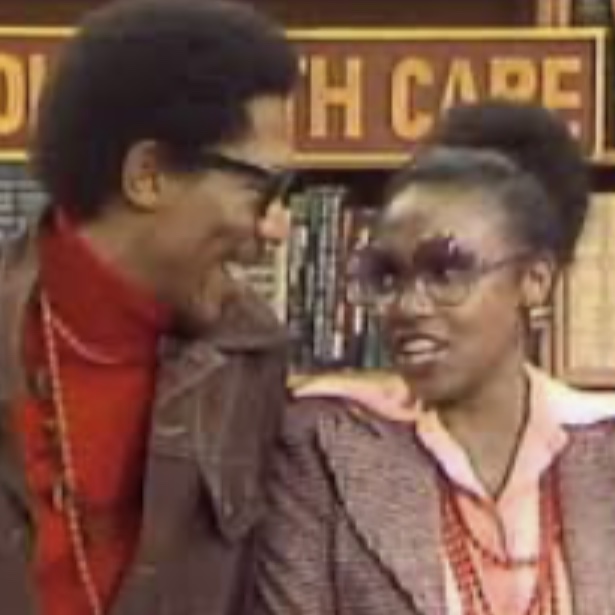
Freeman and Winston as Easy and Valerie
Season 4 introduced Spidey Super Stories, with Danny Seagren, 31, a professional dancer who had previously appeared on Sesame Street, as the first ever live-action version of the Marvel Comics superhero Spider-Man. This Spidey didn't exactly "talk": Instead, his words were put on the screen in "word balloons," followed by a pause for the kids watching at home to try to read, before whoever he was talking to repeated it. Instead of Spidey's usual rogues' gallery -- no Green Goblin, Dr. Octopus, Electro and so on -- the various castmembers played one-shot villains, never seen before or since.
One edition showed Spidey attending Fargo's birthday party, along with Easy, Jennifer and Paul, interrupted by Ávalos as The Blowhard, a villain with destructive super-breath that Fargo -- apparently considerably more competent when we're not watching -- had once put in prison, and was seeking revenge. Just as he was about to blow them all away, Paul hit him in the face with Fargo's birthday cake, giving Spidey the chance to sling his web and trap him.
While Spidey's civilian persona, Peter Parker, was established as living in Queens, The Electric Company and Spider Super Stories was the initial establishment of him as a fan of the New York Mets, who (then as now) played in Queens. Marvel ran with it, and made Peter's Met fandom comic canon.
Boyd played The Wall, disrupting a Met game that Spidey attended in costume: "Well, if it isn't the Wall-Crawler himself! Well, this is one Wall you'll never crawl!" Hinnant played an ill-fated outfielder, and Freeman a typically vision-impaired umpire.
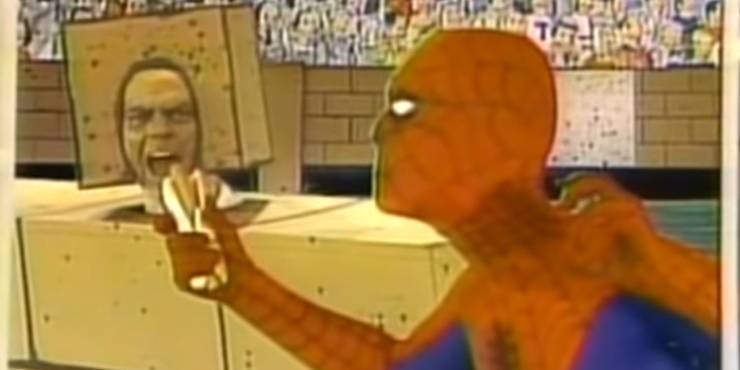
I said the stories were titled "Super." I didn't say they were good.
There were animated segments as well. One had a character who never got an official name, so they just called him "Blond-Haired Cartoon Man." Mel Brooks did his voice. Satirical singer Tom Lehrer wrote and sang a series of songs featuring the "ly" and "sn" sounds, and "Silent E." Warner Brothers contributed some animated shorts featuring the Road Runner and Wile E. Coyote.
And before Spidey or the Blue Beetle were ever on the show, there was The Adventures of Letterman. Letterman was dressed like an old-time football player, with a "varsity letter" on his chest, which always happened to be just the letter needed to restore a word that had been changed by The Spellbinder, a villain who would use his magic wand to change a word and turn an item into something dangerous, or at least upsetting. Letterman was voiced by Gene Wilder, The Spellbinder by Zero Mostel, and the narrator was Joan Rivers, all of whom had worked with Brooks.

"Faster than a rolling O, stronger than Silent E,
able to leap Capital T in a single bound!
It's a word! It's a plan! It's Letterman!"
And there was the band, 5 teenagers named The Short Circus, a play on "short circuit." The original band of 1971 was June Angela, 12, as Julie, on tambourine; Irene Cara, 12, as Iris, on keyboards; Melanie Henderson, 14, as Kathy, on guitar; Douglas Grant, 12, as Zach, on guitar; and Steve Gustafson, 12, as Buddy, on drums.

Angela couldn't play an instrument, but, as the best singer they auditioned, they had to keep her, so she selected a tambourine, possibly a nod to Eddie Brigati of The Rascals and/or Mark Volman of The Turtles. She named her character after Julie Andrews. Gustafson, being a drummer, named his after Buddy Rich.
Since Cosby and Moreno were already stars, and Freeman didn't become a big star for many more years, until Driving Miss Daisy was released in 1989, Cara got the biggest boost to her career of any castmember, appearing in both the film Fame and the subsequent NBC show based on it, and having Number 1 hits from the themes from Fame and the film Flashdance.
Part of the problem with having teenage actors is that they grow up too fast, and sometimes it became hard for the little kids to relate to them. Cara left the show after the 1st season, and was replaced on keyboards by Denise Nickerson, 15 and already known for playing Violet Beauregarde in Willy Wonka and the Chocolate Factory, as Allison. In 1973, the keyboard position was eliminated, and Nickerson was replaced by Bayn Johnson, 15, as guitarist Kelly; and Grant was replaced by Gregg Burge, 14, as bass guitarist Dwayne.
In 1975, the entire band was replaced, except for Angela: Being short meant that she could still appear on the show at age 18. Henderson was replaced on guitar by Réjane Magloire, 11, as Samantha;
Johnson on guitar by Janina Mathews, 12, as Gail; Burge on bass by Rodney Lewis, 12, as Charlie; and Gustafson on drums by Todd Graff, 16, as Jesse.

Angela was the show's only Asian-American regular, while Cara was Hispanic, and Henderson, Grant, Burge, Magliore and Lewis were black.
On occasion, Short Circus members would interact with the adult castmembers, such as when they went to see Vi at the diner or Valerie at the library. Sometimes, a Spidey Super Story would be narrated by Angela, or feature another bandmember as the younger version of the villain, telling the brief origin story: "And so, he (or she) turned to a life of crime!"
The show made new episodes until 1977, and remained on the air in reruns until 1985. In 2009, PBS began airing a new show with the title, but, aside from the title and the use of Moreno's catchphrase, "Hey you guyyyyyyyys!" it bore no resemblance to the original. It lasted only 2 years.
Ironically, from the original show, the first castmember to die was one of The Short Circus, Burge, in 1998. Boyd died in 2013, Ávalos and Chamberlin in 2014, Grant in 2018, and Nickerson in 2019. The rest of the cast lived to see the show's 50th Anniversary -- although there will always be a cloud over Cosby, no matter how long he lives. Cara died in 2022.
UPDATE: Seagren died in 2025.
*
October 25, 1971 was a Monday. Baseball Hall of Fame pitcher Pedro Martinez was born. So were actor Craig Robinson, and classical violinist Midori Goto.
The baseball season had ended 8 days earlier, with the Pittsburgh Pirates beating the Baltimore Orioles in Game 7 of the World Series. Future Hall-of-Famer Pedro Martinez was born on this day.
Most of the NFL teams had played the day before, but on this night, ABC Monday Night Football aired the Minnesota Vikings beating the defending NFL Champion Baltimore Colts, 10-3 at Metropolitan Stadium in the Minneapolis suburb of Bloomington, Minnesota.
There was 1 NBA game played that night: The Boston Celtics beat the Atlanta Hawks, 136-116 at the Boston Garden. For the Celtics, Dave Cowens scored 27 points, and John Havlicek added 25. For the Hawks, Herm Gilliam scored 25 and Lou Hudson 23, but Pete Maravich was injured and didn't play. And there were no games scheduled that night for the ABA or the NHL.