Showing posts with label nice. Show all posts

Wednesday, September 14, 2022

September 14, 1927: The Death of Isadora Duncan

September 14, 1927: The life of Isadora Duncan, so often touched by unconventionality and tragedy, comes to an unconventional and tragic end.

Angela Isadora Duncan was born on May 26, 1877 in San Francisco, and began dancing as a child, finding it liberating from a life of poverty where girls were restricted. She moved to New York to further her career in 1896, but she soon became disillusioned with the tight control of the entertainment industry there. She thought American dance instruction was too tight: She later wrote, of anyone who wanted to dance, "Let them come forth with great strides, leaps and bounds, with lifted forehead and far-spread arms, to dance."

She found a more receptive audience in Europe, especially in Paris, where innovation in art was established as a way of life. She gained large audiences at the Universal Exposition of 1900, attraction attention by wearing loose, flowing dresses that revealed her figure, and for dancing barefoot. A 1902 tour of Europe increased her fame.

She became the most famous dancer, and the most famous dance instructor, in the world. On June 20, 1912, French fashion designer Paul Poiret rented a mansion in the northern suburbs of France, and hosted La fête de Bacchus on June 20, 1912, re-creating the Bacchanalia hosted by King Louis XIV at his Palace at Versailles. Isadora wore a Greek evening gown designed by Poiret, and danced on tables among 300 guests. It was said that 900 bottles of champagne were consumed until the first light of day.

She returned to the U.S. in 1914, but her reputation preceded her, and work was hard to come by. She returned to Europe in 1915, initially planning to do so aboard the RMS Lusitania, but could not afford a luxurious crossing, and avoided the Germany sinking of that ship.

Her love-life was also complicated. Her affairs included one with theater designer Gordon Craig, resulting in the birth of her daughter Deirdre in 1906; and one with philanthropist Paris Singer, son of sewing machine magnate Isaac Singer, resulting in the birth of her son Patrick in 1910. In 1913, both children died while riding in a car driven by their nanny, into the River Seine in Paris.

Isadora was driven by grief to the Greek island of Corfu, where her brother and sister were staying, and then to Viareggio, Italy, where her friend, the renowned actress Eleonora Duse, lived. While there, in 1914, she fell for the sculptor Romano Romanelli, and this affair led to the birth of a son, but he died after only a few days. She adopted 6 daughters, all of whom took the surname Duncan, and 3 of them also became dance instructors.

She only married once. In 1921, she moved to Moscow, where she met the poet Sergei Yesenin, who was 18 years younger. They married in 1922, but separated the next year. In 1925, he hanged himself.

At some point, Isadora said he had had enough of love, lamenting that what men called "love," women only considered "possession." But, even in her 40s, she still wanted a child. A story which may be apocryphal says that she suggested to writer Anatole France, "Imagine a child with my beauty and your brains!" To which he Anatole responded, "Yes, but imagine a child with my beauty and your brains!

After Yesenin, she spent her time running up debts at various hotels around Europe, essentially a high-class homeless person. Friends urged her to save her financial situation by writing her memoirs. She did, and, by September 14, 1927, the manuscript for My Life was completed -- but not yet published.

That day, in Nice, on the French Riviera, she was staying at the home of her friend, singer Mary Desti, whose son, Preston Sturges, became a prominent film director. Isadora left in an Amilcar CGSS driven by Benoit Falchetto, a mechanic. She told Desti and the other guests, "Je vais à l'amour" ("I am off to love").
A 1927 Amilcar CGSS

Given what happened next, they didn't want those to go down in history as her last words, because it sounded like she was going off for a night of passion with Falchetto. So Desti told the press that Isadora told them, "Adieu, mes amis. Je vais à la gloire!" ("Farewell, my friends. I go to glory!")

She was wearing a long silk scarf, draped around her neck, became entangled, in the wheel well, around the open-spoked wheels and rear axle, pulling her from the open car and breaking her neck. Desti said she called out to warn Duncan about the scarf almost immediately after the car left. Desti took Duncan to the hospital, where she was pronounced dead. She was only 50 years old.

She was buried at Paris' Père Lachaise Cemetery, as have been many other artists, writers and entertainers. Several dance schools with her name were founded, and some still survive.

She was played by Vivian Pickles in Isadora Duncan, the Biggest Dancer in the World, in 1966; Vanessa Redgrave in Isadora, 1968; and Lily-Rose Depp, daughter of Johnny Depp and Vanessa Paradis, in The Dancer, about Duncan's colleague Loie Fuller, in 2016.

*

September 14, 1927 was a Wednesday. These baseball games were played:

* The New York Yankees beat the Cleveland Indians, 4-1 at Yankee Stadium. Babe Ruth went 1-for-3 with a walk. Lou Gehrig did the same, and added an RBI.

* A doubleheader was split at Sportsman's Park in St. Louis. The St. Louis Cardinals won the opener, 6-3. Chick Hafey won it with a home run in the bottom of the 10th inning, making a winning pitcher out of Carlisle Littlejohn, who had relieved Grover Cleveland Alexander. The New York Giants won the nightcap, 9-3.

The previous off-season, the Giants had traded Frankie Frisch to the Cardinals for Rogers Hornsby. Over these 2 games, Frisch went 2-for-7 with 2 walks and an RBI on a sacrifice fly, Hornsby went 3-for-9, and Bill Terry went 6-for-11 with 3 RBIs.

* The Brooklyn Dodgers (or the Robins, as they were known under Wilbert Robinson's managing from 1914 to 1931) beat the Chicago Cubs, 10-6 at Wrigley Field in Chicago.

* The Boston Red Sox beat the St. Louis Browns, 9-6 at Fenway Park in Boston.

* The Philadelphia Athletics beat the Chicago White Sox, 5-4 at Shibe Park in Philadelphia. Jimmie Foxx singled Walt French home with the winning run in the bottom of the 11th inning. Ty Cobb, running out the string, went 3-for-5.

* The Washington Senators beat the Detroit Tigers, 3-2 at Griffith Stadium in Washington.

* The Pittsburgh Pirates swept a doubleheader from the Boston Braves, 6-2 and 3-0 at Forbes Field in Pittsburgh. Johnny Miljus pitched a 6-hit shutout in the 2nd game. Over the 2 games, Paul Waner went 3-for-9, and Lloyd Waner went 5-for-9 with an RBI.

* And the Cincinnati Reds beat the Philadelphia Phillies, 7-6 at Redland Field (later Crosley Field) in Cincinnati.

Friday, January 21, 2022

January 22, 1892: The Origin of Edvard Munch's "The Scream"

January 22, 1892: Norwegian painted Edvard Munch, in Nice on the French Riviera, writes this in his diary:
One evening I was walking along a path, the city was on one side and the fjord below. I felt tired and ill. I stopped and looked out over the fjord – the sun was setting, and the clouds turning blood red. I sensed a scream passing through nature; it seemed to me that I heard the scream. I painted this picture, painted the clouds as actual blood. The color shrieked. This became The Scream.
He later described his inspiration for the image:
I was walking along the road with two friends – the sun was setting – suddenly the sky turned blood red – I paused, feeling exhausted, and leaned on the fence – there was blood and tongues of fire above the blue-black fjord and the city – my friends walked on, and I stood there trembling with anxiety – and I sensed an infinite scream passing through nature.
Munch (pronounced like "moonk") was born on December 12, 1863 in Ådalsbruk, Norway, a country which was then under Swedish control; and grew up in Kristiana, which became the national capital under the name Oslo upon breaking from Sweden in 1905. By that point, his place in art history was assured.

Tuberculosis killed his mother when he was 3 years old, and his sister when he was 13. His father, a doctor, was so deeply religious that Edvard thought him mentally ill, writing, "From him I inherited the seeds of madness. The angels of fear, sorrow, and death stood by my side since the day I was born." 

Although he did well in college, he dropped out to attend an art school, against his father's protest that art was "an unholy trade." He was first inspired by the Impressionists, but when he saw the work of Paul Gaugin (and the as-yet-largely-unknown Vincent van Gogh), he became, like them, a Post-Impressionist. The Scream definitely shows a use of color that van Gogh, had he lived beyond 1890, would have understood as being influenced by his own.

Munch's 1886 painting The Sick Child was a tribute to his dead sister Johanne Sophie. In 1889, he painted his surviving sister in Inger on the Beach. Later that year, his father died, and, rather than feeling relief that his harshest critic was gone, he fell into a depression: "I live with the dead -- my mother, my sister, my grandfather, my father… Kill yourself and then it's over. Why live?"

In 1891, his painting Melancholy was displayed at the Autumn Exhibition in Oslo. The following year, having already been inspired to paint The Scream, he was invited to be the first artist to have a one-man exhibition at the Union of Berlin Artists. It stirred up such emotion, some positive, some negative, that it closed after one week: "Never have I had such an amusing time. It's incredible that something as innocent as painting should have created such a stir."
In 1889, at the Universal Exposition in Paris, the World's Fair that introduced the Eiffel Tower, a mummy from Peru was on display. Its hands raised to its head, and its open jaw, may have been seen by Munch, and served as the inspiration for the pose of the figure in The Scream.

As for the intensity of the red: Since Munch wrote, "One evening... " without specifying a year, the evening could have been in 1883 or 1884, after the world's skies had been darkened by the eruption of the volcano Kraktoa, in the Dutch East Indies, now Indonesia. Enough ash was thrown into the air to create a "volcanic winter." Temperatures all over the world dropped in 1883 and 1884. It also created more rainfall than the world was used to: The California cities of Los Angeles and San Diego received the most rain in their respective histories.

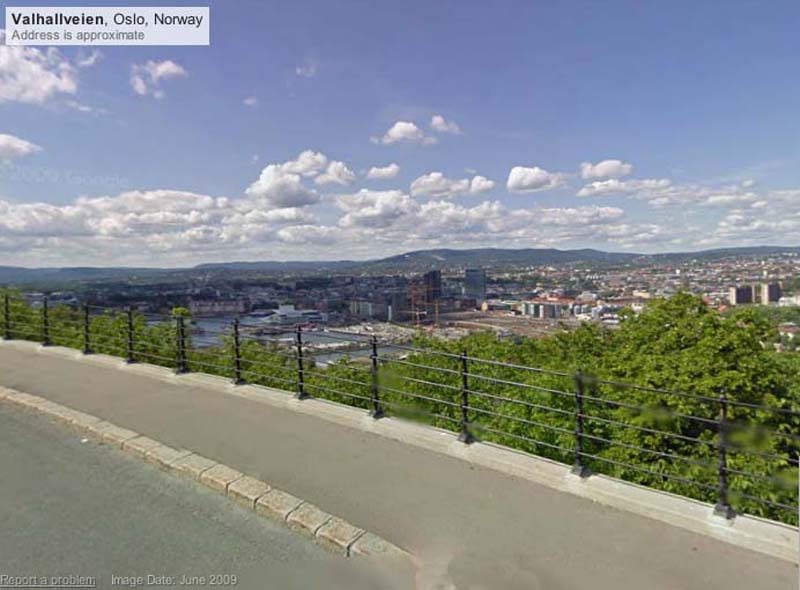
The location is believed to be an overlook on the side of a road called "Valhallveien," on a hill above Oslo. The hill is known as Ekeberg Hill, about 2 miles southeast of downtown. The winding road up to the park on the top of Ekeberg Hill was a popular place for citizens of Oslo to view the city. The hill and park were also popular places for Oslo artists to paint.
A recent photo

The painting has been called a symbolization of the anxieties of humanity in the 19th Century: It had seen the Napoleonic Wars; frequent revolutions; wars of colonialism in which the European powers had conquered "backward" natives of Africa and Asia, but still took the occasional shocking defeat from them, as Britain did at Meerut in India in 1857, Isandlwana in South Africa in 1879, and Khartoum in the Sudan in 1885; the unifications of Italy in 1860 and Germany in 1871, which upset many social orders; a worldwide "Long Depression" caused by the American stock market's Panic of 1873, and lasted until 1879; the aforementioned eruption of Krakatoa, and the environmental issues it caused; and the Industrial Revolution, which was making some men rich (or richer), but making the lives of poor people miserable, through brutally hard jobs or eliminating altogether the jobs they already had.

The painting was indicative of Munch's work from then on, including his series Frieze of Life -- A Poem about Life, Love and Death, which he began in 1893, after The Scream was first exhibited. He wrote, "No longer should interiors be painted, people reading and women knitting: there would be living people, breathing and feeling, suffering and loving."

In 1897, he returned to Oslo, where he was celebrated. He had a mental breakdown in 1908, and this caused him to give up drinking, and to paint more optimistic images. He survived both World War I (writing, "All my friends are German but it is France I love") and a bout with the Spanish Flu epidemic at its end, but not the Nazi takeover of Norway in 1940: He died at his house in Ekely, near Oslo, on January 23, 1944, at age 80.

Journalist Arthur Lubow called The Scream "A Mona Lisa for our time." Like Leonardo da Vinci's 1506 Mona Lisa, it has been endlessly parodied and homaged. Pop psychologist Arthur Janov put it on the cover of his 1970 book The Primal Scream. Macaulay Culkin's screaming pose in the 1990 film Home Alone has been compared to it. The Ghostface mask from the Scream movies that began in 1996 is a direct homage. So is the Internet's "scream emoji": 😱 

Munch painted 4 versions of The ScreamToday, the original version is in Norway's National Gallery. Another is in the Munch Museum. Both are in Oslo.

*

January 22, 1892 was a Friday. Baseball and football were out of season. Hockey was still all-amateur. And the sport of basketball had been invented only 1 month earlier. So there were no scores on this historic day.

December 31, 1999 & January 1, 2000: The Millennium

December 31, 1999:  The Millennium arrives. The people of planet Earth survived. At a terrible cost. But we hadn't destroyed ourselves. ...