Showing posts with label truman capote. Show all posts

Monday, November 28, 2022

November 28, 1966: Truman Capote's Black and White Ball

November 28, 1966: Author Truman Capote hosts "The Black and White Ball" at the Plaza Hotel, off Grand Army Plaza, at the southeastern corner of Central Park, at 59th Street and 5th Avenue in Manhattan, New York City.

Supposedly, it was meant to honor Katharine Graham, publisher of The Washington Post. Historian Deborah Davis, who wrote a biography of Graham, also wrote a book about the ball, titling it Party of the Century.

Truman Streckfus Persons was born on September 30, 1924 in New Orleans. After his parents divorced, his mother took him to her hometown of Monroeville, Alabama, where one of his childhood friends was another author-to-be, Harper Lee. In To Kill a Mockingbird, Lee named the character based on herself Jean Louise Finch, nicknamed Scout; and the one based on Capote "Dill."

When he was 8, his mother remarried, to a Cuban-born bookkeeper living in New York, named José García Capote (pronounced "Kah-POH-tay"), who adopted him as his son, and renamed him Truman García Capote. They lived on Park Avenue, so his stepfather was doing well. Too well, as it turned out: He was convicted of embezzlement.

By 11, the boy was writing. At 15, the family moved to nearby Greenwich, Connecticut. At 18, he got a job as a copyboy at The New Yorker magazine. Two years later, he was fired for having angered Robert Frost, America's greatest living poet. That was the 1st time he willingly annoyed a better writer than himself. It would not be the last: Speaking of Jack Kerouac in 1959, he said, "That's not writing, that's typing."

He published Other Voices, Other Rooms in 1948, The Grass Harp in 1951, and Breakfast at Tiffany's in 1958. In 1959, he went to Kansas to write about the murder of the Clutter family. In 1965, he published his "nonfiction novel" about the case, In Cold Blood. It gained him the greatest acclaim of his career.

And that's what he was after: Like many people who make it big, he was less interested in being good at what he did than he was in being a star. He was a relentless self-promoter. Had he been buried rather than cremated, his epitaph could well have been his self-description: "I'm an alcoholic. I'm a drug addict. I'm a homosexual. I'm a genius."

Yes, Truman Capote was openly gay -- not just in the 1960s, but in the hyper-repressive 1950s. He may have been the reason why "flamboyant" became a stereotype of gay men. His clothes, his mannerisms, his lisping voice... Even if he hadn't come out of the closet, people would have guessed.

According to a friend, writer Leo Lerman, as far back as 1942, he said that when (not if) he became rich and famous, he would throw a party for his rich and famous friends. In June 1966, he felt secure enough to start setting it up. He was inspired by another author, Dominick Dunne, who had given a black and white ball in 1964, for his 10th wedding anniversary. Capote was a guest. Another inspiration was that year's film version of the musical My Fair Lady: In the scene at Ascot Racecourse, the women all wore black and white dresses.

There had to be a guest of honor. And even Capote didn't have the chutzpah to make himself that. He decided that "Kay" Graham needed cheering up. She disagreed, but knew she couldn't stop him from giving the party: "I was sort of baffled... I felt a little bit like Truman was going to give the ball anyway, and that I was part of the props."
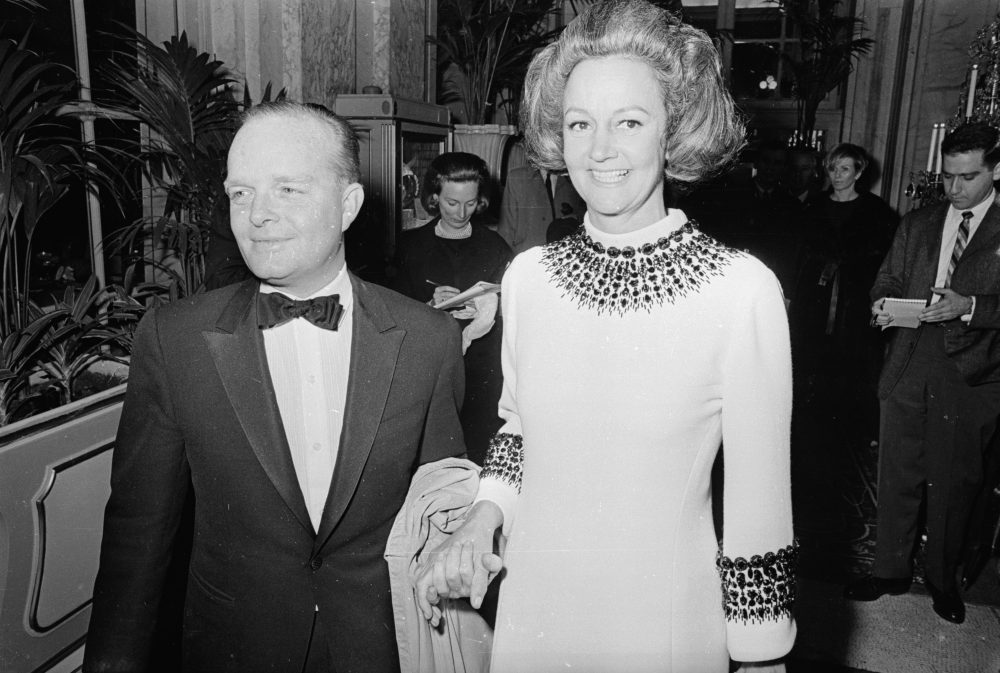
"Tru" and "Kay" at the Ball

While Other Voices, Other Rooms was his 1st published novel, the 1st he'd written was titled Summer Crossing, and its 1st scene was in a dining room at the Plaza Hotel. So he hired the Grand Ballroom of the Plaza. Red tablecloths, with gold candelabra as centerpieces. The menu, served at midnight: Scrambled eggs, sausages, biscuits (Breakfast at midnight?), pastries, spaghetti and meatballs, and, a specialty of the Plaza and one of Capote's favorite dishes, chicken hash. And 450 bottles of Taittinger champagne. How much did Capote spend on this thing? $16,000 -- about $147,000 in 2022 money.

Capote's 540 guests, asked to wear black and white, and masks, included luminaries from New York, Washington, Hollywood and New Orleans. They included the aforementioned Graham and Lerman; CBS chairman William S. Paley and his wife, the former Barbara Cushing, now known as Babe Paley; Scottish businessman Kenneth Keith, Baron Keith of Castleacre, and his wife, the former Mary Gross, now known as Slim Keith; polo champion Winston Guest and his wife, the former Lucy Cochrane, now known as C.Z. Guest; and Prince Stanisław "StashRadziwiłł, and his wife, the former Caroline Bouvier, now known as Lee Radzill, sister of former First Lady Jacqueline Kennedy -- but the invited guests did not include Jackie herself.

Babe, Slim, C.Z. and Lee were the leading members of a group of fabulously wealthy and stylish women who glommed onto Capote as a "safe" gay man that they could talk to while their husbands were off making deals and having affairs. He glommed onto them, too, calling them "my swans." He turned out not to be trustworthy, and exposed them in a very nasty article for Esquire magazine in 1975.

Also among the guests: First Lady Claudia "Lady Bird" Johnson (but not President Lyndon Johnson), the Duke and Duchess of Windsor (formerly King Edward VIII of Britain and Wallis Simpson); Ford Motor Company chairman Henry Ford II, journalist Walter Lippmann, economist John Kenneth Galbraith, National Security Adviser McGeorge Bundy, writers Lillian Hellman, Norman Mailer, John Knowles and George Plimpton; Random House publisher and What's My Line? panelist Bennett Cerf, his wife, and his children; San Francisco Chronicle columnist Herb Caen, historian Arthur Schlesinger Jr., editor Norman Podhoretz, Frank Sinatra and his then-wife Mia Farrow, fashion designer Oscar de la Renta and his wife, Vogue magazine editor Françoise de Langlade; heiress and fashion designer Gloria Vanderbilt, philanthropist Brooke Astor, Harper's Bazaar editor Gloria Guinness, poet Marianne Moore, painter Andy Warhol, Broadway producer Hal Prince, Broadway choreographer Jerome Robbins, photographer Gordon Parks, singer Harry Belafonte, actors Douglas Fairbanks Jr. and Henry Fonda, then-married actors Lauren Bacall and Jason Robards, actress Tallulah Bankhead, and actress Candice Bergen.
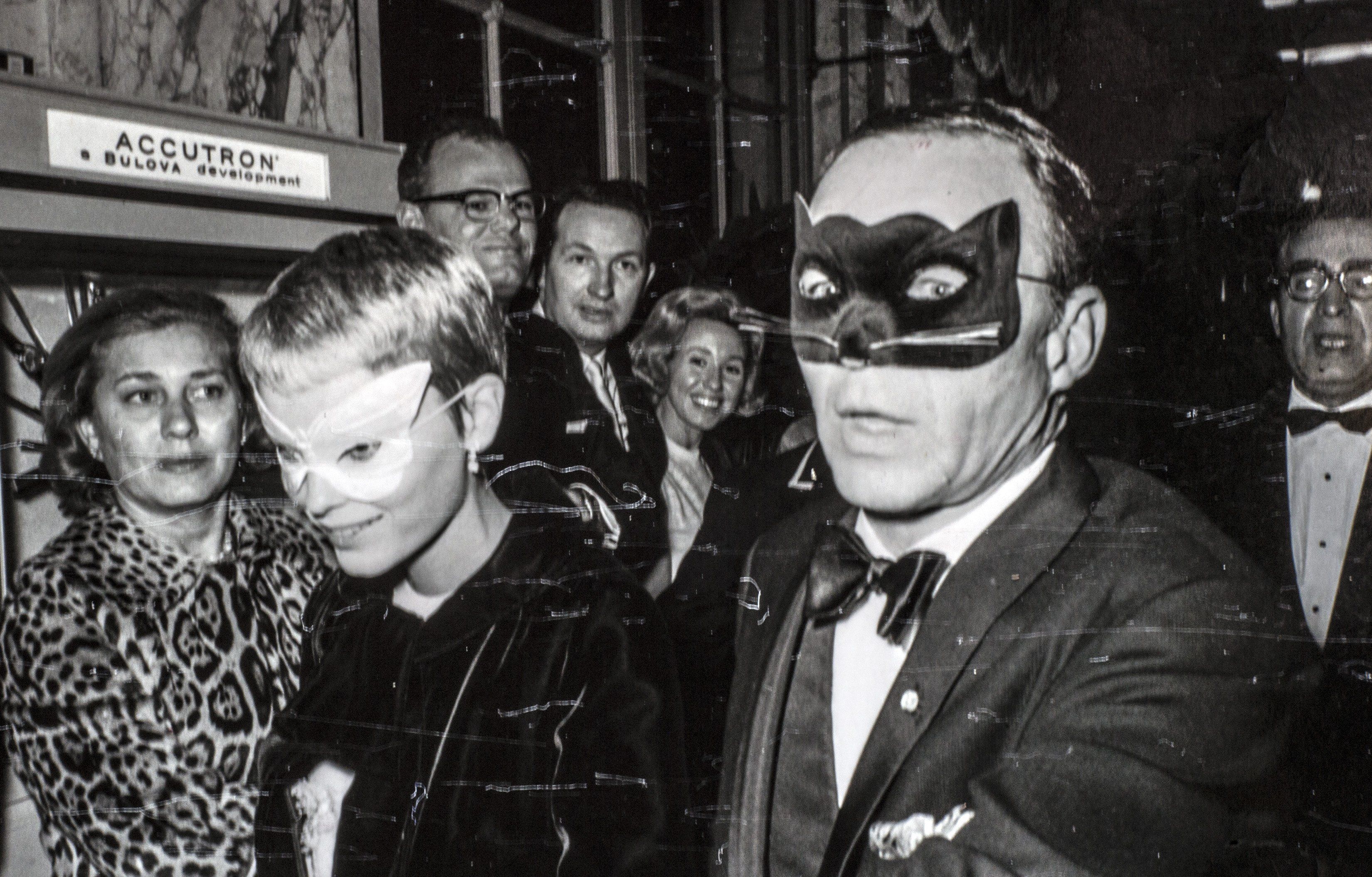
Mia looks comfortable attending. Frank does not.

Oddly, he didn't invite Dunne. Carson McCullers, a woman who, like Capote, was a novelist, a Southerner, and gay, and was allegedly a friend of his, was snubbed as well. Gore Vidal, also an openly gay writer, was not invited, but that wasn't a surprise: They were in a feud that lasted for the rest of Capote's life. Writer William Styron and his wife Rose were invited; he didn't want to go, and didn't, while she did want to go, and did.

Mailer and Bundy nearly got into a fight over the way the Administration was conducting the Vietnam War. Bergen -- only 20 years old at the time -- had misgivings involving the war as well:

I remember the guilt I felt, or actually the guilt that other people thought I should feel. I was 19, I think. Reporters accosted me. "Wasn't it inappropriate to have a ball for five hundred people, when a war was going on?"

Someone said -- could it have been Douglas Fairbanks, in his executioner's hood? -- "The question's inappropriate." Somebody else, who was wearing a mouse mask with little ears, said, "The war's inappropriate."

Nowadays, I don't see how anyone can rationalize a gesture like a ball.
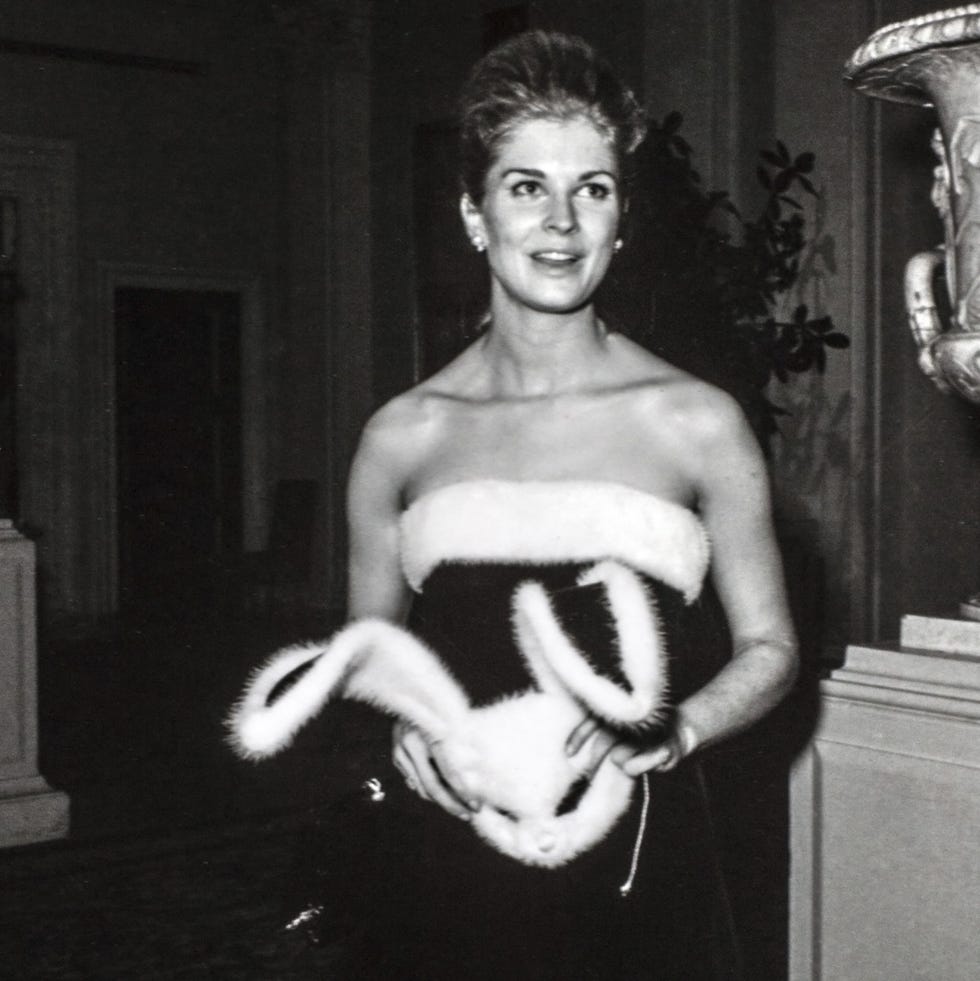
Candice Bergen, 22 years before becoming Murphy Brown

Sinatra did not have a good time. Just before midnight, when the food would be served, he turned to Caen, and said, "Hey, let's get out of here." They and their wives tried to sneak out. Capote tried in vain to stop them. Caen later said of Capote, "I think he was hurt. It was one of those great parties that never got off the ground."

R. Couri Hay, eventually a gossip columnist for Warhol's magazine Interview, but then only 17 years old, once wrote, "Truman always claimed that he invited five hundred of his friends, and made fifteen thousand enemies."

But Mailer, who infamously stabbed his wife at a party he'd hosted at his New York apartment 6 years earlier, said, "It was one of the best parties I ever went to. There was so much action… so many people whom you'd never met before... Everybody there felt anointed that night. I think that's Truman's greatest coup. To me, that party's greater than any of his books."

As Deborah Davis wrote in her book about the Ball:

There was no question that the party triggered an insatiable thirst in readers for the very, "who-wore-it-better" coverage that is so popular today. But the distinction is that, at that moment in time, you had to earn your place on the red carpet. And celebrity had a different definition, it wasn't the "15 minutes of fame."

The thing about the black and white ball was that it was a private party that we were given an insider peek at, and it did create a monster, and it also marked Capote's demise in a sense, because, before the ball, he had always said that gregariousness is the enemy of art. When he was writing a book, he would go off into seclusion and he would never be interrupted by any element of social life. After the ball, he became the world's best guest. And he just went from one event to another, and he lost his hold on his art. And that was very sad. The culture changed, and Capote changed as well.

Capote did a little acting, including in the 1976 murder-mystery comedy Murder By Death, where he played a party host who ended up killed; and became a regular on the talk-show circuit, including making several appearances on The Tonight Show Starring Johnny Carson. He hadn't invited Carson to the Ball, but he did become close friends with Carson and his 2nd wife Joanne.

But he never wrote another novel after the Ball. In fact, if you don't count In Cold Blood -- which could count as a novel, since he was accused of making a lot of things up in it -- he published Breakfast at Tiffany's at the age of 34, and then didn't write another novel for the rest of his life. He died on August 25, 1984, from the effects of drinking, drugs and phlebitis, at Joanne Carson's Los Angeles home, where he'd been staying. He was a few weeks short of turning 60. Vidal got the last word in their feud, calling his death "a good career move."

In 1990, Robert Morse won a Tony Award for playing Capote in the play Tru, and an Emmy Award for reprising the role on PBS 2 years later. Philip Seymour Hoffman -- who, sadly, died from drugs even younger, at age 46 -- won an Oscar for starring in the 2005 film Capote, which was about the making of In Cold Blood.

Capote has also been played by Paul Williams in Oliver Stone's 1991 film The Doors, Louis Negin in 54 (about the discotheque Studio 54) in 1998, Sam Street in the Jacqueline Susann biopic Isn't She Great in 2000, and Toby Jones in Infamous in 2006. Michael J. Burg has played him 3 times: In The Audrey Hepburn Story in 2000, in The Hoax in 2006, and in the 1973-set 2009 TV series Life on Mars. (UPDATE: He was played by Tom Hollander in the 2024 FX miniseries Feud: Capote vs. The Swans.)

*

November 28, 1966 was a Monday. Baseball was out of season. Football was in midweek: There would be no Monday Night Football for another 4 years. And no games were scheduled in the NBA or the NHL. So there were no scores on this historic day. Unless you want to count: "Guests 500, Capote 0."

Tuesday, November 15, 2022

November 15, 1959: The "In Cold Blood" Murders

November 15, 1959: Four members of the Clutter family are murdered in their farmhouse, just outside the town of Holcomb, Kansas. The case was detailed by novelist Truman Capote in what he called a "non-fiction novel," In Cold Blood, published in 1966.

Perry Smith and Richard Hickock were recently paroled from the Kansas State Penitentiary. Floyd Wells, a former cellmate of Hickock's had been a farmhand for Herb Clutter, and told him that Clutter kept large amounts of cash in a safe. So Hickock and Smith decided to steal the safe, and use the contents to start a new life in Mexico. Hickock told Smith it was "a perfect score."

After driving all night on November 14 and 15, they drove 400 miles across Kansas, got to Holcomb early in the morning, and entered the Clutter house through an unlocked door. They woke the family up, and pushed Herb's wife Bonnie, their daughter Nancy, and their son Kenyon into a 2nd-floor bathroom. At gunpoint, they took Herb downstairs to his office.

But when they got there, they discovered there was no safe. Herb told them the conducted all of his business by personal check. Their heist having gone wrong, Smith took a knife, and slit Herb's throat, then took his shotgun, and shot him in the head. Smith then shot Kenyon, then Nancy, and finally Bonnie. He later told the police that he talked Hickock out of raping Nancy. Herb was 48 years old, Bonnie 45, Nancy 16 and Kenyon 15.

Hickock and Smith took the only things they could find that they considered to be of any value: Herb's binoculars, Kenyon's portable radio, and $50 in cash. They were arrested in Las Vegas on December 30, and were extradited back to Kansas. They were found guilty of 4 counts of 1st degree murder and sentenced to death. Smith first claimed that Hickock had committed 2 of the murders, then changed his story, saying that he had done all 4, because Hickock's mother was still alive, and he didn't want her to think of her son as a murderer.

Capote, at this point best known for writing Breakfast at Tiffany's (which had not yet been made into a film), learned of the murders, and traveled to Kansas with childhood friend Harper Lee, author of To Kill a Mockingbird. Capote interviewed everybody he could, including the defendants, making a nuisance of himself, which was, far above writing, his greatest talent.

Smith and Hickock were executed by the State of Kansas on the same day, April 14, 1965. Smith was 36, Hickock 33. The next year, Capote published his account, In Cold Blood. It became the biggest-selling true crime book ever, and has been surpassed only by Helter Skelter, Vincent Bugliosi's book about the Charles Manson murders.

In Cold Blood was filmed in 1967, with Robert Blake as Smith, Scott Wilson as Hickock, and John McLiam as Herbert Clutter. CBS made a miniseries out of it in 1996, with the roles played by Eric Roberts, Anthony Edwards and Kevin Tighe.

In 2005, the film Capote premiered, with Clifton Collins Jr. as Smith, Mark Pellegrino as Hickock, Philip Seymour Hoffman as Capote, and Catherine Keener as Harper Lee. A competing film, Infamous, was released in 2006, with those roles being played by Daniel Craig, Lee Pace, Toby Jones and Sandra Bullock.

*

November 15, 1959 was a Sunday. Baseball season was over. These games were played in the NFL:

* The New York Giants lost to the Pittsburgh Steelers, 14-9 at Yankee Stadium.

* The Philadelphia Eagles beat the Chicago Cardinals, 27-17 at Franklin Field in Philadelphia.

* The Cleveland Browns beat the Washington Redskins, 31-17 at Griffith Stadium in Washington.

* The Detroit Lions beat the Los Angeles Rams, 23-17 at Briggs Stadium in Detroit. (It was renamed Tiger Stadium in 1961.)

* The Chicago Bears beat the San Francisco 49ers, 14-3 at Wrigley Field in Chicago.

* And the Baltimore Colts beat the Green Bay Packers, 28-24 at Milwaukee County Stadium.

Two games were played in the NBA. The Boston Celtics beat the Cincinnati Royals, 134-128 at the Cincinnati Gardens. And the Minneapolis Lakers beat the Philadelphia Warriors, 106-100 at the St. Paul Auditorium (now the Roy Wilkins Auditorium).

And the NHL's entire "Original Six" were in action:

* The New York Rangers played the Toronto Maple Leafs to a tie, 2-2 at the old Madison Square Garden.

* The Montreal Canadiens beat the Boston Bruins, 4-1 at the Boston Garden. 

* And the Chicago Black Hawks beat the Detroit Red Wings, 5-3 at the Chicago Stadium.

Wednesday, October 5, 2022

October 5, 1961: "Breakfast at Tiffany's" Premieres

October 5, 1961: Breakfast at Tiffany's premieres, directed by Blake Edwards, and based on the 1958 novella by Truman Capote.

Audrey Hepburn plays her most iconic role: Holly Golightly, a country girl turned Manhattan socialite. Between dating rich men, she dates another man in her building, Paul Varjak, played by George Peppard. Much of the book has to be altered due to the Hays Code: In it, Holly is an unashamed call girl, and Paul is gay. In the film, she's a "socialite," and Paul has confidence issues.

The movie is intensely criticized for Mickey Rooney's portrayal of Holly's landlord, Mr. Yunioshi, a terrible Japanese stereotype that would have been considered over-the-top even in a movie made during World War II. Rooney himself would eventually regret having played the role the way it was written.

In 1961, Breakfast at Tiffany's showed a New York that was still classic and magical. By 1969, Midnight Cowboy showed the City to have became a garish mess of crime and poverty. In 1976, Taxi Driver showed things as even worse, where what was once good had become crazy (including the titular Travis Bickle), and what was bad was irredeemable. Things bottomed out in 1981, with Fort Apache: The Bronx.

*

October 5, 1961 was a Thursday. Football was in midweek. The NBA and NHL seasons hadn't started yet. There was one score on this historic day: It was in Game 2 of the World Series. The Cincinnati Reds beat the New York Yankees, 6-2 at Yankee Stadium. Joey Jay outpitched Ralph Terry. Gordy Coleman hit a home run for the Reds, Yogi Berra for the Yanks. This would be the only World Series game won by the Reds between 1940 and 1970, as the Yankees won the Series in 5 games. 

Tuesday, April 26, 2022

April 26, 1977: Studio 54 Opens

April 26, 1977: Studio 54 opens, at 254 West 54th Street in Midtown Manhattan. It became the defining discotheque of the "Disco Period."

Opened as the Gallo Opera House in 1927, it served as a CBS broadcast studio in the mid-20th Century. Real estate developers Steve Rubell and Ian Schrager opened Studio 54 as a nightclub, retaining much of the former theatrical and broadcasting equipment, at the theater in 1977. 

Writer Truman Capote, not the only older person seeking to recapture a lost youth there, described it as "the nightclub of the future. It's very democratic. Boys with boys, girls with girls, girls with boys, blacks and whites, capitalists and Marxists, Chinese and everything else -- all one big mix."

He spent many nights watching from the D.J.'s crow's nest overlooking the dance floor, "the men running around in diapers, cocktail waiters in satin basketball shorts, often lured away by the customers"; or dancing madly by himself, laughing delightedly every time a giant man in the moon suspended over the dance floor brought a spoonful of white powder to its nose.
The club generally opened at 10:00 PM, with crowds peaking at 12:00 Midnight. The bar closed at 4:00 AM, and the rest of the club stayed open until 6:00 AM. According to Rubell, the vast majority of the club's guests were not celebrities but, rather, members of the public who just wanted to dance.

And yet, to be admitted to Studio 54 was a status symbol, even on nights when the club was open to the public. Admission generally cost $7.00 -- about $34 in 2022 money, so a little stiff, but hardly outrageous -- but guests could pay for an annual membership in exchange for discounted tickets. Tickets were more expensive on weekends, and all ticket prices were increased on nights with performances. Rubell made the final decisions over whether guests were allowed in the club.

Celebrities usually were allowed to enter immediately. According to a 1977 Wall Street Journal article, "very beautiful" members of the public were almost always admitted, while men entering alone were invariably rejected, to prevent predatory behavior. In a November 1977 interview with New York magazine, Rubell bragged about the club's exclusivity: "I turned away 1,400 people last Saturday."

Nobody, but nobody, was guaranteed entry. Spyros Kyprianou, the President of the Mediterranean island nation of Cyprus, was once rejected because the doormen thought he was the president of Cypress Hills Cemetery in Brooklyn. One of the sons of King Khalid of Saudi Arabia was rejected, and the Saudi embassy to the United States wrote Rubell a letter, asking that the Prince not be rejected again. He was. Singer Grace Jones was to perform on New Year's Eve 1977, and she had invited the members of the band Chic. This was known beforehand. The band were still denied entry, and wrote the song "Le Freak" about it.

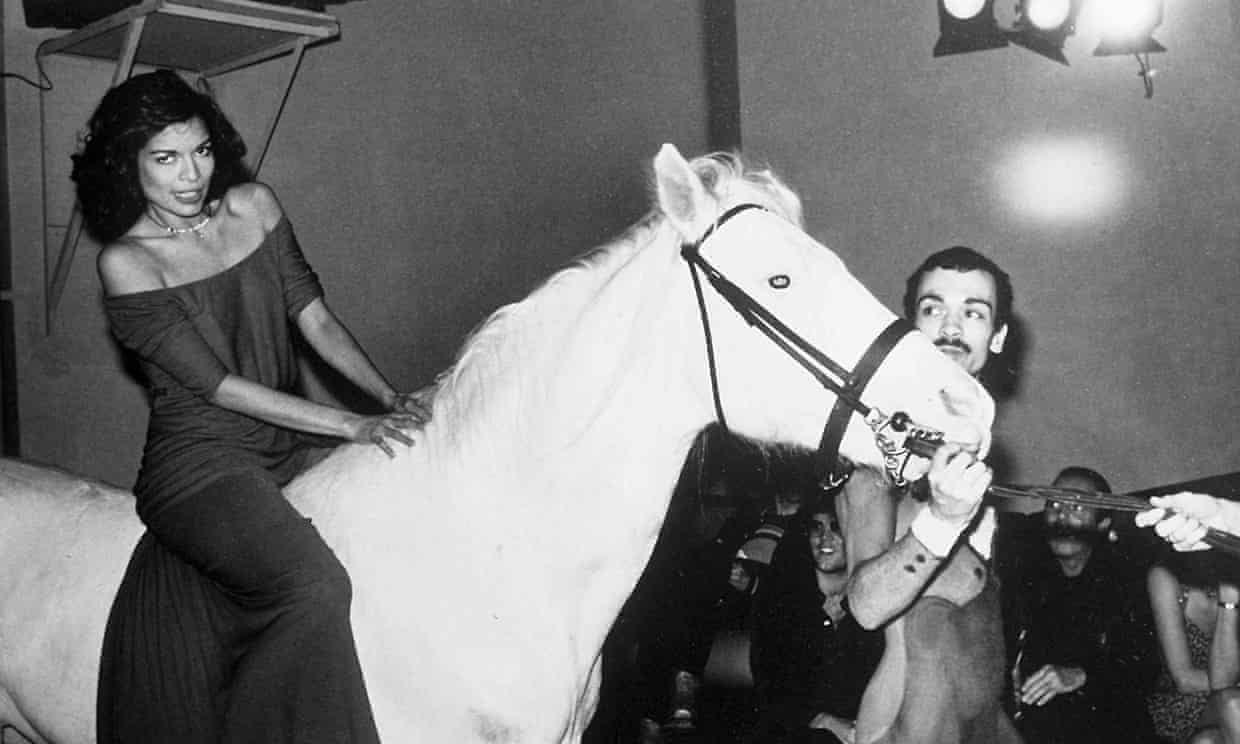
But Bianca Jagger was a frequent guest, both with and without her husband, Mick, the lead singer of The Rolling Stones. So was model Jerry Hall, for whom Mick would eventually leave Bianca. Bianca, a Nicaragua-born socialite and peace activist, once rode onto the dance floor on a white horse.
No, I'm not making that up.

Former First Ladies Jacqueline Kennedy Onassis and Betty Ford were accepted; Betty's husband, Jerry, never tried. Margaret Trudeau, then the First Lady of Canada, got in; her husband, Pierre, never tried. The only major New York politicians who got in were Congresswoman Bella Abzug and Manhattan Borough President Percy Sutton.

It wasn't just for the young and beautiful, like the aforementioned Grace Jones, Mikhail Baryshnikov, Jacqueline Bisset, Gia Carangi, Faye Dunaway, Farrah Fawcett, Diane von Fürstenberg, Richard Gere, Anjelica Huston, actress-model sisters Margaux and Mariel Hemingway, Lauren Hutton, the person then known as Bruce Jenner, Gilda Radner, Brooke Shields (who, like Mariel Hemingway, should have been considered too young to get in), and the man who was about to become the King of Disco, John Travolta. Certainly, Woody Allen, John Belushi, Sylvester Stallone, Robin Williams TV reporter Geraldo Rivera and drag queen Divine were not beautiful, but they were let in.

Being a fashion designer helped: Halston, Tommy Hilfiger, Calvin Klein and Karl Lagerfeld were let in. Being a rock star helped: In addition to Mick, John Lennon and Yoko Ono, Diana Ross, Tina Turner, Cher, Elton John, David Bowie, Michael Jackson, Tom Jones, Debbie Harry of Blondie, Rick James, Freddie Mercury of Queen, Bette Midler, Lou Reed, Paul Stanley of Kiss, and country singer Dolly Parton were seen there.

But even such establishment figures (even if they had once been world-shockers) as Capote, Frank Sinatra, Elizabeth Taylor, Leonard Bernstein, Roy Cohn, Salvador Dali, Doris Duke, Martha Graham, Earth Kitt, Timothy Leary, Frank Lebowitz, Liza Minnelli and her sister Lorna Luft, Jack Nicholson, Al Pacino, Paloma Picasso, Richard Pryor and Andy Warhol. Warhol described the place as "a dictatorship at the door, but a democracy on the dance floor."
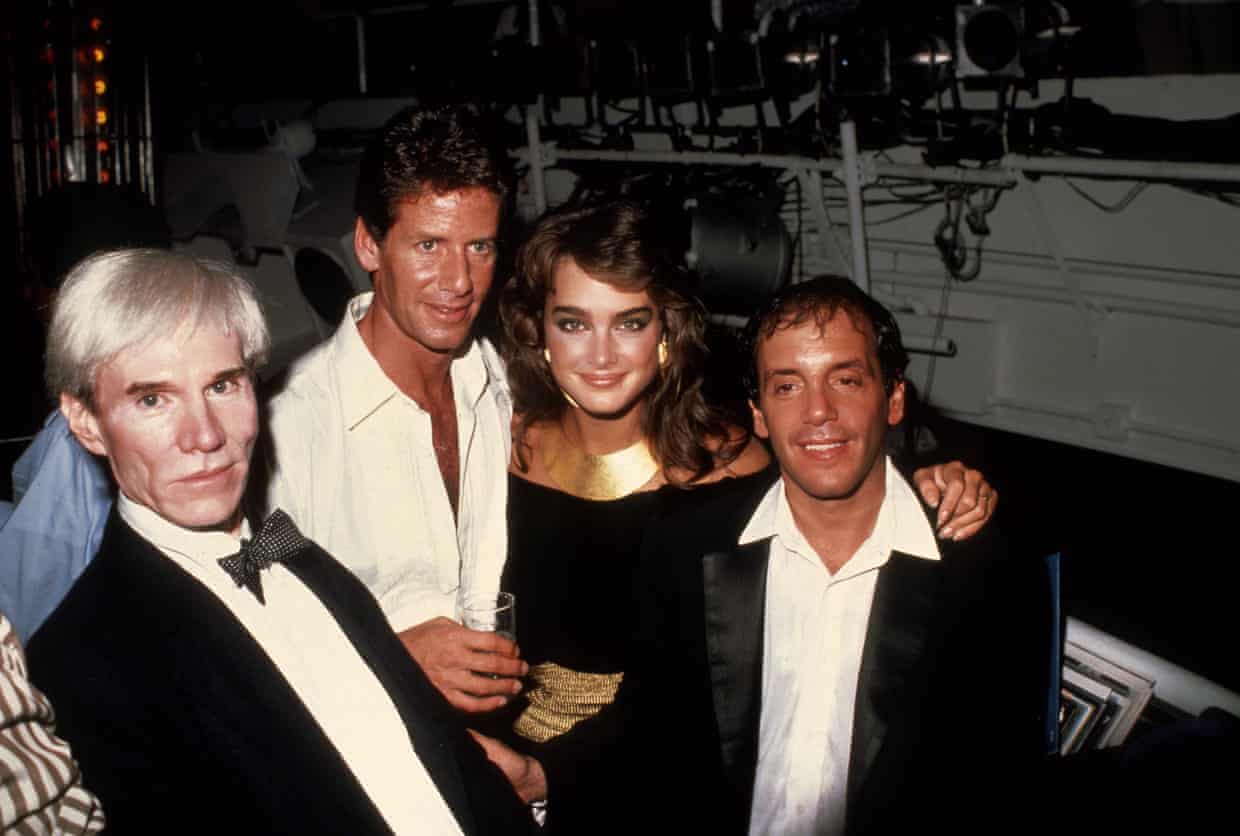
Left to right: Andy Warhol, Calvin Klein, Brooke Shields
(who did commercials for Klein's jeans), Steve Rubell.

Also known to have been there: A young real estate developer who was a client of Cohn's, and his wife at the time: Donald and Ivana Trump. Alec Baldwin, who would later impersonate Trump on Saturday Night Live, worked at Studio 54 as a waiter.

It had been half a century since the Algonquin Hotel, 13 blocks away, with its Algonquin Round Table of writers and journalists, had been the center of New York's social life. Now, the literati had been replaced by a "glitterati."

On December 16, 1978, Rubell and Schrager were arrested by the IRS, for skimming profits. The Manhattan District Attorney's office alleged they had taken $2.5 million (about $12 million in 2022 money), or as much as 60 percent of Studio 54's receipts over the past 2 years.

They hired Cohn to represent them. Threatened with further charges of drug trafficking, obstruction of justice and conspiracy, they pleaded guilty to tax evasion in November 1979. On March 31, 1980, Studio 54 closed. As country singer Willie Nelson (not known to have ever been a guest there) wrote in 1967, "Turn out the lights, the party's over."

Rubell and Schrager were each sentenced to 3 1/2 years in prison, and each was released after a year and 3 months. In 1985, they renovated the former Academy of Music on East 14th Street, and turned it into a dance club called Palladium. That year, Rubell, a closeted gay man, discovered that he had contracted AIDS. He died in 1989.

In 1984, Rubell and Schrager went into the hotel business, pioneering the concepts of the small, but very attentive, "boutique hotel" and "urban resort." As of April 26, 2022, Schrager is still alive, and active in the hotel industry.

Speaking of hotels: In 1997, the MGM Grand Casino and Hotel in Las Vegas opened a Studio 54 replica. It lasted until 2012.

The Roundabout Theatre Company converted the Studio 54 space into a Broadway theater in 1998, retaining the Studio 54 name. The 1st show staged there was a revival of the musical Cabaret, with Natasha Richardson as Sally Bowles and Alan Cumming as the Master of Ceremonies. This was an appropriate choice, given the show's its themes of escape, hiding, reinventing oneself, and impending doom. (Sadly, this proved all too true for Richardson, who died in a skiing accident in 2009.)
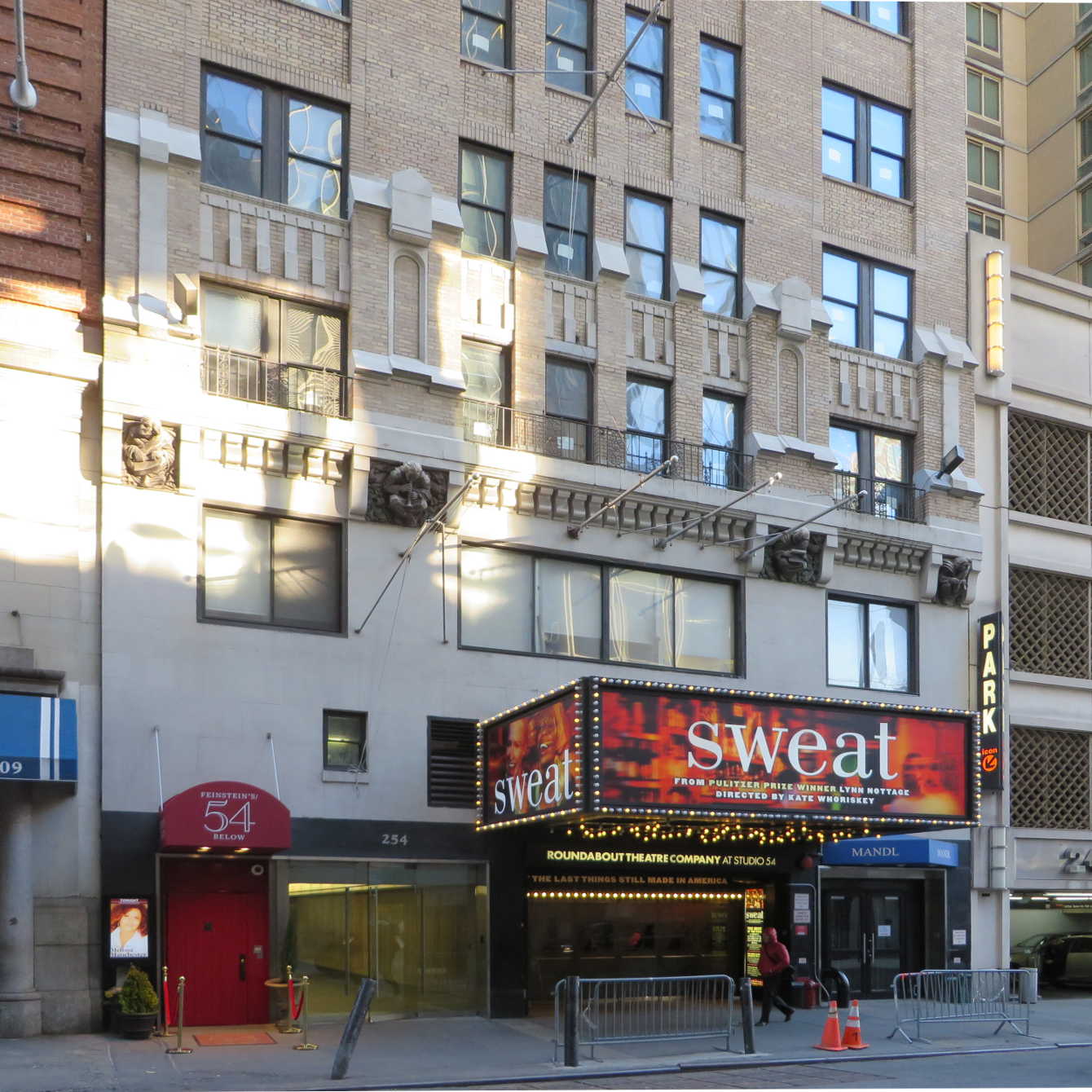
The building in 2017, with the infamous red door to the left

Also in 1998, the film 54 was released, filmed onsite, shortly before its conversion into a theater. Mike Myers played Rubell, and Louis Negin played Capote, but they were the only real people portrayed in the film. Lauren Hutton was in the film, playing an older clubgoer rather than pretending to be her then-36-year-old self. Ryan Phillippe, Salma Hayek, Breckin Meyer and Neve Campbell also starred, all as fictional characters.

UPDATE: In 2021, the producers of the FX TV series American Crime Story had announced that the show's 4th season would focus on Studio 54, but, as of early 2024, it had not yet begun production. At that point, Schrager was still alive, as was the Queen of Studio 54, Bianca Jagger.

And it took me until around that time to think of this, but the 1970s were Schrödinger's Decade. There was too much overwrought music, including disco; and, at the same time, not enough of it.

*

April 26, 1977 was a Tuesday. Japanese baseball star Kosuke Fukudome was born. So was Tom Welling, who played Clark Kent (but only briefly, in the show's final scene, Superman) on the 2001-11 WB/CW Network series Smallville.

These games were played in Major League Baseball:

* The New York Yankees lost to the Baltimore Orioles, 6-2 at Memorial Stadium in Baltimore. Once-and-future Yankee Rudy May outpitched Ken Holtzman. Eddie Murray, who would be named American League Rookie of the Year, hit the 3rd of what would turn out to be 504 career home runs. Reggie Jackson went 0-for-3 with a walk, but had an RBI on a groundout.

* The Cincinnati Reds beat the Atlanta Braves, 9-1 at Atlanta-Fulton County Stadium. Dan Driessen hit 2 home runs, and Johnny Bench hit 1. Pete Rose went 3-for-5.

* The Pittsburgh Pirates beat the Philadelphia Phillies, 5-0 at Three Rivers Stadium in Pittsburgh. John Candelaria went 7 innings, allowing no runs on 3 hits. Rich Gossage, in his 1 seasons in Pittsburgh after 5 with the White Sox, before signing as a free agent with the Yankees, pitched 2 hitless innings the rest of the way, the Candy Man and the Goose combining on a 3-hit shutout. Willie Stargell appeared only as a pinch-hitter, and did not reach base. Mike Schmidt went 0-for-3.

* The Chicago White Sox beat the Detroit Tigers, 10-7 at Tiger Stadium in Detroit. The Tigers led 6-1 after 4 innings, but the White Sox tied the game in the 8th. Each team scored a run in the 13th. Tiger reliever Steve Foucault came in to pitch the top of the 14th, and had nothing, allowing a double and a walk, getting a forceout, then allowing an RBI single to Richie Zisk, allowing an intentional walk, throwing a wild pitch that got a run home, walking another batter, and allowing a 3rd run on a groundout.

* The Chicago Cubs beat their arch-rivals, the St. Louis Cardinals, 4-1 at Wrigley Field in Chicago. Bobby Murcer went 1-for-3 with a walk. Lou Brock went 1-for-4.

* The Boston Red Sox beat the Milwaukee Brewers, 3-1 at Milwaukee County Stadium. Carl Yastrzemski went 0-for-5, but Carlton Fisk went 3-for-4 with an RBI. Robin Yount went 1-for-4.

* The Minnesota Twins beat the Seattle Mariners, 5-3 at Metropolitan Stadium in the Minneapolis suburb of Bloomington, Minnesota. Rod Carew went 0-for-4. That would be a rarity for him that season, as he ended up batting .388 and winning the AL's Most Valuable Player award.

* The Kansas City Royals beat the Texas Rangers, 6-3 at Royals Stadium (now Kauffman Stadium) in Kansas City. George Brett went 2-for-4.

* The Los Angeles Dodgers beat the San Diego Padres, 4-1 at San Diego Stadium (later Jack Murphy Stadium and Qualcomm Stadium).

* The Oakland Athletics beat the California Angels, 7-3 at Anaheim Stadium (now Angel Stadium of Anaheim). For the A's, Dick Allen hit his 350th career home run. He would only hit one more, playing both halves of a Sunday, doubleheader on June 19, left the A's, and never played again. He was only 35, but he was batting .240 for the season, and was probably done.

* The Houston Astros beat the San Francisco Giants, 4-3 at Candlestick Park in San Francisco. Joe Ferguson hit a home run to win the game in the top of the 13th inning.

* The Cleveland Indians and the Toronto Blue Jays were rained out at Cleveland Municipal Stadium. The game was made up 2 days later, and the Indians won, 4-3.

* And the New York Mets and the Montreal Expos were rained out at Shea Stadium. The game was made up on May 30, as a Memorial Day matinee became a traditional holiday doubleheader. The Expos swept, 5-1 and 3-2.

Football was out of season. There were 3 games played in the NBA Playoffs:

* The Houston Rockets beat the Washington Bullets, 107-103 at the Capital Centre in the Washington suburb of Landover, Maryland.

* The Golden State Warriors beat the Los Angeles Lakers, 114-103 at the Oakland Coliseum Arena. Of course, the Warriors view the Lakers as their arch-rivals, but it's never been the other way around: The Lakers' rivals are the Boston Celtics. Despite the defeat, Kareem Abdul-Jabbar scored 41 points and had 18 rebounds. This game tied up the series at 2-2, but the Lakers would win it in 7.

* And the Portland Trail Blazers beat the Denver Nuggets, 105-96 at the Portland Memorial Coliseum.

There were 2 games played in the Stanley Cup Playoffs. The New York Islanders lost to the Montreal Canadiens, 3-0 at the Montreal Forum. And the Boston Bruins beat the Philadelphia flyers, 5-4 at The Specturm in Philadelphia. Terry O'Reilly scored the winning goal, 10:07 into the 2nd overtime.

And there was 1 game played in the World Hockey Association Playoffs: The Winnipeg Jets beat the Houston Aeros, 4-3 in overtime at The Summit in Houston. (The arena has been converted into the "Central Campus" of televangelist Joel Osteen's Lakewood Church.)

December 31, 1999 & January 1, 2000: The Millennium

December 31, 1999:  The Millennium arrives. The people of planet Earth survived. At a terrible cost. But we hadn't destroyed ourselves. ...