Showing posts with label kansas city chiefs. Show all posts

Sunday, December 25, 2022

December 25, 1971: The NFL's Longest Game

December 25, 1971: For the 1st time, the NFL plays a game on Christmas Day. It turned out to be the longest game in the league's history.

The Kansas City Chiefs played the Miami Dolphins at Kansas City Municipal Stadium. The Chiefs had been the defining team of the American Football League, winning the title in 1962, 1966 and 1969. From the AFL's founding in 1960 until the 1962 Championship Game, they were the Dallas Texans. That '62 title game, which they beat the Houston Oilers, went to 2 overtimes, becoming the longest game in pro football history.

The Dolphins had only been founded in 1966, and made the Playoffs for the 1st time in 1970. They were a team on the rise, and this would be their biggest challenge yet. Despite the game being in Kansas City in December, the weather was just fine by Miami standards: 62 degrees and partly cloudy at the 3:00 kickoff (4:00 Eastern Time).

The scoring began with Jan Stenerud kicking a field goal for the Chiefs. They went ahead 10-0 following an interception by Willie Lanier and a touchdown pass from Len Dawson to Ed Podolak. The Dolphins came back, with Larry Csonka running for a touchdown and Garo Yepremian kicking a field goal, making the score 10-10 at the half.

Dawson launched a 75-yard, 10-minute drive that ended with a Jim Otis touchdown, but the Dolphins came back with a Jim Kiick touchdown to make it 17-17. In the 4th quarter, Nick Buoniconti picked up a fumble, but Jim Lynch intercepted Griese to end that threat. Dawson then drove the Chiefs 91 yards, capped by a 3-yard run by Podolak, making it 24-17 Kansas City.

The Dolphins struck back, going 71 yards until Griese threw a 5-yard touchdown pass to Marv Fleming, tying it 24-24 with 1:25 left in regulation. Podolak took the kickoff back 78 yards, but Stenerud missed a 32-yard field goal, and the game went to overtime.

At this point, overtime was still rare. There would not be a provision for it in the regular season until 1974. It had happened in the 1958 NFL Championship Game, with the Baltimore Colts beating the New York Giants. It had happened, as I said, in the 1962 AFL Championship Game. And it had happened in a Playoff for the NFL Western Division Championship in 1965, with the Green Bay Packers beating the Colts. This would be only the 4th time in pro football history that a game went beyond the standard 60 minutes.

Podolak returned the overtime kickoff to the 46-yard line, setting up a 42-yard field goal attempt by Stenerud. But the Dolphins blocked it. Later in the 5th quarter, Yepremian tried a field goal from 52 yards, but this was short. At the end of this 1st overtime period, Jake Scott intercepted a Dawson punt, but this came to nothing, and the teams traded punts.

Finally, Csonka -- on his 25th birthday -- broke off a 29-yard run, setting up a 37-yard field goal attempt by Yepremian, with 7:40 left in the 6th quarter -- 82 minutes and 40 seconds of play. The left-footed Armenian from Cyprus made the kick, it was good, and the Dolphins had won, 24-21.

Chiefs coach Hank Stram said, "I don't think any one player in a big game, a monumental game like that, had a day like Eddie Podolak had." Stram had a point: 17 rushes for 85 yards, 8 catches for 110 yards, 3 kickoff returns for a 154 yards, and 2 punt returns for 2 yards. That's 350 all-purpose yards, still a postseason record, and the 4th-highest total in NFL history. But for all he, and Hall-of-Famers like Len Dawson, Willie Lanier, Buck Buchanan, Bobby Bell, Curley Culp, Johnny Robinson and Jan Stenerud did, it wasn't enough.

In 1981, historian John Thorn left his comfort zone, baseball, and published Pro Football's 10 Greatest Games. He included this game.

This defeat meant that this was the last game the Chiefs would play at Municipal Stadium. They would not host the AFC Championship Game, and the next season, Arrowhead Stadium opened, and it remains the Chiefs' home to this day.

More than this, it was the end of one era, and the beginning of another. The Chiefs had played 8 postseason games in 9 years, winning 3 AFL Championships and Super Bowl IV. They would not play another Playoff game for 15 years, only that 1 for 19 years, and wouldn't win a Playoff game for 20 years.

The Dolphins hosted the Colts, another great team getting old, in the AFC Championship Game, and won, 21-0. They lost Super Bowl VI to the Dallas Cowboys, 24-3. But the following season, they went undefeated, 14-0, and won Super Bowl VII over the Washington Redskins, 14-7. They would win Super Bowl VIII as well.

In 2019, a poll ranked this game 18th on a list of the 100 Greatest Games of the NFL's 1st 100 years.

*

December 25, 1971 was a Saturday. Earlier in the day, the Dallas Cowboys had beaten the Minnesota Vikings, 20-12 at Metropolitan Stadium in the Minneapolis suburb of Bloomington, Minnesota.

The following day, December 26, the Baltimore Colts beat the Cleveland Browns, 20-3 at Cleveland Municipal Stadium; and the San Francisco 49ers beat the Washington Redskins, 24-20 at Candlestick Park in San Francisco.

There were 6 games played in the NHL. Since this day, the League has never played on Christmas Day again. In fact, traditionally, it has not played on December 24, or 25, and usually not on 26, either.

The New York Rangers beat the Minnesota North Stars, 2-1 at the Metropolitan Sports Center in Bloomington. The Boston Bruins beat the Philadelphia Flyers, 5-1 at the Boston Garden. The Toronto Maple Leafs beat the Detroit Red Wings, 5-3 at Maple Leaf Gardens in Toronto. The Pittsburgh Penguins beat the Montreal Canadiens, 4-2 at the Civic Arena in Pittsburgh. 

The St. Louis Blues and the Buffalo Sabres played to a tie, 4-4 at the St. Louis Arena. And the Oakland-based California Golden Seals beat the Los Angeles Kings, 3-1 at The Forum outside Los Angeles, in Inglewood, California.

There were 7 games played in the NBA. The New York Knicks beat the Golden State Warriors, 114-89 at Madison Square Garden. Walt Frazier scored 36 points.

The Boston Celtics beat the Cincinnati Royals, 99-94 at the Cincinnati Gardens. This was the end of a tradition: The last Christmas game in Cincinnati. The following season, the Royals moved, becoming the Kansas City-Omaha Kings.

Also, the Baltimore Bullets beat the Philadelphia 76ers, 117-114 at The Spectrum in Philadelphia. The Atlanta Hawks beat the Buffalo Braves, 140-117 at the Alexander Coliseum in Atlanta. Walt Bellamy scored 40 points. The Detroit Pistons beat the Milwaukee Bucks, 120-118 in overtime at Cobo Hall in Detroit. Kareem Abdul-Jabbar scored 38 points, but it wasn't enough to beat the Pistons.

The Phoenix Suns beat the Seattle SuperSonics, 116-86 at the Arizona Veterans Memorial Coliseum in Phoenix. Connie Hawkins scored 31 for the Suns. And the Chicago Bulls beat the Portland Trail Blazers, 109-88 at the Portland Memorial Coliseum.

There were 3 games played in the ABA. The Virginia Squires beat the Pittsburgh Condors, 133-126 at the Hampton Coliseum. The Memphis Pros beat the Carolina Cougars, 110-102 at the Mid-South Coliseum. And the Utah Stars beat the Indiana Pacers, 150-129 at the Salt Palace in Salt Lake City.

Pierre Trudeau, then the Prime Minister of Canada, became a father on this day, to Justin Trudeau, who would also go on to become Prime Minister. Florian Cloud de Bounevialle O'Malley Armstrong, the English singer known as Dido, was also born.

Saturday, December 24, 2022

December 24, 1994: The Rams and Raiders Abandon Los Angeles

December 24, 1994: The Kansas City Chiefs defeat their arch-rivals, the Los Angeles Raiders, 19-9, before 64,130 fans -- a big crowd, but hardly a sellout at the 93,000 seat Los Angeles Memorial Coliseum.

The Coliseum had been the home of the Raiders since moving from Oakland before the 1982 season, and the home of the Los Angels Rams from 1946 to 1979. The Rams had moved 38 miles southeast to Anaheim Stadium (now Angel Stadium of Anaheim). On this same day, they played there, and lost to the Washington Redskins, 24-21. The crowd was 25,705, a pathetically small one for a stadium whose football capacity was 69,000.
Before the next season opened, the Los Angeles metropolitan area dropped from 2 NFL teams to none: Al Davis took the Raiders back to Oakland, and Rams owner Georgia Frontiere took the team to her hometown of St. Louis. The Rams' move also killed the famous Los Angeles-San Francisco rivalry with the 49ers, whose run of success the preceding few years hurt the Rams as much as anything: For about 15 years before it, the Rams had dominated the division that became the NFC West.

It took the Rams a while to get going in St. Louis, building "The Greatest Show on Turf," winning Super Bowl XXXIV, and losing Super Bowl XXXVI, before falling apart again. After the 2015 season, with Stan Kroenke having bought the team from Mrs. Frontiere's estate, the Rams moved back to Los Angeles, playing 4 seasons at the Coliseum before Kroenke's SoFi Stadium was built in Inglewood, on the site of the Hollywood Park racetrack, across from The Forum. The NBA's Los Angeles Clippers have begun building their new arena, the Intuit Dome, on the same campus.

The Raiders' return to Oakland was shaky. They fell victim to the Tuck Rule Game in the 2001 season, then won the 2002 AFC Championship, but lost Super Bowl XXXVII. Al Davis died in 2011, and his son Mark Davis inherited the team. He never liked Oakland, and tried to go back to Los Angeles, before making a deal to move to Las Vegas for the 2020 season.

With the Raiders having balked in their negotiations, it was the San Diego Chargers who moved for the 2017 season, spending 3 season at Dignity Health Sports Park in suburban Carson, California, before moving into SoFi as tenants of the Rams.

*

December 24, 1994 was a Saturday. No college football bowl games were played. Baseball was out of season. The NBA had no games scheduled. And the NHL team owners were locking out the players. So the only games played on the day were in the NFL.

At the time, the NFL preferred not to play games on Christmas Day, even when it fell on a Sunday. That changed the next year. This time, the only game played on Sunday, December 25 was the Miami Dolphins' 27-20 win over the Detroit Lions at Joe Robbie Stadium (now Hard Rock Stadium) in Miami Gardens, Florida, and that was in prime time. The next night, on ABC Monday Night Football, the Minnesota Vikings beat the San Francisco 49ers, 21-14 at the Metrodome in Minneapolis. The rest of the NFL slate, including the 2 L.A. farewells, was played on the afternoon of Saturday, December 24:

* The New York Giants beat the Dallas Cowboys, 15-10 at Giants Stadium in the Meadowlands.

* The Atlanta Falcons beat the Arizona Cardinals, 10-6 at the Georgia Dome in Atlanta.

* The Green Bay Packers beat the Tampa Bay Buccaneers, 34-19 at Tampa Stadium.

* The New Orleans Saints beat the Denver Broncos, 30-28 at the Superdome in New Orleans.

* The New York Jets lost to the Houston Oilers, 24-10 at the Astrodome in Houston.

* The Cleveland Browns beat the Seattle Seahawks, 35-9 at Cleveland Municipal Stadium.

* The Cincinnati Bengals beat the Philadelphia Eagles, 33-30 at Riverfront Stadium in Cincinnati.

* The Indianapolis Colts beat the Buffalo Bills, 10-9 at the RCA Dome in Indianapolis.

* The New England Patriots beat the Chicago Bears, 13-3 at Soldier Field in Chicago.

* And the San Diego Chargers beat the Pittsburgh Steelers, 37-34 at Jack Murphy Stadium in San Diego.

Wednesday, December 14, 2022

December 14, 1965: The Death of Mack Lee Hill

December 14, 1965: Mack Lee Hill dies on the operating table during knee surgery, at Menorah Medical Center in Kansas City, Missouri. He was only 25 years old.

This was a compound tragedy: Born on August 17, 1940 in Quincy, Florida, outside Tallahassee, and nicknamed "The Truck" after Mack Trucks, he had been drafted out of Southern University in 1964, essentially to fill the hole left a year earlier, when running back Stone Johnson was killed when he broke his neck in a preseason game. He was only 23, and had yet to play a regular-season game in the NFL (or the American Football League, in which the Chiefs were playing at the time).

Hill had rushed for 576 yards in 1964, and had already gained 627 yards in 1965. In both seasons, he led the AFL in yards per carry. He seemed to be a star in the making. But on December 12, 1965, in a 34-25 loss to the Buffalo Bills at War Memorial Stadium in Buffalo, he tore a ligament in his right knee, ending his season.

He was taken back to Kansas City, and was operated on 2 days later. The surgery should have been routine, and seemed to have been completed. But his temperature suddenly spiked to 108 degrees, triggering severe convulsions, and he died an hour and a half later. The team doctor, Albert R. Miller, determined that a fat globule had broken off, entering the bloodstream, and causing a pulmonary embolism.

Chiefs coach Hank Stram said, "Mack Lee Hill was a fine gentleman and a great football player. He was probably one of the most unselfish players I have ever coached. He was completely dedicated to the team. Football was his life."

The Chiefs retired his Number 36, and created the Mack Lee Hill Award, given annually to the team's outstanding rookie. When their team Hall of Fame was established, Hill was elected to it.

The Chiefs have had a sad history, starting with the death of Stone Johnson, and it didn't stop with the death of Hill. In 1980, former All-Pro offensive tackle Jim Tyrer, going through business failures, did what Belcher did today: He shot and killed his wife, and then killed himself. He was 41.

In 1983, running back Joe Delaney, having played 2 All-Pro seasons, drowned in a failed attempt to save 2 drowning boys. He was 24.

In 2000, Derrick Thomas, then one of the best linebackers in the game, crashed his car, was paralyzed, and died a few days later of a blood clot, at 33.

In 2012, Jovan Belcher was added to the list. I don't know what the Chiefs did to bring all this on, but it seems like the club is cursed. In 2020, they won Super Bowl LIV, their 1st World Championship in 50 years. But their history is still tragic.

*

December 14, 1965 was a Tuesday. Actor Ted Raimi was born on this day.

Football was in midweek. Baseball was in the off-season. And no games were scheduled in the NHL. But there were 3 games played in the NBA:

* The New York Knicks beat the San Francisco Warriors, 141-137 at the old Madison Square Garden. Rick Barry scored 57 points for the Warriors, but it wasn't enough, as the Knicks got 31 points from Walt Bellamy and 30 from Dick Barnett.

* The Baltimore Bullets beat the Detroit Pistons, 142-129 at the Baltimore Civic Center (now the CFG Bank Arena). Kevin Loughery scored 35 points for the Bullets.

* And the Cincinnati Royals beat the Philadelphia 76ers, 112-109 at the Cincinnati Gardens. For the Royals, Oscar Robertson had 31 points, while Jerry Lucas had 30 points and 25 rebounds. For the Sixers, Wilt Chamberlain had 32 points and 20 rebounds.

Thursday, December 1, 2022

December 1, 2012: The Tragedy of Jovan Belcher

December 1, 2012: The life of Kansas City Chiefs linebacker Jovan Belcher comes to a shocking end. He was 25 years old.

Jovan Henry Allen Belcher was born on July 24, 1987 in West Babylon, Long Island, New York. One of the few University of Maine football players to reach the NFL, he was not selected in the 2009 NFL Draft, but the Chiefs signed him as a free agent.

He became a regular starter in the 2010 season, had a good year in 2011, and had started 10 of the Chiefs' 11 games to that point in 2012. So he must have been doing something right on the field. He had a girlfriend and an infant daughter. Professionally and personally, things seemed to be looking up for him. There appeared to be no sign that he was unhappy.

But on the morning of December 1, he shot and killed his girlfriend, Kasandra Perkins, 22 -- in the presence of her mother. Then he drove to the Chiefs' practice facility at Arrowhead Stadium, and, in front of head coach Romeo Crennel and general manager Scott Pioli, whom he thanked for giving him a chance to play pro ball, he used his gun again, this time on himself.

A medical examiner's report revealed that Belcher had chronic traumatic encephalopathy, a.k.a. CTE, the brain damage caused by repeated head contact in football.

The Chiefs have had a sad history. In 1963, running back Stone Johnson was killed when he broke his neck in a preseason game. He was only 23, and had yet to play a regular-season game in the NFL (or the AFL, in which the Chiefs were playing at the time).

In 1965, Mack Lee Hill, essentially drafted to fill the hole left by Johnson's death, died on the operating table during what should have been routine knee surgery. He was only 25.

In 1980, former All-Pro offensive tackle Jim Tyrer, going through business failures, did what Belcher later did: He shot and killed his wife, and then killed himself. He was 41.

In 1983, running back Joe Delaney, having played 2 All-Pro seasons, drowned in a failed attempt to save 2 drowning boys. He was 24.

In 2000, Derrick Thomas, then one of the best linebackers in the game, crashed his car, was paralyzed, and died a few days later of a blood clot, at 33.

In 2012, Jovan Belcher was added to the list. I don't know what the Chiefs did to bring all this on, but it seems like the club is cursed. In 2020, they won Super Bowl LIV, their 1st World Championship in 50 years. But their history is still tragic.

*

December 1, 2012 was a Saturday. The Chiefs were scheduled to play at home the next day, against the Carolina Panthers. The game went on as scheduled, following discussions between the NFL, Crennel, and the Chiefs' team captains. No formal mention was made of the shooting at the game, although there was a moment of silence for "victims of domestic violence and their families." The Chiefs defeated the Panthers, 27–21.

It was the last full week of the college football season. These games were among those played:

* Number 2 Alabama beat Number 3 Georgia, 32-28 at the Georgia Dome in Atlanta, in the Southeastern Conference Championship Game.

* Number 7 Kansas State beat Number 23 Texas, 42-24 at Bill Snyder Family Stadium in Manhattan, Kansas. While the Big Twelve Conference did not have a Championship Game that season, this win by KSU gave them a share of the league's title, and their earlier defeat of Oklahoma gave them the tiebreaker.

* Number 13 Florida State beat Georgia Tech, 21-15 at Bank of America Stadium in Charlotte, in the Atlantic Coast Conference Championship Game.

* Number 14 Nebraska were not merely upset, but blown away by Wisconsin, 70-31 at Lucas Oil Stadium in Indianapolis, in the Big Ten Conference Championship Game.

* The University of Tulsa beat Central Florida, 33-27 at Skelly Stadium in Tulsa, in the Conference USA Championship Game.

* The University of Cincinnati beat Connecticut, 34-17 at Rentschler Field in East Hartford, Connecticut. This forged a 4-way tie at the top of the Big East Conference: Cincinnati, Louisville, Syracuse and Rutgers.

* The night before, Number 8 Stanford beat Number 17 UCLA, 27-24 at the new Stanford Stadium in the San Francisco suburb of Palo Alto, California, in the Pacific-Twelve Conference Championship Game.

In the major bowls, Stanford beat Wisconsin in the Rose Bowl, Florida State beat Northern Illinois in the Orange Bowl, Louisville upset Florida in the Sugar Bowl, Oregon beat Kansas State in the Fiesta Bowl, and Texas A&M beat Oklahoma in the Cotton Bowl. And, in the Bowl Championship Series' National Championship Game, in Miami Gardens, Florida, Number 2 Alabama beat Number 1 Notre Dame.

Baseball was in the off-season. The NHL team owners had locked the players out, and the season didn't start until January 19, 2013. But there were 10 games played in the NBA that day:

* The Brooklyn Nets lost to the Miami Heat, 102-89 at the American Airlines Arena (now the Kaseya Center) in Miami. Dwyane Wade scored 34 points.

* The Portland Trail Blazers beat the Cleveland Cavaliers, 118-117 in double overtime at the Quicken Loans Arena (now the Rocket Arena) in Cleveland.

* The Chicago Bulls beat the Philadelphia 76ers, 93-88 at the United Center in Chicago.

* The Milwaukee Bucks beat the Boston Celtics, 91-88 at the Bradley Center in Milwaukee.

* The Oklahoma City Thunder beat the New Orleans Hornets, 100-79 at the Smoothie King Center in New Orleans.

* The Dallas Mavericks beat the Detroit Pistons, 92-77 at the American Airlines Center in Dallas.

* The Houston Rockets beat the Utah Jazz, 124-116 at the Toyota Center in Houston.

* The San Antonio Spurs beat the Memphis Grizzlies, 99-95 at the AT&T Center (now the Frost Bank Center) in San Antonio.

* The Los Angeles Clippers beat the Sacramento Kings, 116-81 at the Staples Center (now the Crypto.com Arena) in Los Angeles.

* And the Golden State Warriors beat the Indiana Pacers, 103-92 at the Oakland Coliseum Arena (then named the Oracle Arena).

And in English soccer, Arsenal lost to Welsh team Swansea City, 2-0 at the Emirates Stadium in North London. Both goals were scored by Spanish striker Michu: One in the 88th minute, the other in stoppage time. Many Arsenal fans, unhappy with losing striker Robin van Persie in the off-season and with his replacement, Olivier Giroud, demanded that the team sign Michu, based on this one performance. It turned out to be the highlight of his career, as he never amounted to anything.

Tuesday, November 29, 2022

November 29, 1992: The Dennis Byrd Game

November 29, 1992: The New York Jets lose 23-7 to the Kansas City Chiefs at Giants Stadium – and nobody cares. The reason is the injury to Jet defensive tackle Dennis Byrd, the result of a freak accident on the field.

Dennis DeWayne Byrd was born on October 5, 1966 in Oklahoma City, Oklahoma. He grew up in Mustang, Oklahoma, played defensive end at the University of Tulsa (the Golden Hurricane), and was drafted by the New York Jets in the 2nd round of the 1989 NFL Draft.

On November 29, 1992, Byrd was enjoying a modest, not particularly noteworthy career when he took the field against the Kansas City Chiefs at Giants Stadium. Byrd and teammate Scott Mersereau attempted to sack Chiefs quarterback Dave Krieg, but Krieg got away, resulting in a collision between the Jet defenders. Byrd's helmet hit Mersereau straight in the chest, compressing Byrd's neck and breaking a bone in his neck the C-5 veretbra.

This was 1 year and 1 day after Detroit Lions guard Mike Utley had broken his neck in a game, and just 3 days after an emotional Thanksgiving Day game in which Utley guided his wheelchair out to midfield and served as the Lions' Honorary Captain.

Like Utley, Byrd was paralyzed from the neck down as a result of his injury. Utley took years before he could even take a few steps unaided, and, essentially, remained in a wheelchair, although he didn't let that stop him from getting around and raising money for spinal cord research.

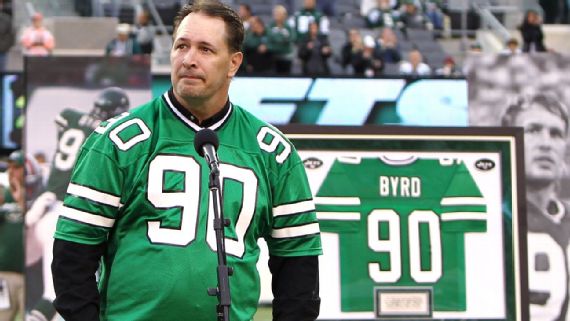
Byrd was considerably luckier: With intense physical therapy, he was able to walk to midfield for the Jets' season opener on September 5, 1993, and serve as Honorary Captain. In the meantime, every Jet helmet had a sticker with his uniform number, 90 over an ichthys -- a "Jesus fish," indicative of Byrd's faith. The 1st game after his injury was against the Buffalo Bills, and some of their players wore the logo on their helmets as well.

The Jets announced an annual Most Inspirational Player Award, to be named for him. They also announced that his Number 90 would never be reissued, and on October 28, 2012, it was formally retired.

Byrd was married to Angela Hales, and they had 4 children. He wrote Rise and Walk: The Trial and Triumph of Dennis Byrd. It was made into a TV-movie starring Peter Berg. He coached on high school football staffs in Oklahoma, at Owasso High School and Lincoln Christian School in Tulsa, the latter naming its football stadium for him. He also became a motivational speaker. 

On October 15, 2016, Byrd was driving his 2004 Hummer H2 southbound on Oklahoma State Route 88, between Claremore and Oologah. A 17-year-old kid (whose name, legally, could not be released) from Claremore was driving a 2000 Ford Explorer, and it veered into the oncoming lane, and hit Byrd's Hummer head-on. Byrd was dead on the scene, just past his 50th birthday.

*

November 29, 1992 was a Sunday. These other NFL games were played that day:

* The Washington Redskins beat the Phoenix Cardinals, 41-3 at Robert F. Kennedy Stadium in Washington.

* The Atlanta Falcons beat the New England Patriots, 34-0 at the Georgia Dome in Atlanta.

* The New Orleans Saints beat the Miami Dolphins, 24-13 at the Superdome in New Orleans.

* The Cleveland Browns beat the Chicago Bears, 27-14 at Cleveland Municipal Stadium.

* The Pittsburgh Steelers beat the Cincinnati Bengals, 21-9 at Riverfront Stadium in Cincinnati.

* The Indianapolis Colts beat the Buffalo Bills, 16-13 at the Hoosier Dome in Indianapolis.

* The Green Bay Packers beat the Tampa Bay Buccaneers, 19-14 at Lambeau Field in Green Bay, Wisconsin.

* The San Diego Chargers beat the Los Angeles Raiders, 27-3 at Jack Murphy Stadium in San Diego.

* The Minnesota Vikings beat the Los Angeles Rams, 31-17 at Anaheim Stadium (now Angel Stadium of Anaheim).

* The San Francisco 49ers bear the Philadelphia Eagles, 20-14 at Candlestick Park in San Francisco.

* Three days earlier, on Thanksgiving, the Dallas Cowboys beat the New York Giants, 30-3 at Texas Stadium in the Dallas suburb of Irving, Texas.

* Also on Thanksgiving, the Houston Oilers beat the Detroit Lions, 24-21 at the Silverdome in the Detroit suburb of Pontiac, Michigan.

* And the night after this, on ABC Monday Night Football, the Seattle Seahawks beat the Denver Broncos, 16-13 at the Kingdome in Seattle.

Baseball was out of season. There were 7 games played in the NBA:

* The New York Knicks lost to the Los Angeles Clippers, 101-91 at the Los Angeles Memorial Sports Arena.

* The New Jersey Nets beat the Atlanta Hawks, 108-101 at The Omni in Atlanta.

* The Orlando Magic beat the Golden State Warriors, 126-102 at the Orlando Arena.

* The Houston Rockets beat the Cleveland Cavaliers, 99-92 at The Summit in Houston. (It's now the Central Campus of televangelist Joel Osteen's Lakewood Church.)

* The San Antonio Spurs beat the Dallas Mavericks, 123-95 at the HemisFair Arena in San Antonio.

* The Denver Nuggets beat the Detroit Pistons, 99-87 at the McNichols Arena in Denver.

* And the Chicago Bulls beat the Seattle SuperSonics, 108-99 at the Seattle Center Coliseum. Michael Jordan led all scorers on the day with 35 points.

There was 1 game in the NHL: The Buffalo Sabres beat the Ottawa Senators, 5-2 at the Ottawa Civic Center (now the TD Place Arena).

Thursday, November 10, 2022

November 10, 1975: The Wreck of the Edmund Fitzgerald

November 10, 1975: The SS Edmund Fitzgerald sinks in a storm in Lake Superior, between the American State of Wisconsin and the Canadian Province of Ontario, with 29 men aboard. There were no survivors.

A year later, Canadian singer Gordon Lightfoot would have a hit song about the ship, reaching Number 2 on the U.S. music charts.

Lightfoot described the way the wind whipped up the Great Lakes as "the Witch of November come stealing." And there was recent precedent: On November 29, 1966, 9 years to the month earlier, the freighter SS Daniel J. Morrell, named for a Pennsylvania Congressman, sank in Lake Huron, taking with it 28 of its 29 crewmen. The sole survivor was named Dennis Hale.

The SS Edmund Fitzgerald, known as "the Eddie Fitz" or "the Big Fitz" was launched in 1958. As Lightfoot said, "As the big freighters go, it was bigger than most." In fact, at the time of its launch, it was the largest ship of any kind sailing the Great Lakes: From west to east, Lake Superior, Lake Huron, Lake Michigan, Lake Erie and Lake Ontario.

(Mark Russell, a native of Buffalo, New York, between Erie and Ontario, and a comedian whose specialty was politics, once commented on a bill before Congress to declare Lake Champlain, between New York, Vermont and Quebec, "the 6th Great Lake": "It is not a Great Lake. It's a pretty good lake, but it's not a great lake." He had a point: It is considerably smaller, with considerably less commercial traffic.)

The ship was owned by the Northwestern Mutual Life Insurance Company, and named for its president. Its home port was Milwaukee. There, on June 8, 1958, it was launched. It took Edmund’s wife Elizabeth 3 tries to break the champagne bottle at its christening. A delay of 36 minutes followed, while the shipyard crew struggled to release the keel blocks. Upon sideways launch, the ship created a large wave that "doused" the spectators and then crashed into a pier before righting herself. One man watching the launching had a heart attack and later died. Maybe all of this was a bad sign.

The ship regularly went to Duluth, Minnesota, where it would pick up deliveries of taconite iron ore from nearby mines in Minnesota's "Iron Range," and taking them to Great Lakes port cities, including Detroit, Toledo and Cleveland. She set seasonal haul records six different times.

On November 9, 1975, at 2:15 PM Central Standard Time, commanded by Captain Ernest McSorley -- as Lightfoot sang, "with a crew and good captain, well-seasoned" -- it left Superior, Wisconsin on its last voyage of the calendar year, due to arrive at Zug Island, off the coast of Detroit. (Lightfoot, either mistakenly or on purpose because it made for a better rhyme, said, "they left fully loaded for Cleveland.")

It would have to be the last voyage of the year, because it was getting colder, and a storm on any of the Great Lakes could be as bad as one on an ocean. As Lightfoot sang, such storms were known among the freighters' crews as "the Gales of November" and "the Witch of November."

The Edmund Fitzgerald traveled Lake Superior at a top speed of 16 miles per hour. At 1:00 AM on November 10, the ship's radio reported winds of 52 knots (60 miles per hour), and waves 10 feet high. At 2:00 AM, they received a report from the National Weather Service, upgrading their official warning from gale to storm. The ship kept going through the night, and the next morning. At 2:45 in the afternoon, it began to snow.

Another freighter crossing Lake Superior, the Arthur M. Anderson, had been in contact with them much of the way, and were even within visual contact until the storm and the fog got to be too much. At 3:30 PM, McSorley radioed the Anderson, reporting to Captain Bernie Cooper that the Fitzgerald was taking on water and listing. He chose to slow his ship down, so that the Anderson could catch up, in case a rescue was necessary.

Shortly afterward, the U.S. Coast Guard warned all shipping that the Soo Locks, between the city of Sault Ste. Marie in Ontario and the city of the same name on Michigan's Upper Peninsula, were closed, and safe anchorage should be sought.

At 4:10, McSorley called the Anderson again: The Fitzgerald's radar had failed, so they were effectively blind. The Anderson would have to get close, and use their radar to act as the Fitzgerald's "eyes." Cooper told McSorley head for Whitefish Bay, Ontario. McSorley learned that the lighthouse at Whitefish Point was on, but not its radio beacon.

At 6:00, both ships were reporting winds of 58 knots (67 MPH), with gusts up to 75 knots (86 MPH -- hurricane force, by definition, is 75 MPH). Waves were regularly as high as 25 feet, and some as high as 35 feet.

At 7:10, the Anderson received a message from McSorley, saying, "We are holding our own." It seemed to be a message of confidence, unlike in the song. But it would be the Fitzgerald's last received message. There was never a distress signal. The Anderson lost both radio and radar contact. At 7:39, after nearly half an hour of trying to reach McSorley, Cooper called the Coast Guard station at Sault Ste. Marie, Michigan on Channel 16, the distress channel -- not for his ship, but for the Fitzgerald.

There weren't sufficient search-and-rescue vessels to look for the Fitzgerald. At 9:00, the Coast Guard advised Cooper to turn around and look for survivors. At 10:30, the Coast Guard asked all commercial vessels in or near Whitefish Bay to assist. Although no other vessels were lost in the rescue attempt, it would take until November 14 to find the Fitzgerald, its hull broken in two and sitting on the bottom of the lake.

The Mariners' Church in Detroit -- in the song, Lightfoot called it "the Maritime Sailors' Cathedral" -- held a memorial service, ringing its bell 29 times, once for each life lost. From 1976 to 2005, it held a memorial every November 10. Starting in 2006, it broadened the annual ceremony, to commemorate all lives lost on the Great Lakes.
Lightfoot had also called the Church "a musty old hall." Due to complaints, he changed the lyric to "a rustic old hall" in his live performances. The native of Orillia, Ontario, a few miles inland from Lake Huron, is still alive and performing, just short of his 84th birthday.
The 29 men: Ernest McSorley, Captain, at the age of 63 the oldest man on board; John McCarthy, first mate, 62; James Pratt, second mate, 44; Michael Armagost, third mate, 37; George Holl, chief engineer, 60; Edward Bindon, 1st assistant engineer, 47; Thomas Edwards, assistant engineer, 50; Oliver Champeau, assistant engineer, 41; Russell Haskell, assistant engineer, 40; Ralph Walter, oiler, 58; Blaine Wilhelm, oiler, 52; Thomas Bentsen, oiler, 23; John Simmons, senior wheelman, 62; John Poviach, wheelman, 59; Eugene O'Brien, wheelman, 50; William Spengler, watchman, 59; Ransom Cundy, watchman, 53; Karl Peckol, watchman, at 20 the youngest man on board; Paul Riippa, deckhand, 22; Bruce Hudson, deckhand, 22; Mark Thomas, deckhand, 21; Gordon MacLellan, wiper, 30; Joseph Mazes, special maintenance man, 59; Thomas Borgeson, maintenance man, 41; Robert Rafferty, steward, 62; Allen Kalmon, second steward, 43; Frederick Beetcher, porter, 56; Nolan Church, porter, 55; and David Weiss, cadet, 22.

As Lightfoot sang, "And all that remains are the faces and the names of the wives and the sons and the daughters."

UPDATE: Gordon Lightfoot died on May 1, 2023.

*

November 10, 1975 was a Monday. Baseball was out of season, as the Cincinnati Reds had beaten the Boston Red Sox in what is remembered as a classic World Series, ending 19 days earlier. The other major North American sports were all in season. However, no games were played on that day in the NBA, or the NHL, or the American Basketball Association, or the World Hockey Association.

The only score was on ABC Monday Night Football: The Kansas City Chiefs beat the Dallas Cowboys, 34-31 at Texas Stadium in the Dallas suburb of Irving, Texas. Ed Podolak rushed for 88 yards and 2 touchdowns. He also caught 3 passes for 26 yards, and another touchdown. Willie Lanier and Mike Sensibaugh each intercepted a pass from Roger Staubach to stop a Cowboy rally.

The Cowboys would win the NFC Championship anyway, but lose Super Bowl X to the Pittsburgh Steelers. The Chiefs finished just 5-9, so this was arguably the highlight of their season. 

Tuesday, November 1, 2022

November 1, 1970: The Ben Davidson Game

November 1, 1970: The Kansas City Chiefs lead the Oakland Raiders, 17-14, late in the last minute of the game at Kansas City Municipal Stadium, and Chiefs quarterback Len Dawson makes a long run and gets out of bounds, seemingly sealing the win.
But Raider defensive end Ben Davidson dives into him at full speed with his helmet, a late hit that would mean 15 yards and an automatic 1st down for the Chiefs. But Chief receiver Otis Taylor sees this, and punches Davidson. The referee calls offsetting penalties, nullifying the play entirely. Now, the Chiefs have to punt, and the Raiders end up tying the game on a field goal by 43-year-old kicker and backup quarterback George Blanda.
As a result of this 17-17 tie, the Raiders finish 8-4-2, and, in this first season after the AFL-NFL merger, became the 1st-ever Champions of the AFC Western Division. The Chiefs finish 7-5-2, and out of the Playoffs entirely. (Only 1 Wild Card per Conference then.) This may be the nastiest episode in the epic rivalry between the Chiefs and the Raiders.
After the season, the NFL changes its rules: A personal foul called after a play is completed will no longer affect the result of the play.
The man the New York Jets' Winston Hill described as "the Number 1 cheap-shot artist in the league," after breaking Joe Namath's cheekbone with a late hit in a 1967 game, Ben Davidson was a 3-time AFL All-Star, so he wasn't just a cheap-shot artist. He later became known for his appearances in commercials for Miller Lite beer. and died in 2012.
*
November 1, 1970 was a Sunday. These other NFL games were played that day:

* The 1st regular-season game between the New York Giants and the New York Jets was played. Despite having the home-field advantage in front of 63,903 fans at Shea Stadium, and being less than 2 years removed from their Super Bowl win, the Jets were defeated by the Giants, 22-10.

It was the 4th game of a 6-game winning streak for the Giants, who finished 9-5. The Jets, on the other hand, looked nothing like a recent champion, as this was the 5th game of a 6-game losing streak, and they finished 4-10.
* The Buffalo Bills beat the Boston Patriots, 45-10 at Harvard Stadium in Boston. The following season, the Pats moved to suburban Foxborough, Massachusetts, and renamed themselves the New England Patriots.
* The Baltimore Colts beat the Miami Dolphins, 35-0 at Memorial Stadium in Baltimore. The Colts went on to win the AFC Eastern Division, and then Super Bowl V. But the Dolphins recovered to win the AFC's lone Wild Card Playoff berth, and then won the next 3 AFC Championships, including Super Bowls VII and VIII.
This was the game where a fan ran onto the field, and got clobbered by Colts linebacker Mike Curtis.
* The Chicago Bears beat the Atlanta Falcons, 23-14 at Atlanta Stadium (later renamed Atlanta-Fulton County Stadium).
* The Los Angeles Rams beat the New Orleans Saints, 30-17 at Tulane Stadium in New Orleans.
* The Dallas Cowboys beat the Philadelphia Eagles, 21-17 at the Cotton Bowl in Dallas.
* The San Diego Chargers beat the Cleveland Browns, 27-10 at Cleveland Municipal Stadium.
* The Minnesota Vikings beat the Detroit Lions, 30-17 at Tiger Stadium in Detroit.
* The football version of the St. Louis Cardinals beat the Houston Oilers, 44-0 at Busch Memorial Stadium.
* The Washington Redskins beat the Denver Broncos, 19-3 at Mile High Stadium in Denver.
* The San Francisco 49ers beat the Green Bay Packers, 26-10 at Kezar Stadium in San Francisco.
* And the next night, on ABC Monday Night Football, the Pittsburgh Steelers beat the Cincinnati Bengals, 21-10 at Three Rivers Stadium in Pittsburgh.
One game was played in the NBA: The Atlanta Hawks beat the expansion Cleveland Cavaliers, 131-107 at the Cleveland Arena. Lou Hudson scored 43 points for the Hawks.
There were 4 games played in the American Basketball Association:
* The New York Nets beat the Virginia Squires, 121-109 at the Island Garden in West Hempstead, New York.
* The Kentucky Colonels beat the Miami Floridians, 112-109 at Curtis Hixon Hall in Tampa. To this day, the Tampa Bay region has not had a regular team in either the NBA or the ABA, with the sort-of exception of the 2020-21 season, when COVID restrictions forced the Toronto Raptors out of their home-base country of Canada, and they played their "home games" at the Amalie Arena in Tampa.
* The Pittsburgh Condors beat the Carolina Cougars, 112-97 at the Civic Arena in Pittsburgh.
* And the Utah Stars beat their geographic rivals, the Denver Rockets, 117-111 at the Auditorium Arena in Denver.
And there were 5 games in the NHL:
* The New York Rangers beat the Chicago Black Hawks, 5-2 at Madison Square Garden.
* The Boston Bruins beat the Minnesota North Stars, 5-0 at the Boston Garden.
* The Philadelphia Flyers beat the Pittsburgh Penguins, 3-2 at The Spectrum in Philadelphia.
* The Toronto Maple Leafs beat the Detroit Red Wings, 5-4 at the Olympia Stadium in Detroit.
* The Los Angeles Kings beat the Buffalo Sabres, 4-2 at The Forum outside Los Angeles in Inglewood, California.
* And the Montreal Canadiens, the St. Louis Blues, the California Golden Seals and the Vancouver Canucks were not scheduled.

Friday, October 7, 2022

October 7, 1996: Fox News Channel Goes On the Air

Roger Ailes

October 7, 1996: Fox News Channel goes on the air, debuting Hannity & Colmes and The O’Reilly Factor.

Rupert Murdoch sued the federal governments of both America and Canada for the legal right to tell lies on a TV news broadcast. In Canada's courts, he lost, and it is illegal to show that channel on their cable systems. In America, he won, and so, led by Chairman Roger Ailes, a former dirty-tricks guy for President Richard Nixon, Fox News continues to lie on America's airwaves.

As a result, for such hosts as Sean Hannity, Bill O'Reilly, Tucker Carlson, Megyn Kelly and Jesse Watters -- even, for a time, disgraced Iran-Contra scandal figure Oliver North -- Fox News told the most ridiculous and/or damning lies about Democratic figures such as Bill and Hillary Clinton, Al Gore, John Kerry, and Barack and Michelle Obama; while letting such Republican figures as Newt Gingrich, George W. Bush, Dick Cheney, Sarah Palin, Mitt Romney and Donald Trump get away with pretty much anything they did, especially what they said on Fox's own shows.

*

October 7, 1996 was a Monday. Baseball was between rounds of its Playoffs. The NBA season had not yet begun, but the NHL season had, and these 3 games were played:

* The New Jersey Devils lost to the Philadelphia Flyers, 3-1 at the CoreStates Center (now the Xfinity Mobile Arena) in Philadelphia. It was only the Flyers' 2nd regular-season game at their new arena, after 29 seasons next-door at The Spectrum.

* The Montreal Canadiens and the Mighty Ducks of Anaheim played to a tie, 6-6 at the Molson Centre (now the Bell Centre) in Montreal. This was the 1st full season at their new arena, after moving from the Montreal Forum in the middle of the previous season, after 71 years.

* And the Phoenix Coyotes beat the Boston Bruins, 5-2 at the FleetCenter (now the TD Garden) in Boston. The Bruins had also moved into their new arena the season before, after 67 years at the Boston Garden.

And on ABC Monday Night Football, the Pittsburgh Steelers beat the Kansas City Chiefs, 17-7 at Arrowhead Stadium in Kansas City.

Thursday, September 29, 2022

September 29, 2014: The Loudest Game In NFL History

September 29, 2014: The Kansas City Chiefs clobber the New England Patriots, 41-14 at Arrowhead Stadium in Kansas City. The ESPN Monday Night Football broadcast registered the crowd noise at 142.2 decibels, the loudest in NFL history -- without the benefit of a dome to hold in the noise.

To put that in perspective: The "threshold of pain" is usually considered to be 120 decibels.

Usually, the loudest stadiums in the NFL have been the first wave of domes: Houston's Astrodome, Seattle's Kingdome and Minneapolis' Metrodome in particular. Defying this were Arrowhead and Robert F. Kennedy Stadium in Washington.

The newer domes tend not to hold sound in so well. Hence, Houston's NRG Stadium and Minneapolis' U.S. Bank Stadium are not as loud as their predecessors.

Seattle's new Lumen Field, with a roof over the stands but not over the field, tends to hold sound in well, and it challenges Arrowhead as the loudest in the NFL.

*

September 29, 2014 was, as said, a Monday. That was the only score on this day. Baseball's regular season had ended the day before, and its Playoffs began the next day; while the NBA and NHL regular seasons were yet to come.

Sunday, September 18, 2022

September 18, 1966: The Oakland-Alameda County Coliseum Opens

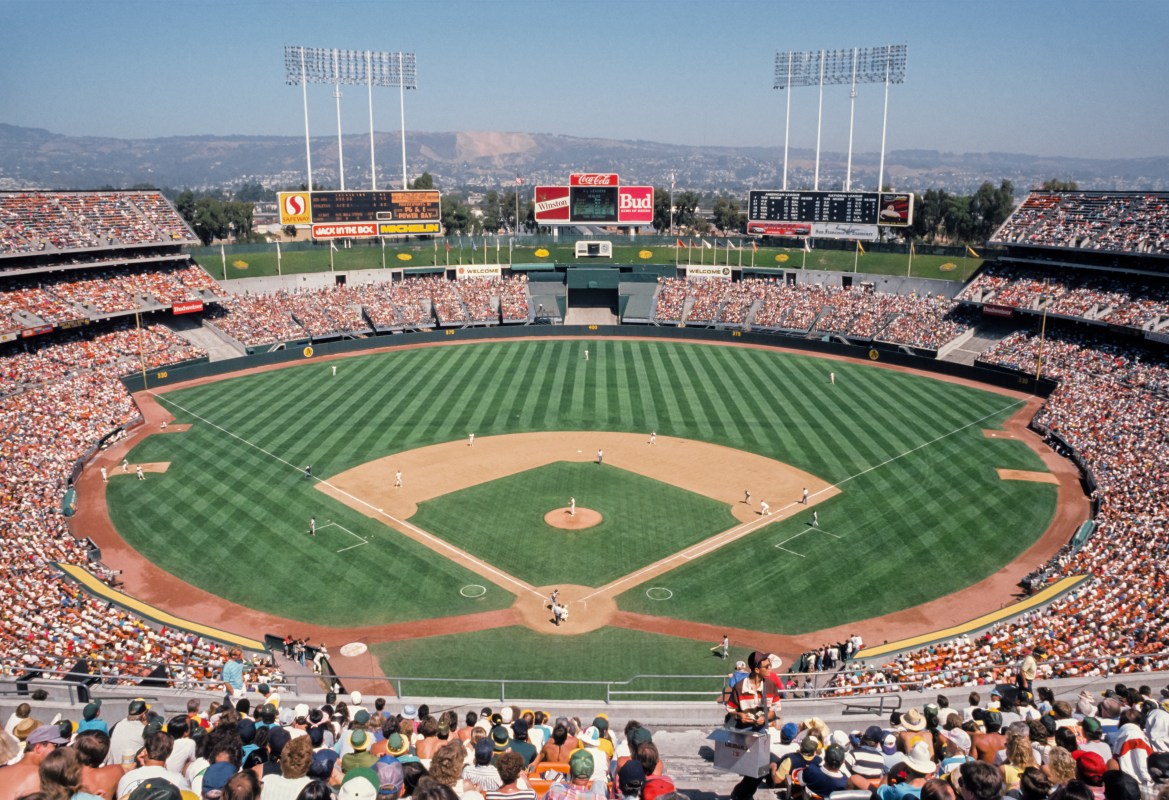
September 18, 1966: The Oakland-Alameda County Coliseum opens. The host Oakland Raiders finally have a home field after 6 American Football League seasons, after playing in San Francisco in the 1960 and 1961 seasons, and at the 22,000-seat Frank Youell Field from 1962 to 1965. But they are beaten by the Kansas City Chiefs, 32-10.

The Raiders would win the AFL Championship Game at the Coliseum on December 31, 1967, beating the Houston Oilers, 40-7. Despite the Coliseum having a reputation for being cold, it was considerably warmer than it was that day for the NFL Championship Game, in Green Bay, Wisconsin, the game that became known as the Ice Bowl.

The Raiders also hosted the AFC Championship Game for the seasons of 1974, losing to the Pittsburgh Steelers; 1976, beating the Steelers; and, after moving to Los Angeles in 1982 and then moving back to Oakland in 1995, hosting again for 2000, losing to the Baltimore Ravens; and 2002, beating the Tennessee Titans. They won the AFC Championship in the seasons of 1976, 1980 and 2002, winning Super Bowls XI and XV, and losing Super Bowls II and XXXVII.

The Kansas City Athletics moved to Oakland on October 22, 1967, and made their home debut on April 17, 1968. Governor Ronald Reagan of California, a former broadcaster for the Chicago Cubs, threw out the ceremonial first ball. It was 2 days after April 15, and Reagan made a short speech, saying, "One thing I'm sure of is that you've all paid your taxes." He got booed. He was never particularly popular in the East Bay. The A's lost that opener, 4-1 to the Baltimore Orioles, whose 1st baseman, John "Boog" Powell, hit the stadium's 1st home run.

The A's reached the Playoffs while playing at the Coliseum in 5 straight seasons, 1971 to 1975, winning 3 straight World Series, 1972, 1973 and 1974. But A's owner Charlie Finley was never happy in Oakland, and he kept trying to move the team, nearly getting a deal to go to Denver for 1978. Attendance was never good, and it dropped so law, the stadium became known as the Mausoleum. New ownership in 1980 kept the team in Oakland, building a new run of 3 straight Pennant winners in 1988, 1989 and 1990, but only winning the World Series in 1989.
Al Davis moving the Raiders back to Oakland for 1995 led to the building of a new east stand, which became known as "Mount Davis." It blocked the nice view of the Oakland hills, and made the Coliseum feel like just another round, soulless multipurpose facility.
The A's had Hall-of-Famers like Reggie Jackson, Jim "Catfish" Hunter, Rollie Fingers, Rickey Henderson and Dennis Eckersley -- but also Mark McGwire, José Canseco and Jason Giambi, players whose achievements were tainted by steroid use.

The Raiders had Hall-of-Famers like Jim Otto, Fred Biletnikoff, George Blanda, Willie Brown, Gene Upshaw, Art Shell, Ken Stabler, Cliff Branch, Ray Guy, Dave Casper, Ted Hendricks, Tim Brown and Charles Woodson. (This doesn't count Hall-of-Famers who played with them entirely or mainly in Los Angeles: Howie Long, Marcus Allen and Mike Haynes.)

Besides the A's and the Raiders, the Coliseum was home to the Oakland Clippers of the National Professional Soccer League in 1967, moving to the North American Soccer League in 1968, and then folding; the Oakland Stompers of the NASL in 1978; the Oakland Invaders of the United States Football League from 1983 to 1985; and for occasional games for Major League Soccer's San Jose Earthquakes in the 2008 and 2009 season.

In 2017, the playing surface was renamed Rickey Henderson Field, for the speedster who grew up in Oakland. This made the Coliseum the only MLB stadium with a playing field named for someone.

Speaking of names, the naming rights to the building were sold many times: It was the Network Associates Coliseum from 1998 to 2004, then the McAfee Coliseum until 2008, operated under its original name again until 2011, was briefly the Overstock.com Coliseum, then Overstock rebranded and that included making the stadium the O.com Coliseum until 2016, back to its original name until 2019, then the RingCentral Coliseum, which it remains as of September 18, 2022.

The A's made the Playoffs many more times, but the upkeep on the Coliseum was not maintained in the 21st Century, and it was ripped as one of the worst stadiums in MLB. The move of the Raiders to Las Vegas in 2020 made the Coliseum the last stadium to be home to both a Major League Baseball team and a professional football team.

The A's have been trying to get a new ballpark built, in or near Oakland. They tried San Jose, but the San Francisco Giants exercised their territorial option, and refused to let them build there.

UPDATE: The building reverted to the Oakland-Alameda County Coliseum name in 2023. A's ownership stopped trying to look for a nearby ballpark in 2024, and announced a move to Las Vegas. Because their stadium won't be ready until at least the 2028 season, they will play at least the 2025, 2026 and 2027 seasons at Sutter Health Park in West Sacramento, California.

In 2025, the Coliseum began to be used by the Oakland Roots of the United Soccer League Championship (USLC), the 2nd tier of American professional men's soccer; the Oakland Soul of the USL W League (USLW), the women's equivalent of the preceding; and the San Francisco Unicorns of Major League Cricket (MLC). Prior to writing this entry in December 2025, I did not know that the USLW and MLC even existed.

*

September 18, 1966 was a Sunday. Tom Chorske, who played on the New Jersey Devils' 1995 Stanley Cup winners, was born.

There were 3 other games were played in the AFL:

* The New York Jets beat the Houston Oilers, 52-13 at Shea Stadium.

* The Buffalo Bills beat the Miami Dolphins, 58-24 at War Memorial Stadium in Buffalo.

* The Boston Patriots beat the Denver Broncos, 24-10 at Bears Stadium in Denver. The stadium was renamed Mile High Stadium in 1968.

* And the San Diego Chargers had a bye.

In the NFL:

* The New York Giants lost to the Dallas Cowboys, 52-7 at the Cotton Bowl in Dallas.

* The Philadelphia Eagles beat the Atlanta Falcons, 23-10 at Franklin Field in Philadelphia.

* The Pittsburgh Steelers beat the Detroit Lions, 17-3 at Pitt Stadium in Pittsburgh.

* The Green Bay Packers beat the Cleveland Browns, 21-20 at Cleveland Municipal Stadium.

* The Baltimore Colts beat the Minnesota Vikings, 38-23 at Metropolitan Stadium in the Minneapolis suburb of Bloomington, Minnesota.

* The football version of the St. Louis Cardinals beat the Washington Redskins, 23-7 at Busch Memorial Stadium in St. Louis.

* And the Los Angeles Rams beat the Chicago Bears, 31-17 at the Los Angeles Memorial Coliseum.

And these baseball games were played:

* The New York Yankees lost to the Minnesota Twins, 5-3 at Yankee Stadium. Bob Allison hit a 3-run home run in the top of the 10th inning. Billy Bryan hit a solo homer in the bottom of the 10th, but it wasn't enough. Harmon Killebrew went 2-for-5. Mickey Mantle went 1-for-2 with an RBI before leaving the game to relieve his bad legs. Roger Maris singled as a pinch-hitter.

* The New York Mets were swept in a doubleheader by the Houston Astros, 9-2 and 6-5 at the Astrodome in Houston. In the opener, Bob Bruce went the distance for the win, advancing to 3-13 on the season. That's what pitching against the pre-1969 Mets could do for a guy. The losing pitcher, in only his 2nd major league game, didn't get out of the 2nd inning. His name was Nolan Ryan.

In the nightcap, Dave Giusti outpitched Frank "Tug" McGraw. In 1969, the Mets converted McGraw into a reliever, and that's one of the reasons the franchise turned around that year.

* The California Angels beat the Boston Red Sox, 5-3 at Fenway Park in Boston. Carl Yastrzemski went 0-for-2 with 2 walks. Tony Conigliaro went 0-for-4.

* The Chicago White Sox beat the Baltimore Orioles, 4-3 at Memorial Stadium in Baltimore. Brooks Robinson went 0-for-3 with a walk. Frank Robinson went 1-for-3 with an RBI. Former White Sox star Luis Aparicio went 1-for-3 with 2 walks for the O's.

* The Washington Senators beat the Kansas City Athletics, 1-0 at District of Columbia Stadium (later Robert F. Kennedy Stadium) in Washington. Phil Ortega pitched a 2-hit shutout, outpitching John "Blue Moon" Odom. The game ended when Fred Valentine tripled Ken Harrelson home in the bottom of the 9th.

* The Atlanta Braves beat the Cincinnati Reds, 9-4 at Atlanta Stadium (later Atlanta-Fulton County Stadium). Hank Aaron went 1-for-5 with 2 RBIs. Eddie Mathews went 3-for-4 with an RBI. Joe Torre went 3-for-5 with a solo home run. Pete Rose went 2-for-4.

* The Cleveland Indians beat the Detroit Tigers, 6-5 at Tiger Stadium in Detroit. Max Alvis singled Vic Davalillo home in the top of the 10th inning. Al Kaline went 1-for-4 with a walk.

* The Chicago Cubs beat their arch-rivals, the St. Louis Cardinals, 3-2 at Wrigley Field in Chicago. Ernie Banks hit a home run. Lou Brock went 1-for-4. Bob Gibson appeared not as a pitcher, but as a pinch-runner.

* The Philadelphia Phillies beat the Los Angeles Dodgers, 4-0 at Dodger Stadium in Los Angeles. Larry Jackson pitched a 7-hit shutout, outpitching Claude Osteen.

* And the Pittsburgh Pirates beat the San Francisco Giants, 3-1 at Candlestick Park in San Francisco. Roberto Clemente went 0-for-3 with a walk. Willie Stargell went 2-for-4 with an RBI. Woodie Fryman outpitched Gaylord Perry. Willie Mays went 0-for-2 before leaving the game. Willie McCovey went 0-for-4.

Saturday, September 17, 2022

September 17, 1972: "M*A*S*H" Premieres

Clockwise from top: William Christopher, Jamie Farr,
David Ogden Stiers, Loretta Swit, Alan Alda,
Harry Morgan and Mike Farrell.

September 17, 1972: M*A*S*H premieres on CBS, based on a 1970 film, which was based on a 1968 novel by Dr. Richard Hornberger, who really was a surgeon from Maine who served at a Mobile Army Surgical Hospital in the Korean War, and wrote the book under the name Richard Hooker. However, in real life, he was very little like Captain Benjamin Franklin "Hawkeye" Pierce, the brilliant but womanizing, hard-drinking and practical-joking Chief Surgeon from the (fictional) little coastal town of Crabapple Cove, portrayed on the show by Alan Alda.

Only one actor from the movie was kept in the same role on the show: Gary Burghoff as the company clerk, Corporal Walter "Radar" O'Reilly, the naive but generous teenager from a farm outside Ottumwa, Iowa, who got his nickname from being able to predict things, such as known that helicopters -- "choppers," they were always called on the show -- were coming in with wounded soldiers.

The other surgeons: Lieutenant Colonel Henry Blake (McLean Stevenson), the commanding officer, from Bloomington, Illinois, a good doctor and a decent guy, but every bit as much a womanizer (despite being married) and a boozer as Hawkeye, and totally unsuited to running a military unit; Captain John "Trapper" McIntire (Wayne Rogers), from Boston, also a womanizer (and married) and a hard drinker, but nearly as good a surgeon as Hawkeye; and Major Frank Burns (Larry Linville), a paranoid right-winger from Fort Wayne, Indiana who was a lousy surgeon, talked the Christian talk but broke as many commandments as he could.

Including cheating on his wife with the camp's blonde bombshell Head Nurse, Major Margaret Houlihan, known as "Hot Lips." She was a career officer and the daughter of a career officer, so she had no real hometown. And she was a dictator with her nurses. But she was also a great nurse herself, and never asked them to work any harder than she did, which was hard.

In the film, where she was played by Sally Kellerman, Frank (played there by the great Robert Duvall) gave her the nickname when he mentioned her lips to her, unaware that their tryst was being caught on a microphone that Hawkeye and Trapper had hidden. But on the show, where she was played by Loretta Swit, a visiting General mentioned the nickname in the pilot, and Hawkeye and Trapper acted as though they'd never heard it before.

One of the show's original surgeons was quickly dropped: Captain Oliver Jones, a black neurosurgeon played by 2 football players: Fred "the Hammer" Williamson in the movie, and Timothy Brown (usually listed as "Timmy" while he played) on TV. Unfortunately, the character had the racist nickname "Spearchucker."

The urban legend that the character was dropped because the Army had no black surgeons during the Korean War turned out to be incorrect: The writers simply realized that they wouldn't have enough stories for a neurosurgeon: While he could assist the other surgeons, Jones had trouble taking the lead on an operation, admitting, "Anything outside the skull, I'm dead."

Also dropped after the 1st season was Captain John Black, an anesthesiologist on loan from the Australian Army, nicknamed "Ugly John." He was played by John Orchard, who later returned for 1 episode as an Australian Military Policeman.

Initially minor characters, but eventually part of the main cast, were Lieutenant Francis Mulcahy (George Morgan in the pilot, William Christopher thereafter), a priest from Philadelphia who serves as the camp's chaplain, a CYO boxing coach but a kindhearted soul who never calls the men out on their adultery; and Corporal Max Klinger (Jamie Farr), a street kid from Toledo, Ohio, was given a choice of jail or the Army, chose the Army, and then ran whatever scam he could to get out, from dressing in women's clothes to faking deaths in the family to things crazy enough to get a psychiatric discharge, a "Section 8."

When the show began, the Vietnam War was still going on. But, set in the Korean War, 20 years earlier, it became an allegory for Vietnam, a satire on how the U.S. Army did not live up to his self-proclaimed efficiency, had ridiculous regulations, and provided the soldiers with horrible food.

Take all of that, throw in all the wounded soldiers, whom the surgeons somehow (even with Frank's bungling) managed to save 98 percent of, and the occasional enemy shelling (they were only 3 miles from the front, and occasionally had to "bug out" and activate the "Mobile" part of their name because the front had come to them), and Hawkeye's inability to stay serious, shown as a defense mechanism, becomes easy to understand: "Making a joke is the only way I can open my mouth without screaming."

The Season 5 episode "The General Practitioner" had this exchange, after Frank misquoted Civil War General William Tecumseh Sherman:

Frank: Well, everybody knows thar war is Hell.
B.J.: Remember: You heard it here last.
Hawkeye: War isn’t Hell. War is war, and Hell is Hell. And of the two, war is a lot worse.
Father Mulcahy, certainly qualified to ask: How do you figure that, Hawkeye?
Hawkeye: Easy, Father. Tell me: Who goes to Hell?
Father Mulcahy: Um, sinners, I believe.
Hawkeye: Exactly. There are no innocent bystanders in Hell. But war is chock full of them: Little kids, cripples, old ladies. In fact, except for a few of the brass, almost everybody involved is an innocent bystander.

In a Season 2 episode, Hawkeye mentioned in a letter to his father, also a surgeon that he was making $413.50 a month. In 2022 money, that works out to about $4,738.61, or about $57,000 a year.

After 3 seasons, Stevenson had had enough, and left. So a script was written where Henry had gotten all his retention points, and he was discharged. But his plane to go home was shot down by a North Korean jet, and he was killed. That Season 3 finale, "Abysinnia, Henry" (a play on "I'll be seeing you" that Henry had used before), on March 18, 1975, was the 1st time a TV show had actually said that a main character had died when his portrayer hadn't. Previously, when an actor died, either the character was played by someone else, or written out and not mentioned again. The same thing was done when an actor simply left the show.

Rogers also left the show, but at least Trapper got to go home alive. He was replaced by Captain B.J. Hunnicutt (Mike Farrell), a native of Mill Valley in the San Francisco Bay Area, married with a baby girl that he had barely seen when he went over to Korea.

And Blake was replaced by Colonel Sherman T. Potter (Harry Morgan), an older man from Hannibal, Missouri, who was "regular Army" (most of them were Army Reserve), and had served in both World Wars (his service in the cavalry in World War I was mentioned many times), but was far better suited to commanding a military hospital.

Frank and Margaret often bullied Henry and went over his head. Potter showed them that they would no longer get away with this. He soon figured out how much rope to give Hawkeye, B.J., and Klinger, too, before pulling them back.

Like many actors who played despicable characters, Linville was actually a good guy, beloved by his castmates. But in 1977, after Season 5, Linville got tired of playing "Ferret Face" Frank. who he called "a cartoon." He was the one character who never really grew. Margaret had, softening a bit, even getting married to another Army officer. The last time viewers saw Frank, he was looking up at the helicopter taking Margaret and her husband to their honeymoon, and softly saying, "Goodbye, Margaret." He had married his wife Louise for her family's money; he truly loved Margaret. (Her marriage was a disaster, and they got divorced within a few months, within the show's continuity.)

Through convoluted circumstances, Frank was transferred Stateside in the Season 6 premiere, and his replacement was Major Charles Emerson Winchester III (David Ogden Stiers), a Boston Brahmin who was every bit as conservative as Frank, but was a lot smarter (he was a Harvard graduate), he was considerably more refined (he frequently listened to classic music on his record player, and drank cognac instead of the "bathtub gin" from the distillery in the surgeons' tent, "The Swamp"), and was on Hawkeye's and B.J.'s level as a surgeon, so there was some reason for him to be pompous and egotistical. And he was both.

Early in Season 8, Burghoff left, and Radar was sent home on a hardship discharge: His father had died when he was really young, so his mother and his Uncle Ed were running the family farm. Now, Uncle Ed was dead, and Radar was sent home so his mother have to run the farm all alone.

That meant that Klinger was now the company clerk, and his added responsibility gave a little weight to the character. The crazy outfits and the schemes soon dwindled away, and while he was under-educated, he used some serious street-smarts to get the camp things it needed. As the man with the big nose and the bigger heart said, "I may be pathetic and inept, but I ain't dumb!" In the Season 10 episode "Promotion Commotion," he was promoted to Sergeant. Mulcahy had been promoted to Captain, in the Season 8 episode "Captains Outrageous."

Given the length of the show, some other turnover was to be expected. In Season 8, Staff Sergeant Zelmo Zale (Johnny Haymer), the dimwitted Brooklyn-born supply sergeant with whom Klinger frequently argued and sometimes physically fought, was phased out, and phased in was Staff Sergeant Luther Rizzo (G.W. Bailey), a shifty native of the Louisiana bayou who ran the motor pool. And yet, Private Igor Straminsky (Jeff Maxwell), who served the lousy chow, somehow got through the entire series without being dropped.

M*A*S*H tried to be realistic, getting historians, including medical historians, to help them get things right. But they got some things wrong. Certainly, at a real army base, the doctors would not have gotten away with so much tomfoolery (to use one of Potter's words). And if they drank that much, they wouldn't be fit to operate -- as Hawkeye pointed out when Alan's father, Broadway legend Robert Alda, played a visiting surgeon in the Season 3 episode "The Consultant."

For another thing, the continuity was all messed up. We were told in the Season 4 premiere, "Welcome to Korea," that Potter took command on September 19, 1952, that B.J. had arrived one week earlier, and that Frank and Radar were still there. But in Season 9, we're told that, by December 31, 1950, B.J., Potter and Charles were already there, and that Frank, Radar, Trapper and Henry Blake were all gone.

You could count that 1980 episode, "A War for All Seasons," covering all of 1951, as an outlier and non-canon. But in the series finale, "Goodbye, Farewell and Amen," Margaret says she's known Charles for 2 years -- so even if she's rounding up, we're talking the Summer of 1951, meaning there's no way B.J., Henry or Frank should still have been there by then.

Throw in the fact that Hawkeye went from living in Vermont, having a sister, and having his mother still being alive to living in Maine, being an only child, and having his mother die when he was 10. Henry's wife was Mildred, then Lorraine. The name Mildred was brought back for Potter's wife. On multiple occasions, Potter mentioned as having a son, who had a nose as big as Klinger's. On a later episode, he said he had a daughter. Later still, he said it was one daughter and no son.

Also, if Klinger (like his portrayer, whose real name is Jameel Farah) has Lebanese ancestry, are all his Lebanese relatives on his mother's side? Because Klinger isn't an Arabic name.

Poor Nurse Kelly. Or Kelley. Or Kellye. (Played by Kellye Nakahara.) We know her rank was Lieutenant throughout. But her name was never fully mentioned, or even definitively spelled. Early on, a couple of times, she was "Nurse Charlie," and another actress was called "Nurse Kelly."

After that, Nakahara's character was always referred to as "Nurse Kelly," suggesting that Kelly (however it was supposed to be spelled) was her last name. Funny, she didn't look Irish. Certainly, she didn't interact much with the very Irish characters of Trapper and Father Mulcahy. (Then again, Hawaii Five-O -- also on CBS, both the 1968-80 classic version and the 2010-20 reboot -- had a character named Chin Ho Kelly.)

But, twice, including in the next-to-last episode, "As Time Goes By," Margaret called her "Lieutenant Nakahara," suggesting that the actress' name was also the character's name. She said a few times that she was from Hawaii. In the real-time Season 8 episode "Life Time," she said she was (ethnically) half-Chinese and half-Hawaiian. But Nakahara is a Japanese name. And in the Season 10 episode "Communication Breakdown," she spoke fluent Japanese. Despite her previously-stated ancestry, and many chances to speak to wounded Chinese soldiers, at no time is she shown speaking Chinese.

Nor is Kellye ever shown speaking Korean, the language of the country they're actually in. Ironically, the only main character who shows any facility with Korean is Radar, who has some difficulty with English!

Indeed, it would have made sense (for any organization but this fictional version of the 1950s U.S. Army) to have a translator there. That could have been a good role for Kellye, and it would have given Nakahara much more screen time, instead of what she usually did: Stand in the background, assist the surgeons, or respond to requests: "Yes, Doctor," or (to Margaret), "Yes, Major."

Despite the "New Wave of Feminism" being underway by the time the show debuted in 1972, the nurse characters, aside from Margaret, really got short shrift, an issue addressed in the final season (Fall 1982), in an episode titled "Who Knew?" when one of the nurses dies in an accident, and no one seems to have learned much about her, not even Hawkeye, with whom she was on a date right before she died.

We know there were nurses named Able, Baker and Charlie (a reference to the "military alphabet"). A black nurse named Lieutenant Ginger Bayless (Odessa Cleveland) was a constant in Season 1. A nurse named Lieutenant Peggy Bigelow was frequently mentioned and shown, usually played by Enid Kent.

But the actresses playing these specific characters tended to change. This made no freakin' sense. The only nurse who tended to get significant screen time (if only to be in the background or to interact with Margaret and the doctors) was Kellye. And she was so underused, we might as well have called her "Uhura." (While Uhura is a Swahili name, like Obama, maybe, like Obama, it could sound Japanese.)

There's a few anachronisms as well. At one point, Hawkeye, hearing a lot of letters of Army acronyms spoken, mockingly sings, "M-O-U-S-E." The Mickey Mouse Club didn't start airing until 1955, 2 years after the war ended. In another episode, he references the assassination of Albert Anastasia, king of the New York Mob, which happened in 1957. And while Indochina is referenced in an episode, in the finale, it's called "Vietnam," and I'm not sure how widespread that name was in 1953.

The biggest anachronisms are the hairstyles. This was the Army. This was the 1950s. No way would Hawkeye, B.J. and Klinger have had that much hair. And I don't think the Fifties Army would have allowed B.J. to grow a mustache. Granted, Major Sidney Freedman, the Brooklynite psychiatrist played by Allan Arbus in one episode every season, had a mustache, but, being older and higher-ranking, they might have given him some leeway.

Another problem is the ages of the characters. When the show began, Burghoff was 29 playing 19, and mainly got away with it because he was short and had a high voice; when he left, he was 36 and balding, playing 21 or so. How old was Klinger? We're led to believe he was a street kid, who might've been soon out of high school, but he sometimes called Radar "Kid." Farr was 38 at the show's start. When the show ended, he was 49, and now playing a character possibly less than half his age!

Once, Charles specifically mentioned that he was "Harvard, Class of '43." This would make him 30 or so when he arrived. Granted, being bald and overweight didn't help, but did Stiers look only 30 to you? He was 35; when the show ended, if we believe his '43 reference, he was 41 playing about 32.

And none of the characters, except Potter, are mentioned as having served in World War II, which ended 5 years before the Korean War began. Not even Margaret, who, because of her father, has lived on Army bases her entire life. Clearly, she's qualified to be a U.S. Army Major, so she's probably at least 30. Which means she was at least 25 when "The Big One" ended. That doesn't mean she was already a combat nurse, but it does mean she was no kid. Certainly, midway through the series, there was a reference to her needing to color her hair to remain blonde.

So, no mention of World War II service for the doctors. Does this mean the doctors (Henry and Potter excepted) had student deferments? This would be understandable, if it meant medical school that could make them military doctors, especially since no one knew until 1945 that the war would end anytime soon.

That makes them at least 30 when the Korean War began, but look at the gray hair that Alan Alda and Mike Farrell had at the end: Alda was 47, Farrell 44. I'm 52 as of this writing, and I don't look nearly as old as any of the doctors, except Wayne Rogers, who played Trapper and always looked good for his age.

Larry Linville was just 4 years older than Gary Burghoff. There's no way that Frank, married with kids and a receding hairline, was just 4 years older than Radar. Though Burghoff usually wore a hat to hide his even more encroaching baldness.

Potter mentioned lying about his age to get into the Army for World War I, but in a later episode, he tells Sidney he's 62, meaning he was 27 when the U.S. got into "Dubya Dubya One," and possibly already a fully-qualified doctor.

The show, about a war that lasted 3 years, ran 11 years, and some of the actors, especially Alda, seemed to have aged even more than that. To again paraphrase General Sherman, fictional war is Hell.

Finally, there's the way the Army is portrayed. A U.S. Army that incompetent wouldn't have won World War II. And there's no way Hawkeye, Trapper and B.J. would've gotten away with half the things they got away with just because they were great surgeons, no matter how many favors Henry and Potter could call in to keep them out of the stockade.

As for Frank, and the even crazier occasional guest star Colonel Flagg, played by Edward Winter, they would have been removed much sooner than they were. Maybe Hawkeye and B.J. wouldn't have been willing to ruin Margaret's career over the truth of her affair with the married Frank later on -- notably, Charles wasn't willing to lie to ruin it and get himself transferred back to his dream job at Tokyo General Hospital -- but early, when she was frequently as bitchy as she wanted to be, oh yeah, Hawkeye and Trapper would have eagerly ruined her and Frank. In the Season 2 episode "The Trial of Henry Blake," they threatened to expose Frank and Margaret if they didn't back off, big-time.

That's the only way Frank, in temporary command after Henry's discharge, could have allowed Hawkeye the 5-day R&R he had in the Season 4 premiere, forcing him to miss Trapper's goodbye. No way Frank agrees to that otherwise.

A prominent feature of the camp was the signpost, with arrows names of cities, and their distances from the camp. The signs, from top to bottom, are: Boston (Trapper and Charles), Seoul (the South Korean capital), Coney Island (could represent Sidney or Zale), San Francisco (B.J. took that arrow home in the finale), Burbank (no character on the original show was said to have come from the Los Angeles area), Death Valley (ditto, and I'm not sure why they would choose one of the few places on the planet more desolate than that section of central Korea to be on the signpost), Toledo (Klinger), and Decatur (not sure if it's the one in Illinois or the one in Georgia, at any rate no character was from either).

In the early seasons, before Klinger was promoted from secondary to primary character (and, in Season 10, from Corporal to Sergeant), there was an Indianapolis sign (no character was said to come from there, although Frank was from Fort Wayne, Indiana), but it was replaced by a Toledo sign. Also, early on, there was a second Seoul sign underneath the Decatur sign, and underneath that there was a Honolulu sign (which could be for Kellye). But why weren't there signs for all the primary characters? At least, for the nearest cities: Portland (Maine, not Oregon) for Hawkeye, Chicago for Henry, St. Louis for Potter, Des Moines (Iowa's capital) for Radar, and Philadelphia for Mulcahy.

But for all the problems with M*A*S*Hit might be the greatest show in the history of television. In its 11 seasons, it won 14 Emmy Awards, including 7 for acting: 3 for Alda, 2 for Swit, and 1 each for Morgan and Burghoff. Alda also won an Emmy for directing, and another for writing.

The 1970 film version was the 1st major studio film to use the word "fuck," or any variant thereof, in its dialogue. The word is spoken during the football game near the end of the film by Captain Walt Waldowski, the camp dentist known as "The Painless Pole," when he says to an opposing football player, "All right, Bud, your fucking head is coming right off!" The actor, John Schuck, said in an interview that Andy Sidaris, who directed the football scene for Robert Altman, encouraged Schuck to "say something that'll annoy him."

The statement made it into the film without a second thought. Previously, under the Hays Code, such a word would have been forbidden, but the Motion Picture Association of America allowed it -- with an R rating.

Likewise, the TV show may have been the 1st to use the phrase, "You son of a bitch!" It was used 3 times: Twice by Hawkeye, to a Korean Colonel, and in the finale to Sidney Freedman for making him un-repress a horrifying memory; and once to him, by a General whose son Hawkeye was unable to save.

Three times on M*A*S*H, one of the antagonistic Majors borrowed the "I'm a doctor, not a… " line of DeForest Kelley's Leonard "Bones" McCoy on Star TrekIn the Season 5 episode "End Run," Frank sees a soldier with a wounded leg, and says, "Yuck!" Hawkeye says, "Frank, have you ever heard of 'patient morale'?" Frank says, "I'm a doctor, not an entertainer!" Hawkeye says, "You could've fooled me!"

In the Season 8 episode "The Yalu Brick Road," most of the camp is stricken with salmonella, and Margaret demands that Charles help her wash sheets. Charles, a chauvinist on top of everything else, says, "Margaret, I'm a doctor, not a woman!" In the Season 9 episode "The Foresight Saga," Charles objects to letting a teenage Korean boy whose village had been bombed stay in the Swamp's spare bunk: "I'm a doctor, not a social worker!"

In the Season 6 episode "The M*A*S*H Olympics," Charles offered a variation: When Potter saw him, Hawkeye, B.J., Margaret, Klinger and Mulcahy unable, between them, to push an overturned ambulance into an upright position, but 4 MPs could, he reminded them, "You people are in sorry shape! This is a mobile hospital! If we ever have to bug out, you people won't be able to lift a tent pole!" Charles said, "I'm a surgeon! I'm not a circus roustabout!" And in the Season 10 episode "A Holy Mess," when Margaret asked him how she was supposed to soft-boil an egg if water won't boil, he said, "I'm a surgeon, not a Hindu philosopher."

The last episode, running 2 1/2 hours, aired on February 28, 1983. Over 105 million viewers watched, making it the most-watched scripted episode in the history of American television, breaking the record set a little over 2 years earlier in the episode of Dallas where they finally answered the question of who shot J.R. Ewing (Larry Hagman).

The record looks safe for all time, given the fragmentation of TV since (there were still only 3 major networks when the episode aired), and the fact that several much-hyped finales since then haven't come close: Cheers got 80 million in 1993, Seinfeld got 76 million in 1998, and, combined, The Sopranos in 2007, Breaking Bad in 2013 and Game of Thrones in 2019 got "only" 36 million.

Indeed, among all U.S.-based TV single-network broadcasts (not counting coverage of live news events), only 8 have ever gotten more viewers than the M*A*S*H finale. All of them have been Super Bowls: XLIV, XLV, XLVI, XLVII, XLVIII, XLIX (on February 1, 2015, New England Patriots over Seattle Seahawks, the record holder at 114 million), 50 and LI.

Incidentally, the most-watched Major League Baseball game ever was Game 7 of the 1986 World Series, New York Mets over Boston Red Sox, 60 million; the most-watched basketball game ever was Game 6 of the 1998 NBA Finals, Michael Jordan in his then-presumed last game, Chicago Bulls over Utah Jazz, 29 million; and the most-watched hockey game ever was the 1980 Winter Olympic Gold Medal Game, U.S. over Finland, 33 million. In other words, the 3 most-watched games in the other "Big Four" North American sports, combined, had 112 million viewers, 2 million fewer than the most-watched Super Bowl.

Over the course of the show, the following characters appeared in this many episodes: Hawkeye, 251 (the only one to appear in all of them); Margaret, 236; Klinger, 216; Mulcahy, 213; Radar, 181; Potter, 180; B.J., 179; Kellye 167, more than 4 "regulars"; Charles, 131; Frank, 121; Trapper, 72; Henry, 72; Igor, 48; Ginger, 22; Zale, 20; Rizzo, 13; Sidney, 12; Ugly John, 11; Brigadier General Crandall Clayton, the official commanding officer of all 5 MASH units in Seasons 1 and 2, played by Herb Voland, 7; Flagg, 7; Spearchucker, 6.

And the characters had their names, or at least their nicknames, used in the titles of this many episodes: Hawkeye, 9; Margaret, 6; 4 each for Henry and Radar; Charles, 2; and 1 each for B.J., Potter and Mulcahy.

Herb Voland died in 1981, Johnny Haymer in 1989, Keye Luke (a veteran Asian actor who played 3 different roles in the series) in 1991, John Orchard in 1995, McLean Stevenson in 1996, Richard Hornberger in 1997, Larry Linville in 2000, Edward Winter in 2001, producer Larry Gelbart in 2009, Harry Morgan in 2011, Allan Arbus in 2013, Wayne Rogers in 2015, and William Christopher in 2016.

David Ogden Stiers, Soon-Tek Oh (who played 5 different roles in the series), John Fujioka (who played 3 different roles) and Beeson Carroll (who played Margaret's brief husband, Lieutenant Colonel Donald Penobscott, in his debut appearance) died in 2018. Kellye Nakahara, producer Gene Reynolds, and theme song composer Johnny Mandel died in 2020. Mike Henry (who played Penobscott in the character's 2nd and last on-screen appearance) died in 2021, and producer Burt Metcalfe in 2022.

As of September 17, 2022, the 50th Anniversary of the pilot, Alan Alda, Loretta Swit, Gary Burghoff, Jamie Farr, Mike Farrell, Odessa Cleveland, Enid Kent, Jeff Maxwell, G.W. Bailey, Eileen Saki (bar owner Rosie) and Rosalind Chao (Soon-Lee, the Korean refugee that Klinger marries in the series finale) are still alive.

UPDATE: Eileen Saki died in 2023. Loretta Swit died in 2025.

It took me until 2024 to think of this, but the 1970s were Schrödinger's Decade. There was too much influence by television, and, at the same time, not enough of it. A lot of TV went too far, but there was also a lot of bad TV, and some of the good TV didn't go as far enough in doing good that it could have.

*

September 17, 1972 was a Sunday. It was also the day that ABC's police drama The Streets of San Francisco premiered, starring Karl Malden and Michael Douglas. Also debuting, interestingly enough, was an American celebrity of Korean descent: Comedian Bobby Lee, best known as a member of the cast of the sketch comedy series MADtv.

There was another debut that day: The Harry S Truman Sports Complex in Kansas City, Missouri. The new home of the NFL's Kansas City Chiefs, Arrowhead Stadium, opened. Unfortunately for the Chiefs, like their last game at Kansas City Municipal Stadium, a Playoff game the preceding Christmas Day, they lost to the Miami Dolphins, in this case 20-10. Nobody knew it yet, but the Dolphins had begun what remains, through the 2021 season, the only undefeated-and-untied Championship season in NFL history.

The following April, adjacent to Arrowhead, Royals Stadium opened. It was renamed Kauffman Stadium in 1993. Both the Chiefs and the Royals still play at the Complex.

Other NFL games played that day:

* The New York Jets beat the Buffalo Bills, 41-24 at War Memorial Stadium in Buffalo. Joe Namath completed only 5 of 14 passes, 1 for a touchdown. But the Bills couldn't stop the Jets' ground game, as John Riggins rushed for 125 yards and a touchdown, and Emerson Boozer rushed for 50 yards and 2 touchdowns.

The Jets' defense held O.J. Simpson to only 41 rushing yards. He actually had more passing yards, 46, going 2-for-2 with an option pass to J.D. Hill for a 21-yard touchdown in the 3rd quarter.

* The New York Giants lost to the Detroit Lions, 30-16 at Tiger Stadium in Detroit.

* The Cincinnati Bengals beat the New England Patriots, 31-7 at Schaefer Stadium (later Sullivan Stadium and Foxboro Stadium) in the Boston suburb of Foxborough, Massachusetts.

* The St. Louis Cardinals beat the Baltimore Colts, 10-3 at Memorial Stadium in Baltimore. Johnny Unitas, starting what turned out to be his last season for the Colts, went 22-for-36 for 257 yards, but had no touchdown passes and 2 interceptions.

* The Pittsburgh Steelers beat the Oakland Raiders, 34-28 at Three Rivers Stadium in Pittsburgh.

* The Green Bay Packers beat the Cleveland Browns, 26-10 at Cleveland Municipal Stadium.

* The Atlanta Falcons beat the Chicago Bears, 37-21 at Soldier Field in Chicago.

* The Dallas Cowboys beat the Philadelphia Eagles, 28-6 at Texas Stadium in the Dallas suburb of Irving, Texas.

* The Denver Broncos beat the Houston Oilers, 30-17 at Mile High Stadium in Denver.

* The Los Angeles Rams beat the New Orleans Saints, 34-14 at the Los Angeles Memorial Coliseum.

* The San Francisco 49ers beat the San Diego Chargers, 34-3 at Candlestick Park in San Francisco.

* The next night, on ABC Monday Night Football, the Washington Redskins beat the Minnesota Vikings, 24-21 at Metropolitan Stadium in the Minneapolis suburb of Bloomington, Minnesota.

And these games were played in Major League Baseball:

* The New York Yankees beat the Baltimore Orioles, 2-1 at Yankee Stadium. Fritz Peterson outpitched Dave McNally. Felipe Alou hit a home run for the Pinstripes. Brooks Robinson went O's-for-4.

* The New York Mets lost to the Chicago Cubs, 6-4 at Wrigley Field in Chicago. Willie Mays was available for the Mets in this game, but did not play. For unlisted reasons, Met starter Jim McAndrew left after only 2 innings, having allowed 2 runs. He made his last 3 starts of the season, although he didn't pitch well in any of them, so it might not have been due to injury. Maybe it was just a precaution.

* The Cleveland Indians beat the Boston Red Sox, 9-2 at Fenway Park in Boston. Buddy Bell hit a home run in support of Gaylord Perry. Carl Yastrzemski went 0-for-4.

* The Philadelphia Phillies beat the Montreal Expos, 3-2 at Veterans Stadium in Philadelphia. Mike Schmidt, who'd made his major league debut 6 days earlier, went 1-for-3. (In that debut, he got a hit off McAndrew. The day before this, he hit the 1st of his 548 career home runs, off Balor Moore.)

* The Atlanta Braves beat the San Francisco Giants, 7-4 at Atlanta Stadium (later Atlanta-Fulton County Stadium). Hank Aaron hit the 670th home run of his career.

* The San Diego Padres beat the Cincinnati Reds, 10-7 at Riverfront Stadium in Cincinnati. Pete Rose went 1-for-5. Johnny Bench went 3-for-5 with 2 RBIs.

* The Detroit Tigers beat the Milwaukee Brewers, 6-2 at Milwaukee County Stadium. Al Kaline went 1-for-4.

* The Kansas City Royals beat the Minnesota Twins, 10-6 at Metropolitan Stadium. (The Vikings played there the next night, so there was time to convert it for football use.) Harmon Killebrew went 0-for-2 before leaving the game due to an injury. Rod Carew only appeared as a pinch-hitter and, uncharacteristically, struck out. The Royals led 6-0 going into the bottom of the 8th inning, but the Angels sent it to extra innings, and then the Royals scored 4 runs in the top of the 10th inning to win it.

* The St. Louis Cardinals beat the Pittsburgh Pirates, 5-4 at Busch Memorial Stadium in St. Louis. Lou Brock went 2-for-3 with a walk. Joe Torre had an unusual day: He came to the plate 4 times, but was only charged with 1 at-bat: He had a sacrifice fly for an RBI, was hit with a pitch, and drew a walk, none of which is an official at-bat according to the rules, before flying out. For the Pirates, Roberto Clemente went 3-for-5. Willie Stargell went 1-for-5.

* The Houston Astros beat the Los Angeles Dodgers, 15-11 at the Astrodome in Houston. Yes, that's a baseball game, not football. Lee May of the Astros and Willie Davis of the Dodgers hit home runs. May and César Cedeño each had 5 RBIs. May went 4-for-6, and Jimmy Wynn went 4-for-5 with 3 RBIs.

Frank Robinson, in his only season with the Dodgers, went 0-for-4, but did draw a walk. Bobby Valentine -- yes, that Bobby V -- went 4-for-5 with 2 RBIs. He was a decent player until injuries took their toll.

* The California Angels beat the Chicago White Sox, 3-1 at Anaheim Stadium (now Angel Stadium of Anaheim).

* And the Oakland Athletics beat the Texas Rangers, 4-1 at the Oakland Coliseum. Jim "Catfish" Hunter went the distance for his 20th win of the season, and Reggie Jackson went 2-for-2 with 2 walks.

Also on this day, as a warmup for the Moscow half of the "Summit Series," Team Canada played the 2nd of back-to-back exhibition games against Sweden. After winning the night before, 4-1, they played to a 4-4 draw. Both games were played at Johanneshovs Isstadion, a.k.a. "Hovet," in the national capital of Stockholm.

December 31, 1999 & January 1, 2000: The Millennium

December 31, 1999:  The Millennium arrives. The people of planet Earth survived. At a terrible cost. But we hadn't destroyed ourselves. ...