Showing posts with label antarctica. Show all posts

Tuesday, December 13, 2022

December 14, 1911: Roald Amundsen Reaches the South Pole

December 14, 1911: Roald Amundsen becomes the 1st person to reach the South Pole. 

It made sense for a Norwegian to attempt to become the 1st person to reach the North Pole, 90 degrees North latitude: The only countries whose mainlands have points further north than Norway's northernmost point are Canada and Russia. This does not count Denmark, which owns Greenland, which has a more northerly point of land than any country: Kaffeklubben Island, at 83.63 degrees North.

It made sense for Amundsen to be the Norwegian to attempt it. In 1906, aboard the sloop Gjøa, he became the leader of the first expedition to sail the long-sought Northwest Passage. He did make an attempt to reach the North Pole, but in 1909, American expeditioner Robert Peary claimed to have gotten there first. Maybe Peary should have kept trying: It is now believed that he did not, in fact, beat Amundsen and everyone else to it.

It did not make much sense for a Norwegian to be the first person to attempt to reach the South Pole, 90 degrees South latitude. The country with the southernmost land is Chile, Hornos Island, at 55.97 degrees South latitude; followed by Argentina and Australia. (Villa Las Estrellas, on King George Island, is the northernmost point on Antarctica, at 62.11 degrees South.) Since Australia was part of the British Empire, a Royal Navy officer, Captain Robert F. Scott, made the first serious attempt at it.

But since Amundsen did have experience in a polar expedition, he thought he could reach the South Pole first. On June 3, 1910, he sailed his ship Fram out of his national capital of Oslo. Upon reaching the Portuguese colony of Madeira, he sportingly sent Scott a telegram stating his intentions. On January 14, 1911, he reached the continent of Antarctica, on the Ross Ice Shelf, and established base camp there.

An attempt set out on September 8, but had to turn back. A 2nd attempt was made on October 19, with 4 sleds, each pulled by 13 dogs. On December 8, they reached 88 degrees, 23 minutes south, the furthest point anyone had yet reached, in 1909 by Ernest Shackleton. They were 97 miles away. They went on.

On December 14, 1911, Amundsen stopped, took some measurements, and told his crew, "Gentlemen, I am certain we are at the South Pole." He asked crewmates to take their own measurements, and a central point within them was decided as the Pole. They pitched a tent, topped with a Norwegian flag. Amundsen wrote a message for Scott, in case he made it, and left it inside the tent.
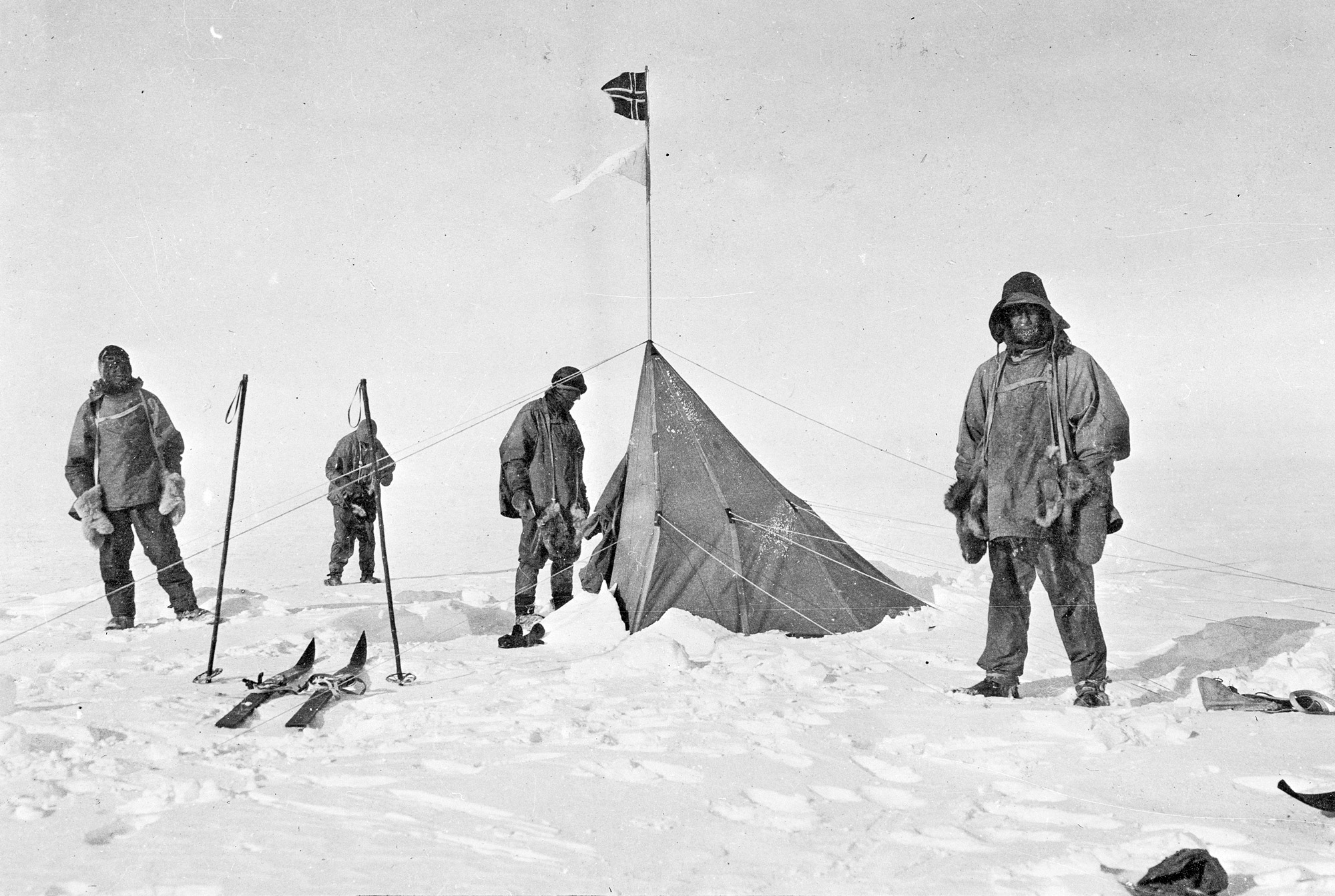
On March 7, 1912, the Fram reached Hobart, Tasmania, Australia. Amundsen made his claim, and learned that no word had yet been reached from Scott. Scott had reached the Pole on January 17, but found Amundsen's tent and note. Scott never made it back alive: Snowstorms prevented him from getting back to his base camp. A search party found him on November 12, with a last entry in his diary dated March 29. He was 43 years old.
Robert F. Scott

Scott was hailed as a hero in death. Amundsen lived on, and on May 12, 1926, led a team on the airship Norge to become the 1st people to fly over the North Pole. On June 18, 1928, he led a team searching the Arctic for the lost airship Italia. His plane, a Latham 47 "flying boat," also disappeared, and has never been found. He was 56.

*

December 14, 1911 was a Thursday. American novelty musician Lindley "Spike" Jones was born on this day. Baseball was out of season. Football season was over. There was no NBA yet. And the professional hockey season was about to start. So there were no scores on this historic day.

Monday, January 10, 2022

January 10, 1917: The Shackleton Expedition Gets Home

January 10, 1917: The Shackleton Expedition returns to port, without having lost a man. This was a miracle.

Ernest Henry Shackleton was born on February 15, 1874 in Kikea, County Kildare, Ireland. He moved with his family to Sydenham in South London at age 10. He served under Captain Robert Falcon Scott on the 1901-04 Discovery expedition, giving him his 1st polar experience. They set a new record of reaching 82 degrees South latitude. On the 1907-09 Nimrod expedition, they reached 88 degrees South, just 97 miles from the South Pole. When they got back, Shackleton was knighted by King Edward VII. He was only 35 years old.

Roald Amundsen of Norway reached the Pole in 1911, a few months ahead of Scott, who didn't make it off Antarctica alive. Shackleton turned his attention to the crossing of Antarctica from sea to sea, via the pole. To this end, he made preparations for what became the Imperial Trans-Antarctic Expedition.

Shackleton left Plymouth, Devon England on August 8, 1914 -- just after the start of World War I. They reached Buenos Aires, Argentina, and left there on October 26. On November 5, they got to South Georgia Island, leaving on the Endurance on December 5. They struggled through ice, and set up camp on Luitpold Land on February 22, 1915. They waited for a chance to set sail again, and it never came: On October 27, 1915, Shackleton gave the 27 men with him the order: Abandon ship. They had to make their way across land.

On April 15, 1916, the James Caird, the Stancomb Wills and the Dudley Docker landed on Elephant Island, to check on the Expedition's progress. On April 24, Shackleton returned on the James Caird, to go back to South Georgia Island and get supplies. Twice, Shackleton sailed back on the Southern Sky, to rescue his men, only to be forced back by the ice.

Finally, on August 30, aboard the Yelcho, he got back to Elephant Island, and saved his 22 men, getting them to Punta Arenas, Chile. On January 10, 1917, they got to New Zealand, safe and sound in the British Empire.

They were unaware of the progress of "The Great War." As big a hero as he had been considered to be, when Shackleton, following a short American lecture tour, finally arrived in England on May 29, 1917 -- the day that future President John F. Kennedy was born -- his return was barely noted in the press. All of his adventuring took a toll on his health, and he died of a heart attack on January 5, 1922, only 47 years old.

In his 1956 address to the British Science Association, Sir Raymond Priestley, one of his contemporaries, said, "Scott for scientific method, Amundsen for speed and efficiency. But when disaster strikes, and all hope is gone, get down on your knees and pray for Shackleton."

*

January 10, 1917 was a Wednesday. This was also the day that the "Silent Sentinels," a group advocating for American women's right to vote, began picketing the White House. I have a separate entry for that event.

Baseball and football were out of season. Professional basketball barely existed. This was the last season of the National Hockey Association. One of its teams was a military team, the Toronto 228th Battalion, taking the place of the disbanded Toronto Shamrocks, and with a roster of professional players. On this day, the Montreal Canadiens beat them, 6-1 at the Montreal Arena (a.k.a. the Westmount Arena). The 228th were coached and captained by Howard McNamara, who had played for both the Canadiens and the Shamrocks.

Also on this day, the Quebec Bulldogs beat the Ottawa Senators, 5-4 at the Quebec Arena. And the Toronto Blueshirts beat the Montreal Wanderers, 9-4 at the Mutual Street Arena in Toronto.

December 31, 1999 & January 1, 2000: The Millennium

December 31, 1999:  The Millennium arrives. The people of planet Earth survived. At a terrible cost. But we hadn't destroyed ourselves. ...