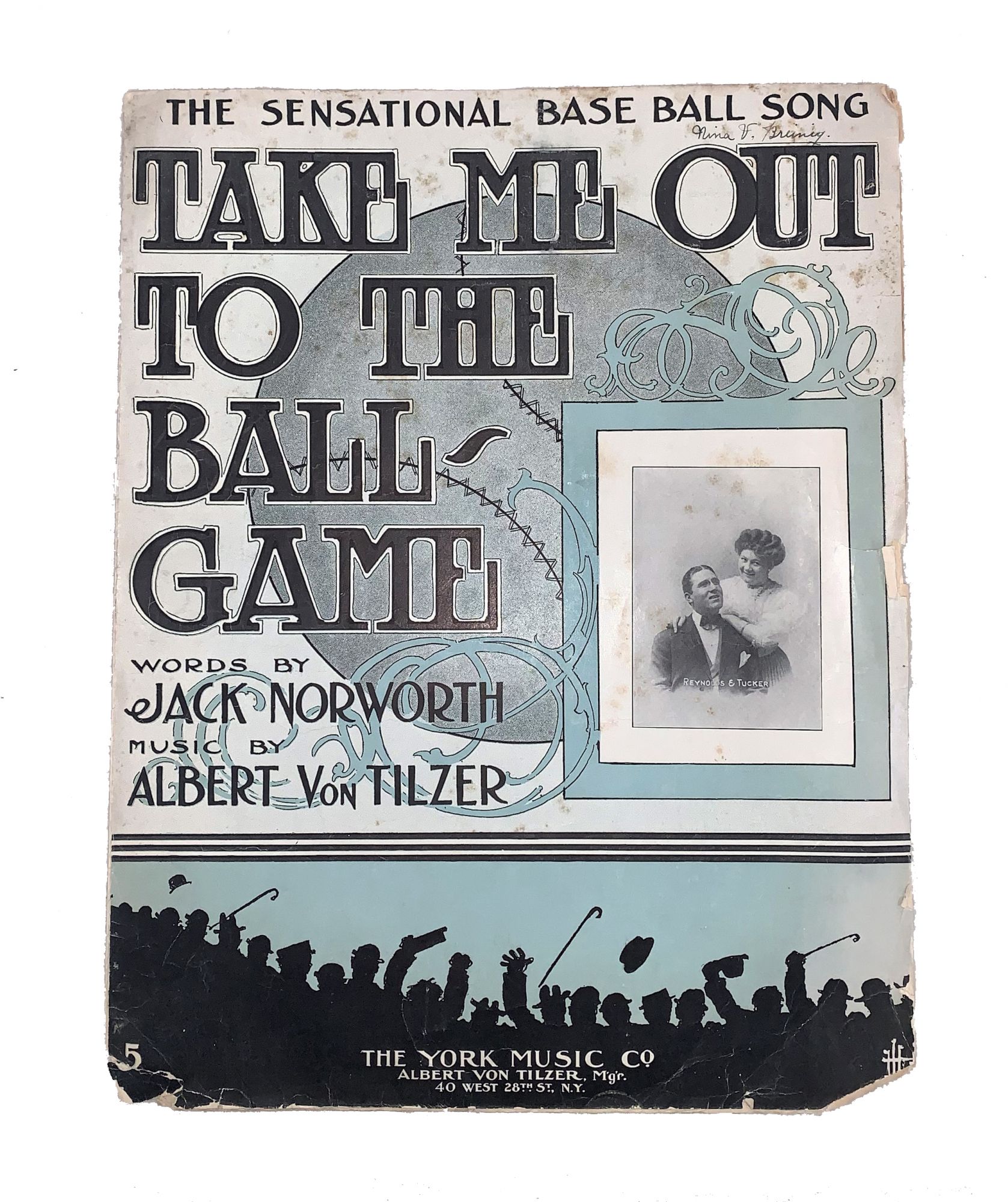
October 24, 1908: Baseball's anthem, "Take Me Out to the Ballgame," is introduced by singer Bill Murray -- no relation to the later actor who got his start on Saturday Night Live. At the time the song was written by composer Albert Von Tilzer and lyricist Jack Norworth (words), neither had ever seen a game. But Norworth had seen an advertising sign on the new (opened 1904) New York Subway:
BASE BALL
TO-DAY
POLO GROUNDS
Katie Casey was baseball mad.
Had the fever and had it bad.
Just to root for her hometown crew
every sou, Katie blew.
On a Saturday, her young beau
called to see if she'd like to go
to see a show
but Miss Kate said no,
I'll tell you what you can do:
Take me out to the ballgame.
Take me out with the crowd.
Buy me some peanuts and Cracker Jack.
I don't care if I never get back.
Let me root, root, root for the home team.
If they don't win, it's a shame.
For it's one, two, three strikes, you're out
at the old ballgame.
Katie Casey saw all the games.
Knew all the players by their first names.
Told the umpire he was wrong,
all along, good and strong.
When the score was just two to two,
Katie Casey, she had the clue.
Just to cheer up the boys she knew,
She made the gang sing this song.
Take me out to the ballgame.
Take me out with the crowd.
Buy me some peanuts and Cracker Jack.
I don't care if I never get back.
Let me root, root, root for the home team.
If they don't win, it's a shame.
For it's one, two, three strikes, you're out
at the old ballgame.
A "sou" is a penny. Sometimes that archaic lyric is changed to "Every cent, Katie spent."
Katie Casey, she had the clue.
Just to cheer up the boys she knew,
She made the gang sing this song.
Take me out to the ballgame.
Take me out with the crowd.
Buy me some peanuts and Cracker Jack.
I don't care if I never get back.
Let me root, root, root for the home team.
If they don't win, it's a shame.
For it's one, two, three strikes, you're out
at the old ballgame.
A "sou" is a penny. Sometimes that archaic lyric is changed to "Every cent, Katie spent."
Norworth probably named her after the title character in the most famous baseball poem, "Casey at the Bat," written in 1888 and thus still relatively new. In 1927, Norworth rewrote the song, and the girl subject became Nellie Kelly -- a better rhyme, and still Irish. But most people don't even know there are verses: They only sing the chorus.
Edward Meeker made the first recording, but Murray appears to have been the first to sing it live. Murray had also recorded "Tessie," which became a ballpark chant for Boston Red Sox fans in 1903. Ironically, Murray was a fan of the New York Highlanders, the team that would become the Yankees. In an even greater irony, Von Tilzer didn't see a live major league game until 1928, and Norworth didn't until 1940.
It apparently took until 1934 for the song to be played at a major league game. In 1976, Chicago White Sox owner Bill Veeck noticed that, while organist Nancy Faust was playing it during the 7th Inning Stretch, broadcaster Harry Caray was leaning out of the press box, and inviting fans to sing the song with him. So Veeck piped Harry and the fans into the public-address system at Comiskey Park, and a tradition was born.
Harry took it with him across town to Wrigley Field, and, with the Cubs' partnership with cable-TV "superstation" WGN, made the singing of that song at that stage of the game a national phenomenon. (And probably saved Wrigley for at least 2 more generations.)
Unfortunately, Harry always got the words wrong, and, to this day, the celebrities the Cubs have brought on to sing it in Harry's place since his death in 1998 -- including that other Bill Murray, a noted Cub fan -- have repeated his mistakes: They sing, "Take me out to the crowd," and, "I don't care if I ever get back."
It apparently took until 1934 for the song to be played at a major league game. In 1976, Chicago White Sox owner Bill Veeck noticed that, while organist Nancy Faust was playing it during the 7th Inning Stretch, broadcaster Harry Caray was leaning out of the press box, and inviting fans to sing the song with him. So Veeck piped Harry and the fans into the public-address system at Comiskey Park, and a tradition was born.
Harry took it with him across town to Wrigley Field, and, with the Cubs' partnership with cable-TV "superstation" WGN, made the singing of that song at that stage of the game a national phenomenon. (And probably saved Wrigley for at least 2 more generations.)
Unfortunately, Harry always got the words wrong, and, to this day, the celebrities the Cubs have brought on to sing it in Harry's place since his death in 1998 -- including that other Bill Murray, a noted Cub fan -- have repeated his mistakes: They sing, "Take me out to the crowd," and, "I don't care if I ever get back."
In 1994, I heard it played at Mercer County Waterfront Park (now Arm & Hammer Park), home of the Trenton Thunder of the Class AA Eastern League. The Thunder didn't do too well in that 1st season of professional baseball in New Jersey in the modern era, and it inspired me to sing, "I don't think this team's gonna come back, for it's root, root, root for the home team, if they don't win, it's the same."
*
October 24, 1908 was a Saturday. The only games played on this day were in college football. Some of them:
* The Carlisle Indian School, outside Harrisburg, Pennsylvania, made an early inroads into public consciousness, achieving a 6-6 tie with the University of Pennsylvania at the original Franklin Field. A freshman named Jim Thorpe scored Carlisle's touchdown, but also missed 3 field goals, any one of which could have won the game. Both teams had come into the game unbeaten: Carlisle at 5-0, Penn at 7-0.
* Another matchup of unbeatens took place at Worden Field, on the campus of the U.S. Naval Academy in Annapolis, Maryland. Navy played Harvard University, and this one also ended in a 6-6 tie.
* Yale University beat Washington and Jefferson University, 38-0 at Yale Field in New Haven, Connecticut.
* The University of Pittsburgh beat Bucknell University, 22-0 at Exposition Park in Pittsburgh, home of the Pittsburgh Pirates -- until the following June 30, when Forbes Field opened.
* Michigan beat Ohio State, 10-6 at Ohio Field in Columbus.
* Georgia Tech beat Alabama, 11-6 at Ponce de Leon Park in Atlanta, home of minor-league baseball's Atlanta Crackers.
* In New York City, Fordham and New York University were idle.
* In New Jersey, Rutgers lost to Haverford College, 9-5 in the Philadelphia suburb of Haverford, Pennsylvania. Princeton played the next day, held to a 0-0 tie by Syracuse at University Field in Princeton.
In that other kind of football, Woolwich Arsenal beat Manchester-area team Bury, 4-0 at the Manor Ground in Plumstead, Kent, now part of Southeast London.


