Showing posts with label herbert hoover. Show all posts

Saturday, December 31, 2022

December 31, 1929: Guy Lombardo Becomes "Mr. New Year's Eve"

December 31, 1929: Guy Lombardo, conducts his orchestra, the Royal Canadians, in performing Robert Burns' "Auld Lang Syne" on New Year's Eve for the 1st time, at the Roosevelt Hotel in Midtown Manhattan.

He would do so 48 times, first on radio, then from 1956 onward on television, on CBS; first at the Roosevelt, and then from 1960 onward 4 blocks away, at the Waldorf Astoria.

Born on Gaetano Alberto Lombardo on June 19, 1902 in London, Ontario, Canada, he became a violin virtuoso, and formed the Royal Canadians in 1924, with his brothers Carmen, Lebert and Victor, and other musicians from London. They billed themselves as creating "the sweetest music this side of Heaven." The Lombardos are believed to have sold over 100 million records during their lifetimes, many featuring the band's lead singer from 1940 onward, Kenny Gardner, who married the Lombardo brothers' sister, Elaine. Lilibeth Glenn, whom Guy married in 1926, also sang with the band.

The band specialized in music that would already have been considered "oldies" at the time, late 19th Century and early 20th Century popular songs. While they did eventually embrace what they called "sweet jazz," and "show tunes" of the 1930s and '40s, they never adapted rock and roll songs to their style and added them to their repertoire.

Guy died on November 5, 1977, in Houston, on the road with his band. By this point, Dick Clark had already been doing his New Year's Rockin' Eve on ABC for 6 years, and he took over the role of "Mr. New Year's Eve" – not that my grandmother, who loved the kind of music that was already old hat to both her and Lombardo, would ever hear of anyone but Lombardo having that role. Like many others in her generation, she said, "It's just not New Year's Eve without Guy Lombardo."

Carmen Lombardo had already died in 1971. Lilibeth died in 1982, Lebert in 1993, Victor in 1994, Elaine in 1999, and Kenny Gardner in 2002.

Still, when the ball drops in Times Square, it’s the Royal Canadians' version of "Auld Lang Syne" that plays – followed by Frank Sinatra's version of "Theme from New York, New York," Louis Armstrong's version of "What a Wonderful World," Ray Charles' version of "America the Beautiful," and Israel Kamakawiwoʻole's version of "Over the Rainbow."

The Roosevelt Hotel is at 45 East 45th Street, between Madison and Park Avenues. The Waldorf is at 301 Park Avenue, between 49th and 50th Streets.

*

December 31, 1929 was a Tuesday. Baseball was out of season. The NBA hadn't been founded yet. Football season was over, except for 2 games the next day, New Year's Day, January 1, 1930. The University of Southern California beat the University of Pittsburgh, in the Rose Bowl, in the stadium of the same name, in the Los Angeles suburb of Pasadena, California: USC 47, Pitt 14. And, in a game that wasn't officially called a bowl game, Washington State beat Hawaii, 28-7 at Honolulu Stadium.

One game was played in the NHL: The New York Rangers and the Ottawa Senators played to a 1-1 tie at the building that would eventually be known as "the old Madison Square Garden," though it was then just 4 years old.

Wednesday, December 28, 2022

December 28, 1929: The 1st NHL Game In New Jersey

Boardwalk Hall

When was the 1st National Hockey League game in New Jersey? It was the Devils' opener in 1982, right? Actually, it goes back a lot further than you might think.

December 28, 1929: It was at the end of the Roaring Twenties, just 2 months after the stock market's Crash of 1929. No one had yet realized that the Great Depression had begun. The Shore resort of Atlantic City had just opened a new Convention Hall, a 17,000-seat amphitheater, with the round end of the horseshoe pointing to the beach and a stage at the inland end.

The New York Rangers had begun play in the 1926-27 season. In 1927-28, they won the Stanley Cup. In 1928-29, they reached the Stanley Cup Finals, but lost to the Boston Bruins. For reasons lost to time, they decided to play a "home game" of the 1929-30 season 120 miles away, at Convention Hall.

The Rangers were loaded, with a forward line of Frank Boucher centering the brothers Bill and Frederick "Bun" Cook. Their defense was led by Ivan Johnson, known as "Ching" because, in that much less politically correct era, some people, who clearly needed glasses, thought he looked Chinese. Their goalkeeper for this game, and for every game from 1928 to 1933, was John Ross Roach, picked up following a goalkeeping emergency that nearly cost them the '28 Cup.

The Ottawa Senators had won the Cup in 1920, '21, '23 and '27, but were now in decline. They were still led by forwards Frank Nighbor, Frank Finnigan, and the brothers Hector and Wally Kilrea. Their defense still had Frank "King" Clancy and Alex Smith, with Alex Connell in goal.

Boucher opened the scoring at 14:30 of the 1st period. Clancy tied the game at 5:11 of the 2nd. At 9:00, Paul Thompson, later to help the Chicago Black Hawks win the 1934 and '38 Stanley Cups, gave the Rangers the lead. With 2:24 left in regulation, Leroy Goldsworthy (no relation to 1970s hockey star Bill Goldsworthy) gave the Broadway Blueshirts an insurance goal. The Rangers won, 3-1.
Frank Boucher

Two more games would be played at Convention Hall that season. On January 25, 1930, the Chicago Black Hawks beat the Pittsburgh Pirates, 5-2. And on March 15, the Senators returned, and beat the New York Americans, 8-7. The next season, the hockey version of the Pirates became the Philadelphia Quakers, but went out of business after that one season. They played at the Philadelphia Arena, and did not play any games in Atlantic City.

The Rangers reached the Finals again in 1932, and won the Cup in 1933, before rebuilding, and reaching the Finals in 1937 and winning the Cup in 1940. World War II wrecked the franchise, and they have only won the Cup once since, in 1994. They're still better off than the Senators, who went out of business in 1934. A new Ottawa Senators franchise began in 1992, but has only reached the Finals once, in 2007.

Despite the World Hockey Association moving the New York Golden Blades (formerly the New York Raiders) to the Cherry Hill Arena in the Philadelphia suburbs, and renaming them the Jersey Knights, in the middle of the 1973-74 season, after which they folded, there would be no more NHL games in New Jersey for 52 years, until October 5, 1982, when the New Jersey Devils made their regular-season debut, tying the Pittsburgh Penguins, 3-3.

Convention Hall, renamed Boardwalk Hall in 2001, still stands. From 1940 to 1997, and again from 2013 to 2019, it hosted the Miss America Pageant. Within days in August 1964, it hosted both the Democratic National Convention and a concert by The Beatles. It hosted the Liberty Bowl football game in 1964, despite not quite being long enough for a standard football field. It's hosted many concerts, and some big prizefights, the most famous of them being Mike Tyson's 91-second knockout of Michael Spinks in 1988.

*

December 28, 1929 was a Saturday. One other NHL game was played that day: The Boston Bruins beat the Montreal Canadiens, 3-2 at the Montreal Forum. The Bruins had won the Stanley Cup the season before, but the Canadiens would win it this season.

Baseball was out of season. Football season had just ended. The NBA hadn't been founded yet.

One other sports note from this day: The English soccer team I have come to support, Arsenal F.C., went to Yorkshire, and lost to Leeds United, 2-0 at Elland Road. They went on to win their 1st major trophy that season, anyway, the 1930 FA Cup.

Tuesday, December 27, 2022

December 27, 1932: Radio City Music Hall Opens

December 27, 1932: Radio City Music Hall opens, at 1260 Sixth Avenue (renamed "Avenue of the Americas" in 1945, but everybody still calls it "6th Avenue") and West 49th Street in Midtown Manhattan, at the northern end of "The Theater District."

It was built as part of the Rockefeller Center complex -- which, at the time, because it housed the headquarters of Radio Corporation of America (RCA) and its radio network, the National Broadcasting Company (NBC), was nicknamed "Radio City." For most of the Music Hall's history, the Radio City name has applied to it, alone. This should not be confused with "Radio Row," the series of appliance stores on the Lower West Side of Manhattan that were among the buildings demolished in the mid-1960s to make way for the original World Trade Center.

At 5,960 seats, it was the largest movie theater in the world. While it is still in operation, it rarely shows films anymore, sticking to stage shows, like the annual Radio City Christmas Spectacular. Most of its shows feature its famous high-kicking lady dancers, the Rockettes.

It has hosted the Grammy Awards, the Tony Awards, the Daytime Emmy Awards, the MTV Video Music Awards (VMAs); and, in sports, the NFL Draft and, with a temporary court put on its stage, 6 home games of the WNBA's New York Liberty, a setup done so that the 2004 Republican National Convention could be held at Madison Square Garden.

Notable rock concerts at Radio City include Pink Floyd in 1973, The Grateful Dead in 1980, Devo in 1981, A-ha in 1986, the WCBS-FM 15th Anniversary Concert headlined by Dion in 1987, Lady Gaga and Tony Bennett in 2015, Adele in 2015, Britney Spears in 2018, Christina Aguilera in 2018, and Mariah Carey in 2019.

*

December 27, 1932 was a Tuesday. Baseball and football were out of season. Professional basketball was strictly minor-league at this point. There were 4 games played in the NHL that night:

* The New York Americans lost to the Detroit Red Wings, 3-1 at what would come to be called "the old Madison Square Garden." The New York Rangers were not scheduled for the day. The Americans went out of business in 1942.

* The Boston Bruins beat the Montreal Canadiens, 1-0 at the Boston Garden.

* The Ottawa Senators beat the Montreal Maroons, 3-0 at the Ottawa Auditorium. The Senators went out of business in 1934, the Maroons in 1938.

* And the Toronto Maple Leafs beat the Chicago Black Hawks, 4-3 at the Chicago Stadium.

Sunday, December 25, 2022

December 25, 1932: The 1st Royal Christmas Message

December 25, 1932: King George V delivers a Royal Christmas Message to the British Empire, broadcast live over the British Broadcasting Corporation and its Worldwide Service, thus beginning a tradition.

John Reith, founder of the BBC, had first approached the King about the idea in 1922, but the King declined, saying that radio was mainly an entertainment. Reith waited 10 years before trying again. This time, he was smart: He gave the idea to Queen Mary first. When she told her husband it was a good idea, he relented. To be on the safe side, he also talked to the Prime Minister, James Ramsay MacDonald, who was prepared to be an additional voice to try to talk the King into it.

The tradition of the British royal family staying at Sandringham House, their country retreat in Norfolk, East Anglia, for the Christmas season had been put in place ever since it was bought in 1862, as a summer home for the King's father, then the Prince of Wales, later King Edward VII. A temporary studio was set up there, eventually replaced by a permanent one.

The address was written for the King by one of Britain's most honored (if not "greatest") authors then living, Rudyard Kipling, and is said to have been heard by 20 million people. The broadcast began at 3:00 PM London time, for the best possible distribution across the time zones: Eastern Canada, 10:00 AM; South Africa, 5:00 PM; New Dehli, 8:30 PM; Hong Kong, 11:00 PM; Sydney and Melbourne, 1:00 AM on December 26.

The speech was introduced by a local shepherd named Walton Handy. The town church rang its bells, and its choir sang Christmas carols. Finally, the King spoke, for a little over 3 minutes:

Through one of the marvels of modern science, I am enabled, this Christmas Day, to speak to all my peoples throughout the Empire.

I take it as a good omen that Wireless should have reached its present perfection at a time when the Empire has been linked in closer union. For it offers us immense possibilities to make that union closer still.

It may be that our future may lay upon us more than one stern test. Our past will have taught us how to meet it unshaken.

For the present, the work to which we are all equally bound is to arrive at a reasoned tranquility within our borders; to regain prosperity without self-seeking, and to carry with us those whom the burden of past years has disheartened or overborne.

My life's aim has been to serve as I might, towards those ends. Your loyalty, your confidence in me has been my abundant reward.

I speak now from my home and from my heart to you all.

To men and women so cut off by the snows, the desert or the sea, that only voices out of the air can reach them; to those cut off from fuller life by blindness, sickness, or infirmity; and to those who are celebrating this day with their children and grandchildren.

To all, to each, I wish a Happy Christmas. God Bless You!

George V delivered such Messages again in 1933 and 1934. In 1935, it was noticed that his voice sounded weaker. Sure enough, he died less than a month later, on January 20, 1936.

His son, King Edward VIII, abdicated the throne on December 11, 1936, so not only did he never get a Coronation, he never got to deliver a Royal Christmas Message. His brother became King George VI. He did not deliver a Royal Christmas Message in 1936. He did in 1937, but not in 1938. But in 1939, all through World War II, and into his final illness, he and delivered them every year through 1951. He died on February 6, 1952.

Since then, his daughter, Queen Elizabeth II, has delivered the Message every December 25. Her 1st Message, in 1952, was simulcast, in sound only, on BBC television. Not until 1957 would it be broadcast live on TV.

In 1953, as she and her husband, Prince Philip, Duke of Edinburgh, were on a tour of the British Commonwealth, she delivered her Message from Auckland, New Zealand. Since then, it has been pre-recorded at either Sandringham House or Buckingham Palace.

*

December 25, 1932 was a Sunday. Baseball was out of season. The NBA hadn't been founded yet. The NFL season had ended the previous Sunday, with the Chicago Bears defeating the Portsmouth Spartans (of Ohio) for the Championship.

There were 2 games played in the NHL that day. The New York Rangers beat the Montreal Maroons, 2-0 at the old Madison Square Garden. And the Detroit Red Wings beat the Chicago Black Hawks, 4-0 at the Olympia Stadium in Detroit.

"Back in Blighty," this was the era when England's Football League still regularly played games on Christmas Day. But not on Sundays, so there were no games played in that League.

Saturday, December 24, 2022

December 24, 1931: The 1st Rockefeller Center Christmas Tree

December 24, 1931: This is the 1st Christmas with a Christmas tree in Rockefeller Center in New York, even though the project is still under construction. 30 Rockefeller Plaza -- a.k.a. 30 Rock, and known as the RCA Building, then the GE Building from 1988 to 2015, and now the Comcast Building -- opened on May 1, 1933, and the Rockefeller Center Skating Rink in 1936. The tree has been placed between 30 Rock's front entrance and the Rink ever since.

The tree is usually a Norway Spruce, nearly always cut from somewhere in New York State, and tends to rise to between 70 and 100 feet. It is decorated only with lights, not "ornaments" as we now understand that term. With 30 Rock's most famous tenant being NBC, the tree-lighting ceremony, presided over by the Mayor of New York, was televised locally beginning in 1951 and nationally since 1997.

Some cities, including Philadelphia, Baltimore, Pittsburgh, Miami and Denver,  have their main trees at City Hall. Other cities:

* Atlanta: Colony Square.
* Boston: Boston Common.
* Chicago: Millennium Park.
* Cincinnati: Fountain Square.
* Cleveland: Public Square.
* Dallas: The Galleria Dallas, a shopping mall.
* Detroit: Campus Martius Park.
* Kansas City: Crown Center.
* Los Angeles: The Grove at The Farmers' Market.
* Milwaukee: Fiserv Forum, the new sports arena.
* Minneapolis: Nordic Plaza.
* New Orleans: The French Market.
* St. Louis: Kiener Plaza Park, in front of the Old Courthouse.
* San Diego: Liberty Station.
* San Francisco: Union Square.
* Seattle: Pike Place Market.
* Washington, D.C.: In front of the White House.

*

December 24, 1931 was a Thursday. Baseball was in the off-season. Football was in midweek: There was a college game on Christmas Day, but no college or pro games on this Christmas Eve. The NBA hadn't been founded yet.

There was 1 game in the NHL: The Toronto Maple Leafs beat their arch-rivals, the Montreal Canadiens, 2-1 at the Montreal Forum. Harvey "Busher" Jackson, the left wing on the Leafs' "Kid Line" with right wing Charlie Conacher and center Joe Primeau, scored the winning goal 9:55 into overtime.

Sunday, December 18, 2022

December 18, 1932: The NFL Moves Indoors

December 18, 1932: A Playoff game is held to determine the Champion of the National Football League. Snow forces the young League indoors for the 1st time.

There had been controversies for the League title in 1921 and 1925, so having a definitive title game would have helped. This time, there would be no questions.

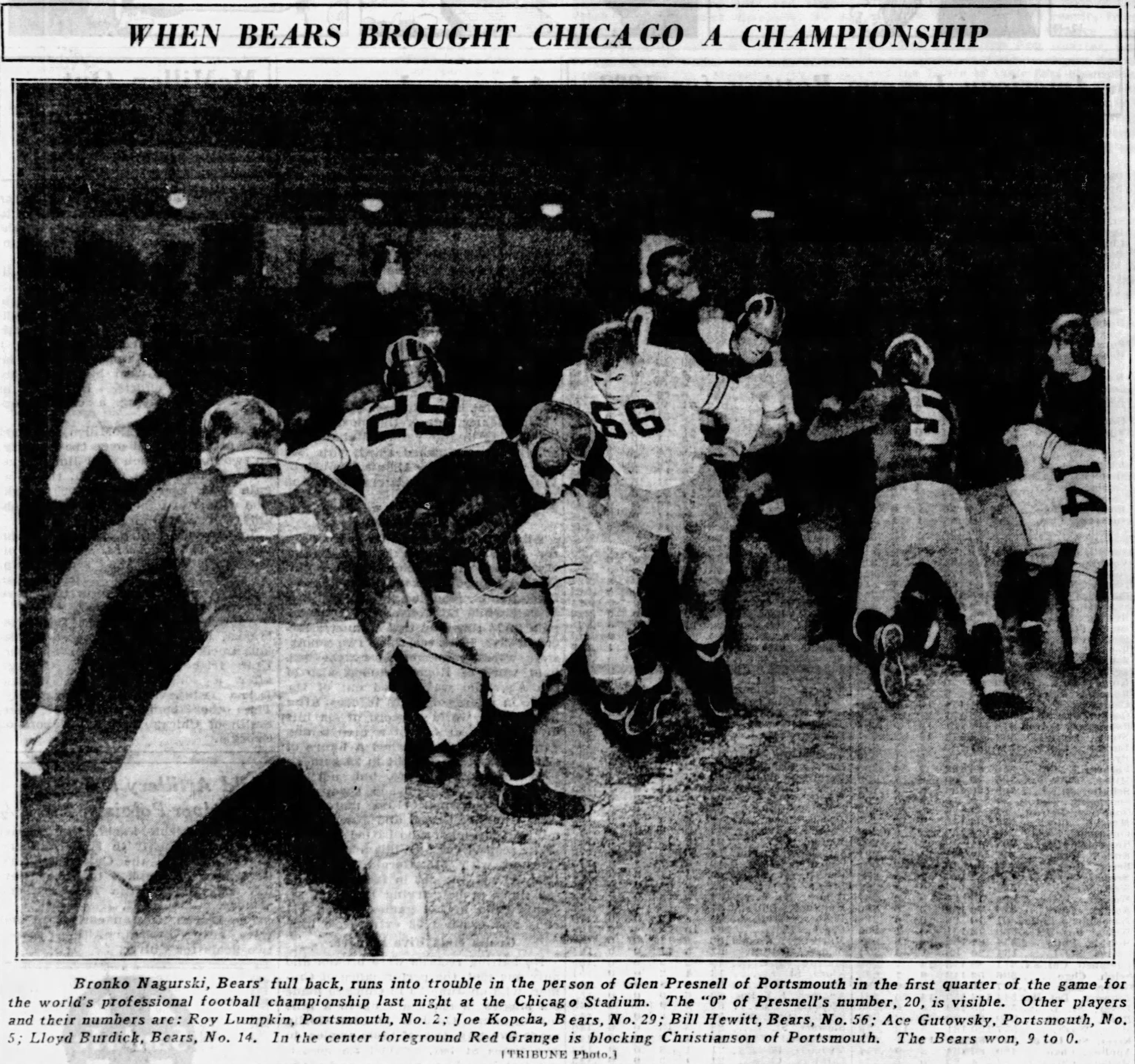
The Chicago Bears, owned and coached by NFL founder George Halas, and with the all-time greatest running back tandem of Red Grange and Bronko Nagurski, were the best team in the League. Their record was 6 wins, 1 loss... and 6 ties.

They began the season badly, not scoring at all in their 1st 4 games. Their 1st 3 games were all scoreless ties, away to the Green Bay Packers, away to New York's Staten Island Stapletons, and against the Chicago Cardinals. And then the Bears lost 2-0 at home to the Green Bay Packers, so they were 0-3-1.

For a reason I haven't been able to find, the Cardinals shared Wrigley Field with the Bears and baseball's Chicago Cubs for the 1932 season, instead of playing their home games at the White Sox' Comiskey Park like they usually did. So while the 0-0 tie between the Chicago teams was at Wrigley, it was officially a home game for the Cardinals.

The Bears snapped out of it. The Stapletons came into Wrigley, and the Bears beat them, 27-7. The Bears made an Eastern swing, and tied the Boston Braves (the team that would become the Washington Redskins) 7-7, and beat the New York Giants 28-8. With 3 straight home games, they tied the Portsmouth Spartans, 13-13; beat the football version of the Brooklyn Dodgers, 20-0, and beat the Cardinals, 34-0.

Portsmouth, Ohio, across the Ohio River from Portsmouth, Kentucky, about 100 miles east of Cincinnati, was one of those small Midwestern cities like the ones that founded the NFL: Green Bay, Wisconsin; Decatur, Illinois, from whence the Bears came; Muncie, Indiana; Canton, Ohio; Rochester, New York. Of those, only Green Bay survives today.

The Spartans began in 1930, and were 5-6-3. But under head coach George "Potsy" Clark, they started 1931 out at 8-0, before falling to 11-3, and finishing 2nd in the NFL to the Packers. With a backfield -- both offensive and defensive in those days -- of Earl "Dutch" Clark (no relation to Potsy), Glenn Presnell, LeRoy "Ace" Gutowski and Roy "Father" Lumpkin, they were 5-1-3 when they hosted the Bears at Universal Stadium on November 27, the Sunday after Thanksgiving. The game ended in a 7-7 tie.

The Spartans played just 1 more game, beating the Packers, 19-0 at home. The Bears played 2 more, both at Wrigley, beating the Giants 6-0 and the Packers 9-0. The Bears had finished 6-1-6, the Spartans 6-1-4. Under current rules, with winning percentage being the decider, and ties being counted as half a win and half a loss, the title would actually have gone to the Packers: Their 10-3-1 record gave them a winning percentage of .750, to the Bears' .692 and the Spartans' .636. Of course, under current rules, every team would have played the same number of games: The Packers had played 14, the Bears 13, the Spartans 11.

But ties weren't counted, and so the percentages were actually Bears .857, Cardinals .857, and Packers .769. After winning the NFL Championship in each of the preceding 3 seasons, Green Bay were out, and there was a tie for the title. So a Playoff game was set for Sunday, December 18, at Wrigley Field, since it had more seats than Universal Stadium. The Spartans did not object: Money from gate receipts mattered more than home-field advantage. It was the depth of the Great Depression, after all, between the electoral rejection of Herbert Hoover and the Inauguration of Franklin Delano Roosevelt.

But Chicago was hit by snow, and it stayed cold all week. It was impossible to play the game at Wrigley, or at Comiskey, or at Soldier Field, or at the University of Chicago's Stagg Field, or at Northwestern University's Dyche Stadium.

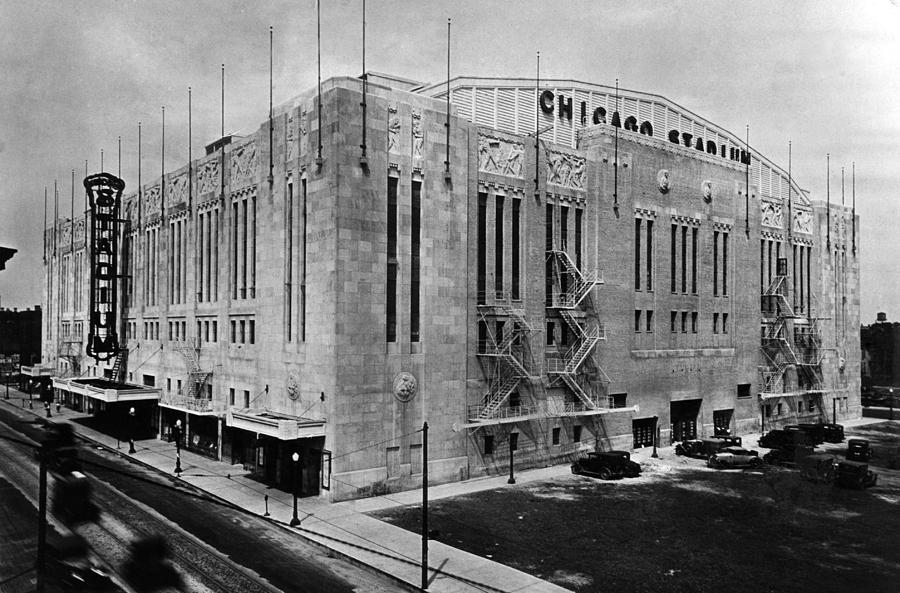
In 1929, the Chicago Stadium, on the West Side, opened as the new home of the NHL's Chicago Black Hawks. In 1930, the Bears and the Cardinals had played a postseason charity exhibition game indoors there. George Halas suggested to Potsy Clark that they move the Playoff game to the Stadium. Since the only other option was to wait until an outdoor stadium was available, by which point his team might have gotten stale in waiting, he agreed.

A week before the game, the concrete surface had tanbark, the bark of oak trees, placed atop it, for a Salvation Army-sponsored circus. Elephant manure that had seeped into the surface produced an odor that caused a Bears player to throw up on the field. And because of the limited dimensions of the indoor arena, special rules were adopted for the game:

  • The tanbark-covered field itself was only 80 yards long -- 60 yards between the goal lines -- and 45 yards wide, 10 yards narrower than the regulation width at the time.
  • The goalposts were moved from the endlines to the goal lines.
  • Every time a team crossed the 10-yard line, the ball was moved back 20 yards to allow for the shortened field.
  • For the first time, all plays started with the ball on or between the hash marks, which were 10 yards from the sidelines.
  • The forward pass, officially legal only from 5 yards behind the line of scrimmage, was legalized from anywhere behind the line of scrimmage.
  • Drop kicks (still relatively common) and field goals would not be used in the game, for fear of footballs going into the stands, and the referees running out of them.

The high temperature for that Sunday in Chicago was 20 °F, warmer than anticipated earlier in the week. Attendance was listed at 11,198 -- about half the heated Stadium's capacity, but probably more than would have braved the cold at Wrigley, had the snow been removed from the field to make playing a game there possible. The host Bears wore white jerseys, the Spartans purple.

With terrible footing on the mulch, limited room for the offenses to work, and the circumstances of the era making the NFL a defense-oriented league at the time, anyway, the defenses dominated the game's 1st 3 quarters, with the game remaining scoreless. Bears quarterback John Doehling's 1st pass flew into the stands, as did most punts and kickoffs, rendering the fear that caused the cancellation of dropkicks and field goals very real. One punt collided with a Black Hawks sign. Another hit Al Melgard, the Stadium's organist. Only 1 punt had the chance to be returned.
On one drive, the Spartans were in position to score when Presnell tripped before he could reach the end zone. In the 4th quarter, the Bears scored on a controversial touchdown: Carl Brumbaugh handed the ball off to Nagurski, who pulled up and threw to Grange in the end zone for the score. The Bears later scored a safety after the Spartans fumbled the ball out of their end zone, making the final score 9-0, and the Bears were Champions.

To eliminate the circumstances of the 1932 Playoff -- barring the weather, which, of course, even George Halas couldn't control, or at least buy control of -- the NFL got seriously revamped prior to the 1933 season. The liberalized passing rules required by the smaller field from the Playoff were written into the regular rules. So was the creation of hashmarks, to keep the ball closer to midfield, lengthwise. Putting the goalposts on the goal line was kept, until they were moved back to the end line in 1974. 

The League was divided into an Eastern Division and a Western Division, with each team playing each of its Division opponents home and away, no more, no less; and each Division winner facing the other in an NFL Championship Game, to determine a definitive title-winner.

The Western Division winner would host the Championship Game in odd-numbered years, the Eastern winner in even-numbered years. The Bears won the 1st such game, beating the Giants, 23-21 at Wrigley. The following year, the Giants beat the Bears at the Polo Grounds in New York.

All these changes, and a slimmer football that was introduced for the 1934 season, led to more scoring, and fewer ties, and helped increase the NFL's popularity. It was these changes that turned the NFL from what could still be called a minor league into a major league.

In 1934, Detroit radio executive George Richards bought the Spartans, and moved them, making them the Detroit Lions. They won the NFL Championship in 1935. The 8,500-seat Universal Stadium, the Spartans' former home, is one of the few remaining relics of the early NFL: It has been renamed Spartan Municipal Stadium, after both of the teams famous for playing there, the other being Portsmouth's Notre Dame High School.

Today, Portsmouth is home to about 18,000 people. It was the hometown of Major League Baseball stars Al Bridwell, Del Rice, Rocky Nelson, Al Oliver, Gene Tenace and Larry Hisle; baseball executive Branch Rickey; opera singer Kathleen Battle; Ohio Governor Ted Strickland; and "singing cowboy" Roy Rogers.

In 1968, the American Football League's Houston Oilers moved into the Astrodome. In 1970, with the rest of the AFL, they were merged into the NFL. On September 27, 1970, they played the NFL's 1st indoor regular-season game, losing to the Miami Dolphins, 20-10. In 2022, out of the NFL's 32 teams, 10 play under domes, 5 of them having retractable roofs, allowing both indoor and outdoor games. The Chicago Bears are not one of them, but the Detroit Lions, who used to be the Portsmouth Spartans, are.

*

December 18, 1932 was a Sunday. Baseball was out of season. The NBA hadn't been founded yet. There were 2 games in the NHL. Chicago Stadium was available because the Chicago Black Hawks were on the road, and played the New York Americans to a tie, 0-0 at Madison Square Garden. And the Detroit Red Wings, in their 1st season under that name, beat the Boston Bruins, 2-1 at the Olympia Stadium in Detroit.

December 18, 1931: Legs Diamond Is Rubbed Out

December 18, 1931: Bootlegger Jack "Legs" Diamond is rubbed out in Albany, New York. It was at least the 6th attempt on his life, the 3rd in the last year.

John Thomas Diamond was born on July 10, 1897 in Philadelphia. When his mother died, his father moved the family to Brooklyn. Jack found his way to Manhattan, where he got mixed up with a gang called the Hudson Dusters. He served in the U.S. Army in World War I, but deserted, and got caught, and served in Leavenworth Military Prison. He got out in 1921, and met Arnold Rothstein, the mobster who led the fix of the 1919 World Series, eventually becoming personal bodyguard to the man known as "The Brain" and "The Big Bankroll."

Or maybe it was the other way around. Rothstein was killed on November 6, 1928. By that point, Diamond was 1 of the 2 biggest bootleggers in New York, along with Dutch Schultz. Without Rothstein's protection, "Legs" -- the source of the nickname is in dispute, as he was known to outrun cops and be a great dancer in "The Jazz Age" -- was a marked man. He survived being shot in 1924, 1927 and 1930. Schultz supposedly said, "Ain't there nobody that can shoot this guy so he don't bounce back?"

The question was answered in the affirmative on December 18, 1931. He was in Albany, New York, on trial for a kidnapping that had occurred across the Hudson River in Troy. At 4:30 AM, after a night of partying, he got back to his rooming house and passed out on his bed. At around 5:30, gunshots were heard. He had been shot 3 times in the back of the head. He was 34 years old.

Supposedly, the deed was done by the Albany police, trying to prevent him from moving in on the town -- and breaking up their own racket. Sergeant William Fitzpatrick is said to have fired the shots. He was later appointed Chief of Police. In 1945, he, too, was shot and killed, in his own office.

Legs was a known womanizer. But, rather than any of his mistresses, it was his wife, Alice, who was shot and killed in her Brooklyn apartment, to keep her quiet, on July 1, 1933.

Legs was played by Ray Danton in the 1960 film The Rise and Fall of Legs Diamond, Steven Hill on a 1960 episode of The Untouchables, Peter Allen in the 1988 Broadway musical Legs Diamond, and John Mosby in the 1993 film The Outfit.

*

December 18, 1931 was a Friday. Baseball was out of season. The NBA hadn't been founded yet. The NHL scheduled no games. And the football season was over, except for the Rose Bowl, to be played in Pasadena, California on New Year's Day: The University of Southern California beat Tulane University, 21-12.

Wednesday, December 7, 2022

December 14, 1930: The New York Giants Beat the Notre Dame All-Stars

December 14, 1930: A football game was played at the Polo Grounds in Upper Manhattan. The home team was not the one cheered by most of the fans. Most of them left stunned at the result.

America was a year into the Great Depression, and Jimmy Walker, the flamboyant, corrupt Mayor of New York City, had a private unemployment relief fund. He contacted his friend, Charles Stoneham, owner of the New York Giants baseball team and its home, the Polo Grounds; and another friend, Tim Mara, owner of the New York Giants football team, which leased the Polo Grounds from Stoneham. He asked if Stoneham would host, and Mara would play, a benefit game for the relief fund. Both agreed.

But who would be the opponent? There was a football team called the Brooklyn Dodgers, and another called the Staten Island Stapletons, but neither had a following that would fill the Polo Grounds' 56,000 seats. Nor did the Giants: Only once all season did they have a home crowd over 25,000, and that was on November 23, when 37,000 saw them beat the Green Bay Packers, 13-6. That would be the Packers' only loss of the season, as they won the Championship by 1 game over the Giants.

The most popular football team among New Yorkers was a college team, 700 miles west: The University of Notre Dame, in South Bend, Indiana. Although there is a school in Washington, D.C. named "The Catholic University of America," the high profile of Notre Dame's football team had made their school America's most familiar Catholic school.

This was due to the success of their head coach, the charismatic Norwegian immigrant Knute Rockne. Coaching players like the ill-fated George Gipp on his National Championship teams of 1919 and 1920, and the four-man backfield known as "The Four Horsemen" on his National Championship team of 1924, Rockne had made himself and his school legend. Catholics in cities like New York, Philadelphia, Boston and Chicago, who couldn't afford to go to college, or even to finish high school, read of Notre Dame's exploits in the newspapers, and became fans, known as "Subway Alumni."

The game in which the great Southern, but nationally-syndicated, sportswriter Grantland Rice had named quarterback Harry Stuhldreher, halfback Don Miller and Jim Crowley, and Elmer Layden "The Four Horsemen," after the Apocalypse figures in the Bible's book of Revelation, had been at the Polo Grounds, a win over the U.S. Military Academy, a.k.a. "Army." The 1928 game in which Rockne had told his players of the dying wish of Gipp, suffering from an infection in those pre-antibiotic days, to "win just one for the Gipper," had also been against Army, at Yankee Stadium.

And Notre Dame had won the National Championship again in 1929 and 1930. In the current season alone, they had gone 10-0, and brought 66,000 fans to Pitt Stadium for their win over the University of Pittsburgh, 75,000 to Franklin Field in Philadelphia for their win over the University of Pennsylvania, 110,000 to Soldier Field in Chicago for their win over Army, and 74,000 to the Los Angeles Memorial Coliseum for their win over the University of Southern California.

So they were the ideal opponent. And it's not as though teams in the NFL's early days hadn't played college teams before. So the Giants asked Rockne if he would bring his "Fighting Irish" east to play the Giants.

He wouldn't do it. Not because he objected to playing professionals -- or because the game would be on a Sunday. (The State of New York had only legalized professional sports on Sundays in 1919.) It was because the game had been set for December 14, only 8 days after their win over USC, and, having needed 3 days to get back to South Bend by train, and needing another day to get to New York by train, Rockne thought his players would be too tired to play.

So a team of "Notre Dame All-Stars" was set up: A few of the current players, who felt they could do it, came east. And the Four Horsemen, none of whom had made the trip to Los Angeles, were reunited.

But Stuhldreher was now the head coach at Villanova University in Philadelphia, Crowley the head coach at Michigan State, Layden the head coach at the University of Pittsburgh, and Miller the backfield coach at Ohio State. None of them had played beyond the 1926 season, and they were now 29 (Stuhldreher), 28 (Miller and Crowley) and 27 (Layden) years old -- not old if they had still been playing all along, but old enough to not be able to fully resume their playing careers if they had wanted.

Nevertheless, the American media had put into the heads of the American football-watching public that college football was superior to professional football, that pro football was a way for boys who hadn't grown up to make money playing the game they loved, on top of, or maybe instead of, getting a "real job." The consensus was that the Giants would be no match for the 24 men who assembled to represent the great Notre Dame.

But the Giants had quarterback Benny Friedman, who has been called the NFL's 1st great passer. They had end Red Badgro. They had tackle Steve Owen, who was also their head coach. All 3 would one day make the Pro Football Hall of Fame. They had backs Dale Burnett and Chris Caple. There were reasons why the Giants nearly won the NFL Championship.

Instead, the Giants sacked Stuhldreher in the end zone for a safety just 2 minutes into the game, and led 2-0. The Giants' big linemen overwhelmed the Notre Dame line, including some of the "Seven Mules" who had blocked for the Four Horsemen. It did no good: The Irish gained only 34 yards -- the entire game. Their passing attack was 0-for-9, with 2 interceptions.

In the New York Daily News, Marshall Hunt wrote of the crowd that came to see Notre Dame and ended up seeing the Giants, "More than 50,000 cheered every futile thrust of Knute Rockne's improvised squadron of former Notre Dame football players against the super line of Tim Mara's team."

In the 2nd quarter, Friedman drove the Giants down the field, and scored on a 4-yard touchdown run. Close to halftime, the Giants' line opened a hole for him, and he ran in from 22 yards. Giants 15, Fighting Irish 0.
Rockne lost the plot, as would be said in English soccer. This was not something he did often. He found Giants team president Harry March, and tore into him for allowing the Giants to embarrass his squad in a purported charity game. He told March to call off the dogs in the second half.

March must have gotten the message to Owen, because he sent in the reserves. And still, in the 3rd quarter, Francis "Hap" Moran threw a touchdown pass to Glenn Campbell (no relation to Glen Campbell the later singer). The Giants won, 22-0.

As sports historian Clayton Trutor wrote for Notre Dame Magazine in 2021:

The 22-0 final score headlined all newspapers in the city, earning the hometown team a grudging respect from writers who had previously discounted the professional game. Nevertheless, they were treated like sparring partners by many of the New York papers, who instead focused their coverage on the plucky performance of a Notre Dame alumni team that had assembled just a few days earlier.

It wasn't the catalyst for the NFL to take over from the pros in the minds of the public, but it was part of a gradual process that began, also with the Giants at the Polo Grounds, when Red Grange and the Chicago Bears beat them in front of 75,000.

Rockne died in a plane crash the next year, and many of the other great old football coaches, some of whom had spoken ill of the professional game -- passed from the scene, either through death or retirement.

In 1933, Jim Crowley became the head coach at Fordham University in The Bronx, and coached a line known as "The Seven Blocks of Granite," including future Packer coach Vince Lombardi. That team played their bigger games at the Polo Grounds, and had a famous 0-0 tie with Pittsburgh there, with both teams going in undefeated.

*

December 14, 1930 was a Sunday. There was 1 regular-season game in the NFL that day: The Green Bay Packers, their Championship already assured, played the Portsmouth Spartans to a tie, 6-6 at Universal Stadium (now Spartan Memorial Stadium) in Portsmouth, Ohio.

Baseball was out of season. The NBA hadn't been founded yet. There were 2 games in the NHL. The New York Rangers beat the Detroit Falcons, 3-0 at the old (but then-new) Madison Square Garden. And the Montreal Maroons beat the Chicago Black Hawks, 2-0 at the Chicago Stadium. The Falcons became the Red Wings in 1932, and the Maroons folded in 1938.

Monday, December 5, 2022

December 5, 1931: Montreal Wins Its 1st Grey Cup

Warren Stevens

December 5, 1931: The Montreal Football Club, a.k.a. the Winged Wheelers, a football team sponsored by the Montreal Amateur Athletic Association, defeats the Regina Roughriders, 22-0 at Percival Molson Memorial Stadium in Montreal, to win the Grey Cup.

This is the 1st time the championship of Canadian football was competed for by a Quebec team. Teasm from Western Canada had reached the Final before, since 1921. But this was the 1st time the Final was played outside the Province of Ontario. And, since the Roughriders were from Saskatchewan, one thing was guaranteed, no matter who won: For the 1st time, the Grey Cup would be won by a team from outside Ontario.

The Canadian Winter had already set in: A snowstorm struck the night before the game. Despite the field being cleared of snow, there were still ice patches on it. It was -9° Celsius at kickoff -- 16° Fahrenheit. Only 5,112 attended.

In a foreshadowing of the 1934 NFL Championship Game, "The Sneaker Game," Regina general manager Fred Wilson organized for pairs of lacrosse shoes to be sent to his team. But the plan backfired, because the shoes somehow found their way into the Montreal dressing room instead, meaning that the visiting team had unintentionally supplied their opponents with excellent footwear for the icy conditions.

Separately, Regina head coach Al Ritchie had employed a Montreal shoemaker to attach leather cleats to the Roughriders' shoes. So it should have been an even game, at least by that standard. But the shoemaker couldn't get to the stadium, due to the weather -- on the campus of McGill University, Molson Stadium is halfway up Mount Royal, and the streets around it are steep -- so the Winged Wheelers, coached by Clary Foran, had a major advantage out of the gate because of their footwear.

It showed. In the 1st quarter, Pete Jotkus picked up a Regina fumble, and returned it into the end zone for a touchdown. Only 7 passes were completed in the game, by both teams combined. One was from Montreal's Warren Stevens to Kenny Grant, for a touchdown in the 3rd quarter. In the 4th quarter, Welch kicked a field goal, and Stevens scored another touchdown. The final score was Montreal 22, Regina 0.

In 1881, 3 sporting clubs merged to form the Montreal AAA: The Montreal Snow Shoe Club, the Montreal Bicycle Club, and the Montreal Lacrosse Club. The AAA founded Montreal's annual Winter Carnival. In 1884, they founded the Montreal Hockey Club. This team won the 1st Stanley Cup, in 1893, and also won it in 1894 and 1902.

Some of the players from the 1902 team founded the Montreal Wanderers, who won the Cup in 1906, 1907, 1908 and 1910, and were charter members of the NHL in the 1917-18 season, but had to fold when the Montreal Arena burned down. The AAA continued to sponsor the Montreal Hockey Club, and won the Allan Cup, for the champions of "senior ice hockey" in Canada, in 1930.

This team's logo was a wheel with wings. A version of it would be adopted by the Montreal Football Club. In 1927, Jack Adams, previously a great hockey player, was named the head coach and general manager of the NHL's Detroit Cougars. Their name was changed to the Detroit Falcons. In 1932, remembering the winged wheel logo of the Montreal AAA, he had a new version of it designed, and had his current team's name changed to match: The Detroit Red Wings. Minor-league baseball already had the Rochester Red Wings in Western New York.

The 1931 Grey Cup was a bit of a last gasp for the Montreal AAA. The Great Depression hit Canada every bit as hard as it hit America, and the club left the professional arena, figuratively and literally, despite the 1931 Grey Cup and the 1930 Allan Cup. The AAA does still exist, and is Canada's oldest active sports club.

For the Roughriders, it was their 4th straight loss in the Grey Cup Final. They would make it 5 the next year. In 1946, without regard to how difficult it was to spell, they switched their locality identifier from their City to their Province, becoming the Saskatchewan Roughriders.

In 1966, they finally won their 1st Grey Cup. They have since won it in 1989, 2007 and 2013. But their 4 titles are still the fewest of any Canadian Football League team, since the Ottawa Redblacks are officially considered a continuation of the defunct Ottawa Rough Riders, and the current version of the Montreal Alouettes are considered a continuation of the previous version.

About whom: The Montreal AAA stopped sponsoring the Winged Wheelers after the 1935 season. The Montreal Alouettes were founded in 1946, and won the Grey Cup in 1949, 1970, 1974 and 1977. A financial meltdown led to them being sold in 1982, and renamed the Montreal Concordes. In 1986, the Alouettes name was restored, but they folded after that season.

In 1995, the Grey Cup was won by the Baltimore Stallions, a U.S.-based team. This embarrassment led the CFL to end their American experiment. However, they offered the Stallions' owners the rights to the Montreal market. The Alouettes were reborn in 1996, and have won the Grey Cup again in 2002, 2009 and 2010. (UPDATE: They won another in 2023.)

After 1931, the Grey Cup would not be played in Montreal again until 1969, at the ill-fated Autostade. It has been played at the 1976 Olympic Stadium in 1977 (the Alouettes winning on their home field, beating Edmonton), 1979 (the Alouettes losing on their home field, to Edmonton), 1981, 1985, 2001 and 2008 (the Alouettes losing on their home field, to Calgary).

Built in 1915, and originally known as McGill Graduates Stadium, Percival Molson Memorial Stadium is still used as the home of McGill University outdoor sports. It was named for an alumnus, a member of the Molson brewing family, who was killed in action in World War I. The Alouettes used it as their home field from 1947 to 1967, and have done so again since 1998, though they use the much larger Olympic Stadium for Playoff games.

*

December 5, 1931 was a Saturday. In American football, the NFL had games the next day. Among the college football games played that day were these:

* The University of Tennessee came north, and played a charity game against New York University at Yankee Stadium. A crowd of 40,684 saw the Volunteers beat the Violets, 13-0.

* Navy beat the University of Pennsylvania, 6-0 at Franklin Field in Philadelphia. Army had the week off. It must have helped, because, the following week, at Yankee Stadium, Army beat Navy, 17-7.

* In an all-Pittsburgh matchup, Duquesne and Carnegie Tech (now Carnegie-Mellon) played to a 0-0 tie at the University of Pittsburgh's Pitt Stadium.

* And the University of Southern California beat the University of Washington, 44-7 at the Los Angeles Memorial Coliseum. This was decades before the current Playoff system went into effect, but, the week before, USC beat Notre Dame, 16-14 in South Bend. The week after this, Georgia came into the Coliseum, and USC beat them, 60-0. If there was any doubt that USC were the best team in the country, it ended in the Rose Bowl, where they beat Tulane, 21-12. (The New Orleans school was a major power at the time.)

Baseball was out of season. The NBA hadn't been founded yet. There were 2 games played in the NHL. The Montreal Canadiens beat the Detroit Falcons, 4-0 at the Montreal Forum. The Falcons became the Red Wings the next season. And the Toronto Maple Leafs beat the Montreal Maroons, 4-0 at Maple Leaf Gardens in Toronto.

And in English soccer, North London team Arsenal went to Yorkshire, and beat Sheffield Wednesday, 3-1 at Hillsborough Stadium in Sheffield. Arsenal won the Football League title that season, while Wednesday won the two before that.

Friday, December 2, 2022

December 2, 1929: Irving Berlin Publishes “Puttin’ On the Ritz”

December 2, 1929: Irving Berlin first publishes his song "Puttin' On the Ritz." The title was an expression that Harlemites of the time coined, meaning to dress nice, and takes its name from the Ritz Hotel in London, which may also have produced the adjective "ritzy.: The following year, a film with the title was released, and Harry Richman sang it in front of Hollywood's 1st interracial ensemble.

It's also been sung in films by Clark Gable (complete with white tie and tails) in Idiot's Delight in 1939, Fred Astaire in Blue Skies in 1946, and, for comedic effect, Gene Wilder and Peter Boyle in Young Frankenstein in 1974.

In 1982, Indonesian-Dutch singer Taco Ockerse (using only his first name) released the most recent hit version. It reached Number 4 in the U.S. Irving Berlin was then 95 years old, making him the oldest living songwriter to have a song he wrote enter the Top 10. Unfortunately, Taco's original video for it had blackface performers, and had to be re-shot.

*

December 2, 1929 was a Monday. Sportswriter Dan Jenkins was born.

Baseball was out of season. Football was in midweek. The NBA hadn't been founded yet. And the NHL had a day off. So there were no scores on this historic day.

Tuesday, November 29, 2022

November 29, 1931: The Packers' 1st "Threepeat"

Johnny "Blood" McNally

November 29, 1931: The Championship of the National Football League is clinched... at Ebbets Field. The Green Bay Packers beat the football team named the Brooklyn Dodgers, 7-0, to advance to 12-1 on the season.

Coached by Earl "Curly" Lambeau, the Packers' star player was John Victor McNally Jr., from New Richmond, Wisconsin, across the State, close to Minneapolis rather than to Green Bay or Milwaukee. He starred at St. John's University in Minnesota, and then at Lambeau's Alma Mater, Notre Dame.

In 1922, while at St. John's, he and a teammate, Ralph Hanson, were passing a Minneapolis movie theater, showing the movie Blood and Sand, starring Rudolph Valentino as a Spanish bullfighter. McNally turned to the teammate, and, knowing that they could secretly make money playing professional or semipro ball on Sundays, the day after playing for Notre Dame, if they used fake names, and said, "I'll be Blood, and you be Sand." Hanson, as Ralph Sand, never played in the NFL, but John McNally was "Johnny Blood" from then on.

He played in the NFL for the Milwaukee Badgers, the Duluth Eskimos and the Pottsville Maroons, before joining the Packers in 1929, eventually helping them win 4 NFL Championships. In this 1931 season, the two-way halfback scored 2 touchdowns rushing, a then-record 10 receiving, and another on an interception return. He later served as a player-coach with the football version of the Pittsburgh Pirates, before they changed their name to the Steelers; and returned to St. John's to coach. (St. John's is now an NCAA Division III school, and has no connection besides name to the one in New York City.)

The Packers benefited from having their 1st 7 games all at home, probably because most NFL teams then used the biggest stadium in their city, which tended to be not a college football stadium, including one of the many "Memorial Stadiums" built to honor the dead of World War I in the preceding decade, but a baseball park, and most of those parks were occupied in September.

The Packers beat the football version of the Cleveland Indians, 26-0; the Dodgers, 32-6; the team that would become their arch-rivals, the Bears, 7-0; the football version of the New York Giants, 27-7; the Chicago Cardinals, 26-7; the Frankford Yellow Jackets, 15-0; and the Providence Steam Roller (no "S" on the end), 48-20.

The Packers went to Wrigley Field to play the Bears again, and won, 6-2. They hosted the Staten Island Stapletons, and won, 26-0. They were finally beaten by Ernie Nevers and the Cardinals, 21-13 at Wrigley, where they played their home games that season, rather than at Comiskey Park, the usual home of the Cardinals and baseball's Chicago White Sox.

The Packers rebounded, beating the Giants, 14-10 at the Polo Grounds; beating the Steam Roller, 38-7 at the Providence Cycledrome on Thanksgiving; and clinching against the Dodgers at Ebbets Field. The following week, they lost to the Bears, 7-6 at Wrigley Field. But it didn't matter, because the Portsmouth Spartans finished at 11-3, and could not catch the Packers.

The Packers thus won their 3rd straight NFL Championship. It had never happened before. Through the 2021 season, it has happened only once since: The Packers again, in 1965, 1966 and 1967, including Super Bowls I and II.

This remains the last time the NFL Championship has been decided without some form of postseason play.

Lambeau and McNally were both charter inductees into the Pro Football Hall of Fame in 1963. Lambeau died in 1965, and Green Bay's new City Stadium was renamed Lambeau Field in his memory. McNally was one of a few 1920s players interviewed by NFL Films for their 1976 documentary Old Leather, and lived until 1985.

UPDATE: The Green Bay Packers have the largest team Hall of Fame of any team in the "Big Four" North American sports: The NFL, MLB, the NBA and the NHL. From the team's founding era, 1919 to 1928, but not on the 1929, '30 or '31 title teams, they have inducted tackle Howard "Cub" Buck, back Charlie Mathys, and team executive Andrew Turnbull.

From the 1929-30-31 title teams, they have inducted co-founder, owner, general manager, head coach and back Earl "Curly" Lambeau; co-founder George Whitney Calhoun; executives Frank Jonet, Gerald F. Clifford, Fred Leicht, Emil Fischer and Lee Joannes; backs Johnny "Blood" McNally, Verne Lewellen, Arnie Herber, Hank Bruder and Joseph "Red" Dunn; ends Lavern "Lavvie" Dilweg and Milt Gantenbein; tackle Cal Hubbard; guards Mike Michalske and Howard "Whitey" Woodin; centers Francis "Jug" Earp, Bernard "Boob" Darling and Nate Barragar; trainer Carl "Bud" Jorgensen and team doctor W. Webber Kelly; and the team's 1st broadcaster, Russ Winnie.

Lambeau, Buck, Dilweg, Dunn, Goldenberg, Lewellen, McNally and Michalske have also been inducted into the Wisconsin Athletic Hall of Fame.

*

November 29, 1931 was a Sunday. Only 2 other games were played that day. The Giants and the Steam Roller played to a 0-0 tie at the Polo Grounds. This turned out to be the last game the Steam Roller ever played. They had won the NFL Championship in 1928, but the Great Depression did them in.

And the Spartans beat the Bears, 3-0 at Universal Stadium in Portsmouth, Ohio. It still stands, as Spartan Memorial Stadium.

The day before, the Cardinals beat the Indians, 21-0 at Wrigley Field. And, 2 days before that, on Thanksgiving Day, these games were played:

* The Giants lost to the Stapletons, 9-6 at Thompson Stadium on Staten Island.

* The Bears beat the Cardinals, 18-7 at Wrigley Field.

* And, as I said, the Packers beat the Steam Roller, 38-7 at the Cycledrome.

Baseball was out of season. The NBA hadn't been founded yet. There were 2 games played in the NHL. The New York Rangers beat the Chicago Black Hawks, 5-0 at the Chicago Stadium. And the Detroit Falcons beat the Montreal Canadiens, 3-2 at the Olympia Stadium in Detroit. Ebenezer "Ebbie" Goodfellow scored the winning goal, 3:33 into overtime. The next season, the Falcons became the Detroit Red Wings.

Monday, November 28, 2022

November 28, 1929: The Ernie Nevers Game

November 28, 1929: Ernie Nevers puts on a Thanksgiving performance that is a feast for football fans' eyes.

A native of Superior, Wisconsin, and an All-American two-way back at Stanford University, Nevers debuted in the NFL with the Duluth Eskimos in 1926, but they folded after the 1927 season. He also played in Major League Baseball, pitching for the St. Louis Browns in the 1926, '27 and '28 seasons, going 6-12.

He claimed a back injury had let him to retire as a football player, and he spent the 1928 season assisting his former coach, Glenn "Pop" Warner, at Stanford. But 3 things became clear: He wasn't going to make it as a baseball player, he missed playing football, and he needed money. So, in 1929, he signed with the Chicago Cardinals.

As a running back and a placekicker, he had frequently scored every point the Eskimos had scored in a game. He resumed doing that with the Cardinals. On November 6, in the 1st night game in NFL history, he led the Cards to a 16-0 win over the host Providence Steam Roller. Here's how the 16 Cardinal points broke down: He ran for a touchdown, passed for a touchdown, kicked an extra point (but missed the other), and kicked a field goal.

He was just getting warmed up. On November 24, he scored 3 touchdowns and kicked an extra point, scoring all the Cardinals' points in a 19-0 win over the Dayton Triangles.

Just 4 days later, the Cardinals played the Chicago Bears on Thanksgiving Day, as they had done each year since 1922. It was a nasty rivalry, between the Cardinals, who groundshared with the White Sox at Comiskey Park on the South Side, and the Bears, who groundshared with the Cubs at Wrigley Field on the North Side. That 1st game, in 1922, included a vicious brawl that included Bears end, head coach, general manager and owner George Halas.

This time, at Comiskey, there was no brawl. There was only the Ernie Nevers Show. In the 1st quarter, he ran for a touchdown, but missed the extra point. Then he ran for another, and made the extra point. 13-0 Cardinals. In the 2nd quarter, he ran for another touchdown, and kicked the extra point. At the half, 20-0 Cardinals.

The Bears got on the board in the 3rd quarter, when Garland "Gardie" Grange, younger brother of Red Grange, caught a touchdown pass from Walt Holmer. Gardie was the Bears' kicker that season, and missed the extra point. Nevers ran for a 4th touchdown, and made the extra point. After 3 quarters, 27-6 Cardinals.

In the 4th quarter, Nevers made it 5 touchdowns, but missed the extra point. Finally, he ran for a 6th touchdown, and made the extra point. He attempted no field goals. Final score: Cardinals 40, Bears 6. Nevers had scored 40 points in a single game. That remains an NFL record.

Six touchdowns in a single game? On November 25, 1951, also against the Bears, William "Dub" Jones of the Cleveland Browns ran for 4 and caught passes for 2, in a 42-21 win at Cleveland Municipal Stadium. On December 12, 1965, for the Bears, Gale Sayers ran for 4, caught a pass for 1, and returned a punt for 1, in a 61-20 win over the San Francisco 49ers at Wrigley Field.

Six rushing touchdowns in a single game? That wouldn't be done again until, appropriately enough, another holiday: Christmas, December 25, 2020, when Alvin Kamara of the New Orleans Saints did it in a 52-33 win over the Minnesota Vikings at the Superdome in New Orleans.

But from the 1960s onward, when placekickers tended to be specialists, not also players starting at another position, 40 points in a game has not been seriously threatened. There have been instances of 7 field goals in a game (21 points), plus extra points. But Jones, Sayers and Kamara are the only players to score 36 since Nevers, and none of them kicked anything.

All that playing, including on both offense and defense, finally caught up to Nevers and the Cardinals. Three days after the 40-point performance, the Cards lost to the New York Giants, 24-21 at the Polo Grounds. Still, never ran for a touchdown, threw a touchdown pass, and set up the other Cardinal touchdown when he intercepted a pass from Benny Friedman and took it to the 1-yard line. This time, though, while the Cardinals converted all 3 extra points, Nevers only kicked 1 of them.

Nevers continued to play for the Cardinals through the 1931 season, then went back into coaching, including as head coach of the Cardinals in the 1930, '31, and '39 seasons. He served in the U.S. Marine Corps during World War II, rising to the rank of Major, and serving as the athletic director at the Marine base in San Diego.

He was a charter inductee into the Pro Football Hall of Fame in 1963. Although Stanford retired his Number 1, the Cardinal franchise, now based in Arizona, has never retired the Number 4 he wore with them. However, he is 1 of 8 figures from their Chicago years who have been inducted into their Ring of Honor. He died in 1976. In 2010, the NFL Network ranked him 89th on their list of the 100 Greatest Players.

*

November 28, 1929 was a Thursday, and a Thanksgiving Day. Berry Gordy Jr., founder and operator of Motown Records, was born on this day.

There were 2 other NFL games played that day. The New York Giants beat their then-crosstown rivals, the Staten Island Stapletons, 21-7 at Thompson Stadium in Staten Island. And the Green Bay Packers and the Frankford Yellow Jackets played to a 0-0 tie at Frankford Stadium in Northeast Philadelphia.

And there were 25 college games:

* Carnegie Tech beat NYU, 20-0 at Yankee Stadium.

* Syracuse beat Columbia, 6-0 at Baker Field in Manhattan.

* The University of Pennsylvania beat Cornell, 17-7 at Franklin Field in Philadelphia.

* The University of Pittsburgh beat Penn State, 20-7 at Pitt Stadium in Pittsburgh.

* Maryland beat Johns Hopkins, 28-6 at Homewood Field in Baltimore. (That was, and remains, Hopkins' home field. They now compete in NCAA Division III.)

* Virginia Military Institute (VMI) beat Virginia Polytechnic Institute (VPI, now usually known as Virginia Tech), 14-0 at Maher Field in Roanoke, Virginia (neutral ground).

* West Virginia beat Washington & Jefferson, 6-0 at the old Mountaineer Field in Morgantown, West Virginia.

* Tennessee and Kentucky played to a 6-6 tie at Stoll Field in Lexington, Kentucky.

* North Carolina beat Virginia, 41-6 at Kenan Stadium in Chapel Hill, North Carolina.

* Wake Forest beat Mercer, 13-0 at Memorial Stadium in Asheville, North Carolina.

* Clemson beat Furman, 7-6 at Riggs Field in Clemson, South Carolina.

* Georgia Tech beat Auburn, 19-0 at Grant Field in Atlanta.

* Florida beat Washington & Lee, 25-7 at Fleming Field in Gainesville, Florida.

* Georgia beat Alabama, 12-0 at Legion Field in Birmingham, Alabama.

* The University of Mississippi (then as now, nicknamed Ole Miss) and Mississippi A&M (which became Mississippi State in 1932) played to a 7-7 tie at Hemingway Stadium (now Vaught-Hemingway Stadium), Ole Miss' home in Oxford.

* Tulane beat Louisiana State 21-0 at Tiger Stadium in Baton Rouge, Louisiana.

* Arkansas beat Oklahoma A&M, 32-6 at Lewis Field in Stillwater, Oklahoma. (A&M became Oklahoma State in 1958.)

* Texas A&M beat Texas, 13-0 at Kyle Field in College Station, Texas.

* Marquette beat Kansas State, 25-6 at Marquette Stadium in Milwaukee.

* Missouri beat Oklahoma, 13-0 at Memorial Stadium (now Faurot Field) in Columbia, Missouri.

* Nebraska beat Iowa State, 31-12 at Memorial Stadium in Lincoln, Nebraska.

* Colorado College beat Colorado Mines, 13-0 at Washburn Field in Colorado Springs. (Colorado College became an NCAA Division III school, and they discontinued their football program in 2008. Colorado School of Mines is located in Golden, and now plays in NCAA Division II. Neither should be confused with either the University of Colorado or Colorado State University.)

* Utah beat Utah State, 26-7 at Ute Stadium in Salt Lake City.

* UCLA beat Montana, 14-0 at the Los Angeles Memorial Coliseum.

* And St. Mary's beat Oregon, 31-6 at Kezar Stadium in San Francisco.

Baseball was out of season. And the NBA hadn't been founded yet. But there were 3 games played in the NHL:

* The New York Americans beat the Ottawa Senators, 4-3 at the old (then the new) Madison Square Garden. Normie Himes scored the winner, just 24 seconds into overtime. (The Senators folded in 1934, the Americans in 1942.)

* The New York Rangers beat the Chicago Black Hawks, 3-2 at the Chicago Coliseum.

* And the Detroit Cougars beat the Montreal Maroons, 7-6 at the Montreal Forum. (The Cougars became the Detroit Falcons in 1930, and the Detroit Red Wings in 1932. The Maroons folded in 1938.)

December 31, 1999 & January 1, 2000: The Millennium

December 31, 1999:  The Millennium arrives. The people of planet Earth survived. At a terrible cost. But we hadn't destroyed ourselves. ...