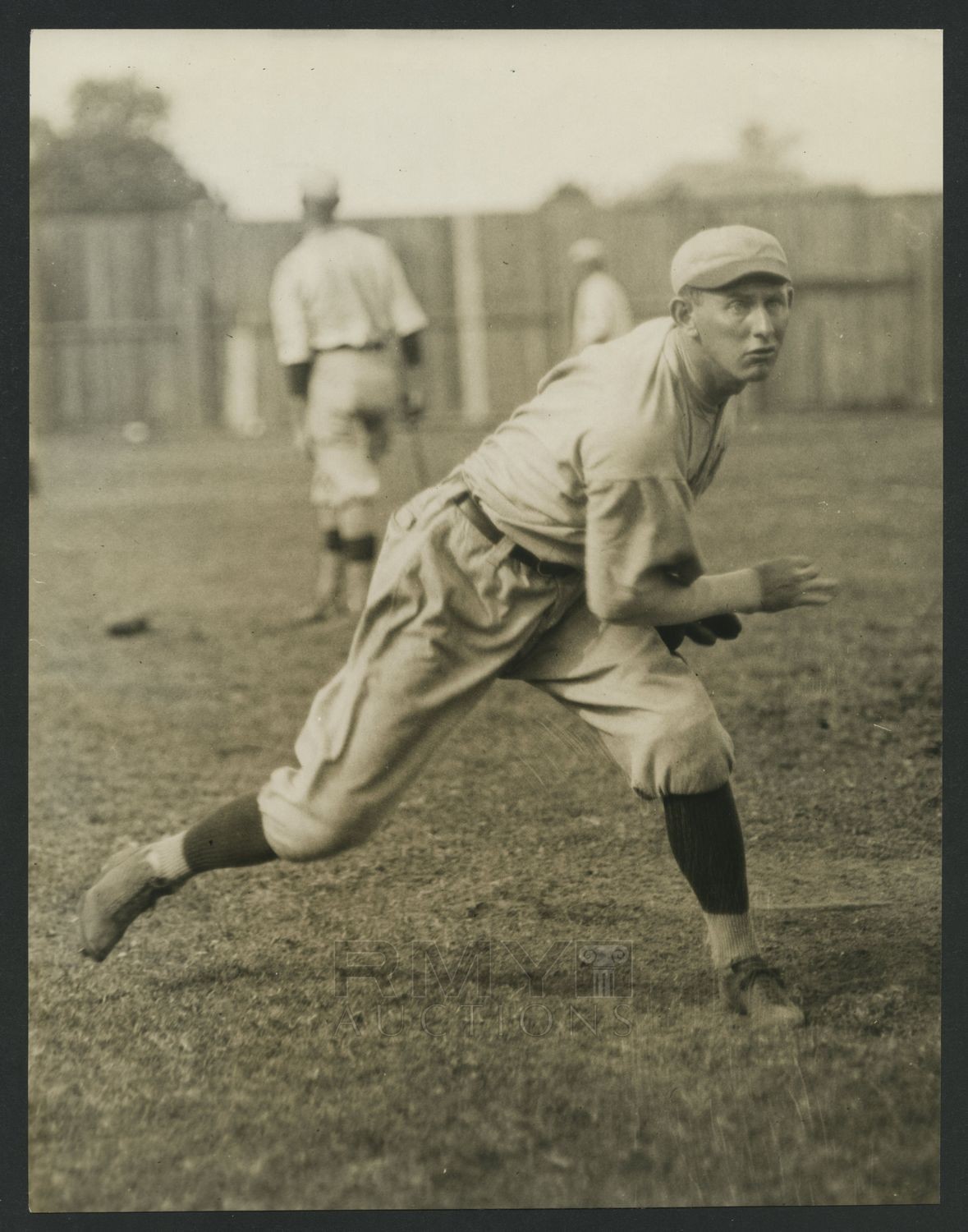
Showing posts with label spitball. Show all posts

Thursday, November 3, 2022

November 3, 1953: No More Gloves On the Field

November 3, 1953: Baseball's rules committee restores the pre-1939 rule which says that a sacrifice fly is not charged as a time at bat.
Also‚ the committee votes for the "no gloves on the field rule." Hank Greenberg‚ the Hall of Fame-to-be slugger who is now the general manager of the Cleveland Indians, had proposed the change‚ saying, "Aside from the possibility of hindering the play‚ gloves on the field look sloppy." It also made it easy for opposing players to sneak creepy-crawly or otherwise disgusting things into the glove of an easily scared player, such as the Yankees' Phil Rizzuto.
The committee also makes a rule that any runner will be called out for deliberately running the bases backwards, or even taking a lead off the base in the wrong direction.
A new balk rule is instituted which gives the batter an option: If he gets a hit after a balk is called‚ he has the option of accepting the outcome of the pitch‚ instead of being limited to the advance of the runner(s). This is the baseball equivalent of a football team that is the beneficiary of a penalty having the option to decline it, if the outcome of such is more advantageous to them than the outcome of the penalty.
Rule suggestions that are rejected include the re-legalization of the spitball‚ 2 bases for an intentional walk‚ and the option of declining ball 4. None of these ideas have been picked up since.
*
November 3, 1953 was a Tuesday. The baseball season was over. Football was in midweek. And while the NBA and NHL seasons had begun, neither scheduled any games. So while this was a notable day in baseball history, there were no scores, in any sport, on this historic day.

Thursday, October 20, 2022

October 21, 1925: Marv Goodwin, the 1st Athlete Killed In a Plane Crash

October 21, 1925: For the 1st time, a professional athlete dies as the result of an airplane crash.

Marv Goodwin was born on January 16, 1891 in Gordonsville, Virginia, outside Charlottesville. He went 21-25 pitching for the Washington Senators, St. Louis Cardinals and Cincinnati Reds from 1916 to 1925. He was 1 of the 17 pitchers permitted to continue throwing any of the banned pitches that fell under the category of "spitball" in 1920. Had he lived a full life, this would be the most interesting fact about him: His pitching career was not otherwise notable.

He missed the 1918 season, serving in World War I as a pilot, becoming an aviation instructor for the U.S. Army, but hadn't yet been sent overseas when the Armistice was signed. He remained in the Army Reserve, rising to the rank of 1st Lieutenant. On October 18, 1925, he was conducting a training exercise at Ellington Field in Houston, when he went into a tailspin and crashed. He died 3 days later, only 34 years old.

He had been a player-manager with the Texas League's Houston Buffaloes in 1924, hence his reserve stationing in Houston. Given that fact, his age, and the fact that he made only 4 major league appearances in 1925, he may have played his last major league game anyway. That doesn't mean, however, that his baseball career was over: He could still have become a major league manager or pitching coach.

Had he survived the crash, and lived to be 71, in 1962, he would have seen Houston gain a Major League Baseball team.

*

October 21, 1925 was a Wednesday. Baseball season was over. Football was in midweek. The NBA hadn't been founded yet. And the NHL season wouldn't start for another month. So there were no scores on this historic day.

Tuesday, September 20, 2022

September 20, 1934: Baseball's Last Legal Spitball

Burleigh Grimes

September 20, 1934: The Brooklyn Dodgers beat the Pittsburgh Pirates, 2-1 at Ebbets Field. The Dodgers score both of their runs in the 1st inning, on a single by Lonny Frey, a double by Len Koenecke, and a single by Tony Cuccinello.

More interesting than how the Dodgers scored is off whom: The Pirates' pitcher for the 1st 7 innings was Brooklyn native, former Yankee ace, future Cincinnati Reds broadcaster, and Hall-of-Famer Waite Hoyt. (No person has been elected to the Hall as both a player and a broadcaster, but Hoyt should have been the 1st.)

The 8th inning was pitched by Burleigh Grimes. He got Cuccinello to fly to center field, Johnny Frederick to ground to short, and "Jersey Joe" Stripp to strike out. This would be the last inning pitched in the major leagues by Grimes, a 41-year-old native of western Wisconsin, who had a career record of 270-212. He led the National League in wins in 1921 and 1928, and in strikeouts in 1921.

He had previously pitched for the Dodgers, including on their 1920 National League Pennant winners; and had also pitched in the World Series for the 1931 St. Louis Cardinals (his only World Championship) and the 1932 Chicago Cubs, making him one of the few players to appear in back-to-back World Series with different teams. His 191 wins during the 1920s made him the winningest pitcher of the decade.

Not only was he elected to the Hall of Fame, but 36 of his teammates were, a record that still stands. This is partly because one of his teammates was Frankie Frisch, who long served on the Hall's Committee on Veterans, and was known for advocating for the election of teammates that might not really have deserved it. Some fans have cited the "Frisch Five," although that list varies, and some have included Grimes on that list. But 270-212 is a pretty good record.

He managed the Dodgers in the 1937 and '38 seasons, with no success. He succeeded Casey Stengel, and was succeeded by Leo Durocher. He managed the Class AAA Toronto Maple Leafs, for whom the hockey team was named in 1927, to the 1943 International League Pennant. Later, as a scout for the Baltimore Orioles, he discovered 2 great pitchers, Hall-of-Famer Jim Palmer and 3-time All-Star Dave McNally, who won 453 games in the major leagues between them. He died in 1985.

Is Grimes' last major league game, on September 20, 1934, really that big a deal? Just because he sent 3 players on a 71-81 team (albeit one managed by Stengel, in his 1st season as a major league manager) down in order? No, not for that reason. The reason his last game is noteworthy is that it was the last time a major league pitcher legally threw a pitch that fell under the definition of the term "spitball."

The term implies that a pitcher spit on the ball. That's not usually how it happened. Usually, the pitcher would lick his fingers, and then grip the ball, so the moistness would cause it to drop, like what would now be called a hard sinker.

Other "foreign substances" would be used on the ball, such as tobacco juice (chewing tobacco was all too common for players, especially pitchers, even into the 1980s, and many died from cancer as a result), Vaseline or some other petroleum product, or resin (not to be confused with rosin, from the rosin bag on the pitcher's mound). Some would damage the ball, including "scuffing" it with an emery board: The emery ball was common in the early 20th Century. Some would just rub the ball in the dirt on the mound. These actions became known as "doctoring" the ball.

But all this did more than just make the ball drop or curve sharply. Sometimes, it would make the ball rise, or come inside and hit the batter. Or, worse, both rise and hit the batter, sometimes in the head. And when there was dirt on the ball, turning a white ball brown, or some sort of gunk on the ball, making it an even darker color, that made it hard to see, especially later in the day when the Sun sank in the sky.

On August 16, 1920, Carl Mays of the New York Yankees, who not only had a "submarine" delivery that made his pitches rise, but had a spitball in his repertoire, hit Ray Chapman of the Cleveland Indians in the head, causing him to lose consciousness, and he died the next day. To the end of his own life, 51 years later, Mays told whoever that would listen that he hadn't purposely hit Chapman. But, even after this, he still pitched inside, and he still threw the spitball. If any manager ever told him not to, he didn't listen.

Ever since, there has been a perception that baseball outlawed such pitches in the wake of Carl Mays hitting Ray Chapman in the head with a pitch on August 16, 1920, causing Chapman to lose consciousness, and die the next day. Certainly, it would have been the right thing to do, had it not already been done. But the ban actually came before that.

If a ball was found to be doctored, the pitcher and the ball would both be thrown out of the game, and the pitcher then fined and suspended. And, while a pitcher blowing on his hand to warm it up during a game in cold weather was allowed (and still is), if an umpire thought he saw a pitcher stick his finger in his mouth, the umpire would automatically call a ball. For a 2nd offense, a warning. For a 3rd offense, ejection from the game.

Detroit Tigers center fielder Ty Cobb, the best player of the era, in one of his many "Old man"/"Get off my lawn" pronouncements, complained in his autobiography, "Freak pitches... were outlawed when the owners greedily sold out to home runs." Indeed, fewer sharp-breaking pitches and easier-to-see balls did give rise to what became known as the Lively Ball Era. Cobb kept on hitting until his retirement in 1928, though, never batting as low as .323 until his last season.

Cobb wasn't the only one who objected to the rule change: Many pitchers did, claiming the spitball was their best pitch, their "money pitch," their "bread and butter." So 17 pitchers were "grandfathered in," allowed to continue using it: Ray Fisher, Doc Ayers, Ray Caldwell (all retiring after the 1921 season), Phil Douglas (1922), Dana Fillingim, Dutch Leonard, Allen Russell (all retiring after 1925), Marv Goodwin (who died right after the 1925 season), Allen Sothoron (1926), Dick Rudolph (1927), Urban Shocker (died of heart trouble late in the 1928 season), Hall-of-Famer Stan Coveleski (1928), Bill Doak (1929), Clarence Mitchell (1932), Hall-of-Famer Urban "Red" Faber and Jack Quinn (1933), and, finally, Grimes.

(Goodwin is believed to be the 1st professional athlete in any sport on Earth to have been killed in a plane crash. Hockey player Hobey Baker, who was killed in a military test flight shortly after World War I ended, never turned pro.)

In March 1955, Commissioner Ford Frick advocated for the return of the spitball, telling a sportswriter, "If I had my way, I'd legalize the old spitter. It was a great pitch, and one of the easiest to throw. There was nothing dangerous about it." Despite his enthusiasm, the team owners didn't vote on it, and the pitch remained illegal.

After 1934, a few pitchers were accused of throwing doctored balls, including Claude Passeau of the 1940s Chicago Cubs, Hugh Casey of the 1940s Brooklyn Dodgers, Preacher Roe of the 1950s Brooklyn Dodgers, Early Wynn of the 1950s Cleveland Indians and Chicago White Sox, Lew Burdette of the 1950s Milwaukee Braves, and Don Drysdale of the 1960s Brooklyn Dodgers.

One pitcher who ended up making the Hall of Fame admitted it: Gaylord Perry. In 1975, he published an autobiography, Me and the Spitter. He claimed to have used Vaseline, but wouldn't say where he hid it. He would also fake hitters out by wiping the sweat off his face, and off his brow, leading some people to think he kept the Vaseline on the brim of his cap. "Just the idea that batters think I'm throwing the spitter when I might not be helps me," he said. "Some of 'em worry more about whether I'm throwing it than about hitting it."

Only once was he ever caught on the field, in 1982, at the age of 44, having already joined the 300 Wins Club and the 3,000 Strikeouts Club, and having become the 1st pitcher to win the Cy Young Award in both Leagues, and, at the time, the oldest pitcher to win the Cy Young.

Yankee Hall-of-Famer Whitey Ford admitted that, late in his career, he would damage the ball, using his wedding ring. (He was lefthanded.) Sometimes, he would ask his catcher, Elston Howard, to cut the ball on the edge of his shinguard.

In the 1986 National League Championship Series, when Houston Astros pitcher Mike Scott was beating the New York Mets -- a team for which he had once pitched, without success -- making their expected World Championship look less than inevitable for the 1st time all season, the Mets accused him of scuffing the ball. The umpires looked at the balls the Mets had collected, and didn't think them damaged enough to toss Scott. The Mets won the Pennant, anyway, clinching in Game 6, thus avoiding a Game 7 against Scott on the road.

Two more former Astro pitchers were caught doctoring the ball, at around the same time. During a game between the Yankees and the California Angels, future Hall-of-Famer Don Sutton was caught on instant replay with a small piece of sandpaper taped to his glove hand. And Joe Niekro, then with the Minnesota Twins, was told to empty his pockets in mid-game, and an emery board fell out. Like his Hall of Fame brother Phil, Joe had used a knuckleball to great success, winning 221 games. If he wanted a pitch that would break sharply, why didn't he just throw his regular knuckler?

*

September 20, 1934 was a Thursday. On that day, Sofia Costanza Brigida Villani Scicolone was born in Rome. We would know her as Sophia Loren, one of the greatest actresses, and one of the most beautiful women, who has ever lived.

These other baseball games were played that day:

* The New York Yankees beat the Detroit Tigers, 11-7 at Navin Field in Detroit. (It was renamed Briggs Stadium in 1938 and Tiger Stadium in 1961.) Babe Ruth didn't play, but Lou Gehrig went 1-for-3 with 2 RBIs. Goose Goslin hit a home run, and Hank Greenberg went 1-for-4 with a walk and an RBI.

* The New York Giants beat the Cincinnati Reds, 4-3 at the Polo Grounds. Manager-1st baseman Bill Terry went 0-for-4. Mel Ott went 1-for-4. Carl Hubbell outpitched Paul Derringer.

* The St. Louis Cardinals swept a doubleheader from the Boston Braves at Braves Field in Boston, 4-1 and 1-0. In the nightcap, Bill Walker allowed 8 hits, but kept the shutout.

* The Philadelphia Phillies beat the Chicago Cubs, 9-7 at Baker Bowl in Philadelphia.

* The Cleveland Indians beat the Washington Senators, 6-1 at League Park in Cleveland.

* The Philadelphia Athletics beat the Chicago White Sox, 6-5 at Comiskey Park in Chicago. Jimmie Foxx and Pinky Higgins hit home runs.

* And the St. Louis Browns beat the Boston Red Sox, 4-3 at Sportsman's Park in St. Louis.

Wednesday, February 9, 2022

February 9, 1920: Baseball Outlaws the Spitball

 
Burleigh Grimes, the last man to legally do it

February 9, 1920: Baseball's National Commission -- then consisting of National League President John Heydler, American League President Byron Bancroft "Ban" Johnson, and Cincinnati Reds owner August "Garry" Herrmann -- votes to outlaw a set of actions that results in what had been known as "trick" or "freak" pitches, which fell under the unofficial category of "spitballs."

Ever since, there has been a perception that baseball outlawed such pitches in the wake of Carl Mays hitting Ray Chapman in the head with a pitch on August 16, 1920, causing Chapman to lose consciousness, and die the next day. Certainly, it would have been the right thing to do, had it not already been done. But the ban actually came before that.

There were other notable rule changes that took effect for 1920:

* Fly balls hit over the fence along the left and right-field lines will be judged fair or foul according to where the ball passes the fence. Previously, umpires would judge based on where the ball landed. On June 25, the rule reverted to the 1919 version, which is based upon where the ball disappears from view. The rule would re-revert to the 1920 version before the 1928 season began.

* When a batter hits a ball over the fence to win the game, he is now credited with a home run. Previously, the batter would be rewarded with only the number of bases needed for the team to win the game and were not considered home runs. In other words, if a game was tied in the bottom of the 9th inning, and a runner was on 2nd base, and the batter hit the ball fair and over the fence, since only 2 bases were required to drive the winning run home, the batter was only credited with a double (and an RBI). From this point onward, it would go into the books as a home run (and the batter would also get RBI credit for driving himself home).

* A balk was to be called if the pitcher releases the ball while the catcher is out of his box.

* The failure of a preceding runner to touch a base would not affect the status of a succeeding runner.

* Cases where the defense intentionally allows the runner to advance without attempting to put him out are scored as "defensive indifference," and do not count as stolen bases. The lack of a putout attempt does not, by itself, indicate defensive indifference; the official scorer must also factor in the game situation and the defensive players' actions.

But the biggest change was the outlawing of the trick pitches. The term "spitball" implies that a pitcher spit on the ball. That's not usually how it happened. Usually, the pitcher would lick his fingers, and then grip the ball, so the moistness would cause it to drop just before it reached the plate, like what would now be called a hard sinker.

Other "foreign substances" would be used on the ball, such as tobacco juice (chewing tobacco was all too common for players, especially pitchers, even into the 1980s, and many died from cancer as a result), Vaseline or some other petroleum product, or resin (not to be confused with rosin, from the rosin bag on the pitcher's mound). Some would damage the ball, including "scuffing" it with an emery board: The emery ball was common in the early 20th Century. Some would just rub the ball in the dirt on the mound. These actions became known as "doctoring the ball."

But all this did more than just make the ball drop or curve sharply. Sometimes, it would make the ball rise, or come inside and hit the batter. Or, worse, both rise and hit the batter, sometimes in the head. And when there was dirt on the ball, turning a white ball brown, or some sort of gunk on the ball, making it an even darker color, that made it hard to see, especially later in the day when the Sun sank in the sky. It's this reason that led later observers to see the year, "1920," and presume that the rule was put into place after Chapman's death. The ban happened before.

If a ball was found to be doctored, the pitcher and the ball would both be thrown out of the game, and the pitcher then fined and suspended. And, while a pitcher blowing on his hand to warm it up during a game in cold weather was allowed (and still is), if an umpire thought he saw a pitcher stick his finger in his mouth, the umpire would automatically call a ball. For a 2nd offense, a warning. For a 3rd offense, ejection from the game, and a 10-game suspension.

Detroit Tigers center fielder Ty Cobb, the best player of the era, in one of his many "Old man"/"Get off my lawn" pronouncements, complained in his autobiography, "Freak pitches... were outlawed when the owners greedily sold out to home runs." Indeed, fewer sharp-breaking pitches and easier-to-see balls did give rise to what became known as the Lively Ball Era. Cobb kept on hitting until his retirement in 1928, though, never batting as low as .323 until his last season.

Cobb wasn't the only one who objected to the rule change: Many pitchers did, claiming the spitball was their best pitch, their "money pitch," their "bread and butter." So 17 pitchers were "grandfathered in," allowed to continue using it: Ray Fisher, Doc Ayers, Ray Caldwell (all retiring after the 1921 season), Phil Douglas (1922), Dana Fillingim, Dutch Leonard, Allen Russell (all retiring after 1925), Marv Goodwin (who died right after the 1925 season), Allen Sothoron (1926), Dick Rudolph (1927), Urban Shocker (died of heart trouble late in the 1928 season), Hall-of-Famer Stan Coveleski (1928), Bill Doak (1929), Clarence Mitchell (1932), Hall-of-Famer Urban "Red" Faber and Jack Quinn (1933), and, finally, Hall-of-Famer Burleigh Grimes (1934).

Although Carl Mays was known to throw the spitball, he was not one of the pitchers "grandfathered in," and he did not rely on the pitch after the ban. And no player is known to have publicly complained about having to face any of the 17 pitchers after the ban.

In March 1955, Commissioner Ford Frick advocated for the return of the spitball, telling a sportswriter, "If I had my way, I'd legalize the old spitter. It was a great pitch, and one of the easiest to throw. There was nothing dangerous about it." Despite his enthusiasm, the team owners didn't vote on it, and the pitch remained illegal.

After 1934, a few pitchers were accused of throwing doctored balls, including Claude Passeau of the 1940s Chicago Cubs, Hugh Casey of the 1940s Brooklyn Dodgers, Preacher Roe of the 1950s Brooklyn Dodgers, Early Wynn of the 1950s Cleveland Indians and Chicago White Sox, Lew Burdette of the 1950s Milwaukee Braves, and Don Drysdale of the 1960s Los Angeles Dodgers.

One pitcher who ended up making the Hall of Fame admitted to doing it: Gaylord Perry. In 1975, he published an autobiography, Me and the Spitter. He claimed to have used Vaseline, but wouldn't say where he hid it. He would also fake hitters out by wiping the sweat off his face, and off his brow, leading some people to think he kept the Vaseline on the brim of his cap. It was a mind game: "Just the idea that batters think I'm throwing the spitter when I might not be helps me," he said. "Some of 'em worry more about whether I'm throwing it than about hitting it."

Only once was he ever caught on the field, in 1982, at the age of 44, having already joined the 300 Wins Club and the 3,000 Strikeouts Club, and having become the 1st pitcher to win the Cy Young Award in both Leagues, and, at the time, the oldest pitcher to win the Cy Young.

*

February 9, 1920 was a Monday. Baseball and football were out of season. Professional basketball barely existed. And the NHL had no games scheduled. So there were no scores on this historic day.

December 31, 1999 & January 1, 2000: The Millennium

December 31, 1999:  The Millennium arrives. The people of planet Earth survived. At a terrible cost. But we hadn't destroyed ourselves. ...