Showing posts with label joe louis. Show all posts

Monday, December 5, 2022

December 5, 1947: The 1st Louis vs. Walcott Fight

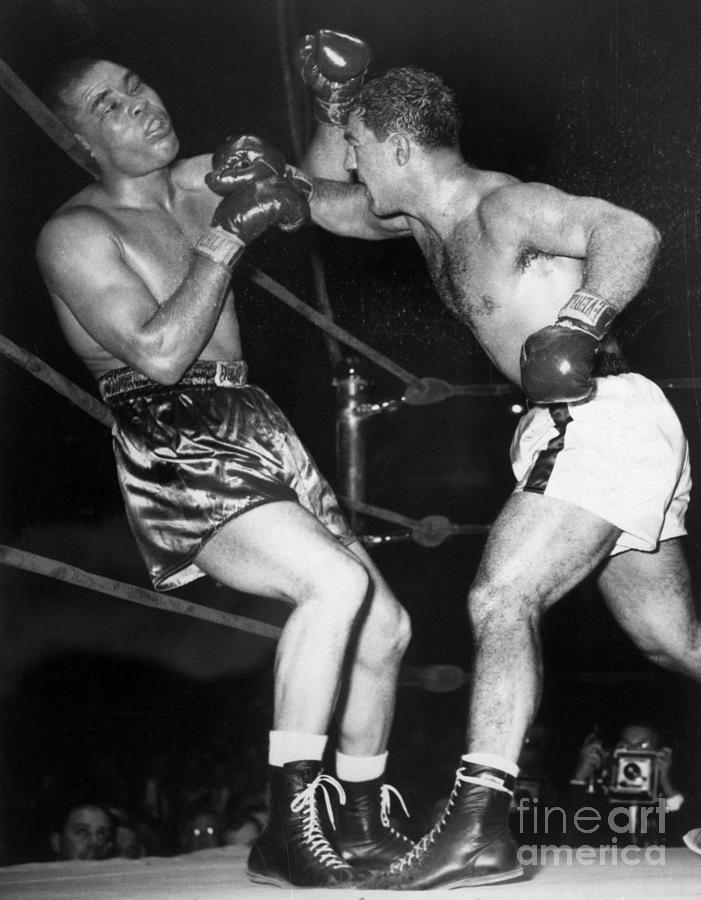
December 5, 1947: Joe Louis defends the Heavyweight Championship of the World against Jersey Joe Walcott, at the old Madison Square Garden. Joseph Louis Barrow had held the title for 10 years. Arnold Raymond Cream, a son of an immigrant from the U.S. Virgin Islands, had named himself after Joe Walcott, from the Caribbean island of Barbados, who held the Welterweight Championship from 1901 to 1906. Jersey Joe, from Pennsauken, across the Delaware River from Philadelphia, was 33, and was thus becoming the oldest man ever to fight for the heavyweight title to that point.

Louis, 56-1 going into the fight, has been called the greatest Heavyweight Champion ever. Those who disagree cite his fighting of what came to be called "The Bum-of-the-Month Club." Most of his opponents were not on his level, although a few were, including Max Schmeling and Billy Conn.

But Louis had trouble with mobile boxers, and Walcott, 42-13-1, was one of them. He knocked Louis down in the 1st round, stunning the live crowd and a nationwide radio audience. He knocked Louis down again in the 4th. As the fight went on, it looked like the twilight of a god: Louis, only 4 months younger than Walcott, looked done.

The fight went the distance, and many observers believed Walcott deserved to be named the winner. But Louis was given a split decision. It was a very controversial decision, even mentioned on an episode of M*A*S*H, 35 years later.

The decision wasn't based on race, as Walcott was also black. It was almost certainly based on money: A rematch could be held in warm weather, outdoors, at the enormous Yankee Stadium, and make more money. Louis won that fight by knockout, on June 25, 1948.

Walcott finally won the title on July 18, 1951, by beating Ezzard Charles. He and Walcott fought 4 times, Charles winning the 1st 2, Walcott the last 2. At 37, he was the oldest man ever to win the title. He lost the title a year later, to Rocky Marciano.

He later refereed the 2nd Muhammad Ali-Sonny Liston fight. In 1971, he was elected Sheriff of his native Camden County, the 1st black Sheriff in New Jersey, serving for 3 years. From 1975 to 1984, he was the Chairman of the New Jersey State Athletic Commission. He died in 1994, 10 months before George Foreman replaced him as the oldest Heavyweight Champion ever. He had outlived Louis by 13 years.

*

December 5, 1947 was a Friday. Baseball was out of season. Football was in midweek: Neither the college ranks, nor the NFL, nor the rebel All-America Football Conference played any games that night. And there were no games scheduled in the NHL.

One game was played in the Basketball Association of America, the league that became the NBA 2 years later: The Boston Celtics beat the Providence Steam Rollers, 73-69 at the Boston Garden.

Wednesday, October 26, 2022

October 26, 1951: Joe Louis' Last Stand

October 26, 1951: Desperate for money to pay a mounting tax bill, Joe Louis, who stood as Heavyweight Champion of the World longer than anyone (12 years, 1937-49) and defended the title more than anyone (25 times), climbs into the ring at the old Madison Square Garden for a purse of $300,000 – about $3.4 million in 2022 money.
He fights Rocky Marciano, then a rising contender who comes into the fight at 37-0. He idolized Louis: telling the press, "This is the last guy I want to fight." It had nothing to do with his own ability, or whatever Louis had left.
It is a mismatch: Marciano is 28, is in superb shape, and has a sledgehammer for a right hand; Louis is 37, struggles with his weight, and his arms and legs, once the fastest in the fight game despite his being a heavyweight, have terribly slowed. Marciano actually knocks Louis out of the ring in the 8th round. Ruby Goldstein, maybe the best referee in the business and himself a former lightweight contender, wisely stopped the fight at that point.
Marciano went back to his dressing room, and cried over what he had done to his greatest hero, and even went over to see him, and said, "I'm sorry, Joe." Sugar Ray Robinson, then Middleweight Champion, was in Louis' dressing room to console him, and was also crying.
Eleven months later, Marciano knocked Jersey Joe Walcott out to become the Heavyweight Champion. He held the title for 3 years, then retired undefeated at 49-0. Louis, still needing money, humiliated himself as a professional wrestler, and not a very good one.
Both men's lives ended badly: Marciano's in a plane crash in Iowa in 1969, just before his 46th birthday; Louis' in a wheelchair, unable to pay his medical bills, with Frank Sinatra hosting a benefit concert for him in Las Vegas in 1978, which kept Louis afloat until he finally passed away in 1981, at 67.
As a Sergeant in the U.S. Army in World War II, he was laid to rest at Arlington National Cemetery, on the order of President Ronald Reagan, and with Sinatra delivering the eulogy. Marciano was interred in a crypt at Forest Lawn Memorial Cemetery in Fort Lauderdale, Florida.
*
October 26, 1951 was a Friday. William "Bootsy" Collins, bass guitarist for George Clinton's P-Funk Empire, was born on this day.

The baseball season was over. Football was in midweek. The NBA season wouldn't start for another 6 days. The NHL season had started, but no games were scheduled. So there were no scores on this historic day.

Tuesday, June 28, 2022

June 28, 1939: Joe Louis vs. Tony Galento

Louis looks like he can't believe
he's wasting his time with this clown.

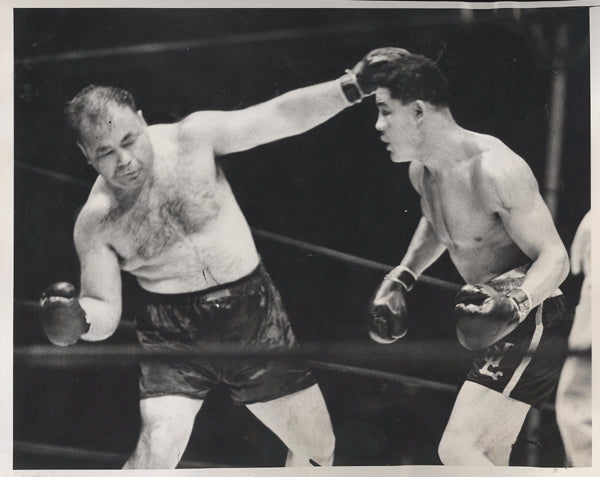
June 28, 1939: Joe Louis steps into the ring at Yankee Stadium to defend the Heavyweight Championship of the World. At first, his opponent looked like little more than the next member of what had become known as Louis' "Bum-of-the-Month Club." Sure, he talked big, but what could he do against the man who had wrecked all comers -- bums, contenders, and former Champions? Surely, this guy was not going to give "The Brown Bomber" a hard time.

Tony Galento was from Orange, Essex County, New Jersey, and 29 years old when he fought Louis, but he sure didn't look like a boxing contender. He was listed at 5-foot-8, but may have been as short as 5-foot-6. And he weighed 240 pounds. Boxing referee Arthur Mercante recalled, "He seemed 5-foot-8, whichever way you looked at him." And he was balding. (Later in life, he took to wearing loud suits and a toupee that even Howard Cosell would have considered gauche.) He was nicknamed "Two-Ton Tony," and he looked like a bartender, which is what he was when he wasn't boxing.

But he was strong, from his previous job as an iceman. And he was mean, from growing up in poverty. He had his 1st professional fight in 1928, and by 1937, he was winning often enough to get by, but not often enough to get a title shot. The Chilean heavyweight Arturo Godoy, who would later lose 2 fights to Louis, beat him in 2 decisions, the 2nd on the undercard of the 1937 fight where Louis beat James J. Braddock to win the title.

But he won his next 11 fights, and Louis needed an opponent for his June '39 fight at Yankee Stadium, and so Galento became the opponent. Asked for a prediction, Galento turned the usual epithet for a Louis opponent back on him: "I'll moidah da bum!" No one, not even his fellow Italian-Americans, took him seriously, even as they rooted for him.

In the weeks leading up to the fight, using the kind of tactics that would later be used on opponents by Muhammad Ali, Galento tried to psych Louis out. Mostly, this consisted of making late-night phone calls, questioning his manhood, using racial slurs, and suggesting that his wife, Marva, was cheating on him.

Yankee Stadium wouldn't have permanent lights until 1946, so temporary lights were set up. A crowd of 34,852 attended, including Governor Herbert Lehman of New York, FBI Director J. Edgar Hoover, former Heavyweight Champion Gene Tunny, married comic actors Jack Benny and Mary Livingstone, and film heartthrob Tyrone Power. NBC broadcast the fight on nationwide radio.

In the 1st round, Galento landed a punch that put Louis on the ropes. Louis quickly recovered, but Galento had won the round. Louis worked on Galento's face in the 2nd round, drawing blood. A left to the chin knocked Galento down. Although he had already lost 23 of his 104 professional fights, 3 by technical knockouts, he had never been knocked down before.

He got back up quickly. In the 3rd round, he threw a left hook that knocked Louis down. He wasn't exactly "murdering the bum," but, to use an expression Ali would later use, he "shook up the world."

But, as he'd already shown in the 1st round, Louis was one of those fighters where hurting him was the worst thing you could do, because he could come back and hurt you worse. He was down for only a moment, shook it off, and went right back to plugging away, preventing Galento from playing his advantage.

As has so often been the case in boxing history, when one man is just a puncher, and the other is a boxer, the boxer usually wins. Sports columnist John A. Cluney wrote that the 4th round "was nothing short of modified murder." Louis landed 30 punches, Galento missing all of his, and Louis knocked Galento down with 31 seconds left in the round. Referee Arthur Donovan had seen enough, and he stopped the fight.

In spite of looking less like a great fighter than anyone Louis had yet faced, Galento had had his moments. The newsreel cameras showed him looking like he'd gone the full 15 rounds, but unbowed, saying, "I shoulda knocked him out."

In 1976, on his PBS sports nostalgia show The Way It Was, Curt Gowdy invited Louis, Galento, and the great boxing broadcaster Don Dunphy, and showed the fight, with Dunphy providing "as if it was happening now" commentary. Galento finally admitted, "I was never gonna knock him out."

Dunphy asked Louis if Galento got him mad. Louis said, "He really got me mad. All those mean things he said about me while training for our fight. He got me mad, all right. So I decided to carry him for a while in the fight, and punish him for those nasty things. But when he knocked me down in the third round, I decided I better not fool around. He hit too hard. So I knocked him out as quickly as I could." Galento apologized for his conduct. Louis entertained no hard feelings.

Galento's next fight was against Lou Nova, and it was considered one of the dirtiest fights of the era. The referee stopped it in the 14th round, awarding Galento a technical knockout. His next 2 fights were against the Baer brothers, Max and Buddy, and both forced him to quit after 7 rounds. In 1943, he knocked out a pre-wrestling Freddie Blassie in 2 rounds, but was knocked out 6 months later by Jack Conley, and that was it for him. Like Blassie, he turned to pro wrestling, which was more his style, anyway. He died in 1979.

*

June 28, 1939 was a Wednesday. These 5 baseball games were played that day, including a spectacular doubleheader:

* Being away from Yankee Stadium didn't hurt the New York Yankees much: They swept a doubleheader from the Philadelphia Athletics, 23-2 and 10-0 at Shibe Park in Philadelphia. The winning pitchers were Monte Pearson and Lefty Gomez.

Over the 2 games, Joe DiMaggio, in the midst of what would be his 1st season awarded the American League's Most Valuable Player, went 5-for-10 with 3 home runs, 2 walks and 5 RBIs. Babe Dahlgren went 7-for-11 with 3 home runs, a walk and 7 RBIs, numbers one would have expected to get from the 1st baseman he replaced, Lou Gehrig, in such a situation.

Joe Gordon went 6-for-12 with 3 home runs and 7 RBIs. George Selkirk went 4-for-10 with a home run, 2 walks and 5 RBIs. Tommy Henrich went 4-for-11 with a home run, 2 walks and 4 RBIs. Bill Dickey went 4-for-9 with a home run, a walk and 2 RBIs. Red Rolfe went 5-for-13 with an RBI. Frankie Crosetti went 5-for-12 with a walk, and while he was the only Yankee starter without an RBI in the opener, he hit a home run in the nightcap.

* The New York Giants beat the Philadelphia Phillies, 7-1 at the Polo Grounds. Mel Ott went 1-for-4 with a walk.

* The Brooklyn Dodgers beat the Boston Bees (as the Braves were known from 1936 to 1940), 6-1 at Braves Field in Boston.

* And the Chicago Cubs beat their arch-rivals, the St. Louis Cardinals, 8-4 at Sportsman's Park in St. Louis.
Wednesday, June 22, 2022

June 22, 1938: Joe Louis Knocks Out Max Schmeling

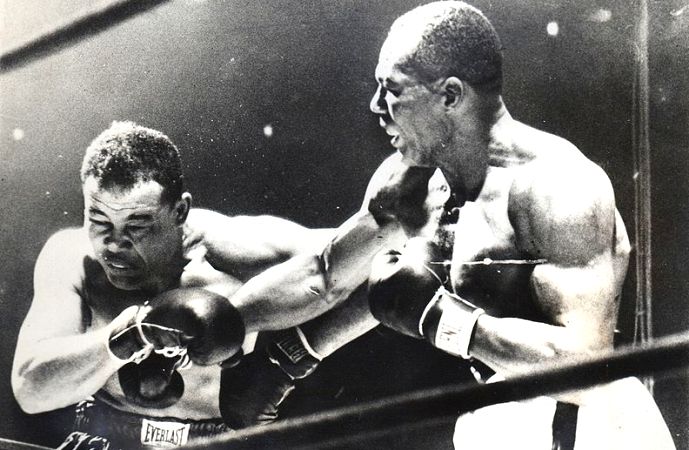
June 22, 1938: Joe Louis, Heavyweight Champion of the World, steps into the ring at the original Yankee Stadium in The Bronx, under temporary lights -- The Stadium will not have permanent lights until 1946 -- in front of a crowd of 80,000 to fight former Heavyweight Champion Max Schmeling.

Born in Alabama as Joseph Louis Barrow, but trained to fight in Detroit, "the Brown Bomber" was the Motor City's 1st great fighter. By 1935, he was challenging men who had been Heavyweight Champion of the World, and winning. In 1936, he lost for the 1st time, to Schmeling.

But he recovered, won 6 more fights, and got a title shot against Champion Jim Braddock, knocking him out at Comiskey Park in Chicago on June 22, 1937. This completed an era in which the Detroit Tigers won back-to-back American League Pennants and a World Series, the Lions won an NFL Championship, and the Red Wings won back-to-back Stanley Cups. Detroit became the 1st city ever to call itself "the City of Champions," and they were right.

There were 5 men who were Heavyweight Champion in the 1930s before Louis, and he had beaten 4 of them: Braddock, Max Baer, Primo Carnera and Jack Sharkey. But he said he wouldn't consider himself the real champ until he beat Schmeling.

Schmeling had previously been rather popular in America. He looked a bit like 1920s Champion Jack Dempsey. Although he had a heavy accent, he spoke fluent English, and was accommodating to the American media. German-Americans were still the nation's largest ethnic group, far ahead of the Irish, the Italians, and all others. And while Germans were despised in America during World War I, that was no longer the case during Schmeling's title-hold, 1930 to 1932.

But at this point, Nazi Germany was holding Schmeling up as an example of "Aryan supremacy." Schmeling didn't like that. He wasn't a bigot. And, with his dark complexion, dark hair, and thick eyebrows, he looked more like one of the Jews that the Nazis hated than a blond, blue-eyed Aryan
Übermensch. Even when World War II came, and he was a paratrooper in the German army -- thus forcing him to swear an oath of loyalty to Adolf Hitler -- he was never a member of the National Socialist Party.

That didn't matter: A message had to be sent to fascists all over the world: America wasn't going to accept anyone as their "masters." And a black man was ready to deliver that message. Going into the fight, President Franklin D. Roosevelt met with Louis, and told him he had to win for all America. And the day of the fight, Louis told a friend, "I'm afraid I'm going to kill Schmeling."

He didn't kill Schmeling. But he sent the message: The fight lasted 2 minutes and 4 seconds. The film shows Schmeling screaming in pain at one point. Joseph Goebbels, the Nazi propaganda minister, ordered the radio network broadcasting the fight throughout the Third Reich to stop broadcasting before Schmeling could be counted out.

Louis was now a hero to all America, white and black alike. He defended the Heavyweight Championship more times than anyone, 25. He held it continuously longer than anyone, 12 years. How he was treated after retiring as Champion is another story, as he was dogged by the taxman and ill health, dying in 1981. He was given a hero's burial at Arlington National Cemetery. Schmeling was one of his pallbearers.

*

June 22, 1938 was a Wednesday. It was the off-season for the NFL, the NBA and the NHL. But there were Major League Baseball games scheduled for that day:

* The fight had been scheduled for Yankee Stadium because it was the biggest stadium in the biggest city, and the Yankees were on the road at the time. They were swept by the Cleveland Indians in a doubleheader at Cleveland Municipal Stadium. Mel Harder outpitched Lefty Gomez, and the Indians won the 1st game 3-1. In the 2nd game, former Yankee Johnny Allen went the distance, beating Monte Pearson, and the Indians won 7-1.

* The New York Giants beat the Cincinnati Reds, 6-4 at the Polo Grounds.

* The St. Louis Cardinals beat the Boston Bees, 4-2 at Braves Field in Boston. The Boston team's name had been changed after a terrible 1935 season, but the ballpark's hadn't been, although it was now nicknamed The Bee Hive. The team became the Braves again in 1941.

* The Detroit Tigers beat the Boston Red Sox, 8-3 at Briggs Stadium (later renamed Tiger Stadium) in Detroit.

* The Chicago White Sox beat the Washington Senators, 16-3 at Comiskey Park in Chicago.

* The Philadelphia Athletics beat the St. Louis Browns, 7-1 at Sportsman's Park in St. Louis.

* And the Brooklyn Dodgers, the Chicago Cubs, the Philadelphia Phillies and the Pittsburgh Pirates were not scheduled. 

Saturday, June 18, 2022

June 18, 1941: Joe Louis vs. Billy Conn

June 18, 1941: Joe Louis defends the Heavyweight Championship of the World against the Light Heavyweight Champion, Billy Conn. Conn might have been the toughest opponent -- figuratively and literally -- that Louis had ever faced.

Louis, 27 and born in Alabama but raised in Detroit, entered the fight with a spectacular record of 50-1. Conn, 23 and from Pittsburgh, was 59-9-1, but had won 17 straight, and had been Light Heavyweight Champion for 2 years. He was forced to give that title up to move up in weight class to fight Louis. (This would not be the case for later Light Heavyweight Champions.) "The Pittsburgh Kid" had been chosen by The Ring magazine, "The Bible of Boxing," as Fighter of the Year in 1940.

The fight was held outdoors, at the Polo Grounds in Upper Manhattan. Conn was, by all accounts, winning after 12 rounds. Then he made a mistake: Instead of running out the clock, he decided to go for the knockout in the 13th round, and left himself exposed. Louis, who won a lot of fights he probably should have lost, seized the opportunity, and knocked Conn out.

After the fight, Conn said, "I lost my head, and a million bucks." The U.S. soon got into World War II, and both Louis and Conn went into the Army. When The War ended in 1945, negotiations for a rematch began, and Conn asked Louis, "Why couldn't you let me hold the title for a year or so?" In other words, After a year, Conn would have happily offered Louis a rematch. Louis told him, "You had the title for 12 rounds, and you couldn't hold onto it."

On June 19, 1946, for the 1st time, a Heavyweight Championship fight was televised, live from Yankee Stadium in The Bronx. In the leadup to the fight, someone told Louis that Conn might try to finish what he started, outpointing him. Louis, in a saying that would become familiar throughout the world, said, "He can run, but he can't hide." Louis was right: He knocked Conn out in the 8th round, for all intents and purposes ending his career. He finished with a record of 64-11-1.

Louis held the title until 1948, then retired, then came back because he needed the money, but was a shell of his former self. He died in 1981.

In 1990, Conn was in a Pittsburgh convenience store when it was robbed. Then 72 years old, he swung his famous left fist at the robber. The punch knocked them both down, they grappled on the floor, and the robber got away -- leaving his coat behind. The coat contained his wallet. So not only did he not get any money or valuables, he'd left his own wallet behind, including his identification, so Conn made it easy for the police to find him.

Billy Conn died in 1993. He was 75, and a hero in the ring, in the Army, and in that store.

*

June 18, 1941 was a Wednesday. These baseball games were played:

* The New York Yankees lost to the Chicago White Sox, 3-2 at Yankee Stadium. Thornton Lee outpitched Spurgeon "Spud" Chandler. Chandler took a 2-1 lead into the top of the 8th, but gave up runs on a single by Taft "Taffy" Wright and a sacrifice fly by George Dickey (no relation to Yankee catcher Bill). Joe DiMaggio went 1-for-3 with a walk. This was the 31st game of his hitting streak.

* The New York Giants and the Pittsburgh Pirates were tied 2-2 after 11 innings, when the game was called due to darkness. Mel Ott hit a home run.

* The Brooklyn Dodgers lost to the Chicago Cubs, 5-1 at Wrigley Field in Chicago. Joe Medwick hit a home run for Dem Bums, while Hank Leiber hit 2 for the Cubbies.

Charlie Keller hit a home run for the Yankees. Joe DiMaggio went 1-for-3 with a walk. It was the 31st straight game in which he'd gotten a hit. He would keep that streak going for a record 56 games.

* The Detroit Tigers beat the Boston Red Sox, 5-2 at Fenway Park in Boston. Jimmie Foxx hit a home run for the Red Sox, but Ted Williams went 0-for-3 with a walk. His batting average dropped... to .417.

* The Cleveland Indians beat the Philadelphia Athletics, 14-2 at Shibe Park in Philadelphia. Bob Feller went the distance for the win, and was backed by home runs from Lou Boudreau, Ray Mack, Ken Keltner, and 2 by Hal Trosky.

* The St. Louis Browns beat the Washington Senators, 3-2 at Griffith Stadium in Washington.

* The Boston Braves beat the Cincinnati Reds, 4-2 at Crosley Field in Cincinnati.

* And the St. Louis Cardinals beat the Philadelphia Phillies, 7-3 at Sportsman's Park in St. Louis.

December 31, 1999 & January 1, 2000: The Millennium

December 31, 1999:  The Millennium arrives. The people of planet Earth survived. At a terrible cost. But we hadn't destroyed ourselves. ...