Showing posts with label south jersey. Show all posts

Wednesday, December 28, 2022

December 28, 1929: The 1st NHL Game In New Jersey

Boardwalk Hall

When was the 1st National Hockey League game in New Jersey? It was the Devils' opener in 1982, right? Actually, it goes back a lot further than you might think.

December 28, 1929: It was at the end of the Roaring Twenties, just 2 months after the stock market's Crash of 1929. No one had yet realized that the Great Depression had begun. The Shore resort of Atlantic City had just opened a new Convention Hall, a 17,000-seat amphitheater, with the round end of the horseshoe pointing to the beach and a stage at the inland end.

The New York Rangers had begun play in the 1926-27 season. In 1927-28, they won the Stanley Cup. In 1928-29, they reached the Stanley Cup Finals, but lost to the Boston Bruins. For reasons lost to time, they decided to play a "home game" of the 1929-30 season 120 miles away, at Convention Hall.

The Rangers were loaded, with a forward line of Frank Boucher centering the brothers Bill and Frederick "Bun" Cook. Their defense was led by Ivan Johnson, known as "Ching" because, in that much less politically correct era, some people, who clearly needed glasses, thought he looked Chinese. Their goalkeeper for this game, and for every game from 1928 to 1933, was John Ross Roach, picked up following a goalkeeping emergency that nearly cost them the '28 Cup.

The Ottawa Senators had won the Cup in 1920, '21, '23 and '27, but were now in decline. They were still led by forwards Frank Nighbor, Frank Finnigan, and the brothers Hector and Wally Kilrea. Their defense still had Frank "King" Clancy and Alex Smith, with Alex Connell in goal.

Boucher opened the scoring at 14:30 of the 1st period. Clancy tied the game at 5:11 of the 2nd. At 9:00, Paul Thompson, later to help the Chicago Black Hawks win the 1934 and '38 Stanley Cups, gave the Rangers the lead. With 2:24 left in regulation, Leroy Goldsworthy (no relation to 1970s hockey star Bill Goldsworthy) gave the Broadway Blueshirts an insurance goal. The Rangers won, 3-1.
Frank Boucher

Two more games would be played at Convention Hall that season. On January 25, 1930, the Chicago Black Hawks beat the Pittsburgh Pirates, 5-2. And on March 15, the Senators returned, and beat the New York Americans, 8-7. The next season, the hockey version of the Pirates became the Philadelphia Quakers, but went out of business after that one season. They played at the Philadelphia Arena, and did not play any games in Atlantic City.

The Rangers reached the Finals again in 1932, and won the Cup in 1933, before rebuilding, and reaching the Finals in 1937 and winning the Cup in 1940. World War II wrecked the franchise, and they have only won the Cup once since, in 1994. They're still better off than the Senators, who went out of business in 1934. A new Ottawa Senators franchise began in 1992, but has only reached the Finals once, in 2007.

Despite the World Hockey Association moving the New York Golden Blades (formerly the New York Raiders) to the Cherry Hill Arena in the Philadelphia suburbs, and renaming them the Jersey Knights, in the middle of the 1973-74 season, after which they folded, there would be no more NHL games in New Jersey for 52 years, until October 5, 1982, when the New Jersey Devils made their regular-season debut, tying the Pittsburgh Penguins, 3-3.

Convention Hall, renamed Boardwalk Hall in 2001, still stands. From 1940 to 1997, and again from 2013 to 2019, it hosted the Miss America Pageant. Within days in August 1964, it hosted both the Democratic National Convention and a concert by The Beatles. It hosted the Liberty Bowl football game in 1964, despite not quite being long enough for a standard football field. It's hosted many concerts, and some big prizefights, the most famous of them being Mike Tyson's 91-second knockout of Michael Spinks in 1988.

*

December 28, 1929 was a Saturday. One other NHL game was played that day: The Boston Bruins beat the Montreal Canadiens, 3-2 at the Montreal Forum. The Bruins had won the Stanley Cup the season before, but the Canadiens would win it this season.

Baseball was out of season. Football season had just ended. The NBA hadn't been founded yet.

One other sports note from this day: The English soccer team I have come to support, Arsenal F.C., went to Yorkshire, and lost to Leeds United, 2-0 at Elland Road. They went on to win their 1st major trophy that season, anyway, the 1930 FA Cup.

Wednesday, November 30, 2022

November 30, 1951: The New Jersey Turnpike Opens

November 30, 1951: The New Jersey Turnpike opens, mostly. For the moment, it runs from Exit 1 in Penns Grove, near the newly-opened Delaware Memorial Bridge, to Exit 11 in Woodbridge, an interchange with U.S. Route 1, U.S. Route 9, State Route 440, and, by 1956, the Garden State Parkway. (On that road, that interchange will be Exit 129.)

Like the later Garden State Parkway, the Turnpike was the brainchild of Governor Alfred E. Driscoll. He set a November 30, 1951 deadline, and there were delays that suggested they wouldn't make it. They did.

The Turnpike was extended to its full 117-mile length the next year, connecting with New York City via the Lincoln Tunnel (Exit 16) and the George Washington Bridge (Exit 18). One notable problem was the Pulaski Skyway, which has carried Routes 1 and 9 from Newark to Jersey City since 1932. If they built the Turnpike under the Skyway, there might not be enough room for trucks to fit. If they built the Turnpike over the Skyway, there would be room, but construction would take a lot more time and money. They decided to build under, and no truck has ever gotten stuck under it. Just in case, a few years ago, a big construction project was undertaken, and it lowered the roadway.

In 1956, the Newark Bay Extension opened at Exit 14, near Newark International Airport. This includes the Newark Bay Bridge, and 3 new exits in Jersey City: Exit 14A for Bayonne, Exit 14B for downtown, and Exit 14C for the Holland Tunnel into New York.

That same year, an extension was built from Exit 6 to the new Delaware River-Turnpike Toll Bridge, connecting the New Jersey Turnpike with the Pennsylvania Turnpike. It is named the Pearl Harbor Memorial Turnpike Extension. From here on north, the New Jersey Turnpike is bannered as part of Interstate 95.

In 1970, the Western Spur was opened, designed to aid travelers going around New York City to New England (taking the Tappan Zee, now Mario Cuomo, Bridge to the New England Thruway). It was also meant to access the planned Meadowlands Sports Complex in East Rutherford. The new exits were labeled 15W, 16W and 18W; while the former Exits 15, 16 and 18 were relabeled 15E, 16E and 18E. In 2005, the newest exit opened: Exit 15X, for the Secaucus Junction Rail Station.

The Turnpike has become not just a great method for getting people from one point in New Jersey to another, or from New York to points south and west (or vice versa) without having to go through Philadelphia, but it's become a cultural icon. Chuck Berry, The Mamas & the Papas, Paul Simon and Bruce Springsteen have all written songs mentioning it. And the opening montage of The Sopranos showed James Gandolfini as Tony Soprano, driving out of the Lincoln Tunnel and down the Turnpike.

Of course, for a lot of people not from New Jersey, the Turnpike is all they see of the State: Things like the Meadowlands' stadiums and swamps, the Skyway, the Airport, the big oil refinery in Linden, and vast swaths of not much of anything taking up the space south of Trenton. These people never see the nice parts of New Jersey, and never understand why it's called "The Garden State."

The Turnpike's exit numbers are sequential, not by milepost as the Parkway's will be. As a result, when new exits need to be built, they require letters. Between Exit 7 in Bordentown Township and Exit 8 in East Windsor is Exit 7A in Robbinsville; and between Exit 8 and Exit 9 in East Brunswick is Exit 8A in Monroe.

If the exits were by mileposts, they would be, as follows: 

* Exit 1, Penns Grove, Salem County, connecting with Interstate 295, U.S. Routes 40 and 130, New Jersey Route 49 and the Delaware Memorial Bridge: Exit 0, or Exit 1.

* Exit 2, Woolwich, Gloucester County, U.S. Route 322 and the Commodore Barry Bridge: Exit 13.

* Exit 3, Runnemede, Camden County, N.J. Route 168 and, by extension, the Atlantic City Expressway and the Walt Whitman Bridge to Philadelphia: Exit 26. Oddly, despite the access to the Expressway, this exit, unlike Exits 7A and 11, is not labeled "Shore Points."

* Exit 4, Mount Laurel, Burlington County, N.J. Route 73 and, by extension, the Ben Franklin Bridge to Philadelphia: Exit 34.

* Exit 5, Westampton, Burlington County, County Route 541: Exit 44.

* Exit 6, Mansfield, Burlington County, Interstate 95 and, by extension, Interstate 276 and the Pennsylvania Turnpike: Exit 51.

* Exit 7, Bordentown Township (surrounding Bordentown City), Burlington County, U.S. Route 206: Exit 53.

* Exit 7A, Robbinsville, Mercer County, Interstate 195: Exit 60. This exit can be used for both the State capital of Trenton and the Six Flags Great Adventure theme park. For drivers going north on the Turnpike, this exit is labeled "Shore Points," due to the access to I-195.

* Exit 8, East Windsor, Mercer County, N.J. Routes 33 and 133: Exit 67.

* Exit 8A, Monroe, Middlesex County, N.J. Route 32 for access to U.S. Route 130 and County Route 535: Exit 74. For me, growing up in East Brunswick in the 1970s and '80s, this was the exit we used for southbound points like Philadelphia, Washington and Virginia.

* Exit 9, East Brunswick, Middlesex County, N.J. Route 18 for access to U.S. Route 1: Exit 83. This was the exit we used for North Jersey and New York City. East Brunswick's main bus terminal was here, and, from 1991 to 2020, I lived 1 mile away, for relatively easy access to The City.

* Exit 10, Edison, Middlesex County, Interstate 287 and N.J. Route 440, and, by extension, the Outerbridge Crossing into Staten Island, New York City: Exit 88.

* Exit 11, Woodbridge, Middlesex County, the Garden State Parkway, U.S. Routes 1 and 9: Exit 91. For drivers going south on the Turnpike, this exit is labeled "Shore Points," due to the Parkway access.

* Exit 12, Carteret, Middlesex County, County Route 602: Exit 96.

* Exit 13, Elizabeth, Union County, Interstate 278 and the Goethals Bridge into Staten Island: Exit 99.

* Exit 13A, Elizabeth, Union County, N.J. Route 81 and, by extension, Newark Liberty International Airport and Elizabeth Seaport: Exit 101. It also provides access to the Jersey Gardens Mall and that big IKEA store visible from the road.

* Exit 14, Newark, Essex County, Interstate 78, U.S. Routes 1, 9 and 22, with access to the Airport and the Newark Bay Extension: Exit 104.

* Exit 15E, Newark, Essex County, U.S. Routes 1 and 9, and thus the Pulaski Skyway toward Jersey City: Exit 107.

* Exit 15W, Kearny, Hudson County, Interstate 280: Exit 108. Theoretically, any of Exits 14, 15E or 15W can be used for downtown Newark and the Prudential Center arena. For Red Bull Arena, Exit 15W is the most convenient.

* Exit 15X, Secaucus, Hudson County, the Secaucus Junction Rail Station: Exit 110.

* Exit 16E, Secaucus, Hudson County, N.J. Routes 3 and 495, accessing the Lincoln Tunnel into Manhattan: Exit 112.

* Exit 16W, East Rutherford, Bergen County, N.J. Route 3 and the Meadowlands Sports Complex: Exit 112.

* Exit 18E and Exit 18W, Carlstadt, Bergen County, Interstates 80 and 95, U.S. Routes 1, 9 and 46: Exit 114.

*

November 30, 1951 was a Friday. Baseball was out of season. There were 3 college football games played that night:

* The University of Richmond beat George Washington University, 20-19 at Griffith Stadium in Washington.

* The University of Miami beat Nebraska, 19-7 at Burdine Stadium (later renamed the Orange Bowl) in Miami. This would happen a few more times in the decades to come.

* And the University of Houston beat North Texas State University (now the University of North Texas), 20-14 at Eagle Field in Denton, Texas.

There was only 1 game played in the NHL that night, at the Montreal Forum, and the Montreal Canadiens and the Toronto Maple Leafs played to a 0-0 tie. There were 3 games played in the NBA that night:

* In a rematch and a reverse of the previous season's NBA Finals, the New York Knicks beat the Rochester Royals, 79-74 at the old Madison Square Garden.

* The Philadelphia Warriors beat the Syracuse Nationals, 81-78 at the Philadelphia Arena. When the Warriors moved to San Francisco in 1962, the Nationals replaced them a year later, as the Philadelphia 76ers.

* And the Washington Capitols beat the Boston Celtics, 85-81 at the Boston Garden. Ironically, the Celtics had just hired a former Capitols coach, who quit because he didn't have the team owner's backing to acquire what he thought were the necessary players. With Walter Brown, owner of the Garden, the Celtics and the Bruins, and making more money on the Ice Capades than on the rest of it combined, paid for the players his new coach wanted.

That new coach was a native of Brooklyn, but went to George Washington University, and seemed at first to be a natural to coach the Caps. And, for the rest of his life, despite being involved with the Celtics in one capacity or another, he kept his home in Washington. He was Arnold Jacob "Red" Auerbach.

Friday, November 11, 2022

November 11, 1985: Pelle Lindbergh Is Killed

November 11, 1985: Pelle Lindbergh is killed in a drunken driving crash, ending his life and his hockey career at the age of 26.

Göran Per-Eric Lindbergh was born on May 24, 1959 in Stockholm, the capital of Sweden. He starred as the goaltender for hometown hockey teams Hammarby and AIK, and helped his country win the Bronze Medal at the 1980 Winter Olympics in Lake Placid, New York. (It gets forgotten in the wake of the wins over the Soviet Union in the Semifinal and Finland in the Final, but Sweden actually came closer to beating the U.S. team than any other, with a tie in the opening game.)

In 1979, Pelle became the 1st European-born goalie to be selected in the NHL Entry Draft, by the Philadelphia Flyers. He made his NHL debut toward the end of the 1981-82 season, and was selected to the NHL All-Rookie Team and the NHL All-Star Game the following season.

The Flyers won the Stanley Cup in 1974 and 1975, and reached the Finals in 1976, with Hall-of-Famer Bernie Parent in goal. They remained strong through 1978-79, but late in that season, Parent took a stick through the eyehole in his mask, permanently damaging his vision, and he never played again.

And, ever since, the Flyers have had some talent, but they haven't found that lockdown goalie. With Pete Peeters, they reached the Finals in 1980, but lost. Lindbergh looked like the answer, especially in 1985, when he made his 2nd All-Star Game, became the 1st European to receive the Vezina Trophy as the NHL's top goalie, and helped get the Flyers into the Finals again, losing to the Edmonton Oilers' dynasty.

While the Oilers seemed to have a hammerlock on the Clarence Campbell Conference (now the Western Conference), the Prince of Wales Conference (now the Eastern Conference) looked wide-open. The Montreal Canadiens' dynasty of 1976-79 had gotten old, and the New York Islanders' dynasty of 1980-84 was already starting to break up due to injury.

There was room for a new dominant team in the East, and with Lindbergh in goal; Mark Howe, Brad Marsh, Brad McCrimmon and Ed Hospodar as defensemen; and forwards like Dave Poulin, Peter Zezel, Brian Propp, Tim Kerr, Dave Brown, Rick Tocchet, and the twins Ron and Rich Sutter, the Flyers looked like they could become that team.

On November 9, 1985, the Flyers hosted a team party at the Coliseum, their practice facility in Voorhees, Camden County, New Jersey. Part of the stereotype of hockey players is that they like to drink, and Lindbergh drank a lot that night. Unfortunately, he got into his car, a customized Porsche 930 Turbo, and headed back toward his apartment across the Delaware River in Philadelphia.

He didn't even make it 2 miles: He crashed into a wall in front of Somerdale Park School, damaging his brain stem and his spinal cord. His blood-alcohol content was .24, and the legal limit in New Jersey was then .10. He had 2 passengers, not easy in a 2-seater, not players but friends of players: Edward Parvin had a fractured skull, and Kathy McNeal had a broken pelvis, a ruptured liver and a ruptured spleen.
They both survived. Lindbergh was brain-dead. His family was brought in from Sweden, and he was kept on life support long enough for them to arrive and say their goodbyes. The machines were turned off on November 11, and his parents gave their permission to have his organs harvested for donation.

Lindbergh received the most votes in the fan balloting for the 1986 NHL All-Star Game. It was the 1st time an athlete was posthumously voted to an All-Star Game. It's only happened once since, with Sean Taylor of the Washington Redskins being selected to the 2008 Pro Bowl.

Given his early death, the Flyers have never again given out his uniform Number 31. But, given the cause of his death, they can't officially retire it. They have instituted the Pelle Lindbergh Memorial Trophy, given to their most improved player. He hasn't been elected to the Hockey Hall of Fame, but he has been elected to the Swedish Hockey Hall of Fame.

The Flyers played the rest of the season in a daze. But they made Ron Hextall their new starting goalie, and he got them into the Stanley Cup Finals in 1987. They reached the Finals again in 1997 and 2010. But they've never won another Cup. Given Hextall's performance in the 1987 Finals, it's hard to say Lindbergh would have made the difference that time. But in 1997, when they got swept by the Detroit Red Wings, Lindbergh would have been 38 years old, which is hardly too old to be a Cup-winning goalie.

UPDATE: In 1988, the Flyers established a team Hall of Fame. As of the 2025-26 season, from their 1985 and '87 Stanley Cup Finalists, they have elected Tim Kerr, Brian Propp, Mark Howe, Dave Poulin and Ron Hextall. Kerr, Propp, Howe, Hextall were also elected to the Philadelphia Sports Hall of Fame. Pelle Lindbergh has been elected to neither. Nor has he been elected to the Hockey Hall of Fame in Toronto.

*

November 11, 1985 was a Monday. The baseball season was over. On ABC Monday Night Football, the Denver Broncos beat the San Francisco 49ers, 17-16 at Mile High Stadium in Denver. And there was 1 game played in the NBA: The New Jersey Nets lost to the San Antonio Spurs, 111-104 at the HemisFair Arena in San Antonio.

And there were 2 games scheduled for the NHL that night, neither of them involving the Flyers. In an "Original Six" matchup, the New York Rangers lost to the Chicago Black Hawks, 5-4 at Madison Square Garden. Bob Murray scored the winner for the Hawks, 53 seconds into overtime. And the Vancouver Canucks beat the Detroit Red Wings, 5-0 at the Pacific Coliseum in Vancouver.

Thursday, September 29, 2022

September 29, 1975: The Tragedy of Jackie Wilson

September 29, 1975: "Dick Clark's Good Ol' Rock and Roll Revue" is held at the Latin Casino, in the Philadelphia suburb of Cherry Hill, New Jersey. In the middle of the song that launched him to stardom in 1959, "Lonely Teardrops," Jackie Wilson sings the line, "My heart is crying, crying... " and collapses onstage.

Like Elvis Presley and James Brown, both of whom had copied him to an extent, Wilson was known for his onstage histrionics, earning him the nicknames "Mr. Excitement" and "The Guy With a Tear in His Eye." He was also known to take salt tablets before going onstage, because he thought women liked to see men sweating when they sang onstage. All this, and an all-around wild lifestyle, had given him a heart attack.

What's worse, his onstage reputation was such that, at first, nobody realized that this collapse wasn't part of the act. By the time the paramedics got to him, his brain had been deprived of enough oxygen to leave damage. He never recovered, spending the rest of his life in hospitals and nursing homes. One of the greatest R&B singers of all time, Jackie was forcibly retired at age 41, and died at 49, on January 21, 1984.

Later that year, singer Marvin Gaye was shot and killed by his father. Gaye had been one of the big stars of Motown Records, founded by Berry Gordy Jr., who got his start writing songs for Jackie Wilson. Another Motown group, The Commodores -- Lionel Richie had gotten his start as their lead singer, but had since gone solo -- recorded "Nightshift," a song that saluted both Gaye and Wilson. It hit Number 3 early in 1985.

It wasn't the 1st song to salute Wilson: In 1972, while he was still alive and performing, Irish singer Van Morrison had a hit song titled "Jackie Wilson Said (I'm In Heaven When You Smile)."

Also on this day, Casey Stengel died of cancer in his adopted hometown of Glendale, California, in the Los Angeles suburbs. "The Ol' Perfesser" was 85. He first wore a major league uniform in 1912, and last did so in 1965. In between, in those 54 seasons, as a player and a manager, he had been a part of 14 Pennant winners and 9 World Championships. He had last appeared in a major league ballpark on June 28, for the Mets' Old-Timers Day.
Jim Murray, the great sports columnist for the Los Angeles Times, wrote, "Well, God is certainly getting an earful tonight."

*

September 29, 1975 was a Monday. Baseball's regular season had ended the day before. The NBA, ABA, NHL and WHA seasons would start in the next few weeks. The only score on this day was a game on ABC Monday Night Football: The Denver Broncos beat the Green Bay Packers, 23-13 at Mile High Stadium in Denver.

Thursday, September 8, 2022

September 8, 1921: The 1st Miss America Pageant

September 8, 1921: The 1st Miss America Pageant is held at Atlantic City, New Jersey. The winner is Margaret Gorman, a 16-year-old native of Washington, D.C. She is still the only Miss America winner who did not come from an actual State.

Gorman was a junior at Western High School in Washington when her photo was entered into a popularity contest at the Washington Herald. She was chosen as Miss District of Columbia on account of her athletic ability, past accomplishments, and outgoing personality.

As a result of that victory, she was invited to join the Second Annual Atlantic City Pageant held on September 8, 1921, as an honored guest. There she was invited to join a new event: the "Inter-City Beauty" Contest. She won the titles "Inter-City Beauty, Amateur" and "The Most Beautiful Bathing Girl in America" after competing in the Bather's Revue. She won the grand prize, the Golden Mermaid trophy. She was expected to defend her positions the next year, but someone else had attained the title of "Miss Washington, D.C.," so she was instead crowned as "Miss America."

A tradition was born. The Pageant would later be limited to unmarried women between the ages of 18 and 28. The contest is now judged on these competition segments with the following scoring percentages:

* Private Interview (30 percent), a 10-minute press conference-style interview with a panel of judges.
* On Stage Question (10 percent), answering of a judge's question while onstage.
* Talent or HER Story (20 percent), a performance talent or 90 second speech.
* Health and Fitness (20 percent), in which contestants demonstrate physical fitness onstage while dressed in athletic wear. And:
* Evening Gown (20 percent), in which contestants model evening-wear onstage.

In 1950, the "year" of Miss America was moved to the following year, since the Pageant was usually held during Labor Day weekend, with the majority of the year having already passed. So there was no Miss America 1950. The COVID-19 pandemic canceled the Pageant, so there was no Miss America 2021.

Among the more prominent winners have been Bess Myerson, 1945, the 1st Jewish winner and later a well-known consumer advocate; Lee Meriwether, 1955, later a prominent actress; Mary Ann Mobley, 1959, also an actress; Phyllis George, 1971, later part of CBS' studio team on The NFL Today, and in 1989 and 1990 the 1st female host of the Pageant; Kaye Lanie Rae Rafko, 1988, the 1st Asian winner; and Heather Whitestone, 1995, the 1st winner with a disability (she was deaf). There has never been an openly gay Miss America, and not until Erin O'Flaherty in 2016 was there even an openly gay contestant.

In 1984, Vanessa Williams became the 1st black winner. But she also had to become the 1st winner to resign her crown, due to a scandal that no longer matters. Oddly, the runner-up who took her place was also black: Suzette Charles, from Mays Landing, New Jersey, just a few miles from Atlantic City. Williams would go on to become a big singing and acting star, and most people have forgotten that she was ever Miss America, let alone why she had to stop. In 2015, all seemed to be forgiven, when Williams was invited to be the Pageant's head judge.

New York has had the most winners, 7. Right behind, with 6, are California, Ohio and Oklahoma. There is often seen to be a bias against candidates from New England: Connecticut has had only 1 winner, and the remaining New England States -- Maine, New Hampshire, Vermont, Massachusetts and Rhode Island -- have none between them. Other States with none: Delaware, Idaho, Iowa, Louisiana, Maryland, Montana, Nevada, New Mexico, South Dakota, Washington West Virginia and Wyoming.

The Pageant was first televised in 1954, on NBC, and that network has usually broadcast it ever since. Bert Parks hosted the Pageant every year from 1955 to 1979, until he was infamously fired. After the crowning of the new winner, he would sing, "There she is, Miss America! There she is, your ideal!" Other notable hosts included Bob Russell (1940-54), Gary Collins (1982-90, and married to Mobley), Regis Philbin and Kathie Lee Gifford (1991-95), Donny and Marie Osmond (1999 and 2000), Tony Danza (2001), and Wayne Brady (2002).

On a 1978 episode of Match Game, there was a question about a man's girlfriend: "From the back, she looks like Miss America. From the front, she looks like (blank)." Panelist Richard Dawson said, "Bert Parks." Meriwether and Mobley both served as semi-regular panelists on Match Game.

The Pageant was subjected to a feminist protest in 1968, as women through various things connected with traditional womanhood into a trash can on the Atlantic City Boardwalk. The objects were not, however, set on fire. Somewhere down the line, this action and the burning of men's draft cards during the Vietnam War became conflated as "women burning their bras."

From 2005 to 2013, the Pageant was held in Las Vegas, which had preceded Atlantic City as a legal gambling center. It then moved back to Atlantic City.

Margaret Gorman later said: "I never cared to be Miss America. It wasn't my idea. I am so bored by it all. I really want to forget the whole thing." In 1925, she married Victor Cahill, and was married until he died in 1957. She lived all her life in Washington, became a socialite and enjoyed traveling. She died on October 1, 1995, aged 90.

*

September 8, 1921 was a Thursday. These baseball games were played:

* The New York Yankees lost to the Philadelphia Athletics, 6-5 at Shibe Park in Philadelphia. Babe Ruth hit his 53rd home run of the season. He would finish with 59. But pitcher Tom Rogers melted down in the bottom of the 9th, allowing 2 runs.

* A doubleheader was split at Braves Field in Boston. The Philadelphia Phillies won the opener, 8-6. The Boston Braves won the nightcap, 13-2.

* The Detroit Tigers beat the Cleveland Indians, 15-1 at League Park in Cleveland. Tiger player-manager Ty Cobb went 3-for-6 with 3 RBIs. Indian player-manager Tris Speaker went 1-for-4.

* The Chicago Cubs beat the Cincinnati Reds, 6-2 at Cubs Park (later renamed Wrigley Field) in Chicago.

* The St. Louis Browns beat the Chicago White Sox, 4-3 at Sportsman's Park in St. Louis. George Sisler went 2-for-3 with a walk and an RBI. Eddie Collins went 0-for-2 with a walk.

 And the New York Giants, the Brooklyn Dodgers, the Pittsburgh Pirates, the St. Louis Cardinals, the Boston Red Sox and the Washington Senators were not scheduled.

Wednesday, September 7, 2022

September 6, 1949: The "Walk of Death" In Camden

September 6, 1949: The "Walk of Death" occurs in Camden, the largest city in southern New Jersey, across the Delaware River from Philadelphia. It is regarded as the 1st mass shooting in American history.

Born in Camden in 1921, Howard Unruh was a moralist and a mama's boy. Serving in World War II changed him, leading to a description of him as "moody, nervous and detached." In 1949, he began arguing with his neighbors.

At 9:20 AM on September 6, he took a Lugar P08 pistol and some ammunition, walked onto River Road, into the shop of his neighbor, shoemaker John Pilarchik, and killed him. He then went to the barbershop of another neighbor, Clark Hoover, killing both him and Orris Smith, the 6-year-old boy whose hair he was cutting. He ran toward the pharmacy of another neighbor, Maurice Cohen. Before he could get there, he saw insurance man James Hutton blocking his path. A man truly in the wrong place at the wrong time, Hutton was killed, even though Unruh had never even met him before.

The Cohen family tried to escape. But Maurice's wife Rose and 12-year-old son Charles hid in closest, and Unruh found Rose, and killed her. Then he killed Cohen's mother, Minnie, because she was on the phone with the police. He followed Maurice onto a porch roof, and shot him. Charles got away unharmed, the only surviving member of the family.

Unruh walked back to River Road, saw a car coming, and shot the driver, Alvin Day. He went after another neighbor at his store, tailor Thomas Zegrino. He wasn't there, making him the only intended victim to survive. But his wife Helga was there, and Unruh killed her.

He ran back to River Road, saw a car waiting at an intersection, and shot everybody in it: Helen Wilson, her son John, and her mother, Emma Matlack. All 3 died. He then fired through an apartment window, killing 2-year-old Thomas Hamilton. Total victims: 13.

A man named Frank Engel saw Unruh from a tavern window, ran out, and shot him in the leg. Trying to get away, Unruh shot at Madeline Harris and her son Armand, outside their home. Both were wounded, but survived.

Unruh went back to his apartment building, which was quickly surrounded by the police. They lobbed tear gas bombs into the apartment. He came out and gave up. The police found a list of his intended victims, an arsenal of weapons, and a Bible opened to the 24th Chapter of The Gospel of Matthew.

Unruh was diagnosed with paranoid schizophrenia, making him immune to criminal prosecution. He was taken to Trenton Psychiatric Hospital, and remained there until his death on October 19, 2009 -- 60 years after his crime. In his last interview with a psychologist, he showed no remorse, saying, "I'd have killed a thousand if I had enough bullets."

He even outlived Charles Cohen, 12 at the time of the shooting. He died on September 4, 2009, at the age of 72. His funeral was 2 days later, on the 60th Anniversary of the crime. In the intervening years, mass shootings started out rare, then became common in the 1980s, and got out of control early in the 21st Century.

On February 14, 2018, there was a mass shooting at Marjory Stoneman Douglas High School in Parkland, Florida, in which 17 people died. Carly Novell survived the mass shooting, by hiding in a closet. Just like her grandfather: Charles Cohen.

As Mark Twain once put it, "History doesn't repeat itself, but it often rhymes."

*

September 6, 1949 was a Tuesday. There were 4 baseball games played that day:

* The New York Giants split a doubleheader with the Philadelphia Phillies at the Polo Grounds. The Phils won the opener, 4-2, when Bill Nicholson, known as "Swish" because he struck out a lot, singled, and, with the help of an error, Stan Lopata and Del Ennis scored. The Giants won the nightcap, 4-1, on a home run by Wes Westrum.

* The Brooklyn Dodgers beat the Boston Braves, 10-2 at Braves Field in Boston. Don Newcombe went the distance for the win. Jackie Robinson went 2-for-4 with a walk.

* And the Cincinnati Reds beat the Pittsburgh Pirates, 6-3 at Forbes Field in Pittsburgh. Ralph Kiner hit a home run. The Pirates scored 4 runs in the top of the 10th, and the Reds could only come back with 1 in the bottom half.

Tuesday, September 6, 2022

September 6, 1968: The Miss America Protest

September 6, 1968: Feminists protest the Miss America Pageant on the Boardwalk in Atlantic City, New Jersey. Some people consider this the beginning of the modern feminist movement in America, a.k.a. Second Wave Feminism.

To counter the song Bert Parks, host of the Pageant's broadcast, sang after each Miss America was crowned – "There she is, Miss America! There she is, your ideal!" – they threw items they considered "instruments of oppression" into a trash can.

This included bras. Somehow, in the public mind, this got conflated with men burning their draft cards, and it became the beginning of "bra burning." In fact, nothing was burned at this protest. Maybe some people got sunburn, but there was never a public bra burning in the name of feminism, not on this occasion, or on any other.

The next day, Judith Anne Ford, Miss Illinois, won the Pageant.

*

September 6, 1968 was a Friday. These baseball games were played:

* The New York Mets lost to the Pittsburgh Pirates, 2-1 at Forbes Field in Pittsburgh. Steve Blass outpitched Jim McAndrew. Roberto Clemente hit a home run. The Mets' only run came on a home run by Jerry Grote.

* The Chicago White Sox beat the Baltimore Orioles, 3-2 at Memorial Stadium in Baltimore. Buddy Bradford won the game with a home run leading off the top of the 11th inning. Brooks Robinson went 2-for-5 with an RBI. Frank Robinson went 1-for-6.

* The Atlanta Braves beat the Houston Astros, 7-1 at Atlanta Stadium (later renamed Atlanta-Fulton County Stadium). Hank Aaron went 1-for-3 with a walk.

* The Los Angeles Dodgers swept a doubleheader from the Cincinnati Reds, 6-4 and 8-6 at Crosley Field in Cincinnati. Over the 2 games, Pete Rose went 3-for-10, and Johnny Bench, about to be named National League Rookie of the Year, went 3-for-6 with a walk.

* The Detroit Tigers beat the Minnesota Twins, 8-3 at Tiger Stadium in Detroit. Al Kaline went 1-for-3 with a walk and an RBI. Harmon Killebrew struck out as a pinch-hitter, and Rod Carew did not play. The Twins did get a sign of the future, as Graig Nettles hit a home run, but he wouldn't give most of that future to them.

* The Philadelphia Phillies beat the Chicago Cubs, 5-2 at Wrigley Field in Chicago. Ernie Banks went 1-for-4 with an RBI.

* The San Francisco Giants swept the St. Louis Cardinals, 3-2 and 8-7 at Busch Memorial Stadium in St. Louis. Willie Mays only appeared as a defensive replacement in the 1st game, in which Bobby Bolin outpitched Bob Gibson, who fell to 20-7, with an ERA of 1.03. Juan Marichal outpitched Steve Carlton in the 2nd game, in which Mays went 3-for-4 with a home run and 3 RBIs.

* The California Angels beat the Boston Red Sox, 4-0 at Anaheim Stadium (now Angel Stadium of Anaheim). Andy Messersmith pitched a 2-hit shutout. Carl Yastrzemski went 0-for-1 with 3 walks.

* The Oakland Athletics beat the Cleveland Indians, 7-0 at the Oakland Coliseum. John "Blue Moon" Odom pitched a 6-hit shutout. Rookie Reggie Jackson went 0-for-2 with 2 walks.

* And the New York Yankees and the Washington Senators were rained out at Yankee Stadium. The game was made up as part of a doubleheader the next day. The Yankees swept, 16-2 and 10-0. Mel Stottlemyre won the 1st game, and went 2-for-4 to help his own cause. The Yankees got home runs from Jake Gibbs, Joe Pepitone and Roy White. Mickey Mantle, in what turned out to be his last month as an active player, went 2-for-3 with a walk and an RBI in the 1st game, and got the 2nd game off.

Fritz Peterson won the 2nd game, and the Yankees got home runs from Frank Fernández and, newly acquired and in his last month as an active player, Bronx native and former Cleveland and Detroit slugger Rocky Colavito. 

Over the 2 games, White went 4-for-8 with 2 walks and 2 RBIs, Gibbs went 1-for-6 with 2 RBIs, Pepitone went 2-for-5 with a walk and 2 RBIs, Horace Clarke went 4-for-11 with 3 RBIs, and Tom Tresh went 3-for-9 with 2 RBIs.

Tuesday, August 16, 2022

August 16, 1951: The Delaware Memorial Bridge Opens

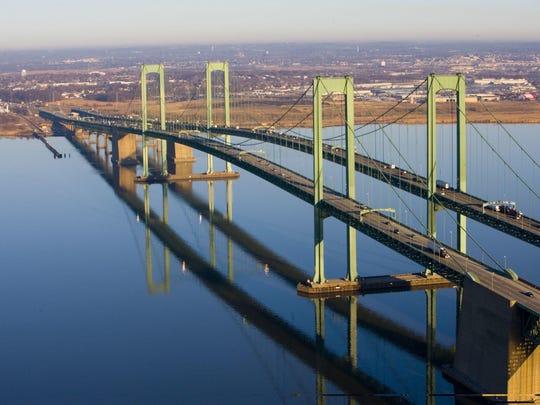
August 16, 1951: The Delaware Memorial Bridge opens, connecting New Castle, New Castle County, Delaware and Pennsville, Salem County, New Jersey, over the Delaware River. It is operated by the Delaware River and Bay Authority.

It is 5 miles southeast of Rodney Square in Wilmington; 34 miles southwest of Center City, Philadelphia; 50 miles north of Legislative Hall (Delaware's State Capitol building) in Dover, 118 miles southwest of Midtown Manhattan; 70 miles northwest of Atlantic City; 73 miles northeast of downtown Baltimore; 91 miles northwest of Rehoboth Beach; and 108 miles northeast of downtown Washington, D.C.

Until 1926, the year what's now known as the Ben Franklin Bridge opened between Philadelphia and Camden, there was no way to get from Delaware's largest city, Wilmington in New Castle County, to New Jersey, except by train. But if, say, you only needed to go 20 miles to Salem, New Jersey, it made no sense to make the 30-mile train trip to Philadelphia, and then another 40 miles to Salem. The aforementioned Bridge only made things a little easier.

A ferry was established as a stopgap measure. Some stopgap: After debating whether a bridge or a tunnel should be built, Congress approved construction of a bridge in 1946. It finally opened 5 years later, bannered as U.S. Route 40 (which had been using the ferry). Soon, it became the southern end of the New Jersey Turnpike. In 1956, the Delaware Turnpike opened, connecting each State's most important highway.

The opening of the Turnpikes put too many cars on the span, and a 2nd bridge was ordered. On September 12, 1968, what's now the westbound span (toward Delaware) was opened, with the original span carrying eastbound traffic (toward New Jersey). In addition to Route 40, the "Twin Span" now carried Interstate 295. Its 174-foot-high towers are arguably the most famous structures in Delaware.

Even though the Bridges were 84 miles from the house in Central Jersey where I grew up, if a trip takes me in that direction, getting over the eastbound span meant I was back in New Jersey, so it felt like I was close to home, just as it did when I would come through the Lincoln Tunnel getting back from New York, 36 miles from home.

*

August 16, 1951 was a Wednesday. These baseball games were played:

* The New York Yankees beat the Washington Senators, 8-5 at Griffith Stadium in Washington. Eddie Lopat was the winning pitcher. Yogi Berra went 4-for-5 with a home run and 4 RBIs. Joe DiMaggio, in his last 2 months as an active player, went 1-for-5. Mickey Mantle, having a rough rookie season, had been sent down to the minor leagues, and not yet called back up.

* The New York Giants beat their arch-rivals, the Brooklyn Dodgers, 3-1 at the Polo Grounds. Jim Hearn outpitched Ralph Branca. Wes Westrum hit a home run. Rookie Willie Mays went 1-for-3. Jackie Robinson appeared only as a pinch-hitter, and did not reach base. The Dodgers had led the Giants, indeed the entire National League, by 13 1/2 games on August 11. That lead was now beginning to be reduced.

* The Boston Braves beat the Philadelphia Phillies, 9-0 at Braves Field in Boston. Warren Spahn allowed 8 hits, but kept the shutout.

* The Boston Red Sox beat the Philadelphia Athletics, 4-2 at Shibe Park in Philadelphia. Ted Williams went 0-for-4.

* The Pittsburgh Pirates beat the St. Louis Cardinals, 7-0 at Forbes Field in Pittsburgh. Bob Friend pitched a 2-hit shutout, although he walked 8 batters, including Stan Musial once. Ralph Kiner hit a home run.

* The Cincinnati Reds beat the Chicago Cubs, 1-0 at Crosley Field in Cincinnati. Ken Raffensberger pitched a 7-hit shutout. The only run of the game came in the bottom of the 4th, on a home run by Ted Kluszewski.

* The Chicago White Sox beat the Detroit Tigers, 2-0 at Comiskey Park in Chicago. Saul Rogovin pitched a 5-hit shutout.

* The Cleveland Indians beat the St. Louis Browns, 9-4 at Sportsman's Park in St. Louis. The Tribe scored 7 runs in the 1st inning, in support of Early Wynn, knocking Ned Garver out of the game.

Friday, July 1, 2022

July 1, 1974: Great Adventure Opens

July 1, 1974: The Great Adventure theme park opens in Jackson, Ocean County, New Jersey, about 60 miles southwest of Midtown Manhattan, and 50 miles northeast of Center City Philadelphia.

It took the place of such already-gone amusement parks as Steeplechase Park in Brooklyn's Coney Island (which closed in 1964, leaving Astroland as Coney's only remaining amusement park), Palisades Amusement Park in the town of the same name in Bergen County (closed in 1971), and Woodside Amusement Park in Philadelphia's Fairmount Park (closed in 1955). It essentially meant the demise of Willow Grove Park in Bucks County, Pennsylvania in 1975. But it also meant a closer option for Philadelphia-area people than the Jersey Shore, 60 miles away at its closest point.

New York businessman Warner LeRoy bought the land from the parachute-making Switlik family, and built the park. The main part of the park was called the Enchanted Forest, and it included roller coasters, a log flume, a monorail, and Wild West-themed rides. Its arcades and eateries, including the ice cream-themed Yum Yum Palace, and its drive-through safari, quickly became beloved by young people in New Jersey, New York, Pennsylvania and Delaware. My family went there that first year, and then every year through 1985.

In 1977, the Six Flags amusement-park company bought Great Adventure. A deal was cut with Warner Brothers to have their cartoon characters, like Bugs Bunny, in costumes. They also cut deals with DC Comics for rides based on their characters, such as Superman and Batman.
The classic rainbow & stars logo

On May 11, 1984, a fire at the Haunted Castle killed 8 teenagers from Queens, and forever cast a pall over the park. But it remains open to this day.

It's hard to believe it's been almost 50 years. It doesn't seem like something that goes back as far as Richard Nixon. To me, it will always bring up thoughts of the late 1970s, the Jimmy Carter years, or the early 1980s, the 1st Ronald Reagan term. It was an escape from the nonsense of the outside world, which was probably why that '84 fire stands out so much in New Jersey's collective memory: The outside world broke through the bubble.

It was a wonderland carved out of the Pine Barrens, for, as the Ringling Brothers/Barnum & Bailey Circus put it, "children of all ages." To this day, many of us refuse to use the corporate name of Six Flags. The original name was perfect: Great Adventure.

*

July 1, 1974 was a Monday. These games were played in Major League Baseball that day:

* The New York Yankees lost to the Detroit Tigers, 4-3 at Tiger Stadium in Detroit. Ron Blomberg hit a home run, but Jim Northrup won the game with a home run off Doc Medich in the 8th inning. Al Kaline went 1-for-4 with an RBI.

* The Boston Red Sox beat the Baltimore Orioles, 6-4 at Memorial Stadium in Baltimore. Carl Yastrzemski went 1-for-2 with a walk and an RBI. Brooks Robinson went 0-for-3, but drove in a run with a groundout.

* The Cleveland Indians swept a doubleheader with the Milwaukee Brewers at Cleveland Municipal Stadium, 3-1 and 9-3.

* The Kansas City Royals beat the Chicago White Sox, 9-0 at Comiskey Park in Chicago. Bruce Dal Canton pitched a 5-hit shutout, and rookie George Brett went 0-for-5.

* The Texas Rangers beat the Minnesota Twins, 6-2 at Metropolitan Stadium in the Minneapolis suburb of Bloomington, Minnesota. Harmon Killebrew hit a pinch-hit home run, the 553rd home run of his career, and Rod Carew went 1-for-4 with a walk.

* The Oakland Athletics beat the California Angels, 5-3 at Anaheim Stadium (now Angel Stadium of Anaheim). Nolan Ryan took a 3-2 lead into the top of the 8th inning, but gave up a single to Bert Campaneris, an RBI double to Sal Bando, an intentional walk to Reggie Jackson, an RBI sacrifice fly to Joe Rudi, a walk to Gene Tenace, and an RBI double to Ángel Mangual.

* While the entire American League played that day, only 2 games were played in the National League. The Montreal Expos beat the Chicago Cubs, 10-4 at Jarry Park in Montreal.

* And the Houston Astros beat the Atlanta Braves, 3-0 at Atlanta Stadium. (It was renamed Atlanta-Fulton County Stadium the next season.) Don Wilson pitched a 5-hit shutout, and Phil Niekro got knocked out of the box in the 4th inning, having allowed just 2 runs, but 10 hits. Hank Aaron did not play in this game.

July 1, 1964: The Cape May-Lewes Ferry Opens

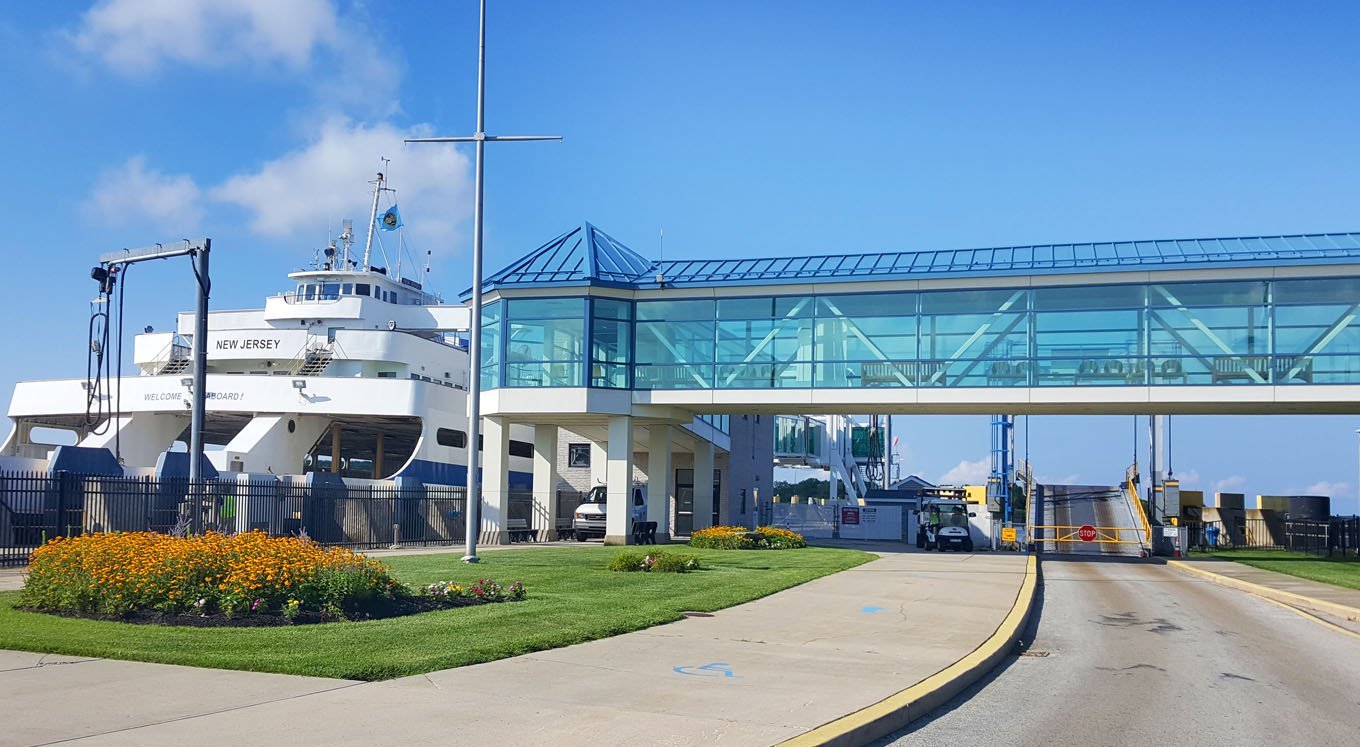
Cape May Ferry Terminal

July 1, 1964: The Cape May-Lewes Ferry begins operation, connecting North Cape May in Lower Township, Cape May County, New Jersey with Lewes, Delaware, across 17 miles of Delaware Bay. Fare: $21 per car, and $8.00 per passenger therein; so, $29.

Ferry service across the Bay had been planned since 1926, when what is now named the Benjamin Franklin Bridge opened, connecting Philadelphia with Camden, New Jersey. But people trying to get from New Jersey to Delaware, or vice versa, had to use that bridge. For people in southernmost New Jersey, or anywhere in Delaware, it was a bit out of the way.

The construction of the original span of the Delaware Memorial Bridge in 1951 helped a little; the opening of the Walt Whitman Bridge in 1957 didn't help at all, since it was further north than the Delaware Memorial. So the Delaware River and Bay Authority (DRBA) acted, and bought 5 ferries from Virginia, as their service had been replaced by the Chesapeake Bay Bridge-Tunnel 3 months earlier. They were replaced in the 1970s.

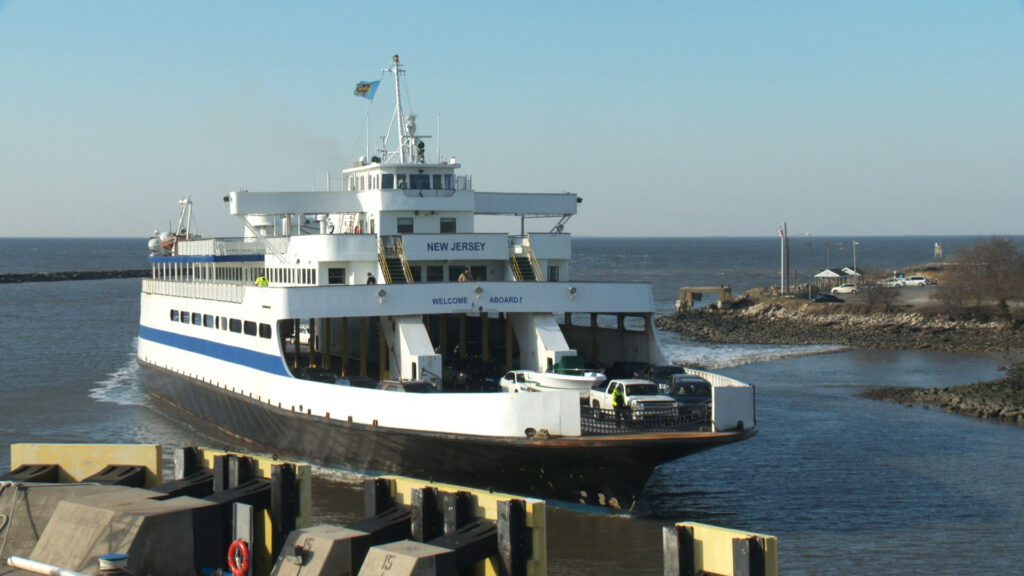
Currently, there are 3 vessels in the fleet: The MV Delaware and the MV New Jersey, both launched in 1974; and the MV Cape Henlopen (named for the Delaware terminus), launched in 1981. The trip takes 1 hour and 25 minutes, and is part of U.S. Route 9. Shuttle bus service is available from the downtowns of Cape May and Lewes to the terminals, and vice versa.
The MV New Jersey

The Ferry made it 45 years without an accident, until December 10, 2009, when the New Jersey ran aground on a sandbar near the mouth of the Cape May Canal during an unusually low tide. The ferry was freed by a rising tide, and did not suffer any structural damage. Nor were there any injuries.

On March 30, 2019, after going 3 miles from Cape May, the ferry lost power with 143 passengers on board. After 2 hours being stuck in the bay, the ferry was towed back to Cape May. And on November 17, 2020, after leaving Cape May in high winds, the Cape Henlopen ran aground off the coast of Cape May. No passengers were harmed, and the vessel was towed back to Cape May shortly after.

Although the 17-mile distance is almost exactly the same as that of the Chesapeake Bay Bridge-Tunnel, no bridge has ever been seriously suggested to replace the route. But in DC Comics, Superman's hometown of Metropolis is said to be in Delaware, a bit north of Lewes; while Batman's hometown of Gotham City is said to be in New Jersey, on the opposite side of the Bay, in real-life Cumberland County; and the Metro-Narrows Bridge stands alongside the route of the Ferry, with Cape May renamed Cape Finger, not for its shape (which would be understandable), but in memory of Batman's co-creator, Bill Finger.

*

July 1, 1964 was a Wednesday. These baseball games were played:

* The New York Yankees lost to the Kansas City Athletics, 5-4 at Yankee Stadium. Reliever Bill Stafford wasted a good start by Whitey Ford, and a home run by Mickey Mantle, and Ralph Terry gave up a home run to Billy Bryan in the top of the 11th inning.

* The New York Mets beat the Houston Astros, 8-6 at the Astrodome in Houston.

* The Minnesota Twins beat the Boston Red Sox, 14-3 at Fenway Park in Boston. Harmon Killebrew went 1-for-3 with 3 walks. Carl Yastrzemski went 2-for-3 with a walk and an RBI.

* The Baltimore Orioles beat the Los Angeles Angels, 4-2 at Memorial Stadium in Baltimore. Brooks Robinson went 1-for-4 with an RBI.

* The Cincinnati Reds beat the Chicago Cubs, 6-5 at Crosley Field in Cincinnati. Pete Rose hit a home run to win the game in the bottom of the 10th inning. Frank Robinson went 1-for-2 with 2 walks and an RBI. Ron Santo hit 2 home runs, Billy Williams hit 1, and Ernie Banks went 2-for-5.

* The Detroit Tigers beat the Cleveland Indians, 3-1 at Tiger Stadium in Detroit. Al Kaline went 1-for-4.

* The Chicago White Sox swept a doubleheader from the Washington Senators, 8-7 and 2-1 at Comiskey Park in Chicago.

* The St. Louis Cardinals beat the Milwaukee Braves, 6-1 at Milwaukee County Stadium. Hank Aaron went 1-for-4.

* The Los Angeles Dodgers beat the Philadelphia Phillies, 3-2 at Dodger Stadium in Los Angeles. Sandy Koufax went the distance for the win.

* And the San Francisco Giants beat the Pittsburgh Pirates, 2-1 at Candlestick Park in San Francisco. Willie Mays hit a home run. Roberto Clemente went 2-for-4 with an RBI.

July 1, 1926: The Benjamin Franklin Bridge Opens

July 1, 1926: The Delaware River Bridge opens, connecting Philadelphia, Pennsylvania and Camden, New Jersey, over the river in question. For the next 3 years, it is the longest suspension bridge ever built.

The name was changed to the Benjamin Franklin Bridge in 1955, named for Philadelphia's favorite son, since the Walt Whitman Bridge, to the south and also over the Delaware, had been approved.

It connects the downtowns of Pennsylvania's largest city and southern New Jersey's largest city, and carries Interstate 676 and U.S. Route 30, and the PATCO Speedline subway railroad. Because it's close to downtown, it's often used for panoramic photographs of the city.

It was preceded as a Delaware River bridge by:

* 1884: The Calhoun Street Bridge in Trenton.
* 1896: The rail-only Delair Bridge.
* 1903: The Morrisville-Trenton Railroad Bridge.
* 1913: The West Trenton Railroad Bridge.

And it has been followed by:

* 1928: The Lower Trenton Bridge, the one with the big letters on each side, reading, "TRENTON MAKES THE WORLD TAKES."
* 1929: The Tacony-Palmyra Bridge, N.J. and Pennsylvania Route 73.
* 1931: The Burlington-Bristol Bridge, N.J. and Pennsylvania Route 413.
* 1951: The original, now-eastward span of the Delaware Memorial Bridge, Interstate 295 and U.S. Route 40.
* 1952: The Trenton-Morrisville Toll Bridge, U.S. Route 1.
* 1956: The Delaware River-Turnpike Toll Bridge, part of the Pearl Harbor Memorial Turnpike Extension, connecting the New Jersey Turnpike with the Pennsylvania Turnpike, Interstate 276.
* 1957: The Walt Whitman Bridge, Interstate 76.
* 1961: The original Scudder Falls Bridge, which was eventually bannered as Interstate 95.
* 1968: The 2nd, westward span of the Delaware Memorial Bridge.
* 1974: The Commodore Barry Bridge, U.S. Route 322.
* 1976: The Betsy Ross Bridge, N.J. and Pennsylvania Route 90.
* 2019: The new Scudder Falls Bridge.

UPDATE: Although not as famous as the Brooklyn Bridge in New York or the Golden Gate Bridge in San Francisco, both of which tend to get destroyed in disaster movies, the Ben Franklin Bridge was shown seriously damaged in the 2023 film Shazam: Fury of the Gods.

*

July 1, 1926 was a Thursday. These baseball games were played:

* A doubleheader was split at Yankee Stadium. The New York Yankees won the opener, 3-2. Urban Shocker outpitched Walter Johnson, thanks to a bottom-of-the-9th-inning triple by Mark Koenng, scoring Earle Combs.

The Washington Senators won the nightcap, 12-5. Curly Ogden outpitched Walter Beall, and Goose Goslin hit a home run. Over the 2 games, Babe Ruth went 2-for-5 with 3 walks and an RBI; and Lou Gehrig went 1-for-7 with a home run, a walk, and an RBI.

* The New York Giants beat their arch-rivals, the Brooklyn Dodgers (known as the Robins while Wilbert Robinson managed them from 1914 to 1931), 5-3 at Ebbets Field. Frankie Frisch went 2-for-5. Zack Wheat went 2-for-4 with an RBI.

* The Boston Braves beat the Philadelphia Phillies, 3-1 at Braves Field in Boston.

* The Boston Red Sox beat the Philadelphia Athletics, 10-5 at Shibe Park in Philadelphia.

* The Pittsburgh Pirates beat the St. Louis Cardinals, 7-3 at Forbes Field in Pittsburgh. Rogers Hornsby, the best 2nd baseman in the game and also the Cardinals' manager, did not put himself into the game.

* The Cleveland Indians beat the Detroit Tigers, 11-6 at Navin Field (later Briggs Stadium and Tiger Stadium) in Detroit. Tris Speaker went 1-for-3 with 2 walks, while Ty Cobb went 2-for-5 with 2 RBIs. Each was his team's respective manager.

* The Chicago Cubs beat the Cincinnati Reds, 2-1 at Wrigley Field in Chicago. Hack Wilson won the game with a home run in the bottom of the 11th inning.

* And the St. Louis Browns beat the Chicago White Sox, 4-3 at Sportsman's Park in St. Louis. George Sisler hit a home run for the Browns, and Eddie Collins went 1-for-4 for the White Sox.

Monday, June 27, 2022

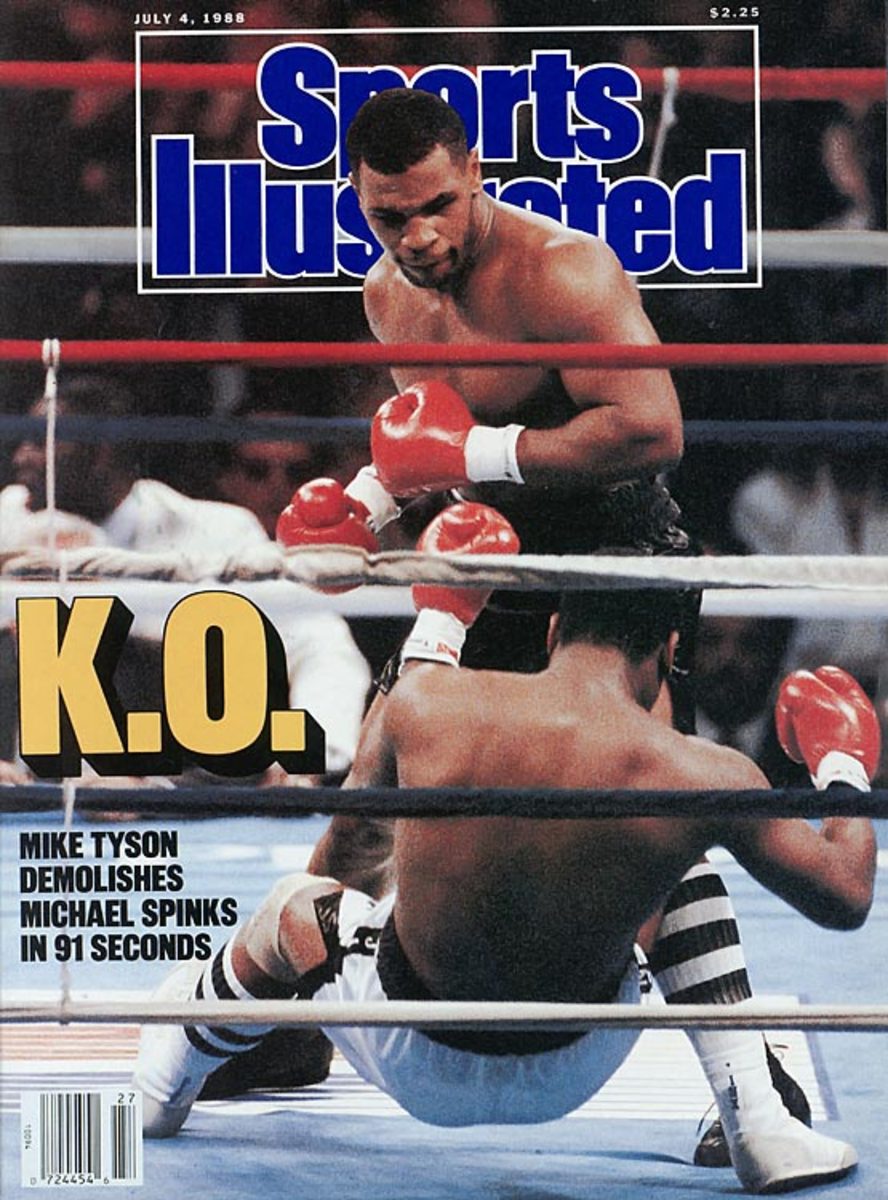
June 27, 1988: Mike Tyson Knocks Michael Spinks Out In 91 Seconds

June 27, 1988: A unification fight for the Heavyweight Championship of the World is held. The Kentucky Derby is often called "The Most Exciting Two Minutes In Sports." This fight could not be called that: It didn't make it to the 2-minute mark.

The 3 major organizations sanctioning boxing championships, then as now, were the World Boxing Association (WBA), the World Boxing Council (WBC), and the International Boxing Federation (IBF). All 3 of those belts were then held by Mike Tyson.

"Iron Mike" was 3 days short of his 22nd birthday, and, at 20, had broken the record of youngest Heavyweight Champion ever, taking the WBC title away from Trevor Berbick. In his next fight, he took the WBA title away from James "Bonecrusher" Smith. Finally, he took the IBF title away from Tony Tucker. He was 34-0, with 30 knockouts, 25 of them going 4 rounds or fewer, 21 going 2 rounds or fewer, and 15 of them in the 1st round.

Boxing hadn't seen a quick-knockout artist like him since Jack Dempsey in the early 1920s. Tyson patterned himself after Dempsey, wearing no socks under his boots, and no robe over his shoulders, just a towel. He called himself "The Baddest Man On the Planet," and it was hard to doubt him.

But there's a reason it was a fight for "the undisputed Heavyweight Championship of the World." Because the title was disputed. The reason there were 3 organizations to begin with is because of Muhammad Ali getting stripped of the title in 1967. Even after he got it back, these 3 governing bodies would recognize their own champions once he was, once again, no longer the champ.

And then there was The Ring magazine, known as "the Bible of Boxing," which recognized a "lineal champion," going all the way back to the last bare-knuckle Heavyweight Champion, John L. Sullivan in the 1880s.

Their champion was Michael Spinks. He and his brother Leon, who took the title away from Ali in 1978 (but not all the organizations thought that he, after only 8 pro fights, should have it) and then lost it back to Ali in his next fight, had both won Gold Medals at the 1976 Olympics in Montreal. Leon had gotten knocked out by Larry Holmes, who became Champion. From 1981 to 1985, Michael was the undisputed Light Heavyweight Champion. In 1985, Michael gave up those titles, moved up to Heavyweight, defeated Holmes to take the IBF title, and then won a rematch.

But he never held either the WBA or the WBC version of the Heavyweight Championship, and the IBF stripped him of their title in 1987, because he refused to fight their Number 1 contender, Tucker. They gave their title to Tucker, and then Tyson beat him.

So a unification fight was set for June 27, 1988, at Convention Hall in Atlantic City, New Jersey. (The building, opened in 1929 and famous as the site of the Miss America Pageant, is now known as Boardwalk Hall.) Spinks went into it at 31-0. This was only the 2nd time that 2 undefeated Heavyweight Champions had ever faced each other, the 1st time being Ali and Joe Frazier in the 1st of their 3 fights, in 1971.
Real estate developer Donald Trump had built his 1st casino-hotel, Trump Plaza, between Atlantic City's 2 most famous buildings: Convention Hall and Caesars Atlantic City. That made me think he was smart. As it turned out, he wasn't. But, through Trump Plaza, he got involved in the promotion of this fight, along with boxing's biggest promoter, Don King.

The Hall seats about 14,000 people, but, with Pay-Per-View, this fight became the highest-grossing in boxing history to that point: Over $70 million. Tyson went into the fight as a 4-1 favorite.

Spinks later admitted, "Fear was knocking at my door, big-time." That became clear quickly, as Tyson landed a left hook 7 seconds in, and Spinks began covering up. Spinks kept backing away. He landed only 2 punches. After 1 minute and 3 seconds, Spinks was dropped to a knee by a right to the body. It was only the 2nd time Spinks had been knocked down as a professional, following Dwight Muhammad Qawi, before Spinks came back and won the Light Heavyweight title from him.

Referee Frank Cappuccino counted to 4 before Spinks got up, and took the rest of the standing 8-count. Cappuccino, as the rules required, asked him if he could continue. Spinks should have said he couldn't. He said he could. He got close to Tyson. Tyson landed a quick left-right combination to Spinks' head, and he went down. He struggled to get up before the count of 10, and couldn't. In 1 minute and 31 seconds -- 91 seconds, or 1 second past the halfway mark of the 1st round -- the fight was over.

Tyson was now the undefeated, the undisputed, Heavyweight Champion of the World, truly the Baddest Man On the Planet. Aside from Spinks, there were some big losers: The promoters, including Trump, because the fight only lasted a minute and a half, costing them TV viewers for more than that.

But hindsight shows us that Tyson did have issues. His main trainer, Constantine "Cus" D'Amato, had died in 1985, before Tyson could become Champion. His secondary trainer, Jimmy Jacobs, had also died, of leukemia, 3 months before this fight. (D'Amato was 77; Jacobs, 58.) Tyson dedicated this fight to Jacobs' memory. And a dispute with Jacobs' successor, Kevin Rooney, led to Tyson firing him. Rooney later said that if Tyson hadn't fired him, Tyson would have retired undefeated.

And the undercard of this fight should be noted. Among the fighters winning were Carl "The Truth" Williams (over former Champion Berbick), Donovan "Razor" Ruddock, and a 28-year-old fighter from Columbus, Ohio, who rose to 27-4-1 on the night: James "Buster" Douglas.

On this night, if anyone guessed that Tyson would one day be beaten, half the people listening would have said he was crazy. But nobody could have imagined that Douglas would be the man to do it. And yet, as it turned out, that's what happened.

Spinks never fought again. As of 2022, he is 65 years old, and lives on a five-acre spread outside Wilmington, Delaware. He usually stays out of the public eye, but he has been known for visiting schools, carrying his Olympic Gold Medal and his four title belts, and he tells kids to pursue their dreams: "Most of the kids don't have a clue who I am, but they listen when they see all the gold."

*

June 27, 1988 was a Monday. These Major League Baseball games were played that night:

* The New York Yankees lost to the Detroit Tigers, 6-3 at Yankee Stadium. Jack Morris outpitched John Candelaria. Mike Pagliarulo hit a home run, Don Mattingly went 1-for-3 with a walk, and Rickey Henderson went 0-for-3 with a walk. For the Tigers, Luis Salazar went 3-for-5 with 3 RBIs.

* The New York Mets lost to the Pittsburgh Pirates, 2-1 at Three Rivers Stadium in Pittsburgh. Dwight Gooden was outpitched by Mike Dunne. (No, I don't remember him, either.) The Mets only got 5 hits, all singles, by Lenny Dykstra, Dave Magadan, Lee Mazzilli, Kevin McReynolds and Mackey Sasser.

* The Boston Red Sox beat the Cleveland Indians, 9-5 at Fenway Park in Boston. Wade Boggs went 1-for-3 with 2 walks.

* The Baltimore Orioles beat the Toronto Blue Jays, 6-2 at Memorial Stadium in Baltimore. Eddie Murray went 0-for-3 with a walk, and Cal Ripken went 1-for-3 with a walk and 2 RBIs.

* The San Francisco Giants beat the Atlanta Braves, 10-9 at Atlanta-Fulton County Stadium.

* The San Diego Padres beat the Cincinnati Reds, 9-2 at Riverfront Stadium in Cincinnati. Tony Gwynn went 1-for-5, his hit a 3-run homer.

* The Chicago Cubs beat the Philadelphia Phillies, 2-1 at Wrigley Field in Chicago. Mike Schmidt went 1-for-5.

* The Montreal Expos beat the St. Louis Cardinals, 6-3 at Busch Memorial Stadium. Each team got a home run in the 13th inning, the Expos from Tim Wallach, the Cardinals from Tom Brunansky. Cardinal pitcher Steve Peters collapsed in the top of the 14th, allowing a walk, a wild pitch, an intentional walk, and a home run by Hubie Brooks.

* The Kansas City Royals beat the Chicago White Sox, 2-1 at Royals Stadium in Kansas City. (It was renamed Kauffman Stadium in 1993.) George Brett went 2-for-3.

* The Los Angeles Dodgers beat the Houston Astros, 4-0 at the Astrodome in Houston. Shawn Hillegas allowed 2 hits over 6 innings, the 1st of 4 pitchers to toss a 5-hit shutout.

* The California Angels beat the Minnesota Twins, 16-7 at Anaheim Stadium. (It was renamed Edison International Field in 1997, and Angel Stadium of Anaheim in 2004.)

* The Oakland Athletics beat the Milwaukee Brewers, 5-4 at the Oakland Coliseum. Robin Yount went 1-for-5, and Paul Molitor was injured and did not play. Dave Henderson singled home the winning run in the bottom of the 14th inning.

* And the Seattle Mariners beat the Texas Rangers, 6-3 at the Kingdome in Seattle.

December 31, 1999 & January 1, 2000: The Millennium

December 31, 1999:  The Millennium arrives. The people of planet Earth survived. At a terrible cost. But we hadn't destroyed ourselves. ...