January 16, 1991: After 5 months of warning, President George H.W. Bush launches the Persian Gulf War against Iraq.
In 1968, the Ba'ath Party had taken power in Iraq. The new President was Ahmed Haasan al-Bakr. His Vice President was Saddam Hussein. Through a combination of oil wealth and socialist policies, the country grew, but was not exactly free.
In 1979, after 11 years of strengthening his case with the country's national security apparatus, and 3 years of doing so through the country's military, Saddam was strong enough to show al-Bakr that, due to his failing health, it was time to "retire." Fearing what would happen if he didn't take the hint, he took it, and died 3 years later.
In 1980, Iraq went to war with Iran, which was then holding Americans hostage. Naturally, America took Iraq's side. The release of the hostages and the change of power in America, both happening on January 20, 1981, did not change this support: The new President, Ronald Reagan, looked on Iraq as a check on Iran's power.
The war lasted 8 years, before both sides finally accepted that it was a stalemate. Saddam, leading the much smaller nation, had some justification to treat this like a victory. He emerged with the 4th-largest army in the world (behind the Soviet Union, China and America), and a great deal of popularity, not just at home, but in the Arab world. (Something a lot of Americans forget: Iran's largest ethnic group is Persians, and they are not Arabs. Most of them don't even speak Arabic: The country's 1st language is Farsi, although they do use the Arabic alphabet.)
Shortly after the Iran-Iraq War ended in 1988, Vice President George H.W. Bush won the election to succeed Reagan as President. For the 1st year and a half of his Administration, he saw no need to treat Iraq, or Saddam in particular, as an enemy. Surely, as President, with access to all national-security-connected information (and, as a former Director of the CIA, he would have been keenly interested in such), he knew of Saddam's civil liberties violations within his own borders. But he acted as though they didn't matter.
But on August 2, 1990, the Iraqi Army invaded the much-smaller neighboring nation of Kuwait. It was a move by Saddam to gain control of Kuwait's oil, to further enrich both himself and his country. Indeed, by ruling Iraq and Kuwait, Saddam now controlled about 10 percent of the world's oil production. But it was also a matter of national pride: Iraq has 18 provinces, and he called Kuwait "the 19th Province."
Bush guessed -- with some justification -- that neighboring Saudi Arabia might be next. This would have resulted in an energy and economic nightmare for the world. It would also have caused a huge civil war within the Muslim world, as Saudi Arabia is home to the 2 holiest sites in Islam: Mecca and Medina. An Iraqi invasion of Saudi Arabia could have meant complete chaos. And with the Soviet Union falling apart, America was now the only nation that could do something about it.
Or... was it? America had been aiding the Saudis for decades, in exchange for cheap oil. (It didn't always work: The Saudis had authorized gas price hikes in 1973 and 1979 that triggered gas shortages, inflation, and recessions.) Famously, in 1981, Reagan had sold the Saudis some AWACS (Airborne Warning And Control System) planes, with the most advanced radar in the world. In return, the Saudis brought their oil prices back down. Even as a Democrat, I have to concede that this was a good move on Reagan's part, as it stopped the nasty inflation of 1979-81.
So the question of late 1990 was, could the Saudis have defended themselves in a war against Iraq? Iraq had the better army. But the Saudis had the far superior navy and air force. Many Americans, myself included, thought that America shouldn't risk its soldiers' lives for the protection of Saudi Arabia or what Bush called "the liberation of Kuwait." (Some liberation: Kuwait did not give women the right to vote until 2005.)
Bush decided that the question of whether the Saudis could defend themselves did not need to be answered. He immediately withdrew America's support for Iraq, stood up for Kuwait, and said, "This naked aggression will not stand." He interrupted his vacation at Walker's Point, the home from his mother's side of the family at Kennebunkport, Maine, launched Operation Desert Shield, and warned Saddam that he had to withdraw his troops from Kuwait, or America and its allies would inflict consequences.
Yes, allies. The nations of NATO, nearby Egypt, and, of course, the Saudis mobilized their troops for this alliance. Britain did so despite a split in the Conservative Party that led to Margaret Thatcher's replacement as Prime Minister by John Major on November 28.
The Soviets, who made semi-socialist Iraq one of the few countries that both they and America supported, were in no position to help them. But, within the Warsaw Pact (which was dissolved on February 25, 1991, as the war was entering its endgame), Poland and Czechoslovakia (it split into 2 nations 2 years later) sent troops. From the Far East, so did Australia, New Zealand, the Philippines and South Korea.
Iran was not going to get on the side of one enemy against another, and so they stayed out of it. And no other major Arab country was going to help Iraq: King Hussein I of Jordan, the leading Arab monarch outside Saudi Arabia, stood up for the Saudis, and stayed out of it. President Hafez al-Assad of Syria, already an ally of Iran, sent troops. (It's hard to believe now, given what Assad and his son Bashar al-Assad have done since, but they helped the official U.S. cause then.)
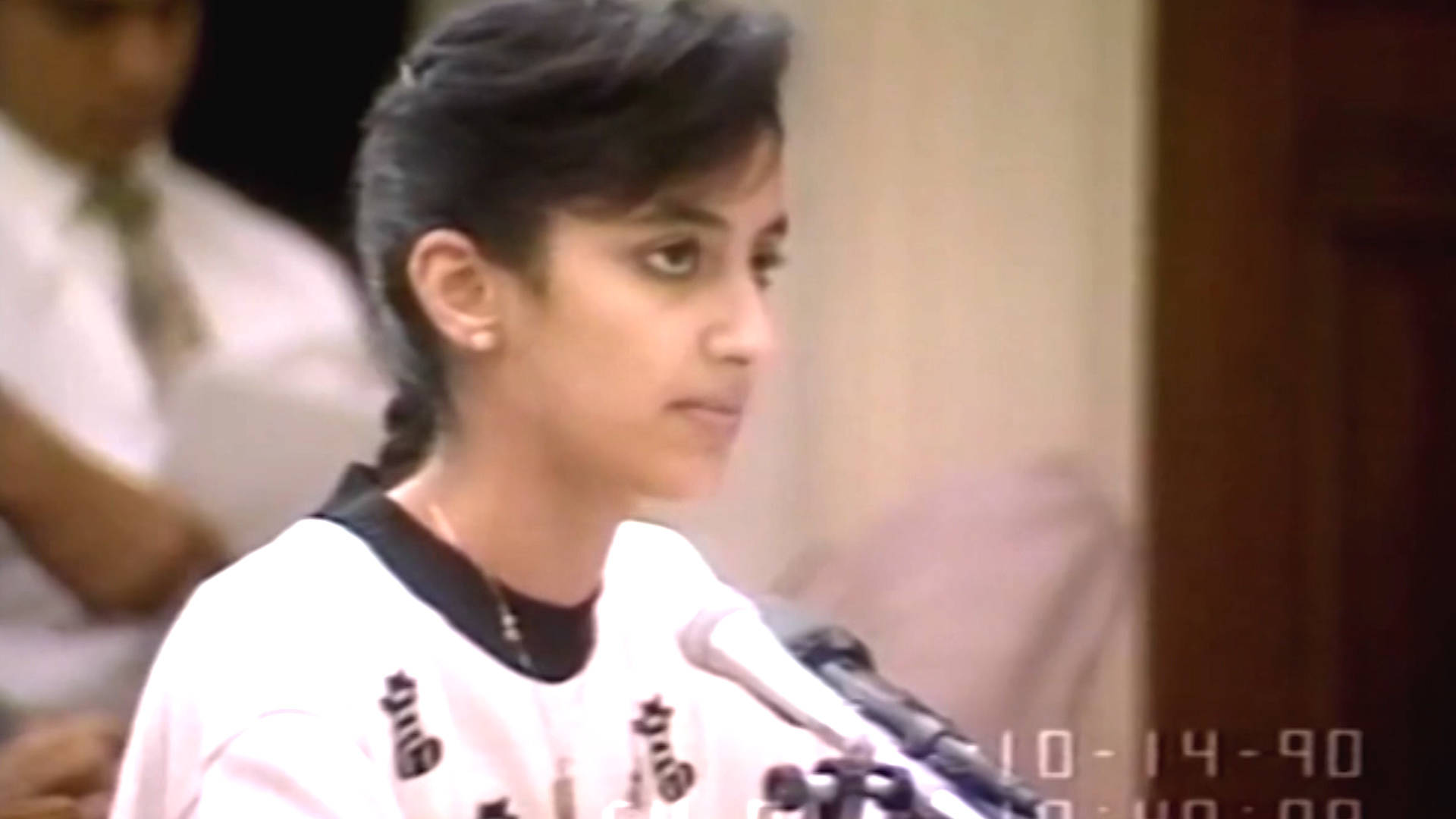
At first, the American people were split on whether such a war would be worth it. On October 10, 1990, testimony was given before the non-governmental Congressional Human Rights Caucus, by a 15-year-old girl who provided only her first name, Nayirah. The testimony was widely publicized, and was cited numerous times by Bush and some Senators in their rationale to back Kuwait.
In 1992, it was revealed that Nayirah's last name was Al-Ṣabaḥ, and that she was the daughter of Saud Al-Nasir Al-Sabah, the Kuwaiti Ambassador to the United States, and a cousin of the nation's monarch, Emir Jaber Al-Ahmad Al-Sabah. Furthermore, it was revealed that her testimony was organized as part of the Citizens for a Free Kuwait public relations campaign, which was run by Hill & Knowlton for the Kuwaiti government. They thought the American people wouldn't know any better -- and they didn't.
A protest against the coming war was held in New York on October 20, 1990: About 25,000 people, including myself, marched down Broadway from Columbus Circle, through Times Square to Herald Square. We were afraid that this war would be another "Vietnam" -- the word "quagmire" was being used by opponents of the would-be war -- leading to the restoration of the draft, and tens of thousands of Americans dead, and hundreds of thousands wounded.
But, like the protests during the Vietnam War, our patriotism was questioned. Those who supported the idea were accused of "rooting for the enemy." And, also like the Vietnam-era protests, it was useless: The war was going to begin when the President of the United States wanted it to, and it was going to end when the President of the United States wanted it to.
Bush set January 16, 1991 as the deadline. Saddam stayed put. At 2:38 AM on January 17, Baghdad time -- 6:38 PM on January 16, New York and Washington time -- Operation Desert Storm was launched. (Bush originally wanted to call it "Desert Sword," but was talked out of it, due to the symbolism of swords in Muslim imagery.) In a display of what his son would call "shock and awe" against Saddam 12 years later, U.S. planes bombarded the Iraqi capital of Baghdad, and did the same to Iraqi military bases.
Dictators always think they're smarter than they actually are, and Saddam thought he had a brilliant way of turning the war in his favor: On January 18, Iraq fired 12 "Scud" missiles at the Israeli cities of Tel Aviv and Haifa. (As Jerusalem is the 3rd-holiest city in Islam, as well as the holiest in Christianity and Judaism, he could not attack that city.)
The Scuds were largely ineffective as a tactic. But as strategy, the idea was that the Israeli government would overreact, and attack Iraq. Why did Saddam want this? Because it would make the Muslim world rally to him, and attack not only American troops, but Israel itself. That was the theory.
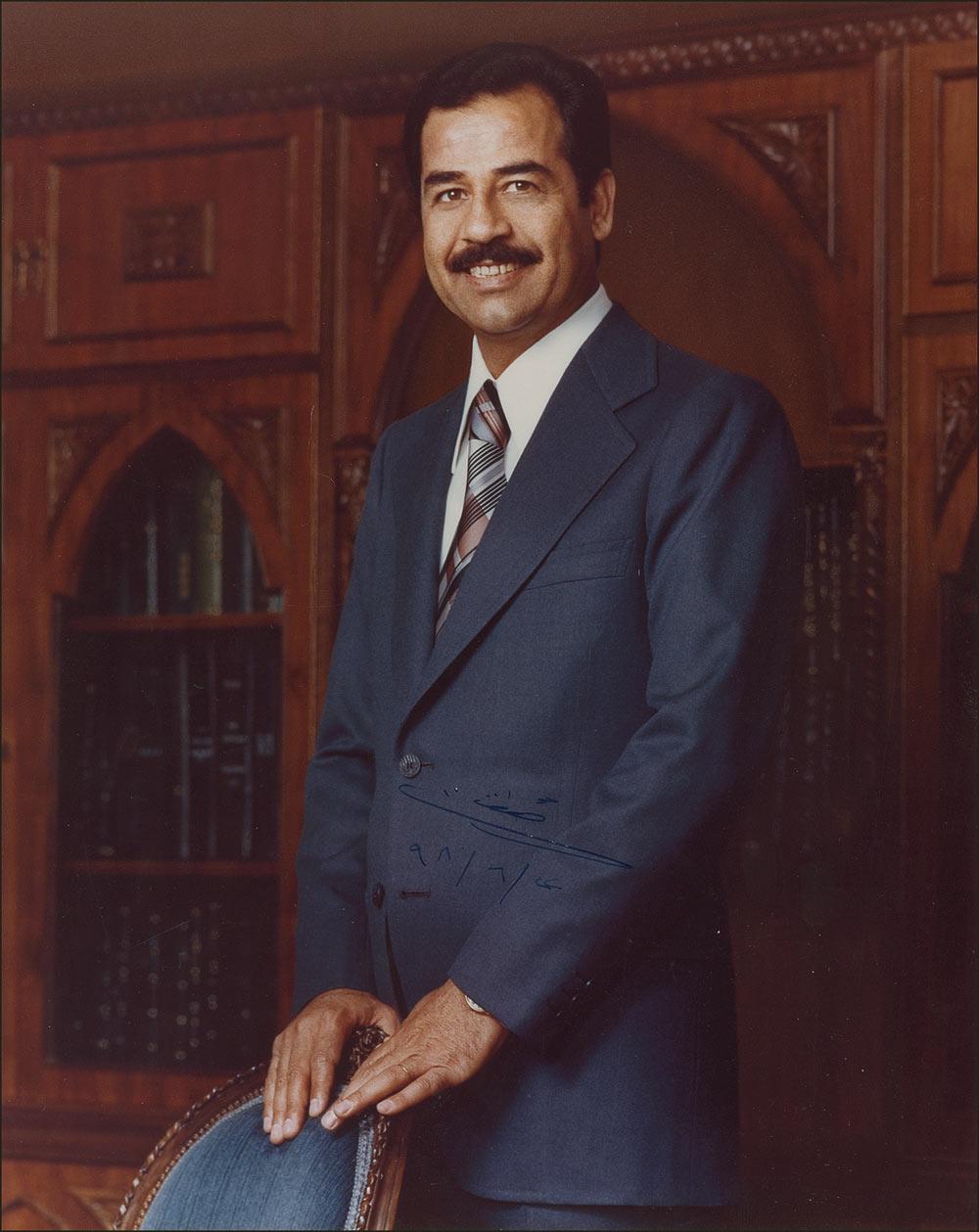
Saddam was a chameleon. He was willing to appear to be whatever people wanted him to be, to keep their support. Put on a suit, and look like a man capable of dealing with Western businessmen? Check.
Put on a uniform, and look like a great military leader? Check.
Dress like a faithful Muslim, and appeal to people's religion? Check. Smile like a man who was a father to his country, and
not a bloodthirsty dictator who would do anything, and kill anybody, to maintain power? Check.
Like many Middle Eastern dictators, he was copying Gamal Abdel Nasser, who ruled Egypt with an iron fist and a cult of personality from 1953 until his death in 1970, right down to making himself appear to be a healthy, good-looking guy with a great mustache. Nasser, of course, was copying
his idol, Soviet dictator Joseph Stalin. Neither Stalin, nor Nasser, nor Saddam was ever quite as physically strong as they appeared to be. But, as with any dictator or would-be dictator, from Alexander the Great to Henry VIII, from Napoleon Bonaparte to Adolf Hitler, reality didn't matter: Image was everything. Or, as would-be dictator Donald Trump would say, the "optics."
Prime Ministers of Israel, knowing that the Torah insists upon facial hair, but also seeing what men with facial hair had done to the Jewish people just in the 20th Century -- including Czar Nicholas II of Russia, Vladimir Lenin, Hitler, Stalin and Nasser -- have tended to be clean-shaven. But in 1990 and '91, the Prime Minister was Yitzhak Shamir, a hard-right leader (though not a dictator), and he had a mustache. He was pissed off, and he knew Israel had the capability to end Saddam's reign in a matter of days, and he wanted to do it.
Bush talked him out of it, telling him that he could beat Saddam, but he could not beat the entire Muslim world, even with America's help. Shamir was angry, but he was not suicidal, politically or otherwise. He accepted that the Scuds wouldn't hurt Israel much, and stayed out of it.
Saddam had played his best card, and didn't even know he was bluffing.
During the Vietnam War, there had been film cameras capturing the shooting, killing and dying as it was happening, and then sending the film to the networks for airing on the next available evening news broadcast. It helped turn the public's opinion against the war.
Bush had been a Congressman from Texas from 1965 to 1970, and had seen this. He knew that, if he was to keep public opinion on his side, he had to control what the public saw from this war. So, at first, he kept up the aerial assault, instead of launching a ground war. It looked spectacular on television. Critics called it "The Video Game War": Beat the enemy, and never lose a life. (Except it cost a lot more than a quarter: The war ended up costing $60 billion, or about $129 billion in 2022 money. The Saudi royal family reimbursed half of that cost.)
The coverage of the war was in-depth, but mostly positive: Unlike in Vietnam, the government encouraged the TV networks to show positive things, and, believing it would mean higher ratings, they did. CNN, in particular, went all-in and went all-out, and its boss, Ted Turner, would be named Time magazine's Man of the Year, ahead of Bush, Powell, Schwarzkopf, Saddam, and anybody else directly involved.
Keep it sanitary, no blood, no screams, no death on our side; and you'll keep it watchable. Keep it sellable.
And Bush, a businessman before running for public office (oil), knew who to assign to sell it: His Chairman of the Joint Chiefs of Staff, the 1st black man to hold that post, Colin Powell, who was charming and personable, and, when he said, "Trust me," people wanted to; and the lead General in the field, "Stormin'" Norman Schwarzkopf, a huge man who had just the right combination of respect for his troops (which was heavily returned) and bluster for the press. John Wayne one minute, a Santa Claus in camo gear the next.
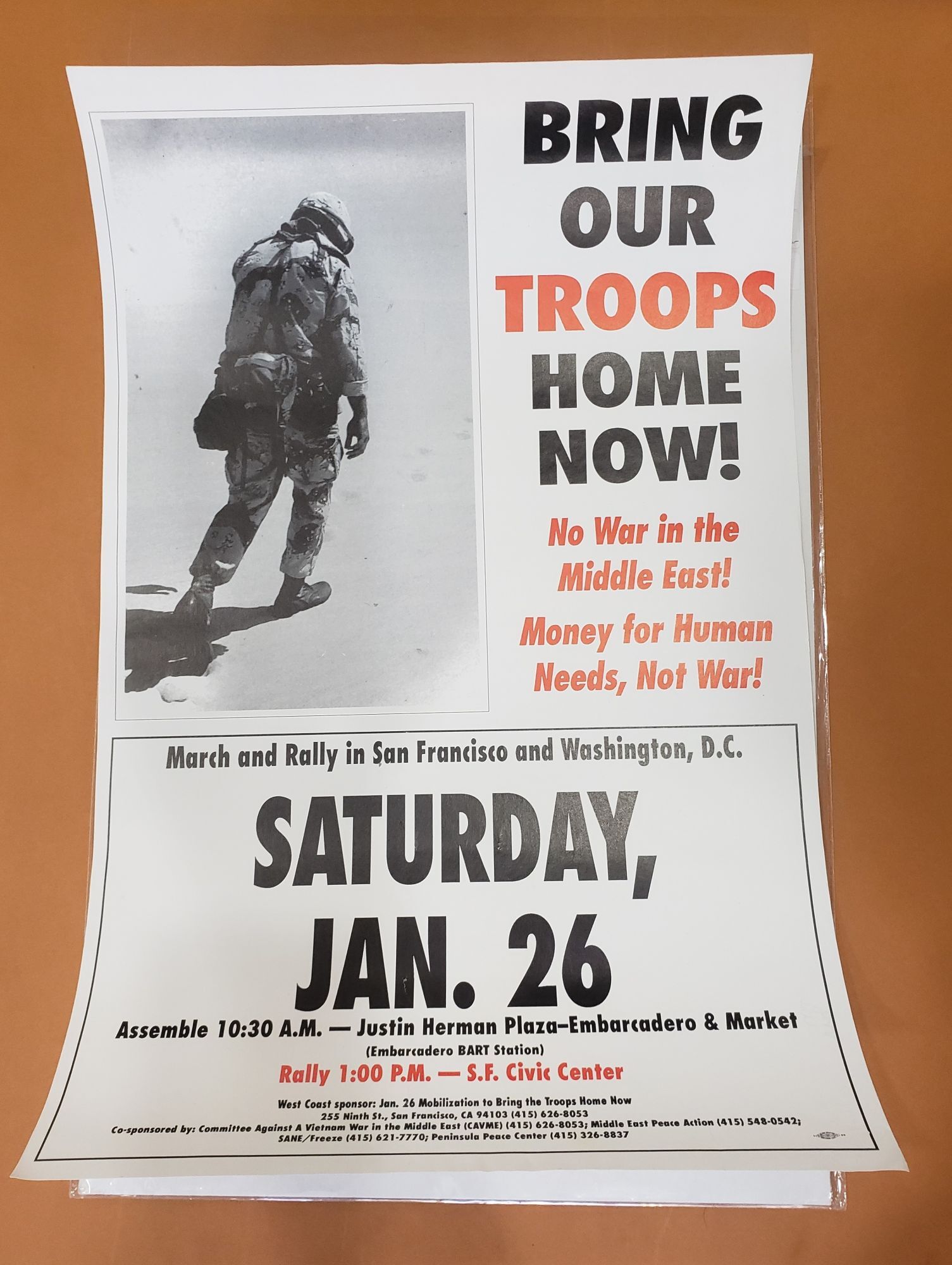
Most Americans were buying it. Some weren't. Many were terrified that this war was going to be another "Vietnam," On January 26, 300,000 people, myself included, went to Washington, braved a bitter cold, and marched from the Capitol to the White House to protest it. Most of the country didn't want to hear any dissent. Our patriotism was questioned harder than ever. After all, as the saying was during World War II, "There's a war on."
The next day, Super Bowl XXV was held in Tampa. Stormin' Norman attended. And Whitney Houston sang what became treated as the most famous rendition of "The Star-Spangled Banner" ever. Never mind that Whitney had one of the greatest voices on Earth: It was lip-synched. Even that was a fake -- or, at the very least, an insincere -- means of selling the war. The country moved on as if the protest the day before hadn't even happened. (Oh yes, the game: The Giants beat the Buffalo Bills, 20-19.)
The air attacks continued, unrelentingly. On February 22, Bush issued a 24-hour ultimatum: Get out of Kuwait, or there will be a ground war. Again, Saddam refused to give in. Pride? Maybe. It led to a situation of, "Fool me once, shame on you. Fool me twice, shame on me." (A saying that Bush's son once famously messed up in a press conference.) On February 24, Bush sent ground troops in.
On February 25, 20,000 Iraqis surrendered to U.S. troops. The world's 4th-largest army collapsed, almost literally overnight. Hearing about this, Saddam ordered a missile attack on a U.S. base in Dhahran, Saudi Arabia, killing 28 Americans.
Like a boxer for whom the worst thing you can do is knock him down, because all it does is make him mad, the U.S. Army just pushed harder. They killed about 10,000 Iraqi troops as they were retreating from Kuwait City down Highway 80 to Basra, Iraq's 2nd-largest city behind Baghdad. The road became known as the Highway of Death. On February 27, U.S. Marines and Saudi troops entered Kuwait City. Later that day, it was announced that 500,000 Iraqi soldiers had been taken as prisoners of war.
On February 28, Iraq announced that it would accept all United Nations resolutions. Bush spoke from the Oval Office at the White House, announcing, "Kuwait is liberated. Iraq's army is defeated. Our military objectives are met." (Kuwait was liberated? As the singer Meat Loaf would have said, Two out of three ain't bad.)
Except for some metaphorical T-crossings and I-dottings, the war was over, after 43 days of aerial bombardment, and 4 days of ground fighting. It rivaled Israel's June 1967 Six-Day War against its Arab neighbors in terms of quick effectiveness, and easily surpassed the most recent notable victory of a NATO nation, Britain's 74-day Falklands War against Argentina in the Spring of 1982.
Many people, especially neoconservatives, wanted Bush to keep the war going, to send U.S. troops on to Baghdad, and to topple Saddam. He wouldn't do it. A seasoned diplomat who understood the world, he knew that, under those conditions, it would be harder to "win the peace" than to win the war.
He also knew that having Saddam in place as a check on Iran -- what was in place before the war, known by the Latin phrase Status quo ante bellum -- would save American lives and resources. To paraphrase a stage play that had recently been on Broadway, and was being adapted into a film, Aaron Sorkin's A Few Good Men, Bush needed Saddam "on that wall."
It would also save the enormous popularity he had gained. Never as popular as Reagan, even after winning 426 Electoral Votes in the 1988 election, and (despite being a genuine hero as the U.S. Navy's youngest fighter pilot in World War II) having a reputation as a "wimp," Bush now had an approval rating of 91 percent.
That rating scared several Democrats out of running against him in 1992. One that it didn't scare was Governor Bill Clinton of Arkansas, who pointed out that the war hadn't helped to lift the American economy out of the worst recession the nation had seen since the Great Depression. One of the smartest politicians of the modern era, Clinton exercised what could be called political jujitsu: He used Bush's claims of leadership and experience against him, arguing, "The same old experience is not relevant." The Soviet Union had fully collapsed, and there was a new order in the Middle East as well. Instead of riding a victorious war to a landslide re-election, Bush became a victim of his own success.
In what turned out to be a 3-way race, with businessman Ross Perot running a 3rd-party (or, rather, an independent) campaign and earning 19 percent of the popular vote (but not coming close to winning a single State or its Electoral Votes), Clinton was elected, taking 370 Electoral Votes. Bush only won 37 percent of the popular vote, the lowest total for a major-party candidate in 80 years. The Gulf War didn't help him at all.
Hearing that news, Saddam stood on the balcony of his presidential palace, acknowledged the cheers of the crowd that had gathered below, and fired a pistol into the air. He had lost the war, but had outlasted the victor.
In 1996, Margaret Thatcher sat for an interview for a PBS Frontline documentary about the Gulf War. She set up a big question: "There is the aggressor, Saddam Hussein, still in power. There is the President of the United States, no longer in power. There is the Prime Minister of Great Britain, no longer in power. I wonder: Who won?" The documentary immediately cut to an interview with Brent Scowcroft, Bush's National Security Adviser, saying, "We did. We did." He said it very nervously, as if he didn't quite believe it, and was hoping against hope that the viewer would believe it.
In 1994, Bush's son, George W. Bush, was elected Governor of Texas. In 2000, he emerged victorious (I won't say "won") in the Presidential election. In 2002, he copied his father's run-up to war, this time insisting that Saddam had "weapons of mass destruction" that he was ready to use on the free world, and thus had to be stopped.
Now, Colin Powell was Secretary of State, and was sent to the United Nations with the accusation. Once again, he basically said, "Trust me." Unlike Adlai Stevenson, whom President John F. Kennedy had sent to the UN as America's Ambassador to it 40 years earlier, with proof of Soviet missiles in Cuba, Powell had no proof, only the value of his word. Except the value of his word was meaningless, because he was counting on the value of the younger Bush's word. Which, as it turned out, was no good.
Once again, Saddam Hussein refused the demands and ignored the deadlines of an American President named George Bush. Once again, on March 19, 2003, he was made to pay for it. This time, the President named George Bush did go all the way to Baghdad, and did remove Saddam from power. Saddam was executed in 2006.
Except this President named George Bush didn't figure out that he also had to win the peace, and that being an occupying power would prevent that. He wasn't as smart as his father. He was just smart enough to use the continuing situation in Iraq to get himself narrowly re-elected in 2004, but by the Congressional elections of 2006, America had had enough of his incompetence, his Administration's lies, and his Party's lying about the patriotism of Democratic candidates, and elected Democratic majorities in both houses of Congress.
That same year, on an episode of NCIS, Special Agent Leroy Jethro Gibbs (played by Mark Harmon) was hospitalized with a head injury that temporarily cost him his memory of everything that had happened since his service in the Gulf War. He had been watching coverage of the current Iraq War, and his doctor told his friend, Dr. Donald "Ducky" Mallard (David McCallum), that Gibbs wants to know why we're still at war with Iraq. Ducky said, "He's not the only one."
On December 31, 2011, 3 years after another election ended the Republican Party's hold on the White House, the last American troops left Iraq.
*
January 16, 1991 was a Wednesday. Baseball was in its off-season. The NFL was wrapping up its season, with the Super Bowl 11 days away. There were 8 NBA games played that day:
* The New York Knicks lost to the Minnesota Timberwolves, 93-89 at Madison Square Garden. Kiki Vandeweghe led all scorers with 26 points, but it wasn't enough.
* The Golden State Warriors beat the Boston Celtics, 110-105 at the Boston Garden. The trio known as "Run TMC" ran riot: Tim Hardaway Sr. scored 37, Mitch Richmond 26, Chris Mullin 14. For the Celtics, Kevin Gamble scored 26 and Kevin McHale 22, but it wasn't nearly enough. Larry Bird was injured, and didn't play.
* The Chicago Bulls beat the Orlando Magic, 99-88 at the Orlando Arena. Michael Jordan scored 29 points. In his 7th season with Da Bulls, Jordan led them to their, and his, 1st NBA Championship that June.
* The Cleveland Cavaliers beat the Miami Heat, 108-94 at the Coliseum in the Cleveland suburb of Richfield, Ohio. LeBron James did not play for either team. He had just turned 6 years old.
* The Milwaukee Bucks beat the Indiana Pacers, 126-119 at the Bradley Center in Milwaukee. For the Bucks, Jay Humphries scored 33 and Ricky Pierce scored 31. For the Pacers, Reggie Miller scored 26.
* The San Antonio Spurs beat the Dallas Mavericks, 100-94 at the HemisFair Arena in San Antonio. David Robinson scored 30.
* The Denver Nuggets beat the Charlotte Hornets, 111-104 at the McNichols Sports Arena in Denver.
* And the Washington Bullets beat the Los Angeles Clippers, 101-99 at the Los Angeles Memorial Sports Arena. Former Knicks star Bernard King scored 32 for the Wizards-to-be.
And there were 4 NHL games played:
* The New Jersey Devils played the Chicago Blackhawks to a tie, 2-2 at the Brendan Byrne Arena at the Meadowlands. The Devils trailed 2-0 going into the 3rd period, but got goals from Tommy Albelin and Captain Kirk Muller.
* The Hartford Whalers beat the Los Angeles Kings, 4-3 at the Hartford Civic Center (now the PeoplesBank Arena).
* The Buffalo Sabres beat the Detroit Red Wings, 5-3 at the Buffalo Memorial Auditorium.
* And the Winnipeg Jets beat the Vancouver Canucks, 2-1 at the Pacific Coliseum in Vancouver.